What are Buddhist Beliefs? All living beings have the same basic wish to be happy and avoid suffering, but very few people understand the real causes of happiness and suffering.
We generally believe that external conditions such as food, friends, cars, and money are the real causes of happiness, and as a result we devote nearly all our time and energy to acquiring these. Superficially it seems that these things can make us happy, but if we look more deeply we shall see that they also bring us a lot of suffering and problems.
Happiness and suffering are opposites, so if something is a real cause of happiness it cannot give rise to suffering. If food, money, and so forth really are causes of happiness, they can never be causes of suffering; yet we know from our own experience that they often do cause suffering. For example, one of our main interests is food, but the food we eat is also the principal cause of most of our ill health and sickness.
In the process of producing the things we feel will make us happy, we have polluted our environment to such an extent that the very air we breathe and the water we drink now threaten our health and well-being. We love the freedom and independence a car can give us, but the cost in accidents and environmental destruction is enormous.
We feel that money is essential for us to enjoy life, but the pursuit of money also causes immense problems and anxiety. Even our family and friends, with whom we enjoy so many happy moments, can also bring us a lot of worry and heartache.
In recent years our understanding and control of the external world have increased considerably, and as a result, we have witnessed remarkable material progress; but there has not been a corresponding increase in human happiness.
There is no less suffering in the world today, and there are no fewer problems. Indeed, it could be said that there are now more problems and greater unhappiness than ever before. This shows that the solution to our problems, and to those of society as a whole, does not lie in knowledge or control of the external world.
Why is this? Happiness and suffering are states of mind, and so their main causes cannot be found outside the mind. The real source of happiness is inner peace. If our mind is peaceful, we shall be happy all the time, regardless of external conditions, but if it is disturbed or troubled in any way, we shall never be happy, no matter how good our external conditions may be.
External conditions can only make us happy if our mind is peaceful. We can understand this through our own experience. For instance, even if we are in the most beautiful surroundings and have everything we need, the moment we get angry any happiness we may have disappears. This is because anger has destroyed our inner peace.
We can see from this that if we want true, lasting happiness we need to develop and maintain a special experience of inner peace. The only way to do this is by training our mind through spiritual practice – gradually reducing and eliminating our negative, disturbed states of mind and replacing them with positive, peaceful states.
Eventually, through continuing to improve our inner peace we shall experience permanent inner peace, or “nirvana.” Once we have attained nirvana we shall be happy throughout our life, and in life after life. We shall have solved all our problems and accomplished the true meaning of our human life.
Once upon a time, an unusual and beautiful deer was born in the forests near Benares, in northern India. Although he was as big as a young colt, it was easy for his mother to give birth to him. When he opened his eyes, they were as bright as sparkling jewels. His mouth was as red as the reddest forest berries. His hoofs were as black as polished coal. His little horns glistened like silver. And his color was golden, like a perfect summer’s dawn. As he grew up, a herd of 500 deer gathered around him, and he became known as King Banyan Deer.
Meanwhile, not far away, another beautiful buck deer was born, just as splendidly golden in color. In time, a separate herd of 500 deer came to follow him, and he was known as Branch Deer.
The King of Benares, at that time, was very fond of eating venison. So he regularly hunted and killed deer. Each time he hunted, he went to a different village and ordered the people to serve him. They had to stop what they were doing, whether plowing or harvesting or whatever, and work in the king’s hunting party.
The people’s lives were upset by these interruptions. They grew fewer crops, and other businesses also had less income. So they came together and decided to build a large deer park for the king, at Benares. There he could hunt by himself, with no need to command the services of the villagers.
So the people built a deer park. They made ponds where the deer could drink, and added trees and grasses for them to eat from. When it was ready, they opened the gate and went out into the nearby forests. They surrounded the entire herds of Banyan and Branch deer. Then, with sticks and weapons and noise makers, they drove them all into the deer park trap, and locked the gate behind them.
After the deer had settled down, the people went to the king and said, “Our crops and income have suffered because of your hunting requirements. Now we have made you a pleasant safe deer park, where you can hunt by yourself as you like. With no need of our aid, you can enjoy both the hunting and the eating of deer.”
The king went to the new deer park. There he was pleased to see the vast herds. While watching them, his eye was caught by the two magnificent golden deer, with large fully grown antlers. Because he admired their unusual beauty, the king granted immunity to these two alone. He ordered that they should be completely safe. No one could harm or kill them.
Once a day the king would come and kill a deer for his dinner table. Sometimes, when he was too busy, the royal cook would do this. The body would then be brought to the chopping block to be butchered for the oven.
Whenever the deer saw the bow and arrows, they went into a panic, trembling for their lives. They ran around wildly, some being injured and some wounded, many suffering great pain.
One day, King Banyan Deer’s herd gathered around him. He called Branch Deer, and the two herds joined for a meeting. King Banyan Deer addressed them. “Although in the end, there is no escape from death, this needless suffering due to injuries and wounds can be prevented. Since the king only wishes the meat of one deer per day, let one be chosen by us each day to submit himself to the chopping block. One day from my herd, and the next day from Branch Deer’s herd, the victim’s lot will fall to one deer at a time.”
Branch Deer agreed. From then on, the one whose turn it was, meekly surrendered himself and laid his neck on the block. The cook came each day, simply killed the waiting victim, and prepared the king’s venison.
One day, the turn fell by chance to a pregnant doe in Branch Deer’s herd. Caring for the others as well as herself and the unborn one, she went to Branch Deer and said, “My lord, I am pregnant. Grant that I may live until I have delivered my fawn. Then we will fill two turns rather than just one. This will save a turn, and thereby a single life for one long day.”
Branch Deer replied, “No, no, I cannot change the rules in midstream and put your turn upon another. The pregnancy is yours, the babe is your responsibility. Now leave me.”
Having failed with Branch Deer, the poor mother doe went to King Banyan Deer and explained her plight. He replied gently, “Go in peace. I will change the rules in midstream and put your turn upon another.”
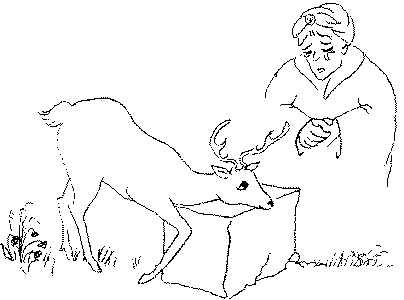
And the deer king went to the executioner’s block, and laid down his own golden neck upon it.
A silence fell in the deer park. And some who tell this story even say that silence also fell in other worlds not seen from here.
Soon the royal cook came to kill the willing victim on the block. But when he saw it was one of the two golden deer the king had ordered spared, he was afraid to kill him. So he went and told the King of Benares.
The king was surprised, so he went to the park. He said to the golden deer, still lying on the block, “Oh king of deer, did I not promise to spare your life? What is the reason you come here like the others?”
King Banyan Deer replied, “Oh king of men, this time a pregnant doe was unlucky enough to be the one to die. She pleaded for me to spare her, for the sake of others as well as her unborn baby and herself. I could not help but feel myself in her place, and feel her suffering. I could not help but weep, to think the little one would never see the dawn, would never taste the dew. And yet, I could not force the pain of death on another, relieved to think it was not his turn today. So, mighty king, I offer my life for the sake of the doe and her unborn fawn. Be assured there is no other reason.”
The King of Benares was overwhelmed. Powerful as he was, a tear rolled down his cheek. Then he said, “Oh great lord, the golden king of deer, even among human beings, I have not seen any such as you! Such great compassion, to share in the suffering of others! Such great generosity, to give your life for others! Such great kindness and tender love for all your fellow deer! Arise.”
“I decree that you will never be killed by me or anyone else in my kingdom. And, so too, the doe and her babe.”
Without yet raising his head, the golden one said, “Are only we to be saved? What of the other deer in the park, our friends and kin?” The king said, “My lord, I cannot refuse you, I grant safety and freedom to all the deer in the park.” “And what of the deer outside the park, will they be killed?” asked Banyan. “No my lord, I spare all the deer in my whole kingdom.”
Still the golden deer did not raise up his head. He pleaded, “So the deer will be safe, but what will the other four-footed animals do?” “My lord, from now on they too are safe in my land.” “And what of the birds? They too want to live.” “Yes, my lord, the birds too will be safe from death at the hands of men.” “And what of the fish, who live in the water?” “Even the fish will be free to live, my lord.” So saying, the King of Benares granted immunity from hunting and killing to all the animals in his land.
Having pleaded for the lives of all creatures, the Great Being arose.
From Kindness <A Treasury of Buddhist Wisdom For Children and Parents>
By Sarah Conover
Once upon a time, the Buddha was born as a magnificent ibex. The forest in which he lived was far from civilization and therefore tranquil, inhabited by many creatures both small and large. Along the banks of clear, babbling brooks were found rare flowers, which blossomed nowhere else on earth. Trees towered above the lush undergrowth and kept the forest cool and mild.
The noble ibex that lived in this forest, the Former Buddha, was as beautiful as he was sleek and swift. He had the body of an animal but the intelligence and empathy of a human being. So deep was his kindness for all living creatures that he often trod delicately so as not to crush anything. He ate nothing but the tips of grasses already gone to seed.
As this region was renowned for its great beauty, hunting parties would at times make long journeys to reach it. On one such occasion, a king and his friends camped on the edge of the forest, hoping to bag large amounts of game before the end of their stay. One morning, the king set out on horseback with his small group following him. Not long after, the king caught a glimpse of the splendid ibex and wanted to hunt him down. Snapping his reins across his horse’s neck, the king dashed away in chase, leaving the group far behind.
When the ibex heard the quick pounding of hooves, he turned and saw the king swiftly bearing down upon him. The king’s bow was drawn taut and an arrow ready in the sites. Although the ibex could have fought the king’s attack, he chose to avoid violence, even in self-defense. So the ibex spun around and took off with great speed towards the dense center of the forest, confident the king could not catch him. Through the thick forest he sprang, still pursued by the king, but the distance between them was increasing. The ibex came to a familiar, small, deep chasm and leapt over it effortlessly. But the king’s horse, coming to that same rocky cliff, abruptly pressed his weight backwards and refused to jump. The king had been watching the ibex, not the forest floor. So when the horse stopped with a jolt, the surprised king fell forward, headlong, into the chasm.
After a time, the ibex heard no hoof beats in pursuit. He slowed and twisted his head around to examine the situation behind him. There in the distance he spotted the rider-less horse at the chasm’s edge and correctly guessed what had happened to the king. A sudden welling of kindness overcame him. He anticipated that the king must be in severe pain, surely having broken a number of bones in the fall. He knew also that the king would never survive long in this forest because there were many tigers and other beasts.
The ibex walked up to the chasm edge and saw the king far below, moaning and writhing in pain. He no longer looked upon the king as his enemy, but felt his suffering keenly. The Former Buddha gently inquired, “I hope your majesty has no serious wounds? Might the pain of your injuries be diminishing by now?”
The king looked up at the ibex in utter astonishment. He felt a dreadful pang of remorse for his behavior towards this noble animal. Oh, how the king felt his shame!
“You see, your Excellency,” comforted the Ibex, “I am no wild devil to be hunted for sport. I am just a peaceful creature living within the bounds of this beautiful forest.”
“Oh!” blurted the king. “It is I who acted as a beast, not you! Can you ever forgive me?” he asked. “My physical pain right now,” continued the king, “is far less than the pain I feel for having threatened a noble creature as yourself.”
“Sire,” responded the ibex, “let me help you out of your predicament. I can rescue you if you’ll trust me.” The ibex took the king’s silence as a sign of goodwill and knew that the king would accept his help. He then searched for a boulder as heavy as a man and practiced lifting it. When he felt he could do it safely, without slipping, he made his way down the rocks beside the king. “If you mount me as you would your horse, your Excellency, I believe I can leap out of the chasm with you on my back,” offered the ibex.
The king followed these directions and held on as best he could. In an instant the ibex leapt in a great arc onto the cliff rim. There the king found his waiting horse but was so overtaken by the goodness of the ibex he could not leave. “What can I do to repay you?” begged the king. “If you would come to my palace, we would see that your every need was met. I can’t bear to think of you left in this forest with hunters in pursuit. Please, please come back with me,” insisted the king.
“Sire, do you think I, who am so contented in the forest, could really adjust to that? I love nothing better than to live here, in peace. But there is one great favor I would ask of you.”
“Anything,” said the king.
“I ask that you give up hunting for sport. You now realize that all creatures want happiness and security. Can it be right to do to them what you yourself would despise? A true king,” proclaimed the ibex, “will gain his people’s love by showing great goodness, not by showing power.”
The grateful king agreed to the request. “Now, let me show you the way back to safety,” suggested the ibex. “Mount your horse and I will guide you home to your camp.”
The king soon returned to his palace, and the ibex disappeared into the shelter of the forest. But forevermore, the king lived by the wise words of the noble ibex, the Former Buddha. He forbade hunting for sport throughout his kingdom’s domain. He protected his people, but no longer waged costly wars against nearby countries. His kingdom flourished. And thus, the good king was greatly loved and respected by his people as the gentlest and wisest of all kings.
Out of compassion and gratitude, King Banyan Deer the Enlightenment Being, taught the King of Benares. He advised him to climb the five steps of training, in order to purify his mind. He described them by saying, “It will benefit you, if you give up the five unwholesome actions. These are:
Destroying life, for this is not compassion;
Taking what is not given, for this is not generosity;
Doing wrong in sexual ways, for this is not loving-kindness;
Speaking falsely, for this is not Truth;
Losing your mind from alcohol, for this leads to falling down the first four steps.”
He further advised him to do wholesome actions, that would bring happiness in this life and beyond. Then King Banyan Deer, and both herds, returned to the forest.
In the fullness of time, the pregnant doe, who had stayed with Banyan’s herd, gave birth to a fawn. He was as beautiful as a lotus blossom given as an offering to the gods.
When the fawn had grown into a young buck deer, he began playing with Branch Deer’s herd. Seeing this, his mother said to him, “Better to die after a short life with the great compassionate one, than to live a long life with an ordinary one.” Afterwards, her son lived happily in the herd of King Banyan Deer.
The only ones left unhappy were the farmers and villagers of the kingdom. For, given total immunity by the king, the deer began to fearlessly eat the people’s crops. They even grazed in the vegetable gardens inside the villages and the city of Benares itself!
So the people complained to the king, and asked permission to kill at least some of the deer as a warning. But the king said, “I myself promised complete immunity to King Banyan Deer. I would give up the kingship before I would break my word to him. No one may harm a deer!”
When King Banyan Deer heard of this, he said to all the deer, “You should not eat the crops that belong to others.” And he sent a message to the people. Instead of making fences, he asked them to tie up bunches of leaves as boundaries around their fields. This began the Indian custom of marking fields with tied up leaves, which have protected them from deer to this very day.
Both King Banyan Deer and the King of Benares lived out their lives in peace, died, and were reborn as they deserved.
The moral is: Wherever it is found, compassion is a sign of greatness.