The Mustard Seed

The Mustard Seed

From Kindness <A Treasury of Buddhist Wisdom For Children and Parents>

By Sarah Conover

Unlike the Buddha, Kisa Gotami grew up very poor. Her family had little food to spare. She often felt weary, hungry, and weak and so was called Kisa-meaning”frail”-Gotami. When Kisa Gotami married, she moved into the house of her husband’s family: the custom in India at the time. But because she came from a humble background, her new family treated her harshly until the day she gave birth to a child. She was respected now, with her new baby boy. Kisa felt proud and happy. Her new son was the light of her life. She cherished everything about him-his delightful laughter, his eager brown eyes, his toothless smiles. But one terrible, tragic day, the boy was taken by a sudden illness. His death overwhelmed poor Kisa. She bundled him in warm blankets and held him tightly to her chest. Crazed with grief, she stumbled from house to house, begging for medicine that would bring him back to life. But instead of helping, people mocked her madness. “Crazy woman!” they jeered. “How can a person be brought back to life!” Hours later, Kisa Gotami stood in the street, wretched and disheartened.As she wept over her child,a kind man passing by studied her.To himself he said,  ”This poor woman has lost her mind from sorrow. I think I know how to get her the medicine she seeks.” He placed his hands firmly on her shoulders.”Dear woman, please let me help you.The wisest of men, a man named the Buddha, resides at a monastery nearby. I will take you to him and you can ask his advice. If anyone has medicine for your child, it is he.”

He led her to the monastery where she found the Buddha teaching, at the front of a large group of monks and nuns. From the edge of the crowd she shouted,”Teacher, teacher! My name is Kisa Gotami. I am desperate! Please, my son needs your medicine!”

The crowd made way for Kisa to reach the Buddha. As she stood before him, he observed the child’s lifeless face.”You did well in coming here for medicine, Gotamit the Buddha comforted her.”Here you will find the help you need. But first, before l can save your child, you must do something for me.You·must return to the city from which you just came. There, find me a single mustard seed and bring it back.”

Kisa Gotami’s face lit up, for she thought this a simple task in exchange for her son’s life.”Most important of all,”said the Buddha,”the mustard seed must be from a family in which no one has died. Go now, make the rounds of the city and·ask at every home. Bring me back just one mustard seed from such a family.”

“Thank you good sir!”said Kisa happily. She turned and hurried back to the city.At the very first house she stopped and knocked at the door.An old woman answered. She easily gave Kisa Gotami a mustard seed-all India used them in cooking. But just as the seed was placed -in Kisa’s palm, she remembered the Buddha’s further instructions. ”Oh, pardon me. Before I take this, I must ask you, has anyone died in this family recently?” The old woman’s head lowered. She fell silent. When she raised her face, there were pooled tears in her eyes.I’m sorry to say the answer is yes,” replied the old woman. “ My dear husband died six months ago.”

“I am so sorry; said Kisa Gotami.”Thank you for your kindness, but I cannot take this seed.”

A few minutes later she knocked at the door of a house with children running in and out of the entrance,chasing each other in play.A young woman saw Kisa standing in the doorway, and came to greet her. Some of the children stood behind the young woman’s skirt to hear what the stranger wanted. “Can I help you?” she asked Kisa Gotami.

“I have been sent here to find special medicine for my son. I am looking for a single mustard seed from a household in which no one has died;’ said Kisa.

“We cannot help you. l am sorry. We lost our mother two years ago;’ stated the young woman quietly. “For many months I was so unhappy I didn’t know how to go on” One of the boys reached up to hold her hand. She clasped his little fingers and continued,”But I knew I had to help my father take care of my brothers and sisters. That’s what my mother would have wanted. I’m sorry we have no such special mustard seed for you:’

And so Kisa Gotami continued to the next house, and then to another, asking for the single mustard seed. But always, someone had lost a beloved-a brother or a sister, a grandparent, an aunt or cousin, a mother or father. The list grew longer and longer. After a time, nightfall came. People snuffed out their oil lamps for the evening. Kisa Gotami sat down, resting against a tree. She gazed down at her son in her arms.

Studying him closely, she felt a gradual change in herself. Not a single household she had visited today lived untouched by death’s sad hand. Many suffered just as she did now. She was not alone. And somehow, with these thoughts, her grief lightened just a bit, and she returned home. The next day, at first light, Kisa Gotami readied her son for his funeral. Tears streamed down her cheeks as she wrapped him in clean cloth and said farewell. After the funeral, Kisa Gotami went back to the monastery to speak with the Buddha.The Buddha dearly saw in her face that she had come back to her senses. He asked,”Gotami, did you bring me a tiny grain of mustard?” 

“ No, teacher. I am done looking for the mustard seed. I know that in the whole city, in the whole world, there is not one family, not one person, free from the certainty of death. It is the way of all living things-we must at some time leave one another.” 

”And where is your child, dear woman?” 

”At last I have said good-bye to him. I felt terribly alone in my grief, but now I know there are many others who have lost what they most cherished. We must help each other, as you have helped me.”

Kisa Gotami, brought back to her right mind from her search for the mustard seed, became a very wise and compassionate woman. It is said that she never left the Buddha after her return to the monastery. And that from her experience, she was able to comfort many, many others in her lifetime.

The moral is : All fear death, all hold life dear. Feel for others as you do for yourself. Remember this and cause no harm.

Title: The Mustard Seed

Link:https://peacelilysite.com/2021/12/23/the-mustard-seed/

#Buddhiststories#Buddhism#Monastery#Death#Buddha#Kindness#BuddhaWisdom

9. THE KING WITH ONE GREY HAIR [ORDINATION]

9. THE KING WITH ONE GREY HAIR [ORDINATION]

Buddhist Tales for Young and Old, volume 1, Prince Goodspeaker, Stories 1-50

A very very long time ago, there were people who lived much longer than they do today. They lived many thousand years. At that time, the Enlightenment Being was born as a baby named Makhadeva. He lived 84,000 years as a child and crown prince. At the time of our story, he had been a young king for 80,000 years.

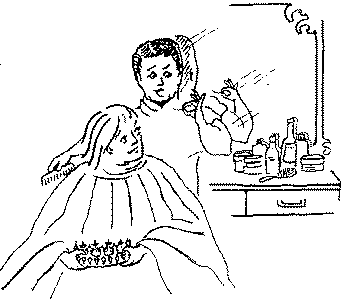
One day, Makhadeva told the royal barber, “If you see any grey hair on my head, you must tell me immediately!” Of course, the barber promised to do so.

Another 4,000 years passed, until Makhadeva had been a young king for 84,000 years. Then one day, while he was cutting the king’s hair, the royal barber saw just one little grey hair on all the king’s head. So he said, “Oh my lord, I see one grey hair on your head.” The king said, “If this be so, pull it out and put it in my hand.” The barber got his golden tweezers, plucked out the single little grey hair, and put it in the king’s hand.

At that time, the king still had at least another 84,000 years left to live as an old king! Looking at the one grey hair in his hand, he became very afraid of dying. He felt like death was closing in on him, as if he were trapped in a burning house. He was so afraid, that the sweat rolled down his back, and he shuddered.

King Makhadeva thought, “Oh foolish king, you have wasted all this long life and now you are near death. You have made no attempt to destroy your greed and envy, to live without hating, and to get rid of your ignorance by learning the truth and becoming wise.”

As he thought this, his body burned and the sweat kept rolling down. Then he decided once and for all, “It is time to give up the kingship, be ordained as a monk, and practice meditation!” Thinking so, he granted the income of a whole town to the barber. It amounted to one-hundred-thousand gold coins per year.

Then the king called his oldest son to him and said, “My son, I have seen a grey hair. I have become old. I have enjoyed the worldly pleasures of great wealth and power. When I die, I want to be reborn in a heaven world, to enjoy the pleasures of the gods. So I will be ordained as a monk. You must now take the responsibility of ruling the country. I will live the life of a monk in the forest.”

Hearing of this, the royal ministers and the rest of the court rushed to the king and said, “Our lord, why do you suddenly want to be ordained?”

The king held up the grey hair in his hand and said, “My ministers and subjects, I have realized that this grey hair shows that the three stages of life — youth, middle age and old age — are coming to an end. This first grey hair was the messenger of death sitting on my head. Grey hairs are like angels sent by the god of death. Therefore, this very day is the time for me to be ordained.”

The people wept at the news of his departure. King Makhadeva gave up his royal life, went into the forest, and was ordained as a monk. There he practiced what holy men call the ‘Four Heavenly States of Mind’. First is loving-kindness, tender affection for all. Second is feeling sympathy and pity for all those who suffer. Third is feeling happiness for all those who are joyful. And the fourth state is balance and calm, even in the face of difficulties or troubles.

After 84,000 years of great effort meditating and practicing these states as a humble forest monk, the Bodhisatta died. He was reborn in a high heaven world, to live a life a million years long!

The moral is: Even a long life is too short to waste.

The King With One Grey Hair [Ordination]

Link:https://hhdorjechangbuddhaiiiinfo.com/2021/11/23/the-king-with-one-grey-hair-ordination/

INTERPRETER’S INTRODUCTION – BUDDHIST TALES FOR YOUNG AND OLD, VOLUME 1, STORIES 1-50

#Buddhisttalesforyoungandold #Buddhiststories #storiesforkids #moralstories #Buddha #Jatakastories #PansiyaPanasJataka

8, 462 THE ONE-HUNDREDTH PRINCE [OBEDIENCE TO A WISE TEACHER]

STORY 8, 462

THE ONE-HUNDREDTH PRINCE

 [OBEDIENCE TO A WISE TEACHER]

Buddhist Tales for Young and Old, volume 1, Prince Goodspeaker, Stories 1-50

Once upon a time, there was a king who had one-hundred sons. The youngest, the one-hundredth, was Prince Gamani. He was very energetic, patient and kind.

All the princes were sent to be taught by teachers. Prince Gamani, even though he was the one-hundredth in line to the throne, was lucky enough to have the best teacher. He had the most learning and was the wisest of them of all. He was like a father to Prince Gamani, who liked, respected and obeyed him.

In those days, it was the custom to send each educated prince to a different province. There he was to develop the country and help the people. When Prince Gamani was old enough for this assignment, he went to his teacher and asked which province he should request. He said, “Do not select any province. Instead, tell your father the king that if he sends you, his one-hundredth son, out to a province, there will be no son remaining to serve him in his home city.” Prince Gamani obeyed his teacher, and pleased his father with his kindness and loyalty.

Then the prince went again to his teacher and asked, “How best can I serve my father and the people, here in the capital city?” The wise teacher replied, “Ask the king to let you be the one to collect fees and taxes, and distribute benefits to the people. If he agrees, then carry out your duties honestly and fairly, with energy and kindness.”

Again the prince followed his teacher’s advice. Trusting his one-hundredth son, the king was glad to assign these functions to him. When he went out to perform the difficult task of collecting fees and taxes, the young prince was always gentle, fair and lawful. When he distributed food to the hungry, and other necessary things to the needy, he was always generous, kind and sympathetic. Before long, the one-hundredth prince gained the respect and affection of all.

Eventually, the king came to be on his deathbed. His ministers asked him who should be the next king. He said that all his one-hundred sons had a right to succeed him. It should be left up to the citizens.

After he died, all the citizens agreed to make the one-hundredth prince their next ruler. Because of his goodness, they crowned him King Gamani the Righteous.

When the ninety-nine older brothers heard what had happened, they thought they had been insulted. Filled with envy and rage, they prepared for war. They sent a message to King Gamani, which said, “We are all your elders. Neighbour countries will laugh at us if we are ruled by the one-hundredth prince. Either you give up the kingdom or we will take it by war!”

After he received this message, King Gamani took it with him to his wise old teacher, and asked his advice.

It just so happened that this honorable gentle teacher was the reborn Enlightenment Being. He said, “Tell them you refuse to wage war against your brothers. Tell them you will not help them kill innocent people you have come to know and love. Tell them that, instead, you are dividing the king’s wealth among all one-hundred princes. Then send each one his portion.” Again the king obeyed his teacher.

Meanwhile the ninety-nine older princes had brought their ninety-nine small armies to surround the royal capital. When they received the king’s message and their small portions of the royal treasure, they held a meeting. They decided that each portion was so small it was almost meaningless. Therefore, they would not accept them.

But then they realized that, in the same way, if they fought with King Gamani and then with each other, the kingdom itself would be divided into small worthless portions. Each small piece of the once-great kingdom would be weak in the face of any unfriendly country. So they sent back their portions of the royal treasure as offerings of peace, and accepted the rule of King Gamani.

The king was pleased, and invited his brothers to the palace to celebrate the peace and unity of the kingdom. He entertained them in the most perfect ways — with generosity, pleasant conversation, providing instruction for their benefit, and treating all with even-handed courtesy.

In this way the king and the ninety-nine princes became closer as friends than they had been as brothers. They were strong in their support of each other. This was known in all the surrounding countries, so no one threatened the kingdom or its people. After a few months, the ninety-nine brothers returned to their provinces.

King Gamani the Righteous invited his wise old teacher to live in the palace. He honored him with great wealth and many gifts. He held a celebration for his respected teacher, saying to the full court, “I, who was the one-hundredth prince, among one-hundred worthy princes, owe all my success to the wise advice of my generous and understanding teacher. Likewise, all who follow their wise teachers’ advice will earn prosperity and happiness. Even the unity and strength of the kingdom, we owe to my beloved teacher.”

The kingdom prospered under the reign of the generous and just rule of King Gamani the Righteous.

The moral is: One is rewarded a hundred-fold for following the advice of a wise teacher.

The One-hundredth Prince

Link:https://hhdorjechangbuddhaiiiinfo.com/2021/11/16/8-462-the-one-hundredth-prince-obedience-to-a-wise-teacher/

INTERPRETER’S INTRODUCTION – BUDDHIST TALES FOR YOUNG AND OLD, VOLUME 1, STORIES 1-50

#KingGamani #theEnlightenmentBeing #Buddhisttalesforyoungandold #Buddhiststories #storiesforkids #moralstories #Buddha #Jatakastories #PansiyaPanasJataka