
Back exercises

Back exercises

Back exercises in 15 minutes a day

Do you want to prevent back pain? Try these exercises to stretch and strengthen your back and supporting muscles. Repeat each exercise a few times, then increase the repetitions as the exercise gets easier.

Knee-to-chest stretch
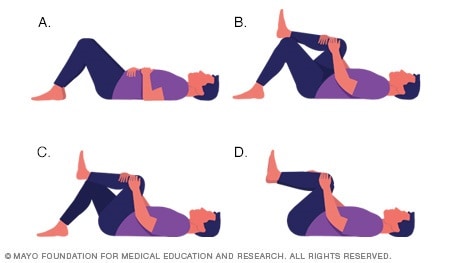
A person lying on back, bringing knees to chest

Lie on your back with your knees bent and your feet flat on the floor (A). Using both hands, pull up one knee and press it to your chest (B). Tighten your abdominals and press your spine to the floor. Hold for 5 seconds. Return to the starting position and repeat with the opposite leg (C). Return to the starting position and then repeat with both legs at the same time (D). Repeat each stretch 2 to 3 times — preferably once in the morning and once at night.

Lower back rotational stretch
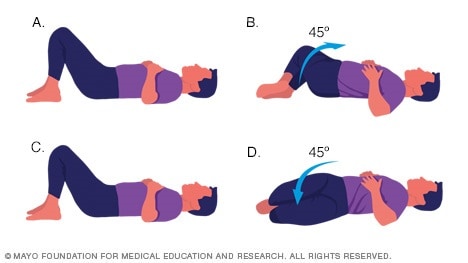
A person lying on back, rolling knees side to side

Lie on your back with your knees bent and your feet flat on the floor (A). Keeping your shoulders firmly on the floor, roll your bent knees to one side (B). Hold for 5 to 10 seconds. Return to the starting position (C). Repeat on the opposite side (D). Repeat each stretch 2 to 3 times — preferably once in the morning and once at night.

Lower back flexibility exercise
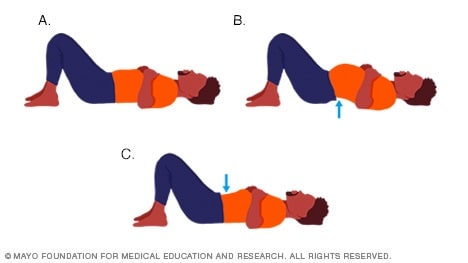
A person practicing lower back flexibility exercise

Lie on your back with your knees bent and your feet flat on the floor (A). Tighten your abdominal muscles so your stomach pulls away from your waistband (B). Hold for five seconds and then relax. Flatten your back, pulling your bellybutton toward the floor (C). Hold for five seconds and then relax. Repeat. Start with five repetitions each day and gradually work up to 30.

Bridge exercise
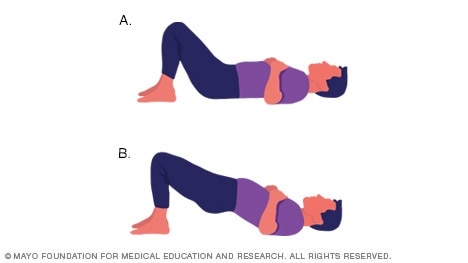
A person practicing bridge exercise

Lie on your back with your knees bent and your feet flat on the floor (A). Keeping your shoulders and head relaxed on the floor, tighten your abdominal and gluteal muscles. Then raise your hips to form a straight line from your knees to your shoulders (B). Try to hold the position long enough to complete three deep breaths. Return to the starting position and repeat. Start with five repetitions each day and gradually work up to 30.

Cat stretch
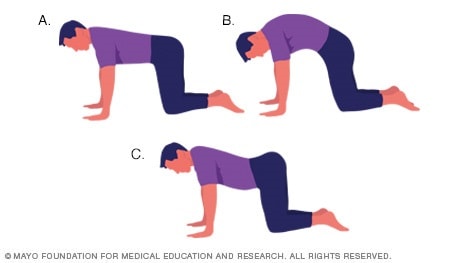
A person practicing cat stretches

Position yourself on your hands and knees (A). Slowly arch your back, as if you’re pulling your abdomen up toward the ceiling (B). Then slowly let your back and abdomen sag toward the floor (C). Return to the starting position (A). Repeat 3 to 5 times twice a day.

Seated lower back rotational stretch
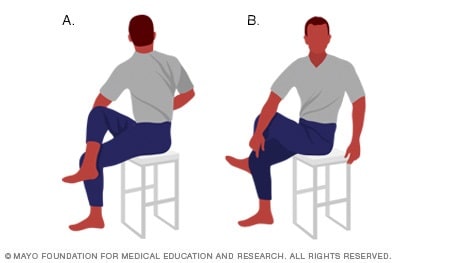
A person practicing seated twists

Sit on an armless chair or a stool. Cross your right leg over your left leg. Bracing your left elbow against the outside of your right knee, twist and stretch to the side (A). Hold for 10 seconds. Repeat on the opposite side (B). Repeat this stretch 3 to 5 times on each side twice a day.

Shoulder blade squeeze
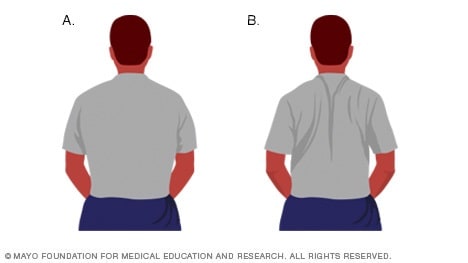
A person doing shoulder blade squeeze

Sit on an armless chair or a stool (A). While maintaining good posture, pull your shoulder blades together (B). Hold for five seconds and then relax. Repeat 3 to 5 times twice a day.

Link: https://wisdomtea.org/2022/04/28/back-exercises/

https://www.mayoclinic.org/healthy-lifestyle/adult-health/multimedia/back-pain/sls-20076265?s=1

Type 2 Diabetes

Type 2 Diabetes

More than 37 million Americans have diabetes (about 1 in 10), and approximately 90-95% of them have type 2 diabetes. Type 2 diabetes most often develops in people over age 45, but more and more children, teens, and young adults are also developing it.

What Causes Type 2 Diabetes?

Insulin is a hormone made by your pancreas that acts like a key to let blood sugar into the cells in your body for use as energy. If you have type 2 diabetes, cells don’t respond normally to insulin; this is called insulin resistance. Your pancreas makes more insulin to try to get cells to respond. Eventually your pancreas can’t keep up, and your blood sugar rises, setting the stage for prediabetes and type 2 diabetes. High blood sugar is damaging to the body and can cause other serious health problems, such as heart disease,  vision loss, and kidney disease.

Symptoms and Risk Factors

Type 2 diabetes symptoms often develop over several years and can go on for a long time without being noticed (sometimes there aren’t any noticeable symptoms at all). Because symptoms can be hard to spot, it’s important to know the risk factors and to see your doctor to get your blood sugar tested if you have any of them

Testing for Type 2 Diabetes

A simple blood test will let you know if you have diabetes. If you’ve gotten your blood sugar tested at a health fair or pharmacy, follow up at a clinic or doctor’s office to make sure the results are accurate.

Photo by Trang Doan on Pexels.com

Managing Diabetes

Unlike many health conditions, diabetes is managed mostly by you, with support from your health care team (including your primary care doctor, foot doctor, dentist, eye doctor, registered dietitian nutritionist, diabetes educator, and pharmacist), family, and other important people in your life. Managing diabetes can be challenging, but everything you do to improve your health is worth it!

You may be able to manage your diabetes with healthy eating and being active, or your doctor may prescribe insulin, other injectable medications, or oral diabetes medicines to help manage your blood sugar and avoid complications. You’ll still need to eat healthy and be active if you take insulin or other medicines. It’s also important to keep your blood pressure and cholesterol close to the targets your doctor sets for you and get necessary screening tests.

You’ll need to check your blood sugar regularly. Ask your doctor how often you should check it and what your target blood sugar levels should be. Keeping your blood sugar levels as close to target as possible will help you prevent or delay diabetes-related complications.

Stress is a part of life, but it can make managing diabetes harder, including managing your blood sugar levels and dealing with daily diabetes care. Regular physical activity, getting enough sleep, and relaxation exercises can help. Talk to your doctor and diabetes educator about these and other ways you can manage stress.

Make regular appointments with your health care team to be sure you’re on track with your treatment plan and to get help with new ideas and strategies if needed.

Whether you were just diagnosed with diabetes or have had it for some time, meeting with a diabetes educator is a great way to get support and guidance, including how to:

  • Develop a healthy eating and activity plan
  • Test your blood sugar and keep a record of the results
  • Recognize the signs of high or low blood sugar and what to do about it
  • If needed, give yourself insulin by syringe, pen, or pump
  • Monitor your feet, skin, and eyes to catch problems early
  • Buy diabetes supplies and store them properly
  • Manage stress and deal with daily diabetes care

Ask your doctor about diabetes self-management education and support services and to recommend a diabetes educator, or search the Association of Diabetes Care & Education Specialists’ (ADCES) nationwide directoryexternal icon for a list of programs in your community.

Type 2 Diabetes in Children and Teens

Childhood obesity rates are rising, and so are the rates of type 2 diabetes in youth. More than 75% of children with type 2 diabetes have a close relative who has it, too. But it’s not always because family members are related; it can also be because they share certain habits that can increase their risk. Parents can help prevent or delay type 2 diabetes by developing a plan for the whole family:

  • Drinking more water and fewer sugary drinks
  • Eating more fruits and vegetables
  • Making favorite foods healthier
  • Making physical activity more fun

Healthy changes become habits more easily when everyone makes them together. Find out how to take charge family style with these healthy tips.

link: https://wisdomtea.org/2022/03/31/type-2-diabetes/

https://www.cdc.gov/diabetes/basics/type2.html