In the past, and even in some places today, people have had superstitions. One such is that a large or unusual tree is inhabited by a tree god, or some kind of spirit. People think that they can make a promise to this tree god, so he will help them in some way. When they think the god has helped them, then they must keep their promise.
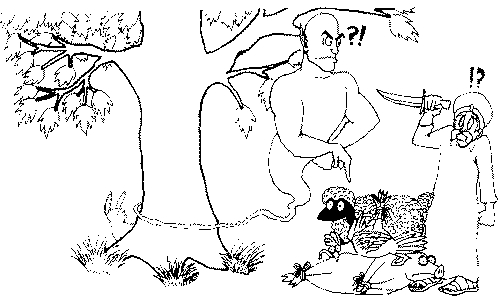
Once upon a time, in the city of Kasi in northern India, a man came upon a large banyan tree. He immediately thought there must be a go
d living there. So he made a promise to this tree god that he would perform an animal sacrifice, in return for a wish being granted.
It just so happened that his wish was fulfilled, but whether by a god or a demon or by some other means — no one knows. The man was sure the tree god had answered his prayer, so he wanted to keep his promise.
Since it was a big wish, it called for a big sacrifice. He brought many goats, mules, chickens and sheep. He collected firewood and prepared to burn the helpless animals as a sacrifice.
The spirit living in the banyan tree appeared and said, “Oh friend, you made a promise. You are now bound by that promise. You think you must keep the promise in order to be released from the bondage to it. But if you commit such terrible unwholesome acts, even though promised, the unpleasant results will put you in much greater bondage. For you will be forced to suffer those results in this life, and even by rebirths in hell worlds! The way to release yourself into future deliverance is to give up unwholesome actions, no matter what!
“And furthermore, since you think I’m a true god, what makes you think I eat meat? Haven’t you heard that we gods eat better things, like ‘ambrosia’ or stardust or sunbeams? I have no need of meat or any other food offerings.” Then he disappeared.
The foolish man understood the mistake he had made. Instead of doing unwholesome deeds that would force unhappy results on him in the future, he began to do only wholesome deeds that would benefit himself and others.
The moral is: Keeping a bad promise is worse than making it.
Once upon a time, there was a very famous priest in a very old religion. He decided it was the right day to perform the ritual sacrificing of a goat. In his ignorance, he thought this was an offering demanded by his god.
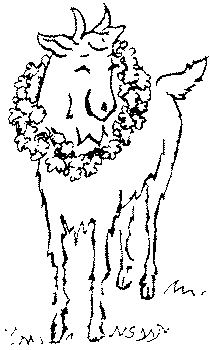
He obtained an appropriate goat for the sacrifice. He ordered his servants to take the goat to the holy river and wash him and decorate him with flower garlands. Then they were to wash themselves, as part of the purification practice.
Down at the riverbank, the goat suddenly understood that today he would definitely be killed. He also became aware of his past births and deaths and rebirths. He realized that the results of his past unwholesome deeds were about to finally be completed. So he laughed an uproarious goat-laugh, like the clanging of cymbals.
In the midst of his laughter, he realized another truth that the priest, by sacrificing him, would suffer the same terrible results, due to his ignorance. So he began to cry as loudly as he had just been laughing!
The servants, who were bathing in the holy river, heard first the laughing and then the crying. They were amazed. So they asked the goat, “Why did you loudly laugh and then just as loudly cry? What is the reason for this?” He replied, “I will tell you the reason. But it must be in the presence of your master, the priest.”
Since they were very curious, they immediately took the sacrificial goat to the priest. They explained all that had happened. The priest, too, became very curious. He respectfully asked the goat, “Sir, why did you laugh so loudly, and then just as loudly cry?”
The goat, remembering his past lives, said, “A long time ago, I too was a priest who, like you, was well educated in the sacred religious rites. I thought that to sacrifice a goat was a necessary offering to my god, which would benefit others, as well as myself in future rebirths. However, the true result of my actions was that in my next 499 lives I myself have been beheaded!
“While being prepared for the sacrifice, I realized that today I will definitely lose my head for the 500th time. Then I will finally be free of all the results of my unwholesome deeds of so long ago. The joy of this made me laugh uncontrollably.
“Then I suddenly realized that you, the priest, were about to repeat the same unwholesome action, and would be doomed to the same result of having your head chopped off in your next 500 lives! So, out of compassion and sympathy, my laughter turned to tears.”
The priest was afraid this goat might be right, so he said, “Well, sir goat, I will not kill you.” The goat replied, “Reverend priest, even if you do not kill me, I know that today I will lose my head and finally be released from the results of my past unwholesome action.”
The priest said, “Don’t be afraid, my fine goat. I will provide the very best protection and personally guarantee that no harm will come to you.” But the goat said, “Oh priest, your protection is very weak, compared to the power of my unwholesome deed to cause its necessary results.”
So the priest cancelled the sacrifice, and began to have doubts about killing innocent animals. He released the goat and, along with his servants, followed him in order to protect him from any danger.
The goat wandered into a rocky place. He saw some tender leaves on a branch and stretched out his neck to reach them. All of a sudden a thunderstorm appeared out of nowhere. A lightning bolt struck an over-hanging rock, and cut off a sharp slab, which fell and chopped off the goat’s head! He died instantly, and the thunderstorm disappeared.
Hearing of this very strange event, hundreds of local people came to the place. No one could understand how it had happened.
There was also a fairy who lived in a nearby tree. He had seen all that had occurred. He appeared, gently fluttering in the air overhead. He began to teach the curious people, saying, “Look at what happened to this poor goat. This was the result of killing animals! All beings are born, and suffer through sickness, old age and death. But all wish to live, and not to die. Not seeing that all have this in common, some kill other living beings. This causes suffering also to those who kill, both now and in countless future rebirths.
“Being ignorant that all deeds must cause results to the doer, some continue to kill and heap up more suffering on themselves in the future. Each time they kill, a part of themselves must also die in this present life. And the suffering continues even by rebirth in hell worlds!”
Those who heard the fairy speak felt that they were very lucky indeed. They gave up their ignorant killing, and were far better off, both in this life, and in pleasant rebirths.
The moral is: Even religion can be a source of ignorance.
A Treasury of Buddhist Wisdom for Children and Parents
Collected and Adapted by Sarah Conover
When the Buddha and his followers lived at Jetavana, a certain monk in the group was always upset – so much so that he could barely concentrate. When the Buddha asked him about it, the monk replied that he desired many things he couldn’t have; thus, he never felt content. “Oh, monk,” said the Buddha kindly, “these passions have been discarded even by monkeys. It is all the more important for one who lives the holy life to leave these feelings behind. “ And the Buddha recounted this old-world tale about the monkey king.
Once, in olden times, the Buddha came into the world as a monkey. He lived among the treetops of a remote jungle with a large family of monkeys. One day, a woodcutter came to this same jungle to fetch a good supply of logs for his family hearth. But when the woodcutter felled a large tree, he accidentally trapped the young monkey underneath as the tree dropped to the forest floor. When the woodcutter saw his surprise, he decided to bring the monkey home as a present to his king.
The bright monkey quickly tamed and was soon the favorite royal pet. The king let him run everywhere about the palace. So the monkey spent his days visiting the royal courts and kitchens, the guards’ quarters, and all the other enterprises within. The monkey easily learned to imitate the manners of the royal retinue, the ministers, the guards, and even the cook who chased him from her kitchen. It was impossible not to laugh at the monkey’s antics.
After a few years, the king requested that the woodcutter return to the palace. Then the king asked, “As a favor to this monkey who has pleased us so, would you bring him back to the jungle where he was captured? It would be kindest if we let him live out his years with fellow monkeys.” So the woodcutter did as the king bid: he brought the monkey back to the very same spot in the very same jungle and released him.
At once, as soon as the woodcutter had left, a hundred monkeys surrounded the palace monkey, all asking questions at once. “Where have you been living this long time? Where did that man take you? Did you go on a great adventure? Why did he let you go free?” On and on the monkeys clamored, full of curiosity.
When they quieted down, the palace monkey recounted his tale. He told them all about the king’s splendid palace and how he had entertained the king. He told them of the sumptuous feasts, the elegant dances, the noble ministers of the royal court, the king’s fearsome army, and the dark dungeons.
“But then, how did you escape?” They wanted to know.
“I was such a good pet, and I amused them all so, that they felt badly keeping me from my home. The king decided to set me free again, so here I am!”
Now the monkeys were really excited. “Oh, tell us all about the palace life!” They jumped and shouted. “Tell us about the ways of people! Tell us about the grand deeds of a king!” they insisted.
“No, you wouldn’t want to know,” cautioned the palace monkey. “You really won’t like it.”
But the monkeys would not let up until he agreed to show them what life was like for a king. So the palace money picked a monkey in the troop and said, “O.K. then, you be the king. Get up on this high rock and make it your throne. We will set to work and bring you the best fruit in the kingdom!”
So the monkey king sat upon his rock throne, surveying his kingdom and looking quite content. Soon a huge pile of delicious fruit surrounded him. After a time the king monkey began to feel distressed. “ But I could never eat all this fruit, even in a whole year! And how there’s nothing left for all of you to eat,” laments the monkey king.
“Of course you can’t eat it all,”said the palace monkey. But that dose’t matter to a king. The point is that you eat whatever you want, but you must not give any of it away. You must always keep a large pile so that others know you are very rich and very powerful!” So the monkeys, wishing to be like men, brought even more fruit and stacked it even higher around their king.
“What else do we do?” asked the monkeys when there was no more fruit to be had.
“You must all come before the king and praise him in every way you can imagine.”
The monkeys liked this idea, so they tried it.
“Well, no wonder his is king!” pronounced one. “His coat glistens like water.”
“His fur is as thick as deep grass!” boasted another.
“I’ve never seen such a strong and capable animal!” exclaimed a third monkey.
“No one is as wise and dignified as our king!” And so they gathered around their king and enjoyed themselves in flattering him.
“Enough of that,” said the little palace monkey. “Now it’s time to come behind the throne and say terrible things about the king.”
The monkeys didn’t like this idea at all and at first refused to do it. But the palace monkey preserved saying, “You have to try this if you want to learn the ways of people! See what it’s like.”
So the monkeys gathered behind the rock and whispered insults about the king.
“Have you noticed how old and confused the king seems lately?” asked a monkey.
“His eyes seem dull and he constantly forgets what he has said!” chuckled another.
“I think his fur is getting extremely thin; I think he might even be going bald in some very funny spots” tittered a third.
“I’ve noticed that the king eats more like a pig than a monkey!” said a fourth and they all howled.
At last the insulted monkey king could stand it no longer. He jumped off his throne and ran after them through the trees. But the monkeys each escaped in a hundred different directions from the frustrated king. When the monkey king as last returned to his throne, his eyes widened in astonishment. All the fruit had vanished!
“Where is the fruit?” cried the king. “All my fruit is stolen!” he bellowed.
“Yes, it’s a shame, but these things happen even to kings!” said the palace monkey. “Now your guards must go find the thieves. That’s what a king would do. And when the guards capture the thieves, they must be sentenced to death at once.”
“What?” cried the monkey king. “You want me to kill them? Oh, how could such a terrible thing come to pass?” he wailed. And he covered his ears with his hands and wept.
“No more! No more!” cried all the monkeys. “We don’t want to know anything else about the ways of people and kings!”
The palace monkey, the Former Buddha, then recited for them a little poem he had made up about life in the palace:
“This gold is mine, this gold is mine!’
so they cry both day and night:
These foolish folk who live in splendor
never think about the holy way”
“And,” said the Buddha, concluding his lesson, “the monkeys ran away from the rock throne and back up to the tree tops where they all lived happily ever after.”
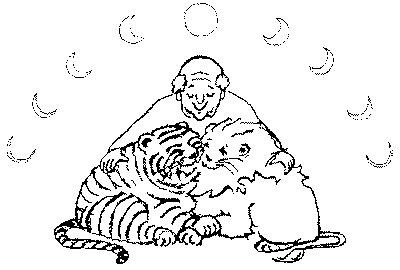
Once upon a time, there were two very good friends who lived together in the shade of a rock. Strange as it may seem, one was a lion and one was a tiger. They had met when they were too young to know the difference between lions and tigers. So they did not think their friendship was at all unusual. Besides, it was a peaceful part of the mountains, possibly due to the influence of a gentle forest monk who lived nearby. He was a hermit, one who lives far away from other people.
For some unknown reason, one day the two friends got into a silly argument. The tiger said, “Everyone knows the cold comes when the moon wanes from full to new!” The lion said, “Where did you hear such nonsense? Everyone knows the cold comes when the moon waxes from new to full!”
The argument got stronger and stronger. Neither could convince the other. They could not reach any conclusion to resolve the growing dispute. They even started calling each other names! Fearing for their friendship, they decided to go ask the learned forest monk, who would surely know about such things.
Visiting the peaceful hermit, the lion and tiger bowed respectfully and put their question to him. The friendly monk thought for a while and then gave his answer. “It can be cold in any phase of the moon, from new to full and back to new again. It is the wind that brings the cold, whether from west or north or east. Therefore, in a way, you are both right! And neither of you is defeated by the other. The most important thing is to live without conflict, to remain united. Unity is best by all means.”
The lion and tiger thanked the wise hermit. They were happy to still be friends.
The moral is: Weather comes and weather goes, but friendship remains.
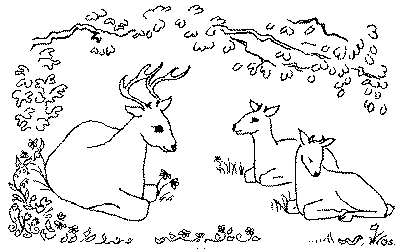
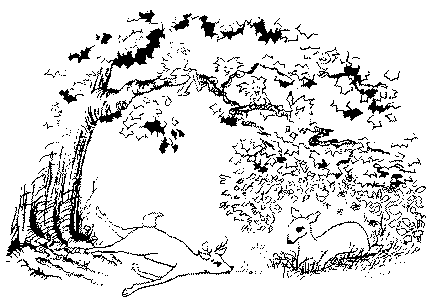
Once upon a time, there was a deer who was the leader of a herd of a thousand. He had two sons. One was very slim and tall, with bright alert eyes, and smooth reddish fur. He was called Beauty. The other was Grey in color, also slim and tall, and was called Grey.
One day, after they were fully grown, their father called Beauty and Grey to him. He said, “I am now very old, so I cannot do all that is necessary to look after this big herd of deer. I want you, my two grown-up children, to be the leaders, while I retire from looking after them all the time. We will divide the herd, and each of you will lead 500 deer.” So it was done.
In India, when the harvest time comes, the deer are always in danger. The rice is at its tallest, and the deer cannot help but go into the paddies and eat it. To avoid the destruction of their crops, the human beings dig pits, set sharp stakes in the ground, and build stone traps — all to capture and kill the deer.
Knowing this was the season, the wise old deer called the two new leaders to him. He advised them to take the herds up into the mountain forest, far from the dangerous farm lands. This was how he had always saved the deer from being wounded or killed. Then he would bring them back to the low lands after the harvest was over.
Since he was too old and weak for the trip, he would remain behind in hiding. He warned them to be careful and have a safe journey. Beauty set out with his herd for the mountain forest, and so did Grey with his.
The villagers all along the way knew that this was the time the deer moved from the low lying farm lands to the high countryside. So they hid along the way and killed the deer as they passed by.
Grey did not pay attention to his father’s wise advice. Instead of being careful and traveling safely, he was in a hurry to get to the lush mountain forest. So he moved his herd constantly, during the night, at dawn and dusk, and even in broad daylight. This made it easy for the people to shoot the deer in Grey’s herd with bows and arrows. Many were killed, and many were wounded, only to die in pain later on. Grey reached the forest with only a few deer remaining alive.
The tall sleek red-furred Beauty was wise enough to understand the danger to his moving herd. So he was very careful. He knew it was safer to stay away from the villages, and from all humans. He knew it was not safe in the daytime, or even at dawn or dusk. So he led his herd wide around the villages, and moved only in the middle of the night. Beauty’s herd arrived in the mountain forest safe and sound, with no one killed or injured.
The two herds found each other, and remained in the mountains until well after the harvest season was over. Then they began the return to the farmland country.
Grey had learned nothing from the first trip. As it was getting cold in the mountains, he was in a hurry to get to the warmer low lands. So he was just as careless as before. Again the people hid along the way and attacked and killed the deer. All Grey’s herd were killed, later to be eaten or sold by the villagers. Grey himself was the only one who survived the journey.
Beauty led his herd in the same careful way as before. He brought back all 500 deer, completely safe. While the deer were still in the distance, the old chief said to his doe, “Look at the deer coming back to us. Beauty has all his followers with him. Grey comes limping back alone, without his whole herd of 500. Those who follow a wise leader, with good qualities, will always be safe. Those who follow a foolish leader, who is careless and thinks only of himself, will fall into troubles and be destroyed.”
After some time, the old deer died and was reborn as he deserved. Beauty became chief of the herd and lived a long life, loved and admired by all.
The moral is: A wise leader puts the safety of his followers first.
Once upon a time, there was a herd of forest deer. In this herd was a wise and respected teacher, cunning in the ways of deer. He taught the tricks and strategies of survival to the young fawns.
One day, his younger sister brought her son to him, to be taught what is so important for deer. She said, “Oh brother teacher, this is my son. Please teach him the tricks and strategies of deer.” The teacher said to the fawn, “Very well, you can come at this time tomorrow for your first lesson.”
The young deer came to the lessons as he was supposed to. When others cut classes to spend all day playing, he remained and paid attention to the good teacher. He was well-liked by the other young bucks and does, but he only played when his class work was complete. Being curious to learn, he was always on time for the lessons. He was also patient with the other students, knowing that some learn more quickly than others. He respected the teacher deer for his knowledge, and was grateful for his willingness to share it.
One day, the fawn stepped in a trap in the forest and was captured. He cried out in great pain. This frightened the other fawns, who ran back to the herd and told his mother. She was terrified, and ran to her brother the teacher. Trembling with fear, crying big tears, she said to him, “Oh my dear brother, have you heard the news that my son has been trapped by a hunter’s snare? How can I save my little child’s life? Did he study well in your presence?”
Her brother said, “My sister, don’t be afraid. I have no doubt he will be safe. He studied hard and always did his very best. He never missed a class and always paid attention. Therefore, there is no need to have doubt or pain in your heart. He will not be hurt by any human being. Don’t worry. I am confident he will return to you and make you happy again. He has learned all the tricks and strategies used by deer to cheat the hunters. So be patient. He will return!”
Meanwhile, the trapped fawn was thinking, “All my friends were afraid and ran away. There is no one to help me get out of this deadly trap. Now I must use the tricks and strategies I learned from the wise teacher who taught so well.”
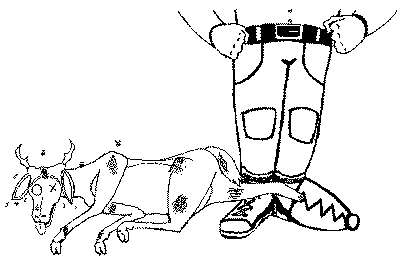
The deer strategy he decided to use was the one called, “playing dead.” First, he used his hoofs to dig up the dirt and grass, to make it look like he had tried very hard to escape. Then he relieved his bowels and released his urine, because this is what happens when a deer is caught in a trap and dies in very great fear. Next, he covered his body with his own saliva.
Lying stretched out on his side, he held his body rigidly and stiffened his legs out straight. He turned up his eyes, and let his tongue hang out of the side of his mouth. He filled his lungs with air and puffed out his belly. Finally, with his head leaning on one side, he breathed through the nostril next to the ground, not through the upper one.
Lying motionless, he looked so much like a stiff corpse that flies flew around him, attracted by the awful smells. Crows stood nearby waiting to eat his flesh.
Before long it was early morning and the hunter came to inspect his traps. Finding the fawn who was playing dead, he slapped the puffed up belly and found it stiff. Seeing the flies and the mess he thought, “Ah, it has already started to stiffen. He must have been trapped much earlier this morning. No doubt the tender meat is already starting to spoil. I will skin and butcher the carcass right here, and carry the meat home.”
Since he completely believed the deer was dead, he removed and cleaned the trap, and began spreading leaves to make a place to do the butchering. Realizing he was free, the fawn suddenly sprang to his feet. He ran like a little cloud blown by a swift wind, back to the comfort and safety of his mother. The whole herd celebrated his survival, thanks to learning so well from the wise teacher.
The moral is: Well-learned lessons bring great rewards.
Once upon a time, the King of Benares had a gardener who looked after his pleasure garden. Animals sometimes came into the garden from the nearby forest. The gardener complained about this to the king, who said, “If you see any strange animal, tell me at once.”
One day, he saw a strange kind of deer at the far end of the garden. When he saw the man, he ran like the wind. That is why they are called ‘wind-deer’. They are a rare breed, that are extremely timid. They are very easily frightened by human beings.
The gardener told the king about the wind-deer. He asked the gardener if he could catch the rare animal. He replied, “My lord, if you give me some bee’s honey, I could even bring him into the palace!” So the king ordered that he be given as much bee’s honey as he wanted.
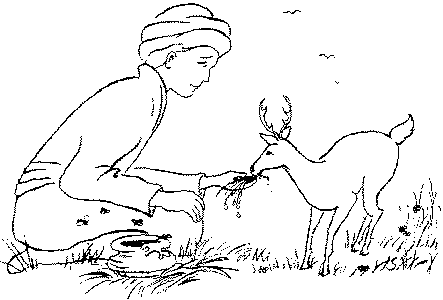
This particular wind-deer loved to eat the flowers and fruits in the king’s pleasure garden. The gardener let himself be seen by him little by little, so he would be less frightened. Then he began to smear honey on the grass where the wind-deer usually came to eat. Sure enough, the deer began eating the honey-smeared grass. Soon he developed a craving for the taste of this ‘honey-grass’. The craving made him come to the garden every day. Before long, he would eat nothing else!
Little by little, the gardener came closer and closer to the wind-deer. At first, he would run away. But later, he lost his fear and came to think the man was harmless. As the gardener became more and more friendly, eventually he got the deer to eat the honey-grass right out of his hand. He continued doing this for some time, in order to build up his confidence and trust.
Meanwhile, the gardener had rows of curtains set up, making a wide pathway from the far end of the pleasure garden to the king’s palace. From inside this pathway, the curtains would keep the wind-deer from seeing any people that might scare him.
When all was prepared, the gardener took a bag of grass and a container of honey with him. Again he began hand-feeding the wind-deer when he appeared. Gradually, he led the wind-deer into the curtained-off pathway. Slowly, he continued to lead him with the honey-grass, until finally the deer followed him right into the palace. Once inside, the palace guards closed the doors, and the wind-deer was trapped. Seeing the people of the court, he suddenly became very frightened and began running around, madly trying to escape.
The king came down to the hall and saw the panic-stricken wind-deer. He said, “What a wind-deer! How could he have gotten into such a state? A wind-deer is an animal who will not return to a place where he has so much as seen a human, for seven full days. Ordinarily, if a wind-deer is at all frightened in a particular place, he will not return for the whole rest of his life! But look! Even such a shy wild creature can be enslaved by his craving for the taste of something sweet. Then he can be lured into the center of the city and even inside the palace itself.
“My friends, the teachers warn us not to be too attached to the place we live, for all things pass away. They say that being too attached to a small circle of friends is confining and restricts a broad outlook. But see how much more dangerous is the simple craving for a sweet flavour, or any other taste sensation. See how this beautiful shy animal was trapped by my gardener, by taking advantage of his craving for taste.”
Not wishing to harm the gentle wind-deer, the king had him released into the forest. He never returned to the royal pleasure garden, and he never missed the taste of honey-grass.
The moral is: “It is better to eat to live, than to live to eat.”
Once upon a time, in northern India, there was a herd of village deer. They were used to being near villages; they were born there and grew up there. They knew they had to be very careful around people. This was especially true at harvest time, when the crops were tall, and the farmers trapped and killed any deer who came near.
At harvest time, the village deer stayed in the forest all day long. They only came near the village during the dark of the night. One of these was a beautiful young doe. She had soft reddish-brown fur, a fluffy white tail and big wide bright eyes.
During this particular season, there was a young mountain buck who had strayed into the same low forest. One day, he saw the beautiful young doe, and immediately became infatuated with her. He didn’t know anything about her. But he imagined himself to be deeply in love with her, just because of her reddish-brown fur and her fluffy white tail and her big wide bright eyes. He even dreamed about her, although she did not know he existed!
After a few days, the young mountain buck decided to introduce himself. As he was walking out into the clearing where she was grazing, he was entranced by her appearance and could not take his eyes off her. He began speaking: “Oh my sweet beauty, as lovely as the stars and as bright as the moon, I confess to you that I am deeply” — Just then the young buck’s hoof got caught in a root, he tripped and fell, and his face splashed in a mud puddle! The pretty village doe was flattered, so she smiled. But inside, she thought this mountain buck was really rather silly!
Meanwhile, unknown to the deer, there was a clan of tree fairies living in that part of the forest. They had been watching the mountain buck, while he secretly watched the village doe. When he walked out into the clearing, began his speech, and fell in the mud puddle – the fairies laughed and laughed. “What fools these dumb animals are!” they cried. But one fairy did not laugh. He said,”I fear this is a warning of danger to this young fool!”
The young buck was a little embarrassed, but he did not see it as any kind of warning. From then on, he followed the doe wherever she went. He kept telling her how beautiful she was and how much he loved her. She didn’t pay much attention.
Then night came, and it was time for the doe to go down to the village. The people who lived along the way knew the deer passed by at night. So they set traps to catch them. That night a hunter waited, hiding behind a bush.
Carefully, the village doe set out. The mountain buck, who was still singing her praises, went right along with her. She stopped and said to him, “My dear buck, you are not experienced with being around villages. You don’t know how dangerous human beings are. The village, and the way to it, can bring death to a deer even at night. Since you are so young and inexperienced (and she thought to herself, ‘and foolish’), you should not come down to the village with me. You should remain in the safety of the forest.”
At this, the tree fairies applauded. But of course, the deer could not hear them.
The young buck paid no attention to the doe’s warning. He just said, “Your eyes look so lovely in the moonlight!” and kept walking with her. She said, “If you won’t listen to me, at least be quiet!” He was so infatuated with her, that he could not control his mind. But he did finally shut his mouth!
After a while, they approached the place where the hunter was hiding behind a bush. The fairies saw him, and became agitated and frightened for the deer’s safety. They flew nervously around the tree, branches, but they could only watch.
The doe could smell the hiding man. She was afraid of a trap. So, thinking to save her own life, she let the buck go first. She followed a little way behind.
When the hunter saw the unsuspecting mountain buck, he shot his arrow and killed him instantly. Seeing this, the terrified doe turned tail and ran back to the forest clearing as fast as she could.
The hunter claimed his kill. He started a fire, skinned the deer, cooked some of the venison and ate his fill. Then he threw the carcass over his shoulder and carried it back home to feed his family.
When the fairies saw what happened, some of them cried. As they watched the hunter cut up the once noble looking buck, some of them felt sick. Others blamed the careful doe for leading him to the slaughter.
But the wise fairy, who had given the first warning, said, “It was the excitement of infatuation that killed this foolish deer. Such blind desire brings false happiness at first, but ends in pain and suffering.”
Once upon a time, an unusual and beautiful deer was born in the forests near Benares, in northern India. Although he was as big as a young colt, it was easy for his mother to give birth to him. When he opened his eyes, they were as bright as sparkling jewels. His mouth was as red as the reddest forest berries. His hoofs were as black as polished coal. His little horns glistened like silver. And his color was golden, like a perfect summer’s dawn. As he grew up, a herd of 500 deer gathered around him, and he became known as King Banyan Deer.
Meanwhile, not far away, another beautiful buck deer was born, just as splendidly golden in color. In time, a separate herd of 500 deer came to follow him, and he was known as Branch Deer.
The King of Benares, at that time, was very fond of eating venison. So he regularly hunted and killed deer. Each time he hunted, he went to a different village and ordered the people to serve him. They had to stop what they were doing, whether plowing or harvesting or whatever, and work in the king’s hunting party.
The people’s lives were upset by these interruptions. They grew fewer crops, and other businesses also had less income. So they came together and decided to build a large deer park for the king, at Benares. There he could hunt by himself, with no need to command the services of the villagers.
So the people built a deer park. They made ponds where the deer could drink, and added trees and grasses for them to eat from. When it was ready, they opened the gate and went out into the nearby forests. They surrounded the entire herds of Banyan and Branch deer. Then, with sticks and weapons and noise makers, they drove them all into the deer park trap, and locked the gate behind them.
After the deer had settled down, the people went to the king and said, “Our crops and income have suffered because of your hunting requirements. Now we have made you a pleasant safe deer park, where you can hunt by yourself as you like. With no need of our aid, you can enjoy both the hunting and the eating of deer.”
The king went to the new deer park. There he was pleased to see the vast herds. While watching them, his eye was caught by the two magnificent golden deer, with large fully grown antlers. Because he admired their unusual beauty, the king granted immunity to these two alone. He ordered that they should be completely safe. No one could harm or kill them.
Once a day the king would come and kill a deer for his dinner table. Sometimes, when he was too busy, the royal cook would do this. The body would then be brought to the chopping block to be butchered for the oven.
Whenever the deer saw the bow and arrows, they went into a panic, trembling for their lives. They ran around wildly, some being injured and some wounded, many suffering great pain.
One day, King Banyan Deer’s herd gathered around him. He called Branch Deer, and the two herds joined for a meeting. King Banyan Deer addressed them. “Although in the end, there is no escape from death, this needless suffering due to injuries and wounds can be prevented. Since the king only wishes the meat of one deer per day, let one be chosen by us each day to submit himself to the chopping block. One day from my herd, and the next day from Branch Deer’s herd, the victim’s lot will fall to one deer at a time.”
Branch Deer agreed. From then on, the one whose turn it was, meekly surrendered himself and laid his neck on the block. The cook came each day, simply killed the waiting victim, and prepared the king’s venison.
One day, the turn fell by chance to a pregnant doe in Branch Deer’s herd. Caring for the others as well as herself and the unborn one, she went to Branch Deer and said, “My lord, I am pregnant. Grant that I may live until I have delivered my fawn. Then we will fill two turns rather than just one. This will save a turn, and thereby a single life for one long day.”
Branch Deer replied, “No, no, I cannot change the rules in midstream and put your turn upon another. The pregnancy is yours, the babe is your responsibility. Now leave me.”
Having failed with Branch Deer, the poor mother doe went to King Banyan Deer and explained her plight. He replied gently, “Go in peace. I will change the rules in midstream and put your turn upon another.”
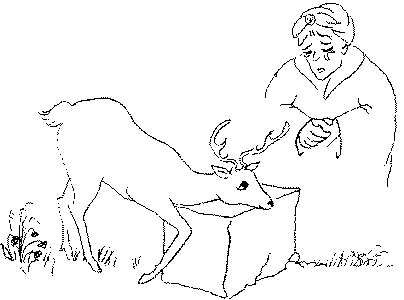
And the deer king went to the executioner’s block, and laid down his own golden neck upon it.
A silence fell in the deer park. And some who tell this story even say that silence also fell in other worlds not seen from here.
Soon the royal cook came to kill the willing victim on the block. But when he saw it was one of the two golden deer the king had ordered spared, he was afraid to kill him. So he went and told the King of Benares.
The king was surprised, so he went to the park. He said to the golden deer, still lying on the block, “Oh king of deer, did I not promise to spare your life? What is the reason you come here like the others?”
King Banyan Deer replied, “Oh king of men, this time a pregnant doe was unlucky enough to be the one to die. She pleaded for me to spare her, for the sake of others as well as her unborn baby and herself. I could not help but feel myself in her place, and feel her suffering. I could not help but weep, to think the little one would never see the dawn, would never taste the dew. And yet, I could not force the pain of death on another, relieved to think it was not his turn today. So, mighty king, I offer my life for the sake of the doe and her unborn fawn. Be assured there is no other reason.”
The King of Benares was overwhelmed. Powerful as he was, a tear rolled down his cheek. Then he said, “Oh great lord, the golden king of deer, even among human beings, I have not seen any such as you! Such great compassion, to share in the suffering of others! Such great generosity, to give your life for others! Such great kindness and tender love for all your fellow deer! Arise.”
“I decree that you will never be killed by me or anyone else in my kingdom. And, so too, the doe and her babe.”
Without yet raising his head, the golden one said, “Are only we to be saved? What of the other deer in the park, our friends and kin?” The king said, “My lord, I cannot refuse you, I grant safety and freedom to all the deer in the park.” “And what of the deer outside the park, will they be killed?” asked Banyan. “No my lord, I spare all the deer in my whole kingdom.”
Still the golden deer did not raise up his head. He pleaded, “So the deer will be safe, but what will the other four-footed animals do?” “My lord, from now on they too are safe in my land.” “And what of the birds? They too want to live.” “Yes, my lord, the birds too will be safe from death at the hands of men.” “And what of the fish, who live in the water?” “Even the fish will be free to live, my lord.” So saying, the King of Benares granted immunity from hunting and killing to all the animals in his land.
Having pleaded for the lives of all creatures, the Great Being arose.
Out of compassion and gratitude, King Banyan Deer the Enlightenment Being, taught the King of Benares. He advised him to climb the five steps of training, in order to purify his mind. He described them by saying, “It will benefit you, if you give up the five unwholesome actions. These are:
Destroying life, for this is not compassion;
Taking what is not given, for this is not generosity;
Doing wrong in sexual ways, for this is not loving-kindness;
Speaking falsely, for this is not Truth;
Losing your mind from alcohol, for this leads to falling down the first four steps.”
He further advised him to do wholesome actions, that would bring happiness in this life and beyond. Then King Banyan Deer, and both herds, returned to the forest.
In the fullness of time, the pregnant doe, who had stayed with Banyan’s herd, gave birth to a fawn. He was as beautiful as a lotus blossom given as an offering to the gods.
When the fawn had grown into a young buck deer, he began playing with Branch Deer’s herd. Seeing this, his mother said to him, “Better to die after a short life with the great compassionate one, than to live a long life with an ordinary one.” Afterwards, her son lived happily in the herd of King Banyan Deer.
The only ones left unhappy were the farmers and villagers of the kingdom. For, given total immunity by the king, the deer began to fearlessly eat the people’s crops. They even grazed in the vegetable gardens inside the villages and the city of Benares itself!
So the people complained to the king, and asked permission to kill at least some of the deer as a warning. But the king said, “I myself promised complete immunity to King Banyan Deer. I would give up the kingship before I would break my word to him. No one may harm a deer!”
When King Banyan Deer heard of this, he said to all the deer, “You should not eat the crops that belong to others.” And he sent a message to the people. Instead of making fences, he asked them to tie up bunches of leaves as boundaries around their fields. This began the Indian custom of marking fields with tied up leaves, which have protected them from deer to this very day.
Both King Banyan Deer and the King of Benares lived out their lives in peace, died, and were reborn as they deserved.
The moral is: Wherever it is found, compassion is a sign of greatness.









 Peace LiLy