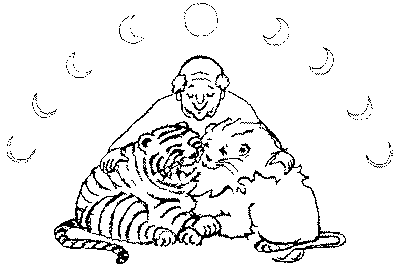
Once upon a time, there were two very good friends who lived together in the shade of a rock. Strange as it may seem, one was a lion and one was a tiger. They had met when they were too young to know the difference between lions and tigers. So they did not think their friendship was at all unusual. Besides, it was a peaceful part of the mountains, possibly due to the influence of a gentle forest monk who lived nearby. He was a hermit, one who lives far away from other people.
For some unknown reason, one day the two friends got into a silly argument. The tiger said, “Everyone knows the cold comes when the moon wanes from full to new!” The lion said, “Where did you hear such nonsense? Everyone knows the cold comes when the moon waxes from new to full!”
The argument got stronger and stronger. Neither could convince the other. They could not reach any conclusion to resolve the growing dispute. They even started calling each other names! Fearing for their friendship, they decided to go ask the learned forest monk, who would surely know about such things.
Visiting the peaceful hermit, the lion and tiger bowed respectfully and put their question to him. The friendly monk thought for a while and then gave his answer. “It can be cold in any phase of the moon, from new to full and back to new again. It is the wind that brings the cold, whether from west or north or east. Therefore, in a way, you are both right! And neither of you is defeated by the other. The most important thing is to live without conflict, to remain united. Unity is best by all means.”
The lion and tiger thanked the wise hermit. They were happy to still be friends.
The moral is: Weather comes and weather goes, but friendship remains.
A Treasury of Buddhist Wisdom for Children and Parents
Collected and Adapted by Sarah Conover
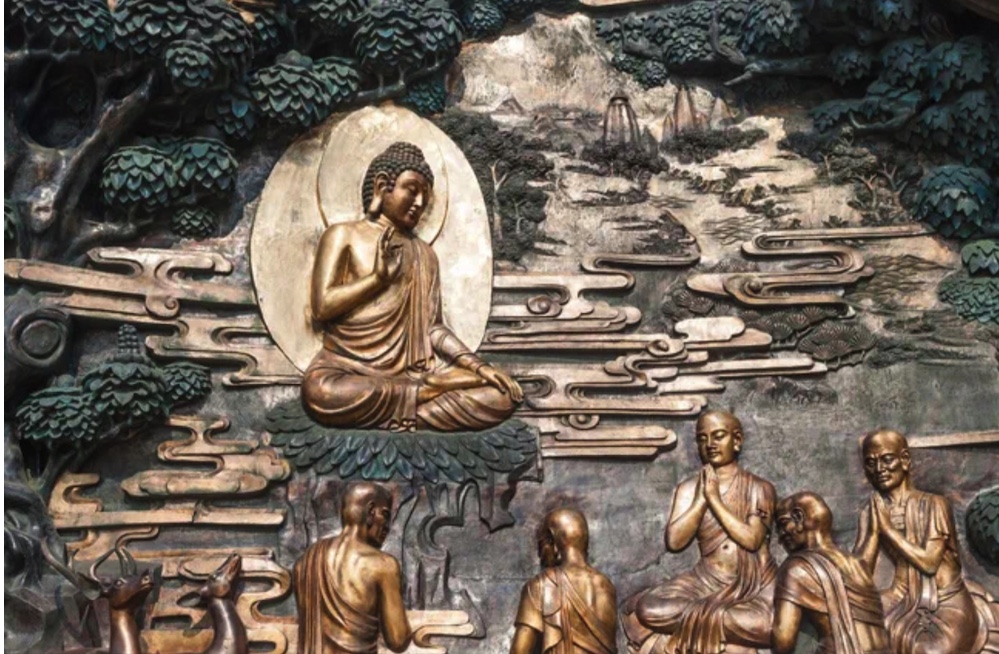
Once, some monks who could not stop quarreling came to the Buddha to ask his advice. “Brothers” the Buddha calmly replied, “ I have told you many times that fight and quarrels solve no problems – yet you continue. Remember, even some kings with great and powerful armies have learned gentleness. So much the more that you, living the holy life without possessions, should be like light in the world, known far and wide for kindness. Listen now to this story of a noble prince, who became a true hero in the world”.
Once upon a time, two kingdoms lay side by side. One kingdom belonged to the King of Kasi: a powerful ruler who possessed a great army and treasures nursing with gold. But in the nearby kings of Kosala lived a much poorer king. He led a meager army, possessed little gold, and held sway over a modest territory. And just as you might guess, the powerful King of Kasi eyed the small kingdom of Kosala and decided he should conquer it.
When the King of Kosala heard that a large garrison was headed his way, he knew he didn’t stand a chance. To avoid any bloodshed, he counseled with his ministers and decided to immediately surrender his army. As the attacking warriors approached, the King of Kosala slipped away to the city’s edge – he and the queen disguised as humble potters.
After time concealed among the common folk, the queen gave birth to a beautiful baby boy. He was secretly named and crowned, Prince Dighavu. They so loved their new son, that the king and queens only concern became his safety. The king feared that somehow – at some time in the future – the royal family would be recognized. He felt it was only a matter of time; a spy would see through their disguises and kill them all. So with heartfelt loss, the King and Queen of Kosala sent their young prince away to be raised in the countryside.
Alas, a dozend years later, events occurred exactly as the king had feared. The present barber of the king of Kasi had once been the barber to the poorer king. And one day, in the hubbub of the busy marketplace, the barber recognized the disguised king. He easily saw through the king’s charade. The barber fell back into the crowd and secretly pursued the king to discover where he now lived. Then the barber reported right away to the King of Kasi, knowing that he would be richly rewarded for the information. “I have news that right within the walls of this city live both the King and Queen of Kosala! I, who know the king’s face better than any, saw it with my own eyes – they live in a potter’s shed and are disguised as beggars!”
When the King of Kasi heard this report, he feared that if the old king and queen were yet alive, they had a hundred reasons to seek his own death and the return of their kingdom. Disguised or not, he anticipate they would find an opportunity to kill him. So he commanded his guards, “Go now to the potters’ sheds near the outskirts of town. Arrest the old king and queen! When you find them, it will be their last hour! Bind their arms, shave their heads, bring them outside the gates of the city and destroy them!” And thus the guards were dispatched to the capture the couple.
But very early this same day, the young Prince Dighavu awoke full of longing to be with his parents. Now old enough to travel from village alone, he reasoned, “It’s been months since I’ve seen my parents. I would so much like to visit them today! I will make them a present of ripened fruit and delicious cheese from the country.” And so the prince cheerfully gathered a few gifts, packed some clothing and money, and set out of the city.
By this time, however, the guards had found the royal couple – just exactly where the barber had betrayed them to be. They bound their arms tightly with thick rope and dragged them roughly through the streets. But the king and queen walked with dignity, even as they reached the city gates where they knew they would soon die.
And so it came to pass that just as Prince Dighavu was entering the city, he witnessed his parents being led to their deaths. In desperation, he made his way to the front of the surrounding crowd. Just sat the moment he spied his parents, they too, saw him amidst the mob. When the prince neared within earshot, his father shouted, “Dear Dighavu, do not look long! Do not look short! For hatred is not stopped by more hatted! No, dear one, hatred ends only by love!”
The soldiers thought the old know had lost his mind. “Who is this Dighavu? What gibberish you speak!”
But the king cautioned Dighavu twice more in the same way, finishing, “He that is intelligent will understand my meaning!” There were the king’s last words. As swords fell upon his parents’ heads, the anguished prince said a silent farewell so as not to reveal his own identity.
Prince Dighavu went to the nearby forest and fell to the ground. In agony he wept and wept until he could weep no more. Under the empty night sky, he considered the terrible murder of his parents and devised a plan to recover his family’s honor.
First, he returned to the city, and purchased some liquor for the soldiers standing guard over his parents. When the guards cucumber to the alcohol and fell asleep, the prince performed a funeral by the city gates. But at that same, exact moment, from the atop the splendid place tower, the King of Kasi happened to see the prince paying his respects to the murdered king and queen. “Alas!” Said the king in great alarm. “What misfortune will happen now? I will still have no safety or peace of mind while someone who cares for them wishes to reverse their deaths!”
And so it came to pass that the very next day Prince Dighavu embarked on such a plan. He went to the king’s elephant stable and asked that the elephant trainer teach him his art. The trainer agreed to take on the eager apprentice. As part of the prince’s secret plan, he rose each day at dawn to play the lute and sing to the entire palace compound. His lovely songs were haunting and captivating. Just as the prince has hoped, the King of Kasi, standing on his palace balcony, heard the enchanting voice and asked his attendants from whence it came. “Your Majesty,” they replied, “it is the elephant trainer’s new apprentice”.
“Bring him to me,” commanded the king. “I must meet the one who possesses such a gift.”
All was proceeding exactly in accord with Prince Dighavu’s Plan. He came before the king, strummed the lute even more beautifully, and sang his most soothing melodies. The king was utterly charmed. “Young man”, said the king, “such a voice comes only from one with the finest sensibilities and depth of feeling. I would like you to have the honor of being my manservant.” So Prince Dighavu – still unknown for his identity – became the king’s personal attendant. He rose before the king, preparing the king’s affairs; he retired at night long after the king’s affairs; and he obeyed the king’s every command in between. And in due time, the king appointed Prince Dighavu as Councilor and Confidant – just as the prince had hoped.
But Prince Dighavu’s secret and grand scheme was far from complete. A year or so later, the prince had the chance he had worked and waited for. It so happened that one balmy, spring day, the king wished to go for a chariot ride. To Prince Dighavu he requested,”Harness the chariot, my best man; I wish to go hunting in the forest and I want you alone to drive me.”
“Yes, your majesty, right away!” Obeyed the prince. A magnificent chariot of gold and lapis was harnessed to two steeds. The prince firmly held the reins and hurried the chariot towards the city’s perimeter. As the city’s gates opened wide for the royal chariot, Prince Dighavu saw the king’s army go in the direction of the eastern forest; the prince steered the chariot towards the west. “I believe the hunting will be better in these quieter woods sir,” he assured the king.
“Very well, my man. Let us try it out,” replied the king.
The day was cloudless, and after an hour of travel, the heat oppressive. The sultry, midday sun made the king grow drowsy. “My man, unharness the chariot,” he mumbled. “ I am tired and I wish to lie down in the shade of some trees.”
“Yes, your majesty,” complied the prince. The prince watered and hobbled the horses, then rested beside the king under a large Banyan tree. The king placed his trusting head in the prince’s lap and fell immediately to sleep.
With the king’s safety resting utterly in the hands of Prince Dighavu, the prince’s plan was nearly complete. As the prince looked upon the sleeping king, he thought to himself, “The king of Kasi has done me as much harm as any man could. He has murdered my mother and father! He has robbed our kingdom of its treasury and territory! He has destroyed the honor of the Kingdom of Kosala! Now is the time for me to avenge my hatred!”
Ever so quietly, the prince unsheathed his sword. But as he raised his sword over the king, ready to inflict his punishment, his father’s last words seemed to shout within him: Dighavu, hatred is not stopped by more hatred! No, dear one, hatred ends only by love! Prince Dighavu could not disobey his father’s dying words. He could not kill this unsuspecting king. The prince slowly sheathed his sword. But then the same thought of revenge – the thought that had been his mission since the day of his parents’ deaths – rose in him more strongly! He had waited years for this moment! Again, he unsheathed his sword. But alas, he stopped himself once more; he could not act against his father’s last wish; he could not end his hatred with another murder.
Suddenly, the king awoke and sat bolt upright – pale and terrified! The prince’s internal struggle abruptly ended. “Your Majesty!” Said the prince, “what ever had occurred? Why did you wake so alarmed?”
The king gasped, “Right now, in my dream, the son of the King of Kosala – the heir and prince – wanted to kill me by sword. He was going to sever my head! I thought I was about to die!”
Then Prince Dighavu, gently touching the neck of the king with his left hand and drawing his sword with the other, told him the truth. “I, your majesty, am that prince! I am Prince Dighavu, son of the King of Kosala! You have robbed my people of food, territory, and treasure. You have even killed my own mother and father! This would indeed be the time to show my hatred and exact my revenge!”
At that admission, the king fell upon his knees at the feet of the prince and begged for forgiveness. “ Grant me my life, dear Dighavu ! Grant me my life!” Wept the king.
In his heart, Prince Dighavu now realized what his father had meant for him to learn. He told the king of his father’s forgiving words – his last words – and how they stopped the prince from ending the king’s life. The prince proclaimed that he would no longer carry this terrible hatred. “Although I have the power to grant you your life at this moment,” said the prince to the king, “you also have the power to grant me my life: for you can assure my safety in your kingdom!”
“This is very true,” agreed the king. “Grant me my life now and I’ll forever grant you yours. We will no longer be enemies, but vow to live in peace.” At that, the prince and king swore an oath never to harm one another and to protect each other’s well being.
Peaceful now, with a warm feeling of forgiveness, the two men harnessed the horses remounted the chariot, and leisurely made their way back to the palace. When the king returned to his court, he gathered all his ministers and councilors together. “Tell me sirs,” asked the king, “if it happened that you laid eyes upon Prince Dighavu, son of the King of Kosala, what would you do?”
A minister immediately spoke up, “ Your majesty, we would kill him on the spot!”
“Yes!” Shouted another. “We would chop off his head and cut him to pieces!” Many voices rose in a cacophony of agreement.
But the king said, “Hush! Sirs, in front of you is Prince Dighavu, son of the King of Kosala.” A great, astonished silence filled the hall. The king continued, “ You may not harm him. He has granted me my life and I have granted him his.” The king turned to the prince; “I would like you to tell them, young prince, the marvelous meaning of your father’s last words.”
All eyes in the court turned to the prince. He looked at his audience with courage and forgiveness. “When my father said to me in his hour of death, ‘Look not long dear Dighavu’ what he meant was, ‘Do not hold on to hatred, do not nurture it.’ When, Your Majesty, my father spoke, ‘Look not short,’ what he meant was, ‘Do not lose friends easily – be the most loyal of friends.’ When my father said, ‘Hatred is not stopped by more hatred!’ What he wanted me to learn was this: the king has had my mother and father killed. Were I to kill Your Majesty, your people wold want to kill me, and my people would want to kill those who had harmed me. Hatred would not end by further hatred. On and on it would go, with many lives lost and many hearts broken. But now,” continued the prince, turning towards the king, “ Your Majesty had given me my life ad safety, and I have done the same for you. So by love and forgiveness we have stopped this terrible cycle of hatred.”
The king blessed the prince, “Oh, councilors! Is it not remarkable how deeply the prince understands his father’s brief words!” And thus the king returned to Prince Dighavu the army, territory, and treasure that rightfully belonged to the Kingdom of Kosala. The prince and the king’s own daughter were soon married, and they all lived in peace, two kingdoms side by side, happily ever after.
“And so I say to you,” declared the Buddha to the monks, “enough of fighting! This is my advice, good brothers.” And the Buddha returned to the solace of his meditation.
The moral is : For never in this world Do hatreds cease through hatred; Through love alone do they end. This is the ancient and eternal law.
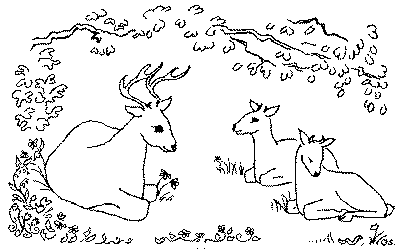
Once upon a time, there was a deer who was the leader of a herd of a thousand. He had two sons. One was very slim and tall, with bright alert eyes, and smooth reddish fur. He was called Beauty. The other was Grey in color, also slim and tall, and was called Grey.
One day, after they were fully grown, their father called Beauty and Grey to him. He said, “I am now very old, so I cannot do all that is necessary to look after this big herd of deer. I want you, my two grown-up children, to be the leaders, while I retire from looking after them all the time. We will divide the herd, and each of you will lead 500 deer.” So it was done.
In India, when the harvest time comes, the deer are always in danger. The rice is at its tallest, and the deer cannot help but go into the paddies and eat it. To avoid the destruction of their crops, the human beings dig pits, set sharp stakes in the ground, and build stone traps — all to capture and kill the deer.
Knowing this was the season, the wise old deer called the two new leaders to him. He advised them to take the herds up into the mountain forest, far from the dangerous farm lands. This was how he had always saved the deer from being wounded or killed. Then he would bring them back to the low lands after the harvest was over.
Since he was too old and weak for the trip, he would remain behind in hiding. He warned them to be careful and have a safe journey. Beauty set out with his herd for the mountain forest, and so did Grey with his.
The villagers all along the way knew that this was the time the deer moved from the low lying farm lands to the high countryside. So they hid along the way and killed the deer as they passed by.
Grey did not pay attention to his father’s wise advice. Instead of being careful and traveling safely, he was in a hurry to get to the lush mountain forest. So he moved his herd constantly, during the night, at dawn and dusk, and even in broad daylight. This made it easy for the people to shoot the deer in Grey’s herd with bows and arrows. Many were killed, and many were wounded, only to die in pain later on. Grey reached the forest with only a few deer remaining alive.
The tall sleek red-furred Beauty was wise enough to understand the danger to his moving herd. So he was very careful. He knew it was safer to stay away from the villages, and from all humans. He knew it was not safe in the daytime, or even at dawn or dusk. So he led his herd wide around the villages, and moved only in the middle of the night. Beauty’s herd arrived in the mountain forest safe and sound, with no one killed or injured.
The two herds found each other, and remained in the mountains until well after the harvest season was over. Then they began the return to the farmland country.
Grey had learned nothing from the first trip. As it was getting cold in the mountains, he was in a hurry to get to the warmer low lands. So he was just as careless as before. Again the people hid along the way and attacked and killed the deer. All Grey’s herd were killed, later to be eaten or sold by the villagers. Grey himself was the only one who survived the journey.
Beauty led his herd in the same careful way as before. He brought back all 500 deer, completely safe. While the deer were still in the distance, the old chief said to his doe, “Look at the deer coming back to us. Beauty has all his followers with him. Grey comes limping back alone, without his whole herd of 500. Those who follow a wise leader, with good qualities, will always be safe. Those who follow a foolish leader, who is careless and thinks only of himself, will fall into troubles and be destroyed.”
After some time, the old deer died and was reborn as he deserved. Beauty became chief of the herd and lived a long life, loved and admired by all.
The moral is: A wise leader puts the safety of his followers first.
Once upon a time, there was a herd of forest deer. In this herd was a wise and respected teacher, cunning in the ways of deer. He taught the tricks and strategies of survival to the young fawns.
One day, his younger sister brought her son to him, to be taught what is so important for deer. She said, “Oh brother teacher, this is my son. Please teach him the tricks and strategies of deer.” The teacher said to the fawn, “Very well, you can come at this time tomorrow for your first lesson.”
The young deer came to the lessons as he was supposed to. When others cut classes to spend all day playing, he remained and paid attention to the good teacher. He was well-liked by the other young bucks and does, but he only played when his class work was complete. Being curious to learn, he was always on time for the lessons. He was also patient with the other students, knowing that some learn more quickly than others. He respected the teacher deer for his knowledge, and was grateful for his willingness to share it.
One day, the fawn stepped in a trap in the forest and was captured. He cried out in great pain. This frightened the other fawns, who ran back to the herd and told his mother. She was terrified, and ran to her brother the teacher. Trembling with fear, crying big tears, she said to him, “Oh my dear brother, have you heard the news that my son has been trapped by a hunter’s snare? How can I save my little child’s life? Did he study well in your presence?”
Her brother said, “My sister, don’t be afraid. I have no doubt he will be safe. He studied hard and always did his very best. He never missed a class and always paid attention. Therefore, there is no need to have doubt or pain in your heart. He will not be hurt by any human being. Don’t worry. I am confident he will return to you and make you happy again. He has learned all the tricks and strategies used by deer to cheat the hunters. So be patient. He will return!”
Meanwhile, the trapped fawn was thinking, “All my friends were afraid and ran away. There is no one to help me get out of this deadly trap. Now I must use the tricks and strategies I learned from the wise teacher who taught so well.”
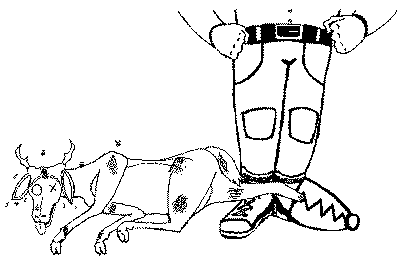
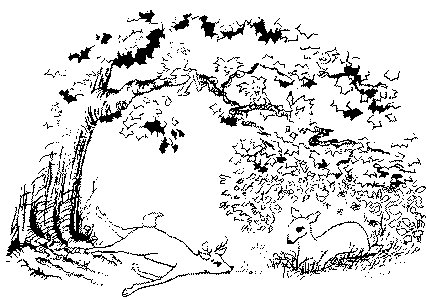
The deer strategy he decided to use was the one called, “playing dead.” First, he used his hoofs to dig up the dirt and grass, to make it look like he had tried very hard to escape. Then he relieved his bowels and released his urine, because this is what happens when a deer is caught in a trap and dies in very great fear. Next, he covered his body with his own saliva.
Lying stretched out on his side, he held his body rigidly and stiffened his legs out straight. He turned up his eyes, and let his tongue hang out of the side of his mouth. He filled his lungs with air and puffed out his belly. Finally, with his head leaning on one side, he breathed through the nostril next to the ground, not through the upper one.
Lying motionless, he looked so much like a stiff corpse that flies flew around him, attracted by the awful smells. Crows stood nearby waiting to eat his flesh.
Before long it was early morning and the hunter came to inspect his traps. Finding the fawn who was playing dead, he slapped the puffed up belly and found it stiff. Seeing the flies and the mess he thought, “Ah, it has already started to stiffen. He must have been trapped much earlier this morning. No doubt the tender meat is already starting to spoil. I will skin and butcher the carcass right here, and carry the meat home.”
Since he completely believed the deer was dead, he removed and cleaned the trap, and began spreading leaves to make a place to do the butchering. Realizing he was free, the fawn suddenly sprang to his feet. He ran like a little cloud blown by a swift wind, back to the comfort and safety of his mother. The whole herd celebrated his survival, thanks to learning so well from the wise teacher.
The moral is: Well-learned lessons bring great rewards.
A Buddhist Tale from Tibet Adapted by Elisa Pearmain
The children at the village school laughed at Chunda. They said that the boy was a simpleton because no matter how hard he tried, he couldn’t seem to learn to read or write. But the adults of the village were fond of Chunda, for he had a kind heart, and though he was a wisp of a teen, he was always willing to help, running an errand or sweeping a front yard.
Chunda admired his older brother Raj above all else. Raj, who was a couple of years older than Chunda was a bright scholar. When he turned 16, he decided to move to the city to study Buddhism at the monastery. Chunda begged to go with him, and his brother found a way for Chunda to live at the monastery and to earn his keep by working. At the monastery Chunda swept the yards, and clapped the dirt from the sandals of the monks as they came in for the evening meal. He watched and listened as the young monks sat in long conversations. How he wished that he could join in, but he would remember how the children had laughed at him, and his shame always drove him away.
Chunda’s brother noticed his brother’s sadness and longing, and spoke to him. “Chunda, perhaps you could study to be a monk as well.” “But how could I become a monk?” He asked, “I can’t read or write, or memorize?”“ There is more to becoming a monk than book learning. Go to see the Buddha (who was the master of the monastery at that time) and tell him your wishes. He is wise, and compassionate.” So Chunda went and sat before the Buddha who quickly saw that he was an honest young man of pure heart. He gave Chunda just one line of scripture to learn. It was the first of hundreds that each monk was expected to learn by heart. “Give up negative actions. Free yourself from negative thoughts.”
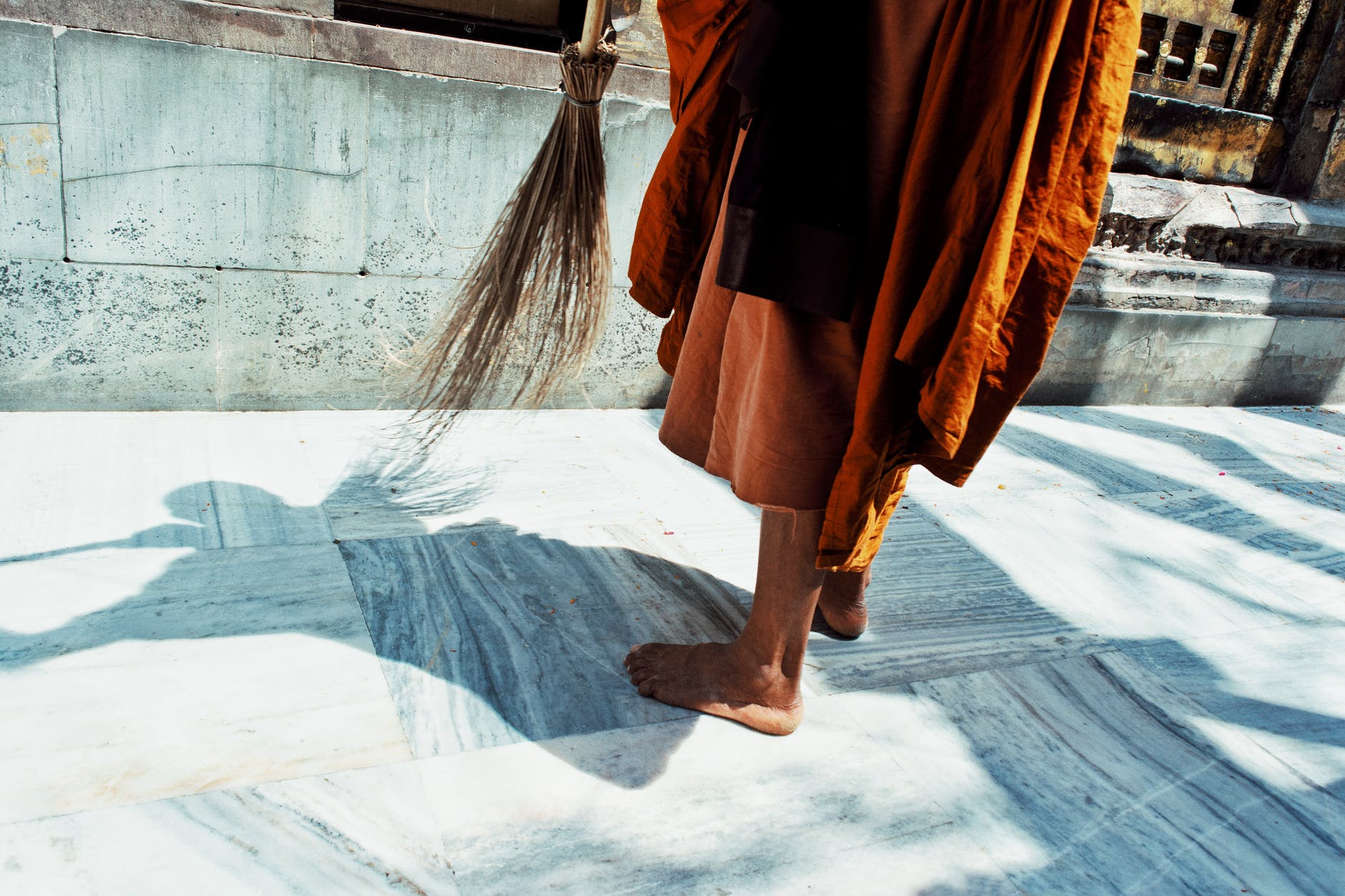
Chunda tried and tried to learn the short passage, but he had to repeatedly ask for help, and once he had learned the first line, he would forget it when he began to learn the second. Chunda returned to the Buddha and told him what had happened. The kind man sat in silence for some time. Finally, an idea occurred to him. “Chunda, you are a hard worker are you not?’ he asked. “Yes master.” “I would like to give you a special job. I want you to sweep the temple hall each day. Can you do that?” “Oh yes, teacher.” Chunda said, jumping up with delight. “That is something I can do well.” “Very well then, Chunda. I will give you the job of sweeping the temple. That is all that you must do, but as you sweep the floors you must speak these two lines to yourself, over and over: “Sweep away the dust, sweep away the dirt.” Can you remember that?” “Sweep away the dust, sweep away the dirt. Yes, that is easy, because that is what I will be doing!” Chunda set off to begin his work. Every day he did sweep the temple, all day long, and as he swept he kept up a rhythm, “Sweep away the dust” he would say with each sweep out, and “Sweep away the dirt,” with each sweep back. Often he would get lost in thought and he would forget to say the lines. Luckily the other monks knew what he was supposed to be chanting, and they would remind him, and he would go back to is work. “Sweep away the dust, sweep away the dirt.”
Then one day the Buddha came upon Chunda who was standing still, thinking hard about something. “Chunda, where is your mind right now.” “Oh sorry, Master, I should be sweeping,” No, Chunda,” he smiled, “share your thoughts.””Well I was thinking that you are a wise man, and you have given me these lines to say about something that I know how to do. When I remember to say them I feel at peace. You have not given me any more lines. Do you mean for me to learn something more from this?” “Yes Chunda. You have found the peace that is there for us in the present moment. Now I want you to think about this: You are sweeping clean the dirt from the temple. Think also about sweeping clean the inner dust and dirt in your mind.” “But what are inner dust and inner dirt?” “Well, Chunda, think of the nature of dust and dirt: They cover what is beautiful and clean, and cloud what is clear. And dust and dirt often cover those things that are old and of no more use to us. It is also the nature of dust that we can see it in the air, but when we grasp for it, it is not there, just like thoughts of the future or the past. Think on this and notice when your thoughts are clouding you from the present moment, and causing unhappiness, and notice when you cling to old ways of thinking.” Chunda went back to sweeping.
One day Chundra noticed that he was often longing to sit with the other students as they talked about the things they were learning. “But,” he would think to himself, “I am not worthy to sit and talk with the other monks and students my age, for I cannot read nor write.” This way of seeing and thinking was like dirt, it was an old way of seeing himself that kept him from happiness. “I should sweep these thoughts from my mind.” He thought. “Sweep away the dust, sweep away the dirt.” He felt peaceful again. Another time he noticed that he was often living in the future wishing, “If only, if only I could read and write like the others, then …” These wishing thoughts were like dust. He was always trying to grasp things out of his reach, and missing the present moment. “Sweep away the dust, sweep away the dirt.”
Chunda went and shared his insights with the Buddha who again smiled. “Ah Chunda, you are doing very well. Tell me, can you stop and enjoy the beauty of a clean temple after you have swept?” “Yes, master.” “Good then, ” smiled the Buddha, “I hope you will now remember to also stop to notice the simple joy of a clean inner temple, as well as an outer one.” Chunda did stop to notice, and he continued to sweep the inner dirt, and the outer dirt, and to stop often to experience the peace of the present moment, and the simple joy that was there when all negative thoughts were gone. And in this way Chunda continued to sweep, to chant and to ponder on the nature of grasping and clinging, and the peace of living in the present moment.
In time the other students noticed his peace, and began to talk with him. He was able to share his wisdom with other monks. As the years passed his wisdom and inner peace grew. He became known as The Broom Master, and many came to hear his simple, yet profound wisdom.
Sources: Conover, Sarah, “The Broom Master” in Kindness: A Treasury of Buddhist Wisdom for Children and Parents, (Spokane, WA: Eastern WA University Press, 2001) pp. 68-71.Lama Surya Das, “Greatness of Heart is What Counts,” in The Snow Lion’s Turquoise Mane: Wisdom Tales from Tibet. Pp. 45-48.
Once upon a time, the King of Benares had a gardener who looked after his pleasure garden. Animals sometimes came into the garden from the nearby forest. The gardener complained about this to the king, who said, “If you see any strange animal, tell me at once.”
One day, he saw a strange kind of deer at the far end of the garden. When he saw the man, he ran like the wind. That is why they are called ‘wind-deer’. They are a rare breed, that are extremely timid. They are very easily frightened by human beings.
The gardener told the king about the wind-deer. He asked the gardener if he could catch the rare animal. He replied, “My lord, if you give me some bee’s honey, I could even bring him into the palace!” So the king ordered that he be given as much bee’s honey as he wanted.
This particular wind-deer loved to eat the flowers and fruits in the king’s pleasure garden. The gardener let himself be seen by him little by little, so he would be less frightened. Then he began to smear honey on the grass where the wind-deer usually came to eat. Sure enough, the deer began eating the honey-smeared grass. Soon he developed a craving for the taste of this ‘honey-grass’. The craving made him come to the garden every day. Before long, he would eat nothing else!
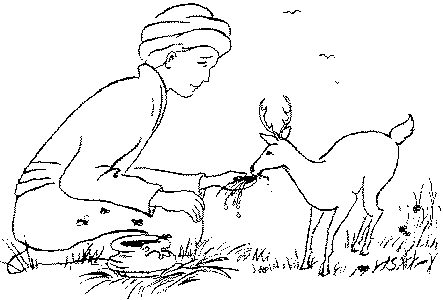
Little by little, the gardener came closer and closer to the wind-deer. At first, he would run away. But later, he lost his fear and came to think the man was harmless. As the gardener became more and more friendly, eventually he got the deer to eat the honey-grass right out of his hand. He continued doing this for some time, in order to build up his confidence and trust.
Meanwhile, the gardener had rows of curtains set up, making a wide pathway from the far end of the pleasure garden to the king’s palace. From inside this pathway, the curtains would keep the wind-deer from seeing any people that might scare him.
When all was prepared, the gardener took a bag of grass and a container of honey with him. Again he began hand-feeding the wind-deer when he appeared. Gradually, he led the wind-deer into the curtained-off pathway. Slowly, he continued to lead him with the honey-grass, until finally the deer followed him right into the palace. Once inside, the palace guards closed the doors, and the wind-deer was trapped. Seeing the people of the court, he suddenly became very frightened and began running around, madly trying to escape.
The king came down to the hall and saw the panic-stricken wind-deer. He said, “What a wind-deer! How could he have gotten into such a state? A wind-deer is an animal who will not return to a place where he has so much as seen a human, for seven full days. Ordinarily, if a wind-deer is at all frightened in a particular place, he will not return for the whole rest of his life! But look! Even such a shy wild creature can be enslaved by his craving for the taste of something sweet. Then he can be lured into the center of the city and even inside the palace itself.
“My friends, the teachers warn us not to be too attached to the place we live, for all things pass away. They say that being too attached to a small circle of friends is confining and restricts a broad outlook. But see how much more dangerous is the simple craving for a sweet flavour, or any other taste sensation. See how this beautiful shy animal was trapped by my gardener, by taking advantage of his craving for taste.”
Not wishing to harm the gentle wind-deer, the king had him released into the forest. He never returned to the royal pleasure garden, and he never missed the taste of honey-grass.
The moral is: “It is better to eat to live, than to live to eat.”
Once upon a time, in northern India, there was a herd of village deer. They were used to being near villages; they were born there and grew up there. They knew they had to be very careful around people. This was especially true at harvest time, when the crops were tall, and the farmers trapped and killed any deer who came near.
At harvest time, the village deer stayed in the forest all day long. They only came near the village during the dark of the night. One of these was a beautiful young doe. She had soft reddish-brown fur, a fluffy white tail and big wide bright eyes.
During this particular season, there was a young mountain buck who had strayed into the same low forest. One day, he saw the beautiful young doe, and immediately became infatuated with her. He didn’t know anything about her. But he imagined himself to be deeply in love with her, just because of her reddish-brown fur and her fluffy white tail and her big wide bright eyes. He even dreamed about her, although she did not know he existed!
After a few days, the young mountain buck decided to introduce himself. As he was walking out into the clearing where she was grazing, he was entranced by her appearance and could not take his eyes off her. He began speaking: “Oh my sweet beauty, as lovely as the stars and as bright as the moon, I confess to you that I am deeply” — Just then the young buck’s hoof got caught in a root, he tripped and fell, and his face splashed in a mud puddle! The pretty village doe was flattered, so she smiled. But inside, she thought this mountain buck was really rather silly!
Meanwhile, unknown to the deer, there was a clan of tree fairies living in that part of the forest. They had been watching the mountain buck, while he secretly watched the village doe. When he walked out into the clearing, began his speech, and fell in the mud puddle – the fairies laughed and laughed. “What fools these dumb animals are!” they cried. But one fairy did not laugh. He said,”I fear this is a warning of danger to this young fool!”
The young buck was a little embarrassed, but he did not see it as any kind of warning. From then on, he followed the doe wherever she went. He kept telling her how beautiful she was and how much he loved her. She didn’t pay much attention.
Then night came, and it was time for the doe to go down to the village. The people who lived along the way knew the deer passed by at night. So they set traps to catch them. That night a hunter waited, hiding behind a bush.
Carefully, the village doe set out. The mountain buck, who was still singing her praises, went right along with her. She stopped and said to him, “My dear buck, you are not experienced with being around villages. You don’t know how dangerous human beings are. The village, and the way to it, can bring death to a deer even at night. Since you are so young and inexperienced (and she thought to herself, ‘and foolish’), you should not come down to the village with me. You should remain in the safety of the forest.”
At this, the tree fairies applauded. But of course, the deer could not hear them.
The young buck paid no attention to the doe’s warning. He just said, “Your eyes look so lovely in the moonlight!” and kept walking with her. She said, “If you won’t listen to me, at least be quiet!” He was so infatuated with her, that he could not control his mind. But he did finally shut his mouth!
After a while, they approached the place where the hunter was hiding behind a bush. The fairies saw him, and became agitated and frightened for the deer’s safety. They flew nervously around the tree, branches, but they could only watch.
The doe could smell the hiding man. She was afraid of a trap. So, thinking to save her own life, she let the buck go first. She followed a little way behind.
When the hunter saw the unsuspecting mountain buck, he shot his arrow and killed him instantly. Seeing this, the terrified doe turned tail and ran back to the forest clearing as fast as she could.
The hunter claimed his kill. He started a fire, skinned the deer, cooked some of the venison and ate his fill. Then he threw the carcass over his shoulder and carried it back home to feed his family.
When the fairies saw what happened, some of them cried. As they watched the hunter cut up the once noble looking buck, some of them felt sick. Others blamed the careful doe for leading him to the slaughter.
But the wise fairy, who had given the first warning, said, “It was the excitement of infatuation that killed this foolish deer. Such blind desire brings false happiness at first, but ends in pain and suffering.”
Once upon a time, an unusual and beautiful deer was born in the forests near Benares, in northern India. Although he was as big as a young colt, it was easy for his mother to give birth to him. When he opened his eyes, they were as bright as sparkling jewels. His mouth was as red as the reddest forest berries. His hoofs were as black as polished coal. His little horns glistened like silver. And his color was golden, like a perfect summer’s dawn. As he grew up, a herd of 500 deer gathered around him, and he became known as King Banyan Deer.
Meanwhile, not far away, another beautiful buck deer was born, just as splendidly golden in color. In time, a separate herd of 500 deer came to follow him, and he was known as Branch Deer.
The King of Benares, at that time, was very fond of eating venison. So he regularly hunted and killed deer. Each time he hunted, he went to a different village and ordered the people to serve him. They had to stop what they were doing, whether plowing or harvesting or whatever, and work in the king’s hunting party.
The people’s lives were upset by these interruptions. They grew fewer crops, and other businesses also had less income. So they came together and decided to build a large deer park for the king, at Benares. There he could hunt by himself, with no need to command the services of the villagers.
So the people built a deer park. They made ponds where the deer could drink, and added trees and grasses for them to eat from. When it was ready, they opened the gate and went out into the nearby forests. They surrounded the entire herds of Banyan and Branch deer. Then, with sticks and weapons and noise makers, they drove them all into the deer park trap, and locked the gate behind them.
After the deer had settled down, the people went to the king and said, “Our crops and income have suffered because of your hunting requirements. Now we have made you a pleasant safe deer park, where you can hunt by yourself as you like. With no need of our aid, you can enjoy both the hunting and the eating of deer.”
The king went to the new deer park. There he was pleased to see the vast herds. While watching them, his eye was caught by the two magnificent golden deer, with large fully grown antlers. Because he admired their unusual beauty, the king granted immunity to these two alone. He ordered that they should be completely safe. No one could harm or kill them.
Once a day the king would come and kill a deer for his dinner table. Sometimes, when he was too busy, the royal cook would do this. The body would then be brought to the chopping block to be butchered for the oven.
Whenever the deer saw the bow and arrows, they went into a panic, trembling for their lives. They ran around wildly, some being injured and some wounded, many suffering great pain.
One day, King Banyan Deer’s herd gathered around him. He called Branch Deer, and the two herds joined for a meeting. King Banyan Deer addressed them. “Although in the end, there is no escape from death, this needless suffering due to injuries and wounds can be prevented. Since the king only wishes the meat of one deer per day, let one be chosen by us each day to submit himself to the chopping block. One day from my herd, and the next day from Branch Deer’s herd, the victim’s lot will fall to one deer at a time.”
Branch Deer agreed. From then on, the one whose turn it was, meekly surrendered himself and laid his neck on the block. The cook came each day, simply killed the waiting victim, and prepared the king’s venison.
One day, the turn fell by chance to a pregnant doe in Branch Deer’s herd. Caring for the others as well as herself and the unborn one, she went to Branch Deer and said, “My lord, I am pregnant. Grant that I may live until I have delivered my fawn. Then we will fill two turns rather than just one. This will save a turn, and thereby a single life for one long day.”
Branch Deer replied, “No, no, I cannot change the rules in midstream and put your turn upon another. The pregnancy is yours, the babe is your responsibility. Now leave me.”
Having failed with Branch Deer, the poor mother doe went to King Banyan Deer and explained her plight. He replied gently, “Go in peace. I will change the rules in midstream and put your turn upon another.”
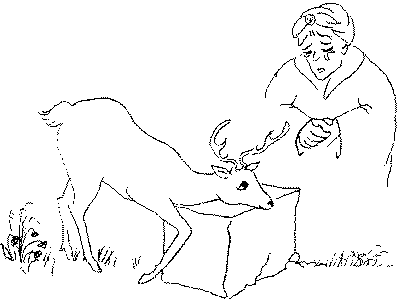
And the deer king went to the executioner’s block, and laid down his own golden neck upon it.
A silence fell in the deer park. And some who tell this story even say that silence also fell in other worlds not seen from here.
Soon the royal cook came to kill the willing victim on the block. But when he saw it was one of the two golden deer the king had ordered spared, he was afraid to kill him. So he went and told the King of Benares.
The king was surprised, so he went to the park. He said to the golden deer, still lying on the block, “Oh king of deer, did I not promise to spare your life? What is the reason you come here like the others?”
King Banyan Deer replied, “Oh king of men, this time a pregnant doe was unlucky enough to be the one to die. She pleaded for me to spare her, for the sake of others as well as her unborn baby and herself. I could not help but feel myself in her place, and feel her suffering. I could not help but weep, to think the little one would never see the dawn, would never taste the dew. And yet, I could not force the pain of death on another, relieved to think it was not his turn today. So, mighty king, I offer my life for the sake of the doe and her unborn fawn. Be assured there is no other reason.”
The King of Benares was overwhelmed. Powerful as he was, a tear rolled down his cheek. Then he said, “Oh great lord, the golden king of deer, even among human beings, I have not seen any such as you! Such great compassion, to share in the suffering of others! Such great generosity, to give your life for others! Such great kindness and tender love for all your fellow deer! Arise.”
“I decree that you will never be killed by me or anyone else in my kingdom. And, so too, the doe and her babe.”
Without yet raising his head, the golden one said, “Are only we to be saved? What of the other deer in the park, our friends and kin?” The king said, “My lord, I cannot refuse you, I grant safety and freedom to all the deer in the park.” “And what of the deer outside the park, will they be killed?” asked Banyan. “No my lord, I spare all the deer in my whole kingdom.”
Still the golden deer did not raise up his head. He pleaded, “So the deer will be safe, but what will the other four-footed animals do?” “My lord, from now on they too are safe in my land.” “And what of the birds? They too want to live.” “Yes, my lord, the birds too will be safe from death at the hands of men.” “And what of the fish, who live in the water?” “Even the fish will be free to live, my lord.” So saying, the King of Benares granted immunity from hunting and killing to all the animals in his land.
Having pleaded for the lives of all creatures, the Great Being arose.
From Kindness <A Treasury of Buddhist Wisdom For Children and Parents>
By Sarah Conover
Once upon a time, the Buddha was born as a magnificent ibex. The forest in which he lived was far from civilization and therefore tranquil, inhabited by many creatures both small and large. Along the banks of clear, babbling brooks were found rare flowers, which blossomed nowhere else on earth. Trees towered above the lush undergrowth and kept the forest cool and mild.
The noble ibex that lived in this forest, the Former Buddha, was as beautiful as he was sleek and swift. He had the body of an animal but the intelligence and empathy of a human being. So deep was his kindness for all living creatures that he often trod delicately so as not to crush anything. He ate nothing but the tips of grasses already gone to seed.
As this region was renowned for its great beauty, hunting parties would at times make long journeys to reach it. On one such occasion, a king and his friends camped on the edge of the forest, hoping to bag large amounts of game before the end of their stay. One morning, the king set out on horseback with his small group following him. Not long after, the king caught a glimpse of the splendid ibex and wanted to hunt him down. Snapping his reins across his horse’s neck, the king dashed away in chase, leaving the group far behind.
When the ibex heard the quick pounding of hooves, he turned and saw the king swiftly bearing down upon him. The king’s bow was drawn taut and an arrow ready in the sites. Although the ibex could have fought the king’s attack, he chose to avoid violence, even in self-defense. So the ibex spun around and took off with great speed towards the dense center of the forest, confident the king could not catch him. Through the thick forest he sprang, still pursued by the king, but the distance between them was increasing. The ibex came to a familiar, small, deep chasm and leapt over it effortlessly. But the king’s horse, coming to that same rocky cliff, abruptly pressed his weight backwards and refused to jump. The king had been watching the ibex, not the forest floor. So when the horse stopped with a jolt, the surprised king fell forward, headlong, into the chasm.
After a time, the ibex heard no hoof beats in pursuit. He slowed and twisted his head around to examine the situation behind him. There in the distance he spotted the rider-less horse at the chasm’s edge and correctly guessed what had happened to the king. A sudden welling of kindness overcame him. He anticipated that the king must be in severe pain, surely having broken a number of bones in the fall. He knew also that the king would never survive long in this forest because there were many tigers and other beasts.
The ibex walked up to the chasm edge and saw the king far below, moaning and writhing in pain. He no longer looked upon the king as his enemy, but felt his suffering keenly. The Former Buddha gently inquired, “I hope your majesty has no serious wounds? Might the pain of your injuries be diminishing by now?”
The king looked up at the ibex in utter astonishment. He felt a dreadful pang of remorse for his behavior towards this noble animal. Oh, how the king felt his shame!
“You see, your Excellency,” comforted the Ibex, “I am no wild devil to be hunted for sport. I am just a peaceful creature living within the bounds of this beautiful forest.”
“Oh!” blurted the king. “It is I who acted as a beast, not you! Can you ever forgive me?” he asked. “My physical pain right now,” continued the king, “is far less than the pain I feel for having threatened a noble creature as yourself.”
“Sire,” responded the ibex, “let me help you out of your predicament. I can rescue you if you’ll trust me.” The ibex took the king’s silence as a sign of goodwill and knew that the king would accept his help. He then searched for a boulder as heavy as a man and practiced lifting it. When he felt he could do it safely, without slipping, he made his way down the rocks beside the king. “If you mount me as you would your horse, your Excellency, I believe I can leap out of the chasm with you on my back,” offered the ibex.
The king followed these directions and held on as best he could. In an instant the ibex leapt in a great arc onto the cliff rim. There the king found his waiting horse but was so overtaken by the goodness of the ibex he could not leave. “What can I do to repay you?” begged the king. “If you would come to my palace, we would see that your every need was met. I can’t bear to think of you left in this forest with hunters in pursuit. Please, please come back with me,” insisted the king.
“Sire, do you think I, who am so contented in the forest, could really adjust to that? I love nothing better than to live here, in peace. But there is one great favor I would ask of you.”
“Anything,” said the king.
“I ask that you give up hunting for sport. You now realize that all creatures want happiness and security. Can it be right to do to them what you yourself would despise? A true king,” proclaimed the ibex, “will gain his people’s love by showing great goodness, not by showing power.”
The grateful king agreed to the request. “Now, let me show you the way back to safety,” suggested the ibex. “Mount your horse and I will guide you home to your camp.”
The king soon returned to his palace, and the ibex disappeared into the shelter of the forest. But forevermore, the king lived by the wise words of the noble ibex, the Former Buddha. He forbade hunting for sport throughout his kingdom’s domain. He protected his people, but no longer waged costly wars against nearby countries. His kingdom flourished. And thus, the good king was greatly loved and respected by his people as the gentlest and wisest of all kings.
Out of compassion and gratitude, King Banyan Deer the Enlightenment Being, taught the King of Benares. He advised him to climb the five steps of training, in order to purify his mind. He described them by saying, “It will benefit you, if you give up the five unwholesome actions. These are:
Destroying life, for this is not compassion;
Taking what is not given, for this is not generosity;
Doing wrong in sexual ways, for this is not loving-kindness;
Speaking falsely, for this is not Truth;
Losing your mind from alcohol, for this leads to falling down the first four steps.”
He further advised him to do wholesome actions, that would bring happiness in this life and beyond. Then King Banyan Deer, and both herds, returned to the forest.
In the fullness of time, the pregnant doe, who had stayed with Banyan’s herd, gave birth to a fawn. He was as beautiful as a lotus blossom given as an offering to the gods.
When the fawn had grown into a young buck deer, he began playing with Branch Deer’s herd. Seeing this, his mother said to him, “Better to die after a short life with the great compassionate one, than to live a long life with an ordinary one.” Afterwards, her son lived happily in the herd of King Banyan Deer.
The only ones left unhappy were the farmers and villagers of the kingdom. For, given total immunity by the king, the deer began to fearlessly eat the people’s crops. They even grazed in the vegetable gardens inside the villages and the city of Benares itself!
So the people complained to the king, and asked permission to kill at least some of the deer as a warning. But the king said, “I myself promised complete immunity to King Banyan Deer. I would give up the kingship before I would break my word to him. No one may harm a deer!”
When King Banyan Deer heard of this, he said to all the deer, “You should not eat the crops that belong to others.” And he sent a message to the people. Instead of making fences, he asked them to tie up bunches of leaves as boundaries around their fields. This began the Indian custom of marking fields with tied up leaves, which have protected them from deer to this very day.
Both King Banyan Deer and the King of Benares lived out their lives in peace, died, and were reborn as they deserved.
The moral is: Wherever it is found, compassion is a sign of greatness.














 Peace LiLy