There was a caterpillar in the flowers, it laid lazily in the grass and did not like to move. An old cricket advised him: “Children should be up for activities. Isn’t there a saying that life is movement!” The caterpillar glanced at the cricket and replied, “I don’t need to move, all I need is to stay safe and stable, soon I will become a beautiful butterfly. A dragonfly flew over and said to the caterpillar, “Ah, I have never seen such an ugly butterfly like you. Do not get lazy, get up and exercise, it is good for you.” The caterpillar did not move, it even closed its eyes. It said, “No matter how much you look down on my body, the fact of my becoming a butterfly will never be changed. So why do I need to move, isn’t it fine that I just quietly wait to become a butterfly?” After having said so, the caterpillar laid motionlessly in the grass and comfortably basked in the sun. Soon the caterpillar was wrapped in a cocoon, inside which its body did not want to move, and it slept all day long. One day, it awoke and found itself a butterfly. It happily wanted to break free of the cocoon, but the cocoon shell did not even budge under its impact. It followed with several more impacts and felt pain over its whole body. So it did not feel like breaking the cocoon and closed its eyes to sleep.
At this time a thump sounded from outside, the old cricket calling from without, “Child, put effort into getting out of the cocoon, otherwise you will die inside.” The caterpillar shrugged and didn’t take it seriously; it thought that the old cricket was really nosy. Inside, the cocoon is safe and comfortable, why do I need to exert my effort to get out of it, will the outside world be safer and more comfortable than inside? Therefore, no matter how hard the old cricket knocked, it did not respond and continued to sleep comfortably.
However, not long after, it discovered that breathing was getting difficult. Its body size was becoming bigger yet the cocoon was shrinking. It became scared and put strength into struggling. But it had no strength left and air decreased inside the cocoon. It had no strength for even a few movements, and its breathing became more difficult. At death’s door, the caterpillar finally realized that although one’s destiny is foreordained, it is through one’s self-effort that it can be fulfilled.
There was a man who had walked in the desert for two days. En route, he encountered a sand strom. After the fierce winds and blowing sands had passed, he was unable to recognize the right direction. Just as he could sustain no longer, he suddenly found a small abandoned house. He dragged his body with fatigue and entered the house.
This was a house without ventilation and piled-up with rotten wood. In desperation, he walked to the corner of the house, and to his surprise, found a water pump. He tried excitedly to pump water, but no matter how hard he tried, not a single drop came out.
Collapsing to the ground, he saw a small corked water bottle next to the water pump. On the bottle was a yellowish paper which read:” You must pour ou the water into the water pump in order to pump water! Don’t forget, please fill the bottle with water again before you leave!”
He pulled out the cork and indeed discovered that the bottle was filled with water! His mind started to struggle… Out of selfishness, as long as I drink all the water in the bottle, I will not die and can walk out of this house alive! If I follow what is written on the paper and pur the only water available into the water pump, in case no water comes up, the I will die of thirst here. Should I take the risk or not?
Finally, he decided to pour the whole bottle of water into the water pump which looked shabby and unusable. He drew water with a shaking hand …. water truly gushed out!
After he had satisfied his thirst, he filled the bottle with water and recorked it. Then, he added his own words at the bottom of the paper: “Believe me, it truly works.” Enlightenment: Learn to give before taking.
Two traveling angels came to a rich family and asked to stay for the night. This family was not friendly towards them, they refused to let the angels rest in a comfortable guest room. Instead, the family gave them a comer in the cold basement. When the angels were setting the bed, the older angel saw a hole in the wall, so he patched it up. The younger angel asked for the reason, the older angel said, “Some things are not how they look.” On the second night, the two angels arrived at a poor farmer’s house, and asked to stay for the night. The farmer couple welcomed them with great warmth. They offered all of their very little food to the two guests, and also let the angels sleep in their bed. The following morning, the two angels saw that the farmer and his wife were crying. Their milk cow, the only source of income, had died last night.
The younger angel was very angry, he questioned the older angel for a good explanation. The first family had everything, and the older angel even helped them patch up a hole in the wall. The second family was very kind even when they were so poor, yet their cow had died. “Sometimes things are not as they look, said the older angel, “when we were staying in the basement of the rich family, I looked through the hole in the wall and found that there was a pile of gold behind the wall. Because the owner was already blinded by greed, he was not willing to share, so l patched up the wall.” “Last night, the angel of Death came for the farmer’s wife, I let the milk cow take her place. So sometimes things are not as they look.”
When Alexander the Great was young, he was extremely powerful and influential. He made conquests everywhere, including most of the three major continents in Europe, Asia, and Africa, which were once belonged to ancient Greece.
Alexander the Great had countless treasures, lands, and subordinates (people); however, this mighty conqueror died at a very young age of 33, and he was nationally mourned. Before his death, Alexander the Great requested to carve out two holes at the sides of his coffin. When he lay inside the coffin, he wanted both of his hands dangling out from his coffin. He told people next to him that he would like to warn the world of the lessons he had learned: Although he owned countless treasures and attained the highest status, he could not take anything with him.
At his deathbed, he called his generals and told them that he had three wishes that they must carry out. He said, “My first desire is that’, said Alexander, “my physicians alone must transport my coffin back to the city. Secondly, when my coffin is being carried to the grave, the path leading to the graveyard is to be strewn with gold, silver and precious stones which I have collected in my treasury. My third and last wish is that both my hands are to be kept dangling out of my coffin.” The people who had gathered there wondered at the king’s strange wishes. But no one dared to bring the question to their lips, so they were silent with the orders. At this very confusing moment, Alexander explained the reason for having these three last wishes, “First, I want my physicians to carry my coffin to show people that no doctor can really cure anybody from sickness. They are powerless and cannot save a person from the clutches of death. So people must not take life for granted. The second wish of strewing gold, silver and other riches on the way to the graveyard is to tell people that not even a fraction of gold will come with me. I spent all my life earning riches but cannot take anything with me. Let people realize that it is a sheer waste of time and life to chase after wealth. Wealth cannot buy back time and life. And about my third wish of having my hands dangling out of the coffin, I wish people know that I came empty-handed into this world and I go out of this world empty-handed as well.
At that time, so very long ago, there were some unfortunate ugly gods called ‘Asuras’. They had taken to living in the second heaven world.
The one who had been Magha the Good in his previous life, was now Sakka, King of the Heaven of 33. He thought, “Why should we, who are the 33, live in our Heaven of 33 with these unfortunate ugly Asuras? Since this is our world, let us live happily by ourselves.”
So he invited them to a party and got them drunk on very strong liquor. It seems that, in being reborn, King Sakka had forgotten some of his own teachings as Magha the Good. After getting the Asuras drunk, he got them to go to a lower world, just as big as the Heaven of 33.
When they sobered up and realized they had been tricked into going to a lower heaven world, the Asuras became angry. They rose up and made war against King Sakka. Soon they were victorious, and Sakka was forced to run away.
While retreating in his mighty war chariot, he came to the vast forest where the Garudas have their nests. These are gods who, unfortunately, have no super powers. Instead they are forced to get around by flapping huge heavy wings.
When King Sakka’s chariot drove through their forest, it upset their nests and made the baby Garudas fall down. They cried in fear and agony. Hearing this, Sakka asked his charioteer where these sad cries were coming from. He answered, “These are the shrieks of terror coming from the baby Garudas, whose nests and trees are being destroyed by your powerful war chariot.”
Hearing this suffering, King Sakka realized that all lives, including his own, are only temporary. Hearing this suffering, the compassion of the Great Being, which passes from life to life, arose within him and said, “Let the little ones have no more fear. The first training step must not be broken. There can be no exception. I will not destroy even one life for the sake of a heavenly kingdom that must some day end. Instead I will offer my life to the victorious Asuras. Turn back the chariot!”
So the chariot returned in the direction of the Heaven of 33. The Asuras saw King Sakka turn around, and thought he must have reinforcements from other worlds. So they ran, without looking back, down to their lower heaven world.
King Sakka returned victoriously to his palace in the Heaven of 33. Next to it stood the mansion of his first wife, the reborn Good-doer. Outside the mansion was the garden of his second wife, the reborn Beauty. And there was the heavenly pond of his third wife, the reborn Happy.
However, Well-born had died and been reborn as a slender crane in the forest. Since he missed her, Sakka found her and brought her up to the Heaven of 33 for a visit. He showed her the mansion and the garden and the pond of his three wives. He told her that, by doing good work, the other three had gained merit. This merit had brought them happiness, both in their previous lives and in their rebirths.
He said. “You, my dear crane, in your previous life as Well-born, did no such good work. So you did not gain either merit or happiness, and were reborn as a forest crane. I advise you to begin on the path of purity by following the Five Training Steps.” After being taught the five steps, the lovely crane decided to follow them. Then she returned to the forest.
Not long afterwards, King Sakka was curious about how the crane was doing. So he took the shape of a fish and lay down in front of her. The crane picked him up by the head. She was just about to swallow the King of the Heaven of 33, when the fish wiggled his tail.
Immediately the crane thought, “This fish must be alive!” Remembering the first training step, she released the living fish back into the stream. Rising from the water, King Sakka returned to his godly form and said, “It is very good, my dear crane, that you are able to follow the Five Training Steps.” Then he returned to the second heaven world.
In the fullness of time, the crane died. Following the Five Training Steps had brought her both merit and a peaceful mind. So she was reborn in the wonderful state of mankind, into a potter’s family in Benares, in northern India.
Again King Sakka was interested in finding out where the one who had been Well-born, and then the crane, was now reborn. He found her in the potter’s family, and wanted to help her in gaining merit and finding happiness.
So he disguised himself as an old man and created a cart full of golden cucumbers. He went into Benares and shouted, “Cucumbers! Cucumbers! I have cucumbers!”
When people came to buy these amazing cucumbers, he said, “These golden cucumbers are not for sale. I will give them away, but only to one who is wholesome, that is, one who follows the Five Training Steps.”
The people said, “We never heard of the Five Training Steps. But we will buy your golden cucumbers. Name your price!” He repeated, “My cucumbers are not for sale. I have brought them to give to any person who practices the Five Training Steps.” The people said, “This man has come here only to play tricks on us.” So they left him alone.
Soon Well-born heard about this unusual man. Even though she had been reborn, she still had the habit of following the Five Training Steps. So she thought, “This man must have come to find me.”
She went to him and asked for the golden cucumbers. He said, “Do you follow the Five Training Steps? Have you given up destroying life, taking what is not given, doing wrong in sexual ways, speaking falsely, and losing your mind from alcohol?” She answered, “Yes sir, I do follow these steps, and I am peaceful and happy.”
Then the old man said, “I brought these cucumbers especially for you, to encourage you to gain more merit and future happiness.” So he left the cart of golden cucumbers with her, and returned to the Heaven of 33.
Throughout the rest of her life, the woman was very generous with all this gold. Spreading her happiness to others, she gained merit. After she died, she was reborn as the daughter of the King of the Asuras. She grew up to be a goddess of great beauty. To the Asuras this seemed like a miracle, since the rest of them were the ugliest of all the gods.
The Asura king was pleased with his daughter’s goodness, as well as her famous beauty. He gathered all the Asuras together and gave her the freedom to choose a husband.
Sakka, King of the Heaven of 33, knew of the latest rebirth of the one who had been his wife Well-born, then a crane, and then a potter’s daughter. So he came down to the lower heaven world and took the shape of an ordinary ugly Asura. He thought, “If Well-born chooses a husband whose inner qualities of wholesomeness are the same as hers, we will be reunited at last!”
Because of her past associations with Magha the Good, reborn as King Sakka, now disguised as an ordinary Asura, the beautiful princess was drawn to him. So she picked him from among all the Asuras.
King Sakka took her to the Heaven of 33, made her his fourth wife, and they lived happily ever after.
The moral is: The Five Training Steps are the beginning of wholesomeness. Wholesomeness is the beginning of peace and happiness.
Buddhist Tales for Young and Old, volume 1, Prince Goodspeaker, Stories 1-50
Once upon a time, when King Magadha was ruling in the land, there was a young noble called, ‘Magha the Good’. He lived in a remote village of just 30 families. When he was young, his parents married him to a girl who had qualities of character similar to his own. They were very happy together, and she gave birth to several children.
The villagers came to respect Magha the Good because he always tried to help improve the village, for the good of all. Because they respected him, he was able to teach the five steps of training, to purify their thoughts, words and deeds.
Magha’s way of teaching was by doing. An example of this happened one day when the villagers gathered to do handicraft work. Magha the Good cleaned a place for himself to sit. Before he could sit down though, someone else sat there. So he patiently cleaned another place. Again a neighbor sat in his place. This happened over and over again, until he had patiently cleaned sitting places for all those present. Only then could he himself sit in the last place.
By using such examples of patience, Magha the Good taught his fellow villagers how to cooperate with each other, without quarrelling. Working together in this way, they constructed several buildings and made other improvements that benefitted the whole village.
Seeing the worthwhile results of patience and cooperation, based on following the gentle ways of the Five Training Steps, all in the village became calmer and more peaceful. A natural side effect was that former crimes and wrongdoing completely disappeared!
You would think this would make everybody happier. However, there was one man who did not like the new situation at all. He was the head of the village, the politician who cared only about his own position.
Formerly, when there were murders and thefts, he handed out punishments. This increased his position of authority, and caused the villagers to fear him. When husbands or wives had affairs with others, the head man collected fines. In the same way, when reputations were damaged by lies, or contracts were not lived up to, he also collected fines. He even got tax money from the profits of selling strong liquor. He did not mind that drunkenness led to many of the crimes.
It is easy to see why the head man was upset to lose so much respect and power and money, due to the people living peacefully together. So he went to the king and said, “My lord, some of the remote villages are being robbed and looted by bandits. We need your help.”
The king said, “Bring all these criminals to me.”
The dishonest politician rounded up the heads of all 30 families and brought them as prisoners to the king. Without questioning them, the king ordered that they all be trampled to death by elephants.
All 30 were ordered to lie down in the palace courtyard and the elephants were brought in. They realized they were about to be trampled to death. Magha the Good said to them, “Remember and concentrate on the peacefulness and purity that come from following the Five Training Steps, so you may feel loving-kindness towards all. In this way, do not get angry at the unjust king, the lying head man, or the unfortunate elephants.”
The first elephant was brought in by his mahout. But when he tried to force him to trample the innocent villagers, the elephant refused. He trumpeted as he went away. Amazingly, this was repeated with each of the king’s elephants. None would step on them.
The mahouts complained to the king that this was not their fault. “It must be,” they said, “that these men have some drug that is confusing the elephants.”
The king had the villagers searched, but they found nothing. Then his advisers said, “These men must be magicians who have cast an evil spell on your mighty elephants!”
The villagers were asked, “Do you have such a spell?” Magha the Good said, “Yes we do.” This made the king very curious. So he himself asked Magha, “What is this spell and how does it work?”
Magha the Good replied, “My lord king, we do not cast the same kinds of spells that others cast. We cast the spell of loving-kindness with minds made pure by following the Five Training Steps.”
“What are these Five Training Steps?” asked the king. Magha the Good said, “All of us have given up the five unwholesome actions, which are: destroying life, taking what is not given, doing wrong in sexual ways, speaking falsely, and losing one’s mind from alcohol.”
“In this way we have become harmless, so that we can give the gift of fearlessness to all. Therefore, the elephants lost their fear of the mahouts, and did not wish to harm us. They departed, trumpeting triumphantly. This was our protection, which you have called a ‘spell’.”
Finally seeing the wholesomeness and wisdom of these people, the king questioned them and learned the truth. He decided to confiscate all the property of the dishonest village head man and divide it among them.
The villagers were then free to do even more good works for the benefit of the whole village. Soon they began to build a big roadside inn, right next to the highway crossroads.
This was the biggest project they had yet undertaken. The men were confident because they had learned so well how to cooperate with each other for a common goal. But they had not yet learned how to cooperate in this work with the women of the village. They seemed to think it was ‘man’s work’.
By this time Magha the Good had four wives. Their names were Good-doer, Beauty, Happy and Well-born. Of these, the first wife, Good-doer, was the wisest. She wanted to pave the way for the women to benefit from cooperating in doing good work. So she gradually became friendly with the boss in charge of the roadside inn project.
Because she wanted to contribute by helping in a big way, she gave a present to the boss. She asked him, “Can you think of a way that I may become the most important contributor to this good work?”
The boss replied, “I know just such a way!” Then he secretly constructed the most important part of the building, the roof beam that would hold the roof together. He wrapped it up and hid it with Good-doer, so it could dry for the time necessary to become rigid and strong.
Meanwhile, the men of the village continued happily in the building project. At last they got to the point of installing the roof beam. They began to make one, but the boss interrupted them. He said, “My friends, we cannot use fresh green wood to make the roof beam. It will bend and sag. We must have an aged dry roof beam. Go find one!”
When they searched in the village, they found that Good-doer just happened to have a perfect roof beam. It was even the right size! When they asked if they could buy it from her, she said, “It is not for sale at any price. I wish to contribute the roof beam for free, but only if you let me participate in building the inn.”
The men were afraid to change their successful ways. So they said, “Women have never been part of this project. This is impossible.”
Then they returned to the construction boss and told him what had happened. He said, “Why do you keep the women away? Women are part of everything in this world. Let us be generous and share the harmony and wholesomeness of this work with the women. Then the project and our village will be even more successful.”
So they accepted the roof beam from Good-doer, and she helped to finish the building of the inn. Then Beauty had a wonderful garden built next to the inn, which she donated. It had all kinds of flowers and fruit trees. So, too, Happy had a lovely pond dug, and planted beautiful lotuses in it. But Well-born, being the youngest and a little spoiled, did nothing for the inn.
In the evenings, Magha the Good held meetings in the roadside inn. He taught the people to assist their parents and elders, and to give up harsh words, accusing others behind their backs, and being stingy.
It is said that the lowest heaven world contains the gods of the four directions, North, East, South and West. Because he followed his own teachings, Magha the Good died with happiness in his heart. He was reborn as Sakka, king of the second lowest heaven world.
In time, the heads of all the other families of the village, as well as Good-doer, Beauty and Happy, also died. They were reborn as gods under King Sakka. This was known as the “Heaven of 33″.
Buddhist Tales for Young and Old, volume 1, Prince Goodspeaker, Stories 1-50
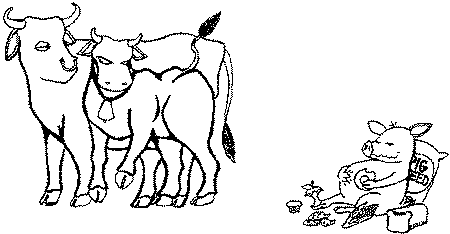
Once upon a time, there were two calves who were part of a country household. At the same home there also lived a girl and a baby pig. Since he hardly ever made a sound, the pig was called ‘No-squeal’.
The masters of the house treated No-squeal very well. They fed him large amounts of the very best rice, and even rice porridge with rich brown sugar.
The two calves noticed this. They worked hard pulling plows in the fields and bullock carts on the roads. Little Red said to Big Red, “My big brother, in this household you and I do all the hard work. We bring prosperity to the family. But they feed us only grass and hay. The baby pig No-squeal does nothing to support the family. And yet they feed him the finest and fanciest of foods. Why should he get such special treatment?”
The wise elder brother said, “Oh young one, it is dangerous to envy anybody. Therefore, do not envy the baby pig for being fed such rich food. What he eats is really “the food of death”.
“There will soon be a marriage ceremony for the daughter of the house, and little No-squeal will be the wedding feast! That’s why he is being pampered and fed in such rich fashion.
“In a few days the guests will arrive. Then this piglet will be dragged away by the legs, killed, and made into curry for the feast.”
Sure enough, in a few days the wedding guests arrived. The baby pig No-squeal was dragged away and killed. And just as Big Red had said, he was cooked in various types of curries and devoured by the guests.
Then Big Red said, “My dear young brother, did you see what happened to baby No-squeal?” “Yes brother,” replied Little Red, “now I understand.”
Big Red continued, “This is the result of being fed such rich food. Our poor grass and hay are a hundred times better than his rich porridge and sweet brown sugar. For our food brings no harm to us, but instead promises long life!”
The moral is: Don’t envy the well-off until you know the price they pay.
Buddhist Tales for Young and Old, volume 1, Prince Goodspeaker, Stories 1-50
Once upon a time, when King Brahmadatta was ruling in Benares, there was an old woman who had a calf. This calf was of a noble dark color. In fact, he was jet black without a spot of white. He was the Bodhisatta — the Enlightenment Being.
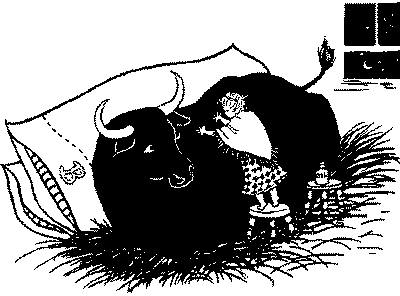
The old woman raised the little calf just as though he were her own child. She fed him only the very best rice and rice porridge. She petted his head and neck, and he licked her hand. Since they were so friendly, the people began calling the calf, “Grandma’s Blackie’.
Even after he grew up into a big strong bull, Grandma’s Blackie remained very tame and gentle. The village children played with him, holding onto his neck and ears and horns. They would even grab his tail and swing up onto his back for a ride. He liked children, so he never complained.
The friendly bull thought, “The loving old woman, who brought me up, is like a kind mother to me. She raised me as if I were her own child. She is poor and in need, but too humble to ask for my help. She is too gentle to force me to work. Because I also love her, I wish to release her from the suffering of poverty.” So he began looking for work.
One day a caravan of 500 carts came by the village. It stopped at a difficult place to cross the river. The bullocks were not able to pull the carts across. The caravan leader hooked up all 500 pairs of bullocks to the first cart. But the river was so rough that they could not pull across even that one cart.
Faced with this problem, the leader began looking for more bulls. He was known to be an expert judge of the qualities of bulls. While examining the wandering village herd, he noticed Grandma’s Blackie. At once he thought, “This noble bullock looks like he has the strength and the will to pull my carts across the river.”
He said to the villagers standing nearby, “To whom does this big black bull belong? I would like to use him to pull my caravan across the river, and I am willing to pay his owner for his services.” The people said, “By all means, take him. His master is not here.”
So he put a rope through Grandma’s Blackie’s nose. But when he pulled, he could not budge him! The bull was thinking, “Until this man says what he will pay for my work, I will not move.”
Being such a good judge of bulls, the caravan leader understood his reasoning. So he said, “My dear bull, after you have pulled my 500 carts across the river, I will pay you two gold coins for each cart – not just one, but two!” Hearing this, Grandma’s Blackie went with him at once.
Then the man harnessed the strong black bull to the first cart. He proceeded to pull it across the river. This was what all one thousand bulls could not do before. Likewise, he pulled across each of the other 499 carts, one at a time, without slowing down a bit!
When all was done, the caravan leader made a package containing only one gold coin per cart, that is, 500 coins. He hung this around the mighty bullock’s neck. The bull thought, “This man promised two gold coins per cart, but that is not what he has hung around my neck. So I will not let him leave!” He went to the front of the caravan and blocked the path.
The leader tried to push him out of the way, but he would not move. He tried to drive the carts around him. But all the bulls had seen how strong he was, so they would not move either!
The man thought, “There is no doubt that this is a very intelligent bull, who knows I have given him only half-pay.” So he made a new package containing the full one-thousand gold coins, and hung it instead around the bull’s neck.
Then Grandma’s Blackie re-crossed the river and walked directly towards the old woman, his ‘mother’. Along the way, the children tried to grab the money package, thinking it was a game. But he escaped them.
When the woman saw the heavy package, she was surprised. The children told her all about what happened down at the river. She opened the package and discovered the one thousand gold coins.
The old woman also saw the tired look in the eyes of her ‘child’. She said, “Oh my son, do you think I wish to live off the money you earn? Why did you wish to work so hard and suffer so? No matter how difficult it may be, I will always care for and look after you.”
Then the kind woman washed the lovely bull and massaged his tired muscles with oil. She fed him good food and cared for him, until the end of their happy lives together.
The moral is: Loving-kindness makes the poorest house into the richest home.
Once upon a time, King Brahmadatta of Benares had a son. He grew up to be a mean and cruel he-man – the type that’s always trying to prove he’s tougher than everyone else. He was a bully who constantly pushed people around and picked fights. Whenever he spoke to people it was with a stream of obscenities – right out of the gutter. And he was always quick to anger – just like a hissing snake that’s just been stepped on.
People inside and outside the palace ran from him as they would from a starving man-eating demon. They avoided him as they would a speck of dirt in the eye. Behind his back everyone called him the ‘Evil Prince’. In short – he was not a nice man!
One day the prince decided to go swimming. So he went down to the river with his servants and attendants. Suddenly it became almost as dark as night. A huge storm came up. Being so rough and tough, the prince was always trying to show he wasn’t scared of anything. So he yelled at his servants, “Take me into the middle of the river and bathe me. Then bring me back to shore.” Following his orders, they took him out to midstream. Then they said, “Now is our chance! Whatever we do here, the king will never find out. So let’s kill the Evil Prince. Into the flood you go, good-for-nothing!” With that they threw him into the stormy raging river.
When they returned to the bank, the others asked where the prince was. They replied, “We don’t know. As the rain came up, he must have swum faster than us and gone back to Benares.” When they returned to the palace, the king asked, “Where is my son?” They said, “We don’t know, your majesty. When the storm came up, we thought he went back ahead of us.” King Brahmadatta collected a search party and began looking for the prince. They searched carefully, all the way to the riverside, but couldn’t find him.
What had happened was this. In the darkness and wind and rain the prince had been swept down the flooding river. Luckily he was able to grab onto a floating dead tree trunk. Frantically he held on for dear life. As he was being swept along, the tough he-man was so afraid of drowning that he cried like a terrified helpless baby!
It just so happened that, not long before, a very rich man had died in Benares. He had buried his treasure hoard in the riverbank, along the same stretch of river. His fortune amounted to 40 million gold coins. Because of his miserly craving for riches, he was reborn as a lowly snake, slithering on his belly while still guarding his treasure.
At a nearby spot on the riverbank another rich miser had buried a treasure of 30 million gold coins. Likewise, due to his stingy clawing after wealth, he had been reborn as a water rat. He too remained to guard his buried treasure.
Lo and behold. when the storm came up, both the snake and the water rat were flooded out of their holes and washed into the raging river. In fear of drowning, they both happened to grab onto the same dead log carrying the frightened wailing prince. The snake climbed up on one end and the water rat on the other.
There also happened to be a tall cotton tree growing nearby. There was a young parrot roosting in it. When the storm-flooded river rose up, the cotton tree’s roots were washed away and it fell into the water. When he tried to fly away, the wind and rain swept the little parrot onto the same dead log with the snake, the water rat and the Evil Prince.
Now there were four on the log, floating towards a bend in the river. Nearby a holy man was living humbly in a little hut. He just happened to be the Bodhisatta – the Enlightenment Being. He had been born into a rich high class family in Kasi. When he had grown up, he had given up all his wealth and position, and had come to live by himself next to the river.
It was the middle of the night when the holy man heard the cries of panic coming from the Evil Prince. He thought, “That sounds like a frightened human being. My loving-kindness will not let me ignore him. I must save him.”
He ran down to the river and shouted. “Don’t be afraid! I will save you!” Then he jumped into the rushing torrent, grabbed the log, and used his great strength to pull it to shore.
He helped the prince step safely onto the riverbank. Noticing the snake, water rat and parrot, he took them and the man to his cozy little hut. He started up his cooking fire. Thinking of the weakness of the animals, he gently warmed them by the fire. When they were warm and dry he set them aside. Then he let the prince warm himself. The holy man brought out some fruits and nuts. Again he fed the more helpless animals first, followed by the waiting prince.
Not surprisingly this made the Evil Prince furious! He thought, “This stupid holy man doesn’t care at all for me, a great royal prince. Instead he gives higher place to these three dumb animals!” Thinking this way, he built up a vengeful hatred against the gentle Bodhisatta.
The next day the holy man dried the deadwood log in the sun. Then he chopped it up and burned it, to cook their food and keep them warm. In a few days the four who had been rescued by that same log were strong and healthy.
The snake came to the holy man to say good-bye. He coiled his body on the ground, arched himself up, and bowed his head respectfully. He said, “Venerable one, you have done a great thing for me! I am grateful to you, and I am not a poor snake. In a certain place I have a buried treasure of 40 million gold coins. And I will gladly give it to you – for all life is priceless! Whenever you are in need of money, just come down to the riverbank and call out. “Snake! Snake!”
The water rat, too, came to the holy man to say good-bye. He stood up on his hind legs and bowed his head respectfully. He said, “Venerable one, you have done a great thing for me! I am grateful to you, and I am not a poor water rat. In a certain place I have a buried treasure of 30 million gold coins. And I will gladly give it to you – for all life is priceless! Whenever you are in need of money, just come down to the riverbank and call out, “Rat! Rat!”
Such grateful generosity from a snake and a water rat! A far cry from their previous stingy human lives! Then came the parrot to say his good-bye to the holy man. He bowed his head respectfully and said, “Venerable one, you have done a great thing for me! I am grateful to you, but I possess no silver or gold. However, I am not a poor parrot. For if you are ever in need of the finest rice, just come down to the riverbank and call out. ‘Parrot! Parrot!’ Then I will gather together all my relatives from all the forests of the Himalayas and we will bring you many cart loads of the most precious scented red rice. For all life is priceless!”
Finally the Evil Prince came to the holy man. Because his mind was filled with the poison of vengeance, he thought only about killing him if he ever saw him again. However, what he said was, “Venerable one, when I become king, please come to me and I will provide you with the Four Necessities.” He returned to Benares and soon became the new king.
In a while the holy man decided to see if the gratitude of these four was for real. First he went down to the riverbank and called out, “Snake! Snake!” At the sound of the first word, the snake came out of his home under the ground. He bowed respectfully and said, “Holy one, under this very spot are buried 40 million gold coins. Dig them up and take them with you!” “Very well,” said the holy man, “When I am in need I will come again.”
Taking leave of the snake, he walked along the riverbank and called out,’ “Rat! Rat!” The water rat appeared and all went just as it had with the snake.
Next, he called out, “Parrot! Parrot!” The parrot flew down from his treetop home, bowed respectfully and said, “Holy one, do you need red rice? I will summon my relatives and we will bring you the best rice in all the Himalayas.” The holy man replied, “Very well, when I am in need I will come again.” Finally he set out to see the king. He walked to the royal pleasure garden and slept there overnight. In the morning, in a very humble and dignified manner, he went to collect alms food in the city of Benares.
On that same morning the ungrateful king, seated on a magnificently adorned royal elephant, was leading a vast procession around the city. When he saw the Enlightenment Being coming from a distance he thought, “Aha! This lazy homeless bum is coming to sponge off me. Before he can brag to everyone how much he did for me, I must have him beheaded!”
Then he said to his servants, “This worthless beggar must be coming to ask for something. Don’t let the good-for-nothing get near me. Arrest him immediately, tie his hands behind his back, and whip him at every street corner. Take him out of the city to the execution block and cut off his head. Then raise up his body on a sharpened stake and leave it for all to see. So much for lazy beggars!”
The king’s men followed his cruel orders. They tied up the blameless Great Being like a common criminal. They whipped him mercilessly at every street corner on the way to the execution block. But no matter how hard they whipped him, cutting into his flesh, he remained dignified. After each whipping he simply announced, for all to hear: “This proves the old saying is still true – ‘There’s more reward in pulling deadwood from a river, than in helping an ungrateful man!’”
Some of the bystanders began to wonder why he said only this at each street corner. They said to each other, “This poor man’s pain must be caused by an ungrateful man.” So they asked him, “Oh holy man, have you done some service to an ungrateful man?”
Then he told them the whole story. And in conclusion he said, “I rescued this king from a terrible flood, and in so doing I brought this pain upon myself I did not follow the saying of the wise of old, that’s why I said what I said.”
Hearing this story, the people of Benares became enraged and said to each other, ‘This good man saved the king’s life. But he is so cruel that he has no gratitude in him at all. How could such a king possibly benefit us? He can only be dangerous to us. Let’s get him!”
Their rage turned the citizens of Benares into a mob. They pelted the king with arrows, knives, clubs and stones. He died while still sitting on the royal elephant. Then they threw the dead body of the one-time Evil Prince into a ditch by the side of the road.
Afterwards they made the holy man their new king. He ruled Benares well. Then one day he decided to go see his old friends. So he rode in a large procession down to the riverbank.
He called out, “Snake! Snake!” The snake came out, offered his respect and said, “My lord, if you wish it. You are welcome to my treasure.” The king ordered his servants to dig up the 40 million gold coins. He went to the water rat’s home and called out, “Rat! Rat!” He too appeared, offered his respect and said, “My lord, if you wish it, you are welcome to my treasure.” This time the king’s servants dug up 30 million gold coins.
Then the king called out “Parrot! Parrot!” The parrot flew to the king, bowed respectfully and said, “If you wish, my lord, I will collect the most excellent red rice for you.” But the holy man king said, “Not now my friend. When rice is needed I will request it of you. Now let us all return to the city.” After they arrived at the royal palace in Benares, the king had the 70 million gold coins put under guard in a safe place. He had a golden bowl made for the grateful snake’s new home. He had a maze made of the finest crystals for the generous rat to live in. And the kind parrot moved into a golden cage, with a gate he could latch and unlatch from the inside.
Every day the king gave rice puffs and the sweetest bee’s honey on golden plates to the snake and the parrot. And on another golden plate he gave the most aromatic scented rice to the water rat. The king became famous for his generosity to the poor. He and his three animal friends lived together in perfect harmony for many years. When they died, they were all reborn as they deserved.
The moral is: Gratitude is a reward, which is itself rewarded.
Here is a story in the Avadanasataka Sutra: At the Buddha’s time, in Sravasti, an elderly Brahman’s wife gave birth to a baby boy. Whenever the child was hungry for milk and as soon as the breast milk entered his mouth, the milk would turn bad. It was the same situation whenever he took in other food. Therefore, this had been how he grew up in a semi-starvation state. After he grew up, he beseeched the Buddha for renunciation from household life. Out of compassion, the Buddha approved it.
After the renunciation, other Bhikkhus always returned with a bowl full of food after they went out to ask for offerings. Yet, he was the only one who returned with an empty bowl. One day, it occurred to him that he had to do something for the Three Jewels. Through the physical work, he wished to eradicate his negative karma. He resolved to clean up the monastery and miraculously, the next day, he returned with delicious food. Therefore, he became even more determined to serve the Three Jewels. This way, he got to have food every day.
One day he slept in and missed the clean-up. Sariputra cleaned up the monastery as he passed by. He was very upset about this and told Sariputra, “I only get to eat after I clean up the place. Now, you have done it. I will definitely have nothing to eat today.” After Sariputra heard about that, he said, “It is no problem. I will go to the city and get food for you.” After he went to a layperson’s house, the couple happened to be in a quarrel. He returned with an empty bowl. The next day, Sariputra told him that an Elder had made a meal offer to the Buddha and the Sangha. The Buddha would take them along. After they arrived at the Elder’s home, everyone’s bowl was full of food, except his. They had missed filling up his bowl. He went to inform the owner about his empty bowl, yet no matter how he yelled out to the owner, somehow, he never could hear him.
After Ananda knew about this, he felt sympathy for him. He volunteered to get food for him the next day. Ananda was known as the first in memory, yet, this time, he totally forgot about his promise. On the fourth day, he finally got a bowl of food. However, on his way back, a dog ran to him and spilled the food. Venerable Maudgalyayana also had learned about this. The following day he went out and got the food for him. On his way back, he took a break under the tree. All the birds in that tree flew down and ate up the food in the bowl. Venerable Maudgalyayana singed, “In spite of being the first in supernatural powers, I also cannot do much due to his heavy negative karma.”
Sariputra could not bear to see this. He made up his mind to find food for him. The next day, he went out and got a bowl of food. When he got to the entrance, the door which used to be open suddenly shut closed with a bang. The bowl of food was hit by the door and spread all over the floor.
Until the seventh day, the Bhikkhu had not taken a bit of food still. He cried out of sorrow and shame. He ended up eating the sand and died. Everyone was amazed by what had happened. They went to the Buddha and inquired about the karmic condition of the Bhikkhu. The Buddha told everyone, “At the time of Indradhvaja Buddha (Sovereign Sign Buddha), there was an Elder who loved to do good deeds and give donations. He often offered vegetarian meals to the Buddha and the sangha. He also had a son who followed after his conducts. The family property was managed by the father at that time; therefore, the son was not against the donations.
After the Elder passed away, the son inherited the property. He became greedy and was unwilling to give. Other than being unwilling to give to the sangha, he also did not allow his mother to make offerings. However, his mother was frugal and tried to save to give to the sangha. One day, the mother told him, “I have nothing left to eat. Can you spare me any food?” He talked back at his mother, “I gave you food, but you gave it away to the sangha. Why don’t you just go and eat the sand?” Later, his mother died of starvation. Due to the negative karma of reluctance in making offerings and respecting parents, he degenerated into the hell realm after his death. After countless of eons he had finally made his way back to the human realm. In the same way, he still had to go through the negative karmic retribution of hunger and starvation. Because he did not oppose his father making offerings to the Buddha in the past, he then had the karmic condition to renounce in this life time. Nevertheless, because of the heavy negative karma of disrespect to his mother, in this life, he experienced extreme hunger and eventually died of eating sand.
This is the karmic retribution of greed, disrespect to parents, and negative speech. In spite of the fact that he had renounced himself from the household life, he still could not escape from retribution. From this, we learn that negative karma can be very horrifying.
It is said that there are two ways to practice religion. One is to live apart from the ordinary everyday world as a monk, a nun or a holy one. Those who are sincere in this way have as their highest goal the direct experience of complete Truth – full Enlightenment. The other way to practice religion is within the ordinary world. Those who are sincere in this way have as their highest goal the harmony of an undivided world, living peacefully under a perfectly wholesome ruler – a ‘King of the World’. Once upon a time the Enlightenment Being was born and given the name ‘Clear-sighted’. As he grew up he developed ten rules of good government: absence of hidden ill will. absence of open hostility, harmlessness, self-control, patience, gentleness, charity, generosity, straightforwardness and goodness.
The people of the world began to notice the wholesomeness and fairness of Clear-sighted, who lived strictly according to these rules. Gradually those in his vicinity volunteered to live under his authority as king, rather than under the dishonest politicians of the time. As his reputation spread, every king in the world came to Clear-sighted and said, “Come, oh lord. You are welcome. My kingdom is your kingdom. Advise me how to rule in your name.” Then Clear-sighted said, “Do not destroy life. Do not take what is not given. Do not behave wrongly in sexual desires. Do not speak falsely. Do not take alcohol that clouds the mind. My commands to the world are only these five. As long as these five are obeyed, my sixth rule is freedom for all to follow local customs and religions.” After all the people on earth had come to live under his peaceful rule, he became known as Clear-sighted the Great, King of the World. His royal city, the capital of the whole world, was called Kusavati. It was a beautiful and prosperous city with four magnificent gates – one golden, one silver, one jade and one crystal.
Outside the gates, Kusavati was surrounded by seven rows of palm trees – a row with golden trunks and silver leaves and fruits; a row with silver trunks and golden leaves and fruits; a row with cat’s-eye trunks and crystal leaves and fruits; a row with crystal trunks and cat’s-eye leaves and fruits; a row with agate trunks and coral leaves and fruits; a row with coral trunks and agate leaves and fruits; and finally a row with trunks and leaves and fruits of every kind of jewel found in the world! When breezes blew through these marvelous palms the sweet sounds of gentle music were heard throughout the city. This music was so enticing and pleasant that some of the citizens were enchanted into stopping their work and dancing for joy! Clear-sighted the Great, King of the World, had a couch encrusted with jewels from the wonderful palms. After a long, righteous and peaceful reign, he lay on the rich couch for the last time. He knew that his end was near.
Of all his 84,000 queens, the one who loved him most was called, ‘Most-pleasant’. Sensing the state of his mind she said, “You rule over all the cities of the world, including this beautiful Kusavati with its four magnificent gates and seven rows of marvelous palms. Think about this and be happy!”
The King of the World said, “No, my dear queen. don’t say that. Instead you should advise me to give up attachment to the cities of the world and all they contain.” Surprised. she asked, “Why do you say this, my lord?” “Because today I will die,” he said.
Then Queen Most-pleasant started to cry, wiping away the tears as they flowed. And all the other 84,000 queens also broke into tears. And the king’s ministers and his whole court, both men and women, could not keep from weeping and sobbing. All eyes overflowed with tears.
But King Clear-sighted the Great said, “Your tears are useless. Be at peace.” Hearing this the wailing subsided and his subjects became silent. Then he said to Queen Most-pleasant, “Oh my queen, do not cry, do not lament. Anything that comes into being, whether it be a kingdom including the whole world, or just a tiny sesame seed – it cannot last forever. Anyone who comes into being, whether it be the King of the World, or the poorest petty thief – all must decay and die. Whatever is built up, falls apart. Whatever becomes, decays. The only true happiness is in the moment when becoming and decaying are not.”
In this way the Enlightenment Being got them to think about what most people don’t want to think about – that all things come to an end. He advised them to be generous and wholesome. Then the King of the World, like everyone else, died. He was reborn as a god in a heaven world, where in time, like everyone else, he died.







 Peace LiLy