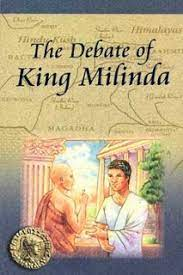
The twelfth among the Eighteen Arhats is recognized as Nagasena in Sanskrit, meaning “Dragon Army.” Often referred to as “Bhikshu Nagasena,” he was a Buddhist theoretical philosopher who received full ordination at the age of twenty and eventually attained the state of Arhat. Bhikshu Nagasena journeyed to the ancient kingdom of Shakyadesha in northwestern India to engage with King Milinda. Responding to the king’s inquiries, Nagasena eloquently expounded on the impermanence of life, the law of karma, and various facets of Buddhist practice, employing metaphors to convey profound insights. This discourse is encapsulated in the “Nagasena Bhikshu Sutra,” representing a comprehensive exposition of fundamental Buddhist teachings.
Below are excerpts from conversations between Nagasena and King Milinda, where the king poses questions and Nagasena responds with profound wisdom and intelligence.
First Question
Once, King Milinda intentionally sought to challenge Bhikkhu Nagasena and questioned him, saying, “You did not live in the same era as the Buddha, and you never met Siddhartha Gautama. How can you be sure that the Buddha actually existed?”
Wise Bhikkhu Nagasena responded by asking, “Great King, how did you inherit your throne?”
“It was passed down to me by my father,” replied the king.
“And from whom did your father receive the throne?” Nagasena inquired.
“From his father, my grandfather.”
“And your grandfather’s throne, from whom did he receive it?”
“From his forefather, my great-grandfather!”
Nagasena continued, “If we trace this lineage generation by generation, do you believe that there was an original founder of your kingdom?”
King Milinda replied with certainty, “Certainly, I believe so!”
“Have you ever seen this founder?” Nagasena asked.
“No, I haven’t.”
“How can you believe in someone you haven’t seen?” Nagasena questioned further.
The king explained, “Our founding monarch established laws, systems, and regulations, all of which are recorded in history. Though I haven’t seen him, I believe in his existence because there are historical records.”
Smiling, Bhikshu Nagasena nodded and said, “In the same way, we believe that the Buddha indeed existed. In Buddhism, there is the Triple Gem of Buddha, Dharma, and Sangha, along with scriptures, Vinaya (monastic rules), and Abhidharma (philosophical teachings). The Buddha’s ethical guidelines and historical events are not fabrications; they are as real as your founding monarch in historical terms!”

Second Question:
Unable to find fault with Bhikkhu Nagasena in the first question, King Milinda, using his wit, posed another challenging query. He asked, “Buddhists often speak of the ultimate happiness being the realization of Nirvana, attaining a state beyond birth, death, and cessation. Bhikshu Nagasena, have you attained Nirvana?”
Bhikshu Nagasena humbly replied, “I’m ashamed to admit that I haven’t.”
King Milinda, feeling triumphant, questioned, “If you haven’t experienced it yourself, how do you know about the state of Nirvana?”
If this question were posed to you, how would you respond?
Rather than directly answering, Bhikshu Nagasena turned the question back to King Milinda, asking, “Great King, if I were to take a large knife and cut off your arm right now, would it be painful?”
King Milinda’s expression changed, and he said, “Certainly, it would be painful! How could having one’s arm cut off not be painful?”
Nagasena pressed on, “But your arm has never been cut off before, so how do you know it would be painful?”
The king replied, “I have seen others experience the pain of having their arms cut off, so I know it would be painful!”
Smiling, Bhikshu Nagasena respectfully remarked, “Great King, just as you can understand the pain of losing an arm by witnessing others, I, too, have seen the joy of those who have realized Nirvana. Hence, I am certain about the sublime nature of the Nirvana state!”
Third Question:
King Milinda, persisting in his skepticism, attempted a third inquiry, asking, “Monastics are supposed to embrace compassion. How do you forgive your enemies?”
Bhikshu Nagasena smiled and replied, “Great King, if you had a festering wound on your leg, would you chop off your entire leg?”
“No, I wouldn’t,” answered the king.
Nagasena continued, “So, what would you do?”
“I would carefully clean it, apply medication, and with time, the wound would heal,” explained the king.
Bhikshu Nagasena stated, “Exactly! Enemies and wrongdoers are like festering wounds. If not taken care of and treated, they will spread and worsen. Therefore, one must use the water of dharma to cleanse them, encouraging them to abandon wrongdoing and turn towards righteousness. This principle is similar to how you, Great King, nurture and care for the wound on your leg!”
Fourth Question:
King Milinda nodded in acknowledgment but remained unconvinced. After contemplating, he posed another question, “You often advise people to accumulate merits for the next life. Since you haven’t experienced death, how do you know there is life after death?”

Bhikshu Nagasena responded with a simile, “It’s similar to a mandarin orange. When the fruit ripens and falls to the ground, the flesh rots away. However, the seed remains buried in the soil. When the time is right, it sprouts, grows, and becomes a robust mandarin orange tree. The human body is just a temporary aggregation of the four elements. When the illusion shatters, the body dies. Yet, the karmic consciousness continues the cycle of birth and death. It is like the seed of the mandarin orange, persistently reincarnating in the six realms, not just once but countless times, with an endless cycle of rebirths.”
Fifth Question:
Despite King Milinda’s lingering dissatisfaction, he presented a fifth question, each one more challenging than the last. However, Bhikshu Nagasena, wise and composed, continued to respond with a smile.
King Milinda asked, “Do monastics love their own bodies?”
Bhikshu Nagasena replied, “The body is merely a temporary confluence of the four elements and five aggregates. Monastics do not have attachment to it.”
King Milinda, feeling confident, cleverly countered, “Oh! You claim not to love your body, but monastics still dress, eat, and sleep. Isn’t that a way of protecting the physical form? If you say you don’t love it, isn’t that a contradiction?”
Bhikshu Nagasena smiled and offered a different perspective, “Great King, if you had a boil on your body, would you love it?”
“A boil? Such a dirty and unpleasant thing! Who would like it?” exclaimed the king.
“If you dislike it, why bother cleaning it, applying medication, and taking constant care to prevent it from worsening? Checking on it every day to see if it’s improving. If you claim not to like the boil, isn’t that contradictory behavior?” Nagasena questioned.
King Milinda, somewhat defiantly, argued, “I do it for the health of my body!”
Bhikshu Nagasena chuckled and said, “Exactly! Monastics may not love this body, but for the purpose of cultivating the spiritual path, they still have to care for this illusory form.”
Sixth Question:
King Milinda, undeterred by previous responses, continued with his inquiries, asking, “Can Siddhartha Gautama, the Buddha, know the causes and effects of the past, present, and future?”
“Buddha possesses great supernatural powers, and indeed, he can know the past, present, and future!” answered Nagasena.
“If that’s the case, why doesn’t he teach all of you those supernatural powers? Then, disciples could instantly know the past, present, and future karmic obstacles, and everyone would attain enlightenment quickly. Why go through gradual training?” questioned the king.
The clever Nagasena, handling the question with ease, asked in return, “Great King, if you were a physician, wouldn’t you know about various medicinal herbs?”
“Of course! A physician needs to know the properties of different herbs and their healing abilities,” replied the king.
“Since a physician knows about numerous medicinal herbs, can he prescribe all of them to a single patient?” Nagasena asked.
King Milinda, dismissing the idea, responded, “Certainly not! Treating an illness requires targeted medications, gradual adjustments, and specific remedies tailored to the patient’s condition. Haphazard prescriptions won’t cure the patient; it needs careful consideration!”
Seizing the opportunity, Nagasena continued, “Likewise, the Buddha imparts the Dharma based on individual capacities, tailoring the teachings to each disciple’s unique qualities. Gradual instruction is necessary, adapting to the disciples’ diverse capacities, to guide them step by step on the path to enlightenment. Otherwise, trying to rush the process might lead to unintended consequences!”

The Debate of King Milinda – Nagasena Bhikkhu Sutra
Link:https://peacelilysite.com/2024/01/11/the-debate-of-king-milinda-nagasena-bhikkhu-sutra/
 Peace LiLy