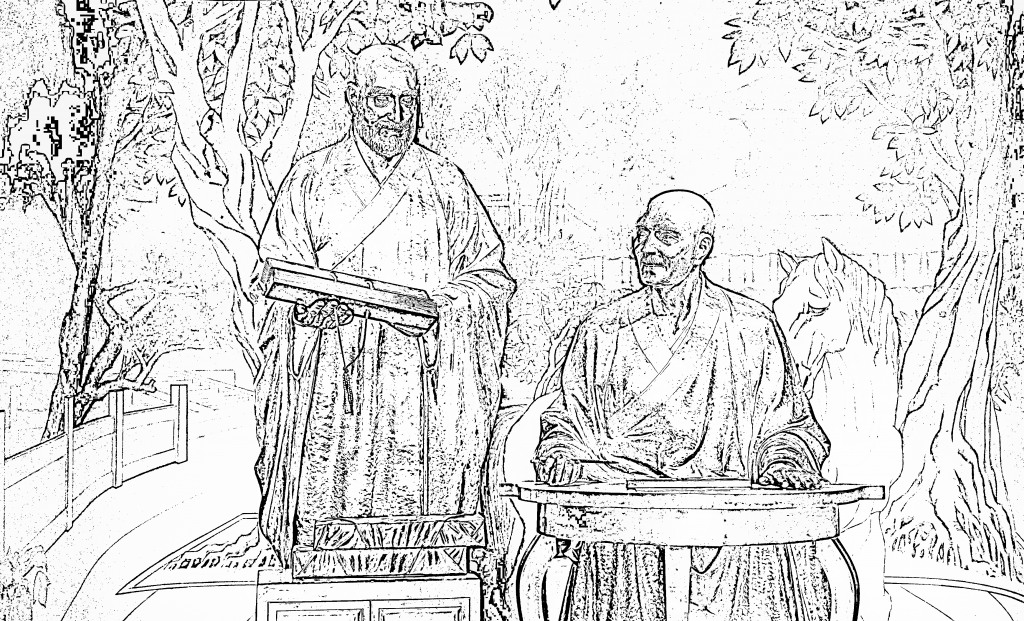
In 64 AD, Emperor Ming of the Eastern Han Dynasty sent Cai Yin and others on a mission to the Western Regions to retrieve Buddhist scriptures. The following year, in 65 AD, Cai Yin, Qin Jing, and others met the esteemed Indian monks She Moteng and Zhu Falan in Greater Yuezhi (present-day Afghanistan), where they were introduced to Buddhist scriptures and statues for the first time. In 67 AD, the Han envoy team returned to Luoyang with the high monks She Moteng, Zhu Falan, and the Buddhist scriptures and statues carried by a white horse. The two high monks were welcomed with a grand reception by Emperor Ming, who also commissioned the construction of China’s first temple, the White Horse Temple in Luoyang, especially for them.

On the first day of the first month in the fourteenth year of Yongping, Taoists from the Five Sacred Mountains submitted a petition requesting a competition with the Brahmin monks to determine the superiority of China’s native Taoism versus the foreign Buddhism. Emperor Ming granted the Taoists’ request. In 71 AD, a historic Buddhist-Taoist debate and contest unfolded in Chinese Buddhist history.
As the competition began, the Taoists said, “Let’s start with debating. You monks pride yourselves on eloquently explaining the Dharma, don’t you? So, let’s have a debate! If you can make one point, we will make two; if you raise one, we will counter with three. Go ahead and present your profound arguments!”
She Moteng slowly lifted one foot and raised it towards the sky, smiling, and said, “Amitabha, I have raised one, now it’s your turn to raise three!”
The Taoists looked at each other, stumped, and couldn’t think of a way to counter for a long time. They then changed the subject: “Let’s compare theories. You Buddhists call yourselves ‘Inner Learning,’ while you call us ‘Heterodox.’ But throughout history, when discussing inner and outer, inner has always been smaller than outer. So, your Inner Learning is small, and cannot compare to our great Heterodox!”
She Moteng brought his palms together in a gesture of respect and slowly explained: “The emperor resides in the inner palace, while the common people live in the outer city; although the inner palace is small, the emperor is great. The heart is inside the body, while the hands and feet are outside, the activity of the heart is boundless, while the movements of the hands and feet are limited. This is another example of how the inner is superior to the outer. Think carefully, the Inner Learning of Buddhism is much greater than the Heterodox!”
The Taoists, unable to win the debate, finally said, “Let’s compare magical powers!” How to compare? By placing the scriptures spoken by the Buddha and the scriptures spoken by the Taoist tradition together and burning them with fire. If one’s scriptures burn, then they are false; if one’s scriptures don’t burn, then they are true.
So, in the south of White Horse Temple, two high platforms were set up, one in the east and one in the west. The east platform held the Buddhist scriptures, images, and relics, while the west platform held the Taoist scriptures.
At that time, five hundred Taoist priests gathered the Taoist scriptures and magical texts together and prayed to the Supreme Lord Laozi, saying: “Oh, Taoist Virtuous Sage! Please show great divine power, and make our Taoist scriptures not burn, and let the Buddhist scriptures burn.”
Many of the Taoist priests at that time had supernatural powers – some could ride clouds and fog, some could fly in the sky and hide underground, and some could become invisible. Invisible means that you could see him right in front of you, and then suddenly he’s gone! There were Taoist priests with such abilities. They could use evasion techniques – Qimen Dunjia, to escape, and with Taoist spells and incantations, they had great supernatural powers.
But what happened when the fire was lit? The Buddhist scriptures did not burn; they emitted light! The Buddha’s relics also emitted a five-colored light, and the scriptures emitted light up into the sky, as if the sun was shining upon the world.
What about the Taoist scriptures? They caught fire as soon as they were burned and were completely destroyed by the fire. Those who could ride clouds and fog could no longer ride clouds or exhibit supernatural powers; those who could fly in the sky could no longer fly; those who could hide underground could no longer hide; those who could become invisible could no longer become invisible. Their spells and incantations also lost their effectiveness and had no power.

She Moteng and Zhu Falan, the two venerable monks, were responsible for overseeing this scripture contest, which was of great significance for the rise or fall of Buddhism. To strengthen the faith of the masses, She Moteng and Zhu Falan displayed eighteen divine transformations, levitating in the sky and reciting the following verses:
“The fox is not of the lion’s kind, a lamp is not as bright as the sun and moon; a pond cannot hold the vast sea, a hill cannot match the towering mountain. The Dharma cloud descends upon the world, the Dharma rain nourishes all beings. Supernatural powers are rare, manifesting everywhere to transform sentient beings.”
“The fox is not of the lion’s kind” means that, although the fox spirit is cunning and can change shape, it is far inferior to the lion. The fox and the lion cannot be compared; they are not of the same kind. This is saying that the breadth of Taoism is like the smallness of the fox, different from Buddhism, which has the grandeur of a lion.
“The lamp is not as bright as the sun and moon” refers to how the light of a lamp or a candle, which were small in the past, is far less bright than the light of the sun and moon. This means that the scriptures and teachings of Taoism are like the light of a lamp, while the Buddhist scriptures and teachings are like the light of the sun and moon, incomparable.
“A pond cannot hold the vast sea” means that a small pond has a limited capacity and can only hold a small amount of water, while the vast sea can accommodate many rivers. The pond and the sea cannot be spoken of in the same breath. This is a metaphor comparing the theories of Taoism to a small pond, while the teachings of Buddhism are like the vast and boundless sea.
“A hill cannot match the towering mountain” means that a small hill cannot compare to the grand and towering Mount Song, one of the Five Sacred Mountains of China. If the practice of Taoism is like a small hill, then the profound teachings of Buddhism are like the towering cliffs and deep ravines of ancient trees.
“The Dharma cloud descends upon the world, the Dharma rain nourishes all beings” means that when Buddhism spread to China, it was like a cloud of Dharma, like sweet dew, pervading the world and nourishing all beings.
“Supernatural powers are a rare thing” means that I have now shown supernatural powers, which is a rare and precious thing in the world.
“Everywhere transforming sentient beings” means that in reality, I did not want to show supernatural powers, and I did not want to compete with you. This is a last resort, for the purpose of guiding you and leading you to a brighter path, I am doing this as a convenient means.

After this contest, Buddhism took deep roots in China, not only producing a succession of talented individuals but also establishing a glorious foundation. White Horse Temple became the first and foremost temple in Chinese Buddhist history, and temples began to be built one after another. Ever since then the marvelous fruits and wondrous flowers of Chinese Buddhism have continued to flourish from generation to generation.
The earliest introduction of Buddhism to China and the first Buddhist-Taoist debate and Contest
Note: The information comes from the internet and may not be entirely accurate. It is for reference only.
Source: https://www.163.com/dy/article/F7BR86210523CRB2.html
 Peace LiLy