A White Whale and the Awakening of the Human Heart
Standing before the massive screen at the exhibition, I raised my arm and waved upward.
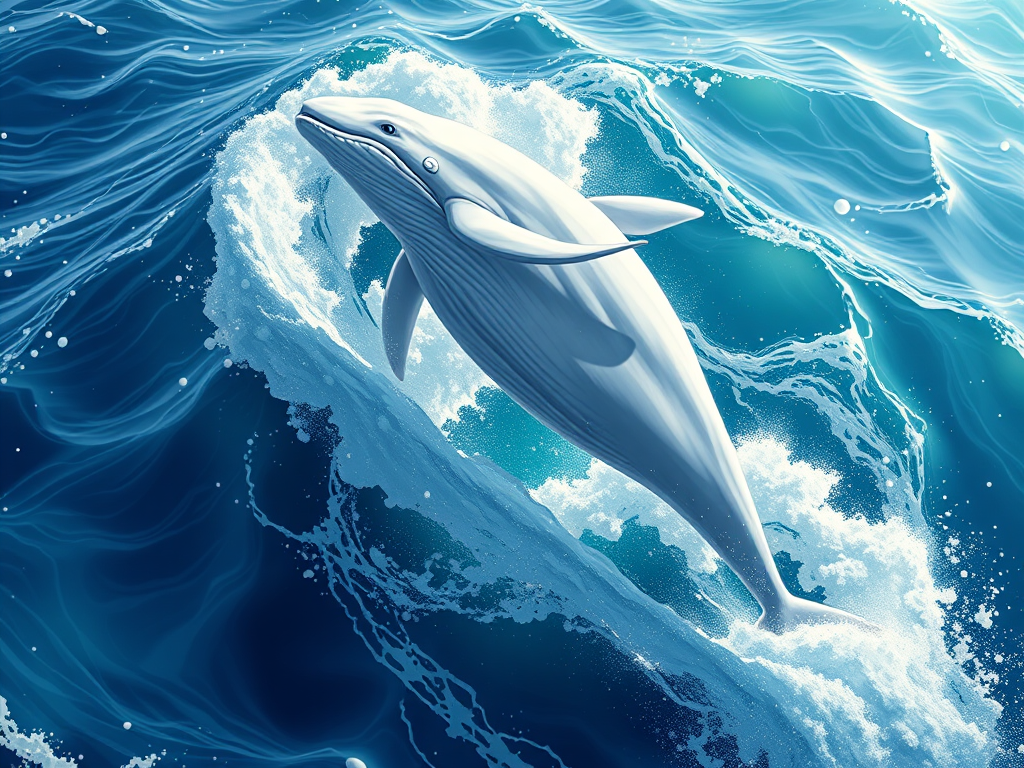
On the screen, a white whale responded instantly—leaping out of the water.
Its enormous body traced a graceful arc through the air before crashing back down, sending waves of spray in every direction.
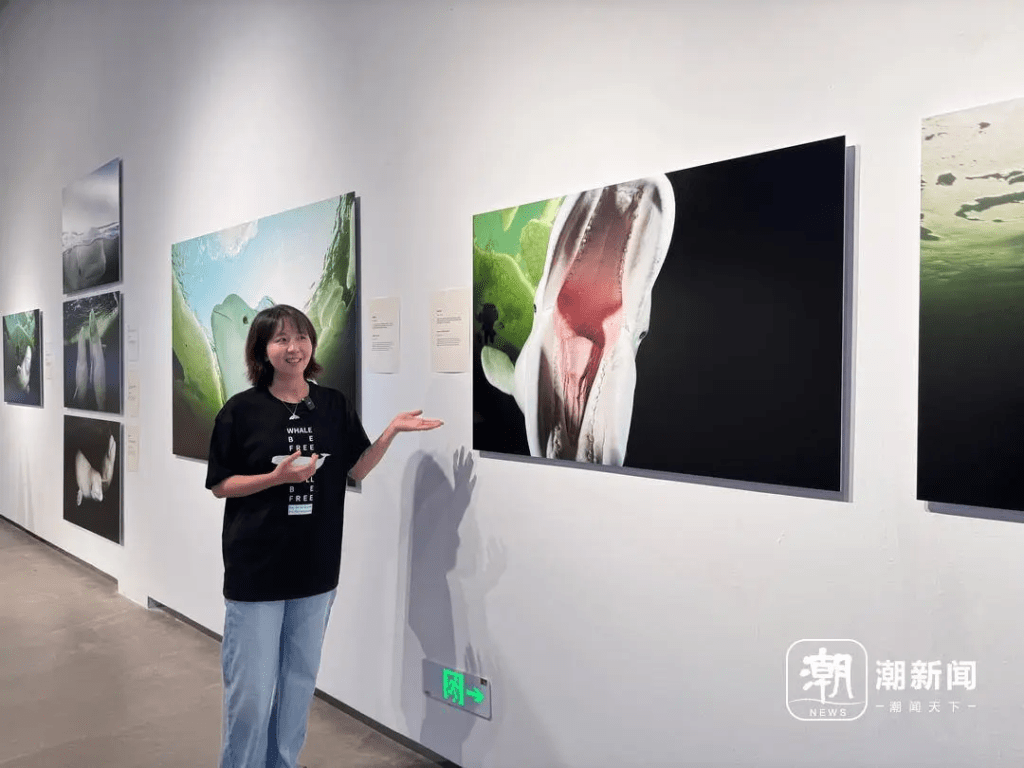
At the recently concluded art exhibition in Shenzhen, Whale Room: A Blue Dream Confined, nearly every visitor briefly stepped into the role of a “whale trainer” through multimedia interaction.
What We Call Beauty May Be Their Burden
In the wild, white whales rarely leap repeatedly out of the water.
Their heavy bodies are not meant for frequent, high jumps.
What humans describe as “graceful” or “awe-inspiring”
may, for them, be exhausting, oppressive,
even a cycle of repeated pain.
The exhibition’s founder, Shao Ran, once worked as a whale trainer for five years.
She stood by the pool countless times, receiving applause and cheers.
This time, however, she chose to tear open the surface of the “blue dream.”
When the decorations are removed, steel and concrete are revealed beneath.
No matter how vast an artificial pool may appear,
to a whale, it is still an inescapable prison.
Their suffering is carefully packaged as entertainment.
When a Life Was Entrusted to a White Whale
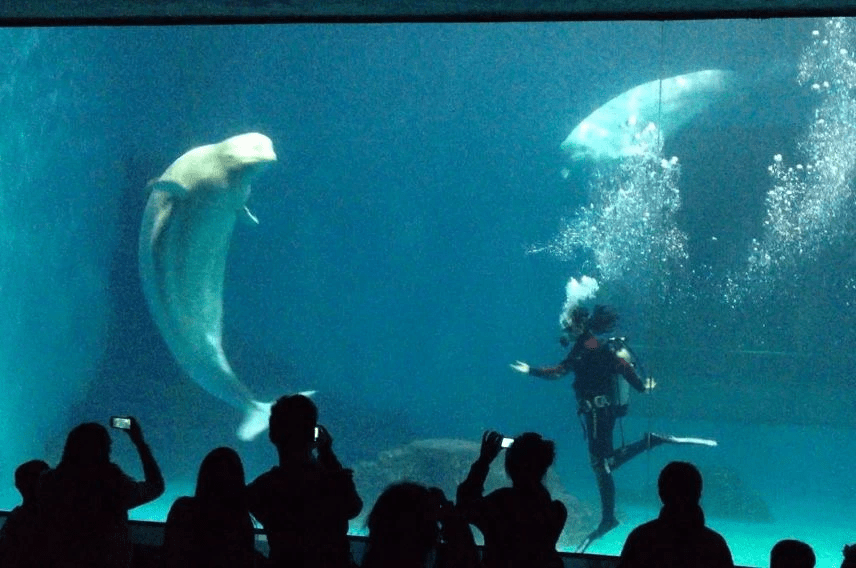
What truly changed Shao Ran’s life was a moment of life and death beneath the water.
That day, she entered the pool to perform with a white whale named Sophie.
Suddenly, Sophie lost control—clamping onto her foot and dragging her downward again and again.
Fear. Powerlessness. Suffocation.
All magnified in that endless blue.
“The only thing I could do was wait,” she later said.
“To gamble on her kindness.”
She did not escape—not out of bravery,
but because for the first time, she fully understood:
In the water, she was no longer the one in control.
She was utterly vulnerable.
She looked into Sophie’s eyes.
No commands. No intimidation.
Only one thought remained:
I want to live.
In the end, Sophie stopped.
She slowly swam closer, lifted Shao Ran’s foot with her mouth,
and gently pushed her back to shore.
In that moment, Shao Ran understood what compassion truly means.
Not weakness—
but the choice not to harm,
even within extreme injustice and oppression.
Who, Then, Is Truly Being Tamed?
Sophie was not the only one who resisted.
Another dolphin, Huahua, after enduring prolonged loneliness and stress,
eventually chose to stop breathing.
That day, as Shao Ran sat beside Huahua’s body,
she could no longer persuade herself with words like
“work,” “regulations,” or “procedure.”
She began to see clearly:
So-called training does not only tame animals.
It slowly tames the human heart as well.
When violence becomes institutionalized,
when suffering is rationalized,
when harm is renamed “normal work”—
Humans, like the captive animals,
lose freedom and awareness.
There is a line in Buddhism: All beings suffer. Ignorance causes beings to harm one another.”
The Buddhist teaching of non-harming
calls us to awaken from this very ignorance.
Walking the Path of Compassion in Another Way
Shao Ran left the marine park.
She no longer stands beside a pool,
but walks into schools, bookstores, and quiet corners of the city,
telling stories about animals.
No stage. No applause.
Sometimes, only a handful of listeners.
Still, she speaks.
She founded a nature protection community called “Ran Ai Tong Sheng”
(“All Beings, One Compassion”).
“Ran” is not her name.
It means following what is natural—
respecting the original state of all beings.
The image of that white whale pushing her gently back to shore
has stayed with me ever since.
After long confinement and deprivation,
it did not choose destruction—
it chose kindness.
Buddhism teaches us:
Compassion is not a result—it is a direction.
If we consider ourselves more intelligent,
more civilized,
more faithful—
Then perhaps we should also learn:
Not to build our joy upon the suffering of others.
Not to hide harm behind habit.
Not to allow violence through silence.
Buddhist compassion is not mere sympathy.
It is a lucid responsibility.
May we, toward every life,
give rise to respect,
and cultivate a heart of non-harming.
When non-harming becomes a choice,
when compassion becomes action,
only then can this world truly move toward freedom.

 Peace LiLy