In March 2014 an extremely holy book by H.H. Dorje Chang Buddha III, Imparting the Absolute Truth Through the Heart Sutra, was published and distributed at a Grand Dharma Assembly held in Hong Kong. Prior to that on March 14, a dharma assembly was held at the Holy Miracles Temple in the United States of America to empower the ink paste and stamping seals used to bestow blessings on this first-publishing memorial edition of the book. At that time, the Buddhas manifested a three-color nectar in a dharma bowl before those assembled at the temple. After chanting mantras the nectar spontaneously appeared to the delight of all present. The entire ceremony was recorded and can be seen at various temples and dharma centers. Click for more information on nectar.
WASHINGTON, June 25, 2011 /PRNewswire-USNewswire/ — The World Peace Prize Awarding Council held a grand award ceremony on June 14, 2011 in the Gold Room at the U.S. Capitol to express our respect for the recipients of the 2010 World Peace Prize: H.H.Dorje Chang Buddha III, prominent leader of Buddhism in the world; Hon. Benjamin A. Gilman, former Chairman of the House Foreign Affairs Committee. The ceremony, chaired by Dr. Han Min Su, founder of the World Peace Prize Awarding Council, was graced by the presence of Senator Mark Kirk, member of the Senate Committee on Appropriations; former Senator Steve Symms; Congresswoman Illeana Ros-Lehtinen, Chairman of the House Foreign Affairs Committee of the United States Congress; Congressman Darrell Issa, Chairman of the House Oversight and Government Reform; Congressman Steve Chabot, member of the U.S. House Committee on Judiciary; and Congresswoman Sheila Jackson-Lee, member of the Committee on Homeland Security; Congresswoman Corrine Brown, Chairwoman of the Transportation Subcommittee on Railroads. They all commented on the great achievements of the awardees, who have contributed tremendously to peace and enlightenment for humanity. This event, awarded for the 2010 recognition to those deserving recipients, is part of a continuing program by the World Peace Corps Mission to recognize the outstanding work of individuals who make major contributions for the establishment and maintenance of peace.
In view of some recent comments that the World Peace Prize Awarding Council has received from individuals and groups, expressing their misconceptions and misunderstanding. Our Council hereby issues this statement.
The co-founder of the World Peace Prize Awarding Council, Dr. Han Min Su, is a Christian leader from South Korea. The foundation of his entire life has been to preach Christianity and morality. He has spared no efforts in advancing world peace and furthering friendship and love among humankind. Wherever he goes, he is well respected within the international community as a minster of high moral character, a kind-hearted leader promoting inter-religious collaboration and world peace.
The Chief Judge of the World Peace Prize Awarding Council, Hon. Lester Wolff, is an experienced and distinguished statesman who has worked hard his entire life for world peace. His contributions to peace and development in Asian countries are especially remarkable. He is the author of the United States Congress “Taiwan Relations Act.” In 1978, he met with Deng Xiao-Ping, the Father of Modern China, and laid down the principles and foundation for diplomatic relations between the United States and China. At the same time, he successfully assured peace and development for both sides of the Taiwan Straits. He also introduced amendments to the White House sponsored Foreign Assistance Act of 1979 to restore the initiative for direct peace talks between Israel and the Arab States.
Dr. Suzi P. Leggett has been involved with politics and has worked in Congress over a long period of time. She has been the Chief of Staff of a former Speaker of the House. Her husband, the late Hon. Robert Leggett, was the co-founder of the World Peace Corps Mission, a legislator of great fairness, impartiality, and integrity. While in Congress, he served on the House Armed Services Committee and Budget Committee, and was Chairman of the Panama Canal Zone House Merchant Marine and Fishery Committee and co-chairman of the National Security Task Force.
H.H. Dorje Chang Buddha III, recipient of the 2010 World Peace Prize Top Honor Prize recipient, was recognized by more than 50 eminent dharma kings, regent dharma kings, and great rinpoches from major Buddhist sects around the world: H.H. Dharma King Dumu Qujie, the Root Master of the 17th Karmapa; H.E. Goshir Gyaltsab, a regent dharma king and national master; H.E. Sharmapa, a regent dharma king; H.H. Dharma King Trulshik, H.H. Taklung Tsetrul, and H.E. Chogye Trichen, all three of whom are Masters of the Dalai Lama; H.H. Dharma King Dodrupchen Thupten Trinle Palzang, H.H. Dharma King Penor, H.H. Dharma King Achuk, H.H. Dharma King Jigme Dorje, amongst others. H.H.Dorje Chang Buddha IIIis the most widely recognized leader in the history of Buddhism.
In the past decade, H.H. Dorje Chang Buddha III has suffered greatly for withstanding long-term persecution for his religious activities. A member country of the Interpol has once requested the Interpol to issue a warrant for His arrest. The request was subsequently withdrawn voluntarily by this member country after some years. Upon thorough investigation, in October of 2008, the 72nd session of the Commission for the Control of Interpol’s Files withdrew the arrest warrant and the entire case against H.H. Dorje Chang Buddha III. Interpol also issued a document stating in definite terms that the arrest warrant against H.H. Dorje Chang Buddha III has been cancelled and all of its member countries have been notified of the cancellation.
Although H.H. Dorje Chang Buddha III long ago received official notification of the withdrawal of the arrest warrant and the removal of the entire case, He has never shown such documents to prove His innocence. Regardless of the slander He has endured, H.H. Dorje Chang Buddha III did not disclose such ironclad evidence. When the World Peace Prize Awarding Council found out, and asked H.H. Dorje Chang Buddha IIIabout this, He responded by saying that what He must do is bear all of the karmic offenses committed by living beings and give to living beings all of the good karma and merit that He has planted. He said that if He proved His innocence by showing those documents, then those who slandered Him would no longer be seen as innocent. Who, He asked, will bear their karmic offenses?
His Holiness Dorje Chang Buddha III is more than deserving of the Top Honor Prize as He exemplifies the nobility of selflessness; a model of morality for all to emulate. He also demonstrated how peace is often attained by determination, humility and the perseverance to advance its cause in the face of adversity.
Hon. Benjamin A. Gilman, also recipient of the World Peace Prize Top Honor Prize, is a distinguished statesman who served as Chairman of the House Foreign Affairs Committee for a long period of time. He is a life-long champion of human rights: fighting world hunger, narcotic abuse and trafficking. He has made many successful efforts to bring about “prisoner exchanges” which resulted in freedom of American citizens in East Germany, Mozambique, Cuba and several other countries. Congressman Gilman served 15 terms, a total of 30 years in the U.S. Congress. Prior to that, he served 6 years in the New York State Legislature as Assemblyman, and several years as Assistant Attorney General in the New York State Department of Law. While in Congress, he served as Chairman of the House Foreign Affairs Committee and as Congressional delegate to the United Nations with title of Ambassador, and later the Ukrainian Famine Commission and Vice Chairman of the Committee on POW’s. Mr. Gilman has been a recipient of numerous honors including the President’s Certificate of Outstanding Achievement “for continued, demonstrated vision, initiative, and leadership in the effort to achieve a world without hunger” and has annually received the “Peace Through Strength” Award presented by the American Security Council.
The World Peace Prize Awarding Council operates according to the core spirit of advancing peace and justice and inter-religious collaborations. The Council is led by co-founder and executive judge Dr. Han Min Su with esteemed members including Chief Judge Hon. Lester Wolff, former Chairman of the United States Congress Asian Affairs Committee; Dr. Suzi P. Leggett, advisor to one of the former Speaker of the United States Congress; Hon Asher Naim, former Israeli Ambassador to the United Nations; Hon. Bhupatry M. Oza, former Ambassador of India; Hon. Peter Lewis, former Speaker of the South Australian House of Assembly; Dr. Kong Shiu-Loon, former advisor to the UNESCO; General Gennady P. Turmov, retired General of Russia.
Preaching and promoting peace is an arduous and sometimes thankless task. Those in the vanguard continue to become targets of others who lurk in the darkness to attack the peacemaker and attempt to undermine their efforts. That is why we established the World Peace Prize, to encourage continuing efforts towards peace and to defend the Peacemaker against scurrilous diatribes that put into question the motivation of well meaning and dedicated individuals.
In order to let my children understand some Buddhist principles, I bought them a book of Buddhist stories. While I read it with them together, one of the stories touched me. The story told about a poor girl who lived in poverty and hardship at the time period when Shakyamuni Buddha lived. After she got married and gave birth to a boy, her husband and family finally began to treat her well. She loved her son like a rare treasure. Her son was the joy and sunshine in her life. However, the good times did not last long, for a disease took the child’s life, which made her unhappy and unable to accept this cruel fact. She held her dead son and begged everyone she met to save her child. One person told her that perhaps only the Buddha in this world could help her, and took her to the Buddha’s residence place. The Buddha told her that he could help her, but on the condition that she must find a mustard seed in the city where she lived. The mustard seed should only come from a family where no one has ever died. She went from house to house for an entire day and did not find the mustard seeds that the Buddha said. In the end, she realized that death is a reality that everyone has to face. She buried her son and returned to the Buddha’s Sangha to begin her cultivation practice.
This story fills my heart with sympathy. I am eager to learn about death because of my father’s own death. In my third year of coming to the United States, I just graduated and found a job. My father left the world suddenly because of a car accident. When I heard this sad news, I couldn’t believe that my father just left forever? I will never see my dad again? I did’t even have a chance to see him for the last time? What was his final advice to his daughter who he was always been concerned about? My father served in the military for about twenty-five years, and was very strong and healthy. I believe my Dad would never expect he would leave this world so quick and sudden, without saying anything to his dear family member and closest friends.
My father’s passing away was like a warning bell, prompting me to think about death. I started to read books on philosophy, religion, and scientific researches on near-death experiences. One day I saw the book “Tibetan Book of Life and Death” in a bookstore. I bought that book because of the mystery of Tibetan Buddhism culture. This book made me deeply shocked and changed the horrible and terrifying concept of death. The book described the magnificent phenomena of some holy monks leaving this world, and the process was fascinating rather than scary. Those holy monks had cultivated to the realm of freedom of life and death. I was very longing for the superbly bright realm when they passed away. It made me long to learn the Dharma that one can escape from reincarnation and achieve freedom of life and death.
Yeas later, we moved to Los Angeles, California, where I was truly blessed to find a place that I can hear pre-recorded Dharma discourse spoken by the contemporary living Buddha H.H. Dorje Chang Buddha III. The Buddha’s sayings are simple and clear, and the profound Buddhist principles are expressed in an easy-to-understand way; there are no advanced academic terms, no deliberately crafted ornate rhetoric. Various metaphors and stories are often used in the Dharma discourses to make people feel lively and not boring. To my surprise whenever I felt sleepy (caused by karma) or not concentrated when listening to the Dharma, there would be fascinating stories in the Dharma discourse told in the infectious voice of the Buddha, that made me suddenly refreshed. This has happened many times. I really admire how the Buddha knows the mentality of sentient beings so accurately. This is the manifestation of the Buddha’s wisdom.
Through these years of listening to the Dharma discourses, I feel that my mind is becoming more and more peaceful. I no longer worry about many things. I hope that more people will have the opportunity to listen to the Buddha’s teachings and live a healthy and happy life. I believe that in this life, if I consistently practice Buddha Dharma according to the Buddha’s teachings, I will go to the western paradise. After I have achieved liberation, I will find my father in the six reincarnations realm and lead him to the pure land of light and bliss.
Every disciple who has received initiation has the potential to quickly obtain supernormal dharma powers through practice. One has the potential to easily assume an infinite variety of forms and obtain good worldly fortune. However, if you violate the precept of lying to your master, even a minor lie, you will not be able to obtain any supernormal powers or good fortune unless you immediately repent and resolve never to violate this rule again. It can be proper to desire such powers, depending upon your motivation. It is not proper to desire such powers primarily for your own use, to appear impressive or show off, subdue people, reap fame and gain, cheat people out of money, hoodwink people into sexual misconduct, or further your worldly selfish and evil intentions. It is not blameworthy to desire miraculous powers to enlighten yourself and others.
The five great supernormal powers or superknowledges (abhijna) are 1) rddhi-saksatkriya: the ability to be anywhere or do anything at will including flying through the air and performing other miracles; 2) divyasrotra: the ability to hear sounds anywhere including those that normally cannot be heard, such as the sounds of ants walking or sounds emanating from a far away place, even in another realm of existence. This is also known as clairaudiance or “the divine ear;” 3) paracittajnana: the ability to know the thoughts or read the minds of other beings; 4) purvanivasanu-smrtijnana: the ability to recollect previous existences or past-lives of oneself and others; and 5) divyacakus: instantaneous view of anything anywhere including the ability to see things that occur outside one’s presence, such as things happening at a far away place, even in another realm of existence. This is also known as clairvoyance or “the divine eye.” The sixth supernormal power (asavakkhaya) is unique to Buddhism and enhances the powers of the other five. Non-Buddhist can achieve the first five powers, but without the wisdom that comes from complete enlightenment they are not as great as those available to a buddha. For example, a Hindu is still bound by the world of Brahma, a Buddhist is not. A Buddha’s powers are limitless. The sixth power is knowing that your defilements are extinguished and that you have attained liberation from the cycle of reincarnation. You have become enlightened. This is also sometimes referred to as anasrava–the cessation of outflows or asravas. These powers are also known as the six superknowledges (abhijna) or supernatural cognitions.
At the Ultimate Bathing the Buddha Dharma Assembly, there was a tub used to bathe the Buddha. When filled with water, that tub weighed more than 4,200 pounds. About a dozen people together tried to lift that tub a few times but did not succeed in moving the tub in the slightest. However, two people of great virtue and high states of realization were able to lift it by themselves. There was also a person of holy virtue who lifted it alone.
Venerable Akou Lamo Rinpoche of Tibet and Venerable Ciren Jiacuo (Gyatso) together lift the two ton lotus tub. What ordinary person in this world could lift such a tub? Only those who learned the true Buddha-dharma can lift it.
The Dharma Protectors guard the use of these powers very closely. They will block the chakras of those unworthy to obtain these powers. Likewise, they will untie the knots in the chakras of those cultivators who are worthy of such powers, causing the supernormal dharma powers of the buddhas and bodhisattvas to suddenly turn into light and enter the chakras. At that time, the mandala in each practitioner’s body will respond and will accept the powers. When your three karmas of body, speech, and mind unite into one body and correspond with the teachings, supernormal dharma powers will come into being. When your state of realization and state of virtue have reached the level where it is appropriate to obtain supernormal dharma powers, then as soon as you practice according to the dharma, supernormal dharma powers will appear. You cannot attain supernormal powers without proper moral discipline, concentration and wisdom. You must first be able to master the Dharma.
In life there are always some unforeseen things that happen and disrupt our arrangements. We planned to go back to my country to see my mom, after my younger son finished high school. The new coronavirus that suddenly swept the world prevented us from traveling. I had not seen my mom for almost 7 years. However, thanks to new digital technologies, we can use video call to chat and see each other. That bring us much closer, the vast distance between us not feeling that far apart. The best part is that she can talk to her grandchildren. Whenever she talks to my sons, she opens her eyes wide and has the happiest smile on her face. She seems to get energy and joy from the youngsters. My mom always says to them, “ Oh my, you guys grew up so big now, more handsome, when you will come to visit me, I miss you guys……”. All the grandma’s style talk.
That reminds me my grandmother, who used to talk to me exactly like that. My grandmother was my childhood best friend in the family. She lived with us since I was in elementary school until I went to high school. Grandma and I lived in the same one room, slept in the same one bed, and I had so many secret talks with her. She taught me how to sew, how to cook, how to clean the house, and told me the best bedtime stories…. She is a very strong and gentle lady. My grandma lived a very hard life. My grandfather, her husband, died when she was only 28 years old. She never married again, and raised up their two kids by herself.
That hard life hurt her health. She got chronic bronchitis. When the weather got cold especially in winter, she coughed severely. Sometimes at night she couldn’t lay down to sleep. She had to roll up and with her face on the pillow to prevent the choking cough. When I saw this I felt so painful and helpless. How I wished my grandma could live happily, healthily and never die. Grandma told me: when you get old you will understand, everyone will get old and sick and die. When I heard this, my heart generated great fear; someday I will be as old as grandma and as sick as grandma and die? I will follow the same life path as my grandma?
I want to know why we come to this world, just to suffer, get old, and die. Is that true what Buddhism says, that life is a cycle of death and birth? Sometimes I went to the temple to burn incense and bow to the Buddha Statues, just wanting to be blessed and protected. At that time I didn’t know what was Buddhism about, didn’t know what cultivation was or what the goal of cultivation was. To me Buddhism was more like myth, and the Buddha and Bodhisattva are wizards, with magical powers. The only thing I knew was the name of Amitaba Buddha and Guanshiyin Bodhisattva, so I just prayed to them, wishing they will somehow grant me a long and healthy life.
It is very fortunate that I then encountered the correct Buddha Dharma about fifteen years ago. I understand everything is following the law of the cause and effects. We live in the web of reincarnation of life and death woven by our own karma. One can get out of the birth and death cycle through practicing the true Buddha Dharma. The goal of believing in and learning Buddhism is for attaining liberation, accomplishment and becoming a holy one. How lucky I am to be able to listen to the Dharma discourses imparted by the living Buddha H.H. Dojre Chang III. I feel so grateful that H.H. Dorje Chang Buddha came to this world again, bringing us the original supreme Buddha Dharma with great compassion.
Now my mom is a grandma, and I can feel the trace of aging of myself. H.H Dorje Chang Buddha III told us the very truth about life in “What is Cultivation”: “My body is impermanent, is changing every nanosecond, and is moving toward decline, old age, and death. I compare why my face has aged over a ten-year period, over a forty-year period, or over a seventy-year period. The degree of agedness of my skin has changed. I will soon enter old age, sickness, and death and continue revolving in the cycle of reincarnation, where I will experience suffering. I also contemplate that joyfully innocent, newborn, fresh, and lively look I had when I was a small child. I contemplate how I no longer have that childlike appearance. My face and skin have aged. My energy has declined. I often fall ill. That quality of youth is gone. The power of impermanence will end my life. My relatives and old friends will all die one after another. Like a dream, it will soon be all over. …….”
How I wished that I could learn about Buddhism earlier; maybe then I could help my dearest grandma to rebirth in the happiest Pure Land.
I hope that I can slow down the steps of impermanence, so I can have time to share the benefits and merits I got from practicing the correct Dharma with my mom. Even though my mom believes in Buddhism, her belief is superstitious and she dose’t truly understand the goal of cultivation. She just wants the Buddha to bless her and her family living healthy and peacefully. I often tell her, you need to vow to re-birth in the Amitaba western paradise; in that world you can have everything that you want to, you will live happiest life and never die; don’t worry about other stuff and don’t be attached to material things you have in this world. I hope I can soon visit her, and listen to the dharma discourse by H.H. Dorje Chang Buddha III together.
All the Buddha and Bodhisattva in the ten directions, please beseech my mom to encounter the true Dharma, and lead her to the Western Paradise when she is at the end of her life. Please beseech my grandma and me as well so we can all live in the western pure land altogether and forever.
Namo Amitabha Buddha! Namo GuanShiYin Bodhisattva!
Over 2500 years ago Shakyamuni Buddha taught for 45 years in the Ganges River basin of north-east India to many types of followers—from beggars to kings, to monastics and lay men and women. It is said that the Buddha taught 84,000 different Dharmas to help beings free themselves of the suffering of worldly existence caused by the 84,000 different afflictions. A council of 500 arhats was convened immediately after the parinivana of the Buddha by the Venerable Mahakasyapa. During this meeting Venerable Upali recited the monastic rules that became known as the Vinaya while Venerable Ananda recited the Sutras. For 400 years the teachings were only transmitted orally.
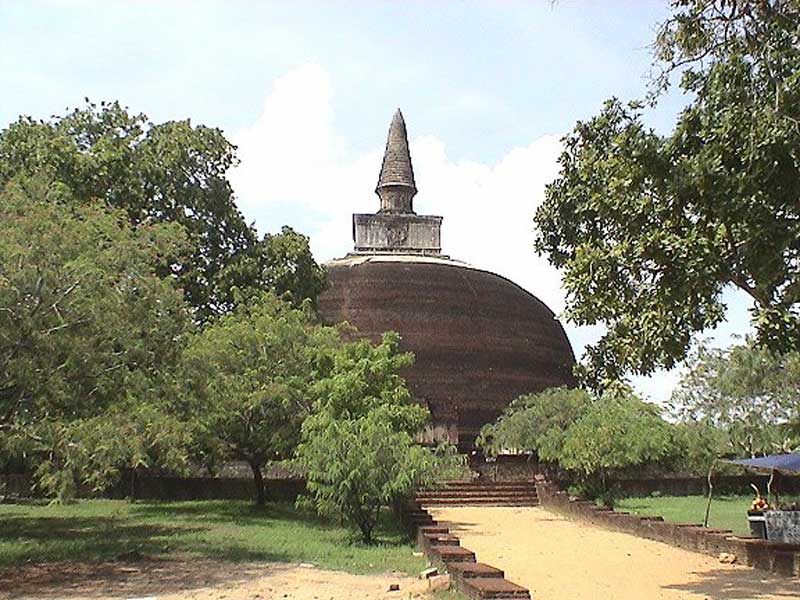
The Jetavanaramaya Stupa built in the third century as part of the Jetavana Monastery in Anuradhapura, Sri Lanka. At 400 feet, it was one of the tallest structures in the ancient world, with only two (the Great Pyramids of Giza) being higher.
In 326 BCE, several hundred years after the Buddha’s death, the Sangha divided into two schools: the Mahasanghika or majority who wanted changes and the Sthaviravada who were opposed to any changes. A hundred years later the Sthaviravada further divided into the Sarvastivada and the Vibhajyavada. The Sarvastivada migrated into northern India in the Kashmir region while the Vibhajyavada flourished in the Ganges River valley under the great Buddhist King Ashoka. In 247 BCE King Ashoka (272-231 BCE) sent his son, the monk Mahinda, and his daughter Sanghamitta, a nun, to Sri Lanka to establish Buddhism there.
By the first century CE there were 18-20 different schools, each with its own version of the Buddha’s teachings. Two written versions remain, at least in part: that produced in Sri Lanka in the ancient language of Pali by the Tamrashatiyas and known as the Southern Transmission and a Sanskrit version from the Sarvastivadas known as the Northern Transmission. These became known as the Tripitaka or three Baskets of the Vinaya or code of rules for monks and nuns, the Sutras or collections of instructional discourses of the Buddha and his closest disciples, and the commentaries that included the Abhidharma, which consists of the extracted and systematized philosophy implicit in the teachings. The Southern Transmission remains as the Pali canon and is followed by the Theravada in Sri Lanka, Burma, Thailand,and other south-east Asian countries. Although only fragments remain of the Northern Transmission in its original Sanskrit, it was translated into Tibetan and Chinese and many of these translations remain. The Tibetan transmission was also translated into Mongolian while the Chinese transmission became the basis for the Korean and Japanese scriptures.
The Buddha started the Mahayana teachings and predicted that great adepts would emerge to revitalize the tradition and explain the teachings that were not yet understandable to the majority of followers. Mahayana Buddhism arose during the 1st or 2nd century BCE from the Mahasanghika. It replaced the concept of the arhat with that of the bodhisattva as the highest ideal of Buddhism. The main difference being that the bodhisattva seeks enlightenment in order to help others, while the arhat is primarily concerned with his own salvation. The mahayana also grew out of the growing lay movements since most of the focus on early Buddhism had been on the monastic communities, although the great mahayana teachers were also monks.
The Buddha himself was keenly aware of the limitations of words in respect to expressing spiritual reality. There is a famous story of how the Buddha held up a flower before the assembly of monks and smiled, saying nothing. The monks were confused by this. Only the Venerable Mahakasyapa responded, indicating that he understood that the truth is beyond words and doctrine.
The earliest and best-known mahayana scripture is the Prajnaparamita Sutra compiled by the master of the Madhyamaka or “Middle Way” school, the great Mahasiddha Nagarjuna, at the beginning of the Current Era from earlier works and various doctrines expressed by the Buddha while He taught in His nirmanakaya form. The well-known Heart Sutra and the Diamond Sutra represent the essence of these teachings.
Much of the Vajrayana or tantric Buddhism was transmitted by Vajrasattva and other Holy Beings in their sambhogakaya embodiments, although Shakyamuni Buddha started the teachings late in His life and predicted the later teachings. By the time of Nagarjuna there were adepts whose realization was high enough that they were able to communicate directly with these sambhogakaya beings. The basic esoteric teachings Shakyamuni Buddha transmitted directly to His son, Rahula. It is a very, very quick way to achieve realization. If, and only if, you have the opportunity to follow a true Vajra Master can you realize Buddhahood in a single lifetime using this method. It is a highly concentrated form of Buddhism. It gives you many supernormal powers. Only highly qualified people can receive this. Actually, for most beings, it is easier to realize Buddhahood in this life than in heaven. In the higher realms, you may not even have a body, but only consciousness. Life here is very difficult with much pain and suffering. This provides the motivation and the raw material for transmutation and realization. Many humans do have the good fortune to be able to pursue spiritual development, something that is not possible in the lower realms as hell beings, hungry ghosts, or animals–or in unfortunate human births.
Vajrayana Buddhism was well established by the seventh century of the Current Era (CE). Its methods evolved from the tradition of the spiritual sadhus, yogis who wandered around India who were adepts in tantric practices designed to provide realization, but, as previously noted, the teachings themselves originated with Shakyamuni Buddha. The source of all these teachings comes from Dorje Chang Buddha who manifested as Dipankara Buddha and taught them to Shakyamuni Buddha in another realm. It reached its peak in Tibet where it also assimilated the indigenous shamanic Bon religion, incorporating the local deities as protectors of the dharma. Vajrayana Buddhism is based on the secret teachings of Shakyamuni Buddha which were only transmitted to very high adepts and higher beings who, in turn, transmitted them to certain highly evolved humans when the conditions were right for them to be received. There were even certain humans like Tilopa, Sukasiddhi, and Niguma who reached a level of realization that they could learn the dharma directly from Dorje Chang Buddha. The aim of this form of Buddhism is to transform one’s body, speech and mind into those of a fully enlightened Buddha by special yogic means, including a variety of ritual and secret methods. In tantra, everything is vested with cosmic energy. For example, sounds or mantras can produce powerful spiritual effects and, as modern science is just beginning to discover, physical effects as well. Likewise, movements like prostrations have a ritual significance as well as a physical and spiritual impact.
Tantra requires the initiation or empowerment of a qualified teacher or master who provides specialized teachings, rituals, and practices to enable the disciple to root out or eliminate the dark side of his/her psyche and thus become like the Bodhisattvas and Buddhas. Supernormal powers that are viewed as the natural outcome of realization are used by qualified teachers. However, ordinary disciples are not allowed to discuss or display their supernormal powers. Only very highly evolved Bodhisattvas and Buddhas dare to display such powers and then only to help living beings. A person seeking initiation must demonstrate an understanding of emptiness, exhibit high moral conduct, and have developed an altruistic desire to help all beings. It is believed that any empowerment will have limited impact without a proper foundation of preliminary practices or Prayogas. These practices may have been performed in previous lives as well as the current one. It recognizes that supernormal powers cannot be given to one who has not eliminated the negative aspects of the self.
Even today, the Highest Tantric teachings and practices are only transmitted orally and are held in great secrecy between the teacher and the disciple. Because of the power of these teachings, it is recognized that the student must be thoroughly prepared to receive them. A true master will usually test a disciple for six to twelve years or longer before transmitting the higher teachings.








 Peace LiLy