There have been numerous talented artists throughout the history of Chinese painting. They have produced countless magnificent paintings that have contributed to the excellent Chinese culture. But most of the great artists throughout the ages have tended to specialize in one particular skill, style, or subject matter. Those who excelled at landscape painting were rarely proficient in flower and bird painting. Those who were proficient in flower and bird painting were rarely adept at figure painting; and so on and so forth. H.H. Dorje Chang Buddha III, however, is proficient in all subject matters—whether landscape, flowers and birds, animals, fish, insects, or figures. With respect to artistic techniques, he has excelled at meticulous painting, freehand brushwork, splash-ink style, and many others. In all of these areas, His Holiness has demonstrated real traditional skills and originality.
Chinese Paintings by H.H. Dorje Chang Buddha III
Chinese Paintings by H.H. Dorje Chang Buddha III
These characteristics of His Holiness’s paintings have long ago been confirmed by art experts and collectors. In 2000, paintings by H.H. Dorje Chang Buddha III entitled “Majesty” and “Venerable Da Li Won” sold at an international auction for US$2,125,327 and US$2,207,912, respectively. At that time, those sales set new records for the highest priced painting of any living oriental artist in the world as well as the highest priced Chinese paintings ever sold at an auction. Various media reported on those two sales and praised H.H. Dorje Chang Buddha III as a consummate artist who is unprecedented in the history of Chinese painting.
In 2007, a painting by His Holiness of lotus flowers entitled “Two Flowers; One Lotus Capsule; One Dharma Nature” sold for U.S.$300,000 per square foot. That painting contains His Holiness’s signature in the form of the two Chinese characters “Wan Ko”, His Holiness’s fingerprint, and His Holiness’s calligraphy and paintings seal. A plum blossom painting by His Holiness sold for U.S.$210,000 per square foot. That painting contains His Holiness’s signature in the form of the two Chinese characters “Wan Ko” and His Holiness’s fingerprint. There is another painting by His Holiness entitled “Pasture in Spring (A Sheppard Boy Herding Cattle).” On that painting His Holiness inscribed in Chinese characters “Dorje Chang Buddha III Wan Ko Yeshe Norbu.” That painting also contains His Holiness’s fingerprint and dharma king seal. It truly is a rare and precious work of art. Although an offer was made to purchase that painting for U.S.$540,000 per square foot, that offer was lower than the selling price set by the International Buddhism Sangha Association of U.S.$900,000 per square foot. Thus, the sale was not consummated.
In the Spring of 2015, the Ink Lotus by H.H. Dorje Chang Buddha III was auctioned in New York for $16.5 Million. That set the highest auction price in history per square footage, considering that the painting is only 10 feet in area.
In his art, H.H. Dorje Chang Buddha III has indeed assimilated the essence of traditional Chinese painting. Not only has His Holiness learned from the painting traditions of Song, Yuan, Ming, and Qing Dynasty scholars, His Holiness has also easily mastered the grand and vigorous style of pre-Song Dynasty painting. Yet, H.H. Dorje Chang Buddha III has not merely emulated the techniques of any one painter or any one school. His Holiness has learned from ancient artistry and has also learned from nature. Combining the two, His Holiness has created a novel and unique style of his own. From a careful examination of paintings by H.H. Dorje Chang Buddha III, it is not difficult to see the legacy of tradition and the spirit of originality.
On April 3, 2008, a solemn and dignified first-publishing ceremony of a fact-recording book entitled H.H. Dorje Chang Buddha III, which published jointly by the World Buddhism Publishing LLC and the World Dharma Voice, Inc., was held at the Library of the Congress of the United States. The book was also formally accepted into the collection of the Library of the Congress of the United States. Only since that time, did people in the world know that Master Wan Ko Yee, who had been broadly respected by the great masses and who had also been known as Great Dharma King Yangwo Yeshe Norbu, had been recognized by the world’s leaders, regent dharma kings, and great rinpoches of Buddhism through official documents as the third incarnation of Dorje Chang Buddha, who is the primordial Sambhogakaya Buddha of the universe. The Buddha’s name is H.H. Dorje Chang Buddha III Since then, people began to address His Holiness the Buddha by “Namo[1]Dorje Chang Buddha III.” This is similar to the situation that Sakyamuni Buddha’s name was Prince Siddhartha Gotama before attaining Buddhahood. However, after Sakyamuni Buddha had attained Buddhahood, His title changed to “Namo Sakyamuni Buddha.” That is why we now address His Holiness the Buddha as “H.H. Dorje Chang Buddha III”
In particular, on December 12, 2012, the Senate Resolution No. 614 of the United States Congress officially used “His Holiness” in the name addressing Dorje Chang Buddha III (That is to say, “H.H. Dorje Chang Buddha III”) Since then, the title and status of H.H. Dorje Chang Buddha III has been definitive by nature. And, as a matter of fact, “Dorje Chang Buddha III” is a name used legally in governmental and official legislative documents. Therefore, the previously used respected name and titles such as “Wan Ko Yee,” Great Master, and Great Dharma King no longer exist.
However, the news below was published before the Buddha’s title of H.H. Dorje Chang Buddha III was publicly announced. At that time, people did not know about the true status of His Holiness the Buddha. Therefore, to respect the true history, we still kept the names used before the title of H.H. Dorje Chang Buddha III was legitimately determined in republishing this news. However, all must clearly know that the only legitimate name of His Holiness the Buddha is H.H. Dorje Chang Buddha III and all other names used before the legitimate determination no longer exist.
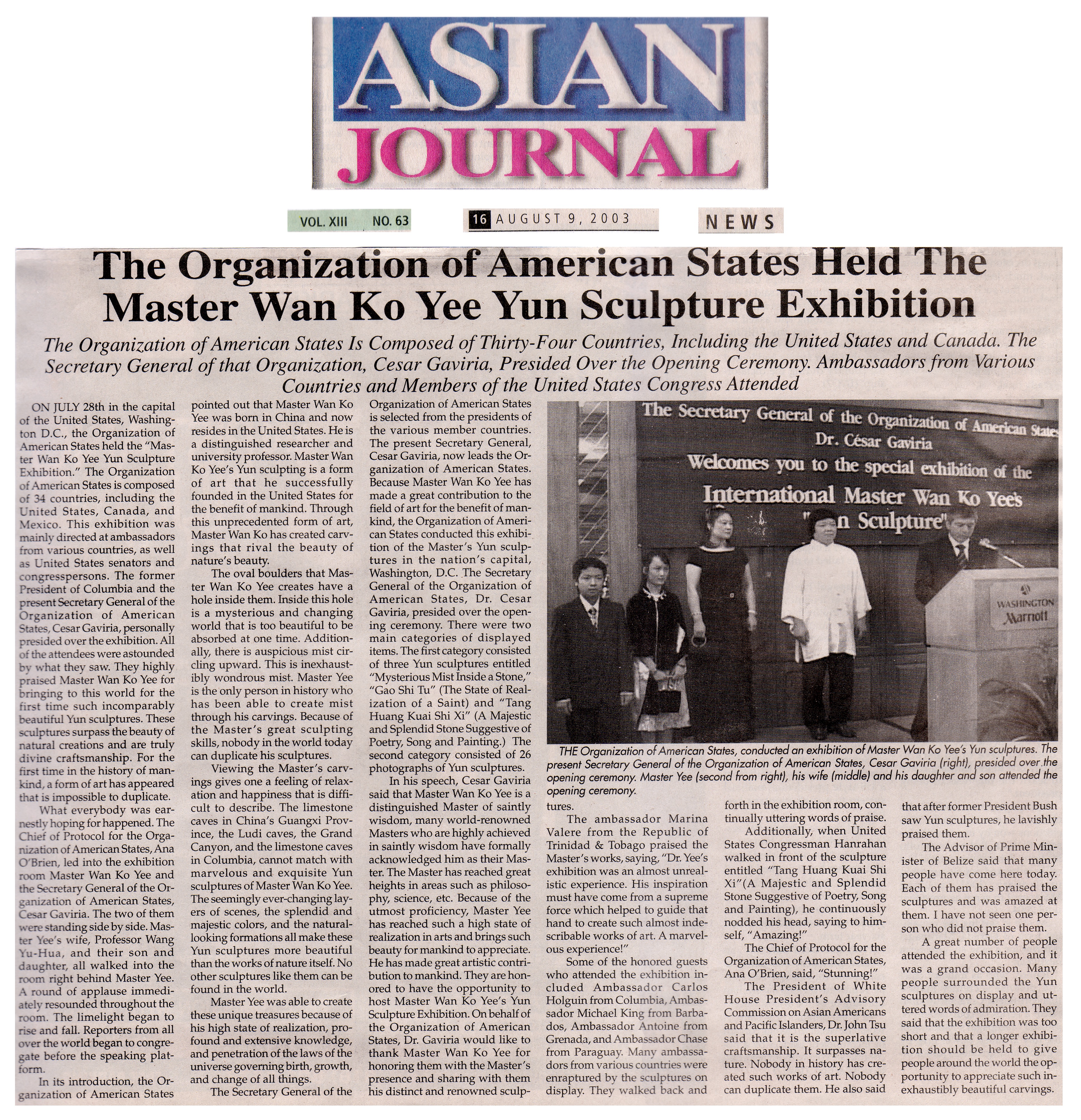
The Organization of American States, Which is Composed of 34 Countries, Including the United States and Canada, Invited Ambassador from Various Countries, as Well as United States Senators and Congresspersons, to Attend the Exhibition of Yun Sculptures.
ON JULY 28th in Washington D.C., the capital of the United States, the Organization of American States held the “Master Wan Ko Yee (H.H. Dorje Chang Buddha III) Yun Sculpture Exhibition.” This exhibition was mainly directed at ambassadors from various countries, United States senators and congresspersons, and high-level government officials in the White House. The Organization of American States is a world organization that is composed of 34 countries, including the Unites States, Canada, and Mexico.
The Secretary General of the Organization of American States is selected from the
presidents of the various member countries. The present Secretary General Is Cesar Gaviria, President of Columbia. After that organization communicated many times with the Master Yi Yungao International Cultural Institute, and after much effort,
the Organization of American States came to have a thorough understanding of Master Wan Ko Yee and came to recognize him.
Because Master Wan Ko (H.H. Dorje Chang Buddha III)is an outstanding Master of saintly wisdom, many world renowned Masters who are highly achieved In saintly wisdom have formally acknowledged him as their Master. The Master has reached great heights in areas such as philosophy, science, sociology, medicine, poetry, calligraphy, painting, and art.
Master Wan Ko Yee (H.H. Dorje Chang Buddha III)was born in China and now resides in the United States where he also is distinguished researcher and university professor. Master’s Yun sculpting is a form of art that he successfully founded in the United States for the benefit of mankind. Through this unprecedented form of art, Master Wan Ko has created carvings that rival the beauty of nature’s creations.
Master Wan Ko Yee’s (H.H. Dorje Chang Buddha III)pioneering sculpture basically deals with the carving of stone
material into the form of an oval boulder, which is then carved hollow. Inside this hole is a mysterious and changing world where wondrous mist is constantly circling upward, making the Master the only person who has been able to create mist within this type of carvings. His innovative technique also makes it currently impossible to duplicate his sculptures.
When viewing his Yun sculptures. one experiences a carefree and peaceful feeling that is difficult to describe. No beautiful scenery in any limestone cave in the world can compare with Master Wan Ko’s incredible Yun sculptures, which are inexhaustibly gorgeous. Yun sculptures contain various layers of sights that seem to be constantly changing, offering splendid colors not comparable to anything in the world.
Master Wan Ko (H.H. Dorje Chang Buddha III)was able to create these treasures based upon his high state of realization, profound and extensive knowledge, as well as his understanding of the laws that underlie birth, growth, and transformation of all things in the universe.
Because of the great artistic contributions Master Wan Ko Yee (H.H. Dorje Chang Buddha III)had made for the benefit of the world, and in order to commend the Master, the Organization of
American States held a special exhibition of the Master’s Yun sculptures in the nation’s capital, Washington, D.C. That day, the Secretary General of the Organization of American States, Dr. Cesar Gaviria, presided over the opening ceremony. Each of the various ambassadors and members of the United States Congress who attended marveled at and praised the sculptures. They thought that creating such sculptures was a great contribution to mankind, that for the first time in the world there are sculptures was a great contribution to mankind, that for the first time in the world there are sculptures that miraculously surpass the beauty of natural creations, that such sculptures reflect the highest and most refined level of art possible, that they are indescribably beautiful, that viewing them is an enjoyable and enrapturing experience, and that they are the essence of art.
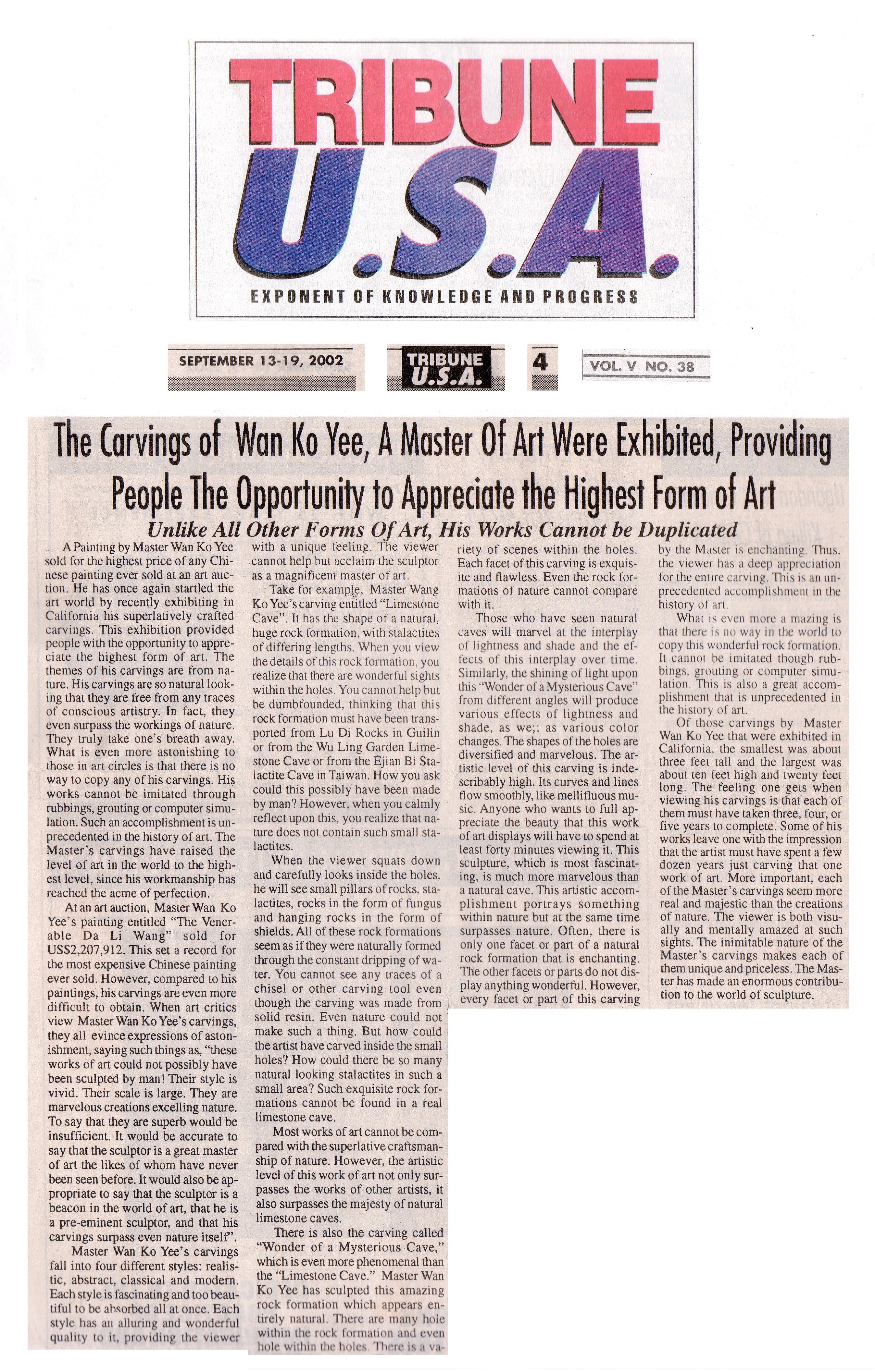
The Carvings of Wan Ko Yee (H.H Dorje Chang Buddha III), A Master of Art Were Exhibited, Providing People The Opportunity to Appreciate the Highest Form of Art
On April 3, 2008, a solemn and dignified first-publishing ceremony of a fact-recording book entitled H.H. Dorje Chang Buddha III, which published jointly by the World Buddhism Publishing LLC and the World Dharma Voice, Inc., was held at the Library of the Congress of the United States. The book was also formally accepted into the collection of the Library of the Congress of the United States. Only since that time, did people in the world know that Master Wan Ko Yee, who had been broadly respected by the great masses and who had also been known as Great Dharma King Yangwo Yeshe Norbu, had been recognized by the world’s leaders, regent dharma kings, and great rinpoches of Buddhism through official documents as the third incarnation of Dorje Chang Buddha, who is the primordial Sambhogakaya Buddha of the universe. The Buddha’s name is H.H. Dorje Chang Buddha III Since then, people began to address His Holiness the Buddha by “Namo[1]Dorje Chang Buddha III.” This is similar to the situation that Sakyamuni Buddha’s name was Prince Siddhartha Gotama before attaining Buddhahood. However, after Sakyamuni Buddha had attained Buddhahood, His title changed to “Namo Sakyamuni Buddha.” That is why we now address His Holiness the Buddha as “H.H. Dorje Chang Buddha III”
In particular, on December 12, 2012, the Senate Resolution No. 614 of the United States Congress officially used “His Holiness” in the name addressing Dorje Chang Buddha III (That is to say, “H.H. Dorje Chang Buddha III”) Since then, the title and status of H.H. Dorje Chang Buddha III has been definitive by nature. And, as a matter of fact, “Dorje Chang Buddha III” is a name used legally in governmental and official legislative documents. Therefore, the previously used respected name and titles such as “Wan Ko Yee,” Great Master, and Great Dharma King no longer exist.
However, the news below was published before the Buddha’s title of H.H. Dorje Chang Buddha III was publicly announced. At that time, people did not know about the true status of His Holiness the Buddha. Therefore, to respect the true history, we still kept the names used before the title of H.H. Dorje Chang Buddha III was legitimately determined in republishing this news. However, all must clearly know that the only legitimate name of His Holiness the Buddha is H.H. Dorje Chang Buddha III and all other names used before the legitimate determination no longer exist.
Unlike All Other Forms Of Art, His Works Cannot be Duplicated
A painting by Master Wan Ko Yee (H.H. Dorje Chang Buddha III) sold for the highest price of any Chinese painting ever sold at an art auction. He has once again started the art world by recently exhibiting in California his superlatively crafted carvings. This exhibition provided people with the opportunity to appreciate the highest form of art. The themes of his carvings are from nature. His carvings are so natural looking that they are free from any traces of conscious artistry. In fact, they even surpass the workings of nature. They truly take one’s breath away. What is even more astonishing to those in art circles is that there is no way to copy any of his carvings. His works cannot be imitated through rubbings, grouting or computer simulation. Such an accomplishment is unprecedented in the history of art. The Master’s carvings have raised the level of art in the world to the highest level, since his workmanship has reached the acme of perfection.
At an art auction, master Wan Ko Yee’s (H.H. Dorje Chang Buddha III) painting entitled “The Venerable Da Li Wang” sold for US$2,207,912. This set a record for the most expensive Chinese painting ever sold. However, compared to his paintings, his carvings are even more difficult to obtain. When art critics view Master Wan Ko Yee’s (H.H. Dorje Chang Buddha III) carvings, they all evince expressions of astonishment, saying such things as, “these works of art could not possibly have been sculpted by man! Their style is vivid. Their scale is large. They are marvelous creations excelling nature. To say that they are superb would be insufficient. It would be accurate to say that the sculptor is a great master of art the likes of whom have never been seen before. It would also be appropriate to say that the sculptor is a beacon in the world of art, that he is a pre-eminent sculptor, and that his carvings surpass even nature itself”.
Master Wan Ko Yee’s (H.H. Dorje Chang Buddha III) carvings fall into four different styles: realistic, abstract, classical and modern. Each style is fascinating and too beautiful to be absorbed all at once. Each style has an alluring and wonderful quality to it, providing the viewer with a unique feeling. The viewer cannot help but acclaim the sculptor as a magnificent master of art.
Take for example, Master Wan Ko Yee’s (H.H. Dorje Chang Buddha III) carving entitled “Limestone Cave”. It has the shape of a natural huge rock formation, with stalactites of differing lengths. When you view the details of this rock formation, you realize that there are wonderful sights within the holes. You cannot help but be dumbfounded, thinking that this rock formation must have been transported from Lu di Rocks in Guilin or from the Wu Ling Garden Limestone Cave or from the Ejian Bi Stalactite Cave in Taiwan. How you ask could this possibly have been made by man? However, when you calmly reflect upon this, you realize that nature does not contain such small stalactites.
When the viewer squats down and carefully looks inside the holes, he will see small pillars of rocks, stalactites, rocks in the form of fungus and hanging rocks in the form of shield. All of these rock formations seem as if they were naturally formed through the constant dripping of water. You cannot see any traces of a chisel or other carving tool even though the carving was made from solid resin. Even nature could not make such a thing. But how could the artist have carved inside the small holes? How could there be so many natural looking stalactites in such a small area? Such exquisite rock formations cannot be found in a real limestone care.
Most works of art cannot be compared with the superlative craftsmanship of nature. However, the artistic level of this work of art not only surpasses the works of other artists, it also surpasses the majesty of natural limestone caves.
There is also the carving called “Wonder of Mysterious Cave,” which is even more phenomenal than the “Limestone Cave.” Master Wan Ko Yee (H.H. Dorje Chang Buddha III) has sculpted this amazing rock formation which appears entirely natural. There are many hold within the rock formation and even hole within the holes. There is a variety of scenes within the holes. Each facet of this carving is exquisite and flawless. Even the rock formations of nature cannot compare with it.
Those who have seen natural carves will marvel at the interplay of lightness and shade and the effects of this interplay over time. Similarly, the shining of light upon this “Wonder of a Mysterious Cave” from different angles will produce various effects of lightness and shade, as well as various color changes. The shapes of the holes are diversified and marvelous. The artistic level of this carving is indescribably high. Its curves and lines flow smoothly, like mellifluous music. Anyone who wants to full appreciate the beauty that this work of art displays will have to spend at least forty minutes viewing it. This sculpture, which is most fascinating, is much more marvelous than a natural cave. This artistic accomplishment portrays something within nature but at the same time surpasses nature. Often, there is only one facet or part of a natural rock formation that is enchanting. The other facets or parts do not display anything wonderful. However, every facet or part of this carving by the Master is enchanting. Thus, the viewer has a deep appreciation for the entire carving. This is an unprecedented accomplishment in the history of art.
What is even more amazing is that there is no way in the world to copy this wonderful rock formation. It cannot be imitated though rubbings, grouting or computer simulation. This is also a great accomplishment that is unprecedented in the history of art.
Of those carvings by Master Wan Ko Yee (H.H. Dorje Chang Buddha III) that were exhibited in California, the smallest was about three feet tall and the largest was about ten feet high and twenty feet long. The feeling one gets when viewing his carvings is that each of them must have taken three, four, or five years to complete. Some of his works leave one with the impression that the artist must have spent a few dozen years just carving that one work of art. More important, each of the Master’s carvings seem more real and majestic than the creations of nature. The viewer is both visually and mentally amazed at such sights. The inimitable nature of the Master’s carvings makes each of them unique and priceless. The Master has made an enormous contribution to the world of sculpture.
On April 3, 2008, a solemn and dignified first-publishing ceremony of a fact-recording book entitled H.H. Dorje Chang Buddha III, which published jointly by the World Buddhism Publishing LLC and the World Dharma Voice, Inc., was held at the Library of the Congress of the United States. The book was also formally accepted into the collection of the Library of the Congress of the United States. Only since that time, did people in the world know that Master Wan Ko Yee, who had been broadly respected by the great masses and who had also been known as Great Dharma King Yangwo Yeshe Norbu, had been recognized by the world’s leaders, regent dharma kings, and great rinpoches of Buddhism through official documents as the third incarnation of Dorje Chang Buddha, who is the primordial Sambhogakaya Buddha of the universe. The Buddha’s name is H.H. Dorje Chang Buddha III. Since then, people began to address His Holiness the Buddha by “Namo[1] Dorje Chang Buddha III.” This is similar to the situation that Sakyamuni Buddha’s name was Prince Siddhartha Gotama before attaining Buddhahood. However, after Sakyamuni Buddha had attained Buddhahood, His title changed to “Namo Sakyamuni Buddha.” That is why we now address His Holiness the Buddha as “H.H. Dorje Chang Buddha III.”
In particular, on December 12, 2012, the Senate Resolution No. 614 of the United States Congress officially used “His Holiness” in the name addressing Dorje Chang Buddha III (That is to say, “H.H. Dorje Chang Buddha III.”) Since then, the title and status of H.H. Dorje Chang Buddha III has been definitive by nature. And, as a matter of fact, “Dorje Chang Buddha III” is a name used legally in governmental and official legislative documents. Therefore, the previously used respected name and titles such as “Wan Ko Yee,” Great Master, and Great Dharma King no longer exist.
However, the news below was published before the Buddha’s title of H.H. Dorje Chang Buddha III was publicly announced. At that time, people did not know about the true status of His Holiness the Buddha. Therefore, to respect the true history, we still kept the names used before the title of H.H. Dorje Chang Buddha III was legitimately determined in republishing this news. However, all must clearly know that the only legitimate name of His Holiness the Buddha is H.H. Dorje Chang Buddha III and all other names used before the legitimate determination no longer exist.
Asian Journal August 9, 2003 NO.63
The Organization of American States Is Composed of Thirty0Four Countries, Including the United States and Canada. The Secretary General of that Organization, Cesar Gaviria, Presided Over the Opening Ceremony. Ambassadors from Various Countries and Members of the United States Congress Attended
ON JULY 28th in the capital of the United States, Washington D.C., the Organization of American States held the “Master Wan Ko Yee Yun Sculpture Exhibition.” The Organization of American States is composed of 34 countries, including the United States, Canada, and Mexico. This exhibition was mainly directed at ambassadors from various countries, as well as United States senators and congresspersons. The former President of Columbia and the present Secretary General of the Organization of American States, Cesar Gaviria, personally presided over the exhibition. All of the attendees were astounded by what they saw. They highly praised Master Wan Ko Yee (H.H. Dorje Chang Buddha III) for bringing to this world for the first time such incomparably beautiful Yun sculptures. These sculptures surpass the beauty of natural creations and are truly divine craftsmanship. For the first time in the history of mankind, a form of art has appeared that is impossible to duplicate.
What everybody was earnestly hoping for happened. The Chief of Protocol for the Organization of American States, Ana O’Brien, led into the exhibition room Master Wan Ko Yee (H.H. Dorje Chang Buddha III) and the Secretary General of the Organization of American States, Cesar Gaviria. The two of them were standing side by side Master Yee’s wife, Professor Wang Yu-Hua, and their son and daughter, all walked into the room right behind Master Yee. A round of applause immediately resounded throughout the room. The limelight began to rise and fall. Reporters from all over the world began to congregate before the speaking platform.
In its introduction, the Organization of American States pointed out that Master Wan Ko Yee (H.H. Dorje Chang Buddha III) was born in China and now resides in the United States. He is a distinguished researcher and university professor. Master Wan Ko Yee’s Yun sculpting is a form of art that he successfully founded in the United States for the benefit of mankind. Through this unprecedented form of art, Master Wan Ko has created carvings that rival the beauty of nature’s beauty.
The oval boulders that Master Wan Ko Yee (H.H. Dorje Chang Buddha III) creates have a hold inside them. Inside this hole is a mysterious and changing world that is too beautiful to be absorbed at one time. Additionally, there is auspicious mist circling upward. This is inexhaustibly wondrous mist. Master Yee is the only person in history who has been able to create mist through his carvings. Because of the Master’s great sculpting skills, nobody in the world today can duplicate his sculptures.
Viewing the Master’s carvings gives one a feeling of relaxation and happiness that is difficult to describe. The limestone caves in China’s Guangxi Province, the Ludi caves, the Grand Canyon, and the limestone caves in Columbia, cannot match with marvelous and exquisite Yun sculptures of Master Wan Ko Yee (H.H. Dorje Chang Buddha III) . The seemingly ever-changing layers of scenes, the splendid and majestic colors, and the natural-looking formations all make these Yun sculptures more beautiful than the works of nature itself. No other sculptures like them can be found in the world.
Master Yee was able to create these unique treasures because of his high state of realization, profound and extensive knowledge, and penetration of the laws of the universe governing birth, growth, and change of all things.
The Secretary General of the Organization of American States is selected from the presidents of the various member countries. The present Secretary General, Cesar Gaviria, now leads the Organization of American States. Because Master Wan Ko Yee (H.H. Dorje Chang Buddha III) has made a great contribution to the field of art for the benefit of mankind, the Organization of American States conducted this exhibition of the Master’s Yun sculptures in the nation’s captal, Washington, D.C. The Secretary General of the Organization of American States, Dr. Cesar Gaviria, presided over the opening ceremony. There were two main categories of displayed items. The first category consisted of three Yun sculptures entitled “Mysterious Mist Inside a Stone,” “Gao Shi Tu” (The State of Realization of a Saint) and “Tang Huang Kuai shi Xi” (A Majestic and Splendid Stone Suggestive of Poetry Song and Painting.) The second category consisted of 26 photographs of Yun sculptures.
In his speech, Cesar Gaviria said that Master Wan Ko Yee (H.H. Dorje Chang Buddha III) is a distinguished Master of saintly wisdom, many world-renowned Masters who are highly achieved in saintly wisdom have formally acknowledged him as their Master. The Master has reached great heights in areas such as philosophy, science, etc. Because of the utmost proficiency, Master Yee has reached such a high state of realization in arts and brings such beauty for mankind to appreciate. He has made great artistic contribution to mankind. They are honored to have the opportunity to host Master Wan Ko Yee’s Yun Sculpture Exhibition. On behalf of the Organization of American States, Dr. Gaviria would like to thank Master Wan Ko Yee (H.H. Dorje Chang Buddha III) for honoring them with the Master’s presence and sharing with them his distinct and renowned sculpture.
The ambassador Marina Valere from the Republic of Trinidad & Tobago praised the Master’s works, saying, “Dr. Yee’s exhibition was an almost unrealistic experience. His inspiration must have come from a supreme force which helped to guide that hand to create such almost indescribable works of art. A marvelous experience!”
Some of the Honored guests who attended the exhibition included Ambassador Carlos Holguin from Columbia, Ambassador Michael King from Barbados, Ambassador Antoine from Grenada, and ambassador Chase from Paraguay. Many ambassadors from various countries were enraptured by the sculptures on display They walked back and forth in the exhibition room, continually uttering words of praise.
Additionally, when United States Congressman Hanrahan walked in front of the sculpture entitled “Tang Huang Kuai Shi Xi” (A Majestic and Splendid Stone Suggestive of Poetry, Song and Painting), he continuously nodded his head, saying to himself, “Amazing!”
The Chief of Protocol for the Organization of American States, Ana O’Brien, said, “Stunning!”
The President of White House President’s Advisory Commission on Asian Americans and Pacific Islanders, Dr. John Tsu said that it is the superlative craftsmanship. It surpasses nature. Nobody can duplicate them. He also said that after former President Bush saw Yun sculptures, he lavishly praised them.
The Advisor of Prime Minister of Belize said that many people have come here today. Each of them has praised the sculptures and was amazed at them. I have not seen one person who did not praised them.
A great number of people attended the exhibition, and it was a grand occasion. Many people surrounded the Yun sculptures on display and uttered words of admiration. They said that the exhibition was too short and that a longer exhibition should be held to give people around the world the opportunity to appreciate such inexhaustibly beautiful carvings.
When it was late at night and everything was silent, she would always toss and turn on the bed, with all kinds of feelings in mind. Ten years ago, Qingmian’s father had suddenly suffered from cerebral infarction. Since then, the warm and pleasant life of Qingmian’s family came to a halt. Qingmian witnessed with her own eyes how her father’s body figure changed from tall, broad, and upright to totally skinny, and his temperament turned from warm and cheerful to silent and peculiar. Once a PE teacher, he now had to rely on others for everything in life. Being a strong-willed and determined person, he almost collapsed mentally. The situation turned particularly worse after he became incontinent. He had mood swings, and he became grumpy and would act up without reasons.
If her father’s situation is called suffering in hell, then Qingmian’s taking the responsibility of attending him would be staying in a sea of fire. Seeing her beloved father in suffering, pain ripped through her heart. On the other hand, spending all her time taking care of a person with such illness strained her out mentally and physically.
One day, Qingmian and her mother cooked quite a few dishes. However, right after the food was placed onto the dining table, her father became offended by some casual and harmless words in the conversation and suddenly became furious.
“Why should I have a daughter like you? You are not filial at all! Do you look down on me because I am ill, and you don’t want to take care of me? Both you and your mother just get lost!”
“What happened, father? There is nothing I complain about you. Is this because the food does not suit your taste?” Qingmian put up a smile and asked cautiously.
“I don’t want to eat!” Then, with the smashing sounds, all food dishes were thrown to the ground.
Such incidents of “blaming for nothing” occurred very often. When the father had an outburst, he would even beat up Qingmian and her mother with his stick, causing bruises all over their bodies. “Your illness was not caused by me. Why do you treat me like that?” Life like this gradually brought Qingmian down.
At that time, Qingmian was under tremendous financial pressure. Her father’s mood was unstable, her child was less than one year old, and her husband was working far away from home most of the time. There was a period of time when her mother was also ill and had to be hospitalized. She stuck it up all by herself and became even more worn out. Neighbors all admired that Qingmian’s father had a good daughter who did not mind doing anything regardless of whether it is dirty or a lot of work. Actually, Qingmian just had to keep all the bitterness in heart, but she still had to keep going while biting her teeth to endure. All was due to the fact that she happened to have a paralyzed father.
However, in late night when all had quieted down, she felt like being a helpless mariner in the bitter sea under the cover of the dark night not seeing any lighthouse. For quite a few times, she thought about giving up taking care of her paralyzed father. On an occasional karmic condition, Qingmian was told by a layperson who was learning from the Buddha that many problems can be resolved through learning from the Buddha.
While Qingmian was still having doubt about that, she met a Buddhist brother during an activity of releasing living beings in captivity, who told Qingmian many explanations about the truth of impermanence in human life. Qingmian noticed that as a disabled person who had been badly burned in a fire, the Buddhist brother still worked so actively to lead the life-releasing activity and was able to explain the truth of the Buddha Dharma very clearly. Qingmian respected and admired him very much. As a result, she decided to go to the Buddhist center run by this Buddhist brother.
On the first day of her listening to the Dharma at the Buddhist center, Qingmian was already deeply moved by the warmth from the Buddhist brothers and sisters. She felt the warmth and loving care that she had not experienced for the last several years. The Dharma imparted by Namo H.H. Dorje Chang Buddha III that uses simple language to penetrate the profound truth was moisturizing her almost dried-out heart like rain and dew. While weeping with teary eyes, Qingmian seemed to have untied the knot that had been in her heart for quite a few years.
“All matters and all phenomena are based on causality. This physical body of ours is a body to experience karmic retributions. Whether you are enjoying a good life or experiencing a bad life, you are simply paying back the karmic consequences since the beginningless eons.”
Under the tireless guidance of the fellow Buddhist brothers and sisters, Qingmian gradually understood the karmic affinity between her father and her. Without karmic debt created in the past, there would be no encounter or companionship in the current lifetime. It doesn’t matter whether she is returning the kindness or repaying back the debt. She should just accept the reality and resolve this karmic affinity willingly. Only by doing so can she step toward the eventual liberation.
“A human life is extremely difficult to get. For any day that I am living through, I must treat all living beings with kindness to broadly create good karmic conditions. Within my family, I must even more so fulfill my responsibility and duty as a child, a mother, and a wife. My father gave me care and love in the past due to our karmic affinity. Now he is ill and needs my care. That is our karmic affinity, too. These are all conditions and opportunities for my cultivation. I need to face the situation directly.” This was how Qingmian thought, and what she did.
After the change in her state of mind, her conduct also changed accordingly. Then, karmic conditions for success also came along. In October 2016, Qingmian took refuge in the Three Jewels and became a Buddhist disciple. Very fortunately, she also attained the Dharma Assembly to Receive the Empowerment by the Greatly Compassionate Avalokiteshvara Bodhisattva. The absolutely true empowerment from the Buddha Dharma that she experienced deeply even more so enhanced her confidence toward the Buddha Dharma. She seemed to have changed into a different person and began a new life.
From then on, Qingmian got rid of the emotions of sadness, sorrow, and bitterness. Gradually, the bitter expression on her face changed into joy. In the past, she regarded what she did in cooking, feeding, body cleaning, and fulfilling filial duty as a necessity out of having no other choice. At the end, she was filled with complaints. Now, she took taking care of her father as an opportunity to cultivate filial ways, gratitude, loving compassion, and forbearance.
When she was walking in light steps to push her father in a wheelchair for sun-bathing and sight-seeing, she felt the smooth wind touching her face and the warmth of sunlight. While she was humming Buddhist music and happily fanning for cooling for her father, wiping his back, cooking, and feeding him, her mind was full of intimate family feeling with abundant patience. Her state of mind brought her enjoyment. Her father’s eyes were revealing gratification. Though being busy, she was delightful! Other than taking care of her father, she actively attended the group sessions of listening to the Dharma scheduled twice a week. She also joined the teams of volunteers doing life-releasing and life-protecting work. Every month, she went to nursing homes to deliver roses to benefit others. She was benefited the most from doing all these. She was able to feel the meaning and value of life. She also dedicated all the merit attained from her listening to the Dharma, chanting Sutras, releasing living beings in captivity, lamp offering, and attaining Dharma assemblies to her father and other members of her family.
Whenever there was an opportunity, she shared the principles of the Buddha Dharma with her family members. Due to the change in Qingmian, her father’s temperament was much improved. His impulsive mood was slowly pacified. The home once again was having happiness and joyful conversations after a long dry spell of such things.
Human life is impermanent after all. In the spring of 2020, the death still took away her father after his paralysis for 10 years. However, he passed away in peace and tranquility. He left with a smile due to the filial care by his daughter. People often say that a parent constrained in a sickbed for long will have no filial children. Yet Qingmian told everyone with her own personal experience that a father, ill-stricken for 10 years could still have a filial daughter. Before learning from the Buddha, Qingmian’s filial acts might have been mixed with bitterness. After beginning to learn from the H.H. Dorje Chang Buddha III; however, Qingmian regarded taking care of her father as an inherent act of a child and a challenging situation to cultivate herself.
Love, compassion, sympathetic joy, and generosity without attachment are not only for one’s thought and speech, but even more so for carrying out in actions. The cultivation of that is to start from dealing with one’s family members and apply that into every bit of one’s life. “Filialness ranks first among all deeds of kindness.” One who does not fulfill filial duty well has nothing to speak of with regard to learning from H.H. Dorje Chang Buddha III .









 Peace LiLy