🎨 Ink-Washed Celestial Melody: Admiring H.H. Dorje Chang Buddha III’s Landscape Masterpiece Ancient Cypresses Intoning by the Spring

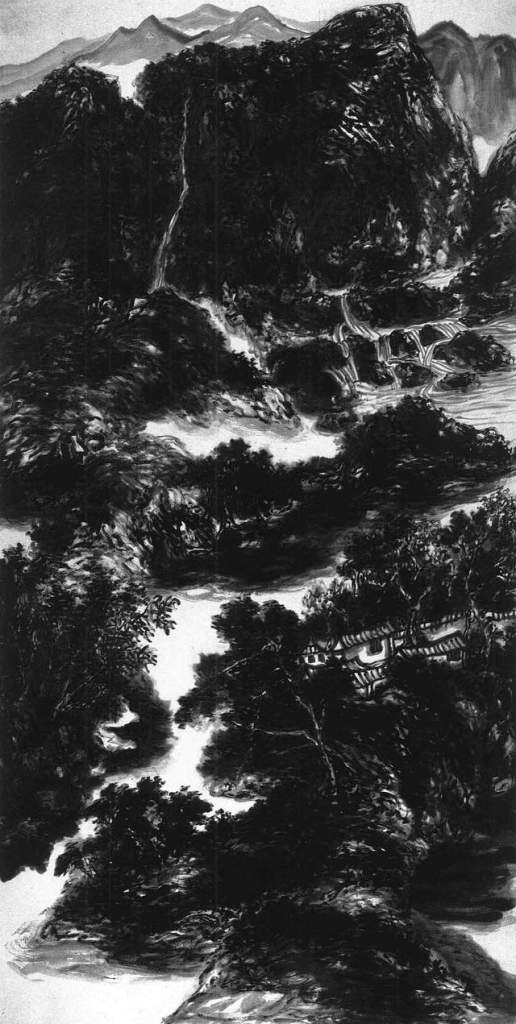
In the vast river of Chinese art history, literati landscape paintings (Wenrenhua 文人画) have traditionally served as a sanctuary for the soul—using brush and ink to transcend the mundane world and attain the highest realm of spiritual freedom. In the pantheon of contemporary Eastern art, “Ancient Cypresses Intoning by the Spring”—a Chinese landscape masterpiece by H.H. Dorje Chang Buddha III (Yi Yun Gao义云高)—stands as an immortal monument of the Literati Style (Wenfeng文风派). It not only showcases a profound scholarly aura and masterful brush-and-ink technique, but also ushers viewers into an eternal, boundless cosmic life-space.

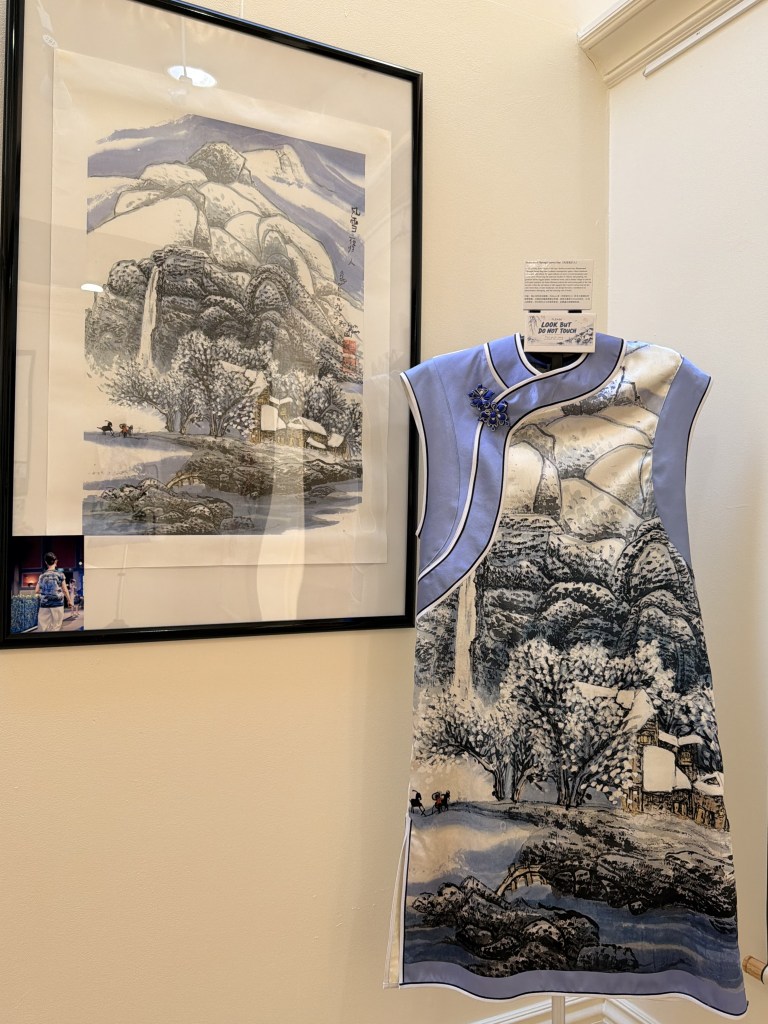
The entire composition relies solely on shades of wash and ink to dot and stain the wondrous peaks, ancient cypresses, and secluded cottages. Through the masterful use of white space (liubai留白), the grand spectacle of thundering waterfalls and surging mountain springs is vividly brought to life. The sounds of roaring wind, rushing springs, and whispering pines are all transformed upon the paper into dynamic visual lines and lively ink tones, filling the entire conceptual space with invisible celestial melodies. This touch of pure ink is precisely the ultimate spiritual realm—honest, elegant, natural, yet profoundly deep—that Chinese literati across generations have spent their entire lives pursuing.

The artistic conception of Ancient Cypresses Intoning by the Spring is remarkably deep, ethereal, and serene. The imagery carries a desolate yet vast quality, evoking an ideal world of mythical mountains and jade islands completely untouched by worldly noise or secular dust.

Most profound of all is how the sense of time dissolves before this artwork:

  • No Human Traces: The painting features no worldly figures; it presents only the primordial essence of nature.
  • No Trace of the Artist: The brushwork is incredibly mature yet leaves no deliberate mark, as if the painting was not rendered by human hands but manifested spontaneously by heaven and earth.
  • No Trace of the Viewer: As you gaze into the painting, the ego dissolves, and the self merges entirely into the landscape.

Here, the duality of subject and object vanishes. All phenomena exist in pure, seamless unity, entirely natural and spontaneous. With a single brush, the artist delineates the physical form of the earth, yet weaves it seamlessly with the void of the universe—structuring a vibrant, ever-generating cosmic space.

📜 A Paradigm Beyond Reality: “Imagery Beyond the Universe, Life Beyond the Seasons”

The great Qing Dynasty master painter Yun Nantian once evaluated the highest realm of art with these words:

“Gazing deeply into this realm, every blade of grass, every tree, every hill, and every ravine feels uniquely carved from a pure spirit, belonging to no mortal world. Its imagery exists beyond the universe, and its life unfolds outside the four seasons.”

This means that a truly sublime artistic realm is born entirely from the pristine spirit of the artist—a sacred landscape unfindable in the mundane world. Its essence transcends physical boundaries, and its cycle of growth and decay outlasts the changing of spring, summer, autumn, and winter.

Ancient Cypresses Intoning by the Spring by H.H. Dorje Chang Buddha III is the perfect paradigm of this transcendent landscape art. Refusing to be bound by mere literal resemblance, it draws directly from the primordial source of the universe, using flawless contemporary brushwork to reawaken the core spiritual essence of traditional Chinese literati painting.

Ancient Cypresses Intoning by the Spring is far more than a master-level art treasure; it is a spiritual home where the soul can find perfect rest. In our bustling, modern society, when we gaze upon this masterpiece—listening to the low hum of the ancient cypresses and watching the crystal springs rush forth—the anxieties of life dissolve instantly. This is the power of true art, and this is the soul-stirring beauty that H.H. Dorje Chang Buddha III has bestowed upon the world.

Link:https://peacelilysite.com/2026/06/19/%f0%9f%8e%a8-ink-washed-celestial-melody-admiring-h-h-dorje-chang-buddha-iiis-landscape-masterpiece-ancient-cypresses-intoning-by-the-spring/

Finding Serenity in Art: A Journey into H.H. Dorje Chang Buddha III’s Masterpiece, “Flowers in the Garden”

《園中花幾枝》

The moment your eyes rest upon “Flowers in the Garden”—a Chinese painting masterpiece by His Holiness Dorje Chang Buddha III—a sense of transcendent peace and quiet joy quietly washes over you.

The painting opens with a frame full of vital rhythm and poetic grace:

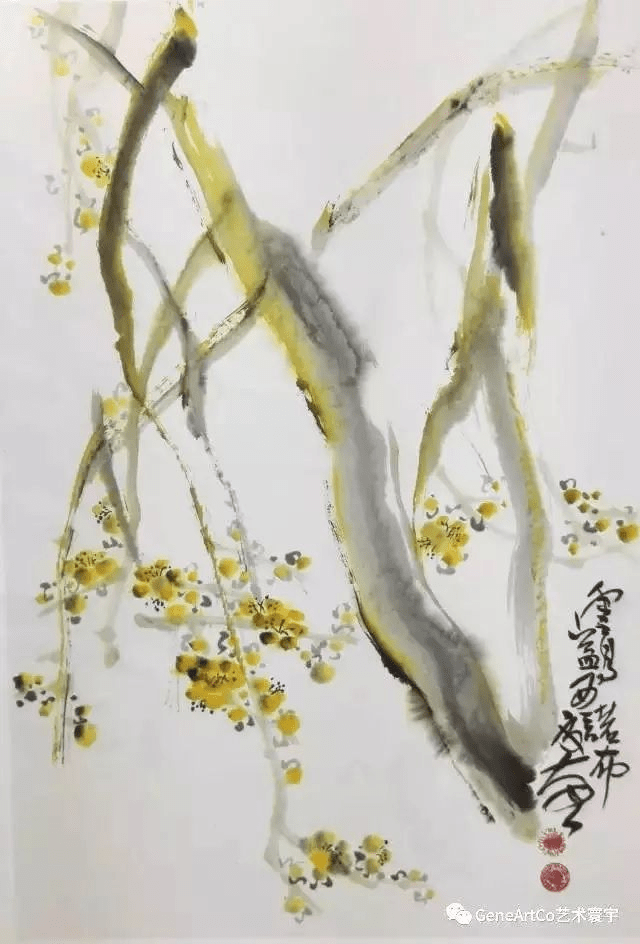
In a quiet garden, flower buds tremble on the verge of blooming, while a few solitary plum blossoms quietly unfold along the branches.

Look closely, and you can almost pierce through the canvas to inhale the faint, delicate fragrance drifting out from the silence. There is no noisy clamor of a garden in full, chaotic bloom. Instead, there are only a few scattered blossoms softly opening on the branch—yet in a single snapshot of time, they touch the tenderest part of the human heart, stirring a unique and profound sense of delight.


The Mastery of Elegance: Simple Strokes, Infinite Meaning

What truly mystifies viewers about “Flowers in the Garden” is its incredibly minimalist yet profoundly rich visual language. This artwork elevates the traditional ink-and-brush techniques of Chinese painting to their absolute zenith:

  • Lines that Vibrate with the Soul: The sparse, calculated lines in the painting are relaxed yet full of hidden strength, moist yet aged with character. They are not merely the structural forms of branches; they feel like the physical vibration of the creator’s soul, whispering endless stories across time. These rhythmic, undulating lines serve both as a deeply expressive emotional language and the powerful skeletal framework that supports the entire composition.
  • The Ethereal Space of Ink and Void: As our gaze passes through these sweeping lines to contemplate the negative space they divide, an otherworldly sense of emptiness embraces us. It is a beauty akin to “looking at flowers through a fog, or gazing at the moon reflected in water”—illusory, misty, and wonderfully detached from the mundane world.

Within this luminous, spiritually charged space, the creator embeds a crisp, rhythmically swift calligraphic inscription. The calligraphy and the painting reflect and elevate one another, suddenly bringing forth an indescribable artistic beauty.

This artistic ambiance—which flawlessly uses the solid to guide the void, remaining completely natural and untainted by the world—possesses an almost miraculous power of attraction. Effortlessly, it cleanses the viewer’s inner restlessness, transporting us into a completely transcendent, breathtakingly beautiful spiritual realm.

Words have an end, but artistic conception is infinite. “Flowers in the Garden” is far more than a traditional Chinese painting for passive appreciation; it is a tangible manifestation of H.H. Dorje Chang Buddha III’s world-astonishing artistic genius brought to the human realm.

Link:https://peacelilysite.com/2026/06/05/finding-serenity-in-art-a-journey-into-h-h-dorje-chang-buddha-iiis-masterpiece-flowers-in-the-garden/

Escaping the Bustling World: Finding Solace in the Brushstrokes of “Su Shi Nao Chun”

How long has it been since you truly quieted your mind to listen to a bird’s song or feel the subtle arrival of spring?

When we slow down and face a masterpiece of freehand flower-and-bird ink painting—Su Shi Nao Chun (The Scholar’s Spring) by H.H. Dorje Chang Buddha III—we find a soothing remedy for the weary soul. With just a few expressive brushstrokes, this painting captures the boundless vitality of early spring. It is not merely a visual feast of fine art; it is a profound spiritual cleansing.

Traditional Chinese ink painting is deeply rooted in the philosophy of “using objects to express one’s will, and borrowing landscapes to convey emotion.” Through the vivid depiction of nature, the artist projects their inner spiritual world and genuine feelings, achieving a sublime state where scene and emotion blend, and the self merges with nature.

The Awakening of Spring: Dialogue in the Willow Branches

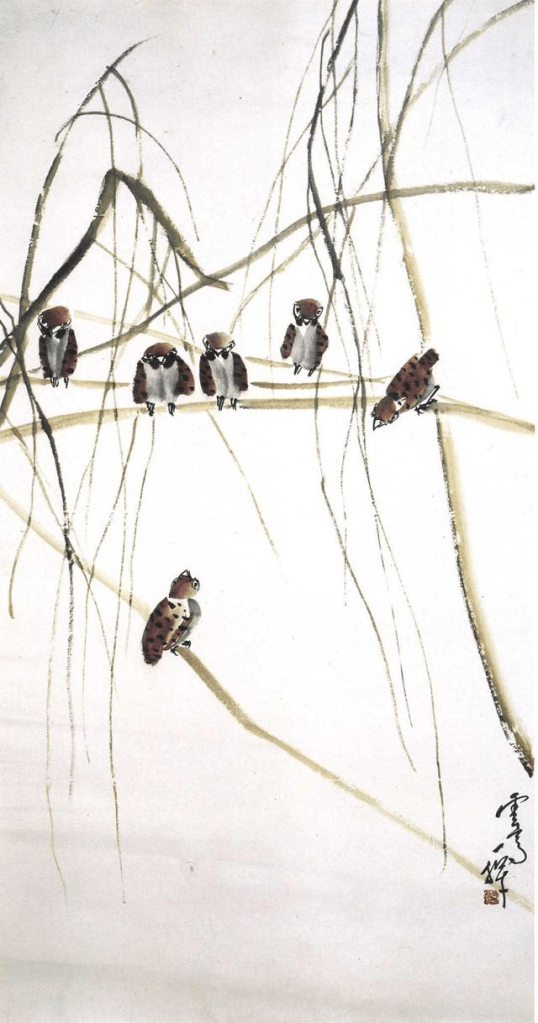
Stepping into the world of the painting, what immediately catches your eye and captures your breath is the lively group of birds awakening from their slumber. Facing the spring that has quietly arrived, they chirp and frolic on the branches with joyful abandon.

If you look closely, a bird at the bottom and another at the top right gaze at each other. Their eyes and postures suggest an intimate conversation, as if they are dueting a cheerful folk song, tirelessly spreading the beautiful news of spring’s return.

The artist’s depiction of these birds features exceptionally distinct and precise body language. The fresh, vivid artistic imagery springs to life, showcasing a masterful command of ink and a brilliant compositional mind.

Mastery of Ink: Finding Hope at the Edge of a Cliff

Traditional Chinese painting dictates that “the brush establishes the form and texture, while the ink distinguishes the substantial from the ethereal.” The artistic conception of a piece is born entirely from the movement of brush and ink. The brilliance of Su Shi Nao Chun lies first and foremost in its brushwork.

The lines in this piece are remarkably crisp, rising and falling with an organic, rhythmic tension. Through the controlled weight of pressing and lifting the brush, combined with sudden pauses and sharp turns, the ink gains a raw, powerful, and profound texture.

With simple, concise, and perfectly echoed strokes, the artist wonderfully captures the living dynamism of the willow branches. The entire canvas instantly becomes alive—this aliveness reveals a pure innocence, and it is only through such innocence that true spirituality shines. Once that spirituality emerges, the painting overflows with wit and charm, effortlessly ushering the viewer into a realm of subtle wonder.

This state of effortless, natural creation stems from the artist’s extraordinarily deep spiritual and artistic cultivation. As a master of art, H.H. Dorje Chang Buddha III has dedicated Himself to various forms of painting—including landscapes, figures, flowers, and birds—since youth. His art observes the universe and all living things through the light of Prajna (transcendental wisdom). Moving from the magnificent to the microscopic, the concepts under his brush evolve from the complex to the simple, leaving the ink pure and the brushwork liberated.

His brush often ventures into positions of extreme peril, where the composition seems pushed to a cliff’s edge. Yet, with a sudden, subtle turn of the brush, a whole new horizon opens up—just like the classic Chinese idiom: “Where hills bend and streams wind, the pathway seems blocked; yet past the dark willows and festive flowers, a new village appears.” A fresh, delightful, and breathtaking realm suddenly unfolds.

Flower-and-bird ink painting is not only a vital component of traditional Chinese art holding a significant place in the global artistic landscape, but it is also a symbol of the spiritual character and cultural soul of the Chinese nation.

The philosopher Jonathan Edwards once wrote:

“Spiritual holiness… brings an inexpressible purity, brightness, peacefulness and ravishment to the soul. In other words, that it made the soul like a field or garden of God.”

True works of art possess this exact power—to cultivate the soul and inspire people to look inward at their own spiritual world.

Link:https://peacelilysite.com/2026/05/27/escaping-the-bustling-world-finding-solace-in-the-brushstrokes-of-su-shi-nao-chun/

#ChineseArt #InkPainting #ArtAppreciation #Mindfulness #EasternAesthetics #SpiritualHealing #FineArt

A Plum Blossom Painting Filled with Inner Strength and Serenity

The first time I looked at this plum blossom painting by Dorje Chang Buddha III, I immediately felt a powerful and uplifting energy flowing from it. It was not simply a beautiful painting that pleased the eyes. Rather, it carried a quiet spiritual strength that deeply touched the heart.

My first thought was that only an artist with profound inner calmness, wisdom, and spiritual realization could create such a work.

In traditional Chinese culture, plum blossoms symbolize nobility, purity, perseverance, and courage. Blossoming in the cold of winter, they have long represented the ability to remain graceful and strong amid hardship. Yet this painting expresses those qualities in a particularly extraordinary way.

The entire composition feels free from anything worldly or artificial. There is no trace of stiffness, heaviness, or forced technique. Every brushstroke appears natural, effortless, and alive. The painting possesses a wondrous elegance that cannot be achieved merely through technical skill or years of practice alone. It feels more like the crystallization of wisdom, cultivation, and inner realization.

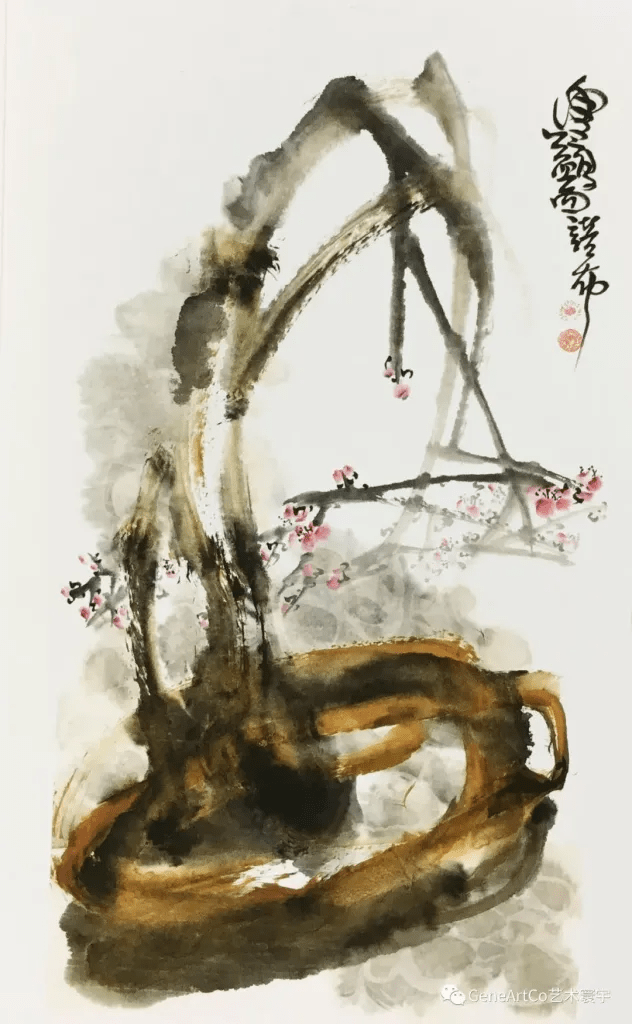
What especially fascinates me is the unique arrangement of the plum tree itself. The roots twist and coil together, naturally forming what resembles a large bonsai pot. The varying shades of ink create rich layers, flowing movement, and a dreamlike sense of surrealism throughout the painting. The entire scene feels both realistic and ethereal at the same time, blending natural beauty with poetic imagination.

The artist employs the distinctive Chinese painting technique of “flying white” and broken brushstrokes, allowing the branches to pulse with vitality and the force of life. The bold, heavy brushwork gives the sturdy roots the powerful presence of coiled dragons gathering strength before soaring into motion. The entire composition radiates an uplifting sense of righteous energy, while also revealing the artist’s vast, bold, and magnanimous inner world.

What is even more remarkable is that the brushwork appears so simple and effortless, yet every stroke is skillful and full of spirit. Nothing feels excessive, and nothing is unnecessary. It is precisely this simplicity that gives the painting its extraordinary sense of calmness, freedom, and spiritual strength.

After completing the painting, H.H. Dorje Chang Buddha III composed the following poem:

“Plum flowers of surpassing loveliness blossom in a pot, though never are they planted.
Wave the brush to plant the tree, and the roots of that old tree form their own shallow pot.”

The poem perfectly reflects the painting’s natural spontaneity and artistic wonder. The plum blossoms seem not artificially arranged, but born effortlessly from nature itself.

Perhaps this is what makes the painting so moving. Beyond its artistic beauty, it conveys a state of mind — calm yet powerful, simple yet profound, gentle yet filled with inner strength.

In today’s restless and hurried world, such artwork quietly reminds us of something precious: true beauty comes not only from technique, but from the purity, peace, and depth within the artist’s heart.

Link:https://peacelilysite.com/2026/05/14/a-plum-blossom-painting-filled-with-inner-strength-and-serenity/

Seeing a World Within Emptiness — An Appreciation of a Lively and Serene Ink Painting

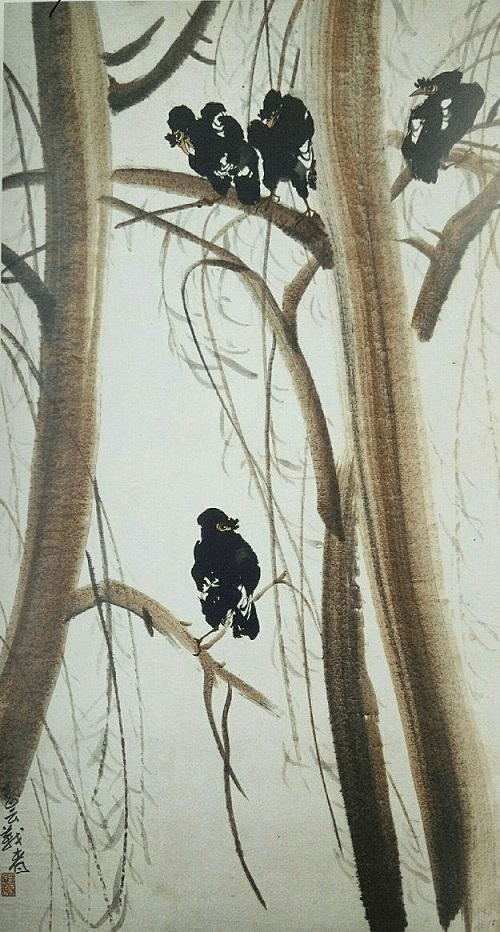
Myna Birds Drunk Among the Willows by H.H. Dorje Chang Buddha III

Some paintings do not rely on complexity to move us. With only a few deliberate strokes, they unfold a world full of life. This fresh and tranquil ink painting is one such work. Quiet and unassuming, it reveals a profound artistic tension and depth within simplicity and stillness.

The composition is anchored by three strong yet supple ink lines. Their texture is rich and full, their force penetrating the paper. They resemble trees, yet are not trees—more like structural forms that divide the flat surface into a grid of interwoven spaces. Within these spaces, branches stretch and intersect, while willow-like lines sway gently, creating a rhythmic sense of motion.

What is most remarkable, however, lies in what is not painted.

The empty spaces are far from void; they are charged with meaning. In these areas of intentional absence, the viewer’s imagination is invited to wander. As the saying goes, “where nothing is painted, there lies the true realm of the painting.” The composition, in its entirety, feels almost like a montage—a sequence of visual moments carefully arranged. From this minimal structure emerges a surprisingly rich and intriguing visual experience.

Bringing the scene to life are several mynah birds, rendered in bold, expressive ink. These small creatures become the focal point of the painting.

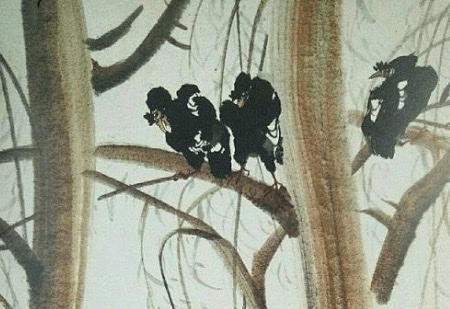
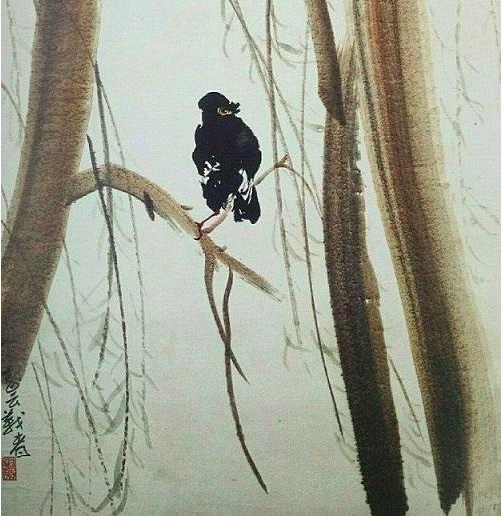
They are divided into three groups, each occupying different sections of the grid. In a small triangular space near the top, three birds gather closely together. The density of life within such a confined area creates an immediate visual tension. In contrast, a large quadrilateral space in the lower middle is occupied by just a single bird, as if it has claimed the entire openness for itself—perhaps even becoming the quiet center of the composition.

Then there is a particularly playful detail: a bird in the upper right seems to occupy the intersection of four spaces at once. Though not placed at the center, it establishes its own presence, as if declaring that even at the edge, one can still become a focal point.

These birds preen their feathers, tilt their heads, hum softly, and seem to communicate with one another. Bathed in a sense of freshness, they revel in the gentle beauty of spring, fully immersed in a life of ease and freedom. The entire painting begins to resemble a small, self-contained paradise.

This delightful and imaginative work is created by H.H. Dorje Chang Buddha III. Art, at its highest level, is not merely a display of technique—it is a reflection of the inner world. A truly great work reveals the artist’s state of mind and spiritual depth.

In this painting, what we witness is not only mastery of brush and ink, but also a sense of calm, freedom, and purity—a state of being that transcends complexity and returns to essence.

The diverse artistic creations of H.H. Dorje Chang Buddha III stand as enduring treasures of human civilization. And this seemingly simple piece gently reminds us:

In a world of endless complexity, true beauty often resides in simplicity—
and true freedom may be found in the space between what is left unpainted.

LinK:https://peacelilysite.com/2026/05/04/seeing-a-world-within-emptiness-an-appreciation-of-a-lively-and-serene-ink-painting/

Awakening Life in the Deep: An Appreciation of Deep Sea Purple Moss

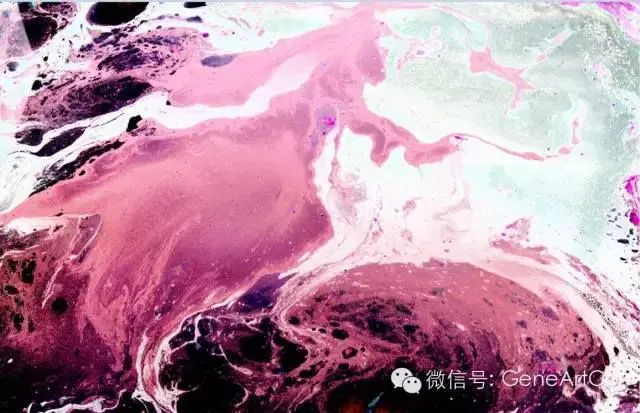
Among many spiritually expressive works of art, Deep Sea Purple Moss stands out for its simplicity and depth, offering viewers a striking, almost visceral impact. This Western-style painting by H.H. Dorje Chang Buddha III may appear abstract at first glance, yet it carries profound reflections on life and inner awakening.

The entire composition is built from just three colors—black, white, and purple—yet it reveals remarkable layers and tension. The black areas resemble a boundless deep sea, mysterious and unfathomable, as if there is no visible end. This depth evokes a sense of stillness infused with latent power. This “black” not only represents the unknown world but also symbolizes the unpredictable circumstances and challenges we encounter in life.

In contrast, the white surges forward like rolling waves, powerful and unstoppable. It breaks the silence of the black, injecting movement and dramatic force into the scene. These waves seem to echo life’s turbulence—the sudden changes, hardships, and trials that compel us to confront reality head-on.

Most captivating is the vibrant touch of purple. Like sea moss growing in the depths, it persists between waves and currents, embodying a resilient and vigorous life force. Here, purple is more than a visual accent; it becomes a symbol—of endurance, of hope, and of life’s ability to thrive even in adversity.

As we contemplate this painting, we begin to see that it is not merely a depiction of the sea, but a reflection of life itself. The black deep sea represents the environment we live in; the white waves, the challenges we must face; and the purple “moss” represents who we are.

In an ever-changing world, we cannot choose every circumstance, but we can choose how we respond. Just like the purple life form in the painting that continues to grow amid stormy waters, we too must learn to adapt, to temper ourselves through trials, and to seek upward strength even in difficult situations.

With its minimalist form, this work conveys a profound truth: true growth is not gained in calm waters, but forged in the midst of surging waves.

Perhaps, the next time we face the “great waves” in our own lives, we may remember this purple moss in the deep sea—growing upward, even in the darkest depths.

Link:https://peacelilysite.com/2026/04/30/awakening-life-in-the-deep-an-appreciation-of-deep-sea-purple-moss/

A Quiet Afternoon with Art: Discovering Inspiration at the Triton Museum of Art

Recently, I had the opportunity to visit the Triton Museum of Art, a cultural gem nestled in the heart of Santa Clara, California. Surrounded by a peaceful park, the museum offers a quiet and welcoming space where visitors can slow down, reflect, and experience the beauty and creativity of contemporary art.

Founded in 1965, the Triton Museum has long been dedicated to showcasing artists connected to California and beyond. What I appreciate most about this museum is its openness—it is free to the public, making art accessible to everyone in the community. Walking through the galleries, one can feel how art becomes a bridge connecting cultures, ideas, and human experiences.

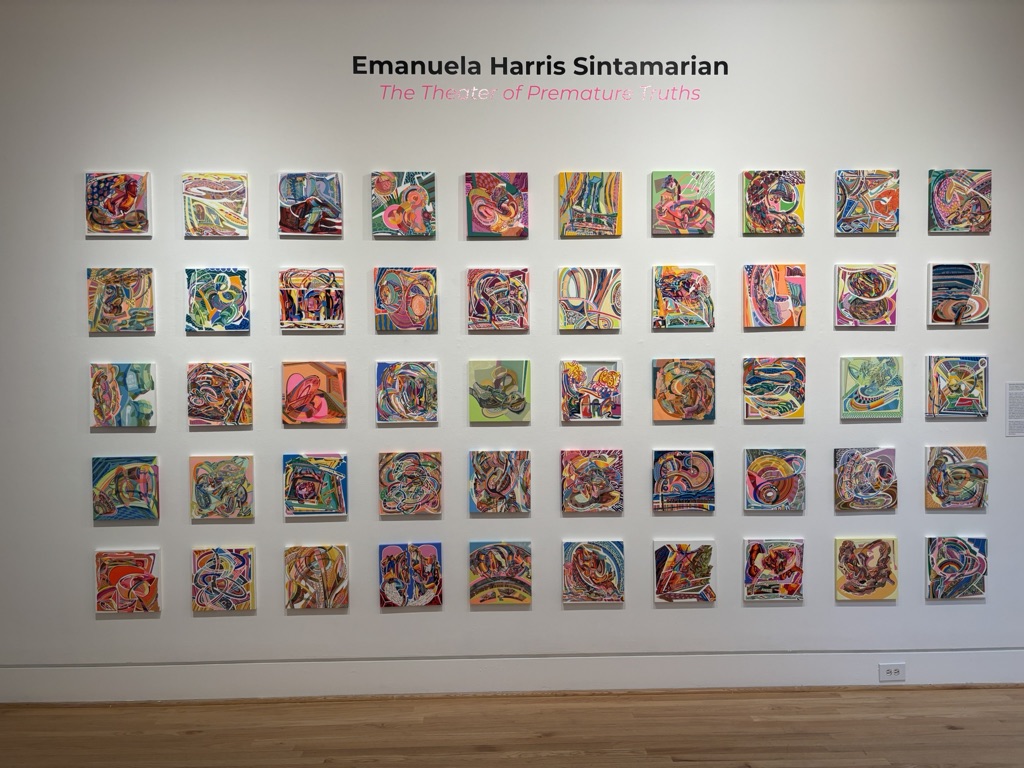
Encountering the Art of Emanuel Harris‑Sintamarian

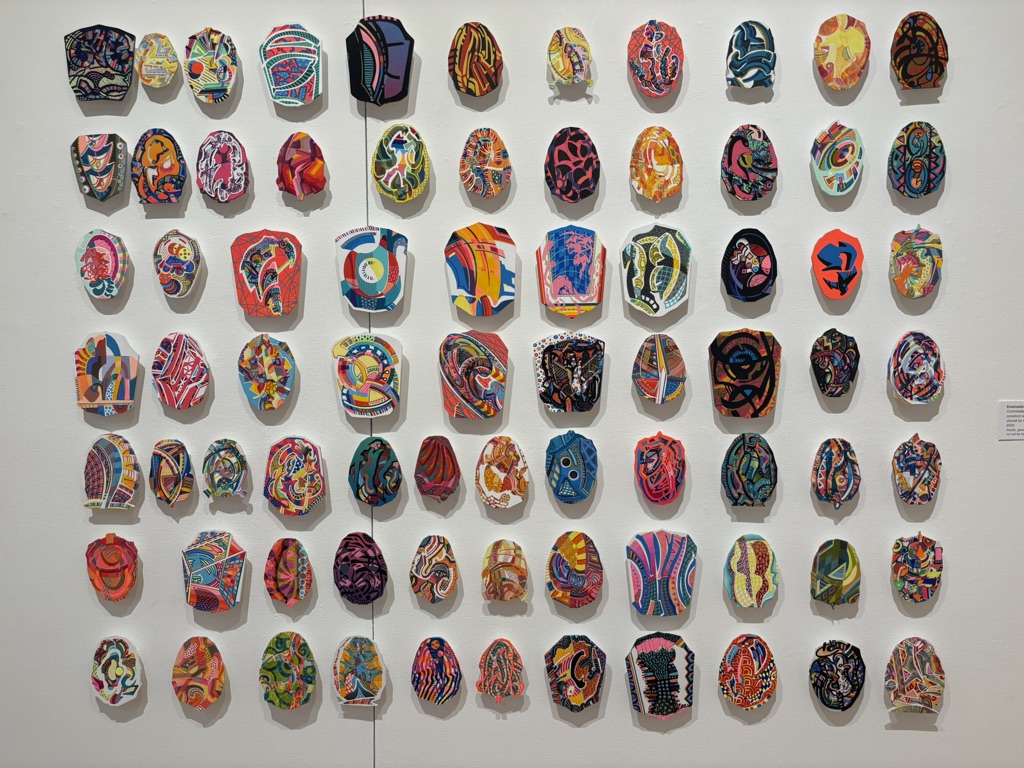
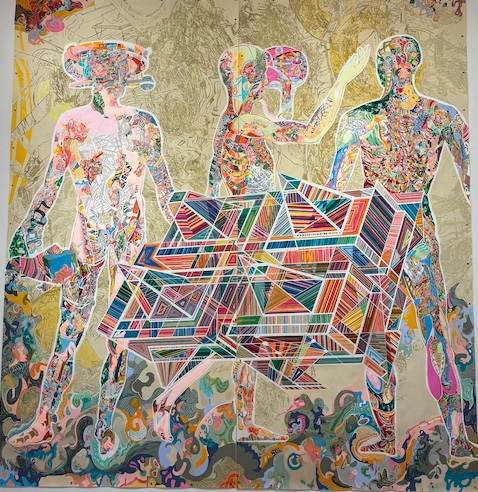
During my visit, one exhibition that particularly captured my attention featured the work of Romanian artist Emanuel Harris‑Sintamarian. His paintings immediately drew me in with their unique textures, layered compositions, and deeply expressive forms.

There is something both mysterious and meditative about his work. The colors and shapes seem to flow organically across the canvas, inviting viewers to pause and explore their own interpretations. Rather than presenting a straightforward image, his art feels like a visual journey—one that encourages contemplation and emotional reflection.

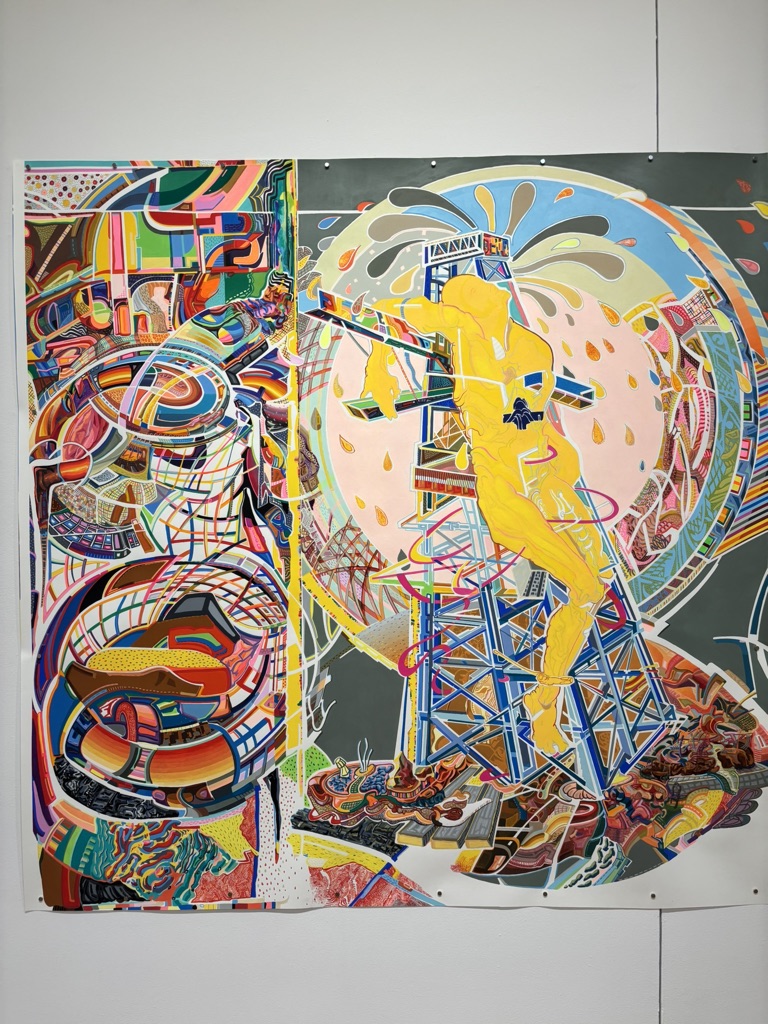
During my visit, I took several photos of the exhibition that I would like to share here. These images capture only a small glimpse of the atmosphere inside the gallery, but they reflect the creativity and thoughtful spirit of the artists on display.

Jesus, Popcorn and other details
2024
Acrylic, gouache on paper
In Jesus, Popcorn and Other Details, I
bring the sacred into direct contact with
systems of spectacle, labor, and
consumption. Jesus is not placed above the
world, but embedded within it – caught in
scaffolding, color, and movement – where
belief collides with industry and visual
excess. Popcorn becomes both image and
metaphor, standing in for abundance,
distraction, and the way meaning is
consumed, repeated, and ritualized
I intentionally built a dense, restless
composition that resists hierarchy or
stillness, reflecting how faith, entertainment,
and production compete for attention in
contemporary life. Rather than offering
reverence or critique alone, the painting
holds these tensions in place, asking the
viewer to sit inside the noise and consider
where meaning survives.

Link:https://peacelilysite.com/2026/03/14/a-quiet-afternoon-with-art-discovering-inspiration-at-the-triton-museum-of-art/

Appreciation of the Western Painting of H.H. Dorje Chang Buddha III — “The Rhythm of Water Bubbles”

A supernatural abstract color work

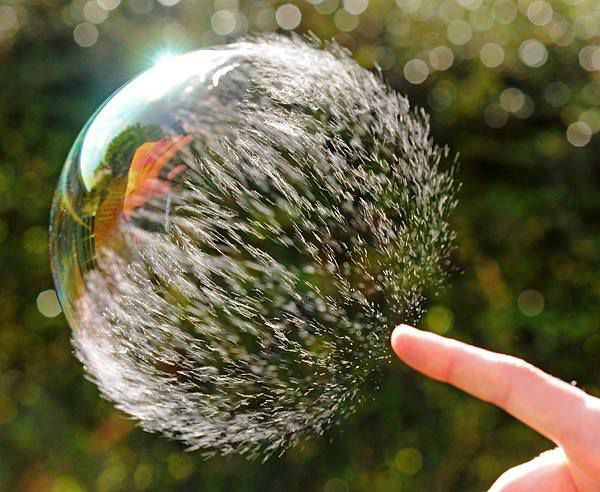
Through his brushwork, H.H. Dorje Chang Buddha III renders the subtle life cycle of a water bubble—its emergence, transformation, and eventual dissolution—with remarkable vitality. Though the medium is static, the painting evokes a striking sense of movement and immediacy. One almost senses the gentle drifting of bubbles across the surface, and even imagines the delicate sound that might accompany the instant when a bubble touches the ground and quietly disappears.

Beyond its visual beauty, the work carries a deeper contemplative resonance. In the fleeting rhythm of the bubbles, one cannot help but see a metaphor for the human condition. The trajectory of a bubble—from its brief formation to its silent vanishing—mirrors the arc of human life: birth, growth, aging, and departure. Life itself unfolds within the span of a breath, fragile and transient, reminding us of the importance of awareness and presence in each passing moment.

From an artistic perspective, the painting also demonstrates a remarkable command of impressionistic expression. The composition operates not only as a unified whole but also as a constellation of smaller visual worlds. Any isolated fragment of the canvas could stand independently as an exquisite impressionist study, rich in color, light, and atmosphere. This structural richness gives the work a dreamlike, almost illusory quality—where forms appear to emerge and dissolve within layers of color and movement.

In this way, the painting invites the viewer to linger, not merely to observe, but to reflect. It transforms a simple natural phenomenon into a meditation on impermanence, perception, and the delicate beauty of existence.

Click here to Wikitia page on H.H. Dorje Chang Buddha III that list major accomplishments and teachings with links.

Link: https://peacelilysite.com/2026/03/04/appreciation-of-the-western-painting-of-h-h-dorje-chang-buddha-iii-the-rhythm-of-water-bubbles/

Xing Garden on Mount Rili: Where Nature, Brush, and Spirit Converge

Chinese Painting by H.H. Dorje Chang Buddha III

Created in 1993, Xing Garden at Mount Rili stands as a masterful expression of the artist’s profound understanding of nature and brushwork. The painting presents a dramatic world of steep cliffs and cascading water, inviting the viewer into a landscape that feels both monumental and intimate.

Dominated by vibrant greens, the work vividly captures moss and grasses spreading freely across rocky surfaces. These lush tones breathe life into the cliffs, softening their ruggedness while emphasizing the quiet vitality that thrives within seemingly harsh terrain. Nature here is not static; it pulses with energy and renewal.

The painting employs the refined “Miaoxie” (妙写) technique—a style that reveals its true depth through careful observation. At first glance, the composition appears fluid and effortless. Yet upon closer inspection, the brushstrokes intertwine like delicate wires, layered and interwoven with extraordinary precision. These subtle lines create constant movement and variation, generating emotional richness and visual intrigue through their complexity.

One of the most captivating aspects of this work lies in its masterful use of illusory watery ink, where solidity and transparency coexist. Ink seems to flow and dissolve at the same time, offering a boundless sense of depth and atmosphere. Whether viewed from afar or examined up close, the painting reveals a bottomless waterfall, rendered with meticulous detail yet infused with powerful momentum.

What is especially striking is the contrast between refinement and strength. From a distance, the scene appears serene and orderly; yet when the viewer studies the brushwork closely, the strokes reveal unexpected vigor and boldness. Within apparent emptiness, there is substance; within seeming chaos, there is profound order. This balance embodies the highest level of artistic cultivation.

Through free yet disciplined brushwork, the artist transforms a simple natural motif—a waterfall between two cliffs—into a scene of extraordinary aesthetic depth. The power of each stroke carries both physical strength and spiritual presence, allowing the painting to transcend mere representation and enter the realm of lived experience.

Xing Garden at Mount Rili is more than a landscape painting. It is a quiet dialogue between nature and the artist’s inner world, revealing how true mastery lies not in excess, but in the ability to uncover profound beauty within simplicity.

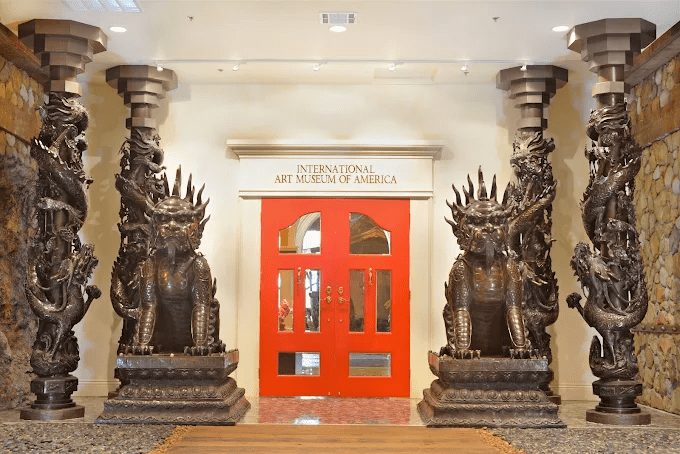
This beautiful artwork is part of the permanent exhibition at the International Art Museum of America, located in downtown San Francisco.

Link:https://peacelilysite.com/2026/02/03/xing-garden-on-mount-rili-where-nature-brush-and-spirit-converge/

Be Your Own Spotlight: Seeing Courage, Growth, and Quiet Brilliance Through Young Eyes

IAMA presents Be Your Own Spotlight by Yen’s Art Studio

Walking into Be Your Own Spotlight, presented by Yen’s Art Studio, at IAMA (The international Art Museum of America), I didn’t feel like I was entering a typical student art exhibition. Instead, it felt more like stepping into 150 honest conversations—each one visual, brave, and deeply personal.

The exhibition features 150 outstanding works by young students, created across a wide range of mediums—acrylic, watercolor, pencil, and mixed media. But what moved me most was not the variety of techniques; it was the sense that every piece quietly declared: this is who I am right now.

These students are not just learning how to paint or draw. They are learning how to trust their voices, how to take up space, and how to stand behind what they create. Their works reflect growth, self-discovery, and the joy—and sometimes uncertainty—of becoming. Whether you are a parent, an educator, a collector, or simply someone searching for inspiration, this exhibition offers something meaningful to feel, not just something pleasant to see.

As I moved through the gallery, I was delighted by the sheer range of imagination: striking portraits, fantastical worlds, playful animals in sunglasses, thoughtful reflections on global issues, and moments of pure joy. The diversity of themes reminded me of a beautiful truth that Yen’s Art Studio expresses so well:
“In the world of art, there are no boundaries of age or race. Children’s artwork can reach—and sometimes surpass—the technical ability and creative understanding typically associated with adults.”

One piece that stayed with me was a self-portrait by 8th-grade student Cynthia Liu. It stood out not only for its technical sensitivity, but for its emotional depth. Cynthia is known for her perfectionist nature, something many of us—artists or not—can relate to. Her work quietly reflects a universal truth: no artwork is ever truly finished. Without a clear endpoint, a piece can be revised endlessly, sometimes at the cost of the original vision.

Self-Portrait by Cynthia Liu, 8th grade Yen’s Art Studio

Hanni from Newjeans by Sophie Sun, 9th grade. Yen’s Art Studio

Another story that deeply touched me was Sophie’s. Once a shy student who nearly gave up on art altogether, she found her way back through the creative process at the studio. Through painting, Sophie rediscovered calmness, confidence, and inner strength—one of the most meaningful transformations I learned about in this exhibition. Her journey reflects the studio’s commitment not only to technical excellence, but to nurturing the inner lives of its students.

Lovers by Nova Cui, 9th grade Yen’s Art Studio

Among the more than 150 works, one painting stood out to me for its quiet presence rather than immediate visual impact. Created by Nova, a student dedicated to becoming a professional ballet dancer, the piece carries a sense of discipline, restraint, and inner resolve. Acknowledging the intensity of her dance training, her art education focused less on technical display and more on observation, sensitivity, and emotional understanding.

Her painting reveals genuine emotion and determination, qualities she will undoubtedly carry into her future as a dancer, where movement and art meet as a shared language of expression.

Be Your Own Spotlight is ultimately not just about showcasing talent. It is about honoring courage—especially the quiet kind. It reminds us that every young artist is learning not only how to create, but how to believe in themselves. And as viewers, we are fortunate to witness these moments of bravery, growth, and becoming.

Don’t miss the museum’s permanent exhibition, where world-class artworks offer far more than visual beauty. Here, art becomes a quiet refuge—inviting tranquility, reflection, and a subtle elevation of the spirit. Especially moving are the paintings by H.H. Dorje Chang Buddha III, whose works gently awaken the mind, soothe the heart, and leave the soul deeply inspired long after you depart.

Link:https://peacelilysite.com/2026/02/01/be-your-own-spotlight-seeing-courage-growth-and-quiet-brilliance-through-young-eyes/