A Plum Blossom Painting Filled with Inner Strength and Serenity

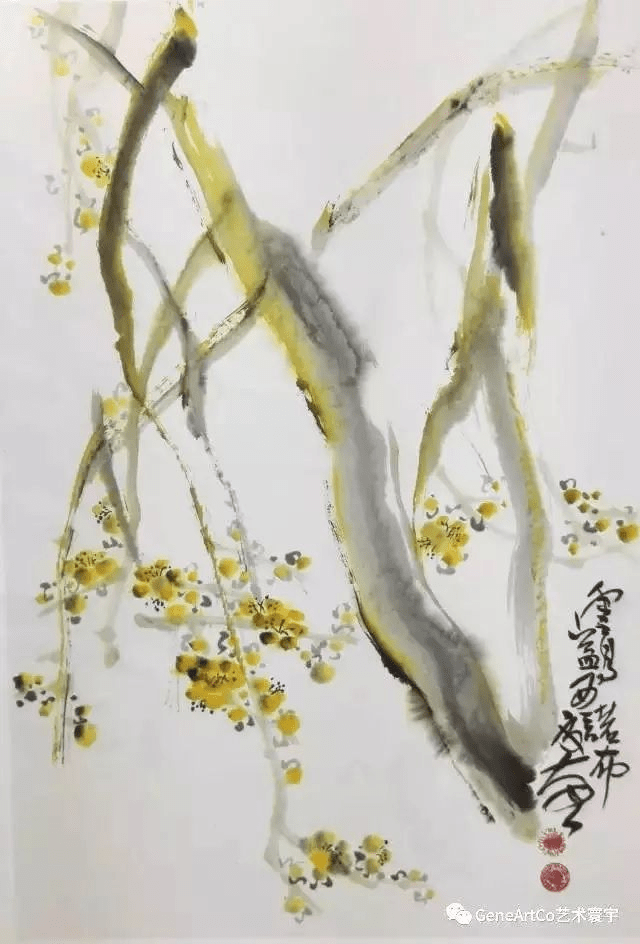
The first time I looked at this plum blossom painting by Dorje Chang Buddha III, I immediately felt a powerful and uplifting energy flowing from it. It was not simply a beautiful painting that pleased the eyes. Rather, it carried a quiet spiritual strength that deeply touched the heart.

My first thought was that only an artist with profound inner calmness, wisdom, and spiritual realization could create such a work.

In traditional Chinese culture, plum blossoms symbolize nobility, purity, perseverance, and courage. Blossoming in the cold of winter, they have long represented the ability to remain graceful and strong amid hardship. Yet this painting expresses those qualities in a particularly extraordinary way.

The entire composition feels free from anything worldly or artificial. There is no trace of stiffness, heaviness, or forced technique. Every brushstroke appears natural, effortless, and alive. The painting possesses a wondrous elegance that cannot be achieved merely through technical skill or years of practice alone. It feels more like the crystallization of wisdom, cultivation, and inner realization.

What especially fascinates me is the unique arrangement of the plum tree itself. The roots twist and coil together, naturally forming what resembles a large bonsai pot. The varying shades of ink create rich layers, flowing movement, and a dreamlike sense of surrealism throughout the painting. The scene feels both realistic and dreamlike at the same time — blending realism with a subtle surreal beauty. The result is a composition filled with vitality, harmony, and poetic imagination.

The brushwork is remarkably simple, yet every stroke is skillful and full of spirit. Nothing appears excessive. Nothing is unnecessary. This simplicity gives the painting an extraordinary sense of calmness and freedom.

After completing the painting, H.H. Dorje Chang Buddha III composed the following poem:

“Plum flowers of surpassing loveliness blossom in a pot, though never are they planted.
Wave the brush to plant the tree, and the roots of that old tree form their own shallow pot.”

The poem perfectly reflects the painting’s natural spontaneity and artistic wonder. The plum blossoms seem not artificially arranged, but born effortlessly from nature itself.

Perhaps this is what makes the painting so moving. Beyond its artistic beauty, it conveys a state of mind — calm yet powerful, simple yet profound, gentle yet filled with inner strength.

In today’s restless and hurried world, such artwork quietly reminds us of something precious: true beauty comes not only from technique, but from the purity, peace, and depth within the artist’s heart.

Link:https://peacelilysite.com/2026/05/14/a-plum-blossom-painting-filled-with-inner-strength-and-serenity/

Seeing a World Within Emptiness — An Appreciation of a Lively and Serene Ink Painting

Myna Birds Drunk Among the Willows by H.H. Dorje Chang Buddha III

Some paintings do not rely on complexity to move us. With only a few deliberate strokes, they unfold a world full of life. This fresh and tranquil ink painting is one such work. Quiet and unassuming, it reveals a profound artistic tension and depth within simplicity and stillness.

The composition is anchored by three strong yet supple ink lines. Their texture is rich and full, their force penetrating the paper. They resemble trees, yet are not trees—more like structural forms that divide the flat surface into a grid of interwoven spaces. Within these spaces, branches stretch and intersect, while willow-like lines sway gently, creating a rhythmic sense of motion.

What is most remarkable, however, lies in what is not painted.

The empty spaces are far from void; they are charged with meaning. In these areas of intentional absence, the viewer’s imagination is invited to wander. As the saying goes, “where nothing is painted, there lies the true realm of the painting.” The composition, in its entirety, feels almost like a montage—a sequence of visual moments carefully arranged. From this minimal structure emerges a surprisingly rich and intriguing visual experience.

Bringing the scene to life are several mynah birds, rendered in bold, expressive ink. These small creatures become the focal point of the painting.

They are divided into three groups, each occupying different sections of the grid. In a small triangular space near the top, three birds gather closely together. The density of life within such a confined area creates an immediate visual tension. In contrast, a large quadrilateral space in the lower middle is occupied by just a single bird, as if it has claimed the entire openness for itself—perhaps even becoming the quiet center of the composition.

Then there is a particularly playful detail: a bird in the upper right seems to occupy the intersection of four spaces at once. Though not placed at the center, it establishes its own presence, as if declaring that even at the edge, one can still become a focal point.

These birds preen their feathers, tilt their heads, hum softly, and seem to communicate with one another. Bathed in a sense of freshness, they revel in the gentle beauty of spring, fully immersed in a life of ease and freedom. The entire painting begins to resemble a small, self-contained paradise.

This delightful and imaginative work is created by H.H. Dorje Chang Buddha III. Art, at its highest level, is not merely a display of technique—it is a reflection of the inner world. A truly great work reveals the artist’s state of mind and spiritual depth.

In this painting, what we witness is not only mastery of brush and ink, but also a sense of calm, freedom, and purity—a state of being that transcends complexity and returns to essence.

The diverse artistic creations of H.H. Dorje Chang Buddha III stand as enduring treasures of human civilization. And this seemingly simple piece gently reminds us:

In a world of endless complexity, true beauty often resides in simplicity—
and true freedom may be found in the space between what is left unpainted.

LinK:https://peacelilysite.com/2026/05/04/seeing-a-world-within-emptiness-an-appreciation-of-a-lively-and-serene-ink-painting/

Awakening Life in the Deep: An Appreciation of Deep Sea Purple Moss

Among many spiritually expressive works of art, Deep Sea Purple Moss stands out for its simplicity and depth, offering viewers a striking, almost visceral impact. This Western-style painting by H.H. Dorje Chang Buddha III may appear abstract at first glance, yet it carries profound reflections on life and inner awakening.

The entire composition is built from just three colors—black, white, and purple—yet it reveals remarkable layers and tension. The black areas resemble a boundless deep sea, mysterious and unfathomable, as if there is no visible end. This depth evokes a sense of stillness infused with latent power. This “black” not only represents the unknown world but also symbolizes the unpredictable circumstances and challenges we encounter in life.

In contrast, the white surges forward like rolling waves, powerful and unstoppable. It breaks the silence of the black, injecting movement and dramatic force into the scene. These waves seem to echo life’s turbulence—the sudden changes, hardships, and trials that compel us to confront reality head-on.

Most captivating is the vibrant touch of purple. Like sea moss growing in the depths, it persists between waves and currents, embodying a resilient and vigorous life force. Here, purple is more than a visual accent; it becomes a symbol—of endurance, of hope, and of life’s ability to thrive even in adversity.

As we contemplate this painting, we begin to see that it is not merely a depiction of the sea, but a reflection of life itself. The black deep sea represents the environment we live in; the white waves, the challenges we must face; and the purple “moss” represents who we are.

In an ever-changing world, we cannot choose every circumstance, but we can choose how we respond. Just like the purple life form in the painting that continues to grow amid stormy waters, we too must learn to adapt, to temper ourselves through trials, and to seek upward strength even in difficult situations.

With its minimalist form, this work conveys a profound truth: true growth is not gained in calm waters, but forged in the midst of surging waves.

Perhaps, the next time we face the “great waves” in our own lives, we may remember this purple moss in the deep sea—growing upward, even in the darkest depths.

Link:https://peacelilysite.com/2026/04/30/awakening-life-in-the-deep-an-appreciation-of-deep-sea-purple-moss/

The Water-Splashing Festival: Where Tradition, Faith, and Renewal Meet

Every year in mid-April, the streets of Xishuangbanna and Dehong in Yunnan, China transform into a vast ocean of water.

To many, the Water-Splashing Festival is simply a joyful, all-out “water fight.” But what is often overlooked is that this grand celebration does not begin with noise or excitement—it begins with a single, quiet drop of perfumed water falling gently on the shoulder of a Buddha statue.

Today, let us step into Sangken Bimai—the New Year shared by the Dai, De’ang, and Blang peoples—and discover how traditional Chinese folk customs and Buddhist culture come together, blending seamlessly through the gentle yet powerful symbolism of water.

“Sangken Bimai” in the Dai language means “the turning of the New Year.” Its roots trace back to Sankranti, a Sanskrit term meaning “transition” or “passage,” tied to ancient Indian calendrical and religious traditions. With the spread of Theravada Buddhism, this observance took root across Southwest China and Southeast Asia, gradually evolving into a festival rich in both spiritual and cultural meaning.

Before the streets erupt in splashing water, every temple begins with a solemn and tranquil ritual: bathing the Buddha.

Devotees gather fresh flowers, soak their petals in clean water, and create a lightly scented infusion. One by one, they approach the Buddha statue, gently pouring the water over it with branches or cupped hands, symbolically washing away dust.

In this moment, there is no noise—only reverence.

This act is not merely an offering of respect to the Buddha; it is also a ritual of inner purification. It represents washing away the greed, anger, and ignorance accumulated over the past year, allowing the heart to return to clarity and light as the new year begins.

The Water-Splashing Festival typically lasts three to four days. While details vary by region, the structure follows a meaningful progression—from letting go of the old, through transition, to welcoming the new.

Day One: Farewell to the Old Year
This day resembles New Year’s Eve.

Along the Lancang River, dragon boats race across the water, sending waves splashing into the air. “Rising rockets”—traditional homemade fireworks—shoot skyward, carrying people’s wishes with them. Dressed in festive attire, people gather at lively markets filled with laughter and celebration, bidding farewell to the passing year.

Day Two: The Day Between Time
This is a deeply symbolic day—belonging neither to the old year nor yet to the new.

People building and decorating sand pagodas with flags and flowers on a beach during a festival

People visit temples to build sand stupas, shaping fine white sand into small pagodas adorned with colorful flags and flowers. Each grain of sand represents a good deed or kind thought.

This act of merit-making expresses hopes for favorable weather, peace, and stability in the coming year.

Day Three: Blessing and Rebirth Through Water
The first day of the New Year begins again with the Buddha-bathing ritual, followed by the festival’s most exuberant moment—water splashing.

For elders, water is gently poured over the shoulders as a sign of respect and blessing. Among peers and younger generations, however, the mood shifts into joyful abandon—buckets, basins, and water guns come into play, and laughter fills the air.

The more water, the deeper the blessing.

At this point, water is no longer just water—it becomes a tangible expression of good fortune and joy, symbolizing the washing away of the past and the arrival of new life.

A Celebration of Culture and Spirit

The Water-Splashing Festival is not only a holiday—it is a vibrant expression of culture.

The rhythmic beat of elephant-foot drums echoes like thunder, while the graceful peacock dance reflects harmony between humans and nature. As night falls, people release floating lanterns onto rivers and send sky lanterns drifting into the night, symbolizing the release of misfortune and the rising of hope.

IP上海 代傲辰 图

In these moments—both dynamic and still—people express reverence for nature and heartfelt wishes for the future.

One Drop of Water, A Shared Cultural World

This festival does not belong to Yunnan alone.

Across Southeast Asia, it appears under different names, yet carries the same cultural essence.

In Thailand, Songkran is not only about water—it is a time of gratitude and family connection. Younger generations gently pour scented water over the hands of elders to receive blessings, while also participating in merit-making rituals such as building sand stupas. Bright floral shirts have become a modern symbol of the celebration.

In Myanmar, the festival—known as Thingyan—has an especially strong spiritual atmosphere. Many people observe periods of fasting, visit temples, or even temporarily ordain as monks to welcome the New Year with purity and reflection. Traditional foods, such as soaked rice infused with fragrant water, are prepared, while large city celebrations feature grand stages where water is sprayed over joyful crowds.

Though names and customs vary, they all trace back to the same origin—Sankranti, marking not only the passage of time, but the renewal of life.

From the valleys of Yunnan to the cities of Southeast Asia, this single drop of water travels across geography and culture, quietly connecting the entire region.

It begins in stillness before the Buddha, and flows into laughter among people.
It symbolizes both letting go and renewal—purification and blessing.

What makes the Water-Splashing Festival so moving is not merely its liveliness, but what it reveals:

Even in the simplicity of everyday life, people continue to express kindness, cherish life, and hold hope for the future in the gentlest of ways.

A drop of water falling on the Buddha’s shoulder is an act of practice.
A splash of water shared among people is a blessing.

And when that water flows through the heart, perhaps what is truly cleansed…is ourselves.

Link:https://peacelilysite.com/2026/04/30/the-water-splashing-festival-where-tradition-faith-and-renewal-meet/

The Poetry Hidden in Chinese Names

Chinese characters are more than just written symbols—they are small works of art shaped by thousands of years of history. Each character carries meaning, imagery, and often a quiet sense of poetry. A single word can evoke light, wind, mountains, or virtue. When these characters come together to form a person’s name, they become something even more meaningful: a reflection of family hopes, cultural heritage, and the beauty of language itself.

A name often carries the very first blessing from parents and the hopes a family places upon the future.

Imagine traveling back in time to ancient China. If you walked up to Liu Bei (刘备)and casually called him “Liu Bei,” he might pause in surprise—or even consider it somewhat impolite. In traditional Chinese culture, a name was never just a label. It was a symbol of lineage and family, a part of life’s rituals, and perhaps the first gentle poem parents wrote for their child.

A name may consist of only a few characters, yet within it often lies thousands of years of cultural tradition and human warmth.

Surnames and Clan Names: An Ancient Way of Asking “Who Am I?”

Today, we simply combine a surname and given name to form what we call a “full name.” But in ancient China, particularly before the Qin dynasty, “xing” (姓) and “shi” (氏) were two different concepts.

The surname (xing) was primarily used to distinguish marriage relations. The earliest Chinese surnames—such as Ji, Jiang, Si, and Ying—often contained the “female” radical in their characters. This reflected the legacy of a matrilineal society. The principle was simple: people with the same surname were considered to share blood ties, so marriage between them was forbidden.

The clan name (shi), on the other hand, represented social status. Only those who held land, titles, or significant achievements were granted a clan name. In other words, the surname represented lineage, while the clan name reflected rank and honor.

A fascinating example is the famous reformer Shang Yang (商殃) of the Warring States period. He was not originally called “Shang Yang.” His ancestral surname was Ji, and his clan name was Gongsun because he descended from the royal family of the State of Wei. Early in life he was known as Gongsun Yang. Later, after helping transform the State of Qin through sweeping reforms, he was granted the territory of Shang and the title “Lord of Shang.” From then on, people began calling him Shang Yang.

Looking back at history, one might smile at an interesting truth:
In ancient times, many people changed their names not to hide who they were—but because life had elevated them to a new chapter.

The Courtesy Name: A Rite of Adulthood

In ancient China, a person often had more than one name. In addition to their given name (ming), they also received a courtesy name (zi).

The given name was mostly used within the family, especially by elders. The courtesy name, however, was the name used in society by peers and acquaintances.

Receiving a courtesy name meant that a person had reached adulthood and should be treated with respect.

For men, this moment came at the age of twenty during the “capping ceremony” (冠礼). In this solemn ritual, elders placed a ceremonial cap on the young man and bestowed upon him his courtesy name. From that day forward, he was no longer the boy running through village fields with childhood nicknames like “Little Dog” or “Iron Egg,” but a recognized adult in society.

For women, adulthood was marked by the hairpin ceremony (笄礼) at around fifteen. After this ceremony, a young woman could wear her hair pinned up with a hairpin, signifying that she had reached marriageable age.

This is where the classical phrase “waiting in the boudoir for one’s courtesy name” (待字闺中) comes from—describing a young woman who has received her courtesy name and awaits the next chapter of life.

These rituals made the transition into adulthood both solemn and graceful.

Chinese culture often reveals its subtle wisdom in the relationship between a person’s given name and courtesy name.

The great strategist Zhuge Liang (诸葛亮)was known by the courtesy name Kongming(孔明).
The character Liang means “bright,” and Ming also means “light” or “clarity.” Together they form a beautiful echo—brightness upon brightness.

The legendary general Zhao Yun (赵云)had the courtesy name Zilong(子龙). Ancient Chinese sayings describe the natural harmony between elements: “Clouds follow the dragon, and the wind follows the tiger.” With “cloud” in his given name and “dragon” in his courtesy name, the combination evokes an image of heroic power moving through the skies.

Then there is the great Song dynasty writer Su Shi(苏轼), whose courtesy name was Zizhan(子瞻). The character Shi refers to a horizontal bar at the front of an ancient carriage—something modest in appearance yet essential for support. Zhan means “to look forward into the distance.” One suggests quiet steadiness; the other, far-reaching vision. Together they reflect the balance of humility and aspiration in his life.

Through these pairings, we can glimpse the hopes of parents and elders, as well as the refined and poetic sensibilities of traditional Chinese culture.

Of course, not every ancient name was elegant or poetic. Some carried a touch of everyday humor.

The ruler Duke Cheng of Jin was said to have the name Heitun(黑臀), meaning “Black Hips,” supposedly because he had a dark birthmark on his body.

Another ruler, Duke Zhuang of Zheng, was named Wusheng(晤生), meaning “born with difficulty,” referring to a difficult birth.

If children today were given such names, they might have a few serious conversations with their parents!

On the other hand, some names sounded incredibly powerful. The king King Wu of Qin was named Ying Dang. In ancient Chinese, the character “Dang” suggested sweeping across lands and conquering territories—a name filled with ambition and authority.

Sometimes a name was lofty and ceremonial; sometimes it simply reflected the humor of daily life.

From ancient tribal totems to the familiar Hundred Family Surnames, Chinese names carry thousands of years of cultural memory.

Today, we no longer perform capping ceremonies or hairpin ceremonies, and few people receive courtesy names. Yet when a new child enters the world, parents still open dictionaries, carefully weighing every sound and every meaning before choosing a name.

In that moment, tradition quietly continues.

As an old Chinese poem says:

“A heart’s great aspirations may remain unopened,
yet spring winds return again and again in dreams.”

A name may consist of only a few characters, but it carries a family’s blessing, the imprint of history, and the gentlest hopes for the future.

It is the very first gift a person receives in life.

Link:https://peacelilysite.com/2026/03/15/the-poetry-hidden-in-chinese-names/

A Quiet Afternoon with Art: Discovering Inspiration at the Triton Museum of Art

Recently, I had the opportunity to visit the Triton Museum of Art, a cultural gem nestled in the heart of Santa Clara, California. Surrounded by a peaceful park, the museum offers a quiet and welcoming space where visitors can slow down, reflect, and experience the beauty and creativity of contemporary art.

Founded in 1965, the Triton Museum has long been dedicated to showcasing artists connected to California and beyond. What I appreciate most about this museum is its openness—it is free to the public, making art accessible to everyone in the community. Walking through the galleries, one can feel how art becomes a bridge connecting cultures, ideas, and human experiences.

Encountering the Art of Emanuel Harris‑Sintamarian

During my visit, one exhibition that particularly captured my attention featured the work of Romanian artist Emanuel Harris‑Sintamarian. His paintings immediately drew me in with their unique textures, layered compositions, and deeply expressive forms.

There is something both mysterious and meditative about his work. The colors and shapes seem to flow organically across the canvas, inviting viewers to pause and explore their own interpretations. Rather than presenting a straightforward image, his art feels like a visual journey—one that encourages contemplation and emotional reflection.

During my visit, I took several photos of the exhibition that I would like to share here. These images capture only a small glimpse of the atmosphere inside the gallery, but they reflect the creativity and thoughtful spirit of the artists on display.

Jesus, Popcorn and other details
2024
Acrylic, gouache on paper
In Jesus, Popcorn and Other Details, I
bring the sacred into direct contact with
systems of spectacle, labor, and
consumption. Jesus is not placed above the
world, but embedded within it – caught in
scaffolding, color, and movement – where
belief collides with industry and visual
excess. Popcorn becomes both image and
metaphor, standing in for abundance,
distraction, and the way meaning is
consumed, repeated, and ritualized
I intentionally built a dense, restless
composition that resists hierarchy or
stillness, reflecting how faith, entertainment,
and production compete for attention in
contemporary life. Rather than offering
reverence or critique alone, the painting
holds these tensions in place, asking the
viewer to sit inside the noise and consider
where meaning survives.

Link:https://peacelilysite.com/2026/03/14/a-quiet-afternoon-with-art-discovering-inspiration-at-the-triton-museum-of-art/

Appreciation of the Western Painting of H.H. Dorje Chang Buddha III — “The Rhythm of Water Bubbles”

A supernatural abstract color work

Through his brushwork, H.H. Dorje Chang Buddha III renders the subtle life cycle of a water bubble—its emergence, transformation, and eventual dissolution—with remarkable vitality. Though the medium is static, the painting evokes a striking sense of movement and immediacy. One almost senses the gentle drifting of bubbles across the surface, and even imagines the delicate sound that might accompany the instant when a bubble touches the ground and quietly disappears.

Beyond its visual beauty, the work carries a deeper contemplative resonance. In the fleeting rhythm of the bubbles, one cannot help but see a metaphor for the human condition. The trajectory of a bubble—from its brief formation to its silent vanishing—mirrors the arc of human life: birth, growth, aging, and departure. Life itself unfolds within the span of a breath, fragile and transient, reminding us of the importance of awareness and presence in each passing moment.

From an artistic perspective, the painting also demonstrates a remarkable command of impressionistic expression. The composition operates not only as a unified whole but also as a constellation of smaller visual worlds. Any isolated fragment of the canvas could stand independently as an exquisite impressionist study, rich in color, light, and atmosphere. This structural richness gives the work a dreamlike, almost illusory quality—where forms appear to emerge and dissolve within layers of color and movement.

In this way, the painting invites the viewer to linger, not merely to observe, but to reflect. It transforms a simple natural phenomenon into a meditation on impermanence, perception, and the delicate beauty of existence.

Click here to Wikitia page on H.H. Dorje Chang Buddha III that list major accomplishments and teachings with links.

Link: https://peacelilysite.com/2026/03/04/appreciation-of-the-western-painting-of-h-h-dorje-chang-buddha-iii-the-rhythm-of-water-bubbles/

Pilgrimage to Bhutan (Part 3): Audience with the Je Khenpo and the Ascent to Tiger’s Nest

By Gongjue Tuji

View of Taktsang Monastery on the cliff face, taken from the cafeteria viewpoint halfway up the trail.
The goal of the ascent in sight: Taktsang Monastery is perched high on the steep cliff face

On a pilgrimage to holy places, one rarely follows a rigid plan. Rather, one engages with a flow of events. Our last days in Bhutan reminded us how valuable it is to let go of expectations. We learned that special doors often open exactly when one is ready to leave the original path.

Change of Plans in Punakha: Trusting the Flow of Things

The sixth day showed us this very clearly. Actually, we had a fixed plan: We wanted to drive from Punakha back to Paro. There, we had donated 3,000 butter lamps which we wanted to light ceremonially in a temple.

But then we received news on short notice that an audience with His Holiness the Je Khenpo, the highest religious head of the country, would be possible. Such an opportunity is a great blessing. However, there was a restriction: Our entire travel group was simply too large for this spontaneous audience.

So we had to split up in Punakha. One part of the group drove directly on to Paro, while the other part drove to Thimphu, where His Holiness the Je Khenpo was staying at the time. I traveled with this group.

Scenic panoramic view over the green Thimphu Valley, with the distinctive Buddha Dordenma statue visible in the distance atop the mountain.
View of Thimphu with the Buddha Dordenma statue in the background

Thangton Dewachen Nunnery: Legacy of the Iron Bridge Monk

Arriving in Thimphu, we still had some time before the appointment. We visited the Thangton Dewachen Duthop Nunnery. It is the only one of its kind in the capital and goes back to the legendary Thangtong Gyalpo. He was a fascinating personality: A great Mahasiddha and at the same time an ingenious engineer who lived in the 15th century. He is famous as the “Iron Bridge Monk,” as he built dozens of suspension bridges made of iron chains throughout the Himalayas to allow pilgrims and travelers to cross raging rivers. Many of his constructions withstood the centuries. We were welcomed very warmly at this place: We were served tea in the courtyard of the monastery, and we could enjoy the peaceful atmosphere for a moment before we had to leave.

Gongjue Tuji in traditional robes standing in the sunny courtyard of the Thangton Dewachen nunnery next to a tall Dharma pillar, while a dog sleeps peacefully in front.
Visiting the Thangton Dewachen Duthop Nunnery

Kalachakra Initiation: Encounter with H.H. the Je Khenpo

After lunch, we made our way to the stadium. There, H.H. the Je Khenpo was leading the conclusion of the Kalachakra initiation. The crowds were immense. The stadium itself was packed to capacity, but that was far from enough. Countless people had also gathered on the grounds outside to partake in the event. It was a very impressive image. The ceremony was also being broadcast live on Bhutanese television. We initially had to wait before the gates until we were allowed into the stadium.

After some time, we were able to enter and were led to a separate waiting area inside the stadium. During this time, a chance but wonderful encounter occurred. We met the young Vairochana Rinpoche (Ngawang Jigme Jigten Wangchuk). He is a highly revered Tulku and the son of Her Royal Highness Princess Sonam Dechan Wangchuk. He is revered as the reincarnation of the great translator Vairochana from the 8th century, one of the most important disciples of Guru Padmasambhava.

Following this, we were granted an audience with H.H. the Je Khenpo. Filled with gratitude, we presented him with a Khata (white scarf) as a token of our deep respect. In this special setting, we also had the opportunity to present His Holiness with information regarding the ‘Holy Heavenly Lake Buddhist Town’ project. Each of us then received a personal blessing, and upon our departure, he presented us with a text of the Amitabha Sadhana for our own practice.

Group photo of the Buddhist travel group after the special audience with H.H. the Je Khenpo at the Thimphu stadium following the Kalachakra initiation.
Our group after the audience with H.H. the Je Khenpo

After the meeting with the Je Khenpo, a further great honor was completely unexpectedly offered to us: Actually, we were supposed to meet the young Vairochana Rinpoche and the Queen Mother for an official audience afterwards. But when the Kalachakra initiation ended, thousands of people streamed out of the stadium at the same time. Traffic in Thimphu came to a complete standstill. There was no getting through, and we could not reach the agreed location in time. Such are the karmic conditions sometimes. But we did not quarrel with fate: After everything we had experienced that day and the blessing we were allowed to receive, we felt richly gifted.

The Tiger’s Nest: Ascent to Guru Rinpoche’s Cave

On the last day of our trip, November 15th, the arguably most famous landmark of Bhutan was on the agenda: Paro Taktsang, widely known as the Tiger’s Nest. It is not only architecturally deeply impressive, but one of the holiest sites in the entire Himalayas.

The famous Tiger's Nest Monastery (Paro Taktsang), clinging spectacularly to a sheer cliff face in the Paro Valley of Bhutan, set against a blue mountain backdrop.
Paro Taktsang Monastery (Tiger’s Nest)

We set off very early to reach the base camp, the parking lot at 2,300 meters. From there, it is about 800 vertical meters up to the monastery, which sits at 3,120 meters. For visitors who do not quite trust themselves with the steep climb, there is generally the option to be carried by a horse or mule for the first part of the route. Our group, however, decided to cover the entire path on foot under our own power.

The ascent took just under three hours. The path is beautiful, but also demanding. It leads through a dense pine forest where rhododendrons grow and the trees are draped with moss. Again and again, prayer flags flutter in the wind. Halfway up, we took a short rest at a café. From there, you already have a first, breathtaking view of the monastery, which literally clings to the steep rock.

Impressions (in order): Resting horses at the starting point, fluttering prayer flags against the mountain backdrop, pack animals on the dusty trail, the first distant view of the cliffside monastery, the moss-covered mountain forest, and Tsa-Tsa offerings in a rock niche.

The history of this place is closely connected to Guru Rinpoche, the great Master Padmasambhava. He is revered by the Bhutanese as the “Second Buddha,” as he brought and firmly established Tantric Buddhism, the Vajrayana, in Bhutan in the 8th century. He manifested his supernatural powers and flew to this very spot on the back of a tigress to subdue a demon. Some say that the tigress was his tantric consort Yeshe Tsogyal in a transformed state. In the cave known as Taktsang Senge Samdup, around which the monastery was later built, he then meditated for exactly three years, three months, three weeks, and three days.

Once at the top, we had to hand in our cameras and bags at the entrance, as photography inside is strictly forbidden. We visited several small temples within the complex. In a special room that is guarded around the clock, I lit a butter lamp. This is the only place in the monastery where open fire is still permitted after a devastating fire destroyed large parts of the complex in the past. In Buddhism, lighting these lamps is a meritorious central ritual.

Gongjue Tuji and Venerable Master Shi Zheng Da standing with Dharma siblings in front of the sacred waterfall near the entrance to Paro Taktsang (Tiger's Nest).
With Venerable Master Shi Zheng Da in front of the Taktsang Waterfall

Farewell in Paro: A Promise to Return

Back at the hotel in Paro, a special guest awaited us in the evening: Dasho Passang Dorji, the former Speaker of the National Assembly of Bhutan. He had been instrumental in organizing the official appointments and came by personally to apologize politely that the meeting with the King had not taken place due to the commotion. He promised us: “Next time I will arrange, this time the King and the Queen have been too busy.”

Ceremonial exchange of gifts between Venerable Master Shi Zheng Da and Dasho Passang Dorji in the hotel lobby at the conclusion of the trip.
Exchange of gifts with Dasho Passang Dorji

In a very friendly atmosphere, an exchange of gifts took place. The Venerable Master Shi Zheng Da presented him with a special art object, a luminous three-dimensional picture of a Yun sculpture designed by H.H. Dorje Chang Buddha III. In return, he gave the Master a large golden Shakyamuni Buddha statue. It was a worthy moment of connection.

Scenes from the performance (in order): The famous Drametse Ngacham (Dance of the Drums), a solo dancer bowing deep, the performers of the yak scene, the humorous interaction of the yak with the audience, the women’s dance group in red garments, and finally a traditional performance with bows and arrows combining song and dance.

Afterwards, we watched a cultural performance together with Dasho Passang Dorji. There were traditional dances and songs whose gentle, flowing movements radiated great calm and peace. There were also humorous interludes, like the dance of a yak, where the performers visibly had fun. Even though I did not understand the language, the joy was contagious. After this show, we all gathered for a large group photo to capture this beautiful final evening.

Large farewell group photo of the entire travel group together with Dasho Passang Dorji and the Bhutanese guides on the illuminated steps of the hotel.
Our entire group with Dasho Passang Dorji and our guides

The next morning, November 16th, it was time to say goodbye. From the hotel, we could look directly at the airport. We had arrived to make a contribution with our donation and our plans. But as I boarded the plane now, I felt that we ourselves were taking away far more than we had given. I took with me not only memories of the mighty mountains and venerable monasteries, but the feeling of a deep connection with our travel group and the people in Bhutan. I return with much inspiration and a heart full of gratitude for the blessing I was allowed to experience in this country.

Link:https://peacelilysite.com/2026/02/05/pilgrimage-to-bhutan-part-3-audience-with-the-je-khenpo-and-the-ascent-to-tigers-nest/

Xing Garden on Mount Rili: Where Nature, Brush, and Spirit Converge

Chinese Painting by H.H. Dorje Chang Buddha III

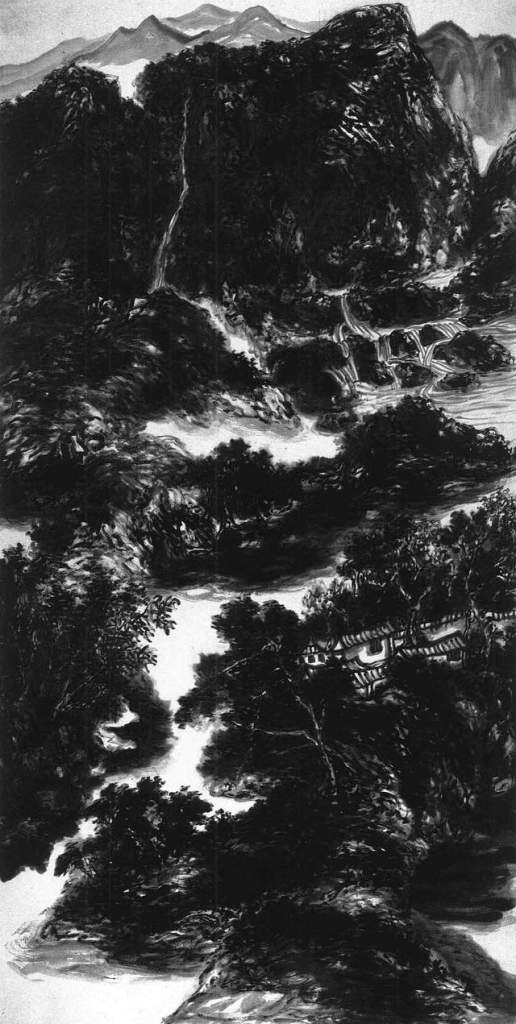
Created in 1993, Xing Garden at Mount Rili stands as a masterful expression of the artist’s profound understanding of nature and brushwork. The painting presents a dramatic world of steep cliffs and cascading water, inviting the viewer into a landscape that feels both monumental and intimate.

Dominated by vibrant greens, the work vividly captures moss and grasses spreading freely across rocky surfaces. These lush tones breathe life into the cliffs, softening their ruggedness while emphasizing the quiet vitality that thrives within seemingly harsh terrain. Nature here is not static; it pulses with energy and renewal.

The painting employs the refined “Miaoxie” (妙写) technique—a style that reveals its true depth through careful observation. At first glance, the composition appears fluid and effortless. Yet upon closer inspection, the brushstrokes intertwine like delicate wires, layered and interwoven with extraordinary precision. These subtle lines create constant movement and variation, generating emotional richness and visual intrigue through their complexity.

One of the most captivating aspects of this work lies in its masterful use of illusory watery ink, where solidity and transparency coexist. Ink seems to flow and dissolve at the same time, offering a boundless sense of depth and atmosphere. Whether viewed from afar or examined up close, the painting reveals a bottomless waterfall, rendered with meticulous detail yet infused with powerful momentum.

What is especially striking is the contrast between refinement and strength. From a distance, the scene appears serene and orderly; yet when the viewer studies the brushwork closely, the strokes reveal unexpected vigor and boldness. Within apparent emptiness, there is substance; within seeming chaos, there is profound order. This balance embodies the highest level of artistic cultivation.

Through free yet disciplined brushwork, the artist transforms a simple natural motif—a waterfall between two cliffs—into a scene of extraordinary aesthetic depth. The power of each stroke carries both physical strength and spiritual presence, allowing the painting to transcend mere representation and enter the realm of lived experience.

Xing Garden at Mount Rili is more than a landscape painting. It is a quiet dialogue between nature and the artist’s inner world, revealing how true mastery lies not in excess, but in the ability to uncover profound beauty within simplicity.

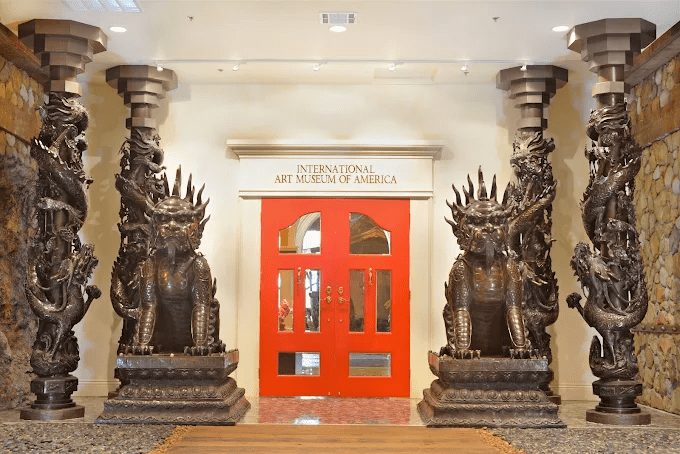
This beautiful artwork is part of the permanent exhibition at the International Art Museum of America, located in downtown San Francisco.

Link:https://peacelilysite.com/2026/02/03/xing-garden-on-mount-rili-where-nature-brush-and-spirit-converge/

Be Your Own Spotlight: Seeing Courage, Growth, and Quiet Brilliance Through Young Eyes

IAMA presents Be Your Own Spotlight by Yen’s Art Studio

Walking into Be Your Own Spotlight, presented by Yen’s Art Studio, at IAMA (The international Art Museum of America), I didn’t feel like I was entering a typical student art exhibition. Instead, it felt more like stepping into 150 honest conversations—each one visual, brave, and deeply personal.

The exhibition features 150 outstanding works by young students, created across a wide range of mediums—acrylic, watercolor, pencil, and mixed media. But what moved me most was not the variety of techniques; it was the sense that every piece quietly declared: this is who I am right now.

These students are not just learning how to paint or draw. They are learning how to trust their voices, how to take up space, and how to stand behind what they create. Their works reflect growth, self-discovery, and the joy—and sometimes uncertainty—of becoming. Whether you are a parent, an educator, a collector, or simply someone searching for inspiration, this exhibition offers something meaningful to feel, not just something pleasant to see.

As I moved through the gallery, I was delighted by the sheer range of imagination: striking portraits, fantastical worlds, playful animals in sunglasses, thoughtful reflections on global issues, and moments of pure joy. The diversity of themes reminded me of a beautiful truth that Yen’s Art Studio expresses so well:
“In the world of art, there are no boundaries of age or race. Children’s artwork can reach—and sometimes surpass—the technical ability and creative understanding typically associated with adults.”

One piece that stayed with me was a self-portrait by 8th-grade student Cynthia Liu. It stood out not only for its technical sensitivity, but for its emotional depth. Cynthia is known for her perfectionist nature, something many of us—artists or not—can relate to. Her work quietly reflects a universal truth: no artwork is ever truly finished. Without a clear endpoint, a piece can be revised endlessly, sometimes at the cost of the original vision.

Self-Portrait by Cynthia Liu, 8th grade Yen’s Art Studio

Hanni from Newjeans by Sophie Sun, 9th grade. Yen’s Art Studio

Another story that deeply touched me was Sophie’s. Once a shy student who nearly gave up on art altogether, she found her way back through the creative process at the studio. Through painting, Sophie rediscovered calmness, confidence, and inner strength—one of the most meaningful transformations I learned about in this exhibition. Her journey reflects the studio’s commitment not only to technical excellence, but to nurturing the inner lives of its students.

Lovers by Nova Cui, 9th grade Yen’s Art Studio

Among the more than 150 works, one painting stood out to me for its quiet presence rather than immediate visual impact. Created by Nova, a student dedicated to becoming a professional ballet dancer, the piece carries a sense of discipline, restraint, and inner resolve. Acknowledging the intensity of her dance training, her art education focused less on technical display and more on observation, sensitivity, and emotional understanding.

Her painting reveals genuine emotion and determination, qualities she will undoubtedly carry into her future as a dancer, where movement and art meet as a shared language of expression.

Be Your Own Spotlight is ultimately not just about showcasing talent. It is about honoring courage—especially the quiet kind. It reminds us that every young artist is learning not only how to create, but how to believe in themselves. And as viewers, we are fortunate to witness these moments of bravery, growth, and becoming.

Don’t miss the museum’s permanent exhibition, where world-class artworks offer far more than visual beauty. Here, art becomes a quiet refuge—inviting tranquility, reflection, and a subtle elevation of the spirit. Especially moving are the paintings by H.H. Dorje Chang Buddha III, whose works gently awaken the mind, soothe the heart, and leave the soul deeply inspired long after you depart.

Link:https://peacelilysite.com/2026/02/01/be-your-own-spotlight-seeing-courage-growth-and-quiet-brilliance-through-young-eyes/