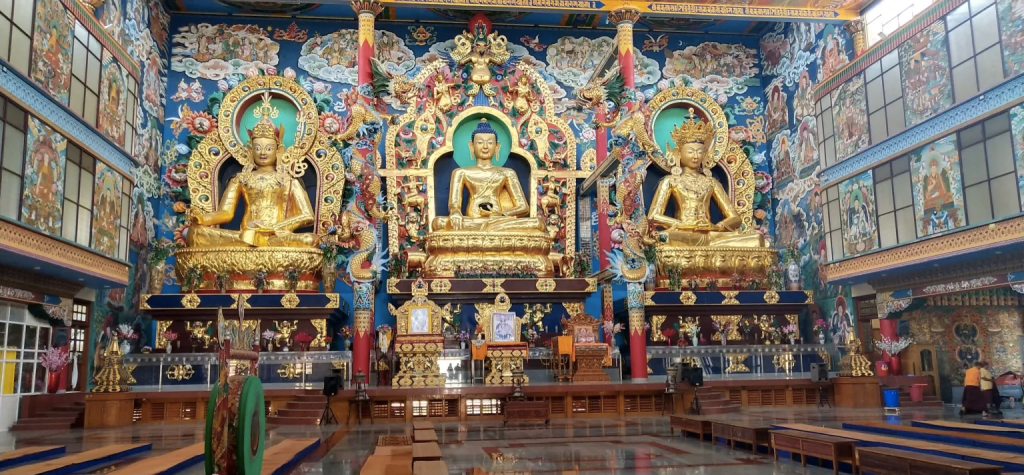
What is Esoteric Buddhist Practice

Photo from https://openbuddhism.org/regions/north-america/2019/tibetan-buddhism-enters-the-21st-century-trouble-in-shangri-la/

Tantra–Esoteric Teachings

Tantra is the secret or esoteric part of Buddhist practice. It is often referred to as the vajrayana or Diamond Path. It is also used as a term for the secret scriptures or esoteric writings. Although it includes the highest dharma within the Buddha-dharma, you should not consider it to be superior or that the exoteric Buddhism practiced by other sects should be considered a low level of dharma. The Buddha-dharma is not divided into high and low as comparisons. All 84,000 dharma methods came into being in response to the different innate faculties of living beings. The Buddha-dharma has only one truth no matter how it is expressed.

Exoteric Buddhism and vajrayana Buddhism are not two separate schools. Exoteric Buddhism is half of a dharma system. True vajrayana Buddhism includes the teachings of the various schools of exoteric Buddhism plus mantras, mudras, visualization, mandala offerings practiced either as a group or alone, and inner and outer tantric initiations. It includes a foundation in the cultivation of the “dharmakaya” from exoteric buddhism as well as the more advanced cultivation of the “sambhogakaya” and the “nirmanakaya.” In vajrayana or tantric practice one strives to realize all three kayas in one lifetime. However, this is ONLY possible if one is able to follow a true vajra master and receive authentic inner tantric initiation.
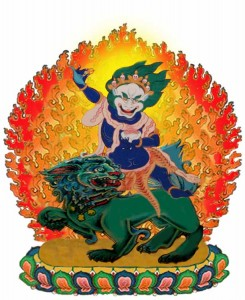
Lion Vajra, an important dharma protector in the Buddha School

True esoteric Buddhism includes all the teachings of the exoteric schools as well as the secret teachings and practices. There are those who claim to be esoteric teachers who can only offer intricate hand movements or mudras, chant mantras, make mandala offerings, or lead the disciple through elaborate visualizations, but who teach or know little of the exoteric sutras. This is not true esoteric Buddhism. Without the foundation in the essential doctrine of the Buddha as found in the Tripitaka, one should not even do the esoteric practices, let alone teach them. That is why the authentic temples which has holly masters teach meditation practices from the Theravadan and Zen or Ch’an Schools, along with certain Pure Land Practices and those of the Hua-yen and Fa-hsiang Schools and others as well as the esoteric methods. Disciples are taught according to their particular karmic affinity with the dharma.

Sometimes these exoteric techniques are taught concurrently with certain esoteric or tantric practices and sometimes they must be mastered prior to introduction to tantra. Not all students are able to receive tantra, which in its highest forms can bring liberation in this lifetime. However, everyone can progress and reach high levels of achievement, according to their efforts and karma. All of the teachings of our temples are to lead beings to liberation from the suffering of the cycle of life and death. That is the only purpose in practicing Buddhism! This is an important point!

Those who learn exoteric Buddhism exclusively are learning only the foundational aspect (some of the theoretical or doctrinal part) of Buddhism. The esoteric vehicle contains the lessor vehicle teachings AND the complete and unsurpassed mahayana teachings of both exoteric and the esoteric Buddhism AND the esoteric practices and rituals.

Tantric initiation is a ceremony within vajrayana Buddhism whereby dharma is transmitted according to tantra by means of a master’s limitless merit and power. During the ceremony, the master visualizes that he or she becomes one with a Buddha or Bodhisattva. During this ceremony the disciple is empowered by the master to carry out specific meditation practices. The student is ritually entered into a mandala of a particular tantric deity by his or her vajra master. He or she is thus empowered to practice the spiritual practices (sadhana) or associated mantras, mudras, and visualization of that deity.

There are three classes of initiation: Outer-tantric initiations, inner-tantric initiations and secret or supreme-tantric initiations (also called “holy” initiations). Each of these three classes is further divided into various dharma methods. During the highest and greatest inner-tantra and secret-tantra initiations there must be supernormal states that are manifested in front of the disciple at the Buddhist altar area (mandala). These miraculous states must be in accordance with the Tibetan tantra laid down by the Buddhas. The disciple is actually turned over to the Buddhas and Bodhisattvas during these initiations. You must remember that unless you personally see the manifestation of supernatural dharma powers, then you have not received an inner-tantric initiation. Most initiations given today are outer-tantra initiations. The supreme or holy initiations are rarely given with very few masters having the ability to perform this type of practice. Vajra masters must undergo certain tests that demonstrate their level of realization to be able to perform this type of ceremony.

Transmission of the greatest dharma requires true nectar during the initiation. For example, the highest dharma within vajrayana Buddhism, the initiation of Ati-yoga, Great Perfection of the Vajra division, requires nectar as an indispensable holy element for cleansing one’s negative karma and is the resource for planting the “Seeds of Vajra.” Other forms of inner trantric initiations can also eliminate karmic obstructions. Disciples can deeply penetrate into the dharma through inner-tantra initiations.

One must have accumulated considerable merit from past practices and good deeds to be able to receive tantra. There are certain preliminary practices that must be performed which can vary depending on the karma of the disciple. There are exceptions possible for 1) those who have completed these steps in a past life; 2) those with exceptional merit due to extraordinary offerings or actions in this life; and 3) through the grace of the guru.

Tantra requires the initiation or empowerment of a qualified teacher or master who provides specialized teachings, rituals, and practices to enable the disciple to root out or eliminate the dark side of his/her psyche and thus become like the Bodhisattvas and Buddhas. Supernormal powers are viewed as the natural outcome of realization and are used by qualified teachers. However, ordinary disciples are not allowed to discuss or display their supernormal powers. Only very highly evolved Bodhisattvas and Buddhas dare to display such powers and then only to help living beings. A person seeking initiation must demonstrate an understanding of emptiness, exhibit high moral conduct, and have developed an altruistic desire to help all beings. Any empowerment will have limited impact without a proper foundation of preliminary practices or Prayogas. It recognizes that supernormal powers cannot be given to one who has not eliminated the negative aspects of the self.

Today as in times past, the highest tantric teachings and practices are only transmitted orally and are held in great secrecy between the teacher and the disciple. Because of the power of these teachings, it is recognized that the student must be thoroughly prepared to receive them. A true master will usually test a disciple for six to twelve years or longer before transmitting the higher teachings.

What is Esoteric Buddhist Practice

Link:https://peacelilysite.com/2023/10/20/what-is-esoteric-buddhist-practice/

#EsotericBuddhistPractice# EsotericBuddhism #EsotericBuddhaDharma

Source: https://xuanfa.net/buddha-dharma/tantra/

The definitive sense of the level from the test and the robe that indicate one’s Dharma capability and accompolishment

United International World Buddhism Association Headquarters

Announcement No. 20160102: The definitive sense of the level from the test and the robe that indicate one’s Dharma capability and accomplishment

To protect Buddhist disciples from falling prey to deceit and lies, it is decreed that the master, whom Buddhist disciples prostrate themselves to, must take the test to determine their status. The test tells whether they are holy or ordinary and what level of accomplishment they have attained. The test result is given per the Dharma rather than the person; It is based on the definitive meaning, not the provisional meaning. No matter how high the status a Buddhist holy person is, it only counts if they have taken the test. If they dare not take the test, it proves that there are severe problems with that master, whom you must not trust even if their fame is higher than the sky.

Unless being determined by the exam, no matter what a venerable, dharma king or a certified reincarnated rinpoche one professes to be is not trustable. Additionally, a person can gain or recede according to whether their cultivation is good or bad before reaching the stage of a non-retrograde Bodhisattva. Consequently, they don’t have the definitive status of accomplishment, even if they may have the nirvana path-fruit (泥丸道果), had their crown opened deep and wide via the Vajra Change-body Zen (金剛換體禪), can show the Tummo Samadhi (拙火三昧) power, can have their consciousness exit the body, or can practice a Dharma to invite a Bodhisattva to manifest holiness and empower the disciples.

The Vajra Faman Selection Dharma (金剛法曼擇決), the Knowing in Advance and Foretelling Dharma (先知預言), or the Selection From One Hundred Dharma Bright Gates in Total Darkness Dharma (百法明門黑關擇決) must be performed to verify a master’s status and realization capability with 100% certainty. Otherwise, that master must have passed the test through the Vajra Array or the Eight-wind Array to get the corresponding level and the robe.

Unless that master can prove themselves by showing the even higher Dharma ability to Establish Mandala Through A Stone Slab (隔石建壇), or by being able to perform the Holy Inner-tantric Initiation, where the disciple holds a Vajra Ball that is as big as a pea in their hand and the master stands five meters away from the disciple. The master practices the Dharma to make the Vajra Ball in the hands of the disciple go through a holy transformation or dance. Any other miraculously manifested phenomenon is not a component of divine accomplishment. But to concretely tell the master’s level of capability, their level from the test and the robe must be checked for confirmation. Only then can their level of ability be known. The following are the details to ascertain the real status of a master definitively:

First, the people taking this year’s test to examine their actual Buddhist status must go through the one-hundred-problem written test on Sutra, Vinaya, and Sustra. Then they must be verified through Famen Gongyu (法門宮羽) to get the certificate of eligibility for the test before they can be qualified to take the holy test. If they can get the certificate of eligibility for the test, but their score from the written test is too low, they cannot take the holy test either.

There are two ways to take the holy test. The first is to write all your strong suits in one document and take one test on all of them. The second is to separately write your items and take a test on each one of them independently. Especially for Blue Button Level 3, which is a fundamental and critical level before advancing up to the Gold Button level, there can be three different types of indication. If one gets Blue Button Level 3 in one test, one can only get three blue buttons. If one retakes the test and gets Blue Button Level 3 again, then one will add a small black button in addition to the three blue buttons that one has already had. If one takes the test for the third time and gets Blue Button Level 3 again, then one adds yet another small black button. In that case, there will be three blue buttons and two little black buttons, totaling five buttons. The master is called Blue Button Level 3, having the status of the Runde.

If you still have more independent strong items that you would like to take the test on, in such a case, you cannot take the Blue Button test anymore. Instead, you will receive the advanced test for the Gold Button. You will then write all the items you have been tested on for the Blue Button Level 3 in one combined document and take the test for Gold Button Level 1 directly. If you fail to pass the Gold Button test, your previous Blue Button level will still be kept. If you pass the Gold Button test, then you will add one gold button to your robe, which maintains the original three blue buttons and two small black buttons, amounting to a total of six buttons. You will become a Holy and Virtuous One of Gold Button Level One.

If you see a master having only three blue buttons, it says that the master has only passed the test for Blue Button Level 3 once. If you see three blue buttons and an additional small black button, it says that the master has passed the test for Blue Button Level 3 twice on two separate items. If you see three blue buttons and two small black buttons, then it says that master has passed the test for Blue Button Level 3 three independent times, each on a different item. It is tough to obtain Blue Button Level 1 from the test. You may only be able to find one such person in two to three thousand Buddhist cultivators. Blue Button Level 2 is naturally higher than Blue Button Level 1, and all who have Blue Button Level 3 have the Runde status, which is extremely rare. It is hard to find one such person among one thousand masters or rinpoches. The Gold Button levels are the rarest among the rarest.

But all the masters taking the test must especially clearly understand that the headquarters has detailed records of everyone who comes to take the test for people to check. The Holy Test Inquiry Team will tell your test results factually to whoever is inquiring but will not expose your score from the written test on the Sutra, Vinaya, and Sustra. We will reply with how many times you have taken the test, and in each time which item you receive the test as well as what level you obtained, whether or not you were engulfed in the Samsara Black Region (輪迴黑界), whether you were unable to enter the Safe and Auspicious Region (平安吉界) that was right in front of you and fell to the ground or as soon as you had entered the Safe and Auspicious Region, you were pushed out of it by the eight winds, and whether you fell to the ground unconsciously and your flesh was hauled out by the four great guardians, but you recovered to safety by the master presiding over the mandala who practiced Dharma to save you.

Except for the robe a master wears, the United International World Buddhism Association Headquarters also issue a Certificate of Level that corresponds to the attire to the master who has achieved the level. If you find that the level and the certificate don’t match, then the robe the master wears is an act of falsehood and lying.

Additionally, we solemnly inform you that this holy and virtuous team will guarantee, with holy and virtuous righteousness, to everyone who calls or emails to inquire with us. We will keep the secret for you and will not reveal which master you are inquiring about or have inquired about.

This public announcement is now published.

United International World Buddhism Association Headquarters

March 17, 2016

(translated by Zunba)

#DorjeChangBuddhaIII #HHDorjeChangBuddhaIII#UnitedInternationalBuddhismAssociationHeadquarters#OfficeofHisHolinessDorjeChangBuddhaIII#BuddhaDharma