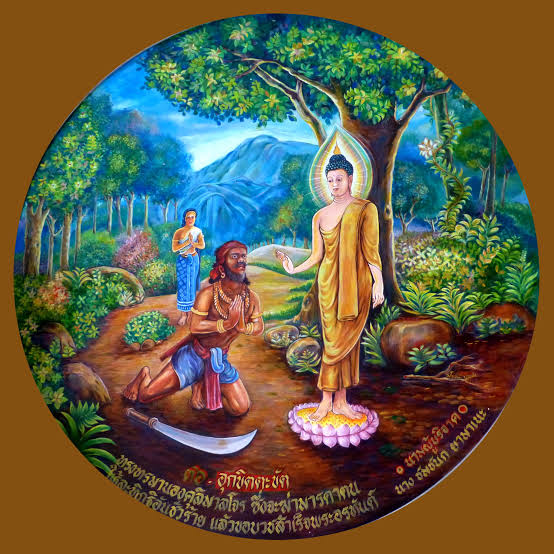
The transformative story of Angulimala

A Tale of Compassion and Transformation

The Angulimala Sutta, a captivating narrative from Buddhist scriptures, recounts the remarkable transformation of a blood-thirsty murderer into a compassionate monk under the profound influence of the Buddha. Angulimala, notorious for his brutal killings and a garland of severed fingers, terrorized the realm of King Pasenadi. The tale unfolds during a time when the Buddha, with unwavering compassion, confronted the darkness that shrouded Angulimala’s soul.

Angulimala’s notoriety as a ruthless killer, leaving villages and towns in a state of fear, paints a grim picture of his violent nature. His garland of fingers serves as a gruesome testament to the lives he had taken, making him a symbol of terror and malevolence.

Undeterred by Angulimala’s fearsome reputation, the Buddha ventured into the region where the murderer roamed freely. Despite warnings from locals about the dangers posed by Angulimala, the Buddha calmly continued his journey, determined to confront the source of darkness.

As the Buddha walked towards Angulimala’s lair, the air thick with tension, he encountered the menacing killer. Rather than responding with fear, the Buddha skillfully engaged Angulimala in a dialogue that would alter the course of his life. The Buddha’s words, laden with wisdom and compassion, began to unravel the tightly woven fabric of Angulimala’s violent identity.

In a pivotal moment, as Angulimala sought to chase down the Buddha with murderous intent, the Buddha employed a feat of psychic power. Despite running at full speed, Angulimala found himself unable to catch up with the Buddha walking at a normal pace. This display of supernatural ability left Angulimala astonished and created a space for the transformative dialogue that followed.

Angulimala urgently called out, “Stop, contemplative! Stop!” The Buddha calmly replied, “I have stopped, Angulimala. You stop.”

Perplexed, Angulimala asked, “While walking, contemplative, you say, ‘I have stopped.’ But when I have stopped, you say I haven’t. I ask you the meaning of this: How have you stopped? How haven’t I?”

The Buddha responded, “I have stopped, Angulimala, once and for all, having cast off violence toward all living beings. You, though, are unrestrained toward beings. That’s how I’ve stopped and you haven’t.”

Baffled by the Buddha’s profound words, Angulimala sought clarity on the apparent contradiction. The Buddha’s response not only clarified the cessation of violence within his own heart but also illuminated the unrestrained nature of Angulimala’s actions. This insightful exchange marked the beginning of a transformative journey within Angulimala, planting the seeds of change in his consciousness.

With a heart now inclined towards virtue, Angulimala, in an impromptu moment, requested ordination from the Buddha. The Buddha, recognizing the sincerity of Angulimala’s transformation, granted his request, welcoming him into the community of monks adorned with saffron robes and shaven heads.

Even as Angulimala embraced the monastic life, local villagers, fearing his past atrocities, sought protection from King Pasenadi. The king, in response, assembled an army and approached the monastery. Despite the villagers’ pleas to “stamp him out,” the Buddha’s wisdom paved the way for an unexpected resolution.

When questioned by the Buddha about how he would treat Angulimala if he had truly renounced violence, King Pasenadi underwent a profound transformation. The Buddha’s teachings on discernment and compassion prompted the king to reconsider his stance. Witnessing Angulimala’s monkhood, the king shifted from disbelief to acceptance, vowing to support him on his path to redemption.

The Angulimala Sutta not only narrates the personal transformation of a notorious murderer but also highlights the transformative power of compassion and wisdom. The Buddha’s fearlessness, compassion, and skillful means shattered the shackles of violence that bound Angulimala. Moreover, the sutta portrays the ripple effect of transformation, as even King Pasenadi undergoes a change of heart. This timeless tale serves as an enduring testament to the potential for redemption, forgiveness, and the profound impact of the Buddha’s teachings on even the most deeply entrenched patterns of suffering.

The transformative story of Angulimala

Link:https://peacelilysite.com/2023/11/15/the-transformative-story-of-angulimala/

#AngulimalaSutta #ShakymuniBuddha #Transformation #Compassion #Wisdom #Monk

Source: https://blogs.icrc.org/religion-humanitarianprinciples/a-humanitarian-re-reading-of-the-angulimala-sutta/#:~:text=Moved%20by%20the%20Buddha’s%20words,saffron%20robes%20and%20shaven%20heads.

Everything is the Best Arrangement

Photo by Benjamin Suter on Pexels.com

A Lesson in Patience and Gratitude

Life has a way of presenting us with unexpected situations, challenging our beliefs and testing our patience. In a world where instant gratification is often sought after, we sometimes forget the value of patience and the wisdom of waiting for life’s answers. A thought-provoking encounter between a traveler and an old lady by the river teaches us the importance of embracing life’s mysteries and being grateful for every experience.

Imagine a tired traveler standing beside a vast river, witnessing an old lady desperately in need of help to cross. Overcoming his own exhaustion, the traveler selflessly aids her in crossing the river. However, his act of kindness is met with disappointment when the old lady hurriedly departs without expressing gratitude. Regret fills the traveler’s heart, and he questions the worth of his effort without a simple “thank you.”

Hours later, just as the traveler’s energy reaches its lowest point, a young man catches up to him. To the traveler’s surprise, the young man expresses gratitude for helping his grandmother and presents him with dried food and a horse as tokens of appreciation. The traveler realizes that the old lady’s departure was not an act of ingratitude but a testament to the unpredictability of life’s unfolding. Sometimes, the answers we seek are not immediate; we must wait patiently to hear the echoes of our actions.

Life is often compared to a tapestry, woven with threads of joy and sorrow, success and failure. Similarly, the years are likened to giant trees, and life itself is the little birds that fly in and out. Adversity may cause our dreams and achievements to fade like bubbles, but in those moments of despair, we must shift our perspective. By embracing the belief that “everything is the best arrangement,” we can find solace and trust in life’s unfolding mysteries.

When faced with the bitter winds and rains of life, it may seem unbearable to our hearts. However, if we persevere and patiently wait, life will reward our efforts. Good times may not immediately emerge, but with steadfast dedication, they will gradually find their way to us. Life’s returns are not always immediate, but by staying hopeful and diligent, we open ourselves to the possibility of unforeseen surprises and positive transformations.

Instead of becoming upset or frustrated with life’s twists and turns, let us cast our eyes towards the horizon of life. Let us resist the urge to resort to self-pity or blame, and instead, cultivate gratitude for every encounter and experience. By maintaining an optimistic outlook, striving for personal growth, and believing in the inherent goodness of the universe, we create a space for blessings to manifest.

Life’s journey is filled with unpredictable encounters, and not all answers are readily available to us. Through the tale of the traveler and the old lady, we are reminded of the power of patience and the importance of gratitude. Remember, “everything is the best arrangement.” By embracing this belief, staying hopeful, and expressing gratitude for life’s encounters, we can navigate the twists and turns with a sense of peace and contentment. So let us be grateful for the wisdom gained from reading this article and cherish the beauty of life’s unfolding mysteries.

A Lesson in Patience and Gratitude

Link:https://peacelilysite.com/2023/06/02/everything-is-the-best-arrangement/

#Patience #Gratitude #Journey #unpredictableEncounters #Wisdom #BestArrangement #Traveler

The Story of Bhiksuni Weimiao

The Story of Bhiksuni Weimiao

Sutra about Wisdom and the Foolishness [賢愚経] ( A sutra translated into Chinese in 445 by Hui-chüeh and others. It contains sixty-two Buddhist tales (sixty-nine tales, in a separate extant edition). A Collection of Records concerning the Tripitaka, the catalog of the Buddhist canon compiled by Seng-yu (445–518), ascribes the translation of the Sutra on the Wise and the Foolish to others. According to that work, T’an-hsüeh, Wei-te, and six other priests went westward from northwestern China to Khotan on the southern edge of the Takla Makan Desert to seek Buddhist scriptures. They happened upon a great Buddhist ceremony that was held once every five years at a monastery. There they heard the learned monks expound the Buddhist scriptures and rules of monastic discipline in the language of Khotan. T’an-hsüeh and the others translated and recorded the lectures in Chinese. Later they returned from Khotan and, upon reaching the region of Turfan, compiled the lectures given by the monks in Khotan as a single sutra, which is known as the Sutra on the Wise and the Foolish. The sutra contains stories explaining the causal relationship between incidents in one’s past existence and those in one’s present existence. In each of these stories, Shakyamuni Buddha makes a connection between someone living in the present and a person involved in a past incident. The law of cause and effect states that every single action in the universe produces a reaction no matter what. We need to abstain from anything that is evil, do everything that is good, and use the correct understanding and views to cultivate. Don’t violate any of the precepts, otherwise you will end in miserable retribution. 

This story comes from ” Karma Scriptures about Wisdom and Foolishness “, the third volume in the ” Weimiao Bhiksuni “. In the era of Buddha Sakyamuni, many aristocratic women after ordination were very worried that their habits, such as lust, anger and ignorance, had not been eliminated yet. So they gathered to consult Bhiksuni Weimiao who had already attained the arhatship. Weimiao Bhiksuni told everyone the pain of the desire to bring, and tells the story of her previous life experience…

The Story of Bhiksuni Weimiao

Link:https://peacelilysite.com/2022/12/28/the-story-of-bhiksuni-weimiao/

#Buddhism#BuddhistSutra#Wisedom#Foolishness#KarmaScriptures#WeimiaoBhiksuni#CauseandEffect#Casulity

Source: https://www.nichirenlibrary.org/en/dic/Content/S/329