THE DHARMA OF CULTIVATION TRANSMITTED BY H.H. DORJE CHANG BUDDHA III


THE DHARMA OF CULTIVATION TRANSMITTED BY H.H. DORJE CHANG BUDDHA III

THE DHARMA OF CULTIVATION TRANSMITTED BY H.H. DORJE CHANG BUDDHA III

An oral discourse on the dharma given by His Holiness Dorje Chang Buddha III Wan Ko Yeshe Norbu Holiest Tathagata to rinpoches and other disciples:

WHAT IS CULTIVATION?

Today you, who are a rinpoche, respectfully requested a discourse on the dharma relating to the question “What is cultivation?” This is a very fundamental lesson; indeed, the first lesson. Nonetheless, this is an important matter that many cultivators, including those who have practiced cultivation over many years, do not understand and are confused about. It is difficult to incarnate as a human being. It is even more difficult to incarnate as a human being with the opportunity to encounter the true Buddha-dharma. Thus, today I will enlighten everyone on dharma relating to the question “What is cultivation?”

The essence of learning Buddhism lies with carrying out what we learn in our cultivation. We use good and bad causes and conditions as objects of cognition. Therefore, we must first understand what cultivation is. Cultivation is cultivating the increase of good karma and cultivating the avoidance of bad karma. It is increasing good karmic conditions, planting good causes, and reaping good effects. It is avoiding the increase of bad karmic conditions, not planting bad causes, and avoiding the reaping of bad effects. But the term cultivation has a rather broad meaning. We must first understand what cultivation is.

There must be that upon which the cultivator can rely. Without that which can be relied upon, your cultivation can easily become erroneous, non-Buddhist cultivation. For example, the cultivation of demonism entails cultivating the behavior of demons. The cultivation of Buddhism entails cultivating the behavior of Buddhas. Therefore, there must be that upon which the cultivator can rely. There must be models that the cultivator can reflect and rely upon.

All other religions espouse eliminating evil, promoting good, restraining selfishness, and benefiting others. The cultivator cannot rely upon this alone, for this is cultivation without understanding the purpose of Buddhism. This alone is not the practice of true Buddhism. Thus, in our cultivation, that which we rely upon is the Buddha. The perfect enlightenment of the Buddha is the model for our cultivation. We use our three karmas of bodily actions, speech, and thoughts to emulate everything about the Buddha. We thereby keep ourselves far away from all impure karma based on delusion and all evil conduct. We thereby constantly stay far away from that which is evil or bad. By not being involved with that which is evil or bad, our three karmas do not increase bad causes. Rather, we must carry out all good karma. Even one kind thought is something we should increase and never decrease. We should increase our good karmic affinity, good causes, and good karma every day. Simply put, we must always avoid that which is evil or bad and accumulate that which is good.

Why can it be said that we must stay far away from evil or bad karma but it cannot be said that we must eliminate evil or bad karma? Within the truth of Buddhism, there is the doctrine that the law of cause and effect can never be denied. Cause and effect cannot be eliminated. To say that it can is to take a nihilistic point of view. Hence, we can only build a wall of good karma, which is like building a retaining wall. This wall of good karma has the effect of blocking us from our evil karma.

Thus, only through learning from the Buddha, cultivating the conduct of the Buddha, and ultimately becoming a Buddha can we thoroughly liberate ourselves from the karma (cause and effect) that binds us to the cycle of reincarnation. Cause and effect still exists when one becomes a Buddha. However, cause and effect can not affect a Buddha. For example, the Buddha saw mountains of swords and seas of fire in the hell realm. The mountains of swords and seas of fire continued to exist as extremely painful means by which living beings undergo karmic retribution. When the Buddha suddenly jumped into the mountains of swords and seas of fire in order to undergo suffering on behalf of other living beings, the mountains and seas immediately transformed into a lotus pond of nectar. They transformed into a wonderful state. With respect to a Buddha, all bad or evil karmic conditions turn into the manifestation of good karma. Not only is there no suffering, there is instead a manifestation of great happiness.

Cultivation is to leave the cycle of reincarnation, liberate yourself from all suffering, become a holy being, and persevere until you become a Buddha. To leave the cycle of reincarnation, we must establish a mind of renunciation (a mind determined to leave the cycle of reincarnation), a mind of firm belief, a mind with immovable vows, a mind of diligence, and mahayana bodhicitta. All real states emanating from these minds rely upon and are based upon right view. Without right view, all states of mind will be inverted and confused. In other words, you will not experience any beneficial effects from cultivation that lacks right view.

For example, if you want to practice bodhicitta first, you will not be successful. It will result in an empty and illusory bodhicitta, a deluded and false state of mind. That is because bodhicitta must be based upon a mind of renunciation. That is, you must have a mind that is truly determined to attain liberation, to attain accomplishment in the dharma, and leave all of the sufferings of reincarnation. You must deeply understand that the cycle of reincarnation is indescribably painful. Not only are you yourself suffering, but all living beings in the six realms of reincarnation, each of whom we regard as our father or mother, are likewise suffering in the painful state of impermanence. Only if you want to extricate yourself from suffering do you truly cultivate yourself. Only then do you engage in Bodhisattva conduct that benefits yourself and others. Only then can bodhicitta arise.

However, it would be a mistake if you begin by cultivating a mind of renunciation. That would not accord with the proper order of cultivation. That would result in a non-substantive, theoretical type of desire to leave reincarnation and a self-deluded and self-confused state of mind. In such case, you would not be able to establish the true state of mind that is determined to leave the cycle of reincarnation.

Thus, if you want to have this true state of mind that is determined to leave the cycle of reincarnation, you must first understand impermanence. The second step is to have a mind of firm belief. You must firmly believe in the sufferings of reincarnation, which has as its source impermanence. Only with such a mind of firm belief will you fear the sufferings caused by impermanence and successfully attain a state of mind that truly fears impermanence. Having attained a state of mind that truly fears impermanence, your state of mind that is determined to leave the cycle of reincarnation will grow stronger day by day. Naturally, your state of mind that is determined to leave the cycle of reincarnation will enter a real state that truly fears impermanence. If living beings do not understand that all conditional dharmas in the universe are impermanent, if they do not understand the sufferings connected with reincarnation and impermanence, then they cannot establish a firm mind that gives rise to thoughts of leaving the cycle of reincarnation. If you have never thought about leaving the cycle of reincarnation, you will not cultivate at all, and you will not want to learn Buddhism. Those who do not learn Buddhism have no desire to leave the cycle of reincarnation. How could one who does not learn Buddhism have a mind determined to leave the cycle of reincarnation? Thus, you cannot first cultivate a mind determined to leave the cycle of reincarnation. As for the first step, you will not enter Buddhism without having a mind of impermanence. (Truly giving rise to feelings of fear of impermanence and truly giving rise to a state that fears impermanence.) Even if you become Buddhist, you will not be able to attain a deep level of correct cultivation.

To understand what cultivation is, you must understand the eight fundamental right views relating to learning Buddhism and cultivation.

The first one is a mind of impermanence. The second is a mind with firm belief. The third is a mind of renunciation (a mind determined to leave the cycle of reincarnation). The fourth is a mind with true vows. The fifth is a mind of diligence. The sixth is the precepts. The seventh is dhyana and samadhi. The eighth is bodhicitta. Recognizing these eight dharmas and carrying them out with right views is correct practice of Buddha-dharma. These eight fundamental right views, which are indispensable for cultivators, must not be taken out of order. All the fruits resulting from a mind of impermanence are causes of cultivation. All of the fruits resulting from a mind with firm belief are causes of steadfastness that does not change. All of the fruits resulting from a mind of renunciation are causes of liberation. All of the fruits resulting from a mind with true vows are causes of action. All of the fruits resulting from a mind of diligence are causes of persistent advancement. All of the fruits resulting from the precepts are causes of correct direction of cultivation. All of the fruits resulting from dhyana and samadhi are causes of wisdom. All of the fruits resulting from bodhicitta are causes leading to becoming a Bodhisattva.

These eight fundamental right views are the foundation of cultivation, liberation, and accomplishment in the dharma. If the root is not right, cultivation will not be established. Therefore, cultivation cannot be disorderly. Thus, practicing the eight fundamentals of cultivation must be guided by right views. That is, guided by right understanding and right view, you correctly develop your cultivation by going through these eight fundamentals in their proper order. That is cultivation. In your cultivation, you must constantly put into practice bodhicitta. That is because bodhicitta is the foundation for becoming a Bodhisattva.

According to the Buddha’s exposition of the dharma, the true meaning of bodhicitta is that it is the cause that will inevitably lead to becoming a Bodhisattva. Whoever walks the path of bodhi will ultimately reap the fruit of bodhi. The broad meaning of bodhicitta includes all of the mahayana dharma having to do with saving living beings out of great compassion and the causes leading to attaining the stages of enlightenment of a Bodhisattva.

However, because of the insufficient good fortune of living beings, some of the originally complete meaning of the Buddha-dharma has been lost as it was handed down from generation to generation. Especially in this current Dharma-Ending Age in which the karma of living beings in the three spheres (worlds) of the universe is like a sea of surging waves, it is as difficult for living beings to encounter the true Buddha-dharma as it is for a blind turtle swimming in the ocean to stick its neck through a tiny knothole in a floating and bobbing board. Thus, it is now extremely difficult to obtain the perfect Buddha-dharma. As a result, the meaning of bodhi has shrunk. It has gradually shrunk from its broad meaning to the narrow meaning of bodhicitta dharma.

There are two types of bodhicitta. There is bodhicitta in the holy sense and bodhicitta in the worldly sense. Bodhicitta in the worldly sense can be roughly divided into “vow bodhicitta” and “action bodhicitta.” The practice of vow and action bodhicitta includes a myriad of dharma methods, such as those relating to sentient beings, non-sentient things, the four great elements, one’s own six elements, as well as breathing, the ear base, the eye base and other bases, inner and outer mandalas, and ritualistic chanting. Whether it is bodhicitta in the worldly sense or the holy sense, if you are guided by the two sets of seven branches of bodhicitta, that is the highest, most excellent, and most complete form of bodhicitta.

Each living being in the six realms of reincarnation within the three spheres of existence has the right to cultivate bodhicitta. However, most living beings do not have the karmic affinity. Thus, they practice a fragmented and shrunken version of bodhicitta dharma. As a result, they frequently harbor the misconceptions that only those with an enlightened mind can practice bodhicitta or bodhicitta is the dharmakaya state of enlightenment. Of course, we do not deny these are existing parts of bodhicitta. However, these conceptions omit the practice of bodhicitta dharma by those living beings who do not have an enlightened mind. More importantly, bodhicitta is not dependant upon an enlightened mind or an unenlightened mind. Bodhicitta is the power of vows made out of great compassion by those living beings who learn Buddhism in any of the six realms of reincarnation within the three spheres of the universe as well as the power of vows made out of great compassion by all holy beings in the dharma realm. Bodhicitta is actual conduct based upon great compassion that aids living beings in becoming Buddhas or Bodhisattvas. It is the mind of love in the holy sense that the enlightened and the unenlightened or the holy and the ordinary both have.

With respect to bodhicitta, those who are enlightened use their enlightened state of virtue and realization, correct practices, and propagation of the true dharma to teach and enlighten living beings so that those living beings will become Buddhas. With respect to bodhicitta, those who are not yet enlightened vow out of great compassion that living beings and themselves shall together attain accomplishment in the dharma and liberation. They help other people enter the path of the true dharma of the Buddha, vowing that they will become Bodhisattvas and Buddhas. To such persons, bodhicitta dharma is the virtue of aiding others to become accomplished in the dharma. Because they benefit others, they receive merit. They thereby increase the causes leading to their becoming Bodhisattvas.

The manifestation of bodhicitta is expressed through actual practice involving the three karmas, which practice reflects great compassion. Any true cultivator, no matter whether he or she is ordinary or holy, has the right to arouse bodhicitta and should arouse bodhicitta. That is because bodhicitta is not an enlightened mind possessed only by holy people. Rather, it is conduct based upon great compassion. It is the planting of causes based upon a vow that oneself and others become enlightened. Bodhicitta does not only include the ten good characteristics, the four limitless states of mind (the four immeasurables), the six paramitas (perfections), and the four all-embracing Bodhisattva virtues (four methods that Bodhisattvas employ to approach and save living beings). Rather, it includes the entireTripitaka, the esoteric scriptures, and all dharma transmitted orally, through the ears, or telepathically that engenders conduct that is greatly compassionate, is in accord with the dharma, and benefits and saves living beings.

Thus, the bodhicitta is ultimate truth in a broad sense. With respect to the Buddha, bodhicitta is the three bodies, the perfect wisdom of Buddha that is summarized in four truths, and the mind of anuttara-samyak-sambodhi. With respect to a Bodhisattva, bodhicitta is propagating the dharma and benefiting and saving living beings out of great compassion. With respect to an enlightened being, bodhicitta is not being attached to the characteristics or distinctive features of things and not engaging in intellectual frivolity or conceptual elaborations. This is his or her original nature. The true emptiness of original nature is wonderful existence. It is the ultimate truth of all conditional dharmas. This truth neither arises nor ceases. With respect to an ordinary person, bodhicitta is compassionately helping other people and vowing that they learn Buddhism and attain liberation.

You must first have the perspective of impermanence before you can arouse bodhicitta. You must understand the impermanence and suffering relating to yourself and other living beings revolving in the cycle of reincarnation and thereby generate a perspective of awareness, a mind of impermanence. You will then vow to leave the cycle of reincarnation. As a result, you will then establish a mind that is determined to leave the cycle of reincarnation. You will say, “I resolve to leave.” You also want all living beings in the six realms, who are like your father or mother, to leave. You understand that the cycle of reincarnation is like a bitter sea, is difficult to endure, and is extremely painful. Because of this resolute perspective, you will generate a strong and pressing fear. You will constantly seek to be liberated at this very moment. But you understand that only by having the conduct of a Bodhisattva can you quickly attain liberation from the cycle of reincarnation. You thus vow to become a Bodhisattva. You seek to quickly enlighten yourself and others. Naturally, you then generate a mind of great compassion. As a result, the seeds of enlightenment are disseminated. The arousal of bodhicitta is based upon a mind of great compassion. Thus the Buddha said, “The water of great compassion irrigates the seeds of bodhi. As a result, the bodhi trees will have lush foliage and the fruits will be plentiful.” Hence, bodhicitta will naturally be established. Bodhicitta is the cause leading to becoming a mahayana Bodhisattva. You will attain pure and correct views and understanding of cultivation. Based upon these right views, you should deeply enter the emptiness bhuta-tathata (true suchness) and the practice of the state of emptiness. At this time, you transform worldy bodhicitta into a state in which you realize that “the three entities are inherently empty.” That is you transform everything in existence into bodhicitta in a holy sense. With bodhicitta, you cultivate the conduct of bodhi and enter the stage of a Bodhisattva.

Cultivation of bodhicitta requires implementation. Cultivation of bodhicitta is not a matter of just ritualistic chanting, making empty vows, or engaging in visualization. In the cultivation of bodhicitta, the most important aspect is deeply pondering the following concerning yourself: “My body is impermanent, is changing every nanosecond, and is moving toward decline, old age, and death. I compare why my face has aged over a ten-year period, over a forty-year period, or over a seventy-year period. The degree of agedness of my skin has changed. I will soon enter old age, sickness, and death and continue revolving in the cycle of reincarnation, where I will experience suffering. I also contemplate that joyfully innocent, newborn, fresh, and lively look I had when I was a small child. I contemplate how I no longer have that childlike appearance. My face and skin have aged. My energy has declined. I often fall ill. That quality of youth is gone. The power of impermanence will end my life. My relatives and old friends will all die one after another. Like a dream, it will soon be all over. My mind generates great fear. With a resolute mind, I act in accord with the precepts, practice in accord with the dharma, and enter bodhicitta by practicing the two sets of seven branch bodhicitta dharma: the Dharma of Great Compassion for All Living Beings as My Mother Bodhicitta and the Dharma of Bodhisattva Correspondence Bodhicitta.”

When practicing the Great Compassion for My Mother Bodhicitta, you arouse great compassion and cultivate the following: understanding who my mother is, bearing in mind kindness, repaying kindness, loving-kindness, compassion, renouncing greed, and eliminating attachment. When practicing this cultivation, everyone should carry out the following for themselves:

Understanding who my mother is: I deeply understand that all living beings in the six realms of reincarnation within the three spheres of the universe have been since beginning-less time my fathers and mothers in the revolving cycle of reincarnation.

Bearing in mind kindness: I should deeply bear in mind that all of my parents (i.e. all living beings) that now exist in the cycle of reincarnation have since beginning-less time given birth to me, reared me, loved me, and became tired and ill for me. Their kindness to me is as heavy as a mountain. I should bear in mind their kindness. I will then regard the sufferings of my parents (i.e. all living beings) as my own suffering.

Repaying kindness: I understand that my parents (i.e. all living beings) have offered me everything. They are now revolving and wandering in the six realms of reincarnation experiencing endless suffering. I resolve to take action to enlighten myself and others, to save and liberate my parents (i.e. all living beings) in order to repay their kindness to me.

Loving-kindness: At all times, through the actions of my three karmas, I am loving and kind toward all living beings, who have been my parents. I wish them a long life without illness, good fortune, good luck, and a happy life.

Compassion: Day and night, I constantly beseech all of the Buddhas and Bodhisattvas to empower all of my parents (i.e. all living beings) so that they may extricate themselves from all forms of suffering, encounter and practice the Buddha-dharma, and liberate themselves from the sufferings of cyclic existence.

Renouncing greed: I hold no attachment in my mind to anything that I do to benefit any living beings, who have been my parents. I cultivate non-attachment to all of my good actions of body, speech, and mind. Thus, my good actions become natural and spontaneous, as my original nature is good. I do not do good purposefully. I do good and then forget about it.

Eliminating attachment: In my practice, as I cultivate all forms of goodness and benefit my parents (i.e. all living beings), I should not become attached to any dharma. I should eliminate all attachment to self. Realizing a state of emptiness, I am aware and I experience wonderful happiness that comes from samadhi. While practicing the dharma, I am not attached to the dharma. I do not intentionally get rid of deluded thoughts. I do not intentionally seek the truth. Not coming and not going, blissful, clear, and without thought, I am as calm as tranquil water. Everything, including myself, is inherently empty.

The supporting conditions for putting bodhicitta into practice must be based upon right view. We contribute to living beings in their performance of good deeds, but we do not contribute or help living beings in their performance of bad deeds. We rectify their behavior so that they perform good deeds. Thus, we do all good deeds that benefit living beings. We plant all good causes that lead to benefiting living beings. In that way, we carry out the seven branches of the Dharma of Bodhisattva Correspondence Bodhicitta. We help living beings in their performing good deeds and help increase their good causes. We help living beings reduce their accumulation of bad karma and help them stay far away from bad causes. The seven branches of the Dharma of Bodhisattva Correspondence Bodhicitta are as follows. The first branch is “self and others are equal” bodhicitta. The second branch is “exchange between self and others” bodhicitta. The third branch is “benefit others before self” bodhicitta. The fourth branch is “dedicating merit” bodhicitta. The fifth branch is “fearlessly protect the dharma” bodhicitta. The sixth branch is “effectively lead others to correct practice” bodhicitta. The seventh branch is “renouncing myself to help others build good karma” bodhicitta. When practicing this cultivation, everyone should carry out the following themselves:

Self and others are equal bodhicitta: When there is a conflict of interest between myself and others, I will rid myself of hatred, antipathy, greed, and arrogant, disparaging mentality. I must not emphasize benefiting myself. I should treat myself and others equally.

Exchange between self and others bodhicitta: I want to bear the sufferings of all living beings. I give to others all of my happiness and good luck so that they may leave suffering and obtain happiness.

Benefit others before self bodhicitta: When other living beings and I are suffering, I want others to extricate themselves from suffering before I do. When other living beings and I are happy, I want others to be happier than I am.

Dedicating merit bodhicitta: I dedicate to all living beings all of the merit and accomplishments from my cultivation in the hope that they will leave suffering and attain liberation.

Fearlessly protect the dharma bodhicitta: When any evil spirits or demons harm the Buddha-dharma, lead living beings to break the precepts, and harm living beings resulting in the suffering of living beings, I will maintain right view, will not fear the evil powers of those demons, and will step forward to protect the Buddha-dharma and the wisdom whereby living beings will become liberated.

Effectively lead others to correct practice bodhicitta: Because living beings are burdened with the power of karma that has accumulated since beginning-less time, because they are ignorant and have created all kinds of negative karma, there will be times when they will not repent or change their ways despite my constructive exhortations. In such case, I will use powerful rectifying dharma methods to lead such people onto the path of true dharma and beneficial and good conduct.

Renouncing myself to help others build good karma bodhicitta: When the realization of other people is higher than mine or their ability to save living beings is better than mine, I will yield to other people so that living beings will be benefited more. At such time, without any hesitation, I yield to them. This furthers the great undertaking of goodness.

Bodhicitta, as part of cultivation, is the source of accomplishment in the dharma and is very important. I will now give an example involving a rinpoche and a dharma master. This rinpoche cultivated himself for more than thirty years. He received more than one thousand esoteric dharma initiations. He mainly practiced the Great Perfection Dharma (Dzogchen) of the Nyingma sect. He was able to expound the Buddha-dharma of the Tripitaka very well. However, he did not have any real dharma powers. The other person, a dharma master, had been a monk for more than twenty years. He strictly abided by the precepts and rules of discipline. He was well versed in the sutras, the vinaya (precepts and rules of discipline), and the commentaries. He practiced important and great dharmas of the Tibetan esoteric school of Buddhism and was the abbot of a famous temple. Like the rinpoche, he was famous in expounding the dharma. However, he also was unable to manifest any actual realization.

I told them that no matter what great dharma of the esoteric school they may practice, it is all like building a tower on quicksand. Such a tower could not be built. I told them that even if they temporarily had some success in their practice, it would quickly vanish. I had them practice letting go of their own knowledge or habituated way of knowing because these are hindrances. I had them practice “What Is Cultivation?” After they practiced such dharma for about eight months, I had them add to their practice the Great Perfection (Dzogchen) and other dharmas. A miracle then happened. During a test of his progress, the rinpoche applied the Vajra Fist Powerful Thunder True Dharma Palm and manifested great powers. Actual realization was shown. However, the dharma master did not manifest any powers. He continued to practice this cultivation dharma. Under my careful pointing out of his shortcomings, he finally understood the importance of true cultivation and how true cultivation requires devoting time and energy on the actual carrying out of the three karmas. He finally understood that there is no room whatsoever for any slippage or compromise in this regard. He continued his practice for three months. In a test to measure his ability to manifest realization, his powers were thoroughly exhibited.

Thus, whoever can cultivate in such manner and carry out his practice according to the dharma will be able to obtain the true Buddha-dharma. Naturally, he will develop wisdom. He will not become involved with empty theories regarding the Five Vidyas. Rather, he will manifest actual states of accomplishment in the true Five Vidyas. Such a person will realize “manifestation of wonderful existence (supernatural power),” attain the fruit of bodhi, and enter the stage of a Bodhisattva.

The practitioners of all Buddhist sects should comply with these rules of cultivation and should practice bodhicitta. If you do not follow such dharma of cultivation in its proper order, then you will easily become confused and lose your way. Such dharma is the key to the methods of practicing cultivation.

Learning the methods of practicing dharma is another matter. All beneficial effects derived from learning the dharma are based upon cultivation. When your practice is in strict conformity with the dharma, you will naturally realize virtue and will successfully reach the true state. If you do not have the correct rules concerning cultivation, the dharma that you learn will become dharma based on erroneous view or even the evil dharma of demons. If you are complying with the dharma of cultivation as stated in this discourse, the dharma that you have learned is good dharma, and you are engaged in practicing Buddha-dharma. Cultivation also involves the ten good characteristics, the four limitless states of mind (the four immeasurables), the six paramitas (perfections), the four all-embracing Bodhisattva virtues (the four methods that Bodhisattvas employ to approach and save living beings), etc.

Some disciples will think that they know all of the important dharma I expounded today on cultivation. They will therefore not carefully ponder and fully incorporate into their thinking the cultivation of which I spoke. Rather, the wish they harbor in their hearts is to learn a great dharma whereby they will become a Buddha in this very lifetime.

Anyone with such a mentality has only superficial knowledge, has fallen into confusion, and has lost his way. Such a person will not learn the true Buddha-dharma. Even if he is practicing great dharma, such as the Great Perfection (Dzogchen) of the Nyingma sect, the Mind Within Mind of the Kagyu sect, the Great Perfection of Wonderful Wisdom of the Sakya sect, the Kalachakra Vajra of the Geluk sect, Zen meditation of the Zen sect of exoteric Buddhism, reciting a Buddha’s name of the Pure Land sect, the dharma of the Consciousness-Only sect, or samatha and vipasyana of the hinayana school, he will not obtain any fruits from his practice and will not be able to transform his consciousness into wisdom. Thus, he will continue to go round and round in the state of an ordinary person. He will not be able to manifest any realization, the source of which is the wisdom of exoteric and esoteric Buddhism. He will not be able to exhibit any actual accomplishments in the Five Vidyas. He will only be able to manifest that which an ordinary person manifests. He may even be quite stupid such that he is only able to memorize theories in books and speak of empty theories, totally incapable of putting those theories into actual practice. Such a person cannot actually do anything. Even if he can do a few things, he cannot exceed those people in the world who are experts in those few things.

Think about it. Does such a person embody the Buddha-dharma? Is the wisdom derived from the Buddha-dharma so inferior? How can one who has not yet developed holy wisdom and still has the consciousness of an ordinary person possess the true dharma to enlighten himself and others? However, if you enter the practice of the dharma according to these rules of cultivation, then you can receive the true Buddha-dharma, can become truly proficient in exoteric and esoteric Buddhism, and can manifest accomplishments in the Five Vidyas. We should therefore understand that cultivation is the foundation for learning dharma, the cause of liberation, and the source of realizing the state of holiness.

Today I spoke briefly on the subject of what cultivation is. I expounded the subject of the correct practice of bodhicitta, which is part of cultivation. I did not speak of other dharma. There is so much more to teach. However, if I casually discussed those other teachings in this book, it would not be in accord with the rules of discipline and could easily create the negative karma of disrespect. Thus, I hope that all of you who learn Buddhism will deeply immerse yourselves in the Tripitaka and esoteric scriptures or will listen to my recorded discourses on the dharma. If you attentively listen to those discourses on the dharma with all your heart, within ten days you can attain a certain degree of joy or the wonderful joy of great enlightenment. If the causes and conditions mature, you will experience beneficial effects for your entire life or even attain great accomplishment, liberation, and Buddhahood.

Now that you have learned this dharma of cultivation, do you want to practice it? Anyone who engages in true cultivation can become accomplished in the dharma and attain liberation from the cycle of birth and death. Thus, we must clearly understand something. Although you have read “What is Cultivation” and although you have read the eight fundamentals of cultivation and two sets of seven branches based upon right view, that is called “reading words relating to practice.” That is not cultivation. If you understand the principles relating to cultivation, that is called “understanding the theories of practice.” This is also not cultivation. If you begin to implement this dharma of cultivation according to its content, that is also not cultivation. That is called “entering the process of cultivation.” If you have done your utmost to apply great compassion in accordance with this dharma of cultivation, that is called “coarse cultivation.” It is not true and correct cultivation. If you do not need to do your utmost to apply great compassion, if you naturally, effortlessly and perfectly carry out the eight fundamentals of cultivation and two sets of seven branches according to the dharma, that is called “cultivation.”

Why is it that doing your utmost in cultivation is not called “cultivation” but rather is called “coarse cultivation”? It is because since beginning-less time, the power of karma and the hindrances of ignorance have obstructed practitioners. Hence, they cannot let go of greed (selfish desire), hatred (anger or antipathy), and ignorance (delusion). They cannot let go of their attachment to self. This produces the hindrances that are based on the defilements (afflictions). This also produces the hindrances that emanate from their own knowledge or habituated way of knowing. These karmic hindrances devour all of the right mindfulness (right thought) of these practitioners. As a result, the process of implementing each of these rules of cultivation is difficult for these practitioners. Precisely because of this difficulty, they choose the method of using their utmost effort to practice cultivation. Using one’s utmost efforts in this manner is like a pebble that is coarse on the inside and out rather than a shining precious stone that has been carved and polished. Practicing part of the eight fundamentals of cultivation and the two sets of seven branches and not practicing the remaining parts is also not called true cultivation. That is why it is called “coarse cultivation” or “incomplete cultivation.”

Thoroughly understanding the rules of cultivation, not forcefully implementing them, and naturally carrying out the eight fundamentals of cultivation and two sets of seven branches according to the dharma is true cultivation that is without attachment to self and that has overcome the hindrances. This is the path of bodhi. Thus, every day practitioners should introspect upon Great Compassion for All Living Beings as My Mother Bodhicitta and Bodhisattva Correspondence Bodhicitta. They should reflect upon those two sets of seven branches, asking themselves whether they have practiced them according to the dharma. If you were unable to practice these rules according to the dharma contained in this discourse, it shows that you have entered the state of “coarse cultivation.” If you did not fully implement these rules, then your cultivation is incomplete cultivation. You will not become accomplished in the dharma and liberated from the cycle of reincarnation through such incomplete cultivation. Even if you have some minor accomplishments, it will be impossible for you to attain great fortune and wisdom, supernatural powers, and realization in the Five Vidyas.

If you introspect every day upon these two sets of seven branches, are not forceful in implementing them, are greatly compassionate, follow goodness in a natural way, and carry out the two sets of seven branches naturally and according to the dharma, that would be true cultivation and complete practice. You will thereby easily be able to attain liberation, become a holy being, and obtain good fortune and wisdom. You will accordingly have realization in the Five Vidyas. You will certainly reach the stage of a Bodhisattva. Thus, you should understand that “reading words relating to practice,” “understanding the theories of practice,” “entering the process of cultivation,” and “incomplete cultivation” is easy. To practice the two sets of seven branches perfectly and without attachment is difficult. Actually, when you let go of attachment to self, you immediately enter correct and true cultivation. How could this be difficult? Everyone can do that!

When you do your daily introspection, besides using thoughts to contemplate and visualize, it is more important that you must use as objects of introspection fellow disciples with whom you are familiar, people with whom you get along, people who are not good to you, negative karmic conditions, any conditions or people that make you unhappy, or people you find hard to get along with, to whom who do not speak, or who do not speak to you. You must use them as objects of your practice, asking yourself, “Today did I act in accordance with the two sets of seven branches and on my own initiative show goodwill to these people? When I approached that person on my own initiative and he attacked me with abusive words, did I forbear those insults with patience and continue to approach him in order to show goodwill?” You must not bear any grudge due to abusive words, abusive conduct, and insults. If, every day, you practice your bodhicitta without relenting, carry out the two sets of seven branches through your three karmas of physical action, speech, and thoughts, actually cultivate yourself according to the dharma in a real and concrete way, and realize “the thing itself is empty,” then it will be very easy for you to learn the supreme Buddha-dharma. In such case, bodhicitta and the stage of a Bodhisattva will naturally be yours. That is cultivation.

I have finished expounding the dharma of cultivation that benefits living beings. However, there is a certain type of matter harmful to living beings that occurs all the time. I am referring to the matter of using my name to harm the interests of living beings. I would now like to call attention again to a problem that is especially important and that everyone should take seriously.

In this world, there currently are some dharma kings, venerable ones, rinpoches, dharma teachers, and even laypersons who claim that they are my trusted followers. They may claim to represent me in handling a certain matter. They may claim to convey a certain message from me. Or, they may claim that what they say are my own words. Actually, I have disciples in exoteric and esoteric Buddhism and in each of the main sects. No matter what the status of any greatly virtuous person making such a claim may be, nobody can represent me. This applies to even very small matters!

Only when a person has a special-purpose document that I gave him or her clearly indicating he or she represents me in handling a certain matter, that document contains my signature and fingerprint, and that document is accompanied by a corresponding videotape can he or she represent me in handling the matter specified in that document. Otherwise, no matter how high the status of a dharma king, venerable one, rinpoche, or dharma teacher may be, his or her views, discourses, and explanations of dharma do not represent my views and do not serve as the standard of correct understanding and correct views. I know that my own oral discourses and writings are the true dharma without any bias. That is because my oral discourses and writings truly benefit and liberate living beings. Furthermore, nobody may use any method to make additions, deletions, or revisions to my writings or discourses on the dharma given orally. Anyone who violates what is stated above is certainly one with wrong views or one who has fallen into demonic ways, no matter how high the status of that person is.

Thus, the only time someone can represent me is when everyone personally sees a document containing my fingerprint and there is accompanying proof in the form of an integral sound recording or videotape that corresponds to the document and in which I personally speak. Otherwise, no matter who the Buddhist disciple may be, including those disciples of holy virtue who have been at my side for a long period of time, everything that they think, do, say, or write is their own conduct and absolutely does not represent me!

THE DHARMA OF CULTIVATION TRANSMITTED BY H.H. DORJE CHANG BUDDHA III

Link: https://hhdorjechangbuddhaiiidharma.com/2021/02/14/the-dharma-of-cultivation-transmitted-by-h-h-dorje-chang-buddha-iii-2/

#DorjeChangBuddhaIII #HHDorjeChangBuddhaIII  #MasterWanKoYee #Buddha #Cultivation

H.H. Dorje Chang Buddha III Imparts Dharma Learning From Buddha

H.H. Dorje Chang Buddha III Imparts Dharma Learning From Buddha

H.H. Dorje Chang Buddha III Imparts Dharma Learning From Buddha
Learning from Buddha

Learning from Buddha is a supreme Dharma treasure. It will be difficult to attain accomplishment without learning this Dharma.

The English translation of this holy book is now available. Please download the PDF file (Please note: the PDF file was last updated on September 24, 2020) of the English version by pressing either one of the download buttons below.

The following is the book’s table of contents.

Table of Contents

Explanation by the Publisher
Explanation by United International World Buddhism Association Headquarters
Translation Notes
1. Learning from Buddha (Part 1 of 3, Lesson 1) – If You Learn Dharma but Do Not Cultivate Yourself, You Cannot Attain Accomplishment
2. Learning from Buddha (Part 2 of 3, Lesson 2) – If You Cultivate Yourself but Do Not Learn Dharma, You Cannot Generate Realization Powers
3. Learning from Buddha (Part 3 of 3, Lesson 3) – If You Do Not Put into Practice the Lessons You Have Heard on Cultivation and Dharma, It Will Be Like Trying to Scoop up the Reflection of the Moon on Water

Explanation by the Publisher

Before you respectfully read the book Learning from Buddha, we would first like to let you know the origin and background of His Holiness Dorje Chang Buddha III and our purpose in publishing this book. H.H. Dorje Chang Buddha III is the true incarnation of the Primordial Sambhogakaya Buddha, Dorje Chang Buddha.

This is not a self-proclaimed or a self-conferred status. Rather, the status of His Holiness the Buddha is universally recognized by leaders, regent Dharma kings, and great rinpoches of all the major sects of Tibetan Buddhism through the issuance of official recognition documents. They include Great Dharma King Dodrupchen, the world-wide reigning lineage-holder of the great Rainbow Body Dharma and the guru of Jigme Phuntok; Great Dharma King Achuk; Great Dharma King Penor; Great Dharma King Jigme Dorje; Great Dharma King Trulshik; Great Dharma King Taklung Tsetrul; Dharma King Gongbao Dumu Qujie; Regent Dharma King Shamarpa; Great Holy Guru Tangtong Gyalpo; and other top leaders of Buddhism. They issued official written documents universally recognizing the status of H.H. Dorje Chang Buddha III. Moreover, based on the outcome of the Vajra Fa-Man Determination by Holy Selection Dharma (金剛法曼擇決), 1 the recognitions issued by those top leaders of Buddhism were conclusively determined to be valid, affirming that H.H. Dorje Chang Buddha III is the true incarnation of Dorje Chang Buddha, the Primordial Buddha!

H.H. Dorje Chang Buddha III is the only one in the history of Buddhism to have received such a large number of recognitions and to be recognized with such supreme status. Thus, as you can well imagine, the Dharma imparted by H.H. Dorje Chang Buddha III has naturally become a marvelous treasure that is the highest Buddha Dharma. The Dharma imparted by H.H. Dorje Chang Buddha III is rooted in the truth and suits the spiritual capacity of different people. The Dharma principles are clear, incisive, and with the appropriate degree of depth. Dharma impartations of H.H. Dorje Chang Buddha III are the best Buddhist sutras. They are supreme, wonderful treasures that best suit all cultivators in their quest to learn Buddha Dharma, enabling them to quickly become accomplished.

This book, Learning from Buddha, is a Dharma that H.H. Dorje Chang Buddha III openly imparted in Miami, Florida for disciples who accompanied Him on that trip. It is also a most important Dharma treasure that all Buddhist disciples must study and put into practice in order to attain accomplishment and liberation. When this Dharma was being imparted, a gigantic leaf of a Western bodhi tree fell from the air in front of all who were there. That occurrence added a holy miracle to this Dharma treasure.

Our purpose in publishing this Buddhist text at this time is to make it convenient for people to study the teachings of His Holiness the Buddha, implement such teachings in both cultivation and Dharma practice, and thereby walk the path of benefiting living beings, bringing peace to the world, experiencing bliss, and becoming accomplished and liberated. It is our honor as well as our duty to learn the teachings of H.H. Dorje Chang Buddha III and do all we can to further the good actions and welfare of living beings.

1 Pronounced in Chinese “Jin Gang Fa-Man Ze Jue (金剛法曼擇決),” it is a supreme Holy Dharma to derive a conclusive and absolutely correct determination, such as determining the authenticity of the reincarnation of a Buddha, Bodhisattva, Arhat, or rinpoche.

Dharma Voice Publishing, LLC

 Dorje Chang Buddha III

Explanation by United International World Buddhism Association HeadquartersThe blue text below is a complete transcript of the words spoken by H.H. Dorje Chang Buddha III regarding the publication of the photos. H.H. Dorje Chang Buddha III said:

United International World Buddhism Association Headquarters2 has requested permission to publish and distribute these two photos of me and asked me to say a few words. First of all, I will not accept any money from the sale of the photos. However, your Headquarters should set a low price for those who purchase them. The name on the photos is Dorje Chang Buddha III. Whether I agree or not, this will be the way the name is written. This is my name, which was recognized and corroborated in official documents issued by leaders of many Buddhist sects throughout the world! It was legally affirmed by the government! It is not a name I conferred upon myself. Although the title of Buddha has been legally affirmed in my name, nevertheless, I am very humbled, and this title means nothing to me. I am not a Bodhisattva, not an Arhat, not a venerable one, not a Dharma king, and not a rinpoche. I am not a holy person. I am one with a heart of humility. When your Headquarters publishes the photos, do not add “Namo” to my name. I am not qualified to be honored with the title “Namo.”

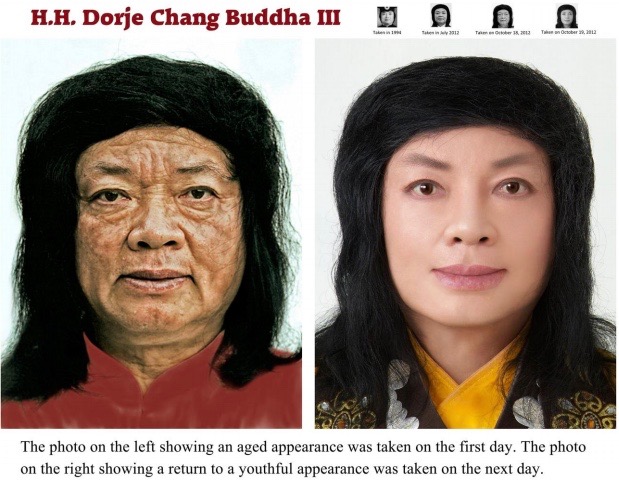
I previously vowed to bear karma on behalf of living beings. My physical strength greatly weakened. I quickly became exhausted, and an aged appearance emerged. Rather than saying I bore karma on behalf of living beings, it would be better to say that my humble body was weak and sickly. Recently, United International World Buddhism Association Headquarters insisted on using my photo to perform the Vajra Fa-Man Determination by Holy Selection Dharma. Regardless of what selection method you use to determine my status, I will not accept it. That is because I am just an ordinary person. The photo of my youthful appearance was the result of having washed my face with medicine given to me by an elder virtuous one. Actually, more cosmetic treatment methods already exist in the field of medicine nowadays. I do not know the Buddha Dharma to reverse old age and return to a youthful appearance. As time goes on, I will gradually become old again. This is because I am a person who is just like you, with no ability to stop the process of impermanence. However, I have one thing that is different from you! I have what Buddhists need, the highest-level great Dharma of the Tathagatas to attain perfect liberation and accomplishment. This is also the same Dharma possessed by all Buddhas in the ten directions: Stay far away from feudal superstition, strange or heretically induced phenomena, evil masters, deceivers, non-Buddhists under the guise of Buddhism, cults, evil teachings, and evil books. Strictly abide by the precepts and disciplinary rules of Buddhism. Establish great compassion as your foundation. Do not do anything that is evil. Do all things that are good. Give up self-interests and benefit others. Patiently endure humiliation and adversity. Practice humility. Purify the mind. When encountering living beings, regardless of whether they are handicapped, deficient, sick, or healthy, treat them all equally as family members. Know that all phenomena are governed by causality. With good causes, you receive good retributions. Good retributions yield good fruits. Good fruits enable you to receive the true Dharma. Relying on the Dharma, you can achieve perfect good fortune and wisdom. Then you can step into the state of accomplishment, break away from the sufferings that living beings experience, cease transmigrating in the cycle of birth and death, and accomplish the perfect enlightenment of a Buddha!

These are the teachings and precepts that I practice and uphold. I say without the slightest ambiguity that the Buddha Dharma I impart is absolutely the true Dharma of the Tathagatas possessed by all Buddhas in the ten directions! I cannot be modest about this. Why? I must speak true words. Otherwise, I would mislead practitioners. If you truly practice the Supreme and Unsurpassable Mahamudra of Liberation; thoroughly comprehend Imparting the Absolute Truth Through the Heart Sutra; often listen to my audio-recorded Dharma discourses that have not been altered or spoken in my stead by other people and, best of all, read published books that record the Dharma I imparted; and if you are truly devout toward all Buddhas, then I, Dorje Chang Buddha III, guarantee that you will learn great Dharma to achieve perfect good fortune and wisdom and will attain accomplishment in your current lifetime!

 If you are a master with disciples, you must at least study in depth some sutras and commentaries as a foundation, such as the Heart Sutra, the Diamond Sutra, the Avatamsaka Sutra, the Lotus Sutra, the Suramgama Sutra, the Agama Sutras, the Hetu-Vidya Treatise, the Madhyamaka Treatise, the Abhidharma-kosa Treatise, the Prajna Treatises, the Precepts and Discipline Treatise, the Consciousness-Only Treatise, the Lam Rim Chen Mo, the Bodhisattvacharyavatara Treatise, and others. Doing so will reduce the possibility of leading others astray in the process of teaching.

Some people have now mentioned that they just want to learn my medicinal cosmetic regimen. Fine! As long as you thoroughly learn either The Xiaman Most Excellent Oceanic Mind Essence (暇滿殊勝海心髓) or The Ultimate Bodhicitta for Attaining Dharma-Nature True-Thusness Oceanic Mind Essence (最勝菩提空行海心髓) in The Supreme and Unsurpassable Mahamudra of Liberation and have put into actual practice what you learn, you can be assured that the highest, holiest great Dharma will be available to you for achieving perfect good fortune and wisdom, liberation, and accomplishment! At that time, why would you still need any medicinal cosmetic regimen?

Finally, I remind you that you must pay attention to something. Some people, including some who are masters, are now using my name to commit fraud in various ways. I hope that you will be careful and observe with caution. Be cautious!

 Whoever distributes my above contrasting photos must be sure to include my words stated above. Anyone who removes my words and just distributes the photos is undoubtedly an evil person!

2 Its current name is World Buddhism Association Headquarters.

 The following are honest words from us at United International World Buddhism Association Headquarters:

We at the Headquarters respectfully studied the spoken words of H.H. Dorje Chang Buddha III, which caused all of us at the Headquarters to be extremely humbled. There are some people among us Buddhists who truly regard themselves as great Bodhisattvas. They boast that someone like them can only be found in the heavens but not on earth. However, in reality, they do not bear the slightest indication of realization or accomplishment. They only know how to pose as venerable ones, Dharma kings, great rinpoches, great Dharma masters, or gurus but do not know to cultivate themselves!

As a true Buddha living in the world at this time, H.H. Dorje Chang Buddha III has never been concerned about damaging His own honor, status, or image, for He has effaced Himself in order to benefit living beings by saying that He is an ordinary person like everyone else. In reality, the facts prove that in the few-thousand-year history of Buddhism, H.H. Dorje Chang Buddha III is truly one who has actually manifested the pinnacle of attainment in both Exoteric and Esoteric Buddhism and perfection in the Five Vidyas! His Holiness the Buddha is also the only one in the history of Buddhism who has made it His practice to benefit and serve living beings without accepting any offerings.

One should know that all things cannot be separated from the law of cause and effect. The retribution that is induced through causality is like a shadow following the body that casts it. The accomplishments of H.H. Dorje Chang Buddha III are the fruits manifested from the cause of being a Buddha! Precisely because of this, it is simply impossible to find anyone who can be assessed as being comparable to Him. H.H. Dorje Chang Buddha III said not to use “Namo” in His name. Therefore, we originally did not use that honorific prefix in the heading over one of the photos. However, after His identity as a Buddha was definitively confirmed through the Vajra Fa-Man Determination by Holy Selection Dharma, we must add the honorific prefix “Namo” and/or “H.H.” to His name. The two photos were taken in the presence of many people. The photo showing an aged appearance was taken on October 18, 2012. The photo showing a reversal of old age and a return to a youthful appearance was taken on the next day, October 19th. As a result of bearing negative karma for living beings, over a three-month period, the face of His Holiness the Buddha turned into that of an aged, exhausted person. Many of the people who saw this lost heart in their own cultivation. Compelled by this pressing condition and having no other choice, His Holiness the Buddha had to quickly rejuvenate, cast away exhaustion, and restore physical strength for everyone to witness. His face changed into a youthful appearance that was even more dignified and handsome than when He was in His youth. As of now, there is simply no medicine in this world that can so quickly reverse old age, restore a youthful appearance, greatly change facial features, regenerate eyebrows, and restore physical strength. Just based on these two contrasting photos taken within two consecutive days, could this possibly be an ordinary person? Would you say so?

To prove the point, Wangzha Shangzun (旺扎上尊), a Great Holy Guru with the status of Gold Button Grade Three, did a demonstration on an elderly person who was more than sixty years old. This person was collectively nominated by those who were present at the demonstration. In about ten minutes, while all were watching, the empowerment by Wangzha Shangzun caused one entire side of this elderly person’s face to return to a youthful appearance of about thirty years of age. This enabled all of the attendees to witness right there the fact of restoring youth through Buddha Dharma and the striking contrast between the two sides of that person’s face. Wangzha Shangzun said, “This little bit of realization power that I have is childish and laughable in front of His Holiness the Buddha. H.H. Dorje Chang Buddha III is the universe. I am just a tiny stone particle. No matter how many of us who are called venerable ones and Dharma kings are put together, we would not be qualified even to carry the shoes of His Holiness the Buddha.”

H.H. Dorje Chang Buddha III does not acknowledge that He is a Buddha, but we must present the true facts to living beings. Hence, the Vajra Fa-Man Determination by Holy Selection Dharma, a great Dharma of the Tathagatas to verify the status of the holiest of all holy ones, was performed by Wangzha Shangzun at two Dharma assemblies. Mozhi Jiaozun (莫知教尊), Dharma King Gar Tongstan (祿東贊法王), Kaichu Ruzun (開初孺尊) and several dozens of eminent monks, greatly virtuous ones, and laypersons were present to bear witness. In front of the watching crowd, an image was put on a bare, flat table. A pinch of Ganges River sand was then placed above the top of the hair of the image. As Wangzha Shangzun was performing the Dharma, the Ganges River sand suddenly underwent a miraculous transformation that astounded everyone there. The sand stacked up grain by grain, forming strands resembling hair. The strands of hair quickly and automatically wove themselves into a Sambhogakaya Buddha Crown that appeared on top of the head of an image of H.H. Dorje Chang Buddha III and on the top of the head of an image of Shakyamuni Buddha. On the other hand, when the same Dharma was performed to verify the status of Huineng (惠能), the sixth patriarch of the Zen School, only a Bodhisattva Dharma Crown manifested. For further details, please see the written oaths signed by the witnesses present on that day.

H.H. Dorje Chang Buddha III said that He is an ordinary person. This is already untenable. Even if we put aside the fact that His Holiness the Buddha has perfect mastery of Exoteric and Esoteric Buddhism and has reached the pinnacle of attainment in the Five Vidyas, the photos showing the rapid reversal of His appearance from old age to youthfulness are right in front of our eyes. This is ironclad evidence! This is irrefutable!

Simply based on the ironclad determination of the Vajra Fa-Man Determination by Holy Selection Dharma, it has been conclusively determined that H.H. Dorje Chang Buddha III is the Primordial Ancient Buddha, Dorje Chang Buddha, who has come to this world. At the same time, the Holy Selection Dharma also confirmed that Namo Shakyamuni Buddha is a true Buddha. This is undeniable! People who attended the Vajra Fa-Man Determination by Holy Selection Dharma Assembly that day personally saw what happened and took serious oaths of truth. They then signed their names, bearing witness to what they saw.

As long as you practice according to the Dharma imparted by H.H. Dorje Chang Buddha III, His Holiness the Buddha has guaranteed that you will attain accomplishment. This is a declaration by His Holiness the Buddha; it is not a hollow statement. Among those who have already learned Dharma transmitted by H.H. Dorje Chang Buddha III, greatly accomplished ones abound and are there for all to see. They are known to the public by their names, the Dharmas they practice, and their accomplishments. Could it be said that these facts do not exist? The ironclad evidence is monumental!

United International World Buddhism Association Headquarters [Seal] October 21, 2015

Download “Learning From Buddha” PDF

Reference: H.H. Dorje Chang Buddha III Imparts Dharma: Learning From Buddha

H.H. Dorje Chang Buddha III Imparts Dharma Learning From Buddha

Link: https://dharmafromhhdorjechangbuddhaiii.org/2021/11/26/h-h-dorje-chang-buddha-iii-imparts-dharma-learning-from-buddha-2/

#HHDorjeChangBuddhaIII #DorjeChangBuddhaIII #DorjeChangBuddha

I am grateful for all I have in my life

I am grateful for all I have in my life

Photo by Marcus Wu00f6ckel on Pexels.com

In this Thanksgiving time, I recall this year in my life, who I should thank, and what I should thank. Every day when I practice my Buddhism homework, I always recite this phrase:”May the merit of my practice, Adorn Buddhas’ Pure Lands, Requite the fourfold kindness from above, And relieve the suffering of the three life-paths below ……”

There are four kinds of grace to be repaid in Buddhism: the first is the grace of the the Buddha, the second is the grace of the country, the third is the grace of parents, and the fourth is the grace of sentient beings.

The first one is Buddha’s Grace:

In fact, Buddha is the ultimate truth of the universe. The Buddha does not need us to repay the grace, but we practice with the goal of “repaying grace”.

The second type is “national grace”: today we can live and work here in peace and contentment. This is the blessing of the country. If the country is unstable, how can we live in peace? We hope that the government will have wise officials to lead, the people will be healthy, and the society will be stable everywhere. Pray for the prosperity of the country that we live in, be a good citizen, follow the laws. This is our way of repaying the country.

The third type is “parents’ grace”: Parents give us life and raise us up, and therefore we need to repay our parents.

The fourth type is “blessings of all beings” Who are all beings? It may be our parents, children, relatives or friends, or strangers. In this world, each of us cannot survive in isolation. There is no moment in our life that can be separated from the help and dedication of others, so we must be grateful to all people.

In addition to humans, there are animals, plants, and microorganisms. Without them, the world would no longer be perfect, and it would be impossible for us humans to exist independently. We should also be grateful for them.

Today when I recited this phrase, I pondered to myself: do I really understand the meaning of this phrase? This year, have I done anything to requite the fourfold kindness, and did I do it by heart or just by mouth?

At that moment a scene flashed in my mind. My husband’s angry face and flaming words: ”why you can’t do anything good and right, always make stupid mistake, such an idiot……” I kept quite in the beginning, but after a few minutes I shouted back at him : “Do it by yourself then, no one wants to work with you…“ 

A couple of weeks ago, we had an argument. When I recalled this scene, I felt unease. I have listened to H.H Dorje Chang Buddha III‘s prerecorded Dharma discourse for many years. In the discourse, Buddha always emphasizes the most important thing for our Buddhist disciple is self cultivation. We must practice Great Compassion and Forbearance, cut off self attachment, and make sure our three karmas can only benefit others….. Did I truly follow the Buddha’s teaching in my daily life? I felt very ashamed that I did not follow Buddha’s teaching. Thus I did not repay the grace of the Buddha.

I respectfully read the Dharma expounded by H.H Dorje Chang Buddha III “ What is Cultivation”. In the book, Buddha teaches: “it is more important that you must use as objects of introspection fellow disciples with whom you are familiar, people with whom you get along, people who are not good to you, negative karmic conditions, any conditions or people that make you unhappy, or people you find hard to get along with, to whom who do not speak, or who do not speak to you. You must use them as objects of your practice…” 

I suddenly understood that my husband is a mirror to reflect the thoughts and attitudes deep in my mind. He constantly helps me to check if I have actually cultivated myself according to the dharma in a real way based on my three karmas of physical action, speech, and thoughts. I should deeply thank him, for without his irritation how could I find that there was so much ignorance, hatred, selfishness, secularity… in my deep heart. 

At this Thanksgiving time I am grateful that I have the opportunity of living in the United States, the best country in the world to learn the great Buddha Dharma from H. H. Dorje Chang Buddha III. I am grateful that my parents gave me life at this Buddha living era.  Also I am grateful that I have a close coach – my husband who helps me to “Let go of all feeling of mistreatment and dissatisfaction. Do not be attached to some small matters. Do not let the mind turn after external states….”

Thanks for all I have in my life, including my two wonderful sons; I can only repay all of these by cultivating myself earnestly.

With a sincere and humble heart,

Peace Lily

Please note: This is only my personal experience and understanding of Buddha Dharma, it may not be completely correct.

I am grateful for all I have in my life

Link: https://peacelilysite.com/2021/11/25/i-am-grateful-for-all-i-have-in-my-life/

#HHDorjeChangBuddhaIII #DorjeChangBuddhaIII #DorjeChangBuddha

The Holy Realization of the Holiest Tathagata – How Nectar Bestowed by Buddha Was Obtained

The Holy Realization of the Holiest Tathagata – How Nectar Bestowed by Buddha Was Obtained

The Holy Realization of the Holiest Tathagata – How Nectar Bestowed by Buddha Was Obtained

Only through cultivation can we achieve liberation from the sufferings of impermanence; from the sufferings of the cycle of reincarnation, which entails repeated birth, aging, illness and death; and from the sufferings of the three lower realms. To obtain liberation from all of these sufferings, I incisively saw the emptiness of the four great elements of this world and became a nun. The goal of my becoming a nun is to live in full accordance with the Buddha’s teachings, strictly keep the precepts, and cultivate myself after the Buddha. I dare not slack off or break the precepts in the slightest, for I am deeply aware that if I broke the precepts, I would have become a nun for nothing and wasted my time! Realizing impermanence and the relentless pace of change, I was able to establish firmly my determination to end the cycle of birth and death. At the temple, I constantly cultivated myself according to the dharma.

        However, the beneficial effects of my practice were very few. Only after extraordinary conditions of merit accumulated from many previous lives reached fruition was I able to go to China; formally acknowledge H.H. Dorje Chang Buddha III Wan Ko Yeshe Norbu Holiest Tathagata as my Master; and learn esoteric Buddhist teachings by following His Holiness. Little did I know that the Buddha Master would demand that I first comprehend thoroughly exoteric Buddhism and pass a test on the exoteric teachings before His Holiness would transmit the preliminary practices, main practices, and completion practices of esoteric Buddhism. With utmost devoutness and respect, I cultivated myself under the teachings of H.H. Dorje Chang Buddha III. Living with a group of nuns all year round, I diligently carried on my practice.

        Five years passed. I gained some direct understanding of my original nature and made clear progress in deepening my insight. However, I seldom manifested true dharma powers. When I saw that many high-level fellow disciples who were around me were able to manifest true dharma powers, I was both upset and nervous and felt tremendous pressure. I asked myself, “Can I liberate myself from the cycle of reincarnation just through empty theories? Why is it that my fellow-disciples of the Buddha Master can manifest the Buddha-dharma and I cannot?”

        Many times I beseeched Buddha Master H.H. Dorje Chang Buddha III Wan Ko Yeshe Norbu to practice the nectar dharma. Each time my Buddha Master compassionately responded with the following teaching: “I have learned how to practice the nectar dharma, but I truly am not sure that I can cause nectar to descend. I have practiced that dharma a few times with no success. This certainly is not a dharma that can be successfully practiced without exception. That is because whoever requests Buddha to bestow nectar must first be granted a dharma certificate with a nectar-merit. That is created when more than ten thousand great rinpoches from Tibet together practice the Fire Offering Dharma and transfer the merit of that practice onto a piece of paper on which seed syllables are written. Although more than ten thousand rinpoches and lamas practice the Fire Offering Dharma, the most important thing is that certain true Bodhisattvas must be among them. If among them there is not a Bodhisattva who represents charity, a Bodhisattva who represents wisdom, a Bodhisattva who represents great compassion, a Bodhisattva who represents patience under adverse circumstances, and a Bodhisattva who represents supernatural powers, then the nectar dharma certificate will be of no effect. All five holy aspects must be represented. Otherwise, I cannot successfully practice the nectar dharma.”

        There was one time when a Tibetan dharma king arrived and brought with him a nectar dharma certificate. I took that opportunity to beseech my Buddha Master to practice the nectar dharma. As before, my Buddha Master said, “All I can do is try. Do not be disappointed if I do not succeed. I truly cannot be sure of success. You should go and give the practice of that dharma a try. If you succeed, then you succeed. If you do not succeed, then you do not succeed.”

        I was very familiar with the rituals of this practice. I began the practice in accordance with the dharma and prayed to Buddha to bestow nectar. However, I was left with an empty bowl at the end of the ceremony. Buddha did not bestow nectar in response to my prayer. This time I was not disappointed because I knew this was a tremendous dharma. My Buddha Master sincerely explained to me that even He does not have absolute confidence that His practice of that dharma will succeed. It was only natural that I could not successfully practice such dharma. My Buddha Master gave me a special discourse on that subject.

        Another year passed and I practiced this dharma once again, only to receive the same result—nothing. This time I felt very sad and ashamed. In the past, elder monk Wu Ming, the chairman of the World Buddhist Sangha Council, washed the dharma bowl under the watch of the Buddha Master. The Buddha Master then successfully invoked the bestowal of nectar for that group of eminent monks. But why was I not up to the task? I begged my Buddha Master for a discourse to explain why it was that I could not bring real benefit to living beings.

        The Buddha Master benevolently expounded: “Successful practice of the dharma to invoke Buddha to bestow nectar requires the aggregation of many causes and conditions. The dharma-conditions are not complete if even one of the conditions is missing. That time when I successfully invoked the bestowal of nectar was a fortunate happenstance among my other unfortunate attempts that did not succeed. Moreover, with respect to the necessary conditions, elder monk Wu Ming and elder monk Yi Zhao have great merit and high realization. They have the karmic affinity to receive the benefits of a true Five Holy Aspects Dharma Certificate.” The Buddha Master also added, “When practicing the nectar dharma, one must at least have a true Five Holy Aspects Dharma Certificate. Even with the foundation and external karmic condition of having such a dharma certificate, the person’s practice must still be in accord with the dharma.”

        I reported to the Buddha Master that there were no mistakes in all of the rituals that I practiced. However, the Buddha Master said, “You did not understand what I meant by practicing in accord with the dharma. I was referring not to the rituals of the nectar dharma but to “What Is Cultivation?” You must gain a deep understanding of the cultivation that I taught you all. Your practices must be in accord with those of the Buddhas and Bodhisattvas.” At that moment, I felt very ashamed of myself and repented from my heart. (The precious dharma of cultivation transmitted by the Buddha Master is contained in this book, A Treasury of True Buddha-Dharma.)

        From that time on, I told myself every moment to take firm hold of my three karmic forces—behavior, speech, and mind. As a result, I deeply understood how truly difficult it is to cultivate oneself and that cultivation is a most subtle matter! If one cultivates oneself with a mixture of hidden doubts and misunderstanding, if one does not thoroughly cultivate oneself, or if one’s bodhicitta is inadequate, then it is not real cultivation. In this way, I practiced earnestly. One day I came to a sudden realization. I decided to drop the word “I” and correct all my errors as soon as they occurred.

        After practicing for another three months, the karmic conditions came together. A Fire Offering Dharma Certificate from more than ten thousand eminent monastics, dharma kings, and rinpoches was obtained. The Buddha Master began to select the one person who would wash the dharma bowl that would receive the nectar. More than twenty experienced practitioners from Taiwan and the United States were there to choose from, including rinpoches and great dharma teachers. Geshe Xing, Xima Rinpoche, and I were from the United States. In the end, unexpectedly, a humble nun such as myself was chosen to carry out the practice of the dharma.

        After cleansing and consecrating the mandala, we first respectfully invited the Buddha Master to ascend to the throne. At that time, I suddenly experienced a great sensation and powerful blessing. I knew that the Buddha Master would invoke Buddha to bestow nectar that day. Still, I was somewhat worried since the Buddha Master told me before He began practicing the dharma that He truly could not be sure that He would successfully invoke Buddha to bestow nectar. His Holiness said that if He could not successfully invoke nectar it would be because the karmic conditions were inadequate. His Holiness hoped that I would understand. Still, the Buddha Master stated that no matter what happened, I must earnestly learn Buddhism and benefit living beings. After I heard those words from the Buddha Master, I felt quite humbled.

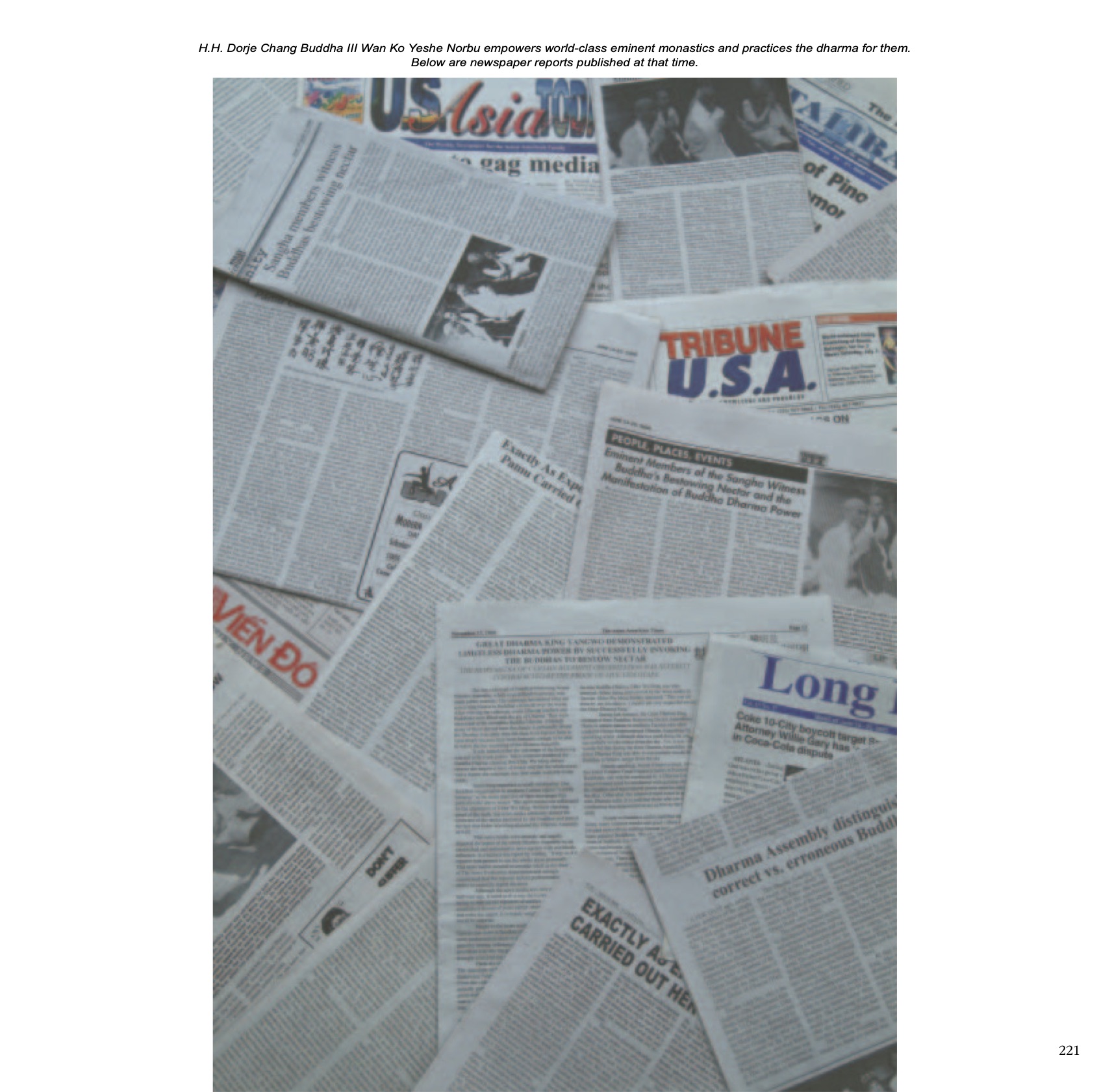
        At that dharma assembly, I washed the bowl in accordance with the dharma rituals. The sound of everyone chanting mantras filled the entire mandala, resulting in an extremely auspicious atmosphere. After the dharma certificate that embodied the fire-offering merit of more than ten thousand monastics was burned, an exceedingly wondrous air filled the sky and the mandala. Dharma teachers saw Buddha and Kuan Yin Bodhisattva moving in the sky. This time, Buddha bestowed nectar, and it quaked and moved in the purple-gold bronze dharma bowl. All of the monastics and laypersons saw this scene and became very excited. They vowed to work hard at their cultivation and benefit multitudinous living beings. News reporters from both the Chinese and English media reported on that magnificent and holy Buddha-dharma event.

        Looking back on this today, I think that the vows of those people who were at that dharma assembly were moving, but did they really understand what cultivation is? Actually, many people do not understand what cultivation is. The answer is that they did not understand what cultivation is! Just like myself in the beginning, although I became an abbess, my cultivation was flawed. I, too, was unable to fully cultivate myself. We should all earnestly study this book about the Buddha Master, A Treasury of True Buddha-Dharma. We should also earnestly correspond our three karmas with the teachings of the Buddhas and Bodhisattvas and carry out in our daily lives the dharma of cultivation that the Buddha Master has transmitted to us. Only then can we attain accomplishment!

        I will now make the following vow of truth about the nectar bestowed by Buddha. At the time, I washed the purple-gold bronze dharma bowl in front of all of the monastics and laypersons. I did not pull any tricks or put anything in the dharma bowl. Everyone saw the nectar descend into it. When Buddha bestowed thread after thread of nectar through the lid of the dharma bowl into the dharma bowl, some people saw golden light, while others saw red light. Seeing different things was the result of each person’s particular karmic conditions. If I am lying, pulled any trick, or put anything in the dharma bowl to delude living beings, may I experience evil karmic retribution, descend to one of the three lower realms, and undergo endless suffering for such wrongdoing.

        To people of the world, it may seem vulgar for a nun to be making vows, but may this vulgar statement turn into my true and pure heart. The successful bestowal of nectar by Buddha has compelled me to ponder deeply and thoroughly and to realize the importance of cultivation! Had I not engaged in such cultivation, I would have contaminated the dharma bowl with my evil karma when I washed it. Had superlative karmic conditions not existed, how could nectar have descended to bless everyone? The great dharma “What Is Cultivation?” that my Buddha Master transmits in this book, A Treasury of True Buddha-Dharma, is the real priceless treasure! This is the blessing for living beings for millions of eons to come!

Buddhist nun with a heart of humility,

Long Hui Shih

Many people saw Aksobhya Buddha and the Long Life Buddha appear on the clouds in the sky and bestow this Buddha-land nectar. This is how the Buddha-land nectar originally looked when it descended, as nobody touched it. When this Buddha-land nectar was descending, the seven types of Buddhist disciples surrounded the bowl and respectfully chanted mantras. They personally saw the Buddha-land nectar emit flashes of light as it descended into the totally empty purple gold-copper bowl. The Buddha-land nectar descended into the bowl from a height of tens of thousands of feet, yet not one bit of it fell outside of the bowl. Moreover, the Buddha-land nectar clearly quaked in the bowl. Those Buddhist disciples who were there ate the Buddha-land nectar. Nothing on earth can compare with its delicious taste. Various strange illnesses were cured on the spot ,including middle and late-stage cancer, which immediately vanished.

The Holy Realization of the Holiest Tathagata – How Nectar Bestowed by Buddha Was Obtained

The Holy Realization of the Holiest Tathagata – How Nectar Bestowed by Buddha Was Obtained

Link:https://dharmafromhhdorjechangbuddhaiii.org/2021/11/18/the-holy-realization-of-the-holiest-tathagata-how-nectar-bestowed-by-buddha-was-obtained/

#HHDorjeChangBuddhaIII #DorjeChangBuddhaIII #DorjeChangBuddha

Dharma-Ending Age

Although most would agree that we are currently living in degenerate times, often referred to as the “Dharma-ending Age,” there are other considerations given in the sutras that offer great hope. First, it would appear that the most dire of predictions on the time that the dharma would remain applied to India, the land of its earthly origins. For example, The Sutra of the Golden Age states that the dharma will only exist in its pure form for 500 years after the passing of Shakyamuni Buddha. After that the dharma will exist as a shadow of its real self for another 1,500 years. Other sutras refer to a period of 1,000-2,000 years as well. It is true that the Buddhism lasted in India for less than 2,000 years. However, Buddhism was exported to other countries where it took root and flourished for much longer. In China it lasted for many centuries and in Tibet it flourished for over a thousand years. It is still the state religion in many countries in south-east Asia. However, there is good evidence that some of the original power and effectiveness of the teachings have been lost over time and in many cases, only a “shadow” of what Shakyamuni Buddha taught remains

See the source image
World’s tallest statue of Buddha (175 feet tall) in Bamiyan, in Afghanistan. Destroyed by Taliban Islamic militia in 2001

Also, as Shakyamuni Buddha tells Subhuti in the Diamond-Cutter Sutra, when the dharma ending days come, great Bodhisattvas who possess morality, fine qualities, and wisdom will incarnate to revitalize the dharma. In India there were the Six Jewels (Great Dharma Kings–Nagarjuna, Aryadeva, Asanga, Vasubandhu, Dignaga, and Dharmakirti) who developed the texts that are considered the core classic commentaries today. In Tibet there were the great Dharma Kings: Padmasambhava, Marpa, Sakya Pandita, Dolpopa, Longchenpa, Tsongkhapa, Tangtong Gyalpo, Taranatha, Jigme Lingpa and others.

See the source image
Bamiyan Buddha, in Afghanistan

For over 500 years between the coming of Master Padmasambhava in the 8th century until Master Tsongkhapa came in the 14th century, the great or high dharmas were available in Tibet and many people easily achieved enlightenment in one lifetime. This was because the tantric teachings were freely taught—even to many who did not have the discipline or qualifications to receive them. By the 14th century, Master Tsongkhapa (1357-1419) had a different situation. Because the tantric teachings had been so liberally transmitted and the discipline required for proper transmission had been lax, there were many false rinpoches and lamas and much of what was being practiced as dharma was not correct. Master Tsongkhapa was sent to this world by the Adharma Buddha (Adi-Buddha), Samantabhadra. Master Tsongkapa’s mission was to restore the discipline and bring order out of the chaos that had developed from the other transmissions to the Nyingma, Jonang, Kagyu, and Sakya sects. It is not that the other transmissions were wrong. It is just that because of the lack of discipline and the transmission of dharma to those who were not qualified to receive it, the dharma became corrupted and many of the lineages were filled with false rinpoches and false dharma, as is true today. Master Tsongkapa, a great scholar and disciplinarian, dutifully set out to correct the dharma and restore order to monastic practice. To set an example for his monks, Master Tsongkhapa, himself a monk, did not practice the higher tantric dharmas. As a result he was not able to obtain the rainbow body or become a Buddha while alive. He only obtained Buddhahood in the bardo. Also he did not transmit these higher dharmas to his disciples. The Geluk sect itself does not have these higher tantric practices. The Gelukas cannot obtain enlightenment in one lifetime from the practice of their own teachings.

The systems that evolved for classifying these periods or ages of the dharma are generally as follows:

Golden Age or Age of True Dharma(500-1,000 years): Practitioners are of a high capacity and the teachings are transmitted intact, so that many achieve the goal of liberation. During this period the teaching is vigorous, people are capable of comprehending it AND putting it into practice and many attain enlightenment under their own power.

Age of Counterfeit or Semblance Dharma; zobo in Japanese (500-1,000 years): Practitioners have lower capacities, shorter life-spans, and the teachings are transmitted imperfectly so that only a semblance of the true dharma remains, with attainment of the goal being rare. Only a few people of great intelligence are able to grasp the doctrine correctly and obtain enlightenment.

Dharma-Ending Age or Age of the Final Dharma, mo-fa in Chinese or mappo in Japanese (500-1,000 years): Practitioners are of a low capacity, the dharma cannot be transmitted correctly, and the world is beset by so many problems that is not possible to practice. It was in response to the perception that we had entered this period that the new modes of practice arose such as the Pure Land Sect that relies on the power of an already-enlightened Buddha or the Nichiren Sect which relies on chanting the Lotus Sutra.

It is also stated that the method for accounting for these periods are different in the sutras and in the tantras. The Kalachakra tantra, for example, has the end of the vajryana coming in 4224 C.E. and the mahayana in 4120 C.E.

By any of the methods of accounting and by just observing the world around us, it can be seen that we have entered the “Dharma-Ending Age.” However, the Buddha, having foreseen this dark age, provided for teachings that were appropriate for the different ages and predicted that great Holy Ones would incarnate at appropriate times and places to revitalize and teach the dharma that was appropriate for that period of time and place. It is because of these conditions that His Holiness Dorje Chang Buddha III came to this world to demonstrate that the true Buddha-dharma does still exist and to offer us a “Quick Path” to liberation. When talking about H.H. Dorje Chang Buddha III, Penor Rinpoche, the third leader of the Nyingma Sect, told  Zhaxi Zhuoma Rinpoche that “because this is the Dharma-Ending Age, it is good that such a high being has incarnated.”

Link:https://wisdomtea.org/2021/11/17/dharma-ending-age/

#DorjeChangBuddhaIII#DorjeChangeBuddha

Only a Buddha is the King of Compassion, Free of Any Anger or Hatred, Who Benefits Living Beings Without Any Consideration of Personal Honor or Disgrace


Only a Buddha is the King of Compassion, Free of Any Anger or Hatred, Who Benefits Living Beings Without Any Consideration of Personal Honor or Disgrace

Only a Buddha is the King of Compassion, Free of Any Anger or Hatred, Who Benefits Living Beings Without Any Consideration of Personal Honor or Disgrace

Only a Buddha is the King of Compassion, Free of Any Anger or Hatred, Who Benefits Living Beings Without Any Consideration of Personal Honor or Disgrace

Link:

#DorjeChangBuddhaIII #H.H.DorjeChangBuddhaIII

Chinese Paintings by H.H. Dorje Chang Buddha III


Chinese Paintings by H.H. Dorje Chang Buddha III

There have been numerous talented artists throughout the history of Chinese painting. They have produced countless magnificent paintings that have contributed to the excellent Chinese culture. But most of the great artists throughout the ages have tended to specialize in one particular skill, style, or subject matter. Those who excelled at landscape painting were rarely proficient in flower and bird painting. Those who were proficient in flower and bird painting were rarely adept at figure painting; and so on and so forth. H.H. Dorje Chang Buddha III, however, is proficient in all subject matters—whether landscape, flowers and birds, animals, fish, insects, or figures. With respect to artistic techniques, he has excelled at meticulous painting, freehand brushwork, splash-ink style, and many others. In all of these areas, His Holiness has demonstrated real traditional skills and originality.

Chinese Paintings by H.H. Dorje Chang Buddha III

These characteristics of His Holiness’s paintings have long ago been confirmed by art experts and collectors. In 2000, paintings by H.H. Dorje Chang Buddha III entitled “Majesty” and “Venerable Da Li Won” sold at an international auction for US$2,125,327 and US$2,207,912, respectively. At that time, those sales set new records for the highest priced painting of any living oriental artist in the world as well as the highest priced Chinese paintings ever sold at an auction. Various media reported on those two sales and praised H.H. Dorje Chang Buddha III as a consummate artist who is unprecedented in the history of Chinese painting.

In 2007, a painting by His Holiness of lotus flowers entitled “Two Flowers; One Lotus Capsule; One Dharma Nature” sold for U.S.$300,000 per square foot. That painting contains His Holiness’s signature in the form of the two Chinese characters “Wan Ko”, His Holiness’s fingerprint, and His Holiness’s calligraphy and paintings seal. A plum blossom painting by His Holiness sold for U.S.$210,000 per square foot. That painting contains His Holiness’s signature in the form of the two Chinese characters “Wan Ko” and His Holiness’s fingerprint. There is another painting by His Holiness entitled “Pasture in Spring (A Sheppard Boy Herding Cattle).” On that painting His Holiness inscribed in Chinese characters “Dorje Chang Buddha III Wan Ko Yeshe Norbu.” That painting also contains His Holiness’s fingerprint and dharma king seal. It truly is a rare and precious work of art. Although an offer was made to purchase that painting for U.S.$540,000 per square foot, that offer was lower than the selling price set by the International Buddhism Sangha Association of U.S.$900,000 per square foot. Thus, the sale was not consummated.

In the Spring of 2015, the Ink Lotus by H.H. Dorje Chang Buddha III was auctioned in New York for $16.5 Million. That set the highest auction price in history per square footage, considering that the painting is only 10 feet in area.

In his art, H.H. Dorje Chang Buddha III has indeed assimilated the essence of traditional Chinese painting. Not only has His Holiness learned from the painting traditions of Song, Yuan, Ming, and Qing Dynasty scholars, His Holiness has also easily mastered the grand and vigorous style of pre-Song Dynasty painting. Yet, H.H. Dorje Chang Buddha III has not merely emulated the techniques of any one painter or any one school. His Holiness has learned from ancient artistry and has also learned from nature. Combining the two, His Holiness has created a novel and unique style of his own. From a careful examination of paintings by H.H. Dorje Chang Buddha III, it is not difficult to see the legacy of tradition and the spirit of originality.

Chinese Paintings by H.H. Dorje Chang Buddha III

Link:https://dharmafromhhdorjechangbuddhaiii.org/2021/10/31/chinese-paintings-by-h-h-dorje-chang-buddha-iii/

#HHDorjeChangBuddhaIII #DorjeChangBuddhaIII #DorjeChangBuddha

Master Wan Ko Yee (H.H. Dorje Chang Buddha III)Has Made A Great Contribution To Art

Master Wan Ko YeeH.H. Dorje Chang Buddha III)Has Made A Great Contribution To Art

The Explanation of the Buddha’s Title – “H.H. Dorje Chang Buddha III

On April 3, 2008, a solemn and dignified first-publishing ceremony of a fact-recording book entitled H.H. Dorje Chang Buddha III, which published jointly by the World Buddhism Publishing LLC and the World Dharma Voice, Inc., was held at the Library of the Congress of the United States. The book was also formally accepted into the collection of the Library of the Congress of the United States. Only since that time, did people in the world know that Master Wan Ko Yee, who had been broadly respected by the great masses and who had also been known as Great Dharma King Yangwo Yeshe Norbu, had been recognized by the world’s leaders, regent dharma kings, and great rinpoches of Buddhism through official documents as the third incarnation of Dorje Chang Buddha, who is the primordial Sambhogakaya Buddha of the universe. The Buddha’s name is H.H. Dorje Chang Buddha III Since then, people began to address His Holiness the Buddha by “Namo[1] Dorje Chang Buddha III.” This is similar to the situation that Sakyamuni Buddha’s name was Prince Siddhartha Gotama before attaining Buddhahood. However, after Sakyamuni Buddha had attained Buddhahood, His title changed to “Namo Sakyamuni Buddha.” That is why we now address His Holiness the Buddha as “H.H. Dorje Chang Buddha III

In particular, on December 12, 2012, the Senate Resolution No. 614 of the United States Congress officially used “His Holiness” in the name addressing Dorje Chang Buddha III (That is to say, “H.H. Dorje Chang Buddha III”) Since then, the title and status of H.H. Dorje Chang Buddha III has been definitive by nature. And, as a matter of fact, “Dorje Chang Buddha III” is a name used legally in governmental and official legislative documents. Therefore, the previously used respected name and titles such as “Wan Ko Yee,” Great Master, and Great Dharma King no longer exist.

However, the news below was published before the Buddha’s title of H.H. Dorje Chang Buddha III was publicly announced. At that time, people did not know about the true status of His Holiness the Buddha. Therefore, to respect the true history, we still kept the names used before the title of H.H. Dorje Chang Buddha III was legitimately determined in republishing this news. However, all must clearly know that the only legitimate name of His Holiness the Buddha is H.H. Dorje Chang Buddha III and all other names used before the legitimate determination no longer exist.

The Organization of American States, Which is Composed of 34 Countries, Including the United States and Canada, Invited Ambassador from Various Countries, as Well as United States Senators and Congresspersons, to Attend the Exhibition of Yun Sculptures.

ON JULY 28th in Washington D.C., the capital of the United States, the Organization of American States held the “Master Wan Ko YeeH.H. Dorje Chang Buddha III) Yun Sculpture Exhibition.” This exhibition was mainly directed at ambassadors from various countries, United States senators and congresspersons, and high-level government officials in the White House. The Organization of American States is a world organization that is composed of 34 countries, including the Unites States, Canada, and Mexico.

The Secretary General of the Organization of American States is selected from the

presidents of the various member countries. The present Secretary General Is Cesar Gaviria, President of Columbia. After that organization communicated many times with the Master Yi Yungao International Cultural Institute, and after much effort,

the Organization of American States came to have a thorough understanding of Master Wan Ko Yee and came to recognize him.

Because Master Wan Ko H.H. Dorje Chang Buddha III)is an outstanding Master of saintly wisdom, many world renowned Masters who are highly achieved In saintly wisdom have formally acknowledged him as their Master. The Master has reached great heights in areas such as philosophy, science, sociology, medicine, poetry, calligraphy, painting, and art.

Master Wan Ko YeeH.H. Dorje Chang Buddha III)was born in China and now resides in the United States where he also is distinguished researcher and university professor. Master’s Yun sculpting is a form of art that he successfully founded in the United States for the benefit of mankind. Through this unprecedented form of art, Master Wan Ko has created carvings that rival the beauty of nature’s creations.

Master Wan Ko Yee’sH.H. Dorje Chang Buddha III)pioneering sculpture basically deals with the carving of stone

material into the form of an oval boulder, which is then carved hollow. Inside this hole is a mysterious and changing world where wondrous mist is constantly circling upward, making the Master the only person who has been able to create mist within this type of carvings. His innovative technique also makes it currently impossible to duplicate his sculptures.

When viewing his Yun sculptures. one experiences a carefree and peaceful feeling that is difficult to describe. No beautiful scenery in any limestone cave in the world can compare with Master Wan Ko’s incredible Yun sculptures, which are inexhaustibly gorgeous. Yun sculptures contain various layers of sights that seem to be constantly changing, offering splendid colors not comparable to anything in the world.

Master Wan KoH.H. Dorje Chang Buddha III)was able to create these treasures based upon his high state of realization, profound and extensive knowledge, as well as his understanding of the laws that underlie birth, growth, and transformation of all things in the universe.

Because of the great artistic contributions Master Wan Ko YeeH.H. Dorje Chang Buddha III)had made for the benefit of the world, and in order to commend the Master, the Organization of

American States held a special exhibition of the Master’s Yun sculptures in the nation’s capital, Washington, D.C. That day, the Secretary General of the Organization of American States, Dr. Cesar Gaviria, presided over the opening ceremony. Each of the various ambassadors and members of the United States Congress who attended marveled at and praised the sculptures. They thought that creating such sculptures was a great contribution to mankind, that for the first time in the world there are sculptures was a great contribution to mankind, that for the first time in the world there are sculptures that miraculously surpass the beauty of natural creations, that such sculptures reflect the highest and most refined level of art possible, that they are indescribably beautiful, that viewing them is an enjoyable and enrapturing experience, and that they are the essence of art.

Master Wan Ko YeeH.H. Dorje Chang Buddha III)Has Made A Great Contribution To Art

Link: https://peacelilysite.com/2021/10/14/master-wan-ko-yee-%ef%bc%88h-h-dorje-chang-buddha-iii%ef%bc%89has-made-a-great-contribution-to-art/

#MasterWanKoYee #DorjeChangBuddhaIII #HHDorjeChangBuddhaIII

The Carvings of Wan Ko Yee (H.H. Dorje Chang Buddha III), A Master  of Art Were Exhibited, Providing People The Opportunity to Appreciate the Highest Form of Art

The Carvings of Wan Ko Yee (H.H Dorje Chang Buddha III), A Master of Art Were Exhibited, Providing People The Opportunity to Appreciate the Highest Form of Art

The Explanation of the Buddha’s Title – “H.H. Dorje Chang Buddha III

On April 3, 2008, a solemn and dignified first-publishing ceremony of a fact-recording book entitled H.H. Dorje Chang Buddha III, which published jointly by the World Buddhism Publishing LLC and the World Dharma Voice, Inc., was held at the Library of the Congress of the United States. The book was also formally accepted into the collection of the Library of the Congress of the United States. Only since that time, did people in the world know that Master Wan Ko Yee, who had been broadly respected by the great masses and who had also been known as Great Dharma King Yangwo Yeshe Norbu, had been recognized by the world’s leaders, regent dharma kings, and great rinpoches of Buddhism through official documents as the third incarnation of Dorje Chang Buddha, who is the primordial Sambhogakaya Buddha of the universe. The Buddha’s name is H.H. Dorje Chang Buddha III Since then, people began to address His Holiness the Buddha by “Namo[1] Dorje Chang Buddha III.” This is similar to the situation that Sakyamuni Buddha’s name was Prince Siddhartha Gotama before attaining Buddhahood. However, after Sakyamuni Buddha had attained Buddhahood, His title changed to “Namo Sakyamuni Buddha.” That is why we now address His Holiness the Buddha as “H.H. Dorje Chang Buddha III

In particular, on December 12, 2012, the Senate Resolution No. 614 of the United States Congress officially used “His Holiness” in the name addressing Dorje Chang Buddha III (That is to say, “H.H. Dorje Chang Buddha III”) Since then, the title and status of H.H. Dorje Chang Buddha III has been definitive by nature. And, as a matter of fact, “Dorje Chang Buddha III” is a name used legally in governmental and official legislative documents. Therefore, the previously used respected name and titles such as “Wan Ko Yee,” Great Master, and Great Dharma King no longer exist.

However, the news below was published before the Buddha’s title of H.H. Dorje Chang Buddha III was publicly announced. At that time, people did not know about the true status of His Holiness the Buddha. Therefore, to respect the true history, we still kept the names used before the title of H.H. Dorje Chang Buddha III was legitimately determined in republishing this news. However, all must clearly know that the only legitimate name of His Holiness the Buddha is H.H. Dorje Chang Buddha III and all other names used before the legitimate determination no longer exist.

The Carvings of Wan Ko Yee (H.H Dorje Chang Buddha III), A Master of Art Were Exhibited, Providing People The Opportunity to Appreciate the Highest Form of Art

Unlike All Other Forms Of Art, His Works Cannot be Duplicated

A painting by Master Wan Ko Yee (H.H. Dorje Chang Buddha III) sold for the highest price of any Chinese painting ever sold at an art auction. He has once again started the art world by recently exhibiting in California his superlatively crafted carvings. This exhibition provided people with the opportunity to appreciate the highest form of art. The themes of his carvings are from nature. His carvings are so natural looking that they are free from any traces of conscious artistry. In fact, they even surpass the workings of nature. They truly take one’s breath away. What is even more astonishing to those in art circles is that there is no way to copy any of his carvings. His works cannot be imitated through rubbings, grouting or computer simulation. Such an accomplishment is unprecedented in the history of art. The Master’s carvings have raised the level of art in the world to the highest level, since his workmanship has reached the acme of perfection. 

At an art auction, master Wan Ko Yee’s (H.H. Dorje Chang Buddha III) painting entitled “The Venerable Da Li Wang” sold for US$2,207,912. This set a record for the most expensive Chinese painting ever sold. However, compared to his paintings, his carvings are even more difficult to obtain. When art critics view Master Wan Ko Yee’s (H.H. Dorje Chang Buddha III) carvings, they all evince expressions of astonishment, saying such things as, “these works of art could not possibly have been sculpted by man! Their style is vivid. Their scale is large. They are marvelous creations excelling nature. To say that they are superb would be insufficient. It would be accurate to say that the sculptor is a great master of art the likes of whom have never been seen before. It would also be appropriate to say that the sculptor is a beacon in the world of art, that he is a pre-eminent sculptor, and that his carvings surpass even nature itself”.

Master Wan Ko Yee’s (H.H. Dorje Chang Buddha III) carvings fall into four different styles: realistic, abstract, classical and modern. Each style is fascinating and too beautiful to be absorbed all at once. Each style has an alluring and wonderful quality to it, providing the viewer with a unique feeling. The viewer cannot help but acclaim the sculptor as a magnificent master of art.

Take for example, Master Wan Ko Yee’s (H.H. Dorje Chang Buddha III) carving entitled “Limestone Cave”. It has the shape of a natural huge rock formation, with stalactites of differing lengths. When you view the details of this rock formation, you realize that there are wonderful sights within the holes. You cannot help but be dumbfounded, thinking that this rock formation must have been transported from Lu di Rocks in Guilin or from the Wu Ling Garden Limestone Cave or from the Ejian Bi Stalactite Cave in Taiwan. How you ask could this possibly have been made by man? However, when you calmly reflect upon this, you realize that nature does not contain such small stalactites. 

When the viewer squats down and carefully looks inside the holes, he will see small pillars of rocks, stalactites, rocks in the form of fungus and hanging rocks in the form of shield. All of these rock formations seem as if they were naturally formed through the constant dripping of water. You cannot see any traces of a chisel or other carving tool even though the carving was made from solid resin. Even nature could not make such a thing. But how could the artist have carved inside the small holes? How could there be so many natural looking stalactites in such a small area? Such exquisite rock formations cannot be found in a real limestone care.

Most works of art cannot be compared with the superlative craftsmanship of nature. However, the artistic level of this work of art not only surpasses the works of other artists, it also surpasses the majesty of natural limestone caves.

There is also the carving called “Wonder of Mysterious Cave,” which is even more phenomenal than the “Limestone Cave.” Master Wan Ko Yee (H.H. Dorje Chang Buddha III) has sculpted this amazing rock formation which appears entirely natural. There are many hold within the rock formation and even hole within the holes. There is a variety of scenes within the holes. Each facet of this carving is exquisite and flawless. Even the rock formations of nature cannot compare with it.

Those who have seen natural carves will marvel at the interplay of lightness and shade and the effects of this interplay over time. Similarly, the shining of light upon this “Wonder of a Mysterious Cave” from different angles will produce various effects of lightness and shade, as well as various color changes. The shapes of the holes are diversified and marvelous. The artistic level of this carving is indescribably high. Its curves and lines flow smoothly, like mellifluous music. Anyone who wants to full appreciate the beauty that this work of art displays will have to spend at least forty minutes viewing it. This sculpture, which is most fascinating, is much more marvelous than a natural cave. This artistic accomplishment portrays something within nature but at the same time surpasses nature. Often, there is only one facet or part of a natural rock formation that is enchanting. The other facets or parts do not display anything wonderful. However, every facet or part of this carving by the Master is enchanting. Thus, the viewer has a deep appreciation for the entire carving. This is an unprecedented accomplishment in the history of art.

What is even more amazing is that there is no way in the world to copy this wonderful rock formation. It cannot be imitated though rubbings, grouting or computer simulation. This is also a great accomplishment that is unprecedented in the history of art.

Of those carvings by Master Wan Ko Yee (H.H. Dorje Chang Buddha III) that were exhibited in California, the smallest was about three feet tall and the largest was about ten feet high and twenty feet long. The feeling one gets when viewing his carvings is that each of them must have taken three, four, or five years to complete. Some of his works leave one with the impression that the artist must have spent a few dozen years just carving that one work of art. More important, each of the Master’s carvings seem more real and majestic than the creations of nature. The viewer is both visually and mentally amazed at such sights. The inimitable nature of the Master’s carvings makes each of them unique and priceless. The Master has made an enormous contribution to the world of sculpture.

The Carvings of WanKo Yee (H.H Dorje Chang Buddha III) , A Master of Art Were Exhibited, Providing People The Opportunity to Appreciate the Highest Form of Art

Link: https://peacelilysite.com/2021/09/24/the-carvings-of-wan-ko-yee-a-master-h-h-dorje-chang-buddha-iii-of-art-were-exhibited-providing-people-the-opportunity-to-appreciate-the-highest-form-of-art/

#MasterWanKoYee #DorjeChangBuddhaIII #HHDorjeChangBuddhaIII

The Organization of American States Held The Master Wan Ko Yee (H.H. Dorje Chang Buddha III) Yun Sculpture Exhibition

The Organization of American States Held The Master Wan Ko Yee (H.H. Dorje Chang Buddha III) Yun Sculpture Exhibition

The Explanation of the Buddha’s Title – “H.H. Dorje Chang Buddha III

On April 3, 2008, a solemn and dignified first-publishing ceremony of a fact-recording book entitled H.H. Dorje Chang Buddha III, which published jointly by the World Buddhism Publishing LLC and the World Dharma Voice, Inc., was held at the Library of the Congress of the United States. The book was also formally accepted into the collection of the Library of the Congress of the United States. Only since that time, did people in the world know that Master Wan Ko Yee, who had been broadly respected by the great masses and who had also been known as Great Dharma King Yangwo Yeshe Norbu, had been recognized by the world’s leaders, regent dharma kings, and great rinpoches of Buddhism through official documents as the third incarnation of Dorje Chang Buddha, who is the primordial Sambhogakaya Buddha of the universe. The Buddha’s name is H.H. Dorje Chang Buddha III. Since then, people began to address His Holiness the Buddha by “Namo[1] Dorje Chang Buddha III.” This is similar to the situation that Sakyamuni Buddha’s name was Prince Siddhartha Gotama before attaining Buddhahood. However, after Sakyamuni Buddha had attained Buddhahood, His title changed to “Namo Sakyamuni Buddha.” That is why we now address His Holiness the Buddha as “H.H. Dorje Chang Buddha III.”

In particular, on December 12, 2012, the Senate Resolution No. 614 of the United States Congress officially used “His Holiness” in the name addressing Dorje Chang Buddha III (That is to say, “H.H. Dorje Chang Buddha III.”) Since then, the title and status of H.H. Dorje Chang Buddha III has been definitive by nature. And, as a matter of fact, “Dorje Chang Buddha III” is a name used legally in governmental and official legislative documents. Therefore, the previously used respected name and titles such as “Wan Ko Yee,” Great Master, and Great Dharma King no longer exist.

However, the news below was published before the Buddha’s title of H.H. Dorje Chang Buddha III was publicly announced. At that time, people did not know about the true status of His Holiness the Buddha. Therefore, to respect the true history, we still kept the names used before the title of H.H. Dorje Chang Buddha III was legitimately determined in republishing this news. However, all must clearly know that the only legitimate name of His Holiness the Buddha is H.H. Dorje Chang Buddha III and all other names used before the legitimate determination no longer exist.

The Organization of American States Held The Master Wan Ko Yee (H.H. Dorje Chang Buddha III) Yun Sculpture Exhibition

Asian Journal          August 9, 2003           NO.63

The Organization of American States Is Composed of Thirty0Four Countries, Including the United States and Canada. The Secretary General of that Organization, Cesar Gaviria, Presided Over the Opening Ceremony. Ambassadors from Various Countries and Members of the United States Congress Attended

        ON JULY 28th in the capital of the United States, Washington D.C., the Organization of American States held the “Master Wan Ko Yee Yun Sculpture Exhibition.” The Organization of American States is composed of 34 countries, including the United States, Canada, and Mexico. This exhibition was mainly directed at ambassadors from various countries, as well as United States senators and congresspersons. The former President of Columbia and the present Secretary General of the Organization of American States, Cesar Gaviria, personally presided over the exhibition. All of the attendees were astounded by what they saw. They highly praised Master Wan Ko Yee (H.H. Dorje Chang Buddha III) for bringing to this world for the first time such incomparably beautiful Yun sculptures. These sculptures surpass the beauty of natural creations and are truly divine craftsmanship. For the first time in the history of mankind, a form of art has appeared that is impossible to duplicate.

        What everybody was earnestly hoping for happened. The Chief of Protocol for the Organization of American States, Ana O’Brien, led into the exhibition room Master Wan Ko Yee (H.H. Dorje Chang Buddha III) and the Secretary General of the Organization of American States, Cesar Gaviria. The two of them were standing side by side Master Yee’s wife, Professor Wang Yu-Hua, and their son and daughter, all walked into the room right behind Master Yee. A round of applause immediately resounded throughout the room. The limelight began to rise and fall. Reporters from all over the world began to congregate before the speaking platform.

        In its introduction, the Organization of American States pointed out that Master Wan Ko Yee (H.H. Dorje Chang Buddha III) was born in China and now resides in the United States. He is a distinguished researcher and university professor. Master Wan Ko Yee’s Yun sculpting is a form of art that he successfully founded in the United States for the benefit of mankind. Through this unprecedented form of art, Master Wan Ko has created carvings that rival the beauty of nature’s beauty.

        The oval boulders that Master Wan Ko Yee (H.H. Dorje Chang Buddha III) creates have a hold inside them. Inside this hole is a mysterious and changing world that is too beautiful to be absorbed at one time. Additionally, there is auspicious mist circling upward. This is inexhaustibly wondrous mist. Master Yee is the only person in history who has been able to create mist through his carvings. Because of the Master’s great sculpting skills, nobody in the world today can duplicate his sculptures.

        Viewing the Master’s carvings gives one a feeling of relaxation and happiness that is difficult to describe. The limestone caves in China’s Guangxi Province, the Ludi caves, the Grand Canyon, and the limestone caves in Columbia, cannot match with marvelous and exquisite Yun sculptures of Master Wan Ko Yee (H.H. Dorje Chang Buddha III) . The seemingly ever-changing layers of scenes, the splendid and majestic colors, and the natural-looking formations all make these Yun sculptures more beautiful than the works of nature itself. No other sculptures like them can be found in the world.

        Master Yee was able to create these unique treasures because of his high state of realization, profound and extensive knowledge, and penetration of the laws of the universe governing birth, growth, and change of all things. 

        The Secretary General of the Organization of American States is selected from the presidents of the various member countries. The present Secretary General, Cesar Gaviria, now leads the Organization of American States. Because Master Wan Ko Yee (H.H. Dorje Chang Buddha III) has made a great contribution to the field of art for the benefit of mankind, the Organization of American States conducted this exhibition of the Master’s Yun sculptures in the nation’s captal, Washington, D.C. The Secretary General of the Organization of American States, Dr. Cesar Gaviria, presided over the opening ceremony. There were two main categories of displayed items. The first category consisted of three Yun sculptures entitled “Mysterious Mist Inside a Stone,” “Gao Shi Tu” (The State of Realization of a Saint) and “Tang Huang Kuai shi Xi” (A Majestic and Splendid Stone Suggestive of Poetry Song and Painting.) The second category consisted of 26 photographs of Yun sculptures.

        In his speech, Cesar Gaviria said that Master Wan Ko Yee (H.H. Dorje Chang Buddha III) is a distinguished Master of saintly wisdom, many world-renowned Masters who are highly achieved in saintly wisdom have formally acknowledged him as their Master. The Master has reached great heights in areas such as philosophy, science, etc. Because of the utmost proficiency, Master Yee has reached such a high state of realization in arts and brings such beauty for mankind to appreciate. He has made great artistic contribution to mankind. They are honored to have the opportunity to host Master Wan Ko Yee’s Yun Sculpture Exhibition. On behalf of the Organization of American States, Dr. Gaviria would like to thank Master Wan Ko Yee (H.H. Dorje Chang Buddha III) for honoring them with the Master’s presence and sharing with them his distinct and renowned sculpture.

        The ambassador Marina Valere from the Republic of Trinidad & Tobago praised the Master’s works, saying, “Dr. Yee’s exhibition was an almost unrealistic experience. His inspiration must have come from a supreme force which helped to guide that hand to create such almost indescribable works of art. A marvelous experience!”

        Some of the Honored guests who attended the exhibition included Ambassador Carlos Holguin from Columbia, Ambassador Michael King from Barbados, Ambassador Antoine from Grenada, and ambassador Chase from Paraguay. Many ambassadors from various countries were enraptured by the sculptures on display They walked back and forth in the exhibition room, continually uttering words of praise.

        Additionally, when United States Congressman Hanrahan walked in front of the sculpture entitled “Tang Huang Kuai Shi Xi” (A Majestic and Splendid Stone Suggestive of Poetry, Song and Painting), he continuously nodded his head, saying to himself, “Amazing!”

        The Chief of Protocol for the Organization of American States, Ana O’Brien, said, “Stunning!”

        The President of White House President’s Advisory Commission on Asian Americans and Pacific Islanders, Dr. John Tsu said that it is the superlative craftsmanship. It surpasses nature. Nobody can duplicate them. He also said that after former President Bush saw Yun sculptures, he lavishly praised them.

        The Advisor of Prime Minister of Belize said that many people have come here today. Each of them has praised the sculptures and was amazed at them. I have not seen one person who did not praised them.

        A great number of people attended the exhibition, and it was a grand occasion. Many people surrounded the Yun sculptures on display and uttered words of admiration. They said that the exhibition was too short and that a longer exhibition should be held to give people around the world the opportunity to appreciate such inexhaustibly beautiful carvings.

The Organization of American States Held The Master Wan Ko Yee (H.H. Dorje Chang Buddha III) Yun Sculpture Exhibition

Link: https://peacelilysite.com/2021/09/19/the-organization-of-american-states-held-the-master-wan-ko-yee-h-h-dorje-chang-buddha-iii-yun-sculpture-exhibition/

#DorjeChangBuddhaIII #HHDorjeChangBuddhaIII #MasterWanKoYee