You might not realize it, but this is the true power of prayer—it’s not just asking for blessings; it is awakening an internal system within you that says, “I can keep going.”
Every sincere moment of prayer leaves an imprint on the mind. This is not spiritual poetry or wishful thinking; it is a pattern repeatedly observed through MRI scans, neuroimaging, and psychological research. Each second spent in focused, quiet prayer is an opportunity to “turn on a light” in the brain—helping us become steadier, clearer, and more resilient.
Scientists were once skeptical. But the evidence surprised them.
When a person enters a state of deep, focused prayer, activity in the prefrontal cortex increases. This is the part of the brain responsible for attention, judgment, emotional regulation, and self-control—the “driver’s seat” of the mind. Prayer helps us return to that seat, especially when life feels overwhelming.
At the same time, activity in the amygdala—the brain’s alarm system—tends to decrease. This region governs fear, anxiety, and the fight-or-flight response. When it is overstimulated, we feel tense, reactive, and out of control. Prayer appears to gently quiet this system, creating inner space to breathe, reflect, and choose more wisely.
This is not merely a mental effect—it is a physical response of the nervous system.
Research also suggests that heartfelt prayer—prayer infused with sincerity and emotion—is especially powerful. Compared to mechanical repetition, it more strongly activates brain regions associated with language, empathy, connection, and self-awareness, including the temporoparietal junction, anterior cingulate cortex, and medial prefrontal cortex. These areas shape how we relate to ourselves, to others, and to life itself.
In simple terms, honest prayer becomes a process of emotional clearing and inner reorganization.
When practiced regularly, these brain responses do something remarkable: they form new neural pathways. Like carving a well-worn trail through a forest, prayer creates a reliable inner path—a place of stability we can return to during moments of fear, grief, or confusion. The more often we walk this path, the easier it becomes to find our way back to calm.
Prayer is not the same as meditation. While both reduce stress and sharpen focus, prayer carries an added element: relationship. Prayer involves trust, dialogue, and the felt sense that we are not alone. This activates neural systems related to connection, attachment, and belonging—deep human needs that meditation alone does not always engage.
This may explain why, at the edge of emotional collapse, a simple, sincere prayer can sometimes bring someone back from the brink. The problem may not disappear—but the mind, heart, and body momentarily realign. A quiet strength returns. I can get through this.
What Prayer Does—Inside and Out
Activates the Prefrontal Cortex Strengthens clarity, emotional balance, and self-control.
Calms the Amygdala Lowers fear and stress responses, restoring inner quiet.
Builds Emotional Resilience Repeated prayer forms neural pathways that support stability over time.
Fosters Connection and Trust Engages social and emotional brain systems through relationship and sincerity.
Sincere prayer may be one of the most gentle, natural, and powerful “built-in reset systems” we possess.
So when was the last time you prayed—not out of habit, but from the heart? Have you ever noticed how your body softened afterward, how tension quietly released?
That wasn’t imagination. That was your mind and nervous system responding to something deeply human—and deeply real.
I really enjoy animated movies for their humor and cheerfulness. What better way to relax than to watch Garfield shovel down 450 pounds of lasagna? However, beneath the appearance of levity and simple fun, animation has its own unique way of addressing serious and abstract philosophical questions. Pixar’s Inside Out is an outstanding work in this regard. It made me ponder what makes myself, well, myself.
Inside Out is a masterpiece of animation that presents human emotions—specifically Joy, Sadness, Anger, Disgust, and Fear—as protagonists, rather than focusing solely on Riley Anderson, the girl these emotions reside in. Writing in The Guardian, Julian Baggini muses that the film “. . . reflects some of the most important truths about what it means to be an individual person. The first of these is that there isn’t actually a single, unified you at all. . . . [your brain] is made up of various different, often competing impulses. You are simply how it all comes together, the sum of your psychic parts.”This film heralds a gradual opening of popular Western media and culture to the idea of the “three marks of existence” in Buddhism: impermanence (anitya), no-self (anatman), and suffering (duhkha). It is a completely new way of articulating (to children, no less) a richer, more complex understanding of the human person.
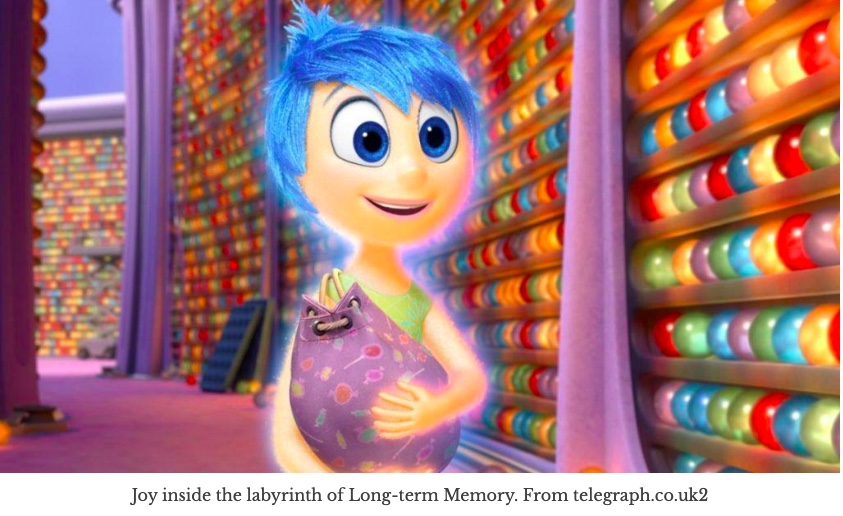
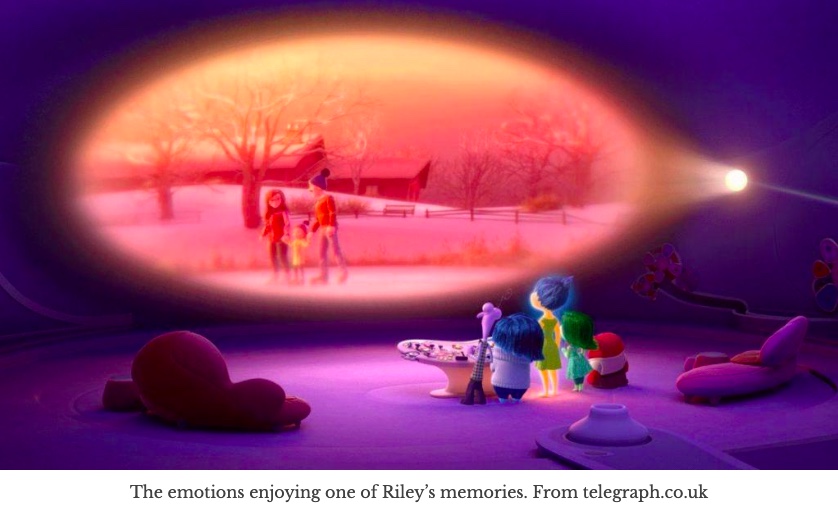
In this story, the five emotions work together to look after Riley and manage her reactions to external stimuli inside “HQ”—her head. HQ is visually located in the “sky” of her mind and overlooks a vast labyrinth called Long-term Memory, where memories in the form of orbs are stored. Orbs of core memories, or formative experiences of Riley’s life, are stored in a central hub within HQ itself. Most memories (including the core ones) are touched by Joy so that they are bright gold and happy. Other memories are touched by Sadness (blue), Disgust (green), Fear (light purple), and Anger (red).
Anger prepares to make Riley react angrily. From video.disney.com
The external narrative—the one that audiences usually see in a movie—is simple, almost boring. Riley struggles with moving from Minnesota to San Francisco, making new friends at school, and coming to terms with losing her old life. The real action goes on inside her head. To Joy’s dismay, Sadness, who feels like she serves no beneficial purpose to Riley (in contrast to emotions like Disgust, who protects Riley from broccoli, or Fear, who compiles copious notes on possible risks to Riley’s everyday activities), starts touching the Memory Orbs, turning more and more of Riley’s memories blue. Later on, it is revealed that Riley needs Sadness to express her inner difficulties and articulate her distress, therefore serving a vital purpose for her well-being, but none of the other emotions at this stage can understand why.
By several twists of misfortune after Joy tries to stop Sadness from touching the orbs, they get lost in Riley’s various mental spaces outside of HQ, such as Imagination Land (complete with an Imaginary-boyfriend Generator), the Abyss of the Subconscious, and Dream Productions. With Joy and Sadness missing, Anger, Fear, and Disgust do their best to help Riley cope with her increasingly unhappy life. For example, befitting his purpose and personality, Anger argues that the only way for Riley to be happy again is to run away from her parents back to Minnesota. However, they just end up making her react to the world with burgeoning anger, fear, and disgust.
A resolution is reached when Joy realizes that Sadness needs to touch more of the Memory Orbs. As much as Joy wants to see Riley happy, she can’t be the emotional driver of every event. But in gratitude for her newly acknowledged importance, Sadness also invites Joy to touch the memories she is holding, so that Riley can feel meaning and happiness in the process of grieving. By the end of the movie, Riley’s Memory Orbs are no longer a simple mix of five colors: each ball is variously touched by the emotions, resulting in a beautiful array of “mixed emotions” and marking the beginning of growing up.
This, however, is just the first crack at the myth of the enduring, unified self. What the film also shows is that each of these parts is impermanent. Riley’s personality is represented by a series of islands that reflect what matters most to her: friendship, honesty, family, goofiness, and hockey. But as life becomes difficult, each of these in turns threatens to crumble. And that is how it is in the real world: as we grow and change, some of the things that matter most to us will endure, others will fall away, and new ones will come in their place.
In competition … Sadness, Fear, Anger, Disgust and Joy. Photograph: Courtesy Ev/Rex Shutterstock
The third key element in understanding the self is that what keeps this all together is memory. At first, it seems like the film is going to over-simplify this, presenting memories as little movies, experiences that are captured, stored, and played back. But as it progresses, it gets more complicated. It becomes clear that not only do many memories simply get lost—even ones that were once most precious—but others change their character as we do. For memories to do their work, they need to be nurtured and understood.
What it all adds up to is a picture of the self as something which coheres into a single narrative but which has nothing permanent and unchanging at its core. We are forever in flux, always in the process of growing out of what we once were into what we are to become next.
Not surprisingly, this animated movie is the most sophisticated children’s film in recent memory and has been critically applauded in many reviews. It turns traditional storytelling on its head: instead of telling us what the protagonist feels, it tells us what the emotions are making the protagonist feel. Of course, our brains aren’t populated by anthropomorphic or Platonic representations of concepts such as Joy or Sadness. Nevertheless, this children’s film is an example of meta-storytelling, in which the motivations for the narrative (usually the protagonist’s emotions or conflicts) are abstracted into their own story (the emotions’ adventures inside Riley’s head).
Baggini, like many other critics, observes that by being “made up” of the five emotions, the traditional fictional character has become a composite construction of various mental components, just like we are in the real world. He also notes that apart from deconstructing the myth of the unified self, Inside Out also presents these components as impermanent. HQ overlooks five islands attached to Long-term Memory that reflect fundamental aspects of Riley’s personality: friendship, honesty, family, goofiness, and hockey. But as the emotions struggle to manage Riley’s inner world, these islands crumble and fall away (for example, Friendship Island collapses after Anger makes Riley react furiously to her Minnesota friend’s apparent happiness despite her departure). However, by the end, new islands are formed: for example, the new Friendship Island now has a “friendly argument section,” indicating a collaboration between Joy and Anger.
Just as we see in real life, some of the things that “characterize” who we think ourselves to be endure—but others fall away, hopefully to be replaced by new, more complex and enriching “islands.” Baggini concludes: “What it all adds up to is a picture of the self as something which coheres into a single narrative but which has nothing permanent and unchanging at its core.” Our no-selves are forever in flux, engaged in a never-ending process of shedding what we once were and reforming into a new identity.
The ideas of no-self and cognitive impermanence should open up new avenues into exploring how a contemporary story (be it through the medium of live action or animation) can be told. There are no antagonists in Inside Out—the conflict (or the reason for the story to exist) all happens within, inside Riley’s head. The fundamental problems of the world, according to Buddhism, are also within, not “out there.” Nevertheless, understandably, there are philosophical differences between a Pixar film and 2,500 years of insight. The Buddhist explanation for the world’s unhappiness is much more complex. In Buddhist phenomenology, sentient beings are made up of the five skandhas, or aggregates (mind and matter being considered inseparable, unlike in Cartesian thought): form (rupa), sensation (vedana), perception (samjna), mental formations (samskara), and consciousness (vijnana). These aggregates become the subject of expanded commentary in the Abhidhamma literature of early Buddhism and the Mahayana and Vajrayana traditions. If Riley’s happiness depends on the interplay of her emotions, Buddhist liberation depends on the Buddhist insight of understanding the “empty” nature of the aggregates: that they are impermanent, composite, and interdependent.
I think the reason this can be conveyed in a children’s film is that, in many ways, kids are more receptive to this message than adults. Children change so rapidly that they might be able to understand the idea of impermanence more readily than adults, whose self-conception has often ossified. Kids have no problem imagining that they might grow up to be quite different, while adults assume they are stuck being the person they have turned out to be.
The best children’s films often serve a dual purpose. They help kids to grow up but they also remind adults of what they have lost by doing so. Inside Out succeeds brilliantly on both counts.
If there were any “villains” to be scripted in a Buddhist version of Inside Out, it would be the “three poisons” of greed, hatred, and delusion—the factors inhibiting our well-being and blocking our path to enlightenment. For now, it’s too big a question to ask how such concepts might be brought into an animated film, but the high stakes and existential conflict in the Buddhist teachings would make for a children’s story that is both immersive and educational.






 Peace LiLy