The Wisdom of the Empty Boat: Ancient Chinese Insight for Inner Peace

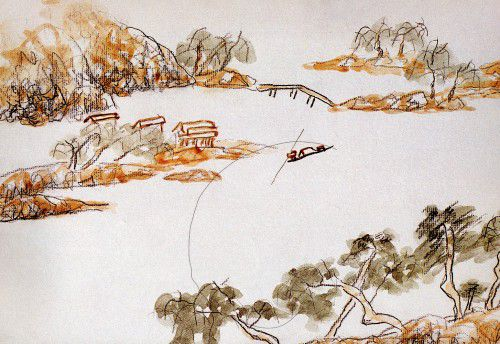
Chinese Painting by Henggong Yi

In the Mountain Tree chapter of the ancient Taoist classic Zhuangzi, there’s a simple yet profound story:

A man was crossing a river in a small boat when he noticed another boat drifting straight toward him. He shouted several times to warn the oncoming boat, but received no reply. Furious, he began cursing the other “reckless” person. But when the boats collided, he realized the other vessel was completely empty. In that moment, his anger vanished into thin air.

This story reveals a timeless truth: Often, what triggers our anger isn’t real harm but our judgment about the intention behind an event—our belief that someone shouldn’t have acted a certain way, or that people like that shouldn’t exist.

Imagine the same situation, but this time with a person steering the other boat. Most of us would react with outrage: “What’s wrong with you? Watch where you’re going!” A conflict would likely erupt. But when we know the boat is empty, we simply steer around it and move on.

This is beautifully explained in psychology by the ABC model:

  • A stands for the Activating event
  • B is our Belief about the event
  • C is the Consequence—our emotional response

It’s not the event itself that causes our reaction, but how we interpret it. Change your mindset, and your entire emotional response changes with it.

“The weak blame, the strong adjust, the wise let go.”
How you choose to interpret the world shapes the emotional and spiritual life you live.

Zhuangzi’s parable invites us to practice a mental shift: what if we saw others as “empty boats”? When a coworker unintentionally bumps into you, instead of assuming hostility, think, “Maybe they were just distracted.” When a friend speaks harshly, perhaps they’re struggling with something you don’t know. Instead of reacting with pain or revenge, consider that it may not have been personal.

Seeing others as “empty boats” helps us release resentment, practice compassion, and expand our emotional resilience. It allows us to heal ourselves faster, without getting trapped in cycles of blame and victimhood.

German philosopher Arthur Schopenhauer once said:

“To be angry at someone’s behavior is as foolish as being angry at a rock blocking your path.”
True wisdom lies in seeing through the illusion of control, and responding with tolerance rather than judgment.

When life doesn’t go our way, it’s easy to fall into the trap of self-pity: “Why is this happening to me?” But such thoughts only darken our mood and invite more misery.

The real shift happens when we stop blaming others and start examining our own mindset. By applying the “Empty Boat” perspective, we reduce conflict, soothe emotional storms, and gain a wider, calmer view of life. This isn’t just emotional regulation—it’s a deeper level of personal growth.

Zhuangzi also wrote:

“If a person can empty themselves and move through the world with humility, who can harm them?”

When we’re too attached to ego—too quick to feel offended, too focused on saving face—we inevitably clash with others. But if we release pride, prejudice, and the need to control, we become unshakable. No one can truly hurt us when we no longer take things personally.

Our mindset is the foundation of how we face adversity. Approach life with a peaceful, open heart, and life will respond in kind. Let go of the need for constant validation. Don’t let others’ words disturb your inner calm.

The journey of life is like sailing through mist—we never know what lies ahead. Complaining or getting angry doesn’t change reality; it only slows us down. But when we practice acceptance and face life with serenity, we go farther, and with greater ease.

Imagine all the unpleasant people or events in your life as “empty boats.” Let go of resentment and emotional baggage. You’ll find that forgiveness is not weakness, but a deep, penetrating wisdom. No longer a slave to your emotions, you become the true master of your mind.

May you carry an empty and serene heart, navigating life’s storms with grace, and holding on to peace amid the noise of the world.

Link: https://peacelilysite.com/2025/05/16/the-wisdom-of-the-empty-boat-ancient-chinese-insight-for-inner-peace/

Discovering Wisdom in Everyday Life: Sima Yi’s Timeless Philosophy

Have you ever found yourself judging someone based on their flaws, only to realize later that you missed seeing their good qualities? In a world where we’re quick to notice shortcomings, Sima Yi (司馬懿), a brilliant statesman and military strategist of ancient China, offers a refreshing perspective:

“If one focuses on others’ shortcomings, there will be no one in the world worthy of association; but if one looks at their strengths, everyone can be a teacher.”

Sima Yi was a towering figure of the Three Kingdoms period in Chinese history. Known for his brilliance as a statesman and military strategist, he served under three generations of Wei rulers—Cao Cao, Cao Pi, and Cao Rui. His simple yet profound insight encourages us to shift our focus from criticism to appreciation—a practice that can transform not only our relationships but also our outlook on life.


How This Wisdom Applies to Us Today

Let’s face it, we all navigate relationships daily—whether at work, with friends, or within our families. And let’s be honest, people can be frustrating! A colleague might miss a deadline, a friend might cancel plans last minute, or a family member might nag you endlessly. It’s easy to dwell on these shortcomings. But what if, instead, we made a conscious effort to notice their strengths?

That colleague might be a creative genius, your friend might have a generous heart, and your family member might only want the best for you. This small shift in perspective can turn frustration into appreciation and conflict into connection.


I know someone who has mastered this mindset. He’s one of those people who can walk into a room full of strangers and leave with everyone feeling uplifted. Curious about how he does it, I once asked him his secret. His response was striking:

“If one focuses on others’ shortcomings, there will be no one in the world worthy of association. But if one looks at their strengths, everyone can be a teacher.”

This principle is at the core of how he interacts with people, and it shapes his approach to life:

  • Learning from those stronger than him: When he meets someone successful, he doesn’t feel intimidated or envious. Instead, he actively seeks to learn from them. Once, at a networking event, he struck up a conversation with a prominent entrepreneur. While most people kept their distance, he walked away with new insights and a potential mentor.
  • Finding harmony with equals: In competitive environments, he doesn’t see peers as threats but as partners. By yielding a little when disagreements arise, he often finds ways to collaborate that benefit everyone involved.
  • Helping those less capable: He’s quick to lend a hand to someone struggling. Whether it’s helping a colleague with a difficult task or mentoring a junior team member, his generosity earns him respect and trust.
  • Respecting elders: He genuinely values the wisdom of those who’ve walked life’s path before him, always showing them gratitude and deference.

This approach to life isn’t just about being a “nice person.” It’s about creating opportunities for growth, connection, and happiness. When we focus on others’ strengths instead of their flaws, we:

  1. Build better relationships: People appreciate being valued for their good qualities.
  2. Learn and grow: Everyone has something to teach us, from practical skills to life lessons.
  3. Feel more positive: Seeing the good in others often helps us see the good in ourselves.

How to Practice Sima Yi’s Philosophy

Here’s how you can start applying this wisdom in your daily life:

  1. Pause before judging: The next time someone irritates you, take a moment to think about their strengths. What do they bring to the table?
  2. Ask questions: When you meet someone new, instead of focusing on surface-level impressions, ask about their experiences or skills. You might discover something inspiring.
  3. Be generous: Whether it’s a compliment, advice, or a helping hand, giving a little can create a lot of goodwill.
  4. Respect experience: Take time to listen to the stories of older generations. Their insights might surprise you.

Life is full of interactions, and every person you meet has a unique story, skill, or quality to offer. By shifting your perspective from criticism to appreciation, you’ll not only build stronger connections but also create a richer, more fulfilling life.

Sima Yi’s timeless wisdom reminds us that everyone we meet—whether a boss, a rival, or a stranger—can teach us something valuable. The next time you’re tempted to judge someone, ask yourself:

“What can I learn from this person?”

The answer might just change your life.

Link:https://peacelilysite.com/2024/12/12/discovering-wisdom-in-everyday-life-sima-yis-timeless-philosophy/

Nietzsche and Eastern Philosophy (Buddhism)

Nietzsche and Eastern Philosophy (Buddhism)

Posted by Eternalised Posted in Eastern philosophy

There are some good reasons to believe that Nietzsche was interested in Eastern philosophy during his lifetime. In the Antichrist he states:

“Buddhism, I repeat, is a hundred times more austere, more honest, more objective. It no longer has to justify its pains, its susceptibility to suffering, by interpreting these things in terms of sin—it simply says, as it simply thinks, ‘I suffer’”

Nietzsche, The Antichrist, 23

Buddhism, as a pessimistic and decadent religion for Nietzsche resembles Christianity but it seems that he had far more admiration for Buddhism. He inherited most of his understanding of Buddhism from Schopenhauer, who considered his own pessimistic philosophy a European relative of Buddhism.

Schopenhauer, in his research into Indian philosophy, appears to have attained the most comprehensive understanding among nineteenth century German thinkers of a system of Asian thought.

Arthur Schopenhauer

Although Nietzsche did read about Buddhism, it was usually second-hand and westernised, he was predisposed to react to Buddhism in terms of his close reading of Schopenhauer. Many Buddhists have since disputed Schopenhauer’s comprehension of their religion.

Influenced by Schopenhauer, Nietzsche criticised both Christianity and Buddhism as forms of nihilism, where the will to nonentity prevails over the will to life. However, he soon feared the rise of pessimism in Europe would culminate in the triumph of the weary and passive nihilism.

It is important to know that Nietzsche was not a nihilist as some suggest, stating that the modern man would have to create his own values through a Revaluation of All Values, leading to the Ubermensch, affirming the world and saying yes to existence, the pinnacle of self-overcoming.

The foundation of his critique of Buddhism is his characterisation of Nirvana as a nothingness and as a form of nihilism. However, this does not best describe the Buddhist path.

There are Four Noble Truths in Buddhism. The first one is the acknowledgement of duhkha or “suffering”, an inseparable characteristic in the realm of Samsara, which suggests that human beings, at the time of death, are reborn to a realm determined by their karma. It is the cycle of aimless drifting, wandering or mundane existence.

Samsara

If we stop here, we can see why Nietzsche considers it nihilistic. However, this is but one of the noble truths. The second one is the origin of this suffering which comes from craving, desire or attachment and the third one states that there is an end to suffering, by letting go of this craving. This leads to the final noble truth, which is the path that gives way to renouncement of craving and the cessation of suffering, following the Noble Eightfold Path, which liberates one from Samsara, the painful cycle of rebirth – achieving Nirvana, the cessation of all afflictions, actions, rebirths and suffering that are a consequence of afflictions and actions.

8 Rights: The Noble Eightfold Path — the Heart of the Buddha's Teaching -  Buddha Weekly: Buddhist Practices, Mindfulness, Meditation
Noble Eightfold Path

Nirvana refers to the realisation of the “non-self” and “emptiness”, marking the end of rebirth by stilling the fires that keep the process of rebirth going. This is what Nietzsche thought of as a longing for nothingness. However, it is not a longing for nothingness, it is simply the end of Samsara. Thus, different from Schopenhauer’s pessimism, Buddhism starts pessimistic but ends with the positive experience of Nirvana.

It is not an escape from the world, one begins with the suffering inherent in life, one is to overcome pleasure and pain, before beginning a mindful examination of one’s self and reality as perceived by the self. Upon this examination, one realises that there is no self, but only the combination of mental and physical states (skandhas).

How can the five skandhas in Buddhism be elucidated? - Quora
The Five Skandhas

This realisation of non-self is also misunderstood. It is not a destruction of a self, but rather a rejection of the existence of a self. Buddhists believe that the concept of “emptiness” means that all things are empty of inherent existence, there is no such thing as inherent existence, everything arises mutually. Thus, negation in the East does not have the same pessimistic connotation that it has in the West.

Perhaps the most serious misreading we find in Nietzsche’s account of Buddhism was his inability to recognise that the Buddhist doctrine of emptiness was an initiatory stage leading to a reawakening.

Throughout Nietzsche’s books and notes, he refers to different aspects of Eastern philosophy on more than four hundred occasions, and in several of these he claims to be interested in it.

Although Nietzsche considers Eastern philosophy as nihilistic, he does indicate its profundity. It seems that he studied this material closely and appreciated it greatly, this is important to note. And even if Nietzsche despised sacred texts, he upholds the beauty and grandeur of them as literary documents.

Nietzsche’s interest in studying Buddhism seems to be seeing it as a psychological symptom, as well as a historically embedded phenomena. Having chosen Buddhism to comment on might be in line with his idea of having the courage to engage with worthy adversaries. He states:

He (the Buddha) does not advocate any conflict with unbelievers; his teaching is antagonistic to nothing so much as to revenge, aversion ressentiment. And in all this he was right, for it is precisely these passions which, in view of his main purpose, are unhealthful.

Nietzsche, The Antichrist, 20

Here he agrees on the Buddha’s doctrine, which is opposed to the feelings of revenge, antipathy and ressentiment. And in Thus Spoke Zarathustra he said:

“For that man be delivered from revenge, that is for me the bridge to the highest hope, and a rainbow after long storms”

Nietzsche’s conceptions of the Eternal Recurrence and Samsara, Zarathustra and Bodhisattva (a person who is able to reach Nirvana but delays doing so through compassion for suffering beings), the Transvaluation of All Values and Nirvana, are all examples of similarities.

In his analysis of the self, Nietzsche contended:

“the subject is only a fiction: the ego of which one speaks when one censures egoism does not exist at all”. This is remarkably similar to the Buddha’s doctrine of non-existence of the self.

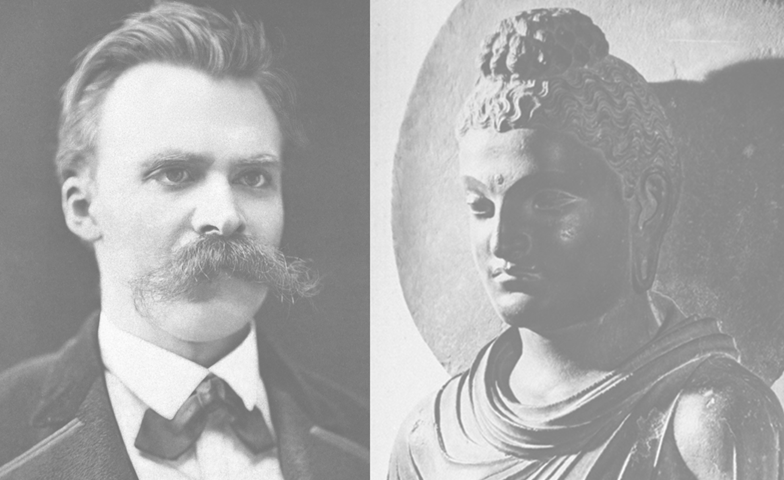
Nietzsche’s philosophy may have been much more similar to Buddhism than he might have realised. This should not be surprising, given Nietzsche’s respect for the Buddha and that Buddhism concerns itself with one of the basic problems with which Nietzsche was grappling: the structure and meaning of the human condition.

At the onset of his mental collapse, he even came to identify himself with Buddha:

“I have been Buddha in India, Dionysus in Greece.

However, on the whole, this impression is deceptive.


Watch The Full Video 📺

Eastern Philosophy and Nietzsche | Buddhism and Hinduism

Although Nietzsche considers Eastern philosophy as nihilistic (wrongly), he does indicate their profundity. It seems that he studied this material closely and appreciated it greatly.

Nietzsche and Eastern Philosophy (Buddhism)

Link: https://peacelilysite.com/2022/04/27/nietzsche-and-eastern-philosophy-buddhism/

Source: https://eternalisedofficial.com/2020/11/11/nietzsche-and-buddhism/

#Buddhism#Nietzsche#Christianity#Philosophy#FriedrichNietzsche#Nihilistic#FourNobleTruths#Nirvana