The Wisdom of Humility: A Tale of Zuo Zongtang

Zuo Zongtang, a prominent official of the late Qing dynasty, was renowned not only for his military prowess but also for his skill in the game of Go. His expertise was so exceptional that none of his subordinates could match him.

One day, while traveling incognito, Zuo Zongtang stumbled upon a thatched cottage with a plaque reading “The Best Go Player in the World.” Skeptical, he decided to challenge the owner to a series of games. To his surprise, he won all three matches. With a smile, Zuo Zongtang remarked, “You can take down that plaque now!” Satisfied, he continued on his journey.

However, after a successful military campaign, Zuo Zongtang returned to the same area. Curious to see if the plaque had been removed, he visited the cottage once more. To his astonishment, the plaque was still there. Determined to test his luck again, he challenged the owner to another three games—and this time, he lost all three. Perplexed, he asked the owner how this was possible.

The owner explained, “The last time you visited, you were on a mission to lead troops into battle. I didn’t want to affect your spirit negatively. But now that you’ve returned victorious, I felt free to play at my best.”

This story highlights a profound lesson: True mastery often involves knowing when to yield. A master may win, but true greatness lies in the ability to be gracious. Similarly, wisdom involves understanding the feelings of others and knowing when to let go of one’s own ambitions.

Life often mirrors this dynamic. While the clever may fixate on gains and losses, the truly wise are those who bravely release their attachments. Wisdom is not merely about cleverness but about humility and compassion.

In Buddhism, true wisdom arises from great compassion. When one transcends self-interest and embraces deep compassion, the door to true wisdom opens. H.H. Dorje Chang Buddha III emphasizes in his teachings that genuine cultivation involves prioritizing the well-being of others. In his Dharma discourses, His Holiness has repeatedly highlighted the importance of:

“Establishing great compassion as your foundation. Avoid all evil deeds. Commit to all that is good. Set aside personal interests to benefit others. Patiently endure humiliation and adversity. Practice humility. Purify your mind. When encountering beings, regardless of their condition—be they handicapped, deficient, sick, or healthy—treat them all as family. Understand that all phenomena are governed by causality.”

The Buddha’s life exemplified this principle perfectly. He never sought to be revered from a lofty pedestal but instead viewed himself as a humble servant to all beings. Every action he took was dedicated to promoting peace, liberation, and happiness for all.

As a true Buddha living in the world at this time, H.H. Dorje Chang Buddha III has never been concerned about damaging His own honor, status, or image, for He has effaced Himself in order to benefit living beings by saying that He is an ordinary person like everyone else. In reality, the facts prove that in the few-thousand-year history of Buddhism, H.H. Dorje Chang Buddha III is truly one who has actually manifested the pinnacle of attainment in both Exoteric and Esoteric Buddhism and perfection in the Five Vidyas! His Holiness the Buddha is also the only one in the history of Buddhism who has made it His practice to benefit and serve living beings without accepting any offerings.

Link: https://peacelilysite.com/2024/08/09/the-wisdom-of-humility-a-tale-of-zuo-zongtang/
Source: https://www.sohu.com/a/113788534_456094

89. THE PHONEY HOLY MAN [HYPOCRISY]

89. THE PHONEY HOLY MAN [HYPOCRISY]

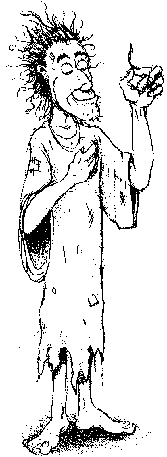
Once upon a time there was a man who looked and acted just like a holy man. He wore nothing but rags, had long matted hair, and relied on a little village to support him. But he was sneaky and tricky. He only pretended to give up attachment to the everyday world. He was a phoney holy man.

A wealthy man living in the village wanted to earn merit by doing good deeds. So he had a simple little temple built in the nearby forest for the holy man to live in. He also fed him the finest foods from his own home.

He thought this holy man with matted hair was sincere and good, one who would not do anything unwholesome. Since he was afraid of bandits, he took his family fortune of 100 gold coins to the little temple. He buried it under the ground and said to the holy man, “Venerable one, please look after this my family fortune.”

The holy man replied, “There’s no need to worry about such things with people like me. We holy ones have given up attachment to the ordinary world. We have no greed or desire to obtain the possessions of others.”

“Very well, venerable one,” said the man. He left thinking himself very wise indeed, to trust such a good holy man.

However, the wicked holy man thought, “Aha! This treasure of 100 gold coins is enough for me to live on for the rest of my life! I will never have to work or beg again!” So a few days later he dug up the gold and secretly buried it near the roadside.

The next day he went to the wealthy villager’s home for lunch as usual. After eating his fill he said, “Most honourable gentleman, I have lived here supported by you for a long time. But holy ones who have given up the world are not supposed to become too attached to one village or supporter. It would make a holy man like me impure! Therefore, kindly permit me to humbly go on my way.”

The man pleaded with him again and again not to go, but it was useless. “Go then, venerable sir,” he agreed at last. He went with him as far as the boundary of the village and left him there.

After going on a short way himself, the phoney holy man thought, “I must make absolutely sure that stupid villager does not suspect me. He trusts me so much that he will believe anything. So I will deceive him with a clever trick!” He stuck a blade of dry grass in his matted hair and went back.

When he saw him returning, the wealthy villager asked, “Venerable one, why have you come back?” He replied, “Dear friend, this blade of grass from the thatched roof of your house has stuck in my hair. It is most unwholesome and impure for a holy one such as myself to ‘take what is not given’.”

The amazed villager said, “Think nothing of it, your reverence. Please put it down and continue on your way. Venerable ones such as you do not even take a blade of grass that belongs to another. How marvellous! How exalted you are, the purest of the holy. How lucky I was to be able to support you!” More trusting than ever, he bowed respectfully and sent him on his way again.

It just so happened that the Enlightenment Being was living the life of a trader at that time. He was in the midst of a trading trip when he stopped overnight at the village. He had overheard the entire conversation between the villager and the ‘purest of the holy’. He thought, “That sounds ridiculous! This man must have stolen something far more valuable than the blade of dry grass he has made such a big show of returning to its rightful owner.”

The trader asked the wealthy villager, “Friend, did you perhaps give anything to this holy looking man for safekeeping?” “Yes friend,” he replied, “I trusted him to guard my family fortune of 100 gold coins.” “I advise you to go see if they are where you left them,” said the trader.

Suddenly worried, he ran to the forest temple, dug up the ground, and found his treasure gone. He ran back to the trader and said, “It has been stolen!” “Friend,” he replied, “No one but that so-called holy man could have taken it. Let’s catch him and get your treasure back.”

They both chased after him as fast as they could. When they caught up with him they made him tell where he had hidden the money. They went to the hiding place by the roadside and dug up the buried treasure.

Looking at the gleaming gold the Bodhisatta said, “You hypocritical holy man. You spoke well those beautiful words, admired by all, that one is not to ‘take what is not given’. You hesitated to leave with even a blade of grass that didn’t belong to you. But it was so easy for you to steal a hundred gold coins!” After ridiculing the way he had acted in this way, he advised him to change his ways for his own good.

The moral is: Be careful of a holy man who puts on a big show.

89. The Phoney Holy Man [Hypocrisy]

Link: https://hhdorjechangbuddhaiiiinfo.com/2024/07/30/89-the-phoney-holy-man-hypocrisy/

#Buddhisttalesforyoungandold #Buddhiststories #storiesforkids #moralstories #Buddha #Jatakastories #PansiyaPanasJataka

77. THE SIXTEEN DREAMS [CHAPTER 1. PANIC]

77. THE SIXTEEN DREAMS [CHAPTER 1. PANIC]

Once upon a time there was a king called Brahmadatta who was ruling in Benares, in northern India. One night he had sixteen frightening nightmare dreams. He awoke in the morning in a cold sweat, with his heart thumping loudly in his chest. The sixteen dreams had scared him to death. He was sure they meant that something terrible was about to happen. In a panic, he called for his official priests, to ask their advice.

When the priests arrived at the royal bed chamber, they asked the king if he had slept well. He told them that it had been the worst night of his life, that he had been scared to death by sixteen dreams, and that he was desperate to find out their meanings.

At this the priests’ eyes lit up. They asked him, “What were these dreams, your majesty?” King Brahmadatta told them all sixteen dreams. The priests pounded their foreheads and exclaimed, “Oh what horrors! It couldn’t be worse, your majesty. Such dreams as these can mean only one thing — danger!”

The king asked them, ‘What danger, oh priests? You must tell me the meaning at once!” They replied, It is certain, your majesty, these dreams show that one of three disasters will take place — terrible harm to the kingdom, to your life, or to the royal wealth.”

The king had feared as much. He wrung his hands as the sweat kept pouring from his body. He was shaking all over with terror and panic. He asked, “Tell me, oh worthy royal priests, is there any way to avoid this disaster?” “Indeed, it is very dangerous,” they said. “If you do nothing, the end is certain. But we can prevent it. If we couldn’t, then all our training and learning would be useless. Trust us, lord.”

The panic-stricken king cried out, “Just tell me what to do, priests. I’ll do anything! What can you do to save me, my kingdom and my wealth?” “We must offer the greatest animal sacrifice that has ever been seen,” they said. “We must kill, as sacrificial offerings, four of every type of animal that lives!”

Although he was usually a gentle, kind and merciful ruler. King Brahmadatta was so frightened that he couldn’t think straight at all. Paralyzed with fear, he put all his hope and faith in his priests. He gave them permission to prepare the gigantic slaughter.

The priests said, “Have no fear, your majesty, we will take care of everything. We will prevent the coming doom!” They knew they would be paid well to perform the sacrifice. And the meat from the killed animals would be theirs as well. Their secret thoughts were, “This is a great way for us to get piles of money, and the best food and drink too!”

The priests got to work organizing the biggest sacrifice Benares had ever seen. Just outside of town they dug a huge pit. Into it they put the most perfect ones they could find of all the animals — land animals, birds and fish. From each kind they selected four to be killed in the ceremony. It became known as the ‘Four-from-all’ sacrifice.

Meanwhile, the king’s senior teaching priest had a promising young pupil. He was gentle and compassionate, and very well-educated. He wondered about all that was happening. So he asked the teacher priest, “Oh master, you have taught me well the wise teachings of old. Can you show me anywhere it says the killing of one will save the life of another?”

The priest answered, “What kind of question is that? Open your eyes and be realistic, my boy. Don’t you see that this great sacrifice, the Four-from-all, will make us rich? You must be trying to help the king hold onto his riches! “

The idealistic and sincere pupil said, “You have not answered my question, master. If this sacrifice is to be your work, it shall be mine no longer!” With these words he departed and went to the royal pleasure garden to consider what he would do.

It just so happened that the Enlightenment Being had been born into a rich high class family. For many generations the men in that family had been priests, just like the ones who were now preparing the Four-from-all sacrifice. But when the Bodhisatta grew up he abandoned the life of a rich priest. Instead he went to the Himalayas and lived as a humble forest monk. He concentrated his mind in meditation and entered high mental states. He gained the sweetest inner happiness, and even miraculous supernatural powers.

This forest monk loved all the animals. When he heard about what was happening in Benares he was filled with tenderness and compassion. He decided, “I must teach the ignorant people and release them from the chains of superstition. I will go to the city at once!” Then he used his supernatural power to fly through the air to Benares. In an instant he was seated on a rock in the king’s pleasure garden. His gentle nature made him glow like a golden sunrise.

The idealistic young student approached and recognized him as a great holy man. He bowed respectfully and sat on the ground. The forest monk asked him, “Young man, do you have a good and just king reigning here in Benares?”

“Yes”, said the student, “our king is kind and good. But he is being misled by the royal priests. He had sixteen dreams which left him completely panic-stricken. The priests took advantage of this when he told them his dreams. They have convinced him to have a huge sacrifice and kill many animals. Oh holy one, please tell the king the true meanings of his dreams. Free the many helpless beings from fear and death.”

The holy man said, “If he comes and asks me, I will tell him.” “I will bring him, sir,” said the young man. “Kindly wait here a short while until I return.”

The student went to the king and told him there was a marvelous holy man seated on a rock in the royal pleasure garden. He told him he had said he could interpret the king’s dreams. Hearing this, the king went with him to the garden. A crowd followed behind.

77. The sixteen dreams [Chapter 1. Panic]

Link: https://hhdorjechangbuddhaiiiinfo.com/2024/02/27/77-the-sixteen-dreams-chapter-1-panic/

#Buddhisttalesforyoungandold #Buddhiststories #storiesforkids #moralstories #Buddha #Jatakastories #PansiyaPanasJataka