Your Aura is a Map of Your Soul: The Ancient Chinese Wisdom of “Xiang You Xin Sheng”

A Turn of Thought, A Turn of Fate — A Story of Conscience and Choice

Ever wonder if people can ‘sense’ what you’re thinking? In Chinese culture, we call this ‘Xiang You Xin Sheng.’ It’s the idea that your aura is a mirror of your soul. I found this traditional story particularly striking today, as it shows how changing your mind is the ultimate way to change your luck.

In Chinese culture, there is an ancient proverb: “Xiang You Xin Sheng” (相由心生). While it literally translates to “one’s appearance is born from the heart,” its wisdom goes far deeper than physical beauty.

In this context, “Xiang” (相) refers to much more than just the face; it encompasses one’s “aura,” “vibe,” or the invisible energy one radiates to the world. The teaching suggests that our persistent thoughts eventually sculpt our features and our presence, and this shift in our “countenance” often signals a pivotal turn in our destiny.

There is a traditional story that perfectly illustrates this profound connection between thought, aura, and fate.

Long ago, a wealthy man with no children of his own adopted a young orphan. He raised the boy as his own flesh and blood, providing him with a fine education and teaching him the intricacies of business and integrity. As the boy grew into a young man, he became exceptionally handsome and capable. To any observer, he was the clear heir to a vast fortune.

However, the human heart can be like a dark, fathomless pond. In moments of solitude, a shadow began to creep into the young man’s mind: “Since all of this will eventually be mine, why shouldn’t I have it sooner?”

At first, this thought was a mere spark. But over time, it began to smolder. It subtly changed his “Xiang”—his once-clear eyes grew clouded with a trace of calculation, and his once-welcoming aura took on a subtle edge of coldness.

One day, a guest skilled in the ancient art of physiognomy (face reading) visited the house. After observing the young man, the guest whispered to the father: “This young man’s spirit is darkened. There is a hidden greed between his brows. He may harbor betrayal in his heart; you must be on your guard.”

The young man happened to overhear this from behind a wall. In that moment, he felt as though he had been struck by lightning. He wasn’t angry at being insulted; he was terrified of being seen. He realized that his inner “vibe” had betrayed him—the “thief” in his heart had indeed been lurking there for a long time.

“My father has treated me with the kindness of a mountain, yet I covet his life and wealth. How am I different from a beast?” he thought. This intense shame acted like a mirror, reflecting the stains on his soul. In that instant, he made the most important decision of his life: he would cut off his greed, leave his comfortable home, and find his true, clean self again.

He bid farewell to his father and set out to make his own way. Not long after, while traveling a lonely path, he found a heavy pouch filled with gold and silver—enough wealth to change a man’s life instantly.

In the silence of the wilderness, with no one watching, the old greed flickered for a second. But he immediately remembered the shame and the awakening he had experienced. Instead of taking the pouch, he waited. He stood his ground from noon until dusk, until a frantic traveler appeared, searching in despair for his lost property.

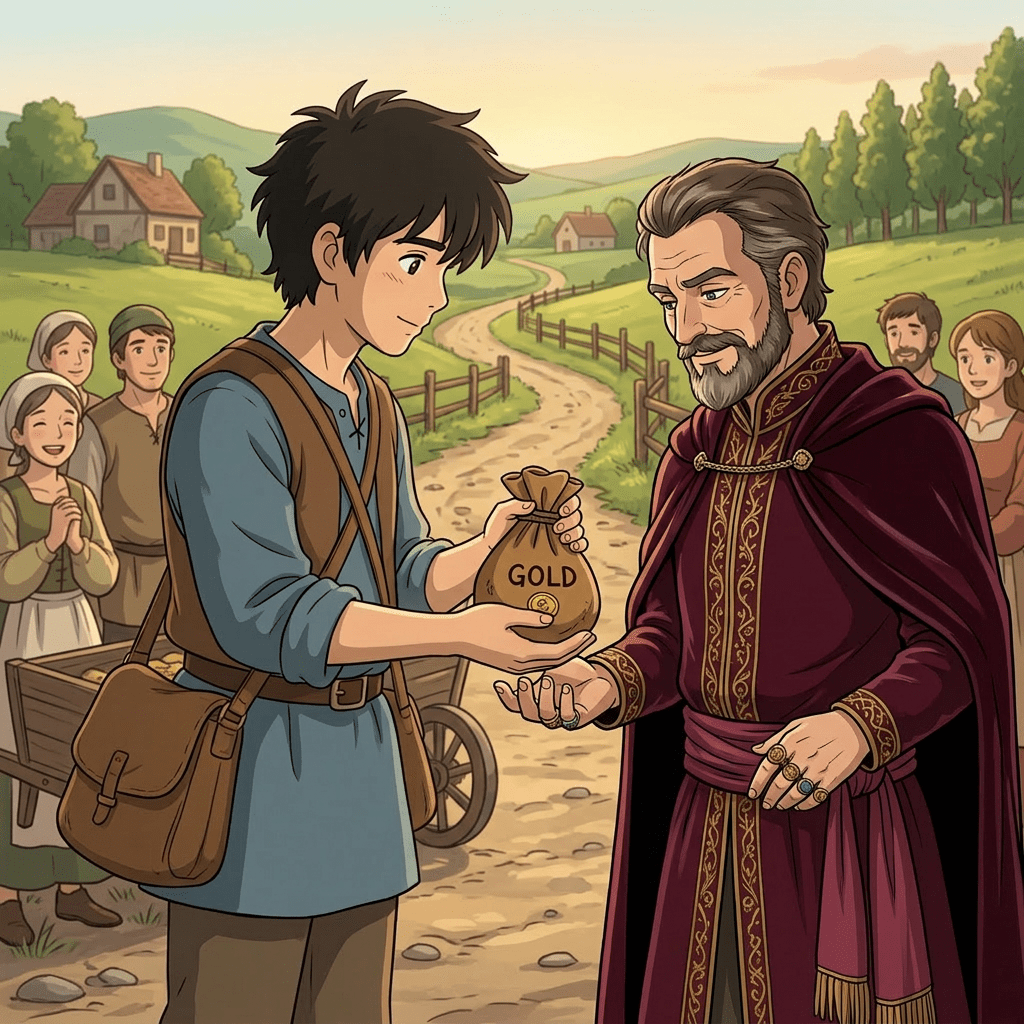
Young man giving a bag labeled GOLD to an elderly woman crying with gratitude

When the young man returned the wealth, the owner was moved to tears. Impressed by such rare integrity, the traveler used his influence to recommend the young man for a prestigious and honorable career. From that point on, the young man no longer relied on an inheritance. Through his own hard work and “righteous spirit,” he built a life of genuine dignity and peace.

Years later, when people spoke of him, they saw a man with a gentle face and a clear, peaceful aura. The gloom of his youth had vanished. He finally understood that what changed his fate wasn’t the bag of gold or the new job; it was the moment he chose to face his own inner ugliness and personally extinguish the fire of greed.

The turning points in our lives rarely happen during grand, public moments. They happen in the silent depths of the heart. One thought can lead a person into an abyss; one shift in thought can lead them back to the light.

We cannot guarantee that we will never harbor a dark thought, but we can choose—the moment we become aware of it—not to follow where it leads.

As the old wisdom teaches: Good and evil exist within a single thought. And destiny? It often waits at the corner of that very same thought, ready to turn your life in a whole new direction.

#Mindfulness #AsianCulture #SelfImprovement #ChineseWisdom#AsianPhilosophy #TraditionalCulture#Chinesestories #Chinesetraditionalconcepts

Link:https://peacelilysite.com/2026/05/04/your-aura-is-a-map-of-your-soul-the-ancient-chinese-wisdom-of-xiang-you-xin-sheng/

A Quiet Offering: Reflecting on National Volunteer Week

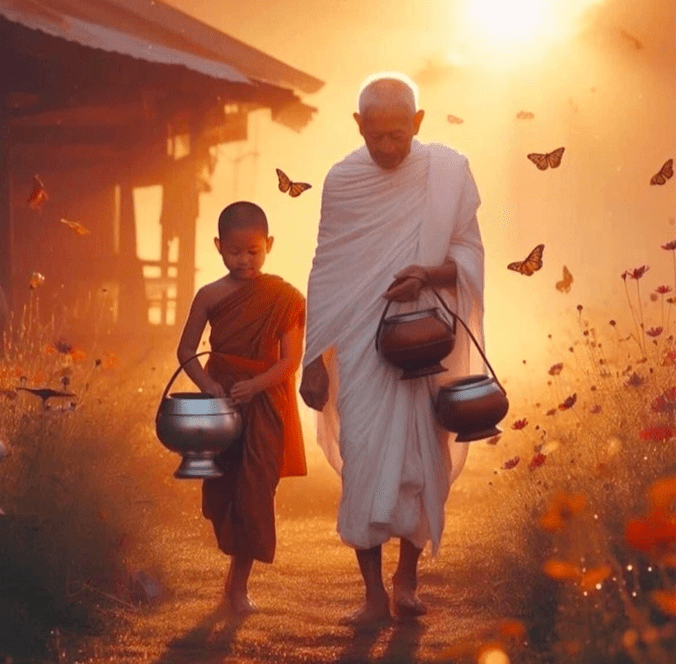
Volunteers serving food and offering support to elderly people at an outdoor community care event

This week is National Volunteer Week, April 19th-25th, a time to recognize those who quietly give their time, energy, and care to others.

In many ways, volunteering is not about doing something extraordinary. It is about doing small things, with a sincere heart, again and again.

Some people offer food.
Some offer time.
Some offer skills.
Some simply offer presence.

These actions may seem simple, but they carry great meaning.

When we think of service, we may remember people like Mohamed Mashally, who spent his life caring for those who could not afford treatment. He did not seek recognition. He simply did what he felt was right.

His life reminds us that helping others does not always require great resources. What matters most is the heart behind the action.

From the teaching of Gautama Buddha, we learn that true giving is not measured by how much we give, but by the intention within. A small act, done with kindness and sincerity, can have a lasting impact.

During this week, we may ask ourselves a simple question:

In our daily life, how can we help others, even in a small way?

It may be offering a kind word.
It may be listening with patience.
It may be giving time to someone in need.

These small actions are like seeds. When planted with care, they grow in ways we may not immediately see.

Volunteering is not only about helping others—it also changes our own mind. When we focus less on ourselves and more on the well-being of others, the heart becomes softer, more open, and more at peace.

In a busy world, it is easy to think that we do not have enough time. But often, it is not about having more time—it is about using a little time with sincerity.

This National Volunteer Week, we do not need to do something grand.

We can begin with something simple.

A small act of kindness.
A moment of patience.
A quiet willingness to help.

And from there, something meaningful can grow.

Because sometimes, the most powerful offering is not something big—

but something done with a true and caring heart.

Link:https://peacelilysite.com/2026/04/21/a-quiet-offering-reflecting-on-national-volunteer-week/

When One Heart Becomes a River: A Story of Quiet Compassion in Kenya

Elephant, zebras, giraffe, lions, buffaloes, and other animals drinking at a watering hole in a dry savannah

In the vast wilderness of Tsavo West National Park at Kenya, drought once tightened its grip on the land. Rivers disappeared. Waterholes turned to dust. Under the relentless sun, the earth cracked open, and the animals—elephants, zebras, buffalo, and antelope—wandered in search of something that no longer existed: water.

Amid this silent crisis, there was a man named Patrick Kilonzo Mwalua.

He was not wealthy, nor powerful. He was an ordinary farmer. But sometimes, it is the most ordinary people who carry the most extraordinary hearts.

Each day, after tending to his own responsibilities, he made a choice—a choice that would quietly change the fate of countless lives. He filled a truck with water and drove for hours across dusty, rugged terrain. The journey was long, the heat unforgiving, and the road uncertain. Yet he returned again and again, carrying thousands of gallons of water into the parched wilderness.

He did not do this once.
He did not do this for recognition.
He did this every day.

And then, something remarkable happened.

The animals began to recognize him.

At the distant sound of his truck engine, elephants would slowly emerge from the horizon. Zebras and antelope gathered nearby. Buffalo stood waiting near the dry waterholes. There was no fear in their eyes—only a quiet trust.

They knew.

This man was bringing life.

Man driving water truck delivering water to animals in desert

In a world where humans often take from nature, here was someone who simply gave back. No speeches, no grand declarations—just the steady rhythm of compassion in action.

When asked why he did it, his answer was simple:
“If I don’t do it, they will die.”

There is a profound truth in those words. Compassion does not always arrive with ceremony. Sometimes, it appears as a single person who sees suffering and refuses to turn away.

This story brings to mind the spirit of Rabindranath Tagore, whose words remind us that a life can gently illuminate another life:

Live yourself as a light,
Because you don’t know
Who, by your light,
May walk out of the darkness.

Keep kindness in your heart,
Because you don’t know
Who, through your kindness,
May walk out of despair.

Though often shared in his name, whether these lines are directly his or inspired by his spirit, their meaning echoes here with quiet truth.

This story reminds us that kindness does not require abundance. It does not wait for perfect conditions. It begins in the heart, in that quiet moment when we choose to care.

Like a drop of water falling into dry soil, one act of goodness can bring life where there was none. And just as water sustains the body, compassion sustains the spirit of the world.

Perhaps we may not all drive water trucks across deserts. But in our own lives, there are always thirsty places—moments, people, and hearts in need of care.

And perhaps, like him, we can choose to become a small river.

Flowing quietly.
Giving steadily.
Nourishing life, one drop at a time. 🌿

Link:https://peacelilysite.com/2026/04/08/when-one-heart-becomes-a-river-a-story-of-quiet-compassion-in-kenya/

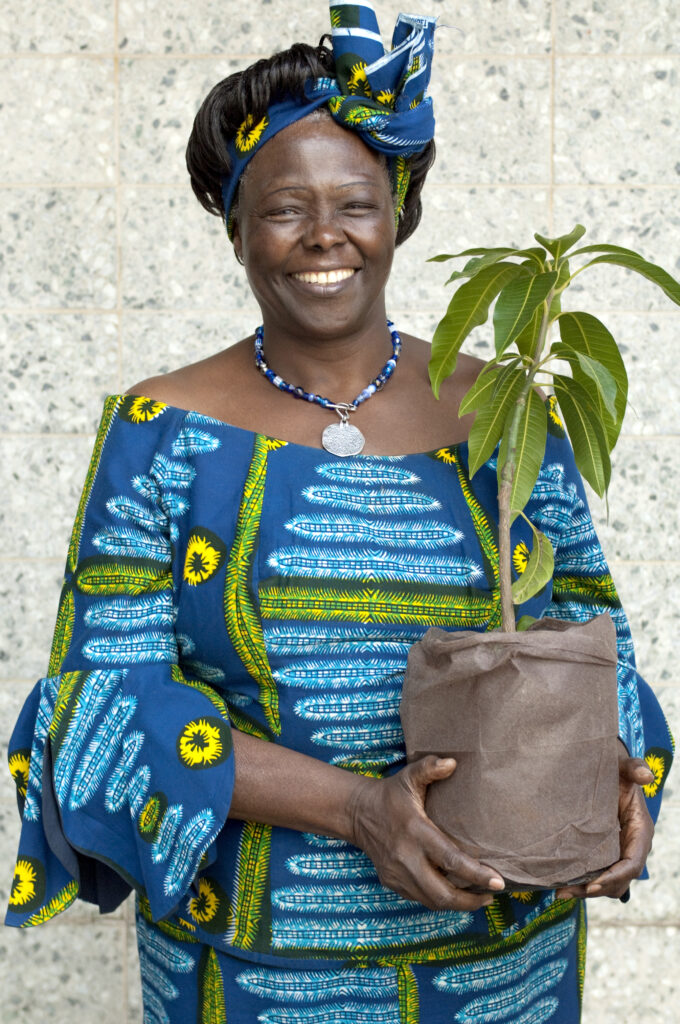
The Woman Who Planted Hope: How Wangari Maathai Changed the World One Tree at a Time

In a world often driven by ambition and material success, it is easy to overlook the quiet, transformative power of compassion. Yet history reminds us that lasting change is often born not from grand gestures, but from simple, sincere actions. The life of Wangari Maathai is a profound example of this truth. With unwavering courage and a heart rooted in service, she transformed the act of planting trees into a movement that restored both the land and the dignity of countless lives.

Born in rural Kenya, Wangari Maathai grew up closely connected to nature. She witnessed the gradual disappearance of forests, the drying of rivers, and the increasing hardship faced by local communities. Among those most affected were women, who depended on the land to sustain their families. Rather than accepting this decline, she chose to act. In 1977, she founded the Green Belt Movement, a grassroots initiative that encouraged women to plant trees in their communities.

What seemed like a simple solution carried deep wisdom. As trees took root, they began to restore the environment, protect water sources, and provide essential resources such as firewood. At the same time, the women who nurtured these seedlings gained a source of income and a renewed sense of independence. Through this work, Wangari Maathai did more than address environmental issues—she empowered women to reclaim their strength, their voices, and their place in society.

Yet her path was far from easy. As her movement grew, it began to challenge powerful interests tied to land exploitation and political control. Speaking out against injustice, she faced harsh resistance. She was arrested, harassed, and even subjected to violence. In the eyes of the authorities, her actions were seen as a threat. But in truth, she stood as a symbol of integrity and moral courage. She remained steadfast, guided not by anger, but by a deep commitment to what was right.

Her perseverance did not go unnoticed. In 2004, she was awarded the Nobel Peace Prize, becoming the first African woman to receive this honor. The recognition reflected more than her environmental achievements; it affirmed her vision that peace is deeply connected to justice, human dignity, and harmony with the Earth. Her life demonstrated that caring for the environment is not separate from caring for humanity—it is, in fact, an essential part of it.

Beautiful aerial forest on Earth, vibrant

There is a quiet spiritual resonance in her journey. In many traditions, we are reminded that every action plants a seed, and every seed will one day bear fruit. Wangari Maathai understood this deeply. Each tree she planted was also an offering of hope, a gesture of compassion, and a step toward a more balanced and just world. Over time, these small acts grew into something far greater than anyone could have imagined.

Her legacy invites us to reflect on our own lives. In a world that often feels overwhelming, it is easy to doubt the impact of our individual efforts. Yet her story gently reminds us that meaningful change does not require perfection or power—it begins with intention. A single act of kindness, a moment of courage, or a commitment to do what is right can ripple outward in ways we may never fully see.

Wangari Maathai planted trees, but more importantly, she planted hope. And that hope continues to grow, quietly and steadily, in the hearts of those who are willing to care, to act, and to believe that even the smallest seed can change the world.

Link:https://peacelilysite.com/2026/04/06/the-woman-who-planted-hope-how-wangari-maathai-changed-the-world-one-tree-at-a-time/

Compassion Is Stronger Than Violence

“In a gentle way, you can shake the world.”
— Mahatma Gandhi

A Reflection Inspired by Gandhi and Buddhist Wisdom

Throughout history, great spiritual teachers have reminded humanity that true strength does not come from violence, but from compassion. One of the most powerful voices for this truth was Mahatma Gandhi, whose philosophy of nonviolence transformed not only India’s independence movement but also the moral thinking of the modern world.

Gandhi believed deeply that responding to hatred with hatred only multiplies suffering. One of his most famous reminders is:

“An eye for an eye only ends up making the whole world blind.”

These words echo a truth that has been taught for thousands of years in Buddhist philosophy. The teachings of Gautama Buddha emphasize that violence and anger inevitably create more suffering through the universal law of cause and effect, often described as karma.

When people act with hatred, harmful consequences naturally follow. But when people act with compassion, patience, and kindness, they plant seeds of peace that can transform the future.

Gandhi understood this deeply. He once said:

“Non-violence is the greatest force at the disposal of mankind.”

At first glance, nonviolence may seem passive or weak. Yet both Gandhi and Buddhist teachings reveal the opposite: choosing compassion when faced with anger requires tremendous inner strength. It means resisting the instinct to retaliate and instead responding with wisdom and humanity.

Another powerful statement from Gandhi reminds us of this inner strength:

“The weak can never forgive. Forgiveness is the attribute of the strong.”

In Buddhist practice, forgiveness and compassion are essential qualities for spiritual growth. When we release anger and cultivate compassion, we stop feeding the cycle of negative karma. Instead, we create positive causes that lead to harmony and healing.

The world today often appears filled with conflict, division, and hostility. Yet the teachings of Gandhi and the Buddha remind us that lasting peace cannot be built through force. Peace grows from the transformation of the human heart.

Every act of kindness, every moment of patience, and every compassionate choice becomes a small but powerful step toward a more peaceful world.

Gandhi expressed this hopeful vision beautifully:

“Where there is love there is life.”

His words remind us that true change does not always come from power or domination. Often, it begins quietly—with compassion, moral courage, and the determination to do what is right.

When we choose compassion over anger, forgiveness over revenge, and wisdom over violence, we participate in a timeless spiritual truth: good causes create good results. In this way, every compassionate action becomes a seed of positive karma that can gradually transform both our own lives and the world around us.

And perhaps this is the deepest lesson shared by both Gandhi and the Buddha:
compassion may appear gentle, but in the end, it is stronger than violence.

In recent days, my heart has been unsettled by the wars, conflicts, and endless scandals that seem to surround our world. In such turbulent times, the gentle wisdom of Gandhi becomes like a quiet lamp in the darkness, calming my mind and reminding me to return to inner peace.

I make a sincere vow to guard the peace within my own heart and not allow anger or despair to take root. Instead, I choose to pray for those who are suffering and to let the love and compassion within me flow outward. My voice may be small in this vast world, but I believe that every sincere prayer carries its own power, and the divine will surely hear it.

May the blessings of all the divine beings in the universe embrace this world. May compassion arise in human hearts, hatred dissolve, and may peace and harmony gently return to our shared home.

Link:https://peacelilysite.com/2026/03/11/compassion-is-stronger-than-violence/

From Tragedy to Hope: A Nobel Peace Laureate’s Journey

Nadia Murad: One Woman’s Courage Can Change the World

In a world often shaken by violence and injustice, the story of Nadia Murad reminds us that even in the darkest moments, the human spirit can rise with extraordinary courage.

Murad was born in a small Yazidi village in northern Iraq. Like many young women, she once dreamed of living a quiet and simple life. She hoped to open a beauty salon in her hometown and build a peaceful future with her family.

But in 2014, her life was shattered when the extremist group Islamic State of Iraq and Syria (ISIS) attacked her village. Many members of her family were killed, and she, along with thousands of Yazidi women and girls, was captured and subjected to unspeakable violence.

After months of captivity, Murad managed to escape. Her survival alone was extraordinary, but what she chose to do next required even greater courage.

Rather than remain silent, she decided to tell the world what had happened. Speaking before global leaders at the United Nations, she courageously shared her story and spoke on behalf of thousands of victims who could not speak for themselves.

As she once said:

“I want to be the last girl in the world with a story like mine.”

These simple but powerful words express her deepest mission—to ensure that no other woman or girl must endure the suffering she experienced.

Murad continued her advocacy for survivors of human trafficking and wartime sexual violence, calling on the world to pursue justice and accountability. Her bravery and determination were recognized globally when she was awarded the Nobel Peace Prize in 2018.

Yet Murad’s work has never been about personal recognition. Her goal has always been to restore dignity and hope to those whose lives have been torn apart by violence.

In another moving statement, she said:

“There is no greater honor than being able to speak on behalf of those who have been silenced.”

Her life demonstrates how even the deepest suffering can be transformed into compassion and purpose. Instead of allowing pain to define her, she chose to turn her experience into a force for justice and healing.

Murad also reminds the world that silence allows injustice to continue:

“If the world had listened earlier, perhaps this tragedy could have been avoided.”

Her words challenge us all—not only to listen, but to act.

Today, Nadia Murad’s voice has become a symbol of resilience, courage, and hope. From a small village in Iraq to the global stage, she has shown that one person’s courage can awaken the conscience of humanity. Her story is not only a testimony of survival—it is a call for compassion.

From a deeper spiritual perspective, her journey also reminds us of the universal law of cause and effect—what many traditions call karma. Violence, hatred, and cruelty create suffering that ripples across generations, while compassion, courage, and moral responsibility create healing and hope. When individuals like Nadia Murad choose truth over silence and compassion over hatred, they help restore moral balance in the world. Her courage encourages each of us to cultivate kindness, protect the vulnerable, and act with integrity in our own lives. In this way, even small acts of compassion can become powerful seeds of positive karma, helping to guide humanity toward a more peaceful and just future.

Link:https://peacelilysite.com/2026/03/08/from-tragedy-to-hope-a-nobel-peace-laureates-journey/

A Hopeful Skeptic

By Jamil Zaki

According to an ancient myth, hope arrived on earth as part of a curse. Prometheus stole fire from the gods, and Zeus avenged the theft with a “gift.” He commanded Hephaestus to mold the first woman, Pandora, and presented her to Prometheus’s brother. Pandora, in turn, was given a clay jar—which Zeus told her never to open. Curiosity got the better of her, she lifted the lid, and out flew all the world’s ills: sickness and famine for our bodies, spite and envy for our minds, war for our cities. Realizing her mistake, Pandora slammed the jar shut, leaving only hope trapped inside.

But what was it doing there in the first place, alongside our miseries? Some people believe hope was the jar’s only good, and trapping it further doomed us. Others think it fits in perfectly with the other curses. The philosopher Friedrich Nietzsche called hope “the most evil of evils because it prolongs man’s torment.” You might agree. Hope has been typecast as delusional and even toxic—causing people to ignore their problems and the world’s.

Scientists think of hope differently. The psychologist Richard Lazarus wrote, “To hope is to believe that something positive, which does not presently apply to one’s life, could still materialize.” In other words, hope is a response to problems, not an evasion of them. If optimism tells us things will get better, hope tells us they could. Optimism is idealistic; hope is practical. It gives people a glimpse of a better world and pushes them to fight for it.

Any of us can practice hope. [My friend] Emile did. He saw the same world most of us do, but instead of retreating into cynicism, he chose to work for peace, build community, and live his principles. To me and many who knew him, Emile’s positivity seemed supernatural. Temperament, experience, will, or some alchemy of all three graced him with a mind and a heart many of us could learn from. Through dozens of tearful, grateful conversations, I gained a deeper understanding of who Emile was and how he got that way. Emile pursued peace the way doctors pursue healing. If illnesses are aberrations in the body’s function, Emile saw conflict and cruelty as diseases of social health. He and his colleagues diagnosed the triggers that inspire hatred, and then designed psychological treatments to reduce conflict and build compassion.

One powerful tool he used to fight cynicism was skepticism: a reluctance to believe claims without evidence. Cynicism and skepticism are often confused for each other, but they couldn’t be more different. Cynicism is a lack of faith in people; skepticism is a lack of faith in our assumptions. Cynics imagine humanity is awful; skeptics gather information about who they can trust. They hold on to beliefs lightly and learn quickly. Emile was a hopeful skeptic, combining his love of humanity with a precise, curious mind.

This mindset presents us with an alternative to cynicism. As a culture, we are so focused on greed, hatred, and dishonesty that humanity has become criminally underrated. In study after study, most people fail to realize how generous, trustworthy, and open-minded others really are. The average person underestimates the average person.

If you’re anything like the average person, this hides some good news: People are probably better than you think. By leaning into skepticism—paying close attention rather than jumping to conclusions—you might discover pleasant surprises everywhere. As research makes clear, hope is not a naive way of approaching the world. It is an accurate response to the best data available. This is a sort of hope even cynics can embrace, and a chance to escape the mental traps that have ensnared so many of us.

Cynicism often boils down to a lack of good evidence. Being less cynical, then, is simply a matter of noticing more precisely. I hope we can witness the good in others and work toward the world most of us want. The cynical voice inside each of us claims that we already know everything about people. But humanity is far more beautiful and complex than a cynic imagines, the future far more mysterious than they know. Cynicism is a dirty pair of glasses more of us put on each year. But we can take them off. We might be astonished by what we find.

Link:https://peacelilysite.com/2026/02/28/a-hopeful-skeptic/

Source: https://www.awakin.org/v2/read/search.php

Walking for Peace: A Call for Moral Leadership Today

In a world shadowed by war, polarization, and a visible crisis of character among national leaders, many people feel a quiet but persistent sense of moral drifting. We watch the headlines, we hear the rhetoric, and we wonder: Where is the steady compass that points us toward what is right?

At this crossroads, political strategies alone are not enough. What we urgently need is moral leadership.

History reminds us what that looks like. Martin Luther King Jr. transformed American society not by deepening divisions, but by calling a fractured nation back to its highest values. His authority did not come from force, wealth, or position. It came from moral clarity. He appealed to conscience. He awakened compassion. He united people under the banner of shared human dignity.

Today, facing new global conflicts and cultural tensions, we must ask again: Where will the next wave of moral authority arise?

Buddhist monks walking in silence, carrying a powerful message of peace and mindfulness. (Handout photo)

Recently, about twenty monks completed a 108-day walking journey for peace. Their pilgrimage was not a political campaign. It was not a media spectacle. It was a living embodiment of mindfulness and compassion in action. Step by step, through towns and cities, they carried a quiet message: peace is not merely an agreement signed on paper—it is a way of walking through the world.

In a society saturated with noise, outrage, and endless commentary, their disciplined silence spoke volumes. Their presence offered a visual reminder that true leadership begins with inner cultivation. When we lead with anger, we multiply conflict. When we lead with compassion, we create space for healing.

This is where Buddhist wisdom offers a profound contribution. Rooted in great compassion, loving-kindness, and deep self-reflection, the Buddhist path teaches that personal transformation and public responsibility are inseparable. A leader who has not mastered their own mind cannot bring harmony to others.

Across North America, millions now identify with Buddhist teachings, making it one of the most influential spiritual communities in the region. This growing presence brings an essential perspective to our troubled era—one that emphasizes empathy for all who suffer and reverence for every form of life.

Within this tradition, many look to Dorje Chang Buddha III as an example of moral leadership. Having lived in the United States for more than two decades, he has been recognized internationally for humanitarian and charitable work. His honors include the World Peace Prize, the Presidential Gold Medal, the Dr. Martin Luther King Jr. Legacy Award, and even a resolution passed in the United States Senate in recognition of his contributions.

Yet perhaps more powerful than any award is his response to recognition. In an age driven by ego and self-promotion, he has expressed a vow of radical humility:

“I will bear all of the karmic offenses committed by living beings, and I will give everyone all of the good karma and merit that I plant.”

Whether one interprets this statement spiritually or symbolically, its moral essence is clear: a true leader does not seek to accumulate praise or advantage. A true leader seeks to shoulder responsibility and give benefit.

This is the kind of leadership our world desperately needs.

Moral leadership is not confined to one religion, culture, or tradition. It can be expressed through Judeo-Christian ethics, Buddhist compassion, or any path that places the common good above personal ambition. What matters is the heart behind the action.

If we are to navigate the challenges of our era, the answer will not come solely from policy, power, or popularity. It will come from conscience.

And perhaps the real invitation is not only to seek moral leaders—but to become them, each in our own sphere of influence.

Link:https://peacelilysite.com/2026/02/19/walking-for-peace-a-call-for-moral-leadership-today/

The Way of the Peaceful Warrior

On meeting conflict without losing ourselves

There are moments in life when, despite our best intentions and most sincere efforts, things still feel profoundly unfair. Right and wrong seem reversed. The ground beneath us shifts, and our inner balance begins to tilt toward chaos. In those moments, our first instinct is often to react—to defend, to argue, to strike back.

Before you do, pause.

Take a breath.
Return to your body.
Listen to what is happening beneath the noise.

When we step into conflict fueled by “righteous anger,” wounded pride, or a desire for revenge, we rarely restore balance. More often, we simply exchange one form of turmoil for another. Peace quietly slips away.

Holding onto resentment or remaining lodged in the role of the victim keeps us circling the same pain, replaying the same arguments, long after the moment has passed. Whether we choose to walk away with a clear conscience or feel called to stand up for what feels just, one truth remains: every action—and every silence—creates ripples. They shape who we are becoming and touch the lives of those around us.

At first glance, the phrase Peaceful Warrior seems contradictory. Yet a life rooted in peace and integrity demands precisely this paradox.

To be peaceful does not mean to be passive.
To be a warrior does not mean to be aggressive.

True strength lies in seeing beyond illusion and surface drama. It lies in choosing awareness over reflex, clarity over emotional momentum. A Peaceful Warrior does not drift from one reaction to the next; they choose their response with care.

Such a warrior knows how to step back and observe themselves in the heat of the moment. They are capable of decisive action, but their actions are guided by wisdom and oriented toward the greater good. Only genuine courage allows us to respond from the heart, rather than from outdated conditioning and habitual fear.

The next time you find yourself facing opposition, remember this: you can remain present. You can maintain your inner edge without surrendering to fear or hostility. You can stand firmly without hardening your heart.

You can be a Peaceful Warrior.

When life confronts us with injustice, it becomes a quiet test of our spiritual maturity. These reflections may help illuminate the path:

1. Discern Reaction from Response
A reaction is automatic—rooted in survival, memory, and past wounds. A response is conscious, grounded in the present moment. When you feel that surge of heat in your chest, pause and ask: Is this my deeper wisdom speaking, or is it my ego defending its image?

2. Release Attachment to Outcomes
The Bhagavad Gita teaches action without attachment to results. Spiritually, this means doing what is right not for victory or validation, but because it aligns with truth. When the need to “win” dissolves, a quieter, more enduring power emerges—one that cannot be taken from you.

3. Receive the Mirror
Those who unsettle us most often reveal where we are still tender or unhealed. This does not excuse harmful behavior, but it offers insight. Let the discomfort become a question: What within me is asking for strength, clarity, or compassion?

Link: https://peacelilysite.com/2026/01/16/the-way-of-the-peaceful-warrior/

The Fragility of Trust

“There are two things in this world one should never look at directly: the sun, and the human heart.” —Higashino Keigo

I recently came across this story online, and it deeply moved me. It reminded me that trust and kindness are fragile treasures—once broken, they are hard to mend. I would like to share this wisdom with everyone who reads my blog, especially in times when misunderstandings and suspicion can so easily damage the relationships we cherish most.

Once, there was a newly married couple deeply in love, inseparable and affectionate.
But the wife began to doubt her husband’s loyalty. Her suspicion grew stronger each day until she asked her best friend to “test” her husband’s faithfulness.

To her shock, the two fell in love with each other. What started as a test ended in betrayal.
In the end, the marriage was destroyed—not by infidelity itself, but by mistrust and the reckless act of testing love.

🧬 The Scientist Who Refused to Test

Finsen, the world-renowned Danish medical scientist and Nobel laureate, once chose a young man named Harry as his successor.

Some colleagues worried that Harry might not endure the long, tedious years of research. Finsen’s assistant suggested testing him by having a wealthy friend offer him a high-paying job to see whether Harry would stay or leave.

But Finsen firmly rejected the idea, saying:

“Never stand on a moral high ground to look down on others, and never test human nature.
Harry was born in poverty and naturally desires financial security. If we place him between an easy, well-paid job and the hardship of research but expect him to choose sacrifice, we are demanding him to be a saint. That would be unfair.”

Years later, Harry became one of Denmark’s most respected medical scientists. When he learned that Finsen had refused to test him, he wept and said:

“If my mentor had tested my integrity with a lucrative offer, I would likely have failed.
At that time, my mother was ill and my younger siblings depended on me for their schooling.
If Finsen had set that test for me, there would be no me as I am today.”

🌿 The Truth About Human Nature

Indeed, ordinary people are not saints—everyone has weaknesses. If we constantly test others—our spouse’s loyalty, our friends’ sincerity, or our coworkers’ honesty—we will often end up with disappointment and broken trust.

In the first story, had the wife trusted her husband instead of testing him, the marriage might have survived.

Finsen understood that human nature is fragile. True wisdom lies not in setting traps to measure others’ virtue, but in tolerating uncertainty with compassion.

Testing human nature is like striking a porcelain bowl—it will only reveal its fragility by breaking it.
Trust, on the other hand, is like holding that bowl gently in your hands—preserving its wholeness, beauty, and purpose.

In life, love, and friendship, may we learn to trust with kindness and lead with understanding.
After all, it is not the test that reveals the truth of a heart, but the grace with which we choose not to test it.

Link:https://peacelilysite.com/2025/11/06/the-fragility-of-trust/