Here is a story in the Avadanasataka Sutra: At the Buddha’s time, in Sravasti, an elderly Brahman’s wife gave birth to a baby boy. Whenever the child was hungry for milk and as soon as the breast milk entered his mouth, the milk would turn bad. It was the same situation whenever he took in other food. Therefore, this had been how he grew up in a semi-starvation state. After he grew up, he beseeched the Buddha for renunciation from household life. Out of compassion, the Buddha approved it.
After the renunciation, other Bhikkhus always returned with a bowl full of food after they went out to ask for offerings. Yet, he was the only one who returned with an empty bowl. One day, it occurred to him that he had to do something for the Three Jewels. Through the physical work, he wished to eradicate his negative karma. He resolved to clean up the monastery and miraculously, the next day, he returned with delicious food. Therefore, he became even more determined to serve the Three Jewels. This way, he got to have food every day.
One day he slept in and missed the clean-up. Sariputra cleaned up the monastery as he passed by. He was very upset about this and told Sariputra, “I only get to eat after I clean up the place. Now, you have done it. I will definitely have nothing to eat today.” After Sariputra heard about that, he said, “It is no problem. I will go to the city and get food for you.” After he went to a layperson’s house, the couple happened to be in a quarrel. He returned with an empty bowl. The next day, Sariputra told him that an Elder had made a meal offer to the Buddha and the Sangha. The Buddha would take them along. After they arrived at the Elder’s home, everyone’s bowl was full of food, except his. They had missed filling up his bowl. He went to inform the owner about his empty bowl, yet no matter how he yelled out to the owner, somehow, he never could hear him.
After Ananda knew about this, he felt sympathy for him. He volunteered to get food for him the next day. Ananda was known as the first in memory, yet, this time, he totally forgot about his promise. On the fourth day, he finally got a bowl of food. However, on his way back, a dog ran to him and spilled the food. Venerable Maudgalyayana also had learned about this. The following day he went out and got the food for him. On his way back, he took a break under the tree. All the birds in that tree flew down and ate up the food in the bowl. Venerable Maudgalyayana singed, “In spite of being the first in supernatural powers, I also cannot do much due to his heavy negative karma.”
Sariputra could not bear to see this. He made up his mind to find food for him. The next day, he went out and got a bowl of food. When he got to the entrance, the door which used to be open suddenly shut closed with a bang. The bowl of food was hit by the door and spread all over the floor.
Until the seventh day, the Bhikkhu had not taken a bit of food still. He cried out of sorrow and shame. He ended up eating the sand and died. Everyone was amazed by what had happened. They went to the Buddha and inquired about the karmic condition of the Bhikkhu. The Buddha told everyone, “At the time of Indradhvaja Buddha (Sovereign Sign Buddha), there was an Elder who loved to do good deeds and give donations. He often offered vegetarian meals to the Buddha and the sangha. He also had a son who followed after his conducts. The family property was managed by the father at that time; therefore, the son was not against the donations.
After the Elder passed away, the son inherited the property. He became greedy and was unwilling to give. Other than being unwilling to give to the sangha, he also did not allow his mother to make offerings. However, his mother was frugal and tried to save to give to the sangha. One day, the mother told him, “I have nothing left to eat. Can you spare me any food?” He talked back at his mother, “I gave you food, but you gave it away to the sangha. Why don’t you just go and eat the sand?” Later, his mother died of starvation. Due to the negative karma of reluctance in making offerings and respecting parents, he degenerated into the hell realm after his death. After countless of eons he had finally made his way back to the human realm. In the same way, he still had to go through the negative karmic retribution of hunger and starvation. Because he did not oppose his father making offerings to the Buddha in the past, he then had the karmic condition to renounce in this life time. Nevertheless, because of the heavy negative karma of disrespect to his mother, in this life, he experienced extreme hunger and eventually died of eating sand.
This is the karmic retribution of greed, disrespect to parents, and negative speech. In spite of the fact that he had renounced himself from the household life, he still could not escape from retribution. From this, we learn that negative karma can be very horrifying.
It is said that there are two ways to practice religion. One is to live apart from the ordinary everyday world as a monk, a nun or a holy one. Those who are sincere in this way have as their highest goal the direct experience of complete Truth – full Enlightenment. The other way to practice religion is within the ordinary world. Those who are sincere in this way have as their highest goal the harmony of an undivided world, living peacefully under a perfectly wholesome ruler – a ‘King of the World’. Once upon a time the Enlightenment Being was born and given the name ‘Clear-sighted’. As he grew up he developed ten rules of good government: absence of hidden ill will. absence of open hostility, harmlessness, self-control, patience, gentleness, charity, generosity, straightforwardness and goodness.
The people of the world began to notice the wholesomeness and fairness of Clear-sighted, who lived strictly according to these rules. Gradually those in his vicinity volunteered to live under his authority as king, rather than under the dishonest politicians of the time. As his reputation spread, every king in the world came to Clear-sighted and said, “Come, oh lord. You are welcome. My kingdom is your kingdom. Advise me how to rule in your name.” Then Clear-sighted said, “Do not destroy life. Do not take what is not given. Do not behave wrongly in sexual desires. Do not speak falsely. Do not take alcohol that clouds the mind. My commands to the world are only these five. As long as these five are obeyed, my sixth rule is freedom for all to follow local customs and religions.” After all the people on earth had come to live under his peaceful rule, he became known as Clear-sighted the Great, King of the World. His royal city, the capital of the whole world, was called Kusavati. It was a beautiful and prosperous city with four magnificent gates – one golden, one silver, one jade and one crystal.
Outside the gates, Kusavati was surrounded by seven rows of palm trees – a row with golden trunks and silver leaves and fruits; a row with silver trunks and golden leaves and fruits; a row with cat’s-eye trunks and crystal leaves and fruits; a row with crystal trunks and cat’s-eye leaves and fruits; a row with agate trunks and coral leaves and fruits; a row with coral trunks and agate leaves and fruits; and finally a row with trunks and leaves and fruits of every kind of jewel found in the world! When breezes blew through these marvelous palms the sweet sounds of gentle music were heard throughout the city. This music was so enticing and pleasant that some of the citizens were enchanted into stopping their work and dancing for joy! Clear-sighted the Great, King of the World, had a couch encrusted with jewels from the wonderful palms. After a long, righteous and peaceful reign, he lay on the rich couch for the last time. He knew that his end was near.
Of all his 84,000 queens, the one who loved him most was called, ‘Most-pleasant’. Sensing the state of his mind she said, “You rule over all the cities of the world, including this beautiful Kusavati with its four magnificent gates and seven rows of marvelous palms. Think about this and be happy!”
The King of the World said, “No, my dear queen. don’t say that. Instead you should advise me to give up attachment to the cities of the world and all they contain.” Surprised. she asked, “Why do you say this, my lord?” “Because today I will die,” he said.
Then Queen Most-pleasant started to cry, wiping away the tears as they flowed. And all the other 84,000 queens also broke into tears. And the king’s ministers and his whole court, both men and women, could not keep from weeping and sobbing. All eyes overflowed with tears.
But King Clear-sighted the Great said, “Your tears are useless. Be at peace.” Hearing this the wailing subsided and his subjects became silent. Then he said to Queen Most-pleasant, “Oh my queen, do not cry, do not lament. Anything that comes into being, whether it be a kingdom including the whole world, or just a tiny sesame seed – it cannot last forever. Anyone who comes into being, whether it be the King of the World, or the poorest petty thief – all must decay and die. Whatever is built up, falls apart. Whatever becomes, decays. The only true happiness is in the moment when becoming and decaying are not.”
In this way the Enlightenment Being got them to think about what most people don’t want to think about – that all things come to an end. He advised them to be generous and wholesome. Then the King of the World, like everyone else, died. He was reborn as a god in a heaven world, where in time, like everyone else, he died.
Once upon a time, in the country of Gandhara in northern India, there was a city called Takkasila. In that city the Enlightenment Being was born as a certain calf. Since he was well bred for strength, he was bought by a high class rich man. He became very fond of the gentle animal, and called him ‘Delightful’. He took good care of him and fed him only the best.
When Delightful grew up into a big fine strong bull, he thought, “I was brought up by this generous man. He gave me such good food and constant care, even though sometimes there were difficulties. Now I am a big grown-up bull and there is no other bull who can pull as heavy a load as I can. Therefore, I would like to use my strength to give something in return to my master.”
So he said to the man, “Sir, please find some wealthy merchant who is proud of having many strong bulls. Challenge him by saying that your bull can pull one- hundred heavily loaded bullock carts.”
Following his advice, the high class rich man went to such a merchant and struck up a conversation. After a while, he brought up the idea of who had the strongest bull in the city.
The merchant said, “Many have bulls, but no one has any as strong as mine.” The rich man said, “Sir, I have a bull who can pull one hundred heavily loaded bullock carts.” “No, friend, how can there be such a bull? That is unbelievable!” said the merchant. The other replied, “I do have such a bull, and I am willing to make a bet.”
The merchant said, “I will bet a thousand gold coins that your bull cannot pull a hundred loaded bullock carts.” So the bet was made and they agreed on a date and time for the challenge.
The merchant attached together one-hundred big bullock carts. He filled them with sand and gravel to make them very heavy.
The high class rich man fed the finest rice to the bull called Delightful. He bathed him and decorated him and hung a beautiful garland of flowers around his neck.
Then he harnessed him to the first cart and climbed up onto it. Being so high class, he could not resist the urge to make himself seem very important. So he cracked a whip in the air, and yelled at the faithful bull, “Pull, you dumb animal! I command you to pull, you big dummy!”
The bull called Delightful thought, “This challenge was my idea. I have never done anything bad to my master, and yet he insults me with such hard and harsh words!” So he remained in his place and refused to pull the carts.
The merchant laughed and demanded his winnings from the bet. The high class rich man had to pay him the one thousand gold coins. He returned home and sat down, saddened by his lost bet, and embarrassed by the blow to his pride.
The bull called Delightful grazed peacefully on his way home. When he arrived, he saw his master sadly lying on his side. He asked, “Sir, why are you lying there like that? Are you sleeping? You look sad.” The man said, I lost a thousand gold coins because of you. With such a loss, how could I sleep?”
The bull replied. “Sir, you called me ‘dummy’. You even cracked a whip in the air over my head. In all my life, did I ever break anything, step on anything, make a mess in the wrong place, or behave like a ‘dummy’ in any way?” He answered, “No, my pet.”
The bull called Delightful said, “Then sir, why did you call me ‘dumb animal’, and insult me even in the presence of others? The fault is yours. I have done nothing wrong. But since I feel sorry for you, go again to the merchant and make the same bet for two thousand gold coins. And remember to use only the respectful words I deserve so well.”
Then the high class rich man went back to the merchant and made the bet for two-thousand gold coins. The merchant thought it would be easy money. Again he set up the one hundred heavily loaded bullock carts. Again the rich man fed and bathed the bull, and hung a garland of flowers around his neck.
When all was ready, the rich man touched Delightful’s forehead with a lotus blossom, having given up the whip. Thinking of him as fondly as if he were his own child, he said, “My son, please do me the honour of pulling these one hundred bullock carts.”
Lo and behold, the wonderful bull pulled with all his might and dragged the heavy carts, until the last one stood in the place of the first.
The merchant, with his mouth hanging open in disbelief, had to pay the two thousand gold coins. The onlookers were so impressed that they honoured the bull called Delightful with gifts. But even more important to the high class rich man than his winnings, was his valuable lesson in humility and respect.
The moral is: Harsh words bring no reward. Respectful words bring honor to all.
(Translated from the Chinese transcript issued by the Holy Miracles Temple on April 15, 2022)
H.E. Denma Tsemang
During the last few days, Buddhist disciples who have come to Holy Miracles Temple from all over the world, to attend the prayer Dharma assemblies at the Holy Miracles Temple, have gradually returned to their respective countries. Venerable Tsemang has met with some Buddhist disciples several times at their requests to address some of their concerns. Below is the summary of what Venerable Tsemang talked about during those meetings with some masters. Venerable Tsemang has reviewed the transcript and given the permission to release it to the public.
Today, I have made time to meet with all of you. Previously, throughout the duration of the prayer Dharma assemblies, some people wanted to talk to me about certain matters, but I declined most of their requests for a few reasons: Firstly, I am a living being filled with tremendous humility. Even though I have continually been learning, my cultivation is very poor, and I have no actualized realization power. I am unable to resolve many of your problems.
Secondly, I do not know most of you. In the past few years, most of the time when the Buddha Master was only giving audiences to Buddhist disciples, but not imparting Dharma, I was not present. They all know this. That was because I did not want to get to know people. I also have plenty of work to tend to. Therefore, I don’t know most people who attended the prayer Dharma assemblies at the Holy Miracles Temple this time.
Thirdly, I do not have enough time. I want to spend most of my time on the organization and translation of the audio recorded Dharmas imparted by His Holiness Dorje Chang Buddha III. This is a task that no one else can do on my behalf.
Another reason, frankly speaking, is that I am afraid that once you step outside the door, you will incorrectly relay to others what I have said, or even completely distort the meaning of what I said. That will cause problems. Just like some time ago when I openly spoke at the Holy Miracles Temple, once my words were disseminated by others on the Internet, the meaning was no longer the same. Most of the things they said were not what I meant. Some people even said things that were contrary to what I said.
That’s why you can see that I have brought an audio recorder today to record my own words. Why? If in the future you relay my meaning incorrectly, at least I will have evidence. At the same time, in the future, when I listen to it again, if I find anything that I said incorrectly, I will be able to tell you what was incorrect and make it right. This is because in any discussion involving knowledge and views about Buddha Dharma, we must be extremely serious and cautious, and cannot be in any way sloppy or careless.
I do know some of you who are here today, but I have not met most of you. I think perhaps I will first address some of your concerns by sharing some of my personal points of views for your reference. These are questions that many of you have asked. After I finish talking, if you have further questions, we can discuss them then. I would like to emphasize that I am a living being filled with humility. It was out of compassion that the Buddha allowed me to stay by His side and therefore I probably have had more opportunities than others in listening to teachings of the Buddha. I perhaps started learning from the Buddha a few years earlier than some other people.
That said, I cannot say that it means my points of views are correct. I am definitely not giving a Dharma discourse here. I have already said so many times on different occasions: I am not qualified to give a discourse on Dharma. What I am about to say is simply my thoughts and opinions, based on some personal experiences in learning from the Buddha and cultivating myself. They are for your reference only. If you think what I said has deviated from the teachings of the Buddha, you are welcome to point out what I have said incorrectly, so that I can make amends.
The first aspect is about a question that many of you, who are masters, have asked: what you should do when you return to where you came from. If I am to answer this question fully and in intricate detail, it is essentially about how we may attain accomplishment and liberation within this lifetime. If I am to talk about this briefly, it can also be very simple. It is simply about abiding by the precepts, cultivating ourselves, and practicing Dharma. I believe neither option of responding is what you want. Therefore, I have listed a few actual things that I will briefly talk about one by one.
1. Continue to chant Sutras, pray and beseech His Holiness the Buddha and Fomu, Holy Mother the Great Mahasattva, to return to the human world to save us living beings.
Why did the Buddha and Fomu, Holy Mother the Great Mahasattva, enter parinirvana? The fundamental reason is the dark karma of us living beings! That’s why every one of us must repent at any time, and not just pay lip service, but sincerely repent of all the sinful karma that we have committed during this lifetime and at this moment. Many people, when they repent, only habitually chant verses such as “I repent all dark karma stemming from greed, aversion and ignorance since beginningless time.” This kind of fake repentance is simply attributing our sins to what has happened in our past lives.
My point of view on this issue is exactly the opposite. It is precisely due to the positive karmic conditions we have accumulated since beginningless time that we have had the good fortune in this lifetime to follow and learn from His Holiness Dorje Chang Buddha III to cultivate ourselves. It is also precisely since we have not cultivated ourselves well during this lifetime up to now, that we still haven’t attained accomplishment and liberation. Therefore, to genuinely repent is to correct all our bad habits in this lifetime that do not accord with the teachings and admonition of the Buddha and enable ourselves to become a genuine cultivator.
The conditions of birth and death do not apply to a Buddha. When we, living beings, have good retribution, the Buddha appears in this world. When living beings no longer have such good fortune, the Buddha enters parinirvana. In the past, Ancient Buddhas did that, Namo Shakyamuni Buddha did that, and now His Holiness Dorje Chang Buddha III has also done the same.
I will tell you about an incident that I personally experienced. In January, 1996, I accompanied His Holiness Dorje Chang Buddha III and Fomu, Holy Mother the Great Mahasattva, to Shenzhen. Fellow Brother Li Dehe was the general manager of Luohu Hotel at the time. He set up a temporary mandala on the top floor of the hotel, the 16th floor, for the Buddha Master to impart Dharma and grant audiences to disciples. One day at noon, it was time to respectfully ask the Buddha Master and Fomu to have lunch. However, we could not find the Buddha Master anywhere. I went to the 16th floor mandala to look for the Buddha Master, but no one was there, it was empty. After a while, a fellow sister also went to the mandala to look for the Buddha Master, but nobody was there.
Shortly afterwards, fellow sister Liu Ge went to the mandala again and there was still nobody there. She did not leave the mandala immediately and was looking at her own reflection in the big mirror right next to the door, with her back toward the window. The glass window was sealed and could be seen from the reflection of the mirror. Suddenly, she saw from the mirror that a foot appeared through the window, then the Buddha Master stepped into the room from the sky through the window. Fellow sister Liu Ge was so startled that she screamed out loud. We ran over there immediately and found the Buddha Master seated at the mandala. Fellow sister Liu Ge then told us what had happened and everything she saw. The reason why I’m telling you this incident, putting it in mundane terms, is to say that the kind of holy power that the Buddha and Fomu, Holy Mother the Great Mahasattva, possess is not something we can comprehend at all. The only thing for us to do is to repent with utmost sincerity and invoke the Buddha and Fomu to return to this world and continue to teach us and save us.
2. Buddhist disciples should be compassionate, supportive, and helpful to each other. In particular, masters must guide your groups well, develop new people, and do not solicit people from other groups to join your group.
Buddha Master said this many times. Among us, Buddhist disciples are not supportive of each other and are far inferior to Christians in this aspect. Some people who have been learning from Buddha for a relatively longer time, or some people who wear rinpoche or acharya attires tend to always criticize others in a condescending manner. The root cause of such behavior is not having compassion. I hope that after you return to your own country, you will guide your group to treat each other as family, to help and support each other when facing adversities. When one person has difficulties, everyone should help this person and resolve the problem together. If you cannot even do this, yet you still claim to be cultivating yourself, and you still want to attain liberation, it will be simply impossible.
Do not form cliques or factions. This is something that Buddha Master greatly opposed. We are Buddhist disciples, we are cultivators. As Buddhist cultivators, we should be broad-minded, rather than furthering our narrow- mindedness while cultivating ourselves. As long as living beings are able to listen to the audio recorded Dharmas imparted by His Holiness Dorje Chang Buddha III, and are cultivating themselves, we should be happy for them regardless of where they listen to the audio recorded Dharmas and which group they join. Buddhist disciples are not anyone’s personal property.
3. We must earnestly and respectfully listen to the audio recorded Dharma Discourses imparted by His Holiness Dorje Chang Buddha III, because they are the source from which we obtain correct knowledge and views. I can even say that in this Dharma Degeneration Age, any Buddhist disciple wanting to attain accomplishment and liberation must listen to the audio recorded Dharmas imparted by His Holiness the Buddha. Whether you are a rinpoche, an acharya, or a master of Dharma listening sessions, your duty is to guide others to listen to the Discourses upon your own foundation of listening to audio recorded Dharma Discourses. This is most important. When you have done this well, your merit will grow.
In many audio recorded Dharma Discourses, His Holiness Dorje Chang Buddha III teaches us how to listen to Dharma in order to attain beneficial effects. Personally, I want to bring everyone’s attention to the following points: First, do not selectively listen to Dharma Discourses based on your personal preferences. We must listen to all the Dharma Discourses comprehensively. Second, when we have questions, we should seek answers to our questions in the Dharma Discourses. The purpose of listening to Dharma Discourses is to obtain correct knowledge and views to guide our cultivation, to resolve the issues we encounter in our daily lives, in our work, and in our cultivation. If someone says that they have not encountered any problems in their cultivation, they would be a Great Bodhisattva, I would congratulate them and learn from them. If that’s not the case, then their issue is so serious that they aren’t even aware of their own problems. Think about this: if they don’t have any problems, why would they still be an ordinary living being? Why are they still being transmigrated in samsara? This explains why these people have very serious problems, and they should make a sincere effort to listen to the audio recorded Dharmas imparted by the Buddha with great respect. You might think that listening to all the Dharma Discourses in a comprehensive manner is contradictory to trying to find answers from Dharma Discourses. They are, in fact, one and the same. If you try to do so conscientiously, you will realize it for yourselves.
4. Cultivating ourselves in a solid and practical manner is the foundation for attaining accomplishment and liberation. In my personal opinion, the most important reason His Holiness Dorje Chang Buddha III came to this world is to correct the many errors made by patriarchs, and to emphasize that cultivation is the foundation for attaining liberation. That’s why Buddha Master always admonishes us that we must cultivate ourselves. Buddha Master imparted many Dharmas on what we need to pay attention to when we cultivate ourselves. You can listen to the audio recorded Dharma Discourses and practice accordingly. What I must emphasize today is: As a Buddhist disciple, regardless of what title you have, whether you are a Dharma master, a rinpoche, an acharya, or a master of Dharma listening sessions, you must never make money through Buddhist disciples. In other words, if you sell products, conduct businesses through Buddhist disciples from your group or other groups, or make pretense that such practices are for everyone to build good fortune and wealth together, then you have already deviated from the correct path of learning from Buddha and cultivating yourself.
If you involve yourself in scams, such as fraudulent multi-level marketing schemes, the so-called “national asset projects !,” or any kind of illegal businesses explicitly forbidden by the government, then you are defrauding people and what you are doing is criminal.
This is extremely important! Buddha Master and Fomu, Holy Mother the Great Mahasattva, have always helped disciples, but have never conducted any businesses to make money through Buddhist disciples. Regardless of who, if anyone coerces Buddhist disciples to buy products or engage in multi-level marketing, Buddhist disciples should sever relations with them.
Some people might not be swindling others for money directly. They might build their fame in a dishonest manner and gather many followers first, before starting to deceive people to obtain money. For example, some people claim that in their dream, Buddha Master gave them holy amrita, and therefore, they can cure diseases very effectively. Some people claim that the Buddha and Fomu, Holy Mother the Great Mahasattva, have empowered them, and that’s why they can enter dhyāna while listening to audio recorded Dharma Discourses. Some even claim they can live without eating or drinking for months, and so on and so forth. Those people are all liars!
Announcements from the World Buddhism Association Headquarters have made it very clear: Only by using the 18 Dharmas that were publicly announced can the level of a person’s actualized realization power be determined. If you claim that you have actualized realization power, then contact the World Buddhism Association Headquarters and register to take the exam. The result will be publicly announced.
After you return to where you came from, not only must you make sure that you don’t deceive others, you must also prevent other Buddhist disciples from being cheated. If you know anyone who has deviated from the teachings of the Buddha and is defrauding others, you must report them to the Headquarters immediately. If there is a criminal conduct, you should report the culprits to the police directly, so that these perpetrators will be brought to justice. In the entire field of Buddhism in the world, only Namo His Holiness Dorje Chang Buddha III and the World Buddhism Association Headquarters have publicly denounced their Buddhist disciples, some of whom are masters, for conduct that does not accord with Dharma. Why? By following the teachings and precepts imparted by His Holiness Dorje Chang Buddha III and Namo Shakyamuni Buddha, the Headquarters handles matters in a fair and unbiased manner in accordance with Dharma.
5. All Buddhist disciples must obey the laws and regulations of their respective countries and regions. This is also critically important. As Buddhist disciples, our goal is to attain liberation, to save ourselves in order to save others. We do not get involved with politics. That said, regardless of which country you’re in, Buddhist disciples must obey the laws and regulations of their respective countries and regions. Different countries have different conditions, so naturally, there are different laws and stipulations. It is essential for a government to maintain order. Some time ago, a rinpoche told me that China currently does not allow people to learn Buddha Dharma imparted by Namo Dorje Chang Buddha III. I told this person that there is no such thing, based on four points:
1) The country’s constitution stipulates that its citizens have freedom of religion. There is no law or regulation forbidding people to learn Buddhism!
Therefore, we can openly learn from Buddha. We are upstanding Buddhist disciples, what do we need to be afraid of?
2) Buddhism was established by Namo Shakyamuni Buddha in India. Buddhism is a foreign religion in China. However, after more than 2000 years of being propagated in China, Buddhism has been integrated into and has become a part of the traditional Chinese culture. It is in Chinese language that Namo Dorje Chang Buddha III propagates the most authentic, profound, and incisive teachings of Buddhism, Buddha studies, and Buddha Dharma to the world. When Buddhist disciples around the world study Sutras and the audio recorded Dharmas imparted by Namo Dorje Chang Buddha III, not only can they learn the absolutely correct Buddhist teachings, they can also learn about and assimilate the essence of traditional Chinese and Han culture. This is a significant driving force in the promotion of Chinese and Han culture. What’s wrong with that?
3) Namo Dorje Chang Buddha III always teaches Buddhist disciples, through His Sutras and audio recorded Dharma Discourses, not to do anything evil, and do all kinds of good deeds, as well as to love, protect and help each other, to obey the law, respect the elderly, care for the young, care for each other, contribute to our country, and promote world peace. A true Buddhist disciple is therefore a good member of their family, an active member of society, and a good citizen of their country.
4) People who have fears in their mind can be categorized into two types: The first type subconsciously believes that learning from the Buddha is wrong and not permitted. If you think that way, why continue to learn from the Buddha? This type of people still wants to attain accomplishment through learning from the Buddha. Isn’t that ridiculous? The second type uses learning from Buddha as a tool to conduct business. Some even engage in illegal businesses, such as cryptocurrency and multi-level marketing forbidden by some governments. Some of them even defraud groups of people, and so on and so forth. These kinds of acts that promote chaos and disturb society are inherently illegal and should be forbidden.
If you are learning from the Buddha and not doing anything illegal, why would you be afraid?
6. Another one of your concerns is about how we can learn Dharma. Actually, the answer to this question is very simple. Once you have cultivated yourself well, the natural progression is for you to receive Buddha Dharma. If your conduct does not accord with Dharma, even if a Dharma had been transmitted to you, it would be futile. Namo Dorje Chang Buddha III told me about a person who repeatedly beseeched the Buddha to transmit Dharma to her. The Buddha was very compassionate and did transmit Dharma to her. After a while, she came to the Buddha and said that she was having a hard time making a living and needed to make some money before resuming her Dharma practice. Do you think the Dharma is of any use to her? Will the Yidam and Dharma Protectors still be there for her? In the face of true Buddha Dharma, we choose Dharma over our own lives, let alone a Dharma being transmitted personally by His Holiness Dorje Chang Buddha III. That’s why, this person has basically ruined that Dharma.
As you can see, cultivating ourselves and having correct knowledge and views are very important. They are the foundation of our Dharma practice. Once our foundation is well built, Buddhas and Bodhisattvas will know. The natural progression is that Dharma Kings and Great Holy Gurus will transmit Buddha Dharma to you. Also, I recommend that you directly study and practice the Supreme and Unsurpassable Mahamudra of Liberation. The Supreme and Unsurpassable Mahamudra of Liberation that combines cultivation practice with Dharma practice. It is the best way to practice. It would be best to have a Master transmit it to you, but if you don’t have a Master, you can also study and practice it yourself. You do not need anyone to transmit it to you. Anyone who steadfastly practices it in accordance with Dharma will attain accomplishment. His Holiness Dorje Chang Buddha III said so a long time ago.
7. Many people also asked about protecting Dharma. In fact, learning, protecting, and propagating Dharma are a trinity. We must first learn Buddha Dharma, and in the process of learning, we protect and support Buddha Dharma. Eventually, when we receive beneficial effects, we must propagate Dharma for more people to learn It. The Dharma Learning from Buddha imparted by His Holiness Dorje Chang Buddha III has been published into a book, as well as audio recorded Dharma Discourse CD’s, in which His Holiness the Buddha has spoken a great deal about protecting Dharma. Protecting Dharma is an integral part of our cultivation as Buddhist disciples. If a Buddhist disciple does not protect Dharma, they are no longer a Buddhist disciple!
About protecting Dharma, many people are easily confused about one thing: Protecting Dharma means protecting the Buddha and protecting Buddha Dharma, not protecting their own interest. They are completely different concepts. It means when the name of the Buddha is tarnished, or when Buddha Dharma is damaged, we come forward without any hesitation to refute evil demons. However, when our own reputation and interest are compromised, we must practice forbearance. This is the most important principle in our cultivation and in protecting Dharma. Yet these days, some people are doing exactly the opposite.
In today’s world, only the Buddha Dharma imparted by Namo Dorje Chang Buddha III can enable living beings to attain liberation. Sutras by Namo Shakyamuni Buddha have been tampered with by the descendants of the Demon King Mara. There are also translation errors. Some people also find it hard to understand ancient language. As a result, it becomes extremely difficult for average people to attain accomplishment through studying the Sutras of Namo Shakyamuni Buddha. Therefore, after you return home, you need to learn and promote the audio recorded Dharma Discourses and Sutras of Namo Dorje Chang Buddha III!
The second aspect is about an incident mentioned in the recent announcement issued by the World Buddhism Association Headquarters. It was originally a very simple matter. However, many people with incorrect knowledge and views have turned it into a very complicated matter.
About this matter, I must be the first to repent. I feel that it is due to my lacking virtue and abilities that such a situation had happened. Under whatever circumstances, having an altercation in the Grand Hall of Shakyamuni Buddha was an extremely evil and sinful behavior. The Holy Miracles Temple is the one and only temple in the world where Buddha once bestowed holy amrita, and where the Grand Hall of Shakyamuni Buddha is an Inner Tantric Mandala. Most importantly, His Holiness Dorje Chang Buddha III and Fomu, Holy Mother the Great Mahasattva, were still inside the Grand Hall when the altercation happened. Having an altercation and hitting people inside the Grand Hall is extremely disrespectful to His Holiness the Buddha and Fomu. That was terrible! I feel very sad. As a disciple, I was truly ashamed in front of the Buddha and Fomu!
Of course, what was being described in the Headquarters’ announcement was factual, and the Headquarters’ decision was indeed correct. Everyone should know that the Holy Gurus at the Headquarters would not err on causality, otherwise they would not have passed the holy exam nor become Holy Gurus! Therefore, if someone doubts the Holy Gurus at the Headquarters and choose rather to believe an ordinary person, I can only say that this kind of person is extremely ignorant. Perhaps they are by nature evil people with deliberate intentions to undermine Buddha Dharma! Think about this: If you don’t even understand such a simple question and such a basic concept, and you claim to be learning from Buddha to cultivate yourself, haven’t you learned all that in vain? Isn’t your learning from Buddha and cultivating yourself just a lie? Therefore, this incident reflects that some people’s knowledge and views are problematic, and I feel that I must talk about it briefly.
First, from this incident, we can see the difference between a real and an ingenuine cultivator. At the very least, as a person involved in the incident, regardless of whether you consider the Headquarters’ announcement factual, the first step you should take is to practice forbearance. This is the very least a cultivator should do. If you practice forbearance, then even if you have done wrong, you have now done the right thing. Because even though you have already done wrong, you are now practicing forbearance and cultivating yourself according to the teachings of the Buddha. If you do not practice forbearance, yet for the sake of saving face and preserving self-interests, and driven by your temper, you vent your grievances and want to deny your wrongdoing, then even if you did not participate in the altercation or hit people, you are now in the wrong, because you have deviated from practicing cultivation.
Not to mention you did indeed hit someone, and then lied about that on the Internet. Furthermore, during the Dharma assemblies, you said you repent your sinful karma in front of the Buddha and Fomu, yet afterwards, you brought chaos and hit people in the Grand Hall. Think about it: In doing so, aren’t you inflicting yourself with additional sins? How could you be so ignorant? From my personal point of view, this kind of sin cannot be resolved by repenting in the normal way. Do you know why? Because this is a direct offence against the Buddha and Fomu. Other than Buddhas, Equal Enlightenment Bodhisattvas, or Wondrous Enlightenment Bodhisattvas, any other Bodhisattvas will not and dare not accept her repentance.
The second point is about the issue of making vows. Many people said that she has already made a vow. Could the vow be false? These people don’t understand the meaning of making vows. Perhaps the person who made the vow doesn’t even understand the meaning. Buddha Master once talked about this, but I cannot remember whether it is in one of the audio recorded Dharma Discourses. I did personally hear the Buddha Master said this: Even if you are very sincere in making a vow, it usually takes 12 years for the consequence of the vow to manifest, as causality takes time to ripen.
Therefore, if a person vows that they didn’t do a certain thing, and that if they did, they will be hit by a car once they step outside the door, or they will immediately go bankrupt and die, or they will lose their job the next day, etc., these are not realistic vows. It is because this kind of vow will not come true immediately. Since many people do not understand this, they think that the person who made the vow must be speaking the truth. As a result, they have been deceived.
If you don’t believe me, we can do an experiment now. If one person here slaps the next person, then immediately make a vow saying that you have not slapped anyone, and if what you said is false, you will be hit by a car and die once you step outside the door. Let me tell you, when you go outside now, as long as you do not intentionally run into a car to be hit, you definitely will not be killed by a car. Even if you intentionally run into a car to be hit, you still might not die. In China, many people defraud people for money by pretending to be hit by other people’s cars. Those are real life examples. Have all those people been killed by cars?
Well, here comes the problem. We clearly saw you hitting someone on the spot, but you swore that you didn’t hit anyone. Yet when you stepped outside, you were not hit by a car and you did not die. Does it mean that your vow now proves that you did not hit anyone? Are we supposed to trust our eyes or your vow? In the past, when Buddhists made vows, they often bet themselves against “not attaining liberation.” “descending to hell after death,” or “falling into the three lower realms after death.” There are two conditions for making such oaths: First, it will definitely come true after a long period of time; secondly, not attaining accomplishment is the worst punishment for a cultivator.
That’s why, being extremely compassionate and could not bear to see anyone fall into the three lower realms, the Buddha Master later said: If someone makes a vow voluntarily, do not vow that you might “go to hell after death.” Rather, use words like “I will definitely be poverty-stricken in this lifetime, and my life will be miserable,” or “I will be sickness-ridden.” This kind of vow will definitively come true after a long period of time, especially if they are made in a temple or in the Grand Hall of Shakyamuni Buddha.
I will tell you another factual example. Once, there was a master, some of you here certainly know him. I won’t say his name. He once cheated money from people to buy a house for himself. When he came to the Buddha Master’s Vajra Mandala to seek an audience with the Buddha, the Buddha asked him about that, and he said he didn’t defraud anyone for money. He immediately made a vow in front of the Buddha: He vowed that if he cheated anyone for money, he would be hit by a car once he stepped outside the front gate. I was at the Vajra Mandala that day, and of course he wasn’t hit by a car. However, after this master returned to his own country, those who were deceived by him sued him. This case went to trial, it was proven that he did defraud quite a few people for money. This master was eventually sentenced to imprisonment. This is indeed a factual example of someone making a false vow. However, I would like to remind you that the law of causality never errs. Do you think there is no consequence for making a false vow? You will be reaping the corresponding outcome.
Third, many people say: “The Buddha and Fomu have always been so compassionate. When this kind of matter happens, They will definitely be merciful toward living beings. Why wasn’t the Headquarters being more compassionate and just criticize these people in private? Why did they have to issue a public announcement?” This kind of saying is extremely ridiculous. They basically don’t understand the principles of Buddha Dharma. They don’t understand what true compassion is. If I am to elaborate on this question, it will take too much time. I will only put forward a few questions for you to think about: Buddhas are the most compassionate beings throughout the universe, but why did Buddhas stipulate so many precepts as guidance, model, and restraint for Buddhists’ words and deeds? Did the Buddha want to deliberately torment Buddhists? The Buddhas are compassionate even toward evil demons, then why did They also transform into the Vajra Beings to eliminate the demons that harm living beings?
Do not equate being compassionate with being unprincipled. Do not equate being a compassionate person with an unprincipled person who just wants to be nice. Genuine loving-kindness and compassion are about how to protect living beings’ opportunity to attain wisdom, and what is truly beneficial to living beings to enable them to attain liberation and accomplishment. Further, are you already a Holy Guru or a Bodhisattva, or are you an ordinary being who is still learning from Buddha to cultivate yourself? You must understand that the Buddha being compassionate is what the Buddha does. As ordinary beings, we cannot assume the enlightenment state of the Buddha. As Buddhists, we must strictly abide by the precepts, otherwise we will only degenerate. Therefore, reflect upon this, then listen to the audio recorded Dharmas imparted by His Holiness Dorje Chang Buddha III. I believe you will understand why the Headquarters must issue the announcement, and why the Headquarters is truly compassionate in doing so.
Fourth, the announcement issued by the Headquarters is not just about those two people. Some people have equally serious problems. So, how should we treat those so-called Buddhists who do not follow the teachings of the Buddha, do not abide by the precepts, and obstinately do not admit their wrongdoing? Some people say that they are all our fellow Vajra brothers and sisters, and we are a family, so we need to support and help each other. Simply put, this is a wrong view! When the Namo World Honored Shakyamuni Buddha was asked this question before entering parinirvana, Shakyamuni Buddha taught: “Forsake them.” That means, Buddhists should stay far away from this kind of evil people, let them live and die on their own, and eventually receive their retribution from causality. Since we are ordinary people, we can’t afford to inflict ourselves with that kind of dark karma. Only great Buddhas and Bodhisattvas can edify these evil people. As living beings, we must stay far away from them. Therefore, the only thing we must do is to follow the teachings of the Buddha.
To those who say they are “Vajra brothers and sisters” I can only say that they really need to make good effort to listen to and learn from the audio recorded Dharma Discourses. This reminds me of some time ago, some people were burning Buddhist books, Buddha statues and audio recorded Dharma Discourse CD’s. Those people are no doubt evil demons. Yet, some other people still wanted to help those evil demons, and as a result, they got themselves stricken with dark karma. It can be said with certainty that eventually, these people will descend to hell along with those evil demons and they will undergo all kinds of sufferings. In the end, they will still need Buddhas and Bodhisattvas to save them.
From another perspective, let’s think about this: Why have so many people brought up so many questions? It is precisely because they have not made good effort to respectfully listen to the audio recorded Dharmas imparted by His Holiness Dorje Chang Buddha III. They have not made good effort to apply what the Buddha teaches in resolving problems they encounter in their daily lives and in their cultivation. The process involves listening, contemplating, practicing cultivation, and eventually attaining fruition. If you only listen, but do not contemplate, and do not practice cultivation, then of course you will not attain fruition! Therefore, I once again emphasize: It is very, extremely important that everyone respectfully listens to the Dharmas imparted by Namo Dorje Chang Buddha III! You must listen to them earnestly, not half-heartedly.
The third aspect is about the Office of His Holiness Dorje Chang Buddha III.
A few days ago, someone forwarded a question asking if the Office could still represent the Buddha now? Whatever motivated this person to ask such a question, I think it is a good question. Because, in the entire universe, no one can represent the Buddha. Only a Buddha can represent another Buddha, not even Bodhisattvas! In the past, the Office served the Buddha and handled many aspects of work on behalf of Namo Dorje Chang Buddha III. However, after the Buddha entered parinirvana, there is no longer the issue of representing the Buddha or not!
Other than praying for the return of the Buddha and Fomu to the human world as soon as possible, the main duty of the Office now is to organize and translate the audio recorded Dharmas imparted by His Holiness Dorje Chang Buddha III. This is for the benefit of all living beings. Going forward, generally speaking, the Office will only publish transcriptions and translations of newly released audio recorded Dharma Discourses and will not be issuing any other announcements. Everyone from the Office, including myself, have not and will not use the Office as a pretext to do anything unrelated to His Holiness Dorje Chang Buddha III; Namo Fomu, Holy Mother the Great Mahasattva; Buddha Dharma; or audio recorded Dharmas imparted by the Buddha. The Office will do our utmost to organize the audio recorded Dharmas imparted by the Buddha as soon as possible, so that everyone can respectfully listen to and learn from the teachings. The organizing of a recent set of audio recorded Dharma Discourses, Namo Dorje Chang Buddha III Imparts Dharma During a Trip in Response to the Karmic Conditions and Needs of Disciples is now complete, and the English translation is in progress. There are 15 chapters in total. These Dharma Discourses are very important. I hope you will respectfully request for these CD’s from the International Buddhist Sangha Association before you return to your cities or countries. After respectfully listening to them, you will understand a lot of truths.
For matters relating to Buddha Dharma, the Holy Gurus at the Headquarters will issue announcements. You must study and understand the announcements issued by the Headquarters with a serious attitude.
Finally, I will say this again: My personal level is poor, and my abilities are very limited. With great humility, what I said today is only from my own experience and thoughts, which I hope you may use as a reference. If you think what I said is wrong, it doesn’t matter. My only hope is that all people and all living beings can learn the Dharma of His Holiness Dorje Chang Buddha III and truly become liberated Holy Gurus, so that they can save more living beings.
Addendum: For English speakers, although this article references audio recordings and offers instructions on listening to Dharma Discourses, the same guidance and recommendations will apply to the English translations of Dharma Discourses that are published.
I really enjoy animation movies for their humor and cheerfulness. What better way to relax, than to watch Garfield shovel down 450 pounds of lasagna? However, beneath the appearance of levity and simple fun, animation has it own unique way of handling the serious and abstract philosophical questions. Spirited Away and Soul are outstanding works in this regard. They sparked my interest, and made me value what I have in my life, and look at the world with a different point of view.
Twenty years ago, on July 20, 2001, a film that would become one of the most celebrated animated movies of all time hit theaters in Japan. Directed by Hayao Miyazaki and produced by Studio Ghibli, Sen to Chihiro no Kamikakushi, titled Spirited Away in English, would leave an indelible mark on animation in the 21st century. The movie arrived at a time when animation was widely perceived as a genre solely for children, and when cultural differences often became barriers to the global distribution of animated works. Spirited Away shattered preconceived notions about the art form and also proved that despite being a Japanese film with elements of Japanese folklore central to its core, it could resonate deeply with audiences around the world.
Imaginative and inspired, Spirited Away immerses the viewer in a fantastical world that at once astounds and alarms. Many of the deities are based on figures in Japanese folklore, and part of the Japanese title itself, kamikakushi, refers to the concept of disappearance from being taken away by gods. The story is a tale of resilience and persistence, as Chihiro, our protagonist, gradually draws on her inner strength to endure this land where humans are designed to perish.
The story follows an ordinary 10-year-old girl name Chihiro and her parents as they stray into a strange world. Her parents turned into pigs because of greed, and Chihiro must go through various tests before finally rescuing her parents and returning to the human world. The parents, who were turned into pigs, have forgotten that they are human, and no matter how Chihiro calls, they just slumber. Just like the reincarnation of Sahas, there is no real reunion. Who do you remember? Are the parents of the previous life? Do we remember ourselves? In the film, those who forget their names cannot find their way home; and if we forget our true nature, we will also be lost in reincarnation for a long long time. For countless kalpas, we have had countless names, but they are all pseudonyms. What is our real name? Where are we originated? Why we come to this world? Everyone has to search inward to find their own answer.
What is it that makes you, well, you? “Soul” introduces Joe Gardner a middle-school band teacher who has a passion for jazz. “Joe wants more than anything to become a professional jazz pianist,” says director Pete Docter. “So when he’s offered a rare, once-in-a-lifetime opportunity to play with one of the greats, Joe feels he’s reached the top of the ultimate mountain.”
But one small misstep takes him from the streets of New York City to The Great Before – a fantastical place where new souls get their personalities, quirks and interests before they go to Earth. According to Docter, the idea for this unique world was 23 years in the making. “It started with my son—he’s 23 now—but the instant he was born, he already had a personality,” says Docter. “Where did that come from? I thought your personality developed through your interaction with the world. And yet, it was pretty clear that we’re all born with a very unique, specific sense of who we are.
In the film, Joe is about to usher in a turning point in his life to realize his dream, but inadvertently becomes a blue soul and becomes the mentor of Soul 22. He only wanted to return to earth, but due to 22, arrives in the “land of ecstasy”. In “The Realm of Ecstasy”, the mysterious old man called Wind of the Moon helps people who have lost themselves to find themselves, and even allows them to return to their consciousness through a special channel, and connect with the body through spiritual consciousness. He is like an accomplished practitioner of practice, who can go to various paths in meditation, and even go to hell to save sentient beings. After many twists and turns, Joe returned to Earth and performed on the same stage with his idol. But when the dream came true, he felt a little lost after the excitement of success. The lead player of the band tells him a story: a small fish swims up to an old fish and says,
“I’m going to find what they call the ocean.”
“Ocean?” the old fish replied, “You’re in the ocean right now. Here.”
“Is it here?” said the little fish, “here is water, what I want is the ocean.”
If a fish can’t feel the sea around it in the water, it can’t feel the real sea. The sea in its heart is actually the subtle existence in which it lives.
Joe eventually returned to Earth. At this time, he has realized that every step of life is like a piece of music, with the beauty of its notes anytime, anywhere. He has completely turned his life into jazz. At this time, his life has become beautiful and full of agility, and at the same time, he will not be overjoyed. His music score is no longer an external program, but a flow after inner awakening.
Before the time of this story, people in Asia used to say that there would never be a time when an elephant and a dog would be friends. Elephants simply did not like dogs, and dogs were afraid of elephants.
When dogs are frightened by those who are bigger than they are, they often bark very loudly, to cover up their fear. When dogs used to do this when they saw elephants, the elephants would get annoyed and chase them. Elephants had no patience at all when it came to dogs. Even if a dog were quiet and still, any nearby elephant would automatically attack him. This is why everybody agreed that elephants and dogs were ‘natural enemies’, just like lions and tigers, or cats and mice.
Once upon a time, there was a royal bull elephant, who was very well fed and cared for. In the neighbourhood of the elephant shed, there was a scrawny, poorly fed, stray dog. He was attracted by the smell of the rich sweet rice being fed to the royal elephant. So he began sneaking into the shed and eating the wonderful rice that fell from the elephant’s mouth. He liked it so much, that soon he would eat nowhere else. While enjoying his food, the big mighty elephant did not notice the tiny shy stray dog.
By eating such rich food, the once underfed dog gradually got bigger and stronger and became very handsome looking. The good-natured elephant began to notice him. Since the dog had gotten used to being around the elephant, he had lost his fear. So he did not bark at him. Because he was not annoyed by the friendly dog, the elephant gradually got used to him.
Slowly they became friendlier and friendlier with each other. Before long, neither would eat without the other, and they enjoyed spending their time together. When they played, the dog would grab the elephant’s heavy trunk, and the elephant would swing him forward and backward, from side to side, up and down, and even in circles! So it was that they became ‘best friends’, and wanted never to be separated.
Then one day a man from a remote village, who was visiting the city, passed by the elephant shed. He saw the frisky dog, who had become strong and beautiful. He bought him from the mahout, even though he didn’t really own him. He took him back to his home village, without anyone knowing where that was.
Of course, the royal bull elephant became very sad, since he missed his best friend the dog. He became so sad that he didn’t want to do anything, not even eat or drink or bathe. So the mahout had to report this to the king, although he said nothing about selling the friendly dog.
It just so happened that the king had an intelligent minister who was known for his understanding of animals. So he told him to go and find out the reason for the elephant’s condition.
The wise minister went to the elephant shed. He saw at once that the royal bull elephant was very sad. He thought, “This once happy elephant does not appear to be sick in any way. But I have seen this condition before, in men and animals alike. This elephant is grief-stricken, probably due to the loss of a very dear friend.”
Then he said to the guards and attendants, “I find no sickness. He seems to be grief-stricken due to the loss of a friend. Do you know if this elephant had a very close friendship with anyone?”
They told him how the royal elephant and the stray dog were best friends. “What happened to this stray dog?” asked the minister. He was taken by an unknown man,” they replied, “and we do not know where he is now.”
The minister returned to the king and said, “Your majesty, I am happy to say your elephant is not sick. As strange as it may sound, he became best friends with a stray dog! Since the dog has been taken away, the elephant is grief-stricken and does not feel like eating or drinking or bathing. This is my opinion.”
The king said, “Friendship is one of life’s most wonderful things. My minister, how can we bring back my elephant’s friend and make him happy again?”
“My lord,” replied the minister, “I suggest you make an official announcement, that whoever has the dog who used to live at the royal elephant shed, will be fined.”
This was done, and when the villager heard of it, he released the dog from his house. He was filled with great happiness and ran as fast as he could, straight back to his best friend, the royal bull elephant.
The elephant was so overjoyed, that he picked up his friend with his trunk and sat him on top of his head. The happy dog wagged his tail, while the elephant’s eyes sparkled with delight. They both lived happily ever after.
Meanwhile, the king was very pleased by his elephant’s full recovery. He was amazed that his minister seemed to be able to read the mind of an elephant. So he rewarded him appropriately.
The moral is: Even ‘natural enemies’ can become ‘best friends.’
Once upon a time there was a world famous teacher in Takkasila, in north-western India. He had 500 high class students who learned sacred teachings from him.
It just so happened that one of these high class students had been named ‘Bad’ by his parents. One day he thought, “When I am told, ‘Come Bad’, ‘Go Bad’, ‘Do this Bad’. it is not nice for me or others. It even sounds disgraceful and unlucky.”
So he went to the teacher and asked him to give him a more pleasant name, one that would bring good fortune rather than bad. The teacher said, “Go. my son, go wherever you like and find a more fortunate name. When you return, I will officially give you your new name.”
The young man named Bad left the city, and traveled from village to village until he came to a big city. A man had just died and Bad asked what his name was. People said. “His name was Alive.” “Alive also died?” asked Bad. The people answered, “Whether his name be Alive or whether it be Dead, in either case he must die. A name is merely a word used to recognize a person. Only a fool would not know this!” After hearing this, Bad no longer felt badly about his own name – but he didn’t feel good about it either.
As he continued on his way into the city, a debt-slave girl was being beaten by her masters in the street. He asked, “Why is she being beaten?” He was told, “Because she is a slave until she pays a loan debt to her masters. She has come home from working, with no wages to pay as interest on her debt.” “And what is her name?” he asked. “Her name is Rich.” they said. “By her name she is Rich. but she has no money even to pay interest?” asked Bad. They said, ‘Whether her name be Rich or whether it be Poor, in either case she has no money. A name is merely a word used to recognize a person. Only a fool would not know this!” After hearing this, Bad became even less interested in changing his name.
After leaving the city, along the roadside he met a man who had lost his way. He asked him, “What is your name? ” He replied, ‘My name is Tourguide.” “You mean to say that even a Tourguide has gotten lost?” asked Bad. Then the man said, “Whether my name be Tourguide or whether it be Tourist, in either case I have lost my way. A name is merely a word used to recognize a person. Only a fool would not know this!”
Now completely satisfied with his own name, Bad returned to his teacher.
The world famous teacher of Takkasila asked him, “How are you, my son? Have you found a good name?” He answered, “Sir, those named Alive and Dead both die, Rich and Poor may be penniless, Tourguide and Tourist can get lost. Now I know that a name is merely a word used to recognize a person. The name does not make things happen, only deeds do. So I’m satisfied with my name. There’s no point in changing it.”
The teacher summarized the lesson his pupil had learned this way – “By seeing Alive as dead, Rich as poor, Tourguide as lost, Bad has accepted himself.”
The moral is: “A rose by any other name would smell as sweet.”
Master Xu Yun was a renowned Zen Buddhist Holy monk, and was one of the most influential Buddhist Masters of the late 19th and 20th centuries.
Master Xu Yun renounced himself at nineteen years old, and passed away when he was one hundred and twenty years old. He had hundreds of thousands of disciples and a great many legendary stories. One time he tamed a general in Yunnan province using his extraordinary wisdom and bravery.
Master Xu Yun
General Li Genyuan was the commander of the Yunnan New Army at that time. He had studied overseas in Germany before returning to China and was a young and energetic general. He regarded himself a strong believer of science and perceived Buddhism as superstition. He wanted very much to have Buddhism removed. Because of that, he came up with the excuse that there were tens of thousands of monks in Mount Jizhu and they might organize armed resistance. Therefore, he personally led his troops to Mount Jizhu. On their way, the several thousands of officers and soldiers were demolishing temples and arresting monks.
When Elder Monk Xu Yun, abbot of Zhu Sheng Temple in Mount Jizhu, heard about this, he decided to come down from the mountain in person to persuade Li Genyuan to stop. When Li Genyuan saw this thin yet spirited elder monk who had his long beard hanging down, noticing Xu Yun’s uncommon grace and peaceful and calm manner, he was spontaneously startled, “Oh! This is Xu Yun. He does have a little uncommon demeanor!”
Li Genyuan harshly shouted, “I want to catch you. Now you even dare send yourself to me! Maybe you label yourself as not fearing death. Let me ask you, how many lives do you have?”
Xu Yun kept his head up and replied calmly, “Great Commander, I, Xu Yun, have only one life. Also, I am not any hero or brave man who does not fear death. I am just a monastic person. Today, I do not shy away from your killing weapons and risk my death to meet you, Great Commander. My purpose is to beseech an order from you, Great Commander, to save Buddhism. I ask you, Great Commander, to immediately stop demolishing temples and destroying Buddhism.”
“Are you really not afraid of death?” Li Genyuan had a cold smile.
Xu Yun did not have the slightest fear on his face and smiled gently and calmly, “I, Xu Yun, have made up my determination to die for Buddhism long ago. If, before my death, you, Great Commander, can give me an opportunity to state my cause clearly and stop doing damages to Buddhism in the future, I am willing to die.”
Li Genyuan spoke coldly, “You answer me first. You kept saying wanting to die for Buddhism and tell me not to destroy Buddhism. Let me ask you. What benefit does Buddhism have?”
Xu Yun replied with a smile, “The Buddha established Buddhism to advocate great love and great compassion, serve the world and benefit the population, and broadly save living beings from suffering and hardship. Buddhism persuade and transform people in the world to do goodness and remove evil, cultivate conduct and virtue, and save oneself as well as others. Buddhism first teaches people to cure their minds. The mind is the source and origin of all afflictions. Once the origin is correct, all things can be in serenity and peace will be everywhere. The world will be calm and peaceful.”
Li Genyuan’s face turned a little milder, “I admit that you have good eloquence of debate. However, what is the use of these statues sculpted with mud and carved from wood? These statues lead people into superstition for nothing!”
Xu Yun stated calmly, solemnly, and respectfully, “The Buddha spoke about the appearance of Buddha-dharma. The appearance is to express the dharma. Not expressing with appearance, the dharma cannot be publicized. The Buddha statues made of sculptures are to symbolize the Buddha’s solemn elegance and loving compassion, to let people generate homage, confidence, and respectful fear from viewing. Without respectful fear in mind, people will do all kinds of malicious acts, thereby creating calamities and upheavals. Even if we just talk about customs in the world, examples are Confucius’ statue in his temple at Mount Ni, an ancient person named Ding Lan carved wood statues of his parents to repent for not being filial enough earlier, worshipping ancestors in ancestral temples by all clans in China, and bronze statues seen in all Western countries. All are for the purpose of letting people view and generate respect and faith. Buddha statues are sculpted with mud and carved from wood. However, what we respect and pay homage to are not the materials of earth and wood. Rather, we respect and pay homage to the symbolized Buddhas and Bodhisattvas with great love and great compassion. As a result, thoughts of all kinds can develop in the mind to induce us to save ourselves and save others. The enthusiasm of respect and faith arises from seeing Buddha statues. The merit and effect are inconceivable!”
Li Genyuan nodded, “It does sound reasonable, hearing what you said. However, my mind does not submit to that. You monks talk about cause and effect and talk about samsara (transmigration). These superstitious views and concepts are elusive without bases in science. I studied science and military in the West. I despise these old superstitions the most. That is why I am determined to uproot them. I would like to hear how you can skillfully argue about that.”
Xu Yun smiled, “First, I need to explain what superstition is. The so-called superstition refers to blindly following and obeying without clearly understanding the truth and knowing the ultimate reason and, moreover, without distinguishing good or bad and upright from evil. Examples are, killing people to sacrifice for evil deities, slaughtering cattle, sheep, chicken, duck, or other lives to worship ghosts and gods, presenting gold and silver to bribe and beg ghosts and gods for blessing wealth, engaging in sexual misconduct to please demonic ghosts and demonic deities, using ghosts and deities as excuses to raise money with selfish purposes, mocking ghosts and deities to carry out despicably intolerable malicious conduct or direct people to do things violating loyalty, trust, and benevolence, teaching people to steal, rape, and kill, teaching people to commit fraud and extortion, and encouraging cruelty and disorder. All acts of these types belong to superstition! If a faith teaches people with loyalty, filial act, benevolence, and love, advocates faith, trust, and peace, praise and spread etiquette, firmly cultivate humility, promote great love and great compassion of Buddhism, broadly save living beings to leave suffering and hardship to arrive at bliss and peace, teach people in the world to help and support each other with loving compassion, use loving compassion, benevolence, and virtue to teach and transform the world, pursue goodness and break away from malicious deeds, and take refuge in correct teaching and abandon evil dogmas, how can superstition come from such correct faith and correct wisdom?”
Li Genyuan quietly listened and the cruel and offending expression on his face gradually disappeared. He said, “Elder Monk, these statements are truly reasonable! However, you did not explain cause and effect and samsara clearly. These do not agree with science!”
Xu Yun said, “The so-called science is the accumulation and investigation of the wisdom and knowledge of humanity. The approach is inheriting from the past and developing the future, knowing the past to probe the future, and using what is known to investigate and validate the unknown. The learning from such investigation and validation never stops or stays at the same place. People must quest and probe incessantly. Only that is the true spirit of science! The scientific knowledge at the current time is of course greatly advanced from that of the ancient and middle ages. However, does that mean there is nothing unknown already? Does that mean we have completely understood all subtleties and secrets of the universe?”
Li Genyuan said, “Of course we have not been able to do that yet.”
Xu Yun smiled, “Sutras of Buddhism already studied the genuine knowledge exhaustively several thousand years ago. It has been known that the universe never ends through all lifetimes. Matters in existence will annihilate and will be reborn after annihilation, in different shape and state. It is just a process of transforming between different form bodies. On the other hand, only in the current era, Western scientists stated the law of matter’s conservation. Buddhist sutras stated the world’s continuity and living beings’ continuity long ago. These agree completely with the law of physics of the universe. Why do you say the concept of samsara is not scientific?”
Li Genyuan asked, “What do these have to do with samsara and cause and effect?”
Xu Yun said, “The law of cause and effect is the law and principle governing the cycle of the universe! All things must first have the causes of birth and annihilation and then have the consequences. This is the cycle from the law of cause and effect! All sentient beings have wisdom and power of consciousness. After the death of the physical body, the power of consciousness still exists, which is the soul that worldly people talk about. A person who cultivates, practices, and carries out good conduct has a concentrated mind and calmed spirit and knows to go toward goodness and avoid calamity by instinct. Focusing the mind to chant Amitabha Buddha’s name will let one to know about going to the World of Ultimate Bliss. If this person practices good conduct, Buddhas and Bodhisattvas will naturally come to receive him. Conversely, if a person has done a lot of malicious acts and evil deeds and has a surly, hostile, and unkind mind nature, then his conscience is closed and his wisdom is also all lost. That means his power of consciousness and soul also got lost. Moreover, because he does not know chanting the Buddha’s name, he will naturally devolve. With a muddled head and not knowing the direction, he can only follow his karmas to transmigrate and cannot get out. Consequently, he has to suffer life after life and also has to pay back for his earlier malicious acts. This is the law and principle of the universe. Things all have coming and going and undergo the never-ending cycle. What is unscientific in the law of cause and effect and samsara?”
Hearing this, Li Genyuan was horrified. He was sweating all over but felt chilling to the bone. He was extremely moved and said sincerely, “Elder Master Xu, hearing this speech from you is more beneficial than studying in school for ten years to me, your disciple! I, your disciple, studied overseas in the West and only learned some skin-deep and hair-thin science. I really do not know the profound principles of the universe and even absurdly wanted to destroy Buddhism! From listening to your teaching and discourse, I am now completely clear. I ask you, Elder Master Xu, to allow me to take refuge before you to become a Buddhist disciple!”
Xu Yun smiled, “Great Commander, please get up. Since you, Great Commander, have become clear and have the determination to believe in Buddhism, this shows you, Great Commander, still has a very deep root of goodness and can realize the truth quickly. However, please first develop more opportunities to get close to Buddha-dharma and let real faith develop in your mind and become firm and unmovable, the matter of taking refuge can be talked about after that.”
Li Genyuan immediately said, “Elder Master Xu, please do not call me, your disciple, great commander anymore. Even though you, Elder Master Xu, do not want to accept me as your disciple today, I, your disciple, have already submitted to you in my mind. Please call me by name directly.”
In that evening, Li Genyuan gave the order to light up candles to talk with Xu Yun at night about the principles of Buddhism. From the clear manifestation of the law of cause and effect to the inter-webbed net of karmas, consequences of karmas and karmic conditions, the continuity of the world, the continuity of living beings, and other fundamental principles of Buddhism, and to the profound axioms in Buddhist sutras, Xu Yun introduced the profundity of the universe. Li Genyuan was completely convinced and had full admiration. They spoke until after midnight and were very high-spirited.
Li Genyuan sighed, “Without hearing Elder Master Xu’s earnest teaching and explanation today, I really do not know the fact that the principles of Buddhism and Buddha-dharma are so broad, great, and profound. I now have the complete faith and submission! I am determined to take refuge in Buddha-dharma.”
The next morning, Li Genyuan personally guarded Xu Yun to return to the temple. Wearing his military uniform indicating a general’s rank, Li Genyuan led the horse in person. Xu Yun, who was 72 years old, was sitting on the horse. They slowly walked to the temple’s gate. Behind them were several dozens of horse-riding guarding officers. With the shining Sun, golden light appeared from the mountain. Starting from the mountain top and coming downward, trees and grasses were covered with golden color. The scene of the entire mountain shining golden light was extremely splendid and solemn.
About one thousand and seven hundred years ago, in China’s Jin Dynasty, there was a very famous writer named Tao, Yuanming. He wrote a fictional short story called “Land of Peach Blossoms”. The story described the people that lived in Qin dynasty who found a remote and secretive place to escape from their oppressive government. After many years of fighting between the small countries, Qin Shi Huang finally conquered whole mainland of China. The ordinary people already suffered a lot from constant wars and battles. Yet, they were still forced to built the Great Wall, the A Fang Palace and the Terracotta Warriors. All people in the country lived a miserable life, and they wanted to find a place they could hide away from the turmoil. Since that time, “Land of Peach Blossoms” is a symbol of a place that is extremely beautiful and where everything seems perfect; there is no killing, no massacre, no horror, a place far away from modern life.
When I look at the painting of H.H. Dorje Chang Buddha III: A Hidden Wonderland, I immediately think about the “Land of Peach Blossoms”. I have imaged the “Land of Peach Blossoms” many times in my heart, wishing I could live there sometime. This painting is a tangible reflection of what I had imagined, and even more beautiful, splendid, and heavenly like.
The style of this painting is Western oil painting plus a mysterious technique that combines the dual skills of fine brushwork and freehand brushwork. The paint has three dimensional sculpture-like effects. From the harmonious unification of these three elements, a holy land of immortals with an unusual landscape of inexhaustible beauty comes into being. It is as if the viewer is taken to a palatial cave, to a world of no worries, and is looking over this wonderland that is beyond our world. The marvelous variations in color, light, and atmosphere are so enchanting that the viewer is carried away to that place, fascinated in the loveliness of it all.
Could such a paradise, this Land of Peach Blossoms, truly exist? Could I set foot in that painted world?
“The remotest corners of the earth are still part of the human world. Those who search for the truth in their dreams perceive themselves as wise, virtuous persons. To find out through which mountain pass you can leave this dusty world full of impediments, look for the cave hole with remnants of light, for that will lead to the land of Peach Blossoms”.
H.H. Dorje Chang Buddha III wrote this poem containing a profound message in order to express the true meaning of this painting: Nowhere in this human realm can one find a place not of ordinary people, not of this mundane world. All born as human beings are in a dream of confusion. However, they usually believe they are seeking the truth. In realty, they are just indulging in self-appreciation and self-consolation. As such, they cannot block the great flow of impermanence. However, there is one opportunity whereby you can attain control over your own living and dying and be guaranteed to transcend this world of mortals. When you see the wondrously intriguing cave hole with remnants of light, know this is the source you are seeking. That is the paradise of immortals, the land of Peach Blossoms, a holy land beyond this world.


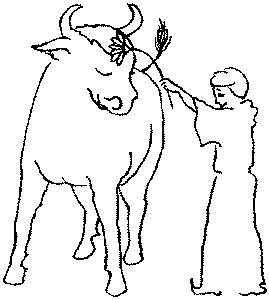



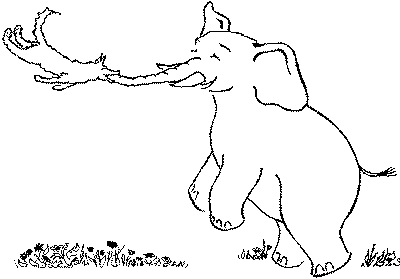

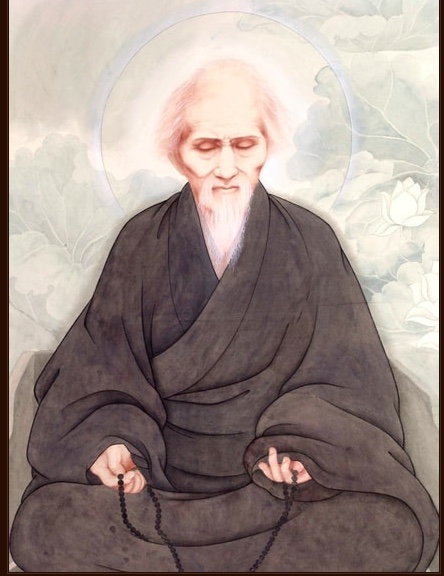
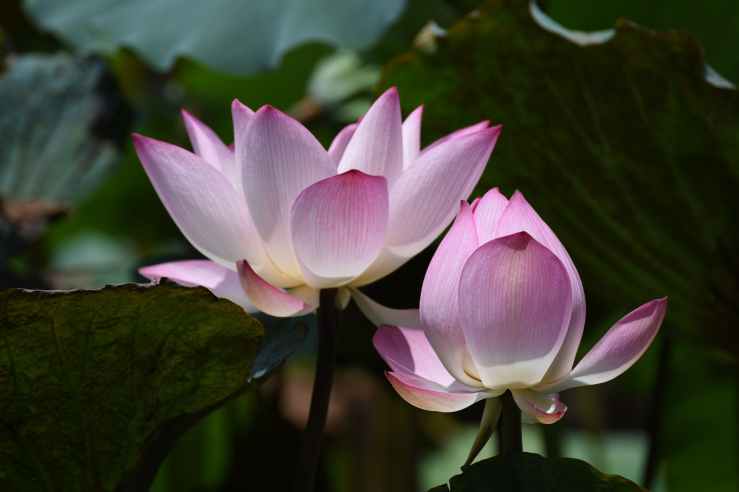


 Peace LiLy