In the heart of Ming Dynasty China, a man named Yuan Liaofan emerged, leaving an indelible mark on history. Born in the picturesque Wujiang County, Jiangsu Province, China, Yuan Liaofan’s original name was Yuan Huang. With the courtesy name Kunyi and the alternative name Xuehai, he later adopted the name Liaofan, symbolizing a profound shift in his life’s trajectory. During his life, he underwent a precise fortune-telling by an adept in divination, which turned out to be accurate. However, Yuan Liaofan later transformed his own destiny.
Yuan Liaofan’s transformative journey began when he sought guidance from a revered monk, a master in the art of divination. The monk, through precise fortune-telling, revealed a predetermined path for Yuan Liaofan. Undeterred by this revelation, the monk imparted invaluable wisdom on how to change his fate.
The monk emphasized the importance of performing virtuous deeds and accumulating positive karma. He outlined a path that involved actively engaging in a thousand good deeds, actions that would not only benefit others but also bring about profound changes in Yuan Liaofan’s own destiny.
Embracing the monk’s teachings, Yuan Liaofan dedicated himself to a life of kindness, compassion, and generosity. He embarked on a mission to perform a thousand good deeds, each act carefully documented in a personal ledger. His deeds ranged from helping the needy and supporting the less fortunate to acts of kindness that reverberated through his community.
As Yuan Liaofan diligently pursued this virtuous path, the effects on his life were nothing short of remarkable. Contrary to the fortune-teller’s prediction that he would not have a son, Yuan Liaofan became a father, experiencing the joys of parenthood. His household, once devoid of the laughter of children, now echoed with the sounds of familial bliss.
Additionally, the diviner had foretold that Yuan Liaofan’s life would be limited to fifty-three years. However, Yuan Liaofan defied this prediction, living a full and fulfilling life until the age of seventy-four. The positive energy generated by his virtuous deeds not only defied fate but also led to a prolonged and healthy existence.
The transformative effects were not confined to his personal life alone. Yuan Liaofan’s career path witnessed an upward trajectory. Through his dedication, hard work, and the positive energy he exuded, he achieved professional success, earning promotions and garnering respect within his professional sphere.
“The Four Lessons of Liaofan,” penned by Yuan Liaofan himself, stands as a testament to his transformative experiences. It serves as a guiding light for all who aspire to harness the potential within themselves to cultivate positive change.
As we navigate the complexities of our modern existence, let Yuan Liaofan’s story inspire us to embark on a journey of goodwill. Embrace the opportunity to contribute to the well-being of others, and in doing so, witness the transformative effects it can bring to your own life.
May Yuan Liaofan’s tale be a beacon of encouragement for us all, urging us to embrace the inherent ability within ourselves to shape our destinies. After all, the power to create a life of abundance and health lies not in the stars, but within the choices we make each day.
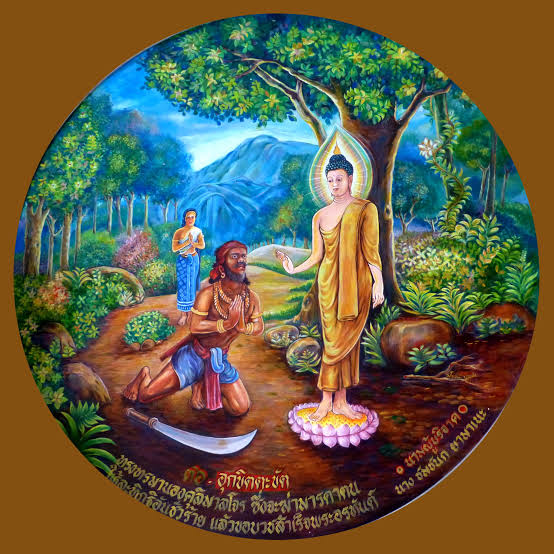
The Angulimala Sutta, a captivating narrative from Buddhist scriptures, recounts the remarkable transformation of a blood-thirsty murderer into a compassionate monk under the profound influence of the Buddha. Angulimala, notorious for his brutal killings and a garland of severed fingers, terrorized the realm of King Pasenadi. The tale unfolds during a time when the Buddha, with unwavering compassion, confronted the darkness that shrouded Angulimala’s soul.
Angulimala’s notoriety as a ruthless killer, leaving villages and towns in a state of fear, paints a grim picture of his violent nature. His garland of fingers serves as a gruesome testament to the lives he had taken, making him a symbol of terror and malevolence.
Undeterred by Angulimala’s fearsome reputation, the Buddha ventured into the region where the murderer roamed freely. Despite warnings from locals about the dangers posed by Angulimala, the Buddha calmly continued his journey, determined to confront the source of darkness.
As the Buddha walked towards Angulimala’s lair, the air thick with tension, he encountered the menacing killer. Rather than responding with fear, the Buddha skillfully engaged Angulimala in a dialogue that would alter the course of his life. The Buddha’s words, laden with wisdom and compassion, began to unravel the tightly woven fabric of Angulimala’s violent identity.
In a pivotal moment, as Angulimala sought to chase down the Buddha with murderous intent, the Buddha employed a feat of psychic power. Despite running at full speed, Angulimala found himself unable to catch up with the Buddha walking at a normal pace. This display of supernatural ability left Angulimala astonished and created a space for the transformative dialogue that followed.
Angulimala urgently called out, “Stop, contemplative! Stop!” The Buddha calmly replied, “I have stopped, Angulimala. You stop.”
Perplexed, Angulimala asked, “While walking, contemplative, you say, ‘I have stopped.’ But when I have stopped, you say I haven’t. I ask you the meaning of this: How have you stopped? How haven’t I?”
The Buddha responded, “I have stopped, Angulimala, once and for all, having cast off violence toward all living beings. You, though, are unrestrained toward beings. That’s how I’ve stopped and you haven’t.”
Baffled by the Buddha’s profound words, Angulimala sought clarity on the apparent contradiction. The Buddha’s response not only clarified the cessation of violence within his own heart but also illuminated the unrestrained nature of Angulimala’s actions. This insightful exchange marked the beginning of a transformative journey within Angulimala, planting the seeds of change in his consciousness.
With a heart now inclined towards virtue, Angulimala, in an impromptu moment, requested ordination from the Buddha. The Buddha, recognizing the sincerity of Angulimala’s transformation, granted his request, welcoming him into the community of monks adorned with saffron robes and shaven heads.
Even as Angulimala embraced the monastic life, local villagers, fearing his past atrocities, sought protection from King Pasenadi. The king, in response, assembled an army and approached the monastery. Despite the villagers’ pleas to “stamp him out,” the Buddha’s wisdom paved the way for an unexpected resolution.
When questioned by the Buddha about how he would treat Angulimala if he had truly renounced violence, King Pasenadi underwent a profound transformation. The Buddha’s teachings on discernment and compassion prompted the king to reconsider his stance. Witnessing Angulimala’s monkhood, the king shifted from disbelief to acceptance, vowing to support him on his path to redemption.
The Angulimala Sutta not only narrates the personal transformation of a notorious murderer but also highlights the transformative power of compassion and wisdom. The Buddha’s fearlessness, compassion, and skillful means shattered the shackles of violence that bound Angulimala. Moreover, the sutta portrays the ripple effect of transformation, as even King Pasenadi undergoes a change of heart. This timeless tale serves as an enduring testament to the potential for redemption, forgiveness, and the profound impact of the Buddha’s teachings on even the most deeply entrenched patterns of suffering.
Once upon a time in a remote village, nestled between the mountains, there lived a wise old monk named Master Sean. He was renowned for his ability to guide people in finding their inner voice, a skill that had been passed down through generations of monks in his lineage.
One day, a young man named Kaito arrived at the monastery seeking guidance from Master Sean. He had heard tales of the wise monk and hoped to learn the secret of listening to his inner voice. Master Sean welcomed Kaito with a warm smile and led him to a quiet room overlooking the monastery’s lush gardens.
Before we begin,” said the wise monk, “I want you to spend some time in silence, observing the garden and the creatures that inhabited it.” Kaito sat by the window watching the birds flip from branch to branch, the squirrel scamper across the grass, and the butterflies dance in the breeze. As he observed the harmony of nature, he felt a sense of peace wash over him.
After some time, Master Sean returned and asked Kaito what he had learned from his observations. Kaito replied, “I saw how each creature has its own rhythm and purpose and how they all coexist in harmony.” Master Sean nodded, pleased with Kaito’s insight.
“Now let me tell you a story,” he said, settling into a comfortable chair. “Once there was a young monk who lived in a monastery high in the mountains. He was diligent in his studies and meditation, but he struggled to hear his inner voice. One day, his master took him to a nearby cave where they found a small clear pool of water.”
The master instructed the young monk to gaze into the pool and describe what he saw. The young monk peered into the water and saw his own reflection, along with the reflections of the cave walls and the flickering light of their torches. The master then asked the young monk to close his eyes and listen to the sounds around him.
The young monk heard the gentle dripping of water, the distant echo of their voices, and the soft rustling of the wind outside the cave. Finally, the master told the young monk to open his eyes and look into the pool once more. This time, the young monk saw something different beneath the surface of the water. He could see a world of shimmering fish darting among the rocks and plants.
The master explained that the pool was a metaphor for the young monk’s mind. The surface reflections represented his thoughts and emotions, while the hidden world beneath symbolized his inner voice. To hear that voice, the young monk needed to learn to look beyond the surface distractions and listen deeply to the quiet whispers within.
Kaito listened intently to Master Sean’s story, feeling a spark of understanding ignite within him. He asked, “How can I learn to look beyond the surface and hear my inner voice?” Master Sean smiled and replied, “You must practice mindfulness and cultivate stillness in your mind. Just as the pool’s surface becomes calm and undisturbed, so too will your mind reveal its hidden depths when you learn to quiet your thoughts and emotions.”
Over the following weeks, Kaito practiced meditation and mindfulness under Master Sean’s guidance. He learned to observe his thoughts without judgment, allowing them to pass like clouds in the sky. Gradually, he began to hear the whispers of his inner voice, guiding him with wisdom and clarity.
As the story of Kaito and Master Sean comes to a close, let us reflect on the nature of happiness. Happiness, like the inner voice, is often found in the depths of our being, beyond the surface distractions of our thoughts and emotions. It is not a fleeting sensation or a temporary state, but rather a profound sense of contentment and inner peace that arises from living in harmony with our true selves.
To cultivate happiness, we must learn to listen to our inner voice, allowing it to guide us on our journey through life. By embracing mindfulness and stillness, we can quiet the noise of our minds and tune into the wisdom that resides within us. In doing so, we discover that happiness is not something to be pursued or acquired, but rather a natural state of being that emerges when we align ourselves with our deepest values and aspirations.
In the words of the ancient philosopher Lao Tzu, “Happiness is the absence of the striving for happiness.” May we all find the courage to let go of our endless pursuit of external validation and material success, and instead turn inward, seeking the happiness that lies within our own hearts and minds.
From a young age, many of us were taught by our parents about the importance of cultivating good habits. Whether it was going to bed early, exercising regularly, or refraining from negative behaviors, these habits were instilled in us with the belief that they would pave the way for success and a fulfilling life. Charles Duhigg, in his influential book “The Power of Habit,” sheds light on the mechanisms of habit formation and transformation. Drawing from scientific discoveries and captivating narratives, Duhigg offers fresh insights into human nature’s capacity for profound change. In addition, religious teachings, such as those found in Buddhism, also emphasize the significance of good habits in leading a virtuous and enlightened life.
“The Power of Habit” explores the scientific foundations behind habit formation. Duhigg introduces the concept of the habit loop, consisting of cues, routines, and rewards, which shape our behaviors and become deeply ingrained in our lives. By comprehending this loop, we gain a better understanding of how habits are formed and how they can be consciously modified or replaced.
Duhigg highlights the power of keystone habits, pivotal behaviors that have the potential to ignite positive transformations in various aspects of our lives. Through real-life examples, such as the habits of Olympic swimmer Michael Phelps, Starbucks CEO Howard Schultz, and civil-rights icon Martin Luther King Jr., the book demonstrates how cultivating keystone habits can lead to remarkable achievements. These habits act as catalysts, triggering a chain reaction of positive changes in other areas of our lives.
In Buddhism, there is a strong emphasis on discipline and the cultivation of good habits. Buddhist monks and nuns follow a set of precepts—more than 200 rules—that guide their daily lives. These precepts serve as a framework for moral conduct, urging practitioners to refrain from harmful behaviors and cultivate virtuous habits. By adhering to these precepts, disciples develop good habits in all aspects of life, fostering mindfulness, compassion, and ethical behavior.
In the pre-recorded Dharma discourse delivered by H.H. Dorje Chang Buddha III, His Holiness expounded on the profound concept that habits can become second nature, highlighting the transformative potential of consistent practice. Through consistent meditation, individuals develop a habit of introspection and mindfulness, leading to increased concentration and ultimately enlightenment. Similarly, the habit of performing good deeds accumulates positive merits, shaping one’s character and promoting spiritual growth.
“The Power of Habit” by Charles Duhigg reveals the malleability of habits and their potential for transformative change. By understanding the science behind habit formation and exploring keystone habits, individuals can consciously shape their behaviors and make positive changes in their lives. Additionally, Buddhism provides valuable insights into the significance of good habits in fostering moral conduct and spiritual development. By embracing these teachings, we can harness the power of habits to lead more fulfilling, successful, and enlightened lives.
Once, a man sought refuge in Gautam Buddha’s ashram after spending two days alone. Finally, he mustered the courage to approach Buddha and said, “Oh Buddha, I have questions lingering in my mind. I believe you hold the answers I seek.” Buddha replied, “Please, share your questions with me.” The man sighed deeply and expressed his dissatisfaction with life, saying, “I am constantly plagued by sadness and find no happiness whatsoever. I yearn to understand why this happens to me.”
Gautam Buddha, in his calm demeanor, responded, “First, tell me about the root cause of your sorrow. What are the exact factors contributing to your grief and anxiety?” The man pondered Buddha’s words for a moment and retorted, “Why do you ask me such a question? Aren’t you supposed to provide me with answers?”
With a serene smile, Buddha gently replied, “Your sorrow is yours to bear, and it is essential for you to identify the causes of your own suffering.” The man, astounded, exclaimed, “Oh Buddha, you possess prophetic abilities, capable of reading minds. You should already know everything.”
Buddha’s smile widened as he humbly replied, “It is a misconception on your part. You believe someone else can liberate you from your grief, but that is not the case. Only you have the power to resolve your own problems. I am just like you, the only difference being that I am free from confusion. The day your inner confusion dissipates, there will be no need for you to seek out a Buddha for answers. Have you ever observed flowers closely?”
Intrigued, the man responded, “Who has time to observe flowers?” Buddha continued, “A flower blooms like a bird at dawn, flourishes throughout the day, and withers by evening. If the flower had known it would wilt in the evening, it might have hesitated to blossom. Similarly, if you constantly dwell on sorrow, you will never experience true happiness. There are countless things in life that can bring you joy. You can smile and relish every moment. To find happiness, you must follow this path. I can show you the way, guide you on the path, but it is you who must walk it. Only then will you discover true happiness in life.”
Upon hearing this, the man fell silent for a while. After thoughtful contemplation, he said, “Buddha, one thing eludes my understanding. Is it possible to solve all the problems in my life simultaneously?” Buddha began to speak slowly, “Imagine someone approaches you and informs you that you will die in the next ten minutes. At that moment, no other problem would occupy your thoughts, for you would solely contemplate the absolute truth of life—death. You would realize the futility of dwelling on problems. We often fail to recognize life’s transience, becoming attached to our desires and perceiving our existence as eternal. Happiness and sorrow are not permanent; they arise from our actions and thoughts.”
The man listened attentively to Buddha’s words and inquired further, “So, should I constantly think about my mortality? Will that resolve my problems?” Buddha gently responded, “No, never think that way. Merely acknowledge the uncertainty of your existence and choose to live happily for as long as you are here. Ponder deeply; there are still many things that can bring you joy and contentment. Cultivate a focused mind, free from confusion. The sorrows and sufferings of life stem from desires. Control your mind. If you can make it as pure and innocent as that of a child, you will attain eternal happiness.”
The man eagerly asked Buddha, “Oh Buddha, how can I control my mind?” Buddha responded, “To gain control, we must understand the distinction between happiness and sorrow. One must recognize what brings happiness and what causes sorrow. The mind should neither be overly elated in extreme happiness nor deeply saddened in extreme sorrow. It is crucial to remain steady in the middle ground. If you closely analyze your sorrows and their underlying causes in real life, you will ultimately realize that the root of all sorrows lies within ourselves. And since the mind governs our actions, by controlling the mind, we can overcome sorrow.”
Buddha then suggested, “If you can accomplish one more task, you will witness the permanent vanishing of sorrow from your life.” The man, filled with enthusiasm, asked, “Tell me, Buddha, what must I do?” Buddha explained, “For the next two days, refrain from conversing with anyone. Find a solitary place in the ashram, take pen and paper, and contemplate your sorrows and their causes. On another piece of paper, write down the happiness that still exists in your life and its reasons. Take your time, think deeply.”
The man respectfully bowed to Buddha and retreated to a secluded corner of the ashram. After two days, he returned to Buddha with numerous sheets of paper. Buddha smiled and said, “Let me hear the summary of your sorrows first.” The man began reading, “Number one, all my siblings are wealthy, but I am burdened with debt and poverty. I fear taking action, always comparing myself to others. Number two, my neighbors have accumulated significant savings, unlike me. The reasons are that I have worked less, earned less, and squandered my money in bad company. I have not saved a single penny. Number three, my wife has been ill for a long time, and I am to blame for her suffering. Neglecting her, I have failed to seek medical help, leaving everything to chance. In truth, a wicked desire lingers in my mind: if my wife dies from her illness, I will remarry a faithful woman. Number four, I constantly daydream of illusory happiness, worrying and grieving when these dreams are unfulfilled due to a lack of money. Every day, I resort to alcohol to drown my sorrows, fully aware that I cannot afford it, yet I make excuses for my drinking. These are my four sorrows, and at the core of all of them lie my actions and thoughts.”
This time, Gautam Buddha smiled and said, “Now, tell me about your list of happiness.” The man’s face beamed with joy as he exclaimed, “I am truly happy, experiencing immense joy within me for the first time in my life during these past two days. The list of reasons for my happiness is so extensive that it would take hours to read. But let me share a few highlights.” Buddha smiled and responded, “Not just for you, but for all of us, the scenario is the same. We simply waste precious time fixating on the causes of sorrow. In reality, life is a treasure trove of happiness, peace, and joy. Well, you don’t need to read the entire list; just share a few.”
The man began with great delight, “First and foremost, I am grateful for being alive in this world, blessed with good health and strength. I have parents, a loving wife, and children, just like the fortunate ones in the world. My wealth extends far beyond material possessions; it encompasses the love and care from my parents, the affection of my beautiful wife, the tenderness of my children, and the joy of being a father. I am capable of working, physically fit and healthy. I have the opportunity to enhance my income through various endeavors, enabling me to fulfill the needs of my entire family. I am happy because I can create a harmonious family without comparing myself to neighbors or siblings. With the compassion instilled in me by your grace, I can leave behind my vices and embrace eternal peace.
The man continued: “The greatest joy and fortune lie in finding a place at the feet of Lord Gautam Buddha through your grace. As long as I am temporarily on this Earth, I will seek the truth of life, understand myself with a composed mind, and strive to bring eternal bliss to myself and others.”
Buddha remarked, “Now, go back to your family, for today you are reborn. Live a life of eternal peace with a steadfast mind. Whenever confusion arises, remind yourself that life is fleeting, and you are not meant to be enslaved by sorrow. Analyze and identify the causes of your sorrows, eliminating them immediately. Only then will you discover everlasting happiness and boundless joy.”
From Kindness A Treasury of Buddhist wisdom for Children and Parents By Sarah Conover
Long ago, during the time of the Buddha, lived a boy named Chundaka. Chunda-as he was fondly called–was a happy and good youngster, but unable to learn to read or write. In comparison, Chunda’s older brother became quite knowledgeable, with a keen interest in Buddhism. When the older brother decided to lead a monk’s life, Chunda followed along. He sought to live near his brother; but secretly, he also hoped to work alongside the monks and learn about Buddhism.
“Why don’t you ask the Buddha if you can become a monk, too?” his brother encouraged. But Chunda had no confidence. “Brother, how can I?” Chunda sadly replied. “I can’t memorize, and I can’t read or write. I have no knowledge of scriptures, and I won’t be able to learn them. A monk must be able to teach others many things.” But his brother assured him that both riches and knowledge were meaningless to the Buddha.” He values only the compassion we have for one another and the ways to help all creatures suffer less. No one is as gentle and kind as he is. I know he will not disappoint you, Chunda. Go and hear for yourself,” prodded his brother hopefully.
So Chunda mustered all his courage. He bathed and purified himself. When he was certain he was quite ready, he approached the Buddha. The Buddha observed that this humble young man had an earnest and pure heart. He could see that Chunda would try his very best. The Buddha welcomed him as the newest monk in the community. The next morning, Ananda, head of all the monks, gave Chunda a small scripture to memorize, just 6 lines long. It was the first of hundreds that each monk was expected to learn by heart. But a week later, having tried his hardest, poor Chunda could still not recite it from beginning to end. Completely disheartened, he went back to the Buddha and admitted his failure.
But the Buddha was not greatly disappointed; he had total faith in Chunda’s good intentions. The Buddha and Chunda sat thoughtfully together in silence. An idea suddenly occurred to the Buddha. “Chunda, are you a hard worker?” asked the Buddha.”Do you think you can sweep the temple and keep it spotlessly clean?” “Oh yes, Buddha I’m a good worker, and I’m very good at sweeping. I just cannot seem to learn scripture.”
So the Buddha gave Chunda the task of keeping the temple perfectly clean. He was to hold no other job but temple sweeper. The Buddha then requested that Chunda speak two lines while sweeping: remove all dust, remove all dirt. But as soon as poor Chunda attempted his task, the words completely vanished from his mind. Luckily, Ananda overheard the Buddha’s instructions and could help Chunda remember them over and over again.
At last, a month later, Chunda had it learned by heart.”Remove all dust,” the monks heard Chunda whisper with the sweep of the broom. “Remove all dirt, he murmured with the return sweep. Behind Chunda’s back, the other monks snickered at his memory problem. More than a few took some pride in the extent of their learning. Day and night Chunda poured his heart into his work, repeating those six words again and again. Eventually, however, over time every monk couldn’t help but admire Chunda’s perseverance. They had never witnessed such single-minded determination. In time, the few words that the Buddha had given him to memorize became more and more meaningful to Chunda. His chores became a meditation upon the words.
Chunda’s curiosity deepened, and he suspected that the Buddha knew all along that these words were not as simple as they first appeared. “Did my teacher want me to sweep outer dust and dirt or inner dust and dirt?” he wondered. “What is inner dirt? How would one go about cleaning inner dirt?” he asked himself many times. Some months later, Chunda found the answers to these questions himself. While he worked, insight nudged its way into his heart. Once in awhile now, the monks saw Chunda thoughtfully pausing from his endless task, leaning against his broom and looking at the far off horizon. At last a day came when Chunda felt ready to discuss his thoughts with the Buddha. “Venerable sir” said Chundaka enthusiastically, “I think I finally understand the real meaning of the words you gave me.” “Please tell me what you understand,” encouraged the Buddha. “I believe that inner dust and dirt is a grasping, said Chunda. “If we don’t like something in our lives, we grasp for a different situation. But if we really like something that we have, then we also grasp because we don’t want it to change.” Chunda continued, “To look at life clearly, we must always see through this. We must sweep the dust and dirt away and keep our inner temple clean.” The Buddha smiled warmly at Chunda’s thoughtful words.
And so, as the years passed, Chunda swept and meditated and thought deeply. He found he did not have to memorize scriptures as the other monks did, for teachings seemed to arise from within. After a time, he became known as one of the wise and gentle teachers of Buddhism, affectionately called “Chundaka, the Broom Master.” He lived a long and happy life. And for many years people journeyed to the monastery from distant places, not just to hear from the learned monks, but to listen especially to Chundaka, the Broom Master. He was their favorite, loved for his very simple, yet very wise sayings.
SUPERNORMAL DHARMA POWERS ARE skills that will inevitably appear during the course of a Buddhist’s cultivation and his striving for enlightenment. These powers are also a type of realization that the cultivator must naturally possess. This is especially true with respect to practitioners of Vajrayana Bud-dhism. When the Vajra Acarya Master manifests the Dharma at the Buddhist altar area, these skills will provide empowerment that is an indispensable part of the Buddhist altar area state. Those who are Rinpoches, Dharma Teachers, and Great Virtuous Ones desire and require such skills. Even ordinary cultivators who have just begun to follow Buddhism want to possess a few supernormal Dharma powers! Because of such ignorant thinking, these practitioners will not only cultivate themselves for their entire lives without attaining any supernormal powers, they will also never have the opportunity to even meet up with a teacher of great virtue who does possess supernormal Dharma powers! What is the reason for this result?
Can it be said that desiring supernormal Dharma powers is blameworthy and produces hindrances? Desiring supernormal powers can be a proper desire for the Dharma. The desire for supernormal powers can be divided into two types: blameworthy and non-blameworthy. It is blameworthy if one desires supernormal Dharma powers primarily for one’s own use. This would include desiring to appear impressive and awe-inspiring by showing off one’s Dharma powers. It would also include using one’s miraculous powers to subdue people, reap fame and Bain, cheat people out of money, hoodwink people into sexual misconduct, further one’s worldly selfish and evil intentions, and do all kinds of bad things.
These people do not know that the Dharma Protectors in space are inspecting and can see their evil minds. The Dharma Protectors will then immediately exercise their samadhi obstructive powers. These Dharma Protectors will seal up the chakras in the bodies of these ill-intentioned people. Their chakras will be confined to this earthly realm. As a result, for their entire lives, these people will only be able to manifest the state of an ordinary person. It will be impossible for them to obtain supernormal powers. This is because if these evil people were ever to obtain supernormal Dharma powers, they would immediately become sorcerers. That would be horrible. Wouldn’t the three spheres of the universe thereby fall into great chaos?
The Buddhas and Bodhisattvas in the various Dharma realms look back into beginningless time and look forward into the eternal future. They know all living beings in the three spheres of existence like the palms of their own hands. They specifically designate certain conditions under which they will bestow supernormal Dharma powers. Additionally, they dispatch Dharma Protectors, who keep watch on all practitioners, to manage the miraculous powers of living beings. Even if a Great Virtuous One is momentarily deceived by a person with such evil intent and consequently transmits the Buddha Dharma to him, as long as this person’s evil intentions still remain, it will be impossible for him to obtain supernormal Dharma powers no matter how diligently he may practice. This is because the Dharma Protectors inspecting from above do not dare to violate the precepts! They see that evil person’s preposterous ideas and immediately cease his miraculous Dharma powers. They block his chakras to prevent his chakras from developing. This is the responsibility of these Dharma Protectors.
There is a second type of person. Their desire to obtain supernormal Dharma powers is not blameworthy. The main reason why this type of person desires miraculous powers is to enlighten themselves and others. The practice of this type of person is based upon the four limitless states of mind. They constantly carry out the six paramitas. They have taken the great bodhicitta vows. They cultivate themselves in order to liberate all living beings. They want to obtain miraculous Dharma powers in order to liberate living beings from the suffering connected with samsara. They desire to obtain supernormal powers in order to benefit all living beings. They themselves clearly believe in the law of cause and effect. They even often fear that obtaining supernormal powers will bring about karmic hindrances and will cause them to go against the law of cause and effect. Thus, they are frightened of miraculous powers and maintain a heart of humility. They are Great Bodhisattvas, yet they always consider themselves to be ordinary living beings.
The practice of this type of person is entirely in accordance with Buddhism. Since their practice is in accordance with what I am now lecturing on – Dharma That Every Buddhist Must Follow – the Dharma Protectors inspecting from above will provide them with the most wonderful assistance. These deities will untie the knots in the energy channels of these practitioners and will cause the supernormal Dharma powers of the Buddhas and Bodhisattvas to suddenly turn into light and enter their chakras. At that time, the mandala in each practitioner’s body will respond well and will accept these powers. As a result, miraculous powers will naturally appear and Dharma powers will open up! Now then, how does one obtain supernormal Dharma powers after all? Those who are smart might already know the answer. However, perhaps those ignorant people who fantasize about learning miraculous Dharma powers do not yet understand. Hence, I, Pamu, will now clearly tell all of you! How should we obtain supernormal Dharma powers?
There are methods to obtain miraculous Dharma powers. There are mantras, mudras, and visualization techniques. When one’s three karmas unite into one body and correspond with the teachings, supernormal Dharma powers will come into being. One can then exhibit power and light. The uniting of one’s three karmas into one body and their correspondence with the teachings will be manifested in the state of realization and state of virtue one has attained through practice of the Buddha Dharma. When one’s state of realization and state of virtue have reached the level where it is appropriate to obtain supernormal Dharma powers, then as soon as one practices according to the Dharma, supernormal Dharma powers will appear. If one’s state of realization and state of virtue have not yet reached the level where it is appropriate to obtain supernormal Dharma powers, then even if one recites mantras until one’s lips crack, and even if one practices mudras until one’s Wrists fall off, one will still not obtain the slightest Dharma power. The ordinary practitioner of exoteric Buddhism knows that without moral discipline, one cannot develop concentration. Without concentration, One cannot attain wisdom. One also cannot attain supernormal powers. Without concentration, one cannot master the Dharma.
I am telling this to all of you here today in the hope that you will pass these instructions on to all of those people who fantasize about having limitless Dharma powers and great supernormal powers. If one does not learn the Tripitaka well and does not live according to Buddhism, or if one does not deeply study and truly practice the teachings contained in the books I have written, such as The Prajna of Ultimate Reality, Entering the Door of the Dharma, Dharma That Every Buddhist Must Follow, Brief Commentary on the Precepts and Discipline Treatise, etc., then one will not be able to obtain supernormal Dharma powers! This is because the great door leading to supernormal Dharma powers is opened by living according to the teachings of Buddhism and by possessing a high state of realization and a high state of virtue. There are no other means by which one can obtain supernormal Dharma powers!
Supernormal Dharma powers are arranged by the Buddhas and are managed by the Dharma Protectors who patrol and inspect in the sky. Since the beginning of Buddhist history, not one Dharma Protector has bestowed supernormal Dharma powers upon any cultivator who does not live in accordance with the teachings of Buddhism and who does not have a high state of realization and a high state of virtue. Since the beginning of Buddhist history, not one Dharma Protector has opened up the energy channel knots of any cultivator who does not live in accordance with the teachings of Buddhism and who does not have a high state of realization and a high state of virtue.
The meaning of Buddhism is to liberate us from the limited perspective given by natural selection, and to observe and experience the world from a higher level.
Buddhism is a complex topic that has been the subject of debate among scholars and practitioners for centuries. Some see it as a religion, complete with supernatural deities and reincarnation, while others view it as a secular philosophy of life or a therapeutic practice. In his book “Why Buddhism Is True,” Robert Wright offers a nuanced perspective on Buddhism that combines elements of these different approaches.
At the heart of Buddhism is the idea that the reason we suffer, and cause suffering for others, is that we don’t see the world clearly. We are deluded by our own emotions and desires, which evolved as survival responses to our environments but may no longer make sense in modern society. By practicing mindful meditation, we can learn to see the world more clearly and gain a deep and morally valid happiness.
Wright draws on science, especially evolutionary psychology, cognitive science, and neuroscience, to support this perspective on Buddhism. He argues that the direct experiences gained through contemplative practice can weaken the hold of our once-needed delusions, making us less likely to wreak havoc on ourselves and the world around us.
One of the key strengths of Wright’s approach is its nonsectarian nature. He does not argue that people need to become Buddhists to practice its truths, and he acknowledges the value of other spiritual and philosophical traditions. Instead, he focuses on the practical benefits of mindful meditation and contemplative practice, which can be applied to any belief system or way of life.
Importantly, Wright emphasizes that simply reading about Buddhist insights into human beings is not enough. To truly benefit from the practice, one must commit to a regular practice and be willing to confront the delusions within themselves. This is why it is called practice – it takes time, effort, and dedication to see results.
Overall, Wright’s blend of Western Buddhism offers a compelling perspective on Buddhism that is rooted in science, applicable to everyday life, and inclusive of other belief systems. While it may not be the definitive answer to the question of what Buddhism really is, it is certainly a valuable contribution to the ongoing conversation about this ancient and fascinating tradition.
The primary purpose in practicing Buddhism is to gain control over your life and death. That is true liberation and true happiness! Disciples of His Holiness Dorje Chang Buddha III have exhibited extraordinary feats at the time of their death. There have also been supernormal phenomena manifest at the time of or after their death. Disciples have even returned from the “Pure Land” to report on their new home to their families and to urge them to follow the teachings of His Holiness.
His Holiness has disciples who are eminent monastics and enlightened laypersons who if they want to live, they live. If they want to die, they die. Many have passed on while sitting in the cross-legged meditation position after they announced that they were leaving. They reached a level where they were liberated from the cycle of reincarnation. Many have left behind shariras or firm relics as evidence of their achievement. They have also left behind their body of flesh that does not rot.
Even non-Buddhist relatives of the Buddha Master’s disciples were able to make the transition to the Pure Land after they received the Buddha Master’s instructions and blessings. In all of these examples, the time of transition was an extremely joyous event. Friends and family were able to know that their loved one was making a peaceful transition to a wonderful existence..
TYPES OF LIBERATION FROM THE CYCLE OF BIRTH & DEATH: Regarding liberation from the cycle of birth and death, His Holiness has told us that there are several ways to obtain it. Roughly speaking, it is divided very crudely into four types. There is a dharma that will lead one to have the lifespan as long as heaven which was called the “immortal body”. This is what Guru Padmasambhava achieved. This is the highest dharma which can not be learned by ordinary people. Then, there is the dharma of the rainbow body transformation, which one achieves by transforming one’s entire fleshy body into a rainbow body. Another type is passing away in a sitting position and freeing oneself from the cycle of birth and death. The other type is passing away and being reborn in the Western Paradise of Ultimate Bliss. These are the four types of achievement. Other than that, without achieving liberation or enlightenment, it is descending to reincarnation and death.
The rainbow immortal body is also referred to as the body of supreme transformation or the rainbow body attainment of All-Surpassing Realization. In this higher form the rainbow body transmutes all psychophysical components into the light of buddhahood, so that no outward change is visible. This is why Padmasambhava, Vimalamitra, Vairocana and the like can pass into other buddha-lands in the same forms they enjoyed in our world. The lower rainbow body attainment transmutes consciousness, feeling, perception, and habitual tendencies into the light of buddhahood, but the component of form shrinks in size until only fingernails, tooth-enamel, hair, or relics remain, some time as a “vajra sharira” or “human body sharira.”
From Kindness <A Treasury of Buddhist Wisdom For Children and Parents>
By Sarah Conover
Unlike the Buddha, Kisa Gotami grew up very poor. Her family had little food to spare. She often felt weary, hungry, and weak and so was called Kisa-meaning”frail”-Gotami. When Kisa Gotami married, she moved into the house of her husband’s family: the custom in India at the time. But because she came from a humble background, her new family treated her harshly until the day she gave birth to a child. She was respected now, with her new baby boy. Kisa felt proud and happy. Her new son was the light of her life. She cherished everything about him-his delightful laughter, his eager brown eyes, his toothless smiles. But one terrible, tragic day, the boy was taken by a sudden illness. His death overwhelmed poor Kisa. She bundled him in warm blankets and held him tightly to her chest. Crazed with grief, she stumbled from house to house, begging for medicine that would bring him back to life. But instead of helping, people mocked her madness. “Crazy woman!” they jeered. “How can a person be brought back to life!” Hours later, Kisa Gotami stood in the street, wretched and disheartened.As she wept over her child,a kind man passing by studied her.To himself he said, ”This poor woman has lost her mind from sorrow. I think I know how to get her the medicine she seeks.” He placed his hands firmly on her shoulders.”Dear woman, please let me help you.The wisest of men, a man named the Buddha, resides at a monastery nearby. I will take you to him and you can ask his advice. If anyone has medicine for your child, it is he.”
He led her to the monastery where she found the Buddha teaching, at the front of a large group of monks and nuns. From the edge of the crowd she shouted,”Teacher, teacher! My name is Kisa Gotami. I am desperate! Please, my son needs your medicine!”
The crowd made way for Kisa to reach the Buddha. As she stood before him, he observed the child’s lifeless face.”You did well in coming here for medicine, Gotamit the Buddha comforted her.”Here you will find the help you need. But first, before l can save your child, you must do something for me.You·must return to the city from which you just came. There, find me a single mustard seed and bring it back.”
Kisa Gotami’s face lit up, for she thought this a simple task in exchange for her son’s life.”Most important of all,”said the Buddha,”the mustard seed must be from a family in which no one has died. Go now, make the rounds of the city and·ask at every home. Bring me back just one mustard seed from such a family.”
“Thank you good sir!”said Kisa happily. She turned and hurried back to the city.At the very first house she stopped and knocked at the door.An old woman answered. She easily gave Kisa Gotami a mustard seed-all India used them in cooking. But just as the seed was placed -in Kisa’s palm, she remembered the Buddha’s further instructions. ”Oh, pardon me. Before I take this, I must ask you, has anyone died in this family recently?” The old woman’s head lowered. She fell silent. When she raised her face, there were pooled tears in her eyes.I’m sorry to say the answer is yes,” replied the old woman. “ My dear husband died six months ago.”
“I am so sorry; said Kisa Gotami.”Thank you for your kindness, but I cannot take this seed.”
A few minutes later she knocked at the door of a house with children running in and out of the entrance,chasing each other in play.A young woman saw Kisa standing in the doorway, and came to greet her. Some of the children stood behind the young woman’s skirt to hear what the stranger wanted. “Can I help you?” she asked Kisa Gotami.
“I have been sent here to find special medicine for my son. I am looking for a single mustard seed from a household in which no one has died;’ said Kisa.
“We cannot help you. l am sorry. We lost our mother two years ago;’ stated the young woman quietly. “For many months I was so unhappy I didn’t know how to go on” One of the boys reached up to hold her hand. She clasped his little fingers and continued,”But I knew I had to help my father take care of my brothers and sisters. That’s what my mother would have wanted. I’m sorry we have no such special mustard seed for you:’
And so Kisa Gotami continued to the next house, and then to another, asking for the single mustard seed. But always, someone had lost a beloved-a brother or a sister, a grandparent, an aunt or cousin, a mother or father. The list grew longer and longer. After a time, nightfall came. People snuffed out their oil lamps for the evening. Kisa Gotami sat down, resting against a tree. She gazed down at her son in her arms.
Studying him closely, she felt a gradual change in herself. Not a single household she had visited today lived untouched by death’s sad hand. Many suffered just as she did now. She was not alone. And somehow, with these thoughts, her grief lightened just a bit, and she returned home. The next day, at first light, Kisa Gotami readied her son for his funeral. Tears streamed down her cheeks as she wrapped him in clean cloth and said farewell. After the funeral, Kisa Gotami went back to the monastery to speak with the Buddha.The Buddha dearly saw in her face that she had come back to her senses. He asked,”Gotami, did you bring me a tiny grain of mustard?”
“ No, teacher. I am done looking for the mustard seed. I know that in the whole city, in the whole world, there is not one family, not one person, free from the certainty of death. It is the way of all living things-we must at some time leave one another.”
”And where is your child, dear woman?”
”At last I have said good-bye to him. I felt terribly alone in my grief, but now I know there are many others who have lost what they most cherished. We must help each other, as you have helped me.”
Kisa Gotami, brought back to her right mind from her search for the mustard seed, became a very wise and compassionate woman. It is said that she never left the Buddha after her return to the monastery. And that from her experience, she was able to comfort many, many others in her lifetime.
The moral is : All fear death, all hold life dear. Feel for others as you do for yourself. Remember this and cause no harm.




















 Peace LiLy