When you grow up in a house where voices are always raised and love comes with conditions, where apologies never come and mistakes are blamed on you, it’s hard to understand what gentleness even means. I didn’t grow up with soft words or warm hugs. No one told me it was okay to make mistakes, or that I was still loved even when I failed. What I learned was to keep quiet, to survive, to toughen up.
I protected myself by building walls, not by opening up. I kept my emotions inside because showing them only led to being hurt or ignored. I became harsh with myself because that’s how others treated me. I thought strength meant being cold. I thought love had to hurt. I thought being kind to myself was weakness.
But somewhere inside, a quiet voice kept whispering “maybe there’s another way.”
It took years of breaking down and rebuilding myself. It took crying in silence and slowly learning how to listen to what my heart really needed. It meant letting go of old beliefs, painful habits, and the voices in my head telling me I wasn’t good enough.
I had to teach myself how to speak gently not just to others, but to myself.
I had to unlearn the idea that I deserved pain. I had to remind myself, again and again, that softness isn’t weakness. That it’s okay to be tender with a heart that’s been hurt too many times.
Gentleness became a daily choice—on angry days, broken days, on the days when the world told me to toughen up and stop caring.
I’ve learned that gentleness isn’t about pretending things don’t hurt. It’s about holding pain with care. It’s about choosing peace when your past only taught you chaos. It’s showing up with kindness, even when life hasn’t been kind to you.
Now I am gentle but it took everything — every scar, every sleepless night, every painful memory, every lonely moment. I lost myself. Then I found myself again.
So when others call me calm, kind, or soft, they don’t see the storms I survived. They don’t hear the silent nights or feel the weight I carried.
And that’s okay. I didn’t become gentle for others to understand me. I did it so I could breathe. So I could find peace. So I could love others the way I wish someone had loved me. Most of all, so I could finally love myself.
During the time of Shakyamuni Buddha, King Prasenajit and his queen were devoted disciples of the Buddha. They had a beloved daughter named Shanguang, who was compassionate, kind-hearted, graceful, intelligent, gentle, and exceptionally wise. Despite her royal status, Shanguang remained humble and approachable, never flaunting her nobility, which earned her the love and admiration of the entire kingdom. The king and queen cherished their beautiful daughter, treating her like a precious gem.
One day, while walking in the royal garden with her father, King Prasenajit said, “Shanguang, the blessings you enjoy today are because of me, your father, the king.”
Shanguang gently replied, “That is not true, Father. My blessings come from my own virtuous deeds and karmic causes, not because of your royal status.”
This exchange occurred three times, with Shanguang steadfast in her belief. Her conviction angered the king, who felt she was ungrateful. Determined to test her, he thought, “I will see if she can enjoy the blessings of a princess on her own!”
The king ordered his servants to find a beggar from the streets and betrothed Shanguang to him. Without complaint, Shanguang removed her fine silk robes and precious jewelry, dressed in coarse clothing, and left with the beggar.
The beggar, who had long lost both parents and wandered alone, was astonished that a princess would marry him. When they returned to his old home, the house was dilapidated, with collapsed walls and overgrown weeds, except for one small patch where no grass grew.
Shanguang instructed her husband to dig at the bare spot. To their amazement, they unearthed a vast treasure of gold and silver. Astonishingly, wherever Shanguang bought land, gold was discovered beneath it. Using these treasures, she built a palace as grand and magnificent as the royal palace itself.
After some time, the king’s anger subsided, and he began to miss his daughter. Curious to see how she was living, he visited her new home. To his astonishment, he saw a palace even more splendid than his own, with countless servants attending to her needs. He was left speechless.
Shanguang explained to her father, “The blessings I enjoy in this life are the result of my past virtuous deeds.”
Perplexed, the king sought answers from the Buddha, asking, “What virtuous deeds did Shanguang perform in her past that she was born into royalty, married a poor beggar, yet still enjoys such wealth and prosperity?”
The Buddha revealed, “Ninety-one eons ago, during the time of Vipashyin Buddha, a king built a stupa to enshrine the Buddha’s relics after His nirvana. The king’s queen made an offering of a magnificent pearl crown, placing it atop the stupa. The radiant jewels on the crown illuminated all directions. That queen was Shanguang in a past life.
Later, during the time of Kashyapa Buddha, Shanguang again performed virtuous deeds by preparing heavenly offerings and the finest food for the Buddha. However, her husband at the time tried to discourage her. Shanguang replied, ‘Please do not stop me. Allow me the opportunity to make offerings to Kashyapa Buddha so I may experience peace and happiness in both body and mind.’ Her sincerity moved her husband, and they made the offerings together.
The beggar she married in this life was that same husband from her past. Because he once tried to prevent Shanguang’s offerings, he faces poverty in this life. However, since he later supported her, he now shares in her accumulated blessings, enjoying prosperity through her merits.
This story illustrates the infallible law of cause and effect. Good and bad karmic actions bring precise results. The blessings one rightfully earns cannot be taken away by others, and blessings not belonging to you cannot be forced into your life. Even the most elaborate schemes can fail, as a single disaster can reduce one to poverty again. Therefore, cultivating virtue and performing good deeds is truly the most rewarding ‘investment’ one can make.
I recently came across a thought-provoking video that offered a profound insight into the root cause of social disorder. A newspaper invited submissions on the topic: “What is the root cause of social disorder?” One answer stood out for its simplicity yet profound depth: “It’s me.”
This response highlights a universal truth: the state of the world mirrors the state of each individual. If “I” embody qualities like sincerity, kindness, and a willingness to help, I can foster harmony in my family and community. Conversely, if “I” succumb to selfishness, greed, and deceit, disorder and instability are inevitable.
The peace and stability of society, our nation, and even the world rest on each of us. By reducing criticism of others and turning our attention inward—reflecting on our thoughts, words, and actions—we can become catalysts for harmony.
True greatness is not about outperforming others but about improving ourselves. By focusing on personal growth, we enrich our lives and contribute to a better world.
Mother Teresa’s Timeless Wisdom
Mother Teresa’s poem “Do It Anyway” offers profound guidance for navigating life’s challenges with integrity, kindness, and resilience. It reminds us to act according to our values, regardless of external circumstances:
People are unreasonable,illogical and self-centered
Love them anyway.
If you are kind,people may accuse you of selfish,ulterior motives;
Be kind anyway.
If you are successful,you will win some false friends and some true enemies;
Succeed anyway.
The good you do today will be forgotten tomorrow;
Do good anyway.
If you are honest and frank,people may cheat you;
Be honest and frank anyway.
People favor under dogs but follow only topdogs.
Fight for a few underdogs anyway.
What you spend years building may be destroyed overnight;
Build anyway.
If you find serenity and happiness,they may be jealous;
Be happy anyway.
People really need help but may attack you if you do help them.
Help people anyway.
Give the world the best you have,And it may never be enough;
Give the world the best you have anyway.
Her words teach us that life’s meaning lies in staying true to our values, not in others’ perceptions or responses. Ultimately, our actions reflect a dialogue with our conscience, not a transaction with others.
Personal growth begins with the courage to look inward. When frustration or dissatisfaction arises, take a moment for self-reflection. Ask yourself, “How can I improve?” This practice shifts focus from external blame to internal progress. Growth unfolds through small, manageable goals—whether it’s mastering a new skill, refining emotional resilience, or nurturing patience.
Kindness is another cornerstone of personal development. Choose compassion, even when faced with misunderstanding or adversity, because every person carries unseen struggles. Alongside kindness, maintain integrity and uphold what’s right, regardless of external validation. As Mother Teresa wisely said, “Give the world the best you have, and it may never be enough; give your best anyway.”
By weaving self-reflection, purposeful improvement, and compassionate action into daily life, we not only enhance ourselves but also contribute to a more harmonious world.
World peace begins with individual actions. Change doesn’t require grand gestures; it starts with small, deliberate acts of kindness—a warm smile, a kind word, or a helping hand.
When we each commit to self-growth, compassion, and mindfulness, we create ripples of positive change in our communities and beyond. Together, these ripples can form a wave of harmony that transforms the world.
Let us strive to become better versions of ourselves, nurturing peace and love in our hearts. By doing so, we can build a brighter, more peaceful future—one person at a time.
One day, a little girl, full of innocence and joy, picked some roses. As she wandered down the road, she saw a poor beggar lying by the roadside. She paused, glanced at the flowers in her hand, and gently placed the most beautiful rose beside the sleeping man. She smiled to herself, thinking, “When he wakes up, he’ll be so happy.” With that, she skipped away, her heart light and joyful.
The sweet fragrance of the rose stirred the beggar from his slumber. Groggily, he opened his eyes and saw the delicate flower in his hand. “Did someone really give this to me? Could something so wonderful happen to someone like me? It’s like the sun rising in the west,” he thought, bewildered. “The person who gave me this flower must be a truly kind and beautiful soul.”
Overcome with emotion, the beggar decided to return to his shabby home. He rummaged through a dusty corner and found an old, dirty bottle. Filling it with water, he placed the rose inside. For a moment, he admired the flower, but then something nagged at him. “Wait,” he thought, “This beautiful rose can’t be in such a filthy bottle.”
He carefully removed the flower, washed the bottle thoroughly, and then placed the rose back inside. But as he looked again, he noticed the dusty table beneath it. “How could such a clean flower sit on such a dirty table?” He set to work, cleaning the table until it gleamed.
As he stepped back to admire the scene, he suddenly realized: “How can this beautiful rose, in a clean bottle, on a spotless table, exist in such a cluttered, dirty room?” He made a bold decision then and there – he would clean the entire house! With renewed energy, he swept away the dust, arranged his belongings neatly, and cleared out all the trash.
With every corner he cleaned, the house became warmer, cozier. A sense of peace filled the room. It was then that he caught his reflection in the mirror – his disheveled hair, his dirty face, his ragged clothes.
“Is that really me?” he asked himself.
Without hesitation, he took a bath, put on his best (though still worn) clothes, shaved, and tidied himself up from head to toe. When he looked in the mirror again, he smiled. “Hmm, I don’t look so bad!”
“Why should I remain a beggar? Tomorrow, I will find work,” he resolved.
Unbothered by hard or dirty work, and unpicky about the job, he soon found employment.
“Someone gave me a flower, and it turns out I’m not worthless after all,” became his daily mantra. It motivated him to work diligently, and as the years passed, he found success. But more than that, he discovered a new purpose.
“A single flower changed my life,” he thought. “I must help others in the same way.” And so, whenever he encountered someone in need, he offered a helping hand. Over time, the number of people he helped grew, and within a few years, he became a respected philanthropist, known far and wide for his kindness.
The story doesn’t end here. Those he helped went on to spread kindness to others, creating a ripple effect that touched countless lives.
In truth, we all need a beautiful flower – a small act of kindness – to remind us of our worth. And that flower? It’s something we all possess and can give freely.
Isn’t it true?
In public, we can hold the door for someone behind us.
When we see someone feeling down, we can offer them a smile.
We can give a genuine compliment to brighten someone’s day.
On a rainy day, we can drive a little slower to avoid splashing water on pedestrians.
We can pick up a stray nail on the ground to prevent someone from getting hurt.
We can speak with kindness and warmth to everyone we meet.
These are simple actions, right? They require little effort, yet they have the power to transform lives. Just like that unnoticed rose changed the beggar’s life, our small acts of kindness can change the world, one person at a time.
In our daily lives, we often believe that once something is done, it’s over. Once words are spoken, they disappear. But in reality, it’s far from over. A kind word, a smile, a simple gesture – these can brighten someone’s day, create ripples of happiness, and leave a lasting impact.
Giving someone a rose, literal or figurative, not only leaves a lingering fragrance in their heart, but it also brings joy back into our own lives. Today, when we plant a seed of kindness, it may grow into a tree in ten years. In a hundred years, it could become a small forest. And in a thousand years, that forest may provide blessings to generations yet to come.
Nothing we do, say, or think ends at the moment. Whether good or bad, everything continues to spread, shaping the world around us.
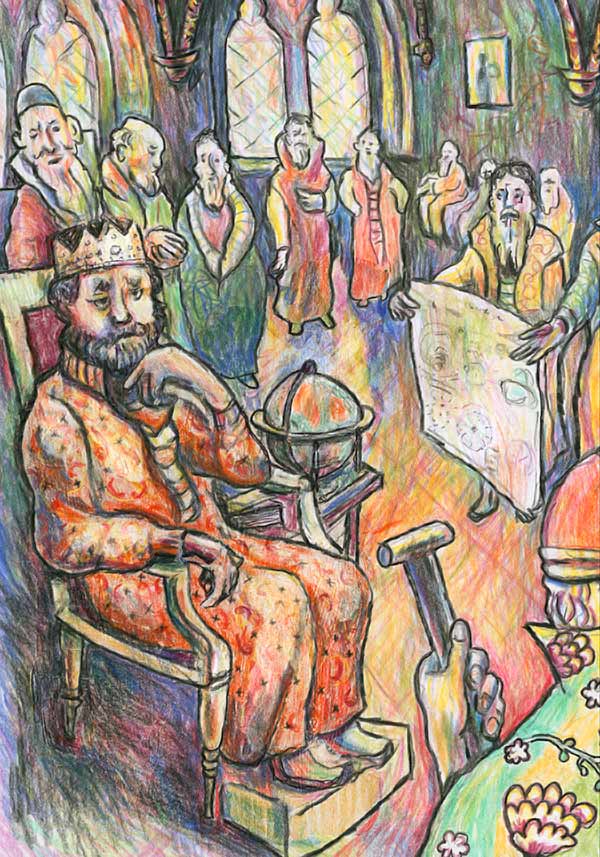
It once occurred to a certain king that if he always knew the right time to begin everything; if he knew who were the right people to listen to, and whom to avoid; and, above all, if he always knew what was the most important thing to do, he would never fail in anything he might undertake.
And this thought having occurred to him, he had it proclaimed throughout his kingdom that he would give a great reward to anyone who would teach him what was the right time for every action, and who were the most necessary people, and how he might know what was the most important thing to do.
And learned men came to the king, but they all answered his questions differently.
In reply to the first question, some said that to know the right time for every action, one must draw up in advance a table of days, months, and years, and must live strictly according to it. Only thus, said they, could everything be done at its proper time. Others declared that it was impossible to decide beforehand the right time for every action, but that, not letting oneself be absorbed in idle pastimes, one should always attend to all that was going on, and then do what was most needful. Others, again, said that however attentive the king might be to what was going on, it was impossible for one man to decide correctly the right time for every action, but that he should have a council of wise men who would help him to fix the proper time for everything.
But then again others said there were some things which could not wait to be laid before a council, but about which one had at once to decide whether to undertake them or not. But in order to decide that, one must know beforehand what was going to happen. It is only magicians who know that; and, therefore, in order to know the right time for every action, one must consult magicians.
Equally various were the answers to the second question. Some said the people the king most needed were his councilors; others, the priests; others, the doctors; while some said the warriors were the most necessary.
To the third question, as to what was the most important occupation, some replied that the most important thing in the world was science. Others said it was skill in warfare; and others, again, that it was religious worship.
All the answers being different, the king agreed with none of them, and gave the reward to none. But still wishing to find the right answers to his questions, he decided to consult a hermit, widely renowned for his wisdom.
The hermit lived in a wood which he never quitted, and he received none but common folk. So the king put on simple clothes and, before reaching the hermit’s cell, dismounted from his horse. Leaving his bodyguard behind, he went on alone.
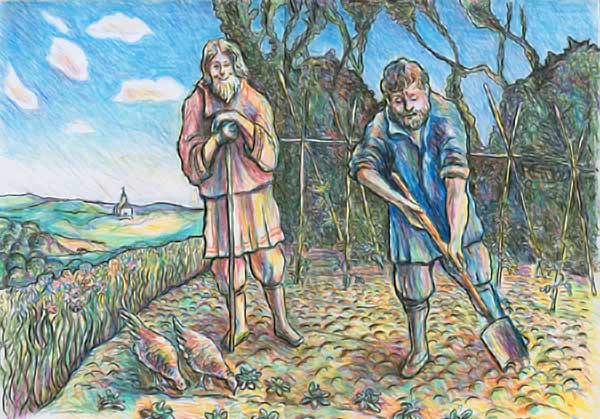
When the king approached, the hermit was digging the ground in front of his hut. Seeing the king, he greeted him and went on digging. The hermit was frail and weak, and each time he stuck his spade into the ground and turned a little earth, he breathed heavily.
The king went up to him and said: “I have come to you, wise hermit, to ask you to answer three questions: How can I learn to do the right thing at the right time? Who are the people I most need, and to whom should I, therefore, pay more attention than to the rest? And, what affairs are the most important and need my first attention?”
The hermit listened to the king, but answered nothing. He just spat on his hand and recommenced digging.
“You are tired,” said the king, “let me take the spade and work awhile for you.”
“Thanks!” said the hermit, and, giving the spade to the king, he sat down on the ground.
When he had dug two beds, the king stopped and repeated his questions. The hermit again gave no answer, but rose, stretched out his hand for the spade, and said:
“Now rest awhile – and let me work a bit.”
But the king did not give him the spade, and continued to dig. One hour passed, and another. The sun began to sink behind the trees, and the king at last stuck the spade into the ground, and said:
“I came to you, wise man, for an answer to my questions. If you can give me none, tell me so, and I will return home.”
“Here comes someone running,” said the hermit. “Let us see who it is.”
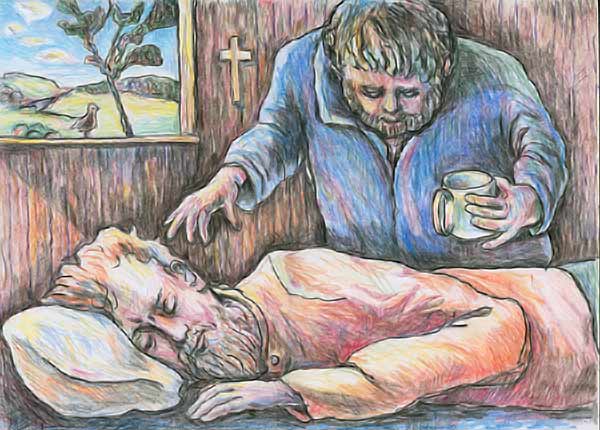
The king turned round and saw a bearded man come running out of the wood. The man held his hands pressed against his stomach, and blood was flowing from under them. When he reached the king, he fell fainting on the ground, moaning feebly. The king and the hermit unfastened the man’s clothing. There was a large wound in his stomach. The king washed it as best he could, and bandaged it with his handkerchief and with a towel the hermit had. But the blood would not stop flowing, and the king again and again removed the bandage soaked with warm blood, and washed and re-bandaged the wound. When at last the blood ceased flowing, the man revived and asked for something to drink. The king brought fresh water and gave it to him. Meanwhile the sun had set, and it had become cool. So the king, with the hermit’s help, carried the wounded man into the hut and laid him on the bed. Lying on the bed, the man closed his eyes and was quiet; but the king was so tired from his walk and from the work he had done that he crouched down on the threshold, and also fell asleep – so soundly that he slept all through the short summer night.
When he awoke in the morning, it was long before he could remember where he was, or who was the strange bearded man lying on the bed and gazing intently at him with shining eyes.
“Forgive me!” said the bearded man in a weak voice, when he saw that the king was awake and was looking at him.
“I do not know you, and have nothing to forgive you for,” said the king.
“You do not know me, but I know you. I am that enemy of yours who swore to revenge himself on you, because you executed his brother and seized his property. I knew you had gone alone to see the hermit, and I resolved to kill you on your way back. But the day passed and you did not return. So I came out from my ambush to find you, and came upon your bodyguard, and they recognized me, and wounded me. I escaped from them, but should have bled to death had you not dressed my wound. I wished to kill you, and you have saved my life. Now, if I live, and if you wish it, I will serve you as your most faithful slave, and will bid my sons do the same. Forgive me!”
The king was very glad to have made peace with his enemy so easily, and to have gained him for a friend, and he not only forgave him, but said he would send his servants and his own physician to attend him, and promised to restore his property.
Having taken leave of the wounded man, the king went out into the porch and looked around for the hermit. Before going away he wished once more to beg an answer to the questions he had put. The hermit was outside, on his knees, sowing seeds in the beds that had been dug the day before.
The king approached him and said, “For the last time, I pray you to answer my questions, wise man.”
“You have already been answered!” said the hermit, still crouching on his thin legs, and looking up at the king, who stood before him.
“How answered? What do you mean?” asked the king.
“Do you not see?” replied the hermit. “If you had not pitied my weakness yesterday, and had not dug these beds for me, but had gone your way, that man would have attacked you, and you would have repented of not having stayed with me. So the most important time was when you were digging the beds; and I was the most important man; and to do me good was your most important business. Afterwards, when that man ran to us, the most important time was when you were attending to him, for if you had not bound up his wounds he would have died without having made peace with you. So he was the most important man, and what you did for him was your most important business. Remember then: there is only one time that is important – now! It is the most important time because it is the only time when we have any power. The most necessary person is the one with whom you are, for no man knows whether he will ever have dealings with anyone else: and the most important affair is to do that person good, because for that purpose alone was man sent into this life.”
This story reminded me of something that Henry Shukman, an English Spiritual Director Emeritus and a Zen Buddhism practitioner, once said: ‘Now… is always and ever the most important thing… there is only one place that fulfillment can happen: here and now.’
One day, a young college student was walking with his professor. The professor was very kind. The young student beside him was his student but also his friend. While walking, they saw an old pair of shoes on the side of the road.
It turned out that there was a man who left his shoes there before working in the fields, and every day when he finished work, he would come back to retrieve his things. It was almost time for that man to get off work.
The young student suddenly told the professor that they should play a joke on the poor man. He proposed to hide the shoes and see how the owner of the shoes would react when he could not find them.
The student decided to do as the professor said, and then they hid behind the woods to see how the poor man would react. Soon the poor man was off work, and he returned to the roadside to find his things.
He put his foot into the first shoe as he put on his clothes. Immediately he felt something in the shoe, and when he bent over, he saw a silver coin inside the shoe. With a look of astonishment on his face, he turned the silver coin over and over again, looked at it and looked at it again, and looked left and right at the same time, to see if anyone was playing a prank. But finding no one around, he put the silver coin in his pocket.
He continued to wear another shoe, and unexpectedly found another silver coin. For the second time, a surprised expression appeared on his face. In addition to being happy, he immediately knelt down and prayed thanks.
He prayed out loud, thanking God for knowing that his wife was sick and there was no food at home, and he thanked God even more for letting him survive through the hands of unknown people.
After the man left, the young student stood beside the professor, and was moved to tears.












 Peace LiLy