
Prince Mahasattva
Jataka tales are fascinating narratives that shed light on the past lives of the Buddha. These captivating stories unveil the incarnations preceding Prince Siddhartha Gautama’s birth and illustrate the ways in which he accumulated virtuous karma through selfless acts of sacrifice.
Before his existence as Prince Siddhartha Gautama, the Buddha’s soul had already amassed immense virtue from numerous previous lifetimes, embodying various selfless beings.
One remarkable representation of these Jataka tales can be found in a Dunhuang mural. Located on the eastern wall of Mogao Cave 428, this mural intricately portrays a renowned Jataka tale featuring Prince Mahasattva. The entire narrative is depicted across three registers, capturing the essence of the story within its captivating artwork.
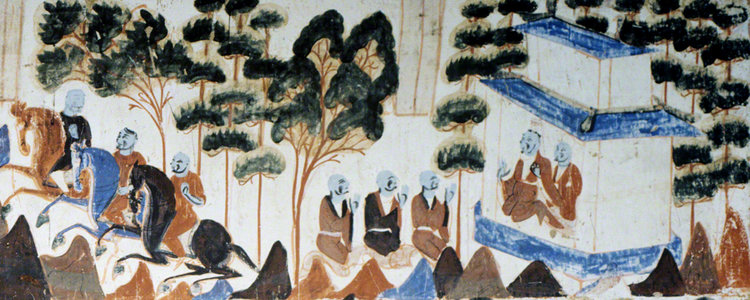
The mural commences on the right-hand side of the first register, where a captivating scene unfolds. Three young men, their hands pressed together in a gesture of genuflection, kneel before a majestic blue pagoda. Inside the pagoda, two figures exuding regal aura can be identified as the king and queen, bidding a heartfelt farewell to their sons, the three young men.
As the story progresses, the mural transitions to subsequent scenes, unveiling the brothers’ journey into the forest for a hunting expedition. Within this vibrant forest setting, an array of deer and tigers roam, coexisting with the majestic presence of towering trees and majestic mountain ranges. The undulating mountains, adorned with a multitude of colors, gracefully assume a smaller scale compared to the trees, animals, and human figures, harmoniously framing each scene of the narrative.

The story unfolds on the second register, commencing from the left-hand side. As the three brothers venture deeper into the forest, they eventually dismount from their horses, seeking respite at the foothills of towering mountains.
While taking a moment to rest, the brothers catch sight of a tigress accompanied by seven adorable cubs. The tigress is portrayed with her mouth agape, and her painted figure exudes a somber aura with limbs hanging low. Her gaze fixates upon the playful cubs frolicking around her, creating an illusion of impending maternal aggression, as if she were poised to devour her own offspring.

The brothers convene to discuss the matter of the tigress. Not wanting to watch a mother devour her own children, the brothers resolve to help her find food. However, there does not appear to be any food nearby.
Prince Mahasattva suddenly comes up with an idea. He keeps it to himself and tells his two brothers to leave the forest to find some food while he stays behind to watch over the tigers.
After his brothers leave, Prince Mahasattva strips off his clothes and lies down in front of the tigress, offering himself to the tigress. He decides to offer himself as food for the tigress so that she wouldn’t have to eat her own children.
The tigress sniffs at his body but makes no move to harm him even though she is starving.
When we offer help to someone and they are unable to accept what is offered, it’s a chance for us to feel good about having attempted goodness without losing anything. We can think to ourselves, well, we tried to help. In the case of Prince Mahasattva, he understood that good intentions alone would not save a life. It would take determined and complete self-sacrifice to save the tigers.
Realizing that the tigers will not eat him alive, Prince Mahasattva climbs to the edge of a cliff, cuts open his neck and throws himself off the ledge. With his neck bleeding profusely, his body drops in front of the tigress and her cubs. At Prince Mahasattva’s second attempt to offer his body, the tigers devour him as nourishment.
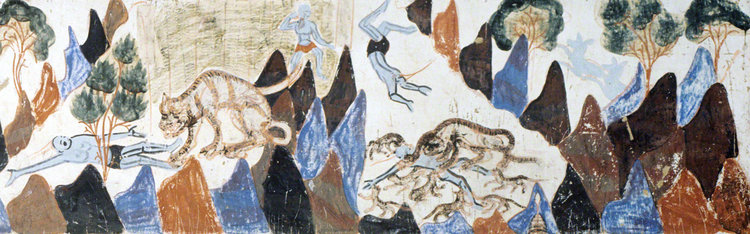
Snaking across and down the three registers, the story continues on the third register by beginning on the right-hand side again. Prince Mahasattva’s brothers return and they understand what happened in their absence when they see the bones left behind by the tigress and her cubs.
The brothers’ bodies contort across the scene in shock, anguish, and grief in reaction to the death of their third sibling.

The two brothers practically fly back to the palace on their horses to tell the king about what happened to Prince Mahasattva.
The story actually ends on the topmost right corner of this image, returning to the place where the two princes found their brother’s corpse. After reporting to the king, the family builds a stupa over Prince Mahasattva’s bones and hair to commemorate his selfless actions.
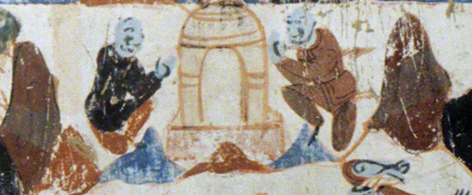
Many of the Mogao caves at Dunhuang have central pillars that take after the stupa form.
Scholars have theorized that worshippers could have circumambulated these central pillars inside the Mogao caves at Dunhuang as one would do around stupas in the open air.

Link:https://peacelilysite.com/2023/06/09/a-jataka-tale-depicted-by-art/
#PrinceMahasattva #Mural #Dunhuang#MogaoCave #BuddhistTeaching #BuddhistSutra #BuddhistTales #moralstories #Buddha #Jatakastories #BuddhistWisdom #BuddhistWisdomforChildrenandParents #Jatakatales




![5. The Price Maker [Foolishness]](https://www.buddhistelibrary.org/buddhism-online/images/volone09.gif)



 Peace LiLy