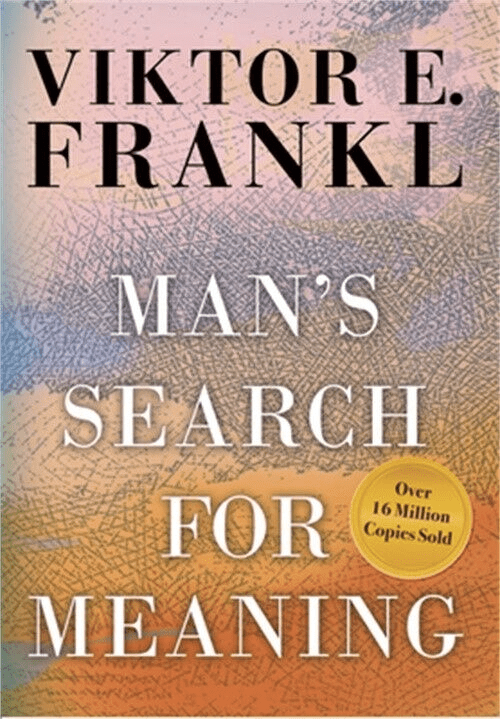
In his profound book “Man’s Search for Meaning,” psychologist Viktor Frankl imparts crucial lessons on finding meaning in our lives. The book is divided into two parts: the first half comprises the author’s semi-autobiographical narrative of life in a concentration camp, retaining insights and thoughts from the perspective of a refugee. Frankl, with the keen observational eye of a psychologist, categorizes the camp’s inhabitants into two main groups. Those who survived were invariably those who found meaning in life and clung to a shred of hope to keep moving forward, although many of them did not persevere until the end. Those who deemed life meaningless, lost the will to live, and had no hope, inevitably perished.
The second half delves into the fundamental concepts of logotherapy from a psychological perspective. Observations from the refugee camp are documented and internalized into the author’s own “logotherapy,” aiding patients—or ordinary people like us—in finding meaning in life and living their unique existence. The author advocates against determinism, emphasizing the importance of individual choice over environmental determinism.
Frankl, a Jewish psychiatrist imprisoned in the Auschwitz concentration camp, experienced a tumultuous journey of emotions. Before Christmas in 1944, rumors spread in Auschwitz that the war would end and everyone would be released, yet after Christmas passed without the anticipated victory, hopelessness descended, resulting in the death of 80% of the camp’s inhabitants—not from hunger and cold, but from the loss of hope. Frankl survived because two things mattered to him: his family, especially his love for his wife, which provided him with immense motivation during times of suffering, and his manuscript, his work on the psychological “logotherapy” he aimed to complete. These two things were bigger than himself, sustaining him through the ordeal.
This book stands out among numerous works because it encompasses both the author’s personal harrowing experiences and the detached observations of a scientist. From the outset, the author states his reluctance to write a mere chronicle of the concentration camp but rather aims to answer one question: “What psychological journey does an ordinary prisoner go through each day in the camp?” His observations focus on the silent, anonymous inmates’ reactions to their environment, including his own.
What fascinates me most is the author’s earnest yet transcendent perspective. Grounded in his own inner being, he strives for honesty without self-pity or complaint, maintaining a clinical detachment that rises above the harsh realities of the time. This writing style and attitude reveal both his resilient spirit and remarkable clarity of mind, as well as his profound understanding of his inhuman conditions, rendering emotional catharsis unnecessary.
At times, he detaches himself from his immediate surroundings, engaging in imaginary dialogues with his beloved wife, allowing love to fill his heart. The ability to detach oneself from reality using imagination is a unique human skill that aids survival in extreme adversity.

His theory posits that the search for meaning in life is the fundamental driving force of human existence. This meaning is unique and individual, requiring realization and practice by each person; only through this realization can one’s will to meaning be fulfilled. The aim of “logotherapy” is to aid individuals in uncovering the meaning in their lives. This meaning varies for each person and changes at different life stages, necessitating personal exploration. Once discovered, it provides hope for easing the neuroses arising from a lack of meaning in life. Meaning in life is concrete and tangible. For instance, a mother may find meaning in living for her children. I wholeheartedly concur with the author’s view that the meaning of life is not fixed. The sustenance it provides varies at different ages and stages of life. For instance, there was an elderly man who had been depressed for two years after losing his wife, seeking assistance from Frankl. When asked what his wife would do if he had passed away before her, the man responded that she would not be able to bear such pain. Frankl then remarked, “So, she left first. You can bear the pain for her to rest in peace. Isn’t that good?” The man felt relieved upon hearing this. He found the meaning of his life at that time.
According to author, there are three paths to finding meaning in life: 1. Creativity and work; 2. Recognizing values (such as love); 3. Suffering. Frankl firmly believes that everyone can find meaning in life, whether through creativity and work, experiencing something or loving someone, or, in extreme circumstances, when all joy is stripped away, unavoidable suffering itself becomes the meaning of life. From his experiences in the concentration camp, he realized the third path.
In extreme adverse conditions, when a person is reduced to nothing but their body and mind, they still retain the freedom to choose their attitude towards their environment. They can either actively and arduously utilize every condition to survive or succumb to the desire to die, yielding to fate. The choice of attitude is the only and complete dignity and meaning. And humans can choose to say “yes” to life.
Therefore, Frankl is a pessimistic optimist. He acknowledges that life itself is inherently meaningless, yet he is willing to inspire humanity to find meaning for themselves. His mission in existential psychiatry is to help patients find their own meaning in life through various methods. In contrast to psychoanalysis, which views humans as passive products of their environment, Frankl places human subjective will in a more significant position.
I cannot disagree with Frankl’s viewpoint. From my own half-century of life experience, I also believe that the attitude we adopt towards our environment, whether favorable or adverse, ultimately determines the trajectory of our lives. This is what I mean by “character determines destiny.” There are times of despair, hopelessness, and pessimism, of course, and there is no need to feel ashamed. We should learn to pull ourselves out of negative emotions and sincerely believe that “tomorrow will be better.” And indeed, tomorrow often turns out fine.

Nine powerful quotes from the book Man’s Search for Meaning
- Choose hope. We cannot always change our circumstances but we always have a choice about our attitude in any given situation. As Viktor Frankl writes, “When we are no longer able to change a situation, we are challenged to change ourselves.”*
- Know your why. Ask yourself: What am I living for? Every single day, we should ask ourselves why we are getting up and why we are here at all “Those who have a ‘why’ can bear with almost any ‘how’.”
- Learn how to cry. Tears are not a sign of weakness; they emanate from a soul that is not afraid to break: “But there was no need to be ashamed of tears, for tears bore witness that a man had the greatest courage, the courage to suffer.”
- Don’t just be part of the herd. The world is upside down; sometimes doing what everyone else is doing is what is insane. “An abnormal reaction to an abnormal situation is normal.”
- Live meaningfully. We create meaning by answering the questions life asks from us. “Ultimately, man should not ask what the meaning of his life is, but rather must recognize that it is he who is asked. In a word, each man is questioned by life and he can only answer to life by answering for his own life. It did not really matter what we expected of life, but rather what life expected of us.”
- Fill your day doing acts of kindness. There is purpose in kindness; there is meaning in the hundreds of small acts of giving that we have the opportunity to grasp each day. “We who lived in concentration camps can remember the men who walked through the huts comforting others, giving away their last piece of bread. They offer sufficient proof that everything can be taken from man but one thing: the last of the human freedoms-to choose one’s own way.”
- Move beyond yourself. We find true meaning when we transcend our own needs and limits. “The more one forgets himself – by giving himself to a cause to serve or another person to love – the more human he is and the more he actualizes himself.”
- Feel the pain of others. Suffering hurts no matter how irrelevant or ordinary it may seem to others. Be attuned to others’ grief even if doesn’t seem like a tragedy in the overall scheme of life. “Thus suffering completely fills the human soul and conscious mind, no matter whether the suffering is great or little. Therefore, the ‘size’ of human suffering is absolutely relative.”
- We can change even when life is hard. We can create meaningful lives full of depth and love and purpose. “Man does not simply exist but always decides what his existence will be, what he will become the next moment. By the same token, every human being has the freedom to change at any instant.”

Source: https://aish.com/viktor-frankl-on-mans-search-for-meaning/?utm_source=googlegrants&utm_medium=cpc&utm_campaign=19561819333&utm_term=&gad_source=1&gclid=Cj0KCQjwxeyxBhC7ARIsAC7dS39s79sG7BUeoDswcsOBoRwlH6T6GmrNQQI4sy3uRqgCvyLnNNoEQooaAo9EEALw_wcB, https://book.douban.com/subject/5330333/reviews
 Peace LiLy