United International World Buddhism Association Headquarters Announcement 20150114

United International World Buddhism Association

Headquarters Announcement 20150114

The Great Venerable Wangzha Shagnzun said: “In an attempt to convince others, some individual unlawful masters falsely claim that they could perform inner-tantric Dharma or give holy inner-tantric initiation and that they could communicate with the Yidam and let the disciple who is receiving the initiation attain all accomplishments in a short time. The fact is, these self-bragging masters are not even approved by the Yidam of Famen Gongyu for entering the door themselves. You must know Famen Gongyu is not just for entering the door to the holy test. It is used as long as seeing and interacting with the Yidam and the Dharma Guardians are involved. If you want to receive and learn an inner-tantric initiation, you must be approved by the Yidam of Famen Gongyu for you to enter the gate as the first step. You can only learn the initiation if you have entered the inner-tantric palace. It is absolutely forbidden if you can’t even enter the door to the inner-tantric initiation but shamelessly claim to be a great holy guru and feign with fakeness, taking advantage of the vague and confusing concept of the holy guru status to deceive a lot of Buddhists.

To prevent evil master and liars from hurting living beings, the Headquarters has adopted the Divination and Divine Foretelling and Famen Gongyu, which are used in the holy test, to definitively establish the titles of masters for the different levels. Although we have published many public announcements to explain this serious issue about the guru titles for the different levels so far, some masters still go around pretending to be a great holy guru and deceiving people with their superficial titles, such as venerable, dharma king, rinpoche, or great dharma master. People fall in their traps even though their actual essence does not match the title of holy or great holy being that they profess to be.

At present, there are still some individual masters who do not really cultivate themselves or rigorously abide by the precepts. They know well that they do not have the three vidyas and the six dharmas* (三明六法), but they still pretend to be holy and falsely claim to be a holy being or great holy being. Buddhist cultivators, on the other hand, do not read the public announcements but only listen to the untrue bragging of these people. Therefore, they always end up being deceived, only to complain a lot afterward. It is they to blame because they never read the public announcements. That is why they are incorrigible because they are willing to fall into the trap of deceit. 

To completely put an end to the vile behaviors of those who cheat and hurt Buddhist disciples by feigning to be true and high but are fake and low, and by claiming to have realized the level but have not, you must first understand that a 100% pure holy guru must obtain their title and level through the test. 

This Headquarters confers authentic titles to those holy gurus who have passed the test and issues the holiness level certificates and the buttons to be worn on the Dharma robes according to the levels they attain in the holy test. The titles issued are the most standard and correct guru titles. Other than obtaining the titles through the holy test, only the titles obtained from the six categories of guru qualification such as the Dharma of Knowing in Advance and Foretelling, or the Dharma of Vajra Faman which is used to determine matters regarding the supreme holy, can be considered definitive and standard. Except these, anyone who is a certified reincarnation from a patriarch or a dharma king, a great dharma king, or a great rinpoche cannot be a true and certain holy guru! 

The titles of the levels we publish today are based on the reasoning of the teachings and chosen by Divination and Divine Foretelling and Famen Gongyu that are employed in the holy test. These titles are definitive: Blue Button Level 1 is called Xingde (pronounced like shing-duh); Blue Button Level 2 is called Zengde (pronounced like zeng-duh); Blue Button Level 3 is called Runde (pronounced like ruen-duh). Blue Button Levels 1 to 2 can be called master. As the Chinese proverb says: “Among every three people there must be one whom I can learn from,” because he or she is good at something to teach others. Blue Button Level 3 is defined according to the Dharma rule as a Vajra Master; Gold Button Level 1 is defined according to the Dharma rule as Ruzun (pronounced as ru-zuen), Gold Button Level 2 is defined according to the Dharma rule as Jiaozun (pronounced as jiao-zuen), Gold Button Level 3 is defined according to the Dharma rule as Shangzun (pronounced as shah-ng-zuen), Gold Button Level 4 is defined according to the Dharma rule as Taizun (pronounced as ty-zuen), and Gold Button Level 5 is defined according to the Dharma rule as Shengzun (pronounced as sheng-zuen). 

This Headquarters beseeched H.H. Dorje Chang Buddha III for His approval with the titles defined according to the Dharma rule. His Holiness the Buddha said: “I am not going to take part in the work of setting up the titles for the masters by your Headquarters. As long as it is an undertaking that is benefiting people, you do it! Establishing these titles according to the Dharma rule to prevent those impostor masters from hurting people and to protect living beings is quite good. It is an action of correct karma.” 

From now on, you must not call someone with the nondefinitive and confusing titles of venerable, dharma king, or rinpoche in person or in writing when it comes to calling someone who has a level, because those titles are vague and nondefinitive concept. Who knows if the person is a holy guru, or what kind of holy guru they are! If people continue using such non-definitive titles, these people must be evil people who intentionally help the demon in hurting living beings. All Buddhists must respect what is decreed by the holy Dharma and not aide the evil to cheat people. You must use the Dharma-decreed titles in your calling. If you do not use the Dharma-decreed titles in your calling, you have committed the vile act of disdaining the Three Jewels, because these Dharma-decreed titles are established using Divination and Divine Foretelling and Famen Gongyu. Only when these titles are fixed can those who have an evil mind to fake as holy be prevented from cheating and confusing the world by pretending to be holy and high-level with ordinary and low-level. 

You must pay special attention. Up till now, there has not been one Ruzun of Gold Button Level 1, Jiaozun of Gold Button Level 2, Shangzun of Gold Button Level 3, Taizun of Gold Button Level 4 (an Equal Enlightenment Bodhisattva), or Shengzun of Gold Button Level 5 (a Marvelous Enlightenment Bodhisattva) who is publicly propagating Dharma in the world. Therefore, you can say people cannot meet a Taizun or a Shengzun at all. That is because the good retributions and karmic conditions of living beings are not there. 

The exaggeration of some famous people in the society where they make the pretense of a Marvelous Enlightenment Bodhisattva or an Equal Enlightenment Bodhisattva is 100% deceitful. They are not the reincarnation of any Bodhisattva at all. Where is their achievement in Five Vidyas? They completely violate the stipulation that says “Bodhisattvas are to be found in Five Vidyas” by Shakyamuni Buddha. Even a great rinpoche who is a reincarnated patriarch from thousands of years ago may not be a true holy guru, because the Buddhist history is, all the same, rife with uncertainty and unreal falsity. The title of a Great Holy Guru is not a vague concept. A Great Holy Guru must be a Shangzun of Gold Button Level 3. A Tremendously Holy Guru must be a Taizun of Gold Button Level 4 or a Shengzun of Gold Button Level 5. Anyone who has not realized the status of Shangzun but falsely claims to be a great holy guru must be a master who has regressed and become evil! 

Buddhist disciples! Everything is dependent on the levels as indicated on the robe the master wears. Based on that, you can know how to call the master without violating the precepts. We hope you all read this public announcement well, lest you should fall prey to the deceit of the individual bad people! The Headquarters cannot do much for Buddhist disciples, but we disapprove of anything thing that violates the law of causality! Therefore, we must issue this solemn public announcement! 

United International World Buddhism Association Headquarters

Link: https://thebodhiwish.com/united-international-world-buddhism-association-headquarters-announcement-20150114/

September 30, 2015

*translator’s note: the English translation of this phrase needs further confirmation

(English translation by Zunba)

#DorjeChangBuddhaIII #HHDorjeChangBuddhaIII#UnitedInternationalBuddhismAssociationHeadquarters#HolyGuru#FarmenGongyu#BuddhaDharma

H.H. Dorje Chang Buddha III Lineage

H.H. Dorje Chang Buddha III Lineage

When the universe originated, it was boundless and everything was silent. There was no such thing as length of time or size of space. There was no shape and form, no interior and exterior, no birth and death. This is the dharmakaya (dharma body) Buddha. The true meaning of the dharmakaya Buddha is the concept of a universe that does not perish. This concept of a universe that does not perish is also called “dharmadhatu-tathata (dharma realm true-suchness),” which is Samantabhadra Tathagata (Adharma Buddha).

However, the dharmakaya Buddha only expresses the concept of the true essence of the universe; that is, not being born and not dying, not coming and not going. The dharmakaya Buddha has no form and does not speak. It has no way to communicate any meaning, such as meaning through images or meaning through language. Because of such karmic conditions, the formless dharmakaya Buddha generated the first sambhogakaya Buddha with form. This sambhogakaya Buddha with form transformed into Vajrasattva and other nirmanakayas.

In order to make a distinction between those three, the dharmakaya Buddha was named Adharma Buddha, the sambhogakaya Buddha was named Dorje Chang Buddha, and the nirmanakaya was named Vajrasattva. Actually, Samantabhadra Tathagata is Adharma Buddha and also is Dorje Chang Buddha. In truth, there are not two Buddhas. These distinctions resulted from there being a dharmakaya, sambhogakaya, and nirmanakaya.

Based on this dharma, Samantabhadra Tathagata did not directly incarnate. Even the ancient Buddha Dipankara and Vajrasattva were the nirmanakayas of Dorje Chang Buddha. Sakyamuni Buddha was a disciple of Dipankara Buddha. However, many sects list Samantabhadra Tathagata as the first Buddha who began all the lineages in the dharmadhatu. This way of thinking is actually not erroneous. That is because although Samantabhadra Tathagata is a dharmakaya without form and has no way of speaking, the origin lies with this dharmakaya from which the sambhogakaya Dorje Chang Buddha manifested. This sambhogakaya Buddha was the first one to spread the Buddha-dharma and save living beings in the three spheres of existence so that they would become holy beings.

Dorje Chang Buddha is also called Buddha Vajradhara or Ruler of the Vajra Beings. In the entire universe, Dorje Chang Buddha is the first Buddha with form and is the highest Buddha. That is, the highest leader of Buddhism in the entire universe came into being in the form of Dorje Chang Buddha. It was Dorje Chang Buddha who began transmitting dharma and saving living beings in the dharmadhatu. As a result, Buddhism was born and the Buddha-dharma began spreading.

The teachings of Dorje Chang Buddha led to many disciples becoming Buddhas. The five most famous among such disciples are Aksobhya Buddha of the east, Ratnasambhava Buddha of the south, Amitabha Buddha of the west, Amoghasiddhi Buddha of the north, and Vairocana Buddha of the center. There are also many other Buddhas and Bodhisattvas among the original disciples of Dorje Chang Buddha. Dorje Chang Buddha was the one who initially propagated the Buddha-dharma in the dharmadhatu. Dorje Chang Buddha is the supreme leader of all of Buddhism in the dharmadhatu.

The incarnation of Dorje Chang Buddha is different from the incarnation of any other Buddha. Such an incarnation is a primordial manifestation of the existence of Buddha-dharma. In each world of living beings, there can be at any one time only one incarnation of Dorje Chang Buddha, who manifests or expresses the existence of the true dharma. There will not be a second incarnation of Dorje Chang Buddha in the same age or era. Only after the first incarnation of Dorje Chang Buddha leaves the world can the second incarnation be born based on karmic conditions relating to the good fortune of living beings. For example, the holy and venerable Vimalakirti, who was the second Dorje Chang Buddha, took birth in this earthly realm in the past. The third Dorje Chang Buddha took birth in this earthly realm more than two thousand years after Vimalakirti left it and only when karmic conditions relating to the good fortune of living beings had matured. Furthermore, according to the formal pronouncement of H.H. Mahavairocana Tathagata Dharma King Zunsheng, the fourth Dorje Chang Buddha will descend into this world five thousand years from now.

H.H. Wan Ko Yeshe Norbu is the only Dorje Chang Buddha III in the history of Buddhism. This has been recognized by greatly accomplished beings of the highest order in the world as well as famous dharma kings and rinpoches from various sects who have issued written recognition documents in accordance with the dharma!

Link: https://wisdomtea.org/2022/02/09/h-h-dorje-chang-buddha-iii-lineage/

Thoughts During Chinese New Year

Thoughts During Chinese New Year

There is a common Chinese saying: An inch of time is an inch of gold, but you can’t buy that inch of time with an inch of gold. When I was a child I often heard the grown up say, ”Time really goes by quickly, it’s already been a year!” I didn’t agree with them. I always felt that the days passed by so slowly. I always wished that time would go faster, so that the holidays could be closer to me. I especially couldn’t wait for the Chinese New Year, and it seems that it would take so long for the Spring Festival to come. I would look forward to the delicious food and delicacies Candy. Sometimes I even got new clothes, a truly wonderful new year presents.  I could play with my friends all day long, we shared holiday treats and exchanged the beautiful candy wraps ( those were our treasure collections)……

Time seems to get shorter and shorter with age. Now I am already in my fifties, and it feels like several decades have passed in the blink of an eye. Looking back, everything seems just like a dream, I can’t go back to those time anymore. The past will never come back, and all I have left are fragmented memories. My grandparents, my father, my older and younger relatives, passed away one by one. They could never come back to the world again.

 Through the years, I have gradually begun to understand what the Buddha said in the Diamond Sutra: All events are like a dream, an illusion, as fleeting as morning dew….. It took me so long to understand the truth of impermanence.

I remember once reading a story about Master Qinluan. He was a famous Japanese Zen master. At the age of nine, he made up his mind to become a monk and asked Zen Master Cizhen to shave his ordination for him. Zen Master Cizhen asked him, “Why do you want to become a monk when you are so young?” Qinluan said: “Although I am only nine years old, my parents have both died. I don’t understand why people must die. Why must I be separated from my parents? Therefore, I must become a monk and explore these truths.” Zen Master Cizhen said: “Very well. I’m willing to accept you as a disciple. However, it’s too late today, so I’ll shave you tomorrow morning.” Qin Luan said, “Master! Although you said that you will shave me early tomorrow morning, I am still young and ignorant. I can’t guarantee whether my determination to become a monk will last until tomorrow. Besides, Master, you are so old, you can’t guarantee that you will even wake up tomorrow morning!” After listening this words, Zen Master Cizhen was surprisingly happy, and said joyfully, “Yes! What you said is absolutely right. Now I will shave for you!”

I really admire the wisdom Master Qinluan’s displayed at age 9. Transcending the cycle of life and death is the most difficult thing in the world. It requires tremendous effort and unshakable determination.

Master Milarepa was a man of great accomplishment within Tibetan Buddhism. His Master – Great Venerable Marpa made him went through all the torture and abusive testing. In the end, Master Milarepa became a person within Vajrayana Buddhism who attained enlightenment by truly undergoing hardship and suffering.

One time as complying with the instructions given to him by Vajrayogini, Master Milarepa  traveled from the Himalayan mountains to the interior of Tibet to save living beings. On the way, he met a husband and wife who were unable to conceive a male offspring. This couple heard that Master Milarepa was Great Accomplished One who had learned tantra. They thus showed him great respect and had great confidence in him.

They invited the Venerable One, Master Milarepa, to their home. They asked the Venerable One not to continue his life of wandering in all directions, a life in which the basic necessities could not even be guaranteed. They asked him to stay with them and be their son. They said that they would provide him with a vast amount of wealth for his use and enjoyment. They said that they would find him a beautiful, virtuous, wise, warm and tender women to marry. He and this wife would then live in the most opulent and beautiful house, which would be tall and large. They would have much fertile land, which they could never use up. This couple hoped that Master Milarepa would, together with his future close family members, share in the joys of family life. They hoped that he would lead a harmonious, stable, and happy life.

Hearing the promises of this extremely kind couple, Master Milarepa remained totally unmoved. He told them that he could not renounce all of those things soon enough, let alone embrace them. The Venerable One imparted his teachings to them by way of songs. Master Milarepa taught them the truly disadvantageous effects one’s worldly family members have on one’s cultivation and worldly life. He taught them the suffering involved with worldly things, how worldly things are impermanent, and how they are like dreamy illusions and empty bubbles. He taught them how all conditioned phenomena preempt and how such phenomena are ultimately subject to the law of cause and effect.

After hearing these teachings, this husband and wife each gave rise to a resolute mind. They became disenchanted with impermanent things and worldly life. They understood that all of the different kinds of worldly emotions and love must ultimately vanish into emptiness, like smoke or clouds that pass before one’s eyes. They therefore gave up all their worldly possessions and wealth. They cut off their attachment to the concept of self and diligently cultivated themselves. In the end, they realized the state of enlightenment.

At this Dharma ending age, it is extremely difficult to find a Dharma Master as Master Milarepa. However the living Buddha Namo H.H. Dorje Chang III has promised: As long as you thoroughly learn either The Xiaman Most Excellent Oceanic Mind Essence (暇滿殊勝海心髓) or The Ultimate Bodhicitta for Attaining Dharma-Nature True-Thusness Oceanic Mind Essence (最勝菩提空行海心髓) in The Supreme and Unsurpassable Mahamudra of Liberation and have put into actual practice what you learn, you can be assured that the highest, holiest great Dharma will be available to you for achieving perfect good fortune and wisdom, liberation, and accomplishment! 

Thoughts During Chinese New Year

Link: https://peacelilysite.com/2022/02/11/thoughts-during-chinese-new-year/

#DorjeChangBuddhaIII #HHDorjeChangBuddhaIII#MasterMilarepa#MasterMarpa#Enlightenment

Master Wan Ko Yee (H.H. Dorje Chang Buddha III) Honored with Museum Dedicated in His Honor

Master Wan Ko Yee (H.H. Dorje Chang Buddha III) Honored with Museum Dedicated in His Honor

The Explanation of the Buddha’s Title – “H.H. Dorje Chang Buddha III

On April 3, 2008, a solemn and dignified first-publishing ceremony of a fact-recording book entitled H.H. Dorje Chang Buddha III, which published jointly by the World Buddhism Publishing LLC and the World Dharma Voice, Inc., was held at the Library of the Congress of the United States. The book was also formally accepted into the collection of the Library of the Congress of the United States. Only since that time, did people in the world know that Master Wan Ko Yee, who had been broadly respected by the great masses and who had also been known as Great Dharma King Yangwo Yeshe Norbu, had been recognized by the world’s leaders, regent dharma kings, and great rinpoches of Buddhism through official documents as the third incarnation of Dorje Chang Buddha, who is the primordial Sambhogakaya Buddha of the universe. The Buddha’s name is H.H. Dorje Chang Buddha III Since then, people began to address His Holiness the Buddha by “Namo[1] Dorje Chang Buddha III.” This is similar to the situation that Sakyamuni Buddha’s name was Prince Siddhartha Gotama before attaining Buddhahood. However, after Sakyamuni Buddha had attained Buddhahood, His title changed to “Namo Sakyamuni Buddha.” That is why we now address His Holiness the Buddha as “H.H. Dorje Chang Buddha III

In particular, on December 12, 2012, the Senate Resolution No. 614 of the United States Congress officially used “His Holiness” in the name addressing Dorje Chang Buddha III (That is to say, “H.H. Dorje Chang Buddha III”) Since then, the title and status of H.H. Dorje Chang Buddha III has been definitive by nature. And, as a matter of fact, “Dorje Chang Buddha III” is a name used legally in governmental and official legislative documents. Therefore, the previously used respected name and titles such as “Wan Ko Yee,” Great Master, and Great Dharma King no longer exist.

Photo by Pixabay on Pexels.com

However, the news below was published before the Buddha’s title of H.H. Dorje Chang Buddha III was publicly announced. At that time, people did not know about the true status of His Holiness the Buddha. Therefore, to respect the true history, we still kept the names used before the title of H.H. Dorje Chang Buddha III was legitimately determined in republishing this news. However, all must clearly know that the only legitimate name of His Holiness the Buddha is H.H. Dorje Chang Buddha III and all other names used before the legitimate determination no longer exist.

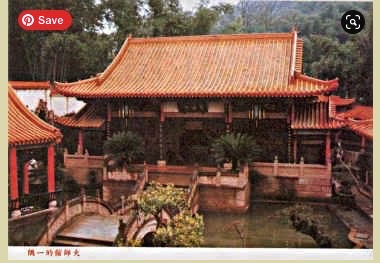
The government of the People’s Republic of China built a palace-like museum to house the many awards and honors received by H.H. Master Wan Ko Yee (H.H. Dorje Chang Buddha III) along with examples of his paintings, calligraphy and books on logic and Buddhist philosophy. This was the only such museum constructed while the honoree was still living. The buildings and gardens are in the classic Chinese Imperial style and consist of seven separate pavilions or “halls.”

Entrance to the Master Wan Ko Yee Museum-China

At a ceremony held at the museum to honor H.H. Master Wan Ko Yee(H.H. Dorje Chang Buddha III), the building began to drip nectar. For three years the 5,612 experts and scholars of the World Poets and Culture Congress, from 48 member countries and territories, undertook an exhaustive review in the comprehensive research and merits of H.H. Master Wan Ko Yee(H.H. Dorje Chang Buddha III) with respect to Buddhism, the Humanities, Chinese painting and calligraphy and ethical morality. Based on the assessment of their findings, the Fourth Session of the World Congress bestowed upon H.H. Master Wan Ko Yee(H.H. Dorje Chang Buddha III) the title “International Master: of the “Preeminently Distinguished” literary rank, or “Preeminent Distinguished International Master” in full. H.H. Master Wan Ko Yee(H.H. Dorje Chang Buddha III) was presented with a mortar, robe and the inscribed gold medallion of the “Preeminent Distinguished International Master.” This award was announced in Hungary with a congratulatory awards ceremony held in Sichuan Province in China at the Master Wan Ko Yee(H.H. Dorje Chang Buddha III) Museum. During that presentation the perfectly dry museum dripped nectar and auspicious clouds and a dragon appeared in the bright blue sky.

The five hundred Arhat jade carvings with different expressions and solemn virtues have a sacred appearance that looks like they were carved in heaven.

Master Wan Ko Yee (H.H. Dorje Chang Buddha III) Honored with Museum Dedicated in His Honor

Link: https://peacelilysite.com/2022/02/10/master-wan-ko-yee-%ef%bc%88h-h-dorje-chang-buddha-iii-honored-with-museum-dedicated-in-his-honor/

#MasterWanKoYee #DorjeChangBuddhaIII #HHDorjeChangBuddhaIII

H.H. Dorje Chang Buddha III Selected Philosophical Sayings About Worldly Matters

H.H. Dorje Chang Buddha III Selected Philosophical Sayings About Worldly Matters

The Explanation of the Buddha’s Title – “H.H. Dorje Chang Buddha III

On April 3, 2008, a solemn and dignified first-publishing ceremony of a fact-recording book entitled H.H. Dorje Chang Buddha III, which published jointly by the World Buddhism Publishing LLC and the World Dharma Voice, Inc., was held at the Library of the Congress of the United States. The book was also formally accepted into the collection of the Library of the Congress of the United States. Only since that time, did people in the world know that Master Wan Ko Yee, who had been broadly respected by the great masses and who had also been known as Great Dharma King Yangwo Yeshe Norbu, had been recognized by the world’s leaders, regent dharma kings, and great rinpoches of Buddhism through official documents as the third incarnation of Dorje Chang Buddha, who is the primordial Sambhogakaya Buddha of the universe. The Buddha’s name is H.H.  Dorje Chang Buddha III. Since then, people began to address His Holiness the Buddha by “Namo[1]  Dorje Chang Buddha IIIIII.” This is similar to the situation that Sakyamuni Buddha’s name was Prince Siddhartha Gotama before attaining Buddhahood. However, after Sakyamuni Buddha had attained Buddhahood, His title changed to “Namo Sakyamuni Buddha.” That is why we now address His Holiness the Buddha as “H.H.  Dorje Chang Buddha III.”      In particular, on December 12, 2012, the Senate Resolution No. 614 of the United States Congress officially used “His Holiness” in the name addressing  Dorje Chang Buddha III (That is to say, “H.H.  Dorje Chang Buddha III.”) Since then, the title and status of H.H.  Dorje Chang Buddha III has been definitive by nature. And, as a matter of fact, “Dorje Chang Buddha III” is a name used legally in governmental and official legislative documents. Therefore, the previously used respected name and titles such as “Wan Ko Yee,” Great Master, and Great Dharma King no longer exist.      However, the news below was published before the Buddha’s title of H.H.  Dorje Chang Buddha III was publicly announced. At that time, people did not know about the true status of His Holiness the Buddha. Therefore, to respect the true history, we still kept the names used before the title of H.H.  Dorje Chang Buddha III was legitimately determined in republishing this news. However, all must clearly know that the only legitimate name of His Holiness the Buddha is H.H.  Dorje Chang Buddha III and all other names used before the legitimate determination no longer exist.

A person is established in character only when he truly knows himself.
Why? It is difficult for a person to be aware of his own flaws, just as he cannot see his own back, though it is in plain sight of other people.
It is quite natural for a person to hide his own flaws, but overdoing it will alienate the person from those around him.
When the person realizes this and feels ashamed, he turns to seek knowledge and adhere to moral integrity so as to establish his own character and win the respect and support of other people.

H.H. Dorje Chang Buddha III Selected Philosophical Sayings About Worldly Matters

Link:https://peacelilysite.com/2022/02/04/h-h-dorje-chang-buddha-iii-selected-philosophical-sayings-about-worldly-matters/

#HHDorjeChangBuddhaIII #DorjeChangBuddhaIII #DorjeChangBuddha

The Broom Master

The Broom Master

A Buddhist Tale from Tibet Adapted by Elisa Pearmain

The children at the village school laughed at Chunda. They said that the boy was a simpleton because no matter how hard he tried, he couldn’t seem to learn to read or write. But the adults of the village were fond of Chunda, for he had a kind heart, and though he was a wisp of a teen, he was always willing to help, running an errand or sweeping a front yard.

Chunda admired his older brother Raj above all else. Raj, who was a couple of years older than Chunda was a bright scholar. When he turned 16, he decided to move to the city to study Buddhism at the monastery. Chunda begged to go with him, and his brother found a way for Chunda to live at the monastery and to earn his keep by working. At the monastery Chunda swept the yards, and clapped the dirt from the sandals of the monks as they came in for the evening meal. He watched and listened as the young monks sat in long conversations. How he wished that he could join in, but he would remember how the children had laughed at him, and his shame always drove him away.

Chunda’s brother noticed his brother’s sadness and longing, and spoke to him. “Chunda, perhaps you could study to be a monk as well.” “But how could I become a monk?” He asked, “I can’t read or write, or memorize?”“ There is more to becoming a monk than book learning. Go to see the Buddha (who was the master of the monastery at that time) and tell him your wishes. He is wise, and compassionate.” So Chunda went and sat before the Buddha who quickly saw that he was an honest young man of pure heart. He gave Chunda just one line of scripture to learn. It was the first of hundreds that each monk was expected to learn by heart. “Give up negative actions. Free yourself from negative thoughts.”

Chunda tried and tried to learn the short passage, but he had to repeatedly ask for help, and once he had learned the first line, he would forget it when he began to learn the second. Chunda returned to the Buddha and told him what had happened. The kind man sat in silence for some time. Finally, an idea occurred to him. “Chunda, you are a hard worker are you not?’ he asked. “Yes master.” “I would like to give you a special job. I want you to sweep the temple hall each day. Can you do that?” “Oh yes, teacher.” Chunda said, jumping up with delight. “That is something I can do well.” “Very well then, Chunda. I will give you the job of sweeping the temple. That is all that you must do, but as you sweep the floors you must speak these two lines to yourself, over and over: “Sweep away the dust, sweep away the dirt.” Can you remember that?” “Sweep away the dust, sweep away the dirt. Yes, that is easy, because that is what I will be doing!” Chunda set off to begin his work. Every day he did sweep the temple, all day long, and as he swept he kept up a rhythm, “Sweep away the dust” he would say with each sweep out, and “Sweep away the dirt,” with each sweep back. Often he would get lost in thought and he would forget to say the lines. Luckily the other monks knew what he was supposed to be chanting, and they would remind him, and he would go back to is work. “Sweep away the dust, sweep away the dirt.”

Then one day the Buddha came upon Chunda who was standing still, thinking hard about something. “Chunda, where is your mind right now.” “Oh sorry, Master, I should be sweeping,” No, Chunda,” he smiled, “share your thoughts.””Well I was thinking that you are a wise man, and you have given me these lines to say about something that I know how to do. When I remember to say them I feel at peace. You have not given me any more lines. Do you mean for me to learn something more from this?” “Yes Chunda. You have found the peace that is there for us in the present moment. Now I want you to think about this: You are sweeping clean the dirt from the temple. Think also about sweeping clean the inner dust and dirt in your mind.” “But what are inner dust and inner dirt?” “Well, Chunda, think of the nature of dust and dirt: They cover what is beautiful and clean, and cloud what is clear. And dust and dirt often cover those things that are old and of no more use to us. It is also the nature of dust that we can see it in the air, but when we grasp for it, it is not there, just like thoughts of the future or the past. Think on this and notice when your thoughts are clouding you from the present moment, and causing unhappiness, and notice when you cling to old ways of thinking.” Chunda went back to sweeping.

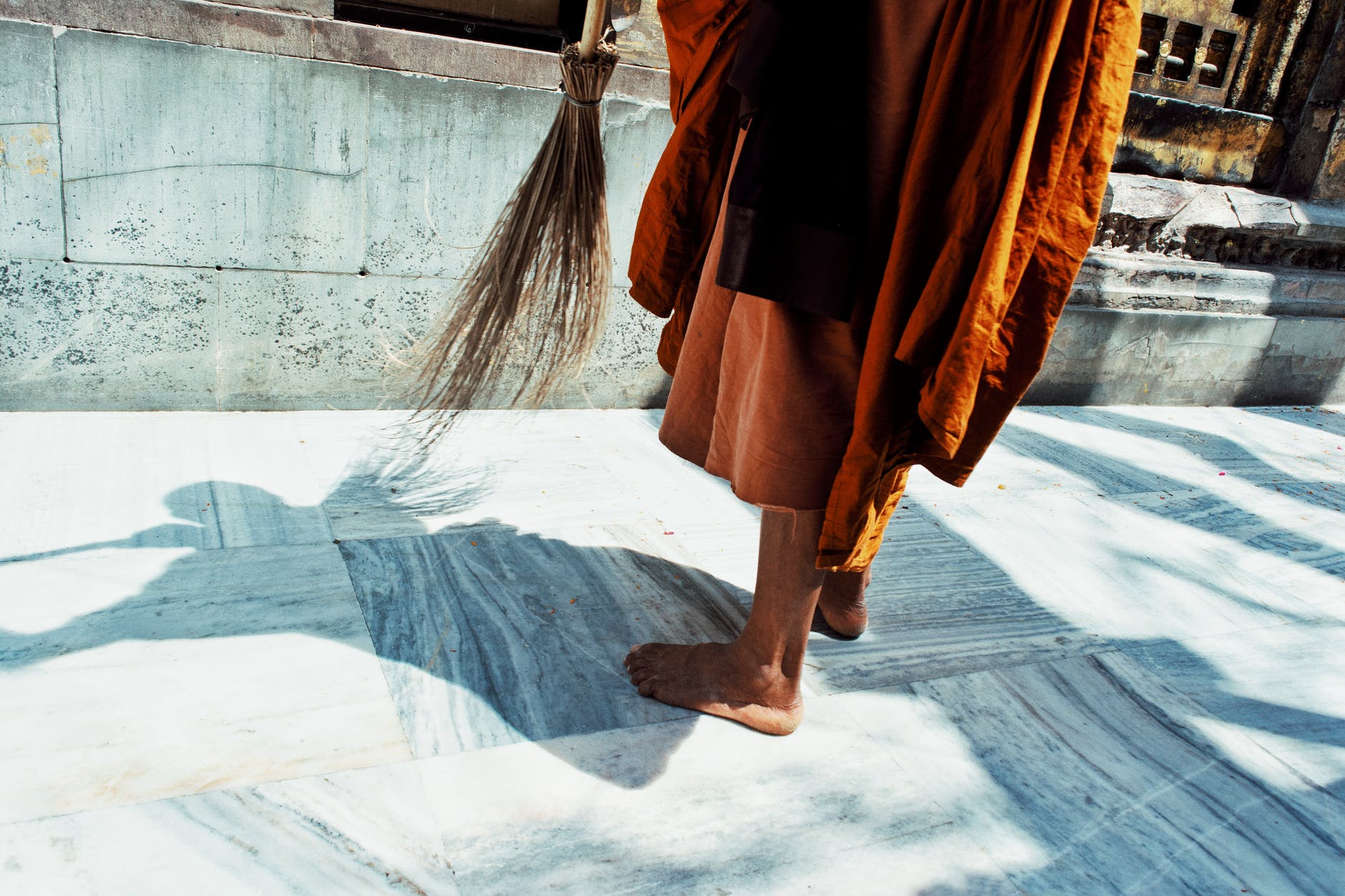
Photo by Riya Kumari on Pexels.com

One day Chundra noticed that he was often longing to sit with the other students as they talked about the things they were learning. “But,” he would think to himself, “I am not worthy to sit and talk with the other monks and students my age, for I cannot read nor write.” This way of seeing and thinking was like dirt, it was an old way of seeing himself that kept him from happiness. “I should sweep these thoughts from my mind.” He thought. “Sweep away the dust, sweep away the dirt.” He felt peaceful again. Another time he noticed that he was often living in the future wishing, “If only, if only I could read and write like the others, then …” These wishing thoughts were like dust. He was always trying to grasp things out of his reach, and missing the present moment. “Sweep away the dust, sweep away the dirt.”

Chunda went and shared his insights with the Buddha who again smiled. “Ah Chunda, you are doing very well. Tell me, can you stop and enjoy the beauty of a clean temple after you have swept?” “Yes, master.” “Good then, ” smiled the Buddha, “I hope you will now remember to also stop to notice the simple joy of a clean inner temple, as well as an outer one.” Chunda did stop to notice, and he continued to sweep the inner dirt, and the outer dirt, and to stop often to experience the peace of the present moment, and the simple joy that was there when all negative thoughts were gone. And in this way Chunda continued to sweep, to chant and to ponder on the nature of grasping and clinging, and the peace of living in the present moment.

In time the other students noticed his peace, and began to talk with him. He was able to share his wisdom with other monks. As the years passed his wisdom and inner peace grew. He became known as The Broom Master, and many came to hear his simple, yet profound wisdom.

Sources: Conover, Sarah, “The Broom Master” in Kindness: A Treasury of Buddhist Wisdom for Children and Parents, (Spokane, WA: Eastern WA University Press, 2001) pp. 68-71.Lama Surya Das, “Greatness of Heart is What Counts,” in The Snow Lion’s Turquoise Mane: Wisdom Tales from Tibet. Pp. 45-48.

The Broom Master

Link: https://peacelilysite.com/2022/02/04/the-broom-master/

#Buddhism#BuddhismStory#BroomMaster#Buddha#Chunda#BuddhismWisdom#WisdomTales

Early Buddhist Sects

Early Buddhist Sects

Sautrantika: One of the early Indian schools of this tradition. Also known as the Sutra-Only School because it focused on just the discourses of the Buddha.

Vaibhasika: An influential early Indian school in north-west India also of this tradition. Its version of the Abhidharma, the Mahavibhasa (The Great Book of Alternatives), was the basis for Vasubandhu’s Abhidharma-kosa that is still studied in Tibetan monasteries and considered to be one of the five classic commentaries or treatises that should be mastered.

Theravada (Lineage of the Elders): This is the form of Buddhism that was transmitted very early to the South-east Asian counties of Sri Lanka (247 BCE) and Burma (272-236 BCE) and later to Thailand (1260), Laos (14th century), Cambodia, and southern Viet Nam. It was between 25 and 17 BCE that the Pali canon or scriptures were first recorded in Sri Lanka. In America it is also popularly known as vipassana or Insight Meditation. The most conservative branch of Buddhism, the Theravadans based their practice exclusively on the Tripitaka of the Pali Scriptures and are the only remaining school evolving out of this tradition. Their focus is the practice of mindfulness, which involves cultivating an awareness of one’s thoughts, actions, and body to become aware of what one does and one’s motivation. This is a prelude to a direct understanding of the transitory, conditioned nature of existence. Theravadans take refuge in the three jewels and follow the five precepts of no killing, no stealing, no inappropriate sex, no inappropriate speech, and no ingesting substances that befuddle consciousness. Monastics must be celibate and cannot claim to have supernormal powers. The goal of one following this path is to become an arhat. It has become a popular form of Buddhism in the United States. Some modern western leaders in this school have questioned if enlightenment is possible or even a useful goal, stressing more the integration of Buddhist concepts and theories with Western psychology and therapy.

When Shakyamuni Buddha lived on this planet over 2500 years ago, he transmitted dharma to the many disciples who followed him. After the Buddha’s Parinivana, one of the Buddha’s foremost disciples, Venerable Mahakasyapa, became the head of the sangha and presided over the First Great Council at Rajagrha that was held to codify the Buddha’s teachings. He was known for his accomplishments in the dharma.

Ananda, the Buddha’s younger cousin and known as “the assistant who heard much,” became the second patriarch in this lineage after Mahakasyapa passed away. As a condition for becoming the Buddha’s attendant, a position he held for 24 years, Ananda requested no preferential treatment and that the Buddha repeat for him any teachings he might miss. He was gifted with total recall and at the First Great Council repeated all of the Buddha’s teachings from memory. His recitation became the basis for the Sutras in the Tripitaka. When Guru Padmasambhava reincarnated eight years after Shakyamuni Buddha left this world, it was Venerable Ananda who transmitted the special dharma that Shakyamuni instructed him to transmit.

The sangha divided into many sects based on different interpretations and emphasis. The main split was between what became known as the Sravakayana (or Path of the Arhats) and Mahayana (or Path of the Bodhisattvas) Vehicles. Of the eighteen or so lessor vehicle sects, only the Theravada School has survived. This is the dominant form of Buddhism practiced in Myanmar (Burma), Cambodia, Laos, Sri Lanka, and Thailand. Today there are over 100 million Theravada Buddhist worldwide with a growing number of temples and groups forming in the West as the people of Southeast Asia migrate to the West.

Many Westerners have also gone to Southeast Asia to study and have brought their own form of usually lay practice to the West, often referred to as Insight Meditation or vipassana. Theravada monasteries have developed in the U.S. that train western monastics, notably the Bhavana Society Forest Monastery and Meditation Center (Sri Lanka) in High View, West Virginia, and Abhayagiri (Fearless Mountain) Monastery (Thai) also in the forest monk tradition in Redwood Valley, California.

Link: https://wisdomtea.org/2022/02/02/early-buddhist-sects/