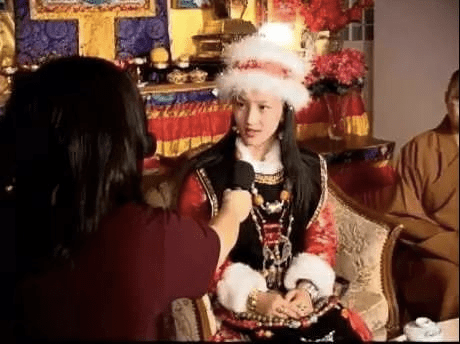
During the visit of a reporter on February 29, 2004, Jinba Pui Chu Yee Rinpoche made a prediction that she would become a world-class “Children’s artist” in just five months. The setting for the meeting was a solemn Buddhist mandala, and Jinba Rinpoche was dressed in traditional Tibetan Rinpoche’s robes, adorned with the seven treasures. Her appearance was slim and graceful, with a natural wisdom reflected in her features. Her sharp eyes exuded both compassion and wisdom.
During the interview, Jinba Rinpoche revealed that her father was none other than the great Dharma King (H.H. Dorje Chang Buddha III), who was not only a spiritual leader but also a talented artist. While Jinba Rinpoche had always been drawn to art, she had never attempted landscaping art before and was unfamiliar with the materials used in such work. Nevertheless, she expressed a strong desire to explore this art form and shared that her father would transmit the Manjushri wisdom and enlightenment dharma to her the day after the interview. With this newfound knowledge, Jinba Rinpoche aimed to publish a book of her landscaping art within five months. When asked about the content of the book, she confidently replied that it would feature a special collection of her own works. Her conviction and determination were evident.
When asked about the level of achievement she aimed for, Jinba Rinpoche, with the poise of a seasoned leader, declared that she aimed for nothing less than world-class status. This was no small feat, given that producing even a few works of landscaping art within five months was a world miracle that most people could hardly fathom, let alone publishing a book. The reporter was understandably curious about her confidence and asked how she could be so sure. Jinba Rinpoche replied that her father, the great artist and spiritual leader, was none other than the Vajra Dharma King, whom she held in the highest regard. She was certain that with his guidance and the teachings of the Tathagata Dharma, she could create stunning landscapes in no time. For her, making landscaping art was a piece of cake.
Despite Jinba Rinpoche’s young age, the reporter was struck by her gravitas and sincerity, leaving no room for doubt about the authenticity of her words. However, as a journalist, he had to ask the questions that the public might raise. Jinba Rinpoche responded with utmost solemnity, “Doubt is intrinsic to all sentient beings, for without doubt, what is sentience? As a Rinpoche, lying is not an option, for it would mean falling into hell. Why would one choose to fall into hell by lying? If I lie to others, I would deserve such a fate. As a Rinpoche, why would I want to end up in hell because of lying?” Her response not only demonstrated her commitment to honesty and integrity but also revealed her deep understanding of the Buddhist principles she espoused.
Her prediction of course came true. The New York Academy of Art evaluated her sculpture landscapes. On May 11, 2004, that Academy issued a certificate to Jinba Pui chu Yee signed by its Executive Director, Mr. Stephen Farthing. That certificate contained the following evaluation: “It have been a great pleasure for both e as Executive Director, and my Faculty at the New York Academy of Art, to get to know the artwork of such an internationally acclaimed artist as Ms. Pui Chu Yee. Her unique approach transports the viewer beyond taste and fantasy to a point where enchantment and contemporary art meet. Her work is a great achievement.”
She has published a book featuring a collection of her landscape compositions, which can be reviewed and purchased at the Hua Zang Si temple in San Francisco. Additionally, some of her artworks are on display in the grand hall of the temple.
Jinba Rinpoche creating art work with special vajra painting on her face
Tibet Plateau
Holy Saint
Mountains and Mirror lake
Signature created by Jinba Rinpoche
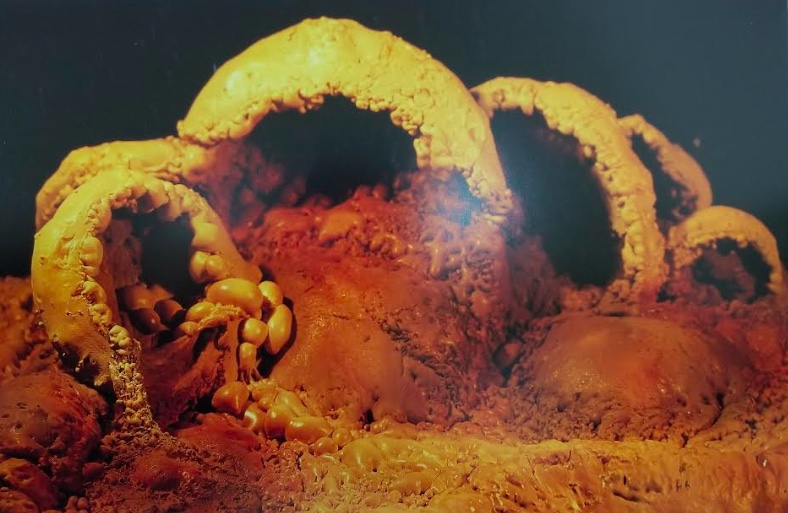
The Source and Flow of Life
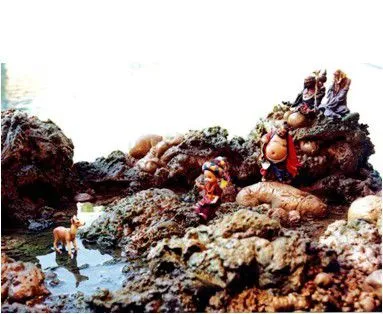
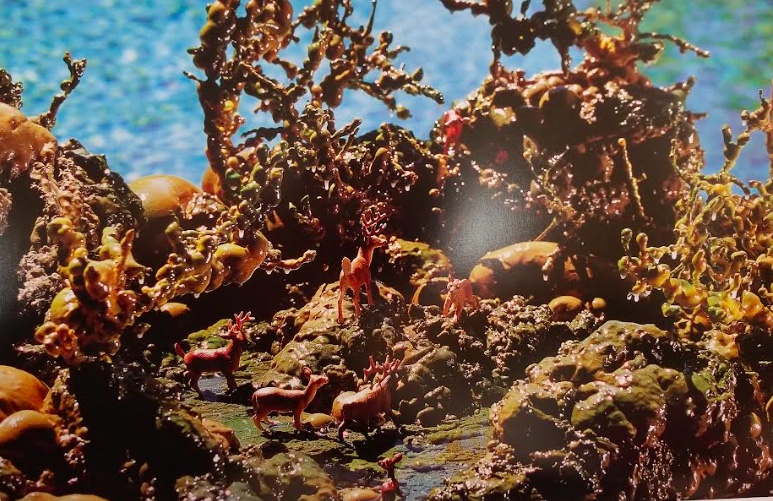
This Is a Place by the Lake Where Wild Deer Gather
Swords man and Warrior Performs Prodigious Feats on a Cliff
There was an elementary school teacher who taught in a remote town. One day, he asked the little children in his class, “Do you have anyone you hate?” After thinking it over, some of the little children remained silent while others nodded with great force. The teacher then passed a bag to everyone and said, “Let’s play a game. Now, all of you think about who has offended you and what hateful things have been done to you in the past week. Once you have them in mind, go find a rock by the riverside on your way home after school. “Paste a little paper note, written with the person’s name, on the rock. If his fault was big, then find a bigger rock; if his fault was small, then find a smaller rock. “Every day, place what you have collected in a bag and bring it with you to school and show me!” All the students felt that it was very interesting and new. After school, every one rushed to the riverside to find rocks. Early next morning, all the students brought their bags, filled with pebbles to school, and discussed about it happily. With the passing of one day passed, two days, and three days, some of the students’ bag grew larger and larger. It had become a burden. Finally, someone protested and said, “This is so tiring!” The teacher smiled but did not respond. Immediately, someone picked the conversation and continue to complaint, “Exactly! Carrying all these rocks to school is so tiring!”
At that moment, the teacher spoke up and said, “Now put down these rocks which represent the faults of people who have offended you!” The students were all surprised, so the teacher explained, “Learn to forgive others’ offenses. Do not keep them as treasures in your mind, nor bear them on your shoulders. No one can stand it overtime.” That week, the students of the class learned an extremely precious life lesson. The greater the number and the bigger the rocks held in the bag, the deeper the tired accumulated in the mind, and the heavier the burden. If you have rocks written with others’ names, you should know what to do.
A true story about a female worker who was saved from being locked inside a freezer at work, due to her having a modest and respectful mind. A lady worked for a food processing factory. One day, at the end of her work, she routinely walked into the freezer for a final check. Suddenly, an unfortunate moment happened, the door accidently closed behind her and she got locked inside the freezer. Although she exhaustedly screamed and pounded on the door, no one could hear her crying voice, she was totally out of people’s sight. All the workers were off from factory at this moment and no one could hear what had happened inside. Five hours later, when she was at the brink of death, the security guard of the factory opened that door and miraculously saved her. Afterwards she asked the security guard why he would open the door since that was not his daily job. He explained, “I have been working at this factory for 35 years. Every day there are several hundred workers who enter and walk out: however, you are the only one who greet me with “How are you?” in the morning and say “Goodbye, see you tomorrow.” in the evening. Many people do not see me as if I were transparent. Today, you came to work in the morning as usual and asked me “How are you?”, but at the end of the work day, I did not hear you say to me “Goodbye, see you tomorrow.” As a result, I decided to take a look inside the factory. I anticipated your “Hi” and “Goodbye”, because these words remind me of who I am and make me very happy. Without hearing your word of goodbye, I knew something might have happened. That was the reason why I searched for you in every corner of the factory.”
He who loves others is constantly loved by them; he who respects others is constantly respected by them. Helping others is truly helping ourselves.
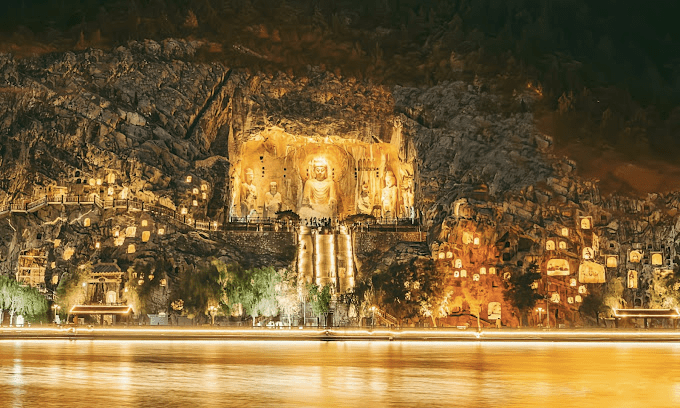
Splendid Night Scene of Longmen Grottoes, By Jack Sparrow
The Longmen Grottoes, a Buddhist cave complex located 13 kilometers south of Luoyang in China’s Henan province, form some of the most significant and exquisite representations of ancient Chinese stone art. Created over the course of approximately five centuries beginning in 493 CE, these grottoes, along with the statues and inscriptions carved within, provide a window into the political, cultural, and artistic circumstances of the late Northern Wei and Tang periods. The caves were carved into the steep limestone cliffs of Mount Longmen and Mount Xiang which face one another along a one kilometer stretch, forming a valley through which the Yi River flows. This site, with its appearance of a natural gate, was historically referred to as Yique or “Gate of the Yi River.” After Emperor Yang of the Sui Dynasty built an imperial palace in Luoyang at the beginning of the 7th century CE with its southern gate aligned to the cliffs of the site, the name Longmen or “Dragon’s Gate” came into use (the dragon served as an emblem of the power of the emperor).
LAYOUT
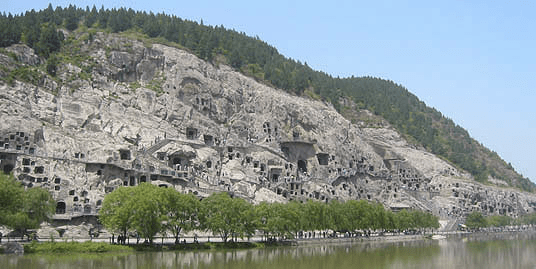
Mt. Longmen as seen from Manshui Bridge to the southeast
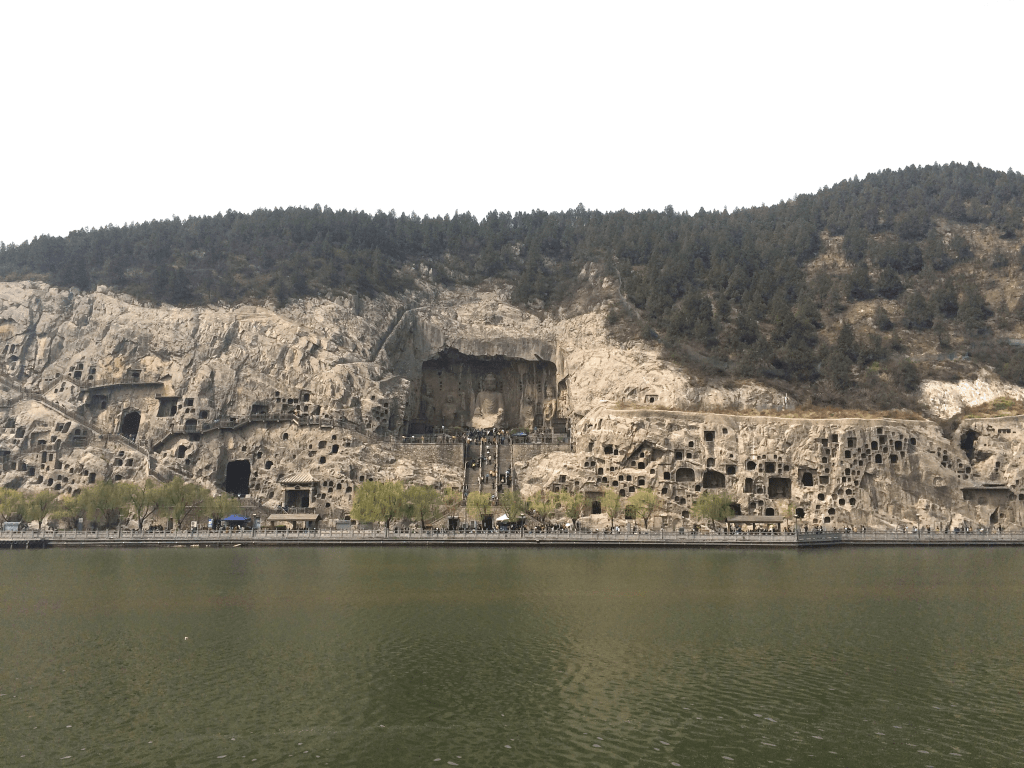
In total, more than 2,300 grottoes and niches, 100,000 Buddhist statues, ranging in size from several centimeters to over 17 meters, and over 2,800 inscriptions were carved into the cliffs at the site, making it the largest such complex in China. A majority of the caves were carved into the face of Mount Longmen, on the west side of the Yi River. Such is the density of grottoes and niches there that they give the cliff face an incredible, honeycomb-like appearance when viewed at a distance. Whereas those grottoes on the west side were used for ceremonies which honored the dead, the caves carved on Mount Xiang to the east were home to a large community of Buddhist monks of various sects.
View of the West Hill Grottoes from the east bank of the Yi River. Charlie – Own work
2,300 GROTTOES & NICHES, 100,000 BUDDHIST STATUES, & OVER 2,800 INSCRIPTIONS WERE CARVED INTO THE CLIFFS AT THE SITE.
REFLECTION OF SOCIETY
The carving of grottoes into remote mountainsides to serve as Buddhist temples was a practice which originated in India c. 3rd century BCE. Buddhism, along with the practice of grotto carving, passed to China along the silk road, influencing the creation of Buddhist grottoes at Yungang near Pingcheng (modern day Datong), the capital of the Northern Wei Dynasty, in the middle of the 5th century CE. When Emperor Xiaowen, who contributed to the carving of the Yungang Grottoes, moved the capital from Pingcheng to Luoyang in 493 CE, he shifted his energy to beginning grotto construction at Longmen.
Many of the statues within the oldest grotto carved there, Guyang Cave, were ones which members of the royalty, who followed Emperor Xiaowen to Luoyang, vowed to build. Over 1,000 niches and 800 inscriptions are contained within the cave, making it one of the richest at Longmen and significant as a reflection of the late Northern Wei style of both sculpting and writing. The central statues of Sakyamuni Buddha and two Bodhisattvas (those on the path to enlightenment) each take on a somber appearance and a slender silhouette, contrasting the earlier, broad-shouldered style found at Yungang. Inscriptions attached to statues within Guyang Cave include 19 of the 20 inscriptions designated as exemplary forms of Northern Wei calligraphy and are critical in helping to identify the origins of each work.
Sakyamuni Buddha and two Bodhisattvas at Guyang Cave
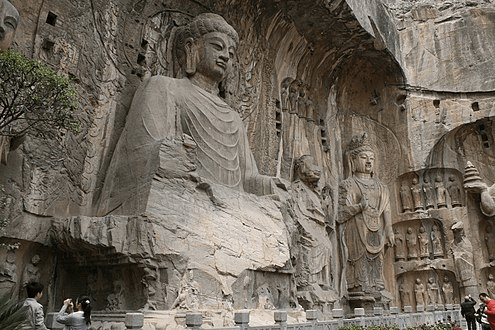
Fengxian, or Feng Xian Si (奉先寺), or Li Zhi cave is the Ancestor Worshipping Cave, which is the largest of all caves carved on the west hill built between 672 and 676 for Empress Wu Zetian. The carvings are claimed to be the ultimate in architectural perfection of the Tang dynasty. The shrine inside the cave measures 39 m x35m. It has the largest Buddha statue at the Longmen Grottoes. Of the nine huge carved statues, the highly impressive image of Vairocana Buddha is sculpted on the back wall of the Fengxian. The image is 17.14m high and has 2 m long ears.An inscription at the base of this figure gives 676 as the year of carving. The Bodhisattva on the left of the main image of Buddha is decorated with a crown and pearls. Also shown is a divine person trampling an evil spirit. The main Vairocana image’s features are plumpish and of peaceful and natural expression. Each of the other large statues are carved with expressions matching their representative roles. These were carved at the orders of Empress Wu Zetian, and are considered uniquely representative of the Tang dynasty’s “vigorous, elegant and realistic style.” The huge Vairocana statue is considered as “the quintessence of Buddhist sculpture in China.”
The Vairocana statue also provides at its base the names of the artisans who worked here, the name of the Emperor Gaozong, who was the donor, and also honors Wu Zetian. It is said that Wu Zetian donated “twenty-thousand strings of her rouge and powder money” to complete this edifice. Hence, it is conjectured that the Vairocana Buddha was carved to resemble the Empress herself and termed a “Chinese Mona Lisa, Venus or as the Mother of China”. All the images here, which remain undamaged, project character and animation. Statues of Kasyapa and Ananda, the two principal disciples of Vairocana, and of two Bodhisattvas with crowns flank the main statue, in addition to numerous images of “lokapalas (guardians or heavenly kings), dvarapalas (temple guards), flying devas and numerous other figures.
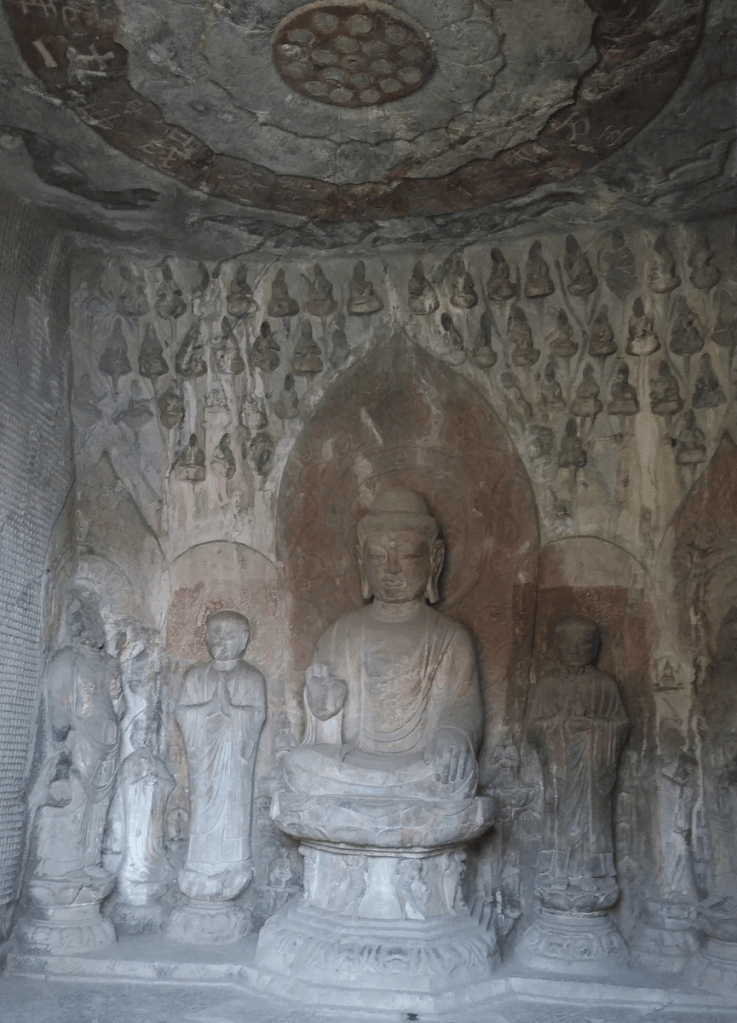
In addition to Guyang and Fengxiansi Caves, several others are particularly worthy of mention. The set of three Binyang Caves (North, Middle, South), carved shortly after the Northern Wei capital was moved to Luoyang, was donated by Emperor Xuanwu in honor of his father, Emperor Xiaowen, and mother, Empress Wenzhao. Unlike figures in Guyang Cave, those in the Binyang Caves are of an earlier Northern Wei style, closer to that found at Yungang Grottoes. Work began on Yaofang Cave in the intervening period between the Northern Wei and Tang dynasties and came to include the engraving of 140 Tang era medical prescriptions – practical remedies to ailments ranging from cholera to hysteria. These treatments, which spread to Japan in the 10th century CE, reveal the degree to which medical science advanced during the Tang Dynasty.
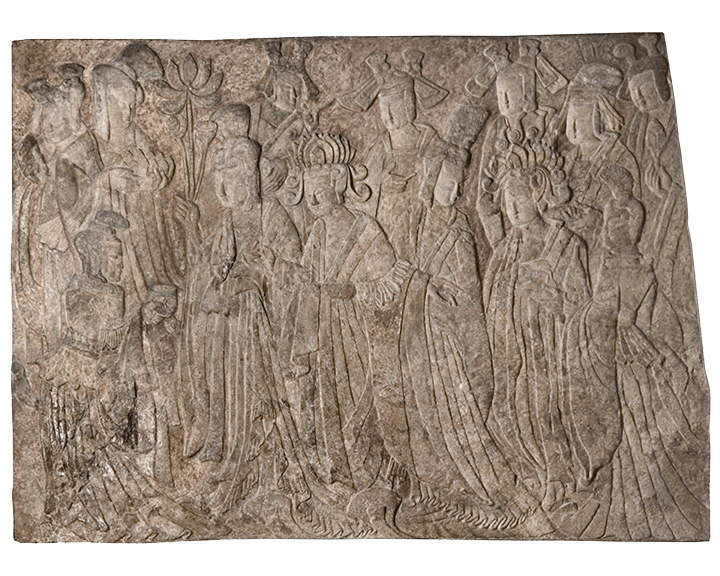
Offering Procession of the Empress as Donor with Her Court, Chinese, from Longmen, Binyang Central Cave, Henan Province, ca. 522 C.E., Northern Wei Dynasty
This Offering Procession of the Empress as Donor with Her Court, was taken off from the original place for reasons. And now you can see it in the Nelson-Atkins Museum of Art in Kansas City, US. The Nelson-Atkins Museum of Art is a much-loved institution. Many americas may not know, though, is that the Nelson also has a world-renowned reputation among artists and scholars of Asian art. With more than 7,000 works spanning 5,000 years, the museum boasts one of the most celebrated collections of Asian art in the West.
Wanfo Cave, which was completed shortly after the completion of Fengxiansi Cave, was created in honor of Emperor Gaozong and Empress Wu Zetian and purportedly contains 15,000 small, sitting Buddha figures carved within the vast grids of tiny niches which blanket several walls. Prominent patrons of the cave included a female court official and a palace chapel nun. The largest grotto on the east side, Kanjingsi Cave, unlike many other large caves, lacks the grouping of large, carved Buddhist statues. In their place is a procession of life-sized Arhats (those far advanced along the path to enlightenment) stretching around the perimeter of the cave, each with a unique expression, carved in relief in the evocative and highly-detailed style found at other Tang era grottoes.
One can only imagine the splendor of the grottoes at Longmen during the Tang Dynasty, with thousands of recently completed carvings painted in a brilliant array of colors. Unfortunately, a number of natural and human forces have detracted from, although in many cases by no means destroyed, the intention of the original artists. Among the natural causes of damage are corrosion due to acid rain, wear from wind exposure, and naturally occurring fissures of the limestone, exacerbated by plant growth and water seepage.
The caves, stone statues, steles and inscriptions scattered in the East Hill and West Hill at Longmen have been well preserved. The property area and buffer zone retain their natural landscapes and the ecological environment that have existed since the late 5th century. The works of humans and nature have been harmoniously unified and the landscapes possess high integrity.
In the continuous evolution of Longmen Grottoes, the aesthetic elements and features of the Chinese cave temples’ art, including the layout, material, function, traditional technique and location, and the intrinsic link between the layout and the various elements have been preserved and passed on. Great efforts have been made to maintain the historical appearance of the caves and preserve and pass on the original Buddhist culture and its spiritual and aesthetic functions, while always adhering to the principle of “Retaining the historic condition”.
As with pilgrims of ages past, who visited Longmen to worship or to gain merit through the dedication of a Buddhist image, these grottoes afford modern visitors the chance to take a step closer to the lives of people from a different era, and to stand in wonder at the ability and determination of humankind.










 Peace LiLy