In 1994, a researcher claimed to have obtained a top-secret photo taken by the Hubble Space Telescope, suggesting it could be an image of Heaven. The Weekly World News was the first to publish this image along with Dr. Marcia Masson’s findings. Despite media coverage, NASA chose not to acknowledge the existence of such a photo.
With the recent repair of the Hubble Telescope and NASA’s official release of new findings, the editorial team at Weekly World News believes that NASA should take responsibility and further investigate this intriguing space anomaly.
As of now, NASA has not issued a response. However, an exclusive report reveals that shortly after space shuttle astronauts repaired the Hubble Space Telescope in mid-December, the lens focused on a star cluster at the universe’s edge, capturing what some describe as a vast white city in the void of space.
HEAVEN PHOTOGRAPHED BY HUBBLE TELESCOPE February 8, 1994
Dr. Marcia Masson, an author and researcher, cites anonymous NASA insiders who claim that hundreds of photos were beamed back to the Goddard Space Flight Center in Greenbelt, Md., on December 26. According to these insiders, the city depicted in the images is believed to be Heaven due to its location in icy, airless space, seemingly incompatible with life as we know it.
Despite Dr. Masson’s excitement about the potential significance of these findings, NASA has remained silent, stating they need further analysis of the photographs received on December 26. However, insiders within the agency admit that this discovery could be transformative for humanity’s future. The photos have even piqued the interest of President Bill Clinton and Vice President Al Gore, who request daily briefings on the matter.
The Hubble Space Telescope, once limited by a lens flaw, now has the capability to photograph distant reaches of the universe. As adjustments were made and focus improved, NASA analysts were astonished by what they found. They authenticated the images and theorized that the city could not be inhabited by life as we understand it, leading some to speculate it might be the dwelling place of departed souls. Speculations abound, and rumors suggest that even Pope John Paul II may have requested copies of these photographs, though the Vatican has neither confirmed nor denied this.
Dr. Masson, having obtained a single photograph from her NASA sources, believes that the agency’s next steps will be crucial. She urges NASA to be transparent and share all relevant information with the public, allowing humanity to grasp the full implications of this extraordinary discovery.
Many people struggle with the challenge of controlling their emotions. When faced with situations that contradict our feelings, desires, or goals, frustration and anger can easily overwhelm us, causing us to lose our temper and shift blame onto others. Unfortunately, such reactions often exacerbate the problem, leading to harm for ourselves and those around us. However, there are valuable lessons we can learn from a story that might inspire us to gain control over our anger and maintain peace and calm within our hearts.
The following story serves as a powerful reminder of the importance of non-reaction:
Once upon a time, there was a young man who was very interested in Zen Buddhism. He had read many books and articles about it, and he was eager to learn more. One day, he decided to visit a Zen master to ask him about the art of non-reaction.
The Zen master was a very old man with long white hair and a beard. He was sitting in the Lotus position on a cushion in his meditation room. The young man bowed respectfully and asked the Zen master to teach him about non-reaction.
The Zen master smiled and said, “Non-reaction is the ability to let go of your thoughts and emotions. It is the ability to see things as they are without judgment or attachment. When you can non-react, you are free from suffering.”
The young man was confused and asked, “How can I let go of my thoughts and emotions? They are a part of me.”
The Zen master replied, “Your thoughts and emotions are not a part of you. They are simply passing through you. You are the witness, not the actor. When you can see your thoughts and emotions for what they are, you will be free from them.”
The young man thought about this for a moment. He had never thought of his thoughts and emotions as being separate from him before, but the Zen master’s words made sense. “I will try to practice non-reaction,” he said.
The Zen master smiled and said, “Good, but remember, it is not something that can be forced. It comes with practice.”
The young man left the Zen master’s house and went on his way. He tried to practice non-reaction throughout the day, but it was difficult. Every time he thought about something that made him angry or upset, he would react. But the young man didn’t give up; he kept practicing, and slowly but surely, he began to get better at it.
He started to notice that when he didn’t react to his thoughts and emotions, they would eventually pass away on their own. One day, while walking down the street, he saw a man arguing with a woman. The man was yelling at the woman, and she was crying. The young man felt angry and upset, but he remembered what the Zen master had said. He took a deep breath and let go of his anger. He saw the man and the woman for what they were: two people caught up in their own suffering of karma. The young man walked away feeling peaceful and at ease. He had finally learned the art of non-reaction.
The young man continued to practice non-reaction throughout his life. He found that it was a powerful tool that helped him live a more peaceful and fulfilling life. He was able to let go of his anger, fear, and sadness, and he was able to see the world with a clear and open mind. The art of non-reaction is a powerful tool that can help us live happier and more fulfilling lives. It is not easy to master, but it is worth the effort.
Father Francis Tiso, a Catholic Priest and renowned scholar of Tibetan Buddhism, shares the unforgettable story behind his riveting book Rainbow Body and Resurrection: Spiritual Attainment, the Dissolution of the Material Body, and the Case of Khenpo A Chö. Khenpo A Chö was a Tibetan monk who, through retreat, prayer, and meditation, prepared his body to turn into radiant light upon his own death. When Khenpo A Chö died, he achieved this phenomenon (it’s called the rainbow body), and in the year 2000, Father Tiso traveled to Tibet to report on its profound significance and how it connects to resurrection across other religions, including the resurrection of Jesus Christ. “They started calling me the Jesus Lama,” Father Tiso tells Wonderstruck’s Elizabeth Rovere, marking one of the many surprising and tender moments from his remarkable journey.
In Vajrayana traditions of Tibetan Buddhism, tangible matter is considered to be made up of five elements: space, air, fire, water, and earth. As described in Tibetan literary sources, including TheTibetan Book of the Dead, the elemental energies that make up the cosmos are understood to be undifferentiated from those that make up the human body. Therefore, the body is simultaneously an individual person and the cosmic whole.
Certain Buddhist meditation practices are meant to alter the gravitational field of these five elements that constitute the body, transforming them into the five radiant lights of the color spectrum. The Tibetan name given to this physical fluorescence is jalu, literally meaning, “rainbow body.” Rainbow body is also the name given to the transformation of the ordinary physical body as a result of years of specific disciplined practices.
nce upon a time, King Brahmadatta was ruling in Benares, in northern India. The Enlightenment Being was born as his son the prince. Being quite intelligent, he completed his entire education by the age of sixteen. So, at this early age, his father made him second in command.
In those days, most people in Benares worshipped gods. They were very superstitious. They thought gods caused things to happen to them, rather than being results of their own actions. So they would pray to these gods and ask special favours. They would ask for a lucky marriage, or the birth of a child or riches or fame.
They would promise the gods that, if their prayers were answered, they would pay them by making offerings to them. In addition…
Gesang Suolang Rinpoche, the founder and leader of the Xuanfa Utah Dharma Center in Salt Lake City, Utah
Gesang Suolang Rinpoche Shares Her Insight into the Dharma of H.H. Dorje Chang III & Why the West Needs It
Like many American Buddhists, I didn’t learn Buddhism in the family home. My interest in and later conversion to Buddhism began in the 1990s when my husband’s teacher, a Japanese Zen priest, stayed with us in our home in Virginia. My husband had studied with this teacher in the 1960s and 1970s when the teacher lived in America. The teacher had returned to Japan to raise his young family before I met my husband, so I didn’t meet him until 1990 when he began to travel to America again to pick up where he’d left off with his students. My husband had been his first student, and our house became a gathering place for the teacher’s students when he started coming to America again. My first exposure to the teachings of the Buddha was at our kitchen table where the teacher gave lectures on the Blue Cliff Record, a famous collection of koans from China. I didn’t understand the texts at all, but there was a scent of the profound and mysterious to them. And in curious contrast, there were earthy, often irreverent quips added to each koan by a later commentator to the collection, followed by transcendent poetry from yet another commentator. These texts sailed straight to the part of my mind that wants to know, wants to understand the depths of the universe. I was hooked. The teacher was at his best when translating and illuminating texts. He had a literary bent of mind, could read Chinese, and did beautiful English translations of Zen texts. He seemed most brilliant when dealing with the profound, the matters that could not be expressed in words. But as a teacher of human beings, his gifts were undeveloped. He was hard as nails, bristling with energy, and seemed to have some dharma powers. I initially thought he would help me understand the dharma, the universe, me, my life, but after a while I couldn’t see what kind of human being would be able to benefit from his unfeeling and bullying approach to students. I began to doubt him. And when those closest to him truly seemed to be suffering mental disorders and deep depression I decided to leave the group. I can’t say that I learned nothing from this experience. I did walk away with a love for the dharma, a deep faith that it was definitely my karma to be a Buddhist and a respect for the practice of patience under insult. Yet, I doubted that I had been presented with the true Buddha-dharma nor a model Buddhist teacher.
After a while, I was drawn to an American Zen teacher. I found him to be charismatic, very confident, and able to work with flawed human beings. He took a psychological approach to the dharma, which was in great contrast to my Japanese teacher who frequently declared that he “didn’t do therapy.” My American teacher talked a lot about becoming a better-functioning human being. His teachings emphasized exploring one’s accumulated psychological knots rather than sitting on one’s stuff. The idea seemed to be that if you became aware of the knots and hurts in your psyche and embraced them instead of burying them you could be free; and by understanding yourself more deeply you could also feel more compassion for others, recognizing that we’re all deluded in so many ways. I did this practice for a number of years and found it helpful and manageable, but I couldn’t stop feeling that something was missing. I couldn’t reconcile these teachings with the sutras or the other great texts of Buddhism. And again, the teacher and assistant teachers, who were often less than admirable models, raised doubt for me. There was a lot of talk about power and empowerment and a great deal of interest in this subject among students, especially about empowerment of the career-oriented type. We were supposed to know and embrace our hidden behavior patterns but there wasn’t much encouragement to simply be good, or to keep precepts. There was an implicit sense — and from some of the teachers an outright suggestion — that intentions and efforts to do good and be beneficial to others were tainted and suspect. I could somewhat appreciate this point of view — a bodhisattva doesn’t have to “do good” –but I felt this stance left us without tools for transformation, for training ourselves in new behaviors.
There was also little talk about becoming enlightened and even the suggestion that we did not need enlightenment, but should aim to become freely functioning human beings. It was as if, by becoming a better human being you needn’t bother becoming a bodhisattva. I think there was a lack of understanding among the teachers of this sangha about what a Bodhisattva would really be like.
I suspect much of Buddhism in the West is similar to this. The main points seem to be: stay in the present, be non-attached, be non-judgmental, don’t believe anything, fully experience your emotions, be ordinary, dharma powers — if not an outright myth, would be laughable to possess, also, Buddhism naturally changes when it enters a new culture. I had gotten the impression from Western-style Buddhism that when Shakyamuni said to “be a lamp unto oneself” he’d meant that we should decide for ourselves what was true or not – like the new-age dictum to “believe what resonates with you” rather than look inside and honestly evaluate oneself.
I had read some sutras, and the dharma talks I heard bore little relation to the teachings of the sutras. I’d had some deep experiences of emptiness so I knew there had to be more to Buddhism than just being a mentally and emotionally healthy person. I wondered about enlightenment, liberation from birth and death, prajna, becoming a Bodhisattva, acquiring the usages of emptiness? Why didn’t we hear about these age-old goals of Mahayana Buddhism in the lecture hall? I was deeply disappointed and felt adrift once again. I liked the community of people I was learning with, but found this psychological approach so limited. Yes, my Buddhist practice was about me, but it also had to be about the not me that had yet to appear. Once I acknowledged my disgruntlement, I could no longer give the benefit of the doubt to some of the things that my teachers said such as: “I’m agnostic about reincarnation,” “why believe that the Buddha’s enlightenment was anything special since we weren’t there,” “we can stand on the shoulders of the Buddha and go beyond the Buddha’s teachings,” and “Zen is a business.” I was doubting my teachers too much to continue with this group.
Then I met Zhaxi Zhuoma Rinpoche, an American teacher who was a close disciple of H.H. Dorje Chang Buddha III. She was touring all 50 U.S. states giving presentations about and distributing copies of a book about H.H. Dorje Chang Buddha III. She presented a copy to every governor’s office in every state. I had actually heard about H.H. Dorje Chang Buddha III a few years earlier, when he was known as Dharma King Wan Ko Yeshe Norbu. An acquaintance had shown me a video about the Dharma King’s artworks. One of these was a sculpture in which he had placed mist into a cavernous structure in the sculpture. To this day, the mist just stays there circulating in the sculpture year after year. No ordinary artist could create such a sculpture, I knew it had to be made by an extraordinary person. It was miraculous. It had been exhibited, along with other examples of his work, in Washington, DC in October 2003 at the Congressional House Office Building. The rock with mist is currently on view in The international Art Museum of America in San Francisco, CA.
The book that prompted this 50 state tour was about the wonderful accomplishments of H.H. Dorje Chang Buddha III. His artworks were only one of 30 categories of accomplishments written about in the book, many miracles were documented there as well.
The book also included photographs of recognition letters written by high-level, independent leaders of the esoteric schools of Buddhism. Some of these great masters said that they entered samadhi and personally saw that H.H. Wan Ko Yeshe Norbu is the true incarnation of Dorje Chang Buddha. Dharma King Omniscience Jamyang Langdok Gyaltsen (Lama Achuk), Urgyen Xirao Woxiu Lama, Dharma King Renzeng Nima* all wrote letters stating they had supernaturally seen the truth that H.H. Master Wan Ko Yeshe Norbu is the incarnation of Dorje Chang Buddha also known as Buddha Vajradhara. (Translations of the letters of these three masters can be found HERE..)
I felt some unease on learning that the Dharma King artist I had admired was now called a Buddha. I thought it would be easier tell other people about this great person if he was still called a Dharma King. Being recognized as a Buddha, I feared, would create an insurmountable barrier for people — that they would find the idea outlandish. Members of my Zen group reacted this way, almost to a person. And the thing is, H.H. Dorje Chang Buddha III really is so extraordinary and so outside the bounds of what is usual. However, we ordinary practitioners were just not equal in wisdom to these great masters of esoteric Buddhism, so who were we to do anything less than celebrate their recognition statements? Langdok Gyaltsen was the leader of one of the largest monasteries in Tibet. His main temple was Second Virtue Mountain Monastery where he provided teachings of the Great Perfection to tens of thousands of practitioners. Urgyen Xirao Woxiu Lama of the Nyingma school is a great terton (a discoverer of ancient texts or terma.) Renzeng Nima is a great dharma king of the Nyingma sect who has transcended the mundane world and has practiced almost his whole life in a secluded mountain valley. In fact, letters of recognition, congratulations and corroborating recognitions from many more Dharma Kings and Rinpoches are reproduced in the book.
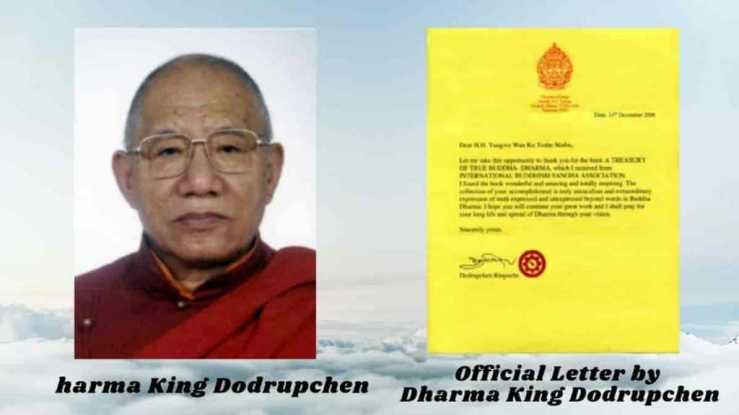
H.H. Dorje Chang Buddha III ‘s accomplishments are unprecedented. H.H. Dodrupchen Rinpoche, the greatest dharma king and master of the Nyingma sect congratulated H.H. Dorje Chang Buddha III with the following words, “The collection of your accomplishment is truly miraculous and extraordinary expression of truth expressed and unexpressed beyond words in Buddha Dharma.” Jigme Dorje, Supreme Dharma King of the Jonang Sect wrote: “Such superlative accomplishments are truly unprecedented in the past few thousand years, outshining the accomplishments of all others, both ancient and modern. His Holiness is a shining paragon among Buddhas.” Buddhist leaders cannot just toss off statements like these as if they were blurbs on the back cover of a book. The consequences of making ill-considered or casual statements about recognizing a Buddha would be enormous.
I can understand the impulse to be suspicious of things outside the normal and usual happenings, but I do sometimes think that our current times are not really all that normal. The natural world is in serious decline. There’s climate change and other troubles for life on the planet. We’re losing birds, insects, sea life, coral reefs and whole species. And there’s very great social change as we embrace the digital world, automation and artificial intelligence. Maybe it really is a time of extraordinary danger and a Buddha has come just in time to help all living beings on earth.
I’d like to say that Zhaxi Zhuoma Rinpoche’s tour of America was a roaring success, but the number of Westerners who follow His Holiness the Buddha is still quite small. After meeting Zhaxi Zhuoma Rinpoche, I traveled to many different places to be able to hear preliminary English translations of recorded discourses by H.H. Dorje Chang Buddha III. Though there are thousands of recordings in Chinese, not many have been translated into English. Of these, only one, The Dharma of Cultivation is completely approved as a translation and published as a book and also free online on multiple websites. Zhaxi Zhuoma Rinpoche’s Holy Vajrasana Temple website has a link to this text. Listening to the discourses, I felt I was hearing the true Buddha Dharma. They were brilliant, clear, informative and extremely practical. If you listen to these discourses, as many thousands of Chinese speakers do, you will know exactly how to transform yourself through cultivation into the causal state for becoming a bodhisattva — that is, one who corresponds with a bodhisattva’s actions of body, speech, and mind.
All my resources for learning and practicing Buddhism are magnificent now. From the Buddha Master’s discourses and dharma teachings I have learned things I never heard before and experienced things I never saw before. Many high-level disciples of His Holiness are shining examples of sincere cultivation and devoted practice. Many of His disciples can manifest dharma powers. Some of them can perform extraordinary rituals of esoteric Buddhism, so that manifestations of Buddha-dharma are being seen and experienced in America now that only used to happen in Tibet. Dharma rituals such as: Creating a Sand Mandala through a Stone Slab; various rituals of selection such as, Drawing Lots from a Golden Vase; high temperature displays of Tummo Concentration; the Vajra Fa Man Initiation in which grains of sand weave themselves into a crown above a portrait of a Buddha or Bodhisattva; Beseeching Nectar from the Buddhas in which nectar manifests in a bowl; Eight Winds in Samsara Battle Position in which masters are tested in the holy realm. My teacher, Zhaxi Zhuoma Rinpoche’s Holy Vajrasana Temple is a Bodhimandala empowered by H.H. Dorje Chang Buddha III where Dharma Protectors will sometimes shake vajra poles to the delight of devout visitors to the temple. It is all so wonderful. I have seen these vajra poles mysteriously, vigorously shake. I have seen and felt nectar from the Buddhas rain from cloudless blue skies. I participated in the Eight Winds in Samsara test. My experiences are everything I expected the true Buddha-dharma to be and I’m experiencing these things in the USA!
As a follower of H.H. Dorje Chang Buddha III, I feel that the dharma I’m receiving is the original, authentic, and very real thing. It is a great treasure that I would like others in the West to enjoy as well. I liken this true Dharma to the silver dimes and quarters we used to use in America. In 1964 the silver content of American coins that had been minted from 90% silver was drastically reduced to no silver at all. There was no loss in their use as currency, their purchasing power remained, but they had lost their intrinsic value. They weren’t real silver and did not have the true properties of silver. I feel that secular Buddhism is like these new coins, which are shiny and still useful, since they still function as currency, but they’re not silver. They have lost the essence of why silver was chosen for coinage in the first place; it reflects light purely and beautifully and can be fashioned into treasured objects. I don’t believe the secular brand of Buddhism with its focus on being the best me, or on therapy, or on succeeding at business and personal relationships has retained its original value and purpose of helping us leave samsara. Many other systems can accomplish these aims as well. And these aims are side effects of sincere practice anyway, so there’s no value at all in losing the treasured ultimate goal of Buddhism. For those of us who want more, who wish to become arhats or bodhisattvas or buddhas, who want to realize enlightenment, accomplish prajna, attain the four wisdoms, the three bodies, the usages of emptiness. For those who wish to be able to expound the dharma that can liberate living beings, they should know there is more to Buddhism than the usual American fare. There is a Buddha here now whose teachings will help them cultivate their three karmas into a causation state for becoming a bodhisattva and whose transmissions of dharma practices can activate true dharma abilities. Everyone please take notice.
Gesang Suolang Rinpoche Shares Her Insight into the Dharma of H.H. Dorje Chang III & Why the West Needs It
Once upon a time in a remote village, nestled between the mountains, there lived a wise old monk named Master Sean. He was renowned for his ability to guide people in finding their inner voice, a skill that had been passed down through generations of monks in his lineage.
One day, a young man named Kaito arrived at the monastery seeking guidance from Master Sean. He had heard tales of the wise monk and hoped to learn the secret of listening to his inner voice. Master Sean welcomed Kaito with a warm smile and led him to a quiet room overlooking the monastery’s lush gardens.
Before we begin,” said the wise monk, “I want you to spend some time in silence, observing the garden and the creatures that inhabited it.” Kaito sat by the window watching the birds flip from branch to branch, the squirrel scamper across the grass, and the butterflies dance in the breeze. As he observed the harmony of nature, he felt a sense of peace wash over him.
After some time, Master Sean returned and asked Kaito what he had learned from his observations. Kaito replied, “I saw how each creature has its own rhythm and purpose and how they all coexist in harmony.” Master Sean nodded, pleased with Kaito’s insight.
“Now let me tell you a story,” he said, settling into a comfortable chair. “Once there was a young monk who lived in a monastery high in the mountains. He was diligent in his studies and meditation, but he struggled to hear his inner voice. One day, his master took him to a nearby cave where they found a small clear pool of water.”
The master instructed the young monk to gaze into the pool and describe what he saw. The young monk peered into the water and saw his own reflection, along with the reflections of the cave walls and the flickering light of their torches. The master then asked the young monk to close his eyes and listen to the sounds around him.
The young monk heard the gentle dripping of water, the distant echo of their voices, and the soft rustling of the wind outside the cave. Finally, the master told the young monk to open his eyes and look into the pool once more. This time, the young monk saw something different beneath the surface of the water. He could see a world of shimmering fish darting among the rocks and plants.
The master explained that the pool was a metaphor for the young monk’s mind. The surface reflections represented his thoughts and emotions, while the hidden world beneath symbolized his inner voice. To hear that voice, the young monk needed to learn to look beyond the surface distractions and listen deeply to the quiet whispers within.
Kaito listened intently to Master Sean’s story, feeling a spark of understanding ignite within him. He asked, “How can I learn to look beyond the surface and hear my inner voice?” Master Sean smiled and replied, “You must practice mindfulness and cultivate stillness in your mind. Just as the pool’s surface becomes calm and undisturbed, so too will your mind reveal its hidden depths when you learn to quiet your thoughts and emotions.”
Over the following weeks, Kaito practiced meditation and mindfulness under Master Sean’s guidance. He learned to observe his thoughts without judgment, allowing them to pass like clouds in the sky. Gradually, he began to hear the whispers of his inner voice, guiding him with wisdom and clarity.
As the story of Kaito and Master Sean comes to a close, let us reflect on the nature of happiness. Happiness, like the inner voice, is often found in the depths of our being, beyond the surface distractions of our thoughts and emotions. It is not a fleeting sensation or a temporary state, but rather a profound sense of contentment and inner peace that arises from living in harmony with our true selves.
To cultivate happiness, we must learn to listen to our inner voice, allowing it to guide us on our journey through life. By embracing mindfulness and stillness, we can quiet the noise of our minds and tune into the wisdom that resides within us. In doing so, we discover that happiness is not something to be pursued or acquired, but rather a natural state of being that emerges when we align ourselves with our deepest values and aspirations.
In the words of the ancient philosopher Lao Tzu, “Happiness is the absence of the striving for happiness.” May we all find the courage to let go of our endless pursuit of external validation and material success, and instead turn inward, seeking the happiness that lies within our own hearts and minds.
At February 2019, the solo art exhibition of Dr. Yuhua Shouzhi Wang was held at the Ratchadamnoen Contemporary Art Center of the Department of Culture of Thailand. Dr. Yuhua Shouzhi Wang is a distinguished international art master of world renown who is highly recognized by the art world both in the East and in the West.
I am very pleased to have the opportunity to appreciate Dr. Wang’s ink paintings which are truly refreshing. I feel like I have entered an art sanctuary of wonderful colors where I can stroll slowly, appreciate silently, and savor the details thoroughly. As I am strolling along, I notice that I have left the noise of the world behind, and I sense the clarity, peacefulness and serenity in my mind.
Great masters specializing in painting flowers and fruits in the recent 100 years are such as Wu Changshuo and Qi Baishi. As I view Dr. Wang’s works, I feel that her artworks are of the top quality in the free hand style of liberal expressivity.
Professor Wang’s paintings contains the brushwork of traditional Chinese ink painting while incorporating the strategies of Western painting. Her art, honoring tradition and breaking new grounds at the same time, is unique and unfathomable, sophisticated and powerful.
From the paintings, we can see how Professor Wang especially pursues and places emphasis on the spirit, the sensibilities, and artistic conception of ink painting through which she shows the different characteristics of Chinese and Western paintings. She merges these characteristics into her distinguished style.
Professor Wang’s ink paintings are leading me into the refreshing and beautiful nature, allowing my restless soul to rest peacefully.
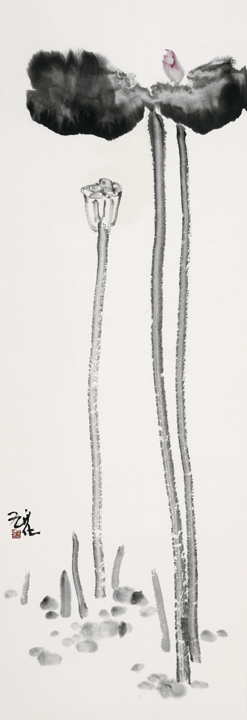
In one of the paintings, three lotuses stand elegantly and the pods have just become fully grown. The stems created by seal-script brushstrokes have a pure and dignified presence.
The composition is clean, simple and effective; echoing the legacy of Bada Shanren. The painting seems to symbolize noble qualities of a lotus that grows out of the sledge yet remains pure, sending off its refreshing fragrance.
Standing in front of the Vitality at the Lotus Pond, I am drawn to the full composition of the ink-wash pastel flowers and the carefree, other-worldly artistic conception. The painting is enlivening a wondrous scenery of lotus in misty rain where the flowers can be compared to the renown classic beauty Xishi who was known to look elegant whether she adorned her face with rich or simple colors.
In a loquat painting, the fruits are painted in a semi-abstract manner. Powerful brushstrokes are used to depict the leaves and the stems. Under Dr. Wang’s sophisticated, forceful and unrestrained brushwork, the leaves of the loquat tree appear robust and energetic. The round and perfect yellow fruits depicted by Dr. Wang in the style of realism look adorable and delicious. There is a sense of classic elegance throughout the composition which also leads one to think of prosperity, peacefulness, and a big family with many children and grandchildren.
A painting depicting cockscomb flowers is inscribed with the verse “Red and white cockscombs are cherished delights. A few strokes of the brushes capture the pleasantness.” The color contrast of the red and white cockscomb flowers seems ordinary yet it is most exceptional. This is truly an extraordinary conception. The upstanding, bright and red flowers with heads held high give a sense of positivity, upward mobility, and vigorous passion.
In another painting, the plum blossoms are energetic and full of power, with slanting branches that are charmingly graceful. The composition of this painting is audacious, lively, and untainted by the mundane, giving a unique sense of spirituality. In this painting, the rich colors are not garish, the faint colors are not cold. The artistic conception is truly transcendent in depicting the subtle fragrance and gentle movement of the flowers.
The five petals of a plum blossom symbolize the five good fortunes including happiness, joy, longevity, wellbeing, and peace. There is a saying that goes, “The plum blossoms give out a sweet fragrance after enduring the bitter cold.” Plum blossom symbolizes strong and noble character.
In the painting Plum Blossoms, Professor Wang has penned the inscription that says, “The charm of the ink and brush is in the spirit, the way of painting plum blossoms is just the same.” The inscription speaks of how vivaciousness and the highest state of artistry can be achieved through the ink, the brush, the color and the lines.
With a faithful mind, I appreciate the paintings one by one silently. I read each and every classic inscription carefully. I feel as if I am taken into a brand-new state of being where I experience poetry in the paintings, paintings in the poetry, and wonderful melodies in praise of the nature’s embrace.
German philosopher Goethe once described art in this way: Beauty is the highest principle of art. It is also the highest goal.”
Professor Yuhua Wang’s paintings are extraordinary. The excellence of her art does not lie in how the artist represents the form of nature, but in how she uses the form to express her mind, and how she brings out the spirit within the form. Her paintings express humanity’s wishes for peace and happiness; they express humanity’s praise to the qualities of freshness, transcendence, nobility and elegance; and they also express humanity’s gratitude to the selfless beneficence of flowers, trees and plants.
In this sanctuary of art, we have enjoyed a precious experience of beauty. Our souls are cleansed and transformed by beauty.
I wish that Professor Yuhua Wang’s exhibition will tour different parts of the world, so more people may enjoy the beauty of nature, the beauty of art, the beauty of life, and the beauty of character.
We also look forward to seeing more of the art of Dr. Yuhua Wang that is of the style of ease.
Even though we are cultivating ourselves, it is hard to overcome many, many lifetimes of evil behavior accumulated over eons of time, both as humans and as non-humans. However, we can stop negative actions from ripening by purifying them.His Holiness Dorje Chang Buddha IIIsaid it is like building a wall of good karma to protect us from the bad. Our bad karma cannot be eliminated–only by becoming enlightened can we escape the laws of cause and effect. The sutras say that “there can be no fault so serious that it cannot be purified by the four powers or four opponent forces.” EvenMilarepaand Angulimala, who were both mass-murderers, were able to purify their negative karma and become enlightened in a single lifetime, but they both were able to do this by following enlightened masters and using these powers. Thesefour opponent powersthat are essential for successful purification are:
H.H. Dorje Chang Buddha IIItells us that “within the truth of Buddhism, there is the doctrine that the law of cause and effect can never be denied. Cause and effect cannot be eliminated. To say that it can is to take anihilisticpoint of view. Hence, we can only build a wall of good karma, which is like building a retaining wall. This wall of good karma has the effect of blocking us from our evil karma.”
Dorje Pa Muhas also told us that allBuddha-dharmacan be condensed into the words cause and effect. All conditioned phenomena are subject to the processes of cause and effect and the four stages of arising, subsisting, changing and passing away. Those who realize the unconditioned obtain enlightenment as a result of certain causes. Yet, they are not attached to the thought of obtaining enlightenment. All Buddhist disciples must…
By Practitioner Yundun Duojibai V, Gadu with a heart of humility
Recently, when I was giving speeches to the friends at the Rotary Club, I was often asked a same question by a number of kind people, which is “What is a correct path of learning Buddhism and cultivation, and how can we correctly follow that path?”
In the following, I am going to use an analogy which is not exactly very appropriate but quite understandable by general public to explain the above question.
First, we must know that there are two very important acts or conducts on the path of learning Buddhism and cultivation, namely, “cultivation” and “dharma practice.”
The so-called “cultivation” means that we should, in our daily life and in our interaction with other people, correct our deeds that are not good so as to conform to the precepts and…










 Peace LiLy