It has been several weeks since the announcement of the news that Namo Dorje Chang Buddha III and Fomu, Holy Mother the Great Mahasattva, have borne dark karmas for living beings and entered parinirvana. Since then I have gradually calmed down from the shock, sadness, sorrow, confusion and loss.
H.H. Dorje Chang Buddha III and Fomu, Holy Mother the Great Mahasattva, set selfless, dedicated, and unsurpassed examples for us. The Buddha’s last words to Venerable Tsemeng Jiaozun so touched my heart: “….. When I said I would bear dark karma for living beings, those were not empty words. To bear dark karma is not to enter dhyāna, but rather, truly and continuously practice shifting the mind-consciousness to suffer on behalf of living beings. What Fomu and I said is what we do. At all times, we must think about bringing auspiciousness, serenity, happiness, and peace to living beings and to the world, to the extent of giving our all and even our lives. ….. I wish all living beings happiness.”
It has been more than ten years since I first heard the pre-recorded Buddha’s Dharma discourse. I have heard many discs, and I have also read the Dharma books written by H.H. Dorje Chang Buddha III, including “The Supreme and Unsurpassable Mahamudra of Liberation”, “Expounding the Absolute Truth through the Heart Sutra”, “Liaoyi Jing” and so on. But have I really put the Buddha’s teachings into practice? I seldom thought about to take on other person’s dark karma and sufferings. Even when my mother followed the evil master, escaped from the Buddha, and defamed H.H. Dorje Chang Buddha III, I did not think of taking on my mother’s guilt. How selfish I am compared to the Buddha.
In all the Dharma imparted by H.H. Dorje Chang Buddha III, the Buddha always emphasizes putting bodhicitta into practice: When there is a conflict of interest between myself and others, I will rid myself of hatred, antipathy, greed, and arrogant, disparaging mentality. I must not emphasize benefiting myself. I should treat myself and others equally. When other living beings and I are suffering, I want others to extricate themselves from suffering before I do. When other living beings and I are happy, I want others to be happier than I am. I dedicate to all living beings all of the merit and accomplishments from my cultivation in the hope that they will leave suffering and attain liberation.
I felt ashamed that I rarely put all these teachings in my daily practice. Most of the time I put myself at the first priority. I want to have good health, good fortune, and good luck — after I have all these I may share some with others.
When I recite The Supreme and Unsurpassable Mahamudra of Liberation, I realize I just did ritualistic chanting, making empty vows, engaging in visualization. I have always considered myself as a true Buddhist, now I realize that I deceived myself. In fact, I was a fake cultivator, I have not truly put Buddha’s principles into practice. I still have so many dark karmas: selfish thoughts, a mind of hatred, greed, jealousy, presumptuousness, arrogance, shamelessness, a mind that considers myself always in the right, a mind that deceives others. In this life time I have done so many wrongs. Here I sincerely repent of my sins, and vow to not commit to these sins again.
I am already in my fifties — how much longer can I live. I have no time to waste. Buddha has entered parinirvana. Impermanence may come to me at any time. I must follow the Buddha’s teachings truly and diligently. Every day I will introspect myself, asking myself how I should treat others when it comes to my words, how I should treat others when it comes to my mentality, and how I should treat others when it comes to my conduct. I must earnestly practice “the three daily introspections” — conducting three introspections in the course of a day. In the morning, introspect about how during the day I should act to become a purely good and compassionate person, a person who benefits the public. At midday, think back: “From morning until midday, did I have that kind of mindset and conduct?” At night, again think back: “From midday until night, did I have that kind of mindset and conduct? Are the things I did today truly reflective of the conduct, speech, and mindset of a Bodhisattva at the causal stage?”
Great compassionate Buddha and Fomu, Holy Mother the Great Mahasattva! Thank you greatly for using your life to sound the alarm of impermanence for me. And thank you greatly for using your life to bring Buddhist disciples the extraordinary cause and condition to study the Tathagata Dharma. I vow to use my own real actions to wash away my sins, and benefit all beings with compassion and pure goodness in order to repay Buddha’s grace!
Great compassionate Buddha and Fomu, Holy Mother the Great Mahasattva! I, a disciple, still want to hold on to a glimmer of hope and beg you all to return to the Saha world and give us foolish beings another chance!
A Treasury of Buddhist Wisdom for Children and Parents
Collected and Adapted by Sarah Conover
When the Buddha and his followers lived at Jetavana, a certain monk in the group was always upset – so much so that he could barely concentrate. When the Buddha asked him about it, the monk replied that he desired many things he couldn’t have; thus, he never felt content. “Oh, monk,” said the Buddha kindly, “these passions have been discarded even by monkeys. It is all the more important for one who lives the holy life to leave these feelings behind. “ And the Buddha recounted this old-world tale about the monkey king.
Once, in olden times, the Buddha came into the world as a monkey. He lived among the treetops of a remote jungle with a large family of monkeys. One day, a woodcutter came to this same jungle to fetch a good supply of logs for his family hearth. But when the woodcutter felled a large tree, he accidentally trapped the young monkey underneath as the tree dropped to the forest floor. When the woodcutter saw his surprise, he decided to bring the monkey home as a present to his king.
The bright monkey quickly tamed and was soon the favorite royal pet. The king let him run everywhere about the palace. So the monkey spent his days visiting the royal courts and kitchens, the guards’ quarters, and all the other enterprises within. The monkey easily learned to imitate the manners of the royal retinue, the ministers, the guards, and even the cook who chased him from her kitchen. It was impossible not to laugh at the monkey’s antics.
After a few years, the king requested that the woodcutter return to the palace. Then the king asked, “As a favor to this monkey who has pleased us so, would you bring him back to the jungle where he was captured? It would be kindest if we let him live out his years with fellow monkeys.” So the woodcutter did as the king bid: he brought the monkey back to the very same spot in the very same jungle and released him.
At once, as soon as the woodcutter had left, a hundred monkeys surrounded the palace monkey, all asking questions at once. “Where have you been living this long time? Where did that man take you? Did you go on a great adventure? Why did he let you go free?” On and on the monkeys clamored, full of curiosity.
When they quieted down, the palace monkey recounted his tale. He told them all about the king’s splendid palace and how he had entertained the king. He told them of the sumptuous feasts, the elegant dances, the noble ministers of the royal court, the king’s fearsome army, and the dark dungeons.
“But then, how did you escape?” They wanted to know.
“I was such a good pet, and I amused them all so, that they felt badly keeping me from my home. The king decided to set me free again, so here I am!”
Now the monkeys were really excited. “Oh, tell us all about the palace life!” They jumped and shouted. “Tell us about the ways of people! Tell us about the grand deeds of a king!” they insisted.
“No, you wouldn’t want to know,” cautioned the palace monkey. “You really won’t like it.”
But the monkeys would not let up until he agreed to show them what life was like for a king. So the palace money picked a monkey in the troop and said, “O.K. then, you be the king. Get up on this high rock and make it your throne. We will set to work and bring you the best fruit in the kingdom!”
So the monkey king sat upon his rock throne, surveying his kingdom and looking quite content. Soon a huge pile of delicious fruit surrounded him. After a time the king monkey began to feel distressed. “ But I could never eat all this fruit, even in a whole year! And how there’s nothing left for all of you to eat,” laments the monkey king.
“Of course you can’t eat it all,”said the palace monkey. But that dose’t matter to a king. The point is that you eat whatever you want, but you must not give any of it away. You must always keep a large pile so that others know you are very rich and very powerful!” So the monkeys, wishing to be like men, brought even more fruit and stacked it even higher around their king.
“What else do we do?” asked the monkeys when there was no more fruit to be had.
“You must all come before the king and praise him in every way you can imagine.”
The monkeys liked this idea, so they tried it.
“Well, no wonder his is king!” pronounced one. “His coat glistens like water.”
“His fur is as thick as deep grass!” boasted another.
“I’ve never seen such a strong and capable animal!” exclaimed a third monkey.
“No one is as wise and dignified as our king!” And so they gathered around their king and enjoyed themselves in flattering him.
“Enough of that,” said the little palace monkey. “Now it’s time to come behind the throne and say terrible things about the king.”
The monkeys didn’t like this idea at all and at first refused to do it. But the palace monkey preserved saying, “You have to try this if you want to learn the ways of people! See what it’s like.”
So the monkeys gathered behind the rock and whispered insults about the king.
“Have you noticed how old and confused the king seems lately?” asked a monkey.
“His eyes seem dull and he constantly forgets what he has said!” chuckled another.
“I think his fur is getting extremely thin; I think he might even be going bald in some very funny spots” tittered a third.
“I’ve noticed that the king eats more like a pig than a monkey!” said a fourth and they all howled.
At last the insulted monkey king could stand it no longer. He jumped off his throne and ran after them through the trees. But the monkeys each escaped in a hundred different directions from the frustrated king. When the monkey king as last returned to his throne, his eyes widened in astonishment. All the fruit had vanished!
“Where is the fruit?” cried the king. “All my fruit is stolen!” he bellowed.
“Yes, it’s a shame, but these things happen even to kings!” said the palace monkey. “Now your guards must go find the thieves. That’s what a king would do. And when the guards capture the thieves, they must be sentenced to death at once.”
“What?” cried the monkey king. “You want me to kill them? Oh, how could such a terrible thing come to pass?” he wailed. And he covered his ears with his hands and wept.
“No more! No more!” cried all the monkeys. “We don’t want to know anything else about the ways of people and kings!”
The palace monkey, the Former Buddha, then recited for them a little poem he had made up about life in the palace:
“This gold is mine, this gold is mine!’
so they cry both day and night:
These foolish folk who live in splendor
never think about the holy way”
“And,” said the Buddha, concluding his lesson, “the monkeys ran away from the rock throne and back up to the tree tops where they all lived happily ever after.”
A Treasury of Buddhist Wisdom for Children and Parents
Collected and Adapted by Sarah Conover
Once, some monks who could not stop quarreling came to the Buddha to ask his advice. “Brothers” the Buddha calmly replied, “ I have told you many times that fight and quarrels solve no problems – yet you continue. Remember, even some kings with great and powerful armies have learned gentleness. So much the more that you, living the holy life without possessions, should be like light in the world, known far and wide for kindness. Listen now to this story of a noble prince, who became a true hero in the world”.
Once upon a time, two kingdoms lay side by side. One kingdom belonged to the King of Kasi: a powerful ruler who possessed a great army and treasures nursing with gold. But in the nearby kings of Kosala lived a much poorer king. He led a meager army, possessed little gold, and held sway over a modest territory. And just as you might guess, the powerful King of Kasi eyed the small kingdom of Kosala and decided he should conquer it.
When the King of Kosala heard that a large garrison was headed his way, he knew he didn’t stand a chance. To avoid any bloodshed, he counseled with his ministers and decided to immediately surrender his army. As the attacking warriors approached, the King of Kosala slipped away to the city’s edge – he and the queen disguised as humble potters.
After time concealed among the common folk, the queen gave birth to a beautiful baby boy. He was secretly named and crowned, Prince Dighavu. They so loved their new son, that the king and queens only concern became his safety. The king feared that somehow – at some time in the future – the royal family would be recognized. He felt it was only a matter of time; a spy would see through their disguises and kill them all. So with heartfelt loss, the King and Queen of Kosala sent their young prince away to be raised in the countryside.
Alas, a dozend years later, events occurred exactly as the king had feared. The present barber of the king of Kasi had once been the barber to the poorer king. And one day, in the hubbub of the busy marketplace, the barber recognized the disguised king. He easily saw through the king’s charade. The barber fell back into the crowd and secretly pursued the king to discover where he now lived. Then the barber reported right away to the King of Kasi, knowing that he would be richly rewarded for the information. “I have news that right within the walls of this city live both the King and Queen of Kosala! I, who know the king’s face better than any, saw it with my own eyes – they live in a potter’s shed and are disguised as beggars!”
When the King of Kasi heard this report, he feared that if the old king and queen were yet alive, they had a hundred reasons to seek his own death and the return of their kingdom. Disguised or not, he anticipate they would find an opportunity to kill him. So he commanded his guards, “Go now to the potters’ sheds near the outskirts of town. Arrest the old king and queen! When you find them, it will be their last hour! Bind their arms, shave their heads, bring them outside the gates of the city and destroy them!” And thus the guards were dispatched to the capture the couple.
But very early this same day, the young Prince Dighavu awoke full of longing to be with his parents. Now old enough to travel from village alone, he reasoned, “It’s been months since I’ve seen my parents. I would so much like to visit them today! I will make them a present of ripened fruit and delicious cheese from the country.” And so the prince cheerfully gathered a few gifts, packed some clothing and money, and set out of the city.
By this time, however, the guards had found the royal couple – just exactly where the barber had betrayed them to be. They bound their arms tightly with thick rope and dragged them roughly through the streets. But the king and queen walked with dignity, even as they reached the city gates where they knew they would soon die.
And so it came to pass that just as Prince Dighavu was entering the city, he witnessed his parents being led to their deaths. In desperation, he made his way to the front of the surrounding crowd. Just sat the moment he spied his parents, they too, saw him amidst the mob. When the prince neared within earshot, his father shouted, “Dear Dighavu, do not look long! Do not look short! For hatred is not stopped by more hatted! No, dear one, hatred ends only by love!”
The soldiers thought the old know had lost his mind. “Who is this Dighavu? What gibberish you speak!”
But the king cautioned Dighavu twice more in the same way, finishing, “He that is intelligent will understand my meaning!” There were the king’s last words. As swords fell upon his parents’ heads, the anguished prince said a silent farewell so as not to reveal his own identity.
Prince Dighavu went to the nearby forest and fell to the ground. In agony he wept and wept until he could weep no more. Under the empty night sky, he considered the terrible murder of his parents and devised a plan to recover his family’s honor.
First, he returned to the city, and purchased some liquor for the soldiers standing guard over his parents. When the guards cucumber to the alcohol and fell asleep, the prince performed a funeral by the city gates. But at that same, exact moment, from the atop the splendid place tower, the King of Kasi happened to see the prince paying his respects to the murdered king and queen. “Alas!” Said the king in great alarm. “What misfortune will happen now? I will still have no safety or peace of mind while someone who cares for them wishes to reverse their deaths!”
And so it came to pass that the very next day Prince Dighavu embarked on such a plan. He went to the king’s elephant stable and asked that the elephant trainer teach him his art. The trainer agreed to take on the eager apprentice. As part of the prince’s secret plan, he rose each day at dawn to play the lute and sing to the entire palace compound. His lovely songs were haunting and captivating. Just as the prince has hoped, the King of Kasi, standing on his palace balcony, heard the enchanting voice and asked his attendants from whence it came. “Your Majesty,” they replied, “it is the elephant trainer’s new apprentice”.
“Bring him to me,” commanded the king. “I must meet the one who possesses such a gift.”
All was proceeding exactly in accord with Prince Dighavu’s Plan. He came before the king, strummed the lute even more beautifully, and sang his most soothing melodies. The king was utterly charmed. “Young man”, said the king, “such a voice comes only from one with the finest sensibilities and depth of feeling. I would like you to have the honor of being my manservant.” So Prince Dighavu – still unknown for his identity – became the king’s personal attendant. He rose before the king, preparing the king’s affairs; he retired at night long after the king’s affairs; and he obeyed the king’s every command in between. And in due time, the king appointed Prince Dighavu as Councilor and Confidant – just as the prince had hoped.
But Prince Dighavu’s secret and grand scheme was far from complete. A year or so later, the prince had the chance he had worked and waited for. It so happened that one balmy, spring day, the king wished to go for a chariot ride. To Prince Dighavu he requested,”Harness the chariot, my best man; I wish to go hunting in the forest and I want you alone to drive me.”
“Yes, your majesty, right away!” Obeyed the prince. A magnificent chariot of gold and lapis was harnessed to two steeds. The prince firmly held the reins and hurried the chariot towards the city’s perimeter. As the city’s gates opened wide for the royal chariot, Prince Dighavu saw the king’s army go in the direction of the eastern forest; the prince steered the chariot towards the west. “I believe the hunting will be better in these quieter woods sir,” he assured the king.
“Very well, my man. Let us try it out,” replied the king.
The day was cloudless, and after an hour of travel, the heat oppressive. The sultry, midday sun made the king grow drowsy. “My man, unharness the chariot,” he mumbled. “ I am tired and I wish to lie down in the shade of some trees.”
“Yes, your majesty,” complied the prince. The prince watered and hobbled the horses, then rested beside the king under a large Banyan tree. The king placed his trusting head in the prince’s lap and fell immediately to sleep.
With the king’s safety resting utterly in the hands of Prince Dighavu, the prince’s plan was nearly complete. As the prince looked upon the sleeping king, he thought to himself, “The king of Kasi has done me as much harm as any man could. He has murdered my mother and father! He has robbed our kingdom of its treasury and territory! He has destroyed the honor of the Kingdom of Kosala! Now is the time for me to avenge my hatred!”
Ever so quietly, the prince unsheathed his sword. But as he raised his sword over the king, ready to inflict his punishment, his father’s last words seemed to shout within him: Dighavu, hatred is not stopped by more hatred! No, dear one, hatred ends only by love! Prince Dighavu could not disobey his father’s dying words. He could not kill this unsuspecting king. The prince slowly sheathed his sword. But then the same thought of revenge – the thought that had been his mission since the day of his parents’ deaths – rose in him more strongly! He had waited years for this moment! Again, he unsheathed his sword. But alas, he stopped himself once more; he could not act against his father’s last wish; he could not end his hatred with another murder.
Suddenly, the king awoke and sat bolt upright – pale and terrified! The prince’s internal struggle abruptly ended. “Your Majesty!” Said the prince, “what ever had occurred? Why did you wake so alarmed?”
The king gasped, “Right now, in my dream, the son of the King of Kosala – the heir and prince – wanted to kill me by sword. He was going to sever my head! I thought I was about to die!”
Then Prince Dighavu, gently touching the neck of the king with his left hand and drawing his sword with the other, told him the truth. “I, your majesty, am that prince! I am Prince Dighavu, son of the King of Kosala! You have robbed my people of food, territory, and treasure. You have even killed my own mother and father! This would indeed be the time to show my hatred and exact my revenge!”
At that admission, the king fell upon his knees at the feet of the prince and begged for forgiveness. “ Grant me my life, dear Dighavu ! Grant me my life!” Wept the king.
In his heart, Prince Dighavu now realized what his father had meant for him to learn. He told the king of his father’s forgiving words – his last words – and how they stopped the prince from ending the king’s life. The prince proclaimed that he would no longer carry this terrible hatred. “Although I have the power to grant you your life at this moment,” said the prince to the king, “you also have the power to grant me my life: for you can assure my safety in your kingdom!”
“This is very true,” agreed the king. “Grant me my life now and I’ll forever grant you yours. We will no longer be enemies, but vow to live in peace.” At that, the prince and king swore an oath never to harm one another and to protect each other’s well being.
Peaceful now, with a warm feeling of forgiveness, the two men harnessed the horses remounted the chariot, and leisurely made their way back to the palace. When the king returned to his court, he gathered all his ministers and councilors together. “Tell me sirs,” asked the king, “if it happened that you laid eyes upon Prince Dighavu, son of the King of Kosala, what would you do?”
A minister immediately spoke up, “ Your majesty, we would kill him on the spot!”
“Yes!” Shouted another. “We would chop off his head and cut him to pieces!” Many voices rose in a cacophony of agreement.
But the king said, “Hush! Sirs, in front of you is Prince Dighavu, son of the King of Kosala.” A great, astonished silence filled the hall. The king continued, “ You may not harm him. He has granted me my life and I have granted him his.” The king turned to the prince; “I would like you to tell them, young prince, the marvelous meaning of your father’s last words.”
All eyes in the court turned to the prince. He looked at his audience with courage and forgiveness. “When my father said to me in his hour of death, ‘Look not long dear Dighavu’ what he meant was, ‘Do not hold on to hatred, do not nurture it.’ When, Your Majesty, my father spoke, ‘Look not short,’ what he meant was, ‘Do not lose friends easily – be the most loyal of friends.’ When my father said, ‘Hatred is not stopped by more hatred!’ What he wanted me to learn was this: the king has had my mother and father killed. Were I to kill Your Majesty, your people wold want to kill me, and my people would want to kill those who had harmed me. Hatred would not end by further hatred. On and on it would go, with many lives lost and many hearts broken. But now,” continued the prince, turning towards the king, “ Your Majesty had given me my life ad safety, and I have done the same for you. So by love and forgiveness we have stopped this terrible cycle of hatred.”
The king blessed the prince, “Oh, councilors! Is it not remarkable how deeply the prince understands his father’s brief words!” And thus the king returned to Prince Dighavu the army, territory, and treasure that rightfully belonged to the Kingdom of Kosala. The prince and the king’s own daughter were soon married, and they all lived in peace, two kingdoms side by side, happily ever after.
“And so I say to you,” declared the Buddha to the monks, “enough of fighting! This is my advice, good brothers.” And the Buddha returned to the solace of his meditation.
The moral is : For never in this world Do hatreds cease through hatred; Through love alone do they end. This is the ancient and eternal law.
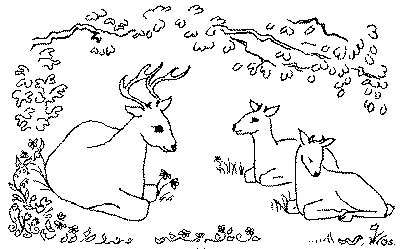
Once upon a time, there was a deer who was the leader of a herd of a thousand. He had two sons. One was very slim and tall, with bright alert eyes, and smooth reddish fur. He was called Beauty. The other was Grey in color, also slim and tall, and was called Grey.
One day, after they were fully grown, their father called Beauty and Grey to him. He said, “I am now very old, so I cannot do all that is necessary to look after this big herd of deer. I want you, my two grown-up children, to be the leaders, while I retire from looking after them all the time. We will divide the herd, and each of you will lead 500 deer.” So it was done.
In India, when the harvest time comes, the deer are always in danger. The rice is at its tallest, and the deer cannot help but go into the paddies and eat it. To avoid the destruction of their crops, the human beings dig pits, set sharp stakes in the ground, and build stone traps — all to capture and kill the deer.
Knowing this was the season, the wise old deer called the two new leaders to him. He advised them to take the herds up into the mountain forest, far from the dangerous farm lands. This was how he had always saved the deer from being wounded or killed. Then he would bring them back to the low lands after the harvest was over.
Since he was too old and weak for the trip, he would remain behind in hiding. He warned them to be careful and have a safe journey. Beauty set out with his herd for the mountain forest, and so did Grey with his.
The villagers all along the way knew that this was the time the deer moved from the low lying farm lands to the high countryside. So they hid along the way and killed the deer as they passed by.
Grey did not pay attention to his father’s wise advice. Instead of being careful and traveling safely, he was in a hurry to get to the lush mountain forest. So he moved his herd constantly, during the night, at dawn and dusk, and even in broad daylight. This made it easy for the people to shoot the deer in Grey’s herd with bows and arrows. Many were killed, and many were wounded, only to die in pain later on. Grey reached the forest with only a few deer remaining alive.
The tall sleek red-furred Beauty was wise enough to understand the danger to his moving herd. So he was very careful. He knew it was safer to stay away from the villages, and from all humans. He knew it was not safe in the daytime, or even at dawn or dusk. So he led his herd wide around the villages, and moved only in the middle of the night. Beauty’s herd arrived in the mountain forest safe and sound, with no one killed or injured.
The two herds found each other, and remained in the mountains until well after the harvest season was over. Then they began the return to the farmland country.
Grey had learned nothing from the first trip. As it was getting cold in the mountains, he was in a hurry to get to the warmer low lands. So he was just as careless as before. Again the people hid along the way and attacked and killed the deer. All Grey’s herd were killed, later to be eaten or sold by the villagers. Grey himself was the only one who survived the journey.
Beauty led his herd in the same careful way as before. He brought back all 500 deer, completely safe. While the deer were still in the distance, the old chief said to his doe, “Look at the deer coming back to us. Beauty has all his followers with him. Grey comes limping back alone, without his whole herd of 500. Those who follow a wise leader, with good qualities, will always be safe. Those who follow a foolish leader, who is careless and thinks only of himself, will fall into troubles and be destroyed.”
After some time, the old deer died and was reborn as he deserved. Beauty became chief of the herd and lived a long life, loved and admired by all.
The moral is: A wise leader puts the safety of his followers first.
There is a common Chinese saying: An inch of time is an inch of gold, but you can’t buy that inch of time with an inch of gold. When I was a child I often heard the grown up say, ”Time really goes by quickly, it’s already been a year!” I didn’t agree with them. I always felt that the days passed by so slowly. I always wished that time would go faster, so that the holidays could be closer to me. I especially couldn’t wait for the Chinese New Year, and it seems that it would take so long for the Spring Festival to come. I would look forward to the delicious food and delicacies Candy. Sometimes I even got new clothes, a truly wonderful new year presents. I could play with my friends all day long, we shared holiday treats and exchanged the beautiful candy wraps ( those were our treasure collections)……
Time seems to get shorter and shorter with age. Now I am already in my fifties, and it feels like several decades have passed in the blink of an eye. Looking back, everything seems just like a dream, I can’t go back to those time anymore. The past will never come back, and all I have left are fragmented memories. My grandparents, my father, my older and younger relatives, passed away one by one. They could never come back to the world again.
Through the years, I have gradually begun to understand what the Buddha said in the Diamond Sutra: All events are like a dream, an illusion, as fleeting as morning dew….. It took me so long to understand the truth of impermanence.
I remember once reading a story about Master Qinluan. He was a famous Japanese Zen master. At the age of nine, he made up his mind to become a monk and asked Zen Master Cizhen to shave his ordination for him. Zen Master Cizhen asked him, “Why do you want to become a monk when you are so young?” Qinluan said: “Although I am only nine years old, my parents have both died. I don’t understand why people must die. Why must I be separated from my parents? Therefore, I must become a monk and explore these truths.” Zen Master Cizhen said: “Very well. I’m willing to accept you as a disciple. However, it’s too late today, so I’ll shave you tomorrow morning.” Qin Luan said, “Master! Although you said that you will shave me early tomorrow morning, I am still young and ignorant. I can’t guarantee whether my determination to become a monk will last until tomorrow. Besides, Master, you are so old, you can’t guarantee that you will even wake up tomorrow morning!” After listening this words, Zen Master Cizhen was surprisingly happy, and said joyfully, “Yes! What you said is absolutely right. Now I will shave for you!”
I really admire the wisdom Master Qinluan’s displayed at age 9. Transcending the cycle of life and death is the most difficult thing in the world. It requires tremendous effort and unshakable determination.
Master Milarepa was a man of great accomplishment within Tibetan Buddhism. His Master – Great Venerable Marpa made him went through all the torture and abusive testing. In the end, Master Milarepa became a person within Vajrayana Buddhism who attained enlightenment by truly undergoing hardship and suffering.
One time as complying with the instructions given to him by Vajrayogini, Master Milarepa traveled from the Himalayan mountains to the interior of Tibet to save living beings. On the way, he met a husband and wife who were unable to conceive a male offspring. This couple heard that Master Milarepa was Great Accomplished One who had learned tantra. They thus showed him great respect and had great confidence in him.
They invited the Venerable One, Master Milarepa, to their home. They asked the Venerable One not to continue his life of wandering in all directions, a life in which the basic necessities could not even be guaranteed. They asked him to stay with them and be their son. They said that they would provide him with a vast amount of wealth for his use and enjoyment. They said that they would find him a beautiful, virtuous, wise, warm and tender women to marry. He and this wife would then live in the most opulent and beautiful house, which would be tall and large. They would have much fertile land, which they could never use up. This couple hoped that Master Milarepa would, together with his future close family members, share in the joys of family life. They hoped that he would lead a harmonious, stable, and happy life.
Hearing the promises of this extremely kind couple, Master Milarepa remained totally unmoved. He told them that he could not renounce all of those things soon enough, let alone embrace them. The Venerable One imparted his teachings to them by way of songs. Master Milarepa taught them the truly disadvantageous effects one’s worldly family members have on one’s cultivation and worldly life. He taught them the suffering involved with worldly things, how worldly things are impermanent, and how they are like dreamy illusions and empty bubbles. He taught them how all conditioned phenomena preempt and how such phenomena are ultimately subject to the law of cause and effect.
After hearing these teachings, this husband and wife each gave rise to a resolute mind. They became disenchanted with impermanent things and worldly life. They understood that all of the different kinds of worldly emotions and love must ultimately vanish into emptiness, like smoke or clouds that pass before one’s eyes. They therefore gave up all their worldly possessions and wealth. They cut off their attachment to the concept of self and diligently cultivated themselves. In the end, they realized the state of enlightenment.
At this Dharma ending age, it is extremely difficult to find a Dharma Master as Master Milarepa. However the living Buddha Namo H.H. Dorje Chang III has promised: As long as you thoroughly learn either The Xiaman Most Excellent Oceanic Mind Essence (暇滿殊勝海心髓) or The Ultimate Bodhicitta for Attaining Dharma-Nature True-Thusness Oceanic Mind Essence (最勝菩提空行海心髓) in The Supreme and Unsurpassable Mahamudra of Liberation and have put into actual practice what you learn, you can be assured that the highest, holiest great Dharma will be available to you for achieving perfect good fortune and wisdom, liberation, and accomplishment!
A Buddhist Tale from Tibet Adapted by Elisa Pearmain
The children at the village school laughed at Chunda. They said that the boy was a simpleton because no matter how hard he tried, he couldn’t seem to learn to read or write. But the adults of the village were fond of Chunda, for he had a kind heart, and though he was a wisp of a teen, he was always willing to help, running an errand or sweeping a front yard.
Chunda admired his older brother Raj above all else. Raj, who was a couple of years older than Chunda was a bright scholar. When he turned 16, he decided to move to the city to study Buddhism at the monastery. Chunda begged to go with him, and his brother found a way for Chunda to live at the monastery and to earn his keep by working. At the monastery Chunda swept the yards, and clapped the dirt from the sandals of the monks as they came in for the evening meal. He watched and listened as the young monks sat in long conversations. How he wished that he could join in, but he would remember how the children had laughed at him, and his shame always drove him away.
Chunda’s brother noticed his brother’s sadness and longing, and spoke to him. “Chunda, perhaps you could study to be a monk as well.” “But how could I become a monk?” He asked, “I can’t read or write, or memorize?”“ There is more to becoming a monk than book learning. Go to see the Buddha (who was the master of the monastery at that time) and tell him your wishes. He is wise, and compassionate.” So Chunda went and sat before the Buddha who quickly saw that he was an honest young man of pure heart. He gave Chunda just one line of scripture to learn. It was the first of hundreds that each monk was expected to learn by heart. “Give up negative actions. Free yourself from negative thoughts.”
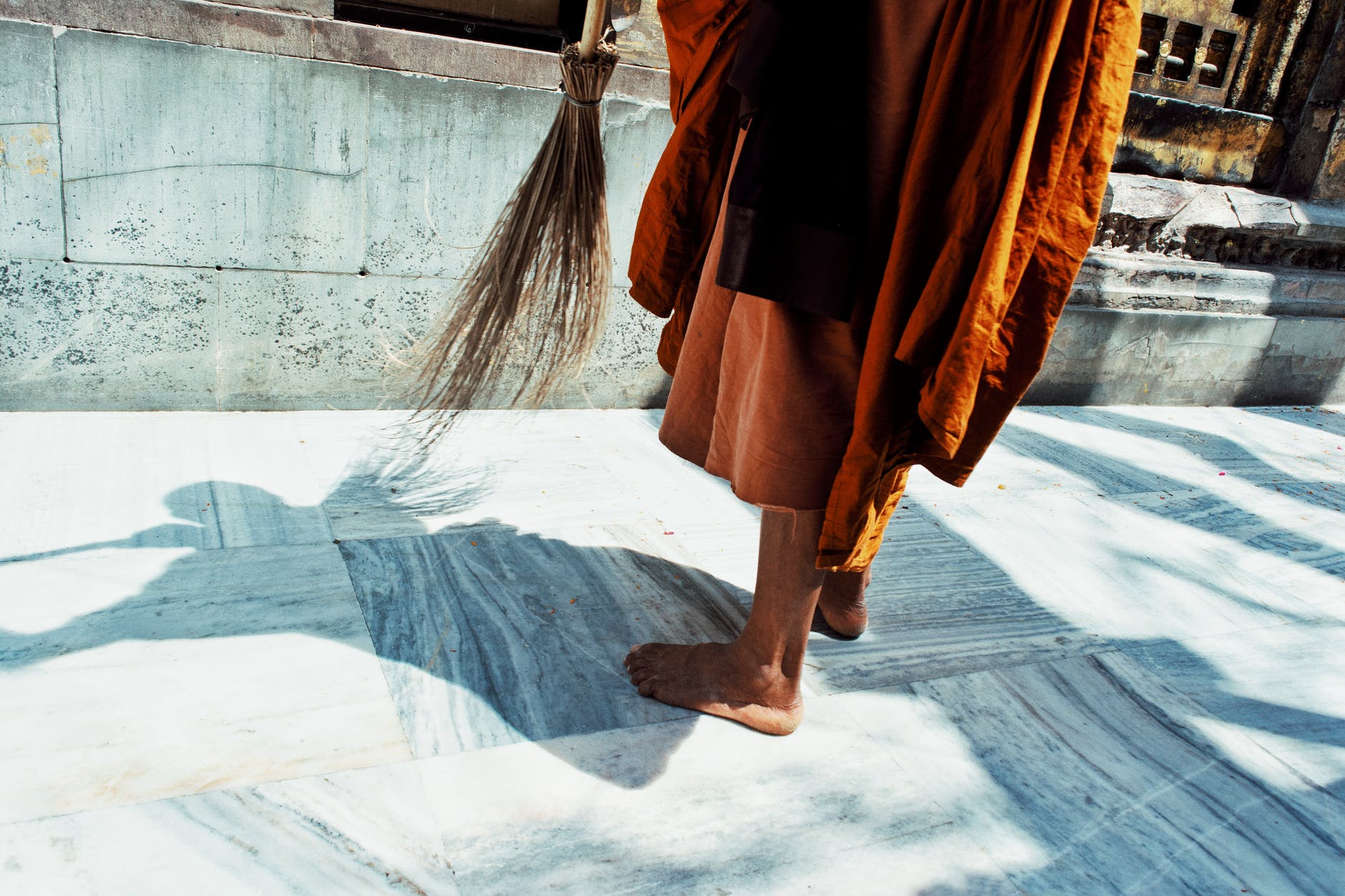
Chunda tried and tried to learn the short passage, but he had to repeatedly ask for help, and once he had learned the first line, he would forget it when he began to learn the second. Chunda returned to the Buddha and told him what had happened. The kind man sat in silence for some time. Finally, an idea occurred to him. “Chunda, you are a hard worker are you not?’ he asked. “Yes master.” “I would like to give you a special job. I want you to sweep the temple hall each day. Can you do that?” “Oh yes, teacher.” Chunda said, jumping up with delight. “That is something I can do well.” “Very well then, Chunda. I will give you the job of sweeping the temple. That is all that you must do, but as you sweep the floors you must speak these two lines to yourself, over and over: “Sweep away the dust, sweep away the dirt.” Can you remember that?” “Sweep away the dust, sweep away the dirt. Yes, that is easy, because that is what I will be doing!” Chunda set off to begin his work. Every day he did sweep the temple, all day long, and as he swept he kept up a rhythm, “Sweep away the dust” he would say with each sweep out, and “Sweep away the dirt,” with each sweep back. Often he would get lost in thought and he would forget to say the lines. Luckily the other monks knew what he was supposed to be chanting, and they would remind him, and he would go back to is work. “Sweep away the dust, sweep away the dirt.”
Then one day the Buddha came upon Chunda who was standing still, thinking hard about something. “Chunda, where is your mind right now.” “Oh sorry, Master, I should be sweeping,” No, Chunda,” he smiled, “share your thoughts.””Well I was thinking that you are a wise man, and you have given me these lines to say about something that I know how to do. When I remember to say them I feel at peace. You have not given me any more lines. Do you mean for me to learn something more from this?” “Yes Chunda. You have found the peace that is there for us in the present moment. Now I want you to think about this: You are sweeping clean the dirt from the temple. Think also about sweeping clean the inner dust and dirt in your mind.” “But what are inner dust and inner dirt?” “Well, Chunda, think of the nature of dust and dirt: They cover what is beautiful and clean, and cloud what is clear. And dust and dirt often cover those things that are old and of no more use to us. It is also the nature of dust that we can see it in the air, but when we grasp for it, it is not there, just like thoughts of the future or the past. Think on this and notice when your thoughts are clouding you from the present moment, and causing unhappiness, and notice when you cling to old ways of thinking.” Chunda went back to sweeping.
One day Chundra noticed that he was often longing to sit with the other students as they talked about the things they were learning. “But,” he would think to himself, “I am not worthy to sit and talk with the other monks and students my age, for I cannot read nor write.” This way of seeing and thinking was like dirt, it was an old way of seeing himself that kept him from happiness. “I should sweep these thoughts from my mind.” He thought. “Sweep away the dust, sweep away the dirt.” He felt peaceful again. Another time he noticed that he was often living in the future wishing, “If only, if only I could read and write like the others, then …” These wishing thoughts were like dust. He was always trying to grasp things out of his reach, and missing the present moment. “Sweep away the dust, sweep away the dirt.”
Chunda went and shared his insights with the Buddha who again smiled. “Ah Chunda, you are doing very well. Tell me, can you stop and enjoy the beauty of a clean temple after you have swept?” “Yes, master.” “Good then, ” smiled the Buddha, “I hope you will now remember to also stop to notice the simple joy of a clean inner temple, as well as an outer one.” Chunda did stop to notice, and he continued to sweep the inner dirt, and the outer dirt, and to stop often to experience the peace of the present moment, and the simple joy that was there when all negative thoughts were gone. And in this way Chunda continued to sweep, to chant and to ponder on the nature of grasping and clinging, and the peace of living in the present moment.
In time the other students noticed his peace, and began to talk with him. He was able to share his wisdom with other monks. As the years passed his wisdom and inner peace grew. He became known as The Broom Master, and many came to hear his simple, yet profound wisdom.
Sources: Conover, Sarah, “The Broom Master” in Kindness: A Treasury of Buddhist Wisdom for Children and Parents, (Spokane, WA: Eastern WA University Press, 2001) pp. 68-71.Lama Surya Das, “Greatness of Heart is What Counts,” in The Snow Lion’s Turquoise Mane: Wisdom Tales from Tibet. Pp. 45-48.
Sautrantika: One of the early Indian schools of this tradition. Also known as the Sutra-Only School because it focused on just the discourses of the Buddha.
Vaibhasika: An influential early Indian school in north-west India also of this tradition. Its version of the Abhidharma, the Mahavibhasa (The Great Book of Alternatives), was the basis for Vasubandhu’s Abhidharma-kosa that is still studied in Tibetan monasteries and considered to be one of the five classic commentaries or treatises that should be mastered.
Theravada (Lineage of the Elders): This is the form of Buddhism that was transmitted very early to the South-east Asian counties of Sri Lanka (247 BCE) and Burma (272-236 BCE) and later to Thailand (1260), Laos (14th century), Cambodia, and southern Viet Nam. It was between 25 and 17 BCE that the Pali canon or scriptures were first recorded in Sri Lanka. In America it is also popularly known as vipassana or Insight Meditation. The most conservative branch of Buddhism, the Theravadans based their practice exclusively on the Tripitaka of the Pali Scriptures and are the only remaining school evolving out of this tradition. Their focus is the practice of mindfulness, which involves cultivating an awareness of one’s thoughts, actions, and body to become aware of what one does and one’s motivation. This is a prelude to a direct understanding of the transitory, conditioned nature of existence. Theravadans take refuge in the three jewels and follow the five precepts of no killing, no stealing, no inappropriate sex, no inappropriate speech, and no ingesting substances that befuddle consciousness. Monastics must be celibate and cannot claim to have supernormal powers. The goal of one following this path is to become an arhat. It has become a popular form of Buddhism in the United States. Some modern western leaders in this school have questioned if enlightenment is possible or even a useful goal, stressing more the integration of Buddhist concepts and theories with Western psychology and therapy.
When Shakyamuni Buddha lived on this planet over 2500 years ago, he transmitted dharma to the many disciples who followed him. After the Buddha’s Parinivana, one of the Buddha’s foremost disciples, Venerable Mahakasyapa, became the head of the sangha and presided over the First Great Council at Rajagrha that was held to codify the Buddha’s teachings. He was known for his accomplishments in the dharma.
Ananda, the Buddha’s younger cousin and known as “the assistant who heard much,” became the second patriarch in this lineage after Mahakasyapa passed away. As a condition for becoming the Buddha’s attendant, a position he held for 24 years, Ananda requested no preferential treatment and that the Buddha repeat for him any teachings he might miss. He was gifted with total recall and at the First Great Council repeated all of the Buddha’s teachings from memory. His recitation became the basis for the Sutras in the Tripitaka. When Guru Padmasambhava reincarnated eight years after Shakyamuni Buddha left this world, it was Venerable Ananda who transmitted the special dharma that Shakyamuni instructed him to transmit.
The sangha divided into many sects based on different interpretations and emphasis. The main split was between what became known as the Sravakayana (or Path of the Arhats) and Mahayana (or Path of the Bodhisattvas) Vehicles. Of the eighteen or so lessor vehicle sects, only the Theravada School has survived. This is the dominant form of Buddhism practiced in Myanmar (Burma), Cambodia, Laos, Sri Lanka, and Thailand. Today there are over 100 million Theravada Buddhist worldwide with a growing number of temples and groups forming in the West as the people of Southeast Asia migrate to the West.
Many Westerners have also gone to Southeast Asia to study and have brought their own form of usually lay practice to the West, often referred to as Insight Meditation or vipassana. Theravada monasteries have developed in the U.S. that train western monastics, notably the Bhavana Society Forest Monastery and Meditation Center (Sri Lanka) in High View, West Virginia, and Abhayagiri (Fearless Mountain) Monastery (Thai) also in the forest monk tradition in Redwood Valley, California.
(Part Three Dharma That Every Buddhist Must Follow)
The second book I read was called Dharma That Every Buddhist Must Follow. From the title I knew this must be a very important book for all Buddhists. In the preface, the author herself, Among Nopu Pamu said: “Dharma That Every Buddhist Must Follow is very deep Buddha Dharma which must be relied upon and applied by teachers and disciples. Because of such conditions, if one dose not rely upon, dose not study, and dose not practice Dharma That Every Buddhist Must Follow, then no matter what Dharma one practices, one cannot attain liberation from the cycle of birth and death. …. Dharma That Every Buddhist Must Follow is the mother of the mother of all Dharmas.”
The book is a collection of discourses that Pamu gave to an assembledge of Buddhist masters of highest rank, over a period of a few days under a very special karmic condition. It lays out the path to enlightenment by pinpointing the many mistakes practitioners of Buddhism can and do make in their actions or non-actions of “body, speech and mind”. To me this book was a truly indispensable guide in my daily practice. As a beginner Buddhist, I did not have a master yet, and sometimes I felt lost and tangled by the different teachings. All my Buddhism knowledge was from books and tapes, and I knew they couldn’t be completely right, since the authors were not a Buddha or Great Buddhisattva. Plus when I put them into my daily practice, I also added my own interpretations and understandings. I didn’t know whether my conducts conformed to the right Buddhism rules and procedures.
In the book, Puma illustrates “The ten superficialities of practitioners”. 1. The superficiality of Reciting Passages without Belief. 2. The superficiality of Speaking about benefiting others when one dose not have great compassion. 3. The superficiality of Donating the one is miserly. 4. For those who practice vajrayana Bddhism, The superficiality of Practicing while not abiding by the Samaya Precepts. 5. For Buddhist monks and nuns, The superficiality of Practicing while not abiding by the Precepts. 6. For laypersons, The superficiality of Practicing yet not diligently cultivating oneself. 7. The superficiality of only studying Principles but not practicing the Dharma. 8. The superficiality of Practicing the Dharma without knowing the Essentials of the Dharma. 9. The superficiality of Teaching people while not acting in accordance with the Dharma. 10. The superficiality of Instructing others when one’s own actions do not match one’s words.
Among the The ten superficialities of practitioners, Number 6: “For laypersons, the superficiality of practicing yet not diligently cultivating oneself“ was truly a wake-up call for me. I was in exactly same situation as written in the book. Laypersons cultivate themselves at home, where there is no one to instruct them or make arrangements for them. In their worldly life lay practitioners are often bound by things of the world. They are entangled by matters involving family, society, children, relatives, and work…. I could always find excuses to miss my homework. Things like, today my friends invited me to a party so I should go and enjoy life, or I was too tired at work so I need to relax a little bit, or today I had an argument with my husband so I felt so bad and did not want to practice the dharma,…. so on and so forth, day after day passed — no wonder I didn’t have any progress in my practices. Here Pamu gave me the utmost guidance: laypersons should have a mind aware of impermanence, a mind determined to break away from samsara. They should constantly remind and admonish themselves not to become confused by matters of this world. They should always remember to diligently cultivate themselves!
I always felt it is difficult to attain enlightenment while being immersed in worldly affairs. It’s like the common Chinese saying that one cannot have both fish and bear’s paws. I couldn’t consider holiness and worldliness at the same time, in my mind they are mutually exclusive. From the book I knew my viewpoint was very narrow and stiff. That was why I had so many defilements when I dealt with worldly affairs and my cultivation. Sometimes I wished I could quit all worldly attachments and go to the temple. Again Pamu shined the light for me: One should know that since the Buddha Dharma exists within this very world, full enlightenment must include awareness of the ultimate realities of this world. To speak of the Buddha Dharma without being concerned with worldly matters would be engaging in empty and incorrect talk. To think of handling ordinary worldly matters and practicing the Buddha Dharma as being opposite to each other is totally against the teachings of Sakyamuni Buddha that householders or laypersons are also able to cultivate themselves.
I felt so grateful that Puma illustrated all of the mistakes a Buddhism practitioner often makes and how one can correct oneself by following the instructions that are in the book. I found out that my way of practice had many flaws. Due to this book I was able to critically examine my way of practice and to correct many mistakes.
What are Buddhist Beliefs? All living beings have the same basic wish to be happy and avoid suffering, but very few people understand the real causes of happiness and suffering.
We generally believe that external conditions such as food, friends, cars, and money are the real causes of happiness, and as a result we devote nearly all our time and energy to acquiring these. Superficially it seems that these things can make us happy, but if we look more deeply we shall see that they also bring us a lot of suffering and problems.
Happiness and suffering are opposites, so if something is a real cause of happiness it cannot give rise to suffering. If food, money, and so forth really are causes of happiness, they can never be causes of suffering; yet we know from our own experience that they often do cause suffering. For example, one of our main interests is food, but the food we eat is also the principal cause of most of our ill health and sickness.
In the process of producing the things we feel will make us happy, we have polluted our environment to such an extent that the very air we breathe and the water we drink now threaten our health and well-being. We love the freedom and independence a car can give us, but the cost in accidents and environmental destruction is enormous.
We feel that money is essential for us to enjoy life, but the pursuit of money also causes immense problems and anxiety. Even our family and friends, with whom we enjoy so many happy moments, can also bring us a lot of worry and heartache.
In recent years our understanding and control of the external world have increased considerably, and as a result, we have witnessed remarkable material progress; but there has not been a corresponding increase in human happiness.
There is no less suffering in the world today, and there are no fewer problems. Indeed, it could be said that there are now more problems and greater unhappiness than ever before. This shows that the solution to our problems, and to those of society as a whole, does not lie in knowledge or control of the external world.
Why is this? Happiness and suffering are states of mind, and so their main causes cannot be found outside the mind. The real source of happiness is inner peace. If our mind is peaceful, we shall be happy all the time, regardless of external conditions, but if it is disturbed or troubled in any way, we shall never be happy, no matter how good our external conditions may be.
External conditions can only make us happy if our mind is peaceful. We can understand this through our own experience. For instance, even if we are in the most beautiful surroundings and have everything we need, the moment we get angry any happiness we may have disappears. This is because anger has destroyed our inner peace.
We can see from this that if we want true, lasting happiness we need to develop and maintain a special experience of inner peace. The only way to do this is by training our mind through spiritual practice – gradually reducing and eliminating our negative, disturbed states of mind and replacing them with positive, peaceful states.
Eventually, through continuing to improve our inner peace we shall experience permanent inner peace, or “nirvana.” Once we have attained nirvana we shall be happy throughout our life, and in life after life. We shall have solved all our problems and accomplished the true meaning of our human life.














 Peace LiLy