A Thanksgiving Reflection: Gratitude towards Our Parents

Embracing Filial Piety in a Modern World

In this season of gratitude, as we gather around tables adorned with festive feasts, it’s an opportune moment to reflect on the essence of filial piety, a cornerstone of Chinese culture. While tradition emphasizes putting parents first, the landscape of communication between generations has evolved, presenting new challenges.

In our pursuit of modernity, we often find a widening gap in understanding between parents and their children. This Thanksgiving, let’s draw inspiration from the timeless wisdom of Socrates, the ancient Greek philosopher.

Once Socrates noticed that Lamprocles was increasingly irritable with Xanthippe, his mother. Recognizing the need for a heart-to-heart conversation, Socrates decided to employ the Socratic method to enhance his son’s relationship with her.

Socrates initiated the dialogue by asking Lamprocles about the meaning of the term “ungrateful.” Lamprocles responded, noting that someone is considered ungrateful if they fail to express gratitude despite being treated well. Establishing this as common ground, Socrates delved deeper, questioning whether ingratitude might be acceptable towards enemies but not friends. Lamprocles rejected this notion, asserting that regardless of friendship or enmity, gratitude should be shown to anyone who has done a favor.

Photo by Berendey_Ivanov / Andrey_Kobysnyn on Pexels.com

Socrates then redirected the conversation toward the unparalleled favor bestowed by parents on their children. Emphasizing the sacrifices parents make, he highlighted the physical and emotional burdens mothers endure, risking their lives during childbirth. Despite this, Lamprocles remained unconvinced, citing his mother’s temper as a significant obstacle.

Socrates posed an intriguing question, asking whether it’s harder to bear with a mother’s ferocity than that of a wild beast. Lamprocles, acknowledging his mother’s intense demeanor, struggled to reconcile her actions with the lack of physical harm. Socrates, steering the conversation, questioned whether Lamprocles had ever been injured by his mother physically, and when the answer was negative, Socrates emphasized the reciprocal nature of their relationship.

The dialogue took an unexpected turn when Socrates compared listening to Xanthippe’s words to actors in tragedies hurling insults at each other. Lamprocles, distinguishing between real intent and theatrical performance, argued that his mother’s words were not mere make-believe. Socrates, unveiling his true intent, reminded Lamprocles that, despite Xanthippe’s anger, it was not devoid of good intentions but rooted in her love for him.

Socrates emphasized Xanthippe’s continuous care for Lamprocles during sickness, her prayers for his well-being, and her genuine desire to help him. He concluded that, ultimately, it is not the sharpness of words but the true underlying intentions that should concern us. Lamprocles, acknowledging his mother’s positive intentions, found solace in understanding that her bluster was akin to the actors’ staged conflicts.

In this heartfelt conversation, Socrates guided his son towards appreciating the true essence of gratitude and the underlying intentions of his mother’s actions. This Thanksgiving, let us draw inspiration from this wisdom, cherishing the imperfect yet unwavering love of our parents.

A Thanksgiving Reflection: Gratitude towards Our Parents

Link:https://peacelilysite.com/2023/11/17/a-thanksgiving-reflection-be-grateful-to-your-parents/

#ThanksgivingReflection #Grateful #Parents #Socrates

Source: https://donaldrobertson.name/2018/03/30/parenting-what-socrates-said/

The transformative story of Angulimala

A Tale of Compassion and Transformation

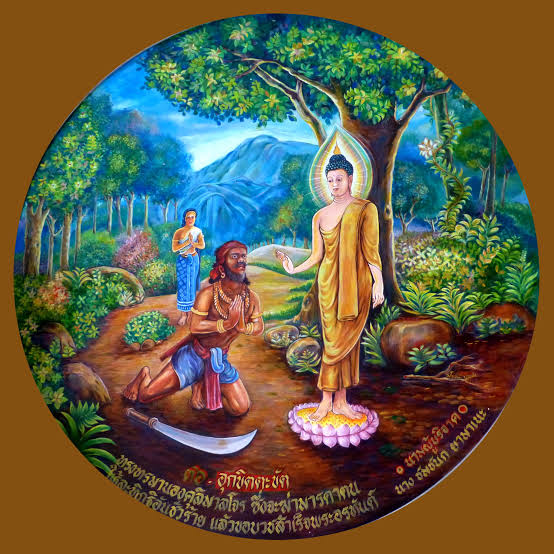
The Angulimala Sutta, a captivating narrative from Buddhist scriptures, recounts the remarkable transformation of a blood-thirsty murderer into a compassionate monk under the profound influence of the Buddha. Angulimala, notorious for his brutal killings and a garland of severed fingers, terrorized the realm of King Pasenadi. The tale unfolds during a time when the Buddha, with unwavering compassion, confronted the darkness that shrouded Angulimala’s soul.

Angulimala’s notoriety as a ruthless killer, leaving villages and towns in a state of fear, paints a grim picture of his violent nature. His garland of fingers serves as a gruesome testament to the lives he had taken, making him a symbol of terror and malevolence.

Undeterred by Angulimala’s fearsome reputation, the Buddha ventured into the region where the murderer roamed freely. Despite warnings from locals about the dangers posed by Angulimala, the Buddha calmly continued his journey, determined to confront the source of darkness.

As the Buddha walked towards Angulimala’s lair, the air thick with tension, he encountered the menacing killer. Rather than responding with fear, the Buddha skillfully engaged Angulimala in a dialogue that would alter the course of his life. The Buddha’s words, laden with wisdom and compassion, began to unravel the tightly woven fabric of Angulimala’s violent identity.

In a pivotal moment, as Angulimala sought to chase down the Buddha with murderous intent, the Buddha employed a feat of psychic power. Despite running at full speed, Angulimala found himself unable to catch up with the Buddha walking at a normal pace. This display of supernatural ability left Angulimala astonished and created a space for the transformative dialogue that followed.

Angulimala urgently called out, “Stop, contemplative! Stop!” The Buddha calmly replied, “I have stopped, Angulimala. You stop.”

Perplexed, Angulimala asked, “While walking, contemplative, you say, ‘I have stopped.’ But when I have stopped, you say I haven’t. I ask you the meaning of this: How have you stopped? How haven’t I?”

The Buddha responded, “I have stopped, Angulimala, once and for all, having cast off violence toward all living beings. You, though, are unrestrained toward beings. That’s how I’ve stopped and you haven’t.”

Baffled by the Buddha’s profound words, Angulimala sought clarity on the apparent contradiction. The Buddha’s response not only clarified the cessation of violence within his own heart but also illuminated the unrestrained nature of Angulimala’s actions. This insightful exchange marked the beginning of a transformative journey within Angulimala, planting the seeds of change in his consciousness.

With a heart now inclined towards virtue, Angulimala, in an impromptu moment, requested ordination from the Buddha. The Buddha, recognizing the sincerity of Angulimala’s transformation, granted his request, welcoming him into the community of monks adorned with saffron robes and shaven heads.

Even as Angulimala embraced the monastic life, local villagers, fearing his past atrocities, sought protection from King Pasenadi. The king, in response, assembled an army and approached the monastery. Despite the villagers’ pleas to “stamp him out,” the Buddha’s wisdom paved the way for an unexpected resolution.

When questioned by the Buddha about how he would treat Angulimala if he had truly renounced violence, King Pasenadi underwent a profound transformation. The Buddha’s teachings on discernment and compassion prompted the king to reconsider his stance. Witnessing Angulimala’s monkhood, the king shifted from disbelief to acceptance, vowing to support him on his path to redemption.

The Angulimala Sutta not only narrates the personal transformation of a notorious murderer but also highlights the transformative power of compassion and wisdom. The Buddha’s fearlessness, compassion, and skillful means shattered the shackles of violence that bound Angulimala. Moreover, the sutta portrays the ripple effect of transformation, as even King Pasenadi undergoes a change of heart. This timeless tale serves as an enduring testament to the potential for redemption, forgiveness, and the profound impact of the Buddha’s teachings on even the most deeply entrenched patterns of suffering.

The transformative story of Angulimala

Link:https://peacelilysite.com/2023/11/15/the-transformative-story-of-angulimala/

#AngulimalaSutta #ShakymuniBuddha #Transformation #Compassion #Wisdom #Monk

Source: https://blogs.icrc.org/religion-humanitarianprinciples/a-humanitarian-re-reading-of-the-angulimala-sutta/#:~:text=Moved%20by%20the%20Buddha’s%20words,saffron%20robes%20and%20shaven%20heads.

Global Buddhists Unite in Compassion: Commemorating the Buddha-Stipulated Day of Releasing Lives

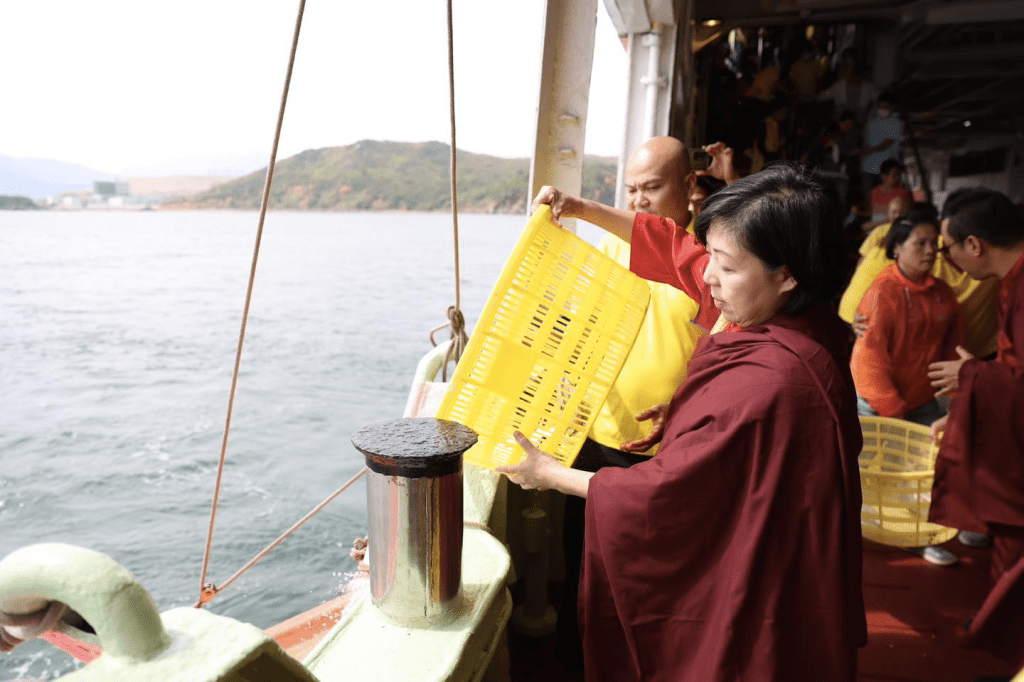
Buddhists worldwide converged on October 29th to observe the Buddha-Stipulated Day of Releasing Lives, an admirable day dedicated to compassion and liberation. Originating in 2009, this tradition finds its roots in the teachings of H.H. Dorje Chang Buddha III, who, after completing a monumental Buddhist activity, led His disciples in releasing captive lives and declared this day as a time to extend compassion to all beings. In 2023, the H.H. Dorje Chang Buddha III Culture and Art Museum and the World Buddhism Association Headquarters commemorated this occasion with life-releasing events in Marina Del Ray, California, and World’s Fair Marina, Flushing, New York.

The practice of releasing captive lives holds deep significance for Buddhists. H.H. Dorje Chang Buddha III once imparted in the Dharma of Cultivation, “All living beings in the six realms of reincarnation within the three spheres of the universe have been since beginningless time my fathers and mothers in the revolving cycle of reincarnation.” Furthermore, “The Brahma’s Net Sutra – The Book of Bodhisattva Precepts” explicitly teaches the importance of compassionately engaging in the practice of releasing captive animals into the wild and freeing living beings from suffering.

On October 28th, the Monastery of Hua Zang Si Temple in San Francisco, along with Buddhist disciples, organized a fish release event at the San Rafael Port, located at 110 Loch Lomond.

Hua Zang Si Abbess Ruzun Ruohui emphasized, “Our acts of compassion are not confined to specific days or places. Guided by the teachings of H.H. Dorje Chang Buddha III and Shakyamuni Buddha, we believe in intervening whenever and wherever beings face dire fear or calamity, offering them safety and liberation from suffering. As the saying puts it, ‘We hold dear the continuity of their lives and cannot bear to witness their untimely end.’ Our driving force is compassion and empathy, with a desire to bestow happiness and freedom upon all sentient beings, relieving them from the burdens of suffering.”

Buddhist disciples in Taiwan organized a fish release event at the ocean beach.

Buddhist disciples at PinDong Taiwan released crickets.

In 2023, nations worldwide continuously struggle with prolonged regional conflicts, ongoing wars, economic turmoil, and the devastating impacts of climate change, resulting in a profound loss of lives and widespread suffering. From storms, flooding, earthquake, to wildfires, 2023 has already been a record catastrophic year for weather and climate disasters globally. On this occasion of the Buddha-Stipulated Day of Releasing Lives, individual Buddhists, temples, and religious organizations from around the world have come together in unity to conduct life-releasing activities. Their shared aspiration is to dedicate all merits to the well-being of living beings. May adversity be vanquished, and may all living beings find prosperity and wisdom, leading to lives filled with goodness. May nations thrive and may peace reign supreme throughout the world.

Global Buddhists Unite in Compassion: Commemorating the Buddha-Stipulated Day of Releasing Lives

Link: https://peacelilysite.com/2023/11/10/global-buddhists-unite-in-compassion-commemorating-the-buddha-stipulated-day-of-releasing-lives/

#Buddha-StipulatedDayReleasingLives #DorjeChangBuddhaIII #HHDorjeChangBuddhaIII #HuaZangSi #ReleasingLives #FishReleasing #Compassion

Source: https://nyweekly.com/lifestyle/global-buddhists-unite-in-compassion-commemorating-the-buddha-stipulated-day-of-releasing-lives/

A Unique Integration of Western Psychology and Eastern Spirituality

Carl Jung’s Psychology Theory and Zen Buddhism

Carl Jung, a pioneer of western psychology, is renowned for his extensive studies of different cultures, religions, and mythologies. He was able to integrate the knowledge from these diverse fields into his theories, making him a unique figure in the field of psychology. One area that had a particularly profound impact on Jung’s thinking was Buddhism, and in particular, Zen Buddhism.

Jung conducted a deep study of Zen Buddhism, and even wrote a foreword for a book by D.T. Suzuki (“An Introduction to Zen Buddhism”), a pioneering Buddhist teacher who introduced Zen Buddhism to the west. In his foreword, Jung used his western perspective and psychological insights to explain the concepts of Zen Buddhism, offering a fresh and new perspective on this ancient tradition.

Could any of us boast that he believes in the possibility of a boundlessly paradoxical transformation experience to the extent moreover of sacrificing many years of his life to the wearisome pursuit of such a goal? And finally , who would dare to take upon himself the responsibility for such an unorthodox transformation experience – except a man who  was little to be trusted, one who, maybe for pathological reasons has too much to say for himself? Just such a person would have no cause to complain of any lack of following among us. But let a ‘Master’ set us a hard task, which requires more than mere parrot-talk, and the European begins to have doubts, for the steep path of self-development is to him as mournful and gloomy a the path to hell.

(Psychology and the East by C. G. Jung – Forward to D.T. Suzukis Introduction to Zen Buddhism, pub. Ark 1978)

One of the key concepts in Zen Buddhism that fascinated Jung was the idea of enlightenment. In Zen, enlightenment is seen as a state of perfect awareness and understanding, where one transcends the limitations of the ego and experiences a deep connection with the universe. Jung was intrigued by the way that Zen Buddhists achieved this state through meditation and other spiritual practices, and saw parallels between their experiences and his own ideas about the unconscious mind.

Jung’s understanding of Zen enlightenment was different from the way that western religions typically view spiritual enlightenment. In western religions, enlightenment is often seen as a state of moral perfection or divine union, and is usually achieved through faith and devotion to a higher power. In contrast, Zen enlightenment is seen as a direct experience of the true nature of reality, and is achieved through introspection and self-realization.

Jung believed that the concepts of Zen Buddhism could offer valuable insights into the human psyche, and he incorporated many of these ideas into his own theories of psychology. He saw the practice of meditation and mindfulness as a way to access the unconscious mind and achieve greater self-awareness, and he believed that the teachings of Zen Buddhism could help people to find inner peace and balance in their lives.

However, many Buddhist masters, experts, and scholars have their own unique understanding of Zen, which often comes from their own experiences. The contemporary Buddha, H.H. Dorje Chang Buddha III has expounded a dharma titled “The Great Dharma of Zen Practice.” In this teaching, the Buddha used perfect wisdom to profoundly explain what Zen is, how the ancient patriarchs practiced Zen and realized the way, and the specific methods of Zen meditation. If you want to understand Zen and practice Zen meditation, this is a must-read classic. Readers will surely gain great benefits and guidance from it.

A Unique Integration of Western Psychology and Eastern Spirituality

Link: https://peacelilysite.com/2023/11/09/a-unique-integration-of-western-psychology-and-eastern-spirituality/

#DorjeChangBuddhaIII #HHDorjeChangBuddhaIII# CarlJung #ZenBuddhism#WesternPsychology #EasternSpirituality #Dharma #ZenPractice #Meditation

Source: https://www.thezengateway.com/culture/c-g-jung-forward-to-d-t-suzuki-s-introduction-to-zen-buddhism

Exploring the Scientific Evidence for Life Beyond Death

“Many Lives, Many Masters” by Brian Weiss

The mystery of what happens after we die has intrigued humanity for centuries. While various belief systems and religions offer their interpretations, the quest for scientific evidence has been an ongoing journey. “Many Lives, Many Masters” by Dr. Brian Weiss takes us on a remarkable voyage through past-life regression therapy, providing substantial evidence that life does not end with death. As a Buddhist who has at times questioned the concept of the life and death cycle, I found this book to be a profound revelation that resonated with my own beliefs.

Dr. Brian Weiss, a prominent psychiatrist and skeptic, had his beliefs challenged when he began treating a patient named Catherine through traditional psychotherapy. Surprisingly, under hypnosis, Catherine began to recall not only her past life experiences but also the concept of reincarnation, which greatly differed from Dr. Weiss’s own beliefs.

What makes “Many Lives, Many Masters” particularly compelling is the abundance of real-life incidents documented throughout the book. Dr. Weiss’s meticulous recording of Catherine’s past-life memories, her interactions with various spirits, and her ability to provide verifiable information from the past all serve as a testament to the reality of her experiences. These experiences create a strong argument for the idea that life continues beyond the physical realm.

Brian Weiss’s background as a trained psychiatrist lends scientific credibility to his exploration of past-life regression therapy. He applies rigorous methodologies to Catherine’s case, ensuring that her experiences are thoroughly documented and verifiable. This scientific approach is essential in making the case for life after death, even to skeptics.

As a Buddhist, I have often contemplated the concept of rebirth and karma, central tenets in Buddhist philosophy. “Many Lives, Many Masters” aligns with these beliefs, providing further validation for the idea of reincarnation and the continuation of life beyond death. The book has given me renewed confidence in the cycle of life and death, offering a fresh perspective on the timeless teachings of Buddhism.

“Many Lives, Many Masters” is a book that challenges the boundaries of conventional thinking and encourages readers to explore the idea that life extends beyond the physical realm. Dr. Brian Weiss’s compelling documentation of real-life instances and his scientific approach make this a captivating read for individuals from all walks of life. Whether you approach this book as a person of faith, a skeptic, or someone in between, it offers a thought-provoking and enlightening journey into the possibility of life after death.

Exploring the Scientific Evidence for Life Beyond Death

Link:https://peacelilysite.com/2023/10/31/exploring-the-scientific-evidence-for-life-beyond-death/

#ManyLivesManyMasters #BrianWeiss #Hypnosis#Buddhism #Cycleoflifeanddeath

The Beauty of Life: A Journey through Bert Hellinger’s Poem “The Life”

There are certain pieces of writing that strike a chord in us, resonating with our deepest emotions and thoughts. One such masterpiece is Bert Hellinger’s poem “The Life”. As a profound expression of the human experience, it has the power to touch and inspire people from all walks of life. In this blog post, I would like to share this beautiful poem with you and explore its meaning and impact.

The Life

Bert Hellinger

Life destroys everything superfluous, until only the important remains

Life does not leave you in peace, so you stop fighting, and accept everything as it is?

Life takes what you have, until you stop complaining and learn gratitude

Life sends you troubled people so that you can heal and stop projecting what you have inside.

Life lets you fall again and again, until you decide to learn the lesson.

Life takes you out of the way and presents you with crossroads, until you stop wanting to control and learn to flow like a river.

Life puts you enemies on the road, until you stop “reacting”.

Life frightens you and startles you as many times as necessary, until you lose the fear and regain faith.

Life takes away your true love, it does not grant or allow it, until you stop trying to buy it with trinkets.

Life distances you from the people you love, until you understand that we are not this body, but the soul that powers it.

Life laughs at you so many times, until you stop taking everything so seriously and laugh at yourself. Life breaks you and breaks you in as many parts as necessary for the light to penetrate.

Life confronts you with rebels, until you stop trying to control.

Life repeats the same message, even with shouts and slaps, until you finally listen.

Life sends you thunder and storms, so you wake up. Life humiliates and defeats you again and again until you decide to let the EGO die.

Life denies you goods and greatness until you stop wanting goods and greatness and you begin to serve. Life cuts your wings and prunes your roots, until you need neither wings nor roots, but only disappear in the forms and fly from the Self.

Life denies you miracles, until you understand that everything is a miracle.

Life shortens your time, so you hurry to learn to live. Life ridicules you until you become nothing, until you become nobody, and so you become everything.

Life does not give you what you want, but what you need to evolve.

Life hurts you, hurts you, torments you, until you let go of your whims and tantrums and appreciate just breathing.

Life hides treasures from you, until you start your journey, until you go out to look for them.

Life denies you God, until you see it in everyone and everything.

Life shortens you, prunes you, takes you away, breaks you, disappoints you, cracks you, … until only LOVE remains.”

I came across Bert Hellinger’s “The Life” during a time of personal introspection, and it had a profound effect on me. The poem’s words were like a gentle whisper, reminding me of life’s intricate tapestry—its joys, sorrows, challenges, and triumphs. It helped me appreciate the beauty of the journey, the importance of embracing every moment, and the interconnectedness of all things. I believe that this poem has the potential to offer comfort, hope, and a fresh perspective to others who may be seeking it. It is a reminder to live life fully, to love deeply, and to find meaning in every experience.

I hope that Bert Hellinger’s “The Life” has touched your heart and soul as much as it has mine. May you find encouragement and inspiration within its verses to navigate the complexities of life with grace and courage. Life is a gift—a beautiful, ever-unfolding mystery that we have the privilege of exploring. Embrace it with open arms, cherish the moments, and let this poem be a guiding light on your journey. Remember, in the words of Hellinger, “The life that awaits us and that we always wanted, is there, ready for us to enter.”

The Beauty of Life: A Journey through Bert Hellinger’s Poem “The Life”

Link: https://peacelilysite.com/2023/10/27/the-beauty-of-life-a-journey-through-bert-hellingers-poem-the-life/

Source: https://www.scienceandnonduality.com/article/the-life, Photos from https://www.sohu.com/a/116683879_349209

Embracing the Universe: Insights from Einstein and Buddha

Albert Einstein and Charlie Chaplin were two of the most iconic figures of the 20th century, known for entirely different reasons. A memorable exchange from early in their friendship perfectly and humorously illustrates these differences.

Einstein once expressed his admiration for Chaplin’s art, saying, “What I most admire about your art is its universality. You don’t say a word, yet the whole world understands you!”

Chaplin’s response, delivered with impeccable comedic timing, was, “True. But your glory is even greater! The whole world admires you, even though they don’t understand a word of what you say.”

I find myself in agreement with Chaplin. While I may not grasp the intricacies of Einstein’s scientific achievements, I admire him as a profound thinker who grappled with life’s deepest questions. His reflections on the universe and our place within it have been particularly inspiring to me since my youth.

Einstein’s curiosity and search for meaning are traits that many of us can relate to. He once expressed a desire to ask God about the origins of the universe, believing that such knowledge would lead to a deeper understanding of life’s purpose. He said, “I used to think that if I could ask God one question, it would be about how the universe began, because then all the rest would be just equations. But as I got older, I became less concerned with how the universe began. Instead, I would want to know why he started the universe. If I knew that, then I would know the purpose of my own life.”

Furthermore, Einstein pondered the nature of the universe and our perception of it, stating, “The most important decision we make is whether we believe we live in a friendly or hostile universe.” This quote underscores the power of our beliefs and attitudes in shaping our experiences and interactions with the world around us. A friendly universe is one where we see opportunities for growth and connection, while a hostile universe may lead to fear and isolation.

The Einstein quote that resonates with me the most is, “A human being is a part of the whole, called by us ‘Universe,’ a part limited in time and space. He experiences himself, his thoughts and feelings as something separated from the rest, a kind of optical delusion of his consciousness. This delusion is a kind of prison for us, restricting us to our personal desires and to affection for a few persons nearest to us. Our task must be to free ourselves from this prison by widening our circle of compassion to embrace all living creatures and the whole of nature in its beauty. Nobody is able to achieve this completely, but the striving for such achievement is in itself a part of the liberation and a foundation for inner security.” In this quote, Einstein alludes to the Buddhist concept of interconnectedness and the illusion of separateness. However, Einstein likely only grasped the theoretical concept and did not experience the oneness with the universe. The Buddha, on the other hand, has seen the truth, experienced the oneness, and achieved inner realization.

Over two thousand five hundred years ago, Shakyamuni crossed the Nairanjana River and sat under a Bodhi tree, where he was immersed in deep inner contemplation. At that time, he was tormented by worldly desires, hunger, craving for sleep, and fear and doubt. But he triumphed over these internal demons and continued his inner quest.

Then, like a limitless, penetrating beam of light, Shakyamuni experienced a moment of clarity in which he gained profound insight that life is eternal and one with the vast cosmos. He became a Buddha—a person awakened to the supreme truth of the Law of life.

The Buddha, Siddhartha Gautama, achieved enlightenment under the Bodhi tree, and the first words he spoke were: “How amazing, how amazing, all sentient beings possess the wisdom and virtue of the Tathagata. However, due to delusions and attachments, they cannot realize it. “

In the eyes of the Buddha, all sentient beings inherently possess the wisdom, the characteristics, and the blessings of the Tathagata within their minds that are troubled by afflictions, defilements, and the cycle of birth and death. Through this teaching, we know that Buddha-nature is inherently present in all sentient beings.

Einstein’s words resonate with the teachings of Buddha, who attained enlightenment and taught that all beings are interconnected. Buddha’s teachings emphasize compassion and understanding for all living beings, recognizing that we are all part of the same universe. Unlike Einstein, who believed that complete compassion was unattainable, Buddha demonstrated that it is possible to embrace all living beings and the universe in its entirety with love and kindness.

However, Buddhism is much deeper and vaster than just these concepts. All Buddhas possess three bodies and four wisdoms. The Mahāyāna theory of the three bodies—the dharma-body, the reward-body, and the response-body—is most common. The dharma body (法身) is considered to be the eternal, indestructible true principle, the Buddha’s original body. The response body (應身) is considered to be the Buddha’s manifest body, but in Mahāyāna Buddhism, it is regarded as the personification body, which manifests from the true principle according to the temperaments and abilities of sentient beings in order to save them.

The reward body (報身) is manifested as a combination of the other two and is therefore not simply the eternal true principle, nor simply an impermanent personality. Rather, it is an ideal body possessed by those who have awakened to the true principle based on meritorious practice. It is the living form of the eternal principle, possessing individuality. This is a general explanation, and there have been many interpretations of the Buddha-body theory in the history of Buddhism, among which there are significant differences. The three bodies are not separate entities but three integral aspects of a single Buddha.

The four wisdoms of Buddha are: Great Mirror Wisdom, which is still and void—motionless; Universal Wisdom, which is capable of facing mind-defilements without attaching to them through love or aversion; Wonderful Observing Wisdom, which has the ability to discriminate and discern the wide field of sensory impressions, while at the same time never experiencing unbridled and reactionary patterns of thought; and Perfecting Wisdom, which can direct all the sense faculties into observing phenomena without being constrained by dualism.

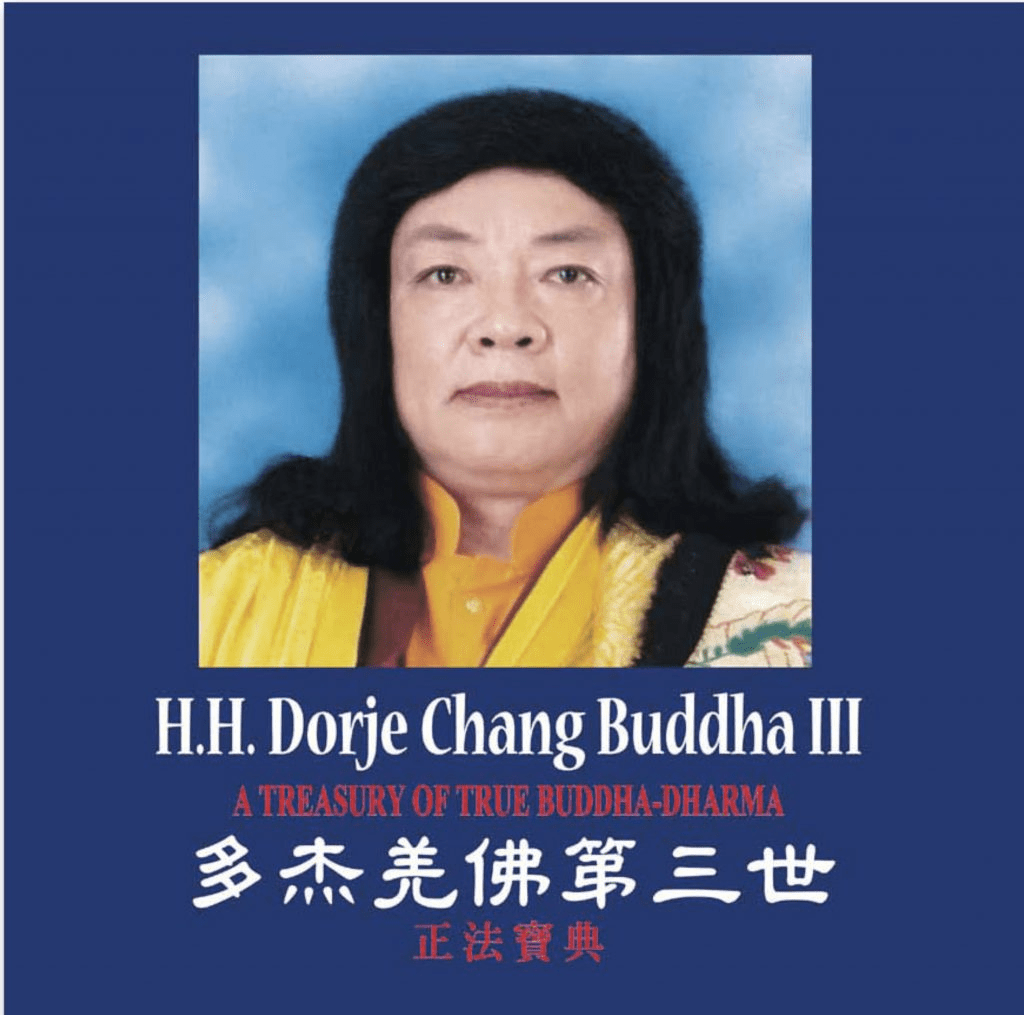
Buddha possesses vast knowledge, superb skills, magnificent supernormal power, and comprehensive wisdom of the universe. The treasure book, “H.H. Dorje Chang Buddha III,” stands as a testament to this statement. However, this book contains only a drop of water from the vast ocean of Buddha’s teachings and wisdom.

The video below showcases the boundless compassion and highlights the extraordinary accomplishments of H.H. Dorje Chang Buddha III. It was published by China Educational Channels TV and features interviews with Buddhist disciples from around the globe.

Discovering the Root of Buddhism, Propagating True Buddha Dharma(H.H. Dorje Chang Buddha III)

Embracing the Universe: Insights from Einstein and Buddha

Link: https://peacelilysite.com/2023/10/26/embracing-the-universe-insights-from-einstein-and-buddha/

#Buddha #Einstein #Buddhism #Buddhist #ShakymuniBuddha #DorjeChangBuddhaIII  #HHDorjeChangBuddhaIII   #Compassion #universe #Chaplin

Source: http://www.buddhism-dict.net/ddb/pcache/4eid(b4e09-8eab).html, https://unbornmind.com/2017/02/18/the-four-wisdoms/, https://www.worldtribune.org/2019/volume-3-chapter-three-the-buddha/, https://www.upworthy.com/albert-einstein-charlie-chaplin-friendship-joke

What is Esoteric Buddhist Practice

Photo from https://openbuddhism.org/regions/north-america/2019/tibetan-buddhism-enters-the-21st-century-trouble-in-shangri-la/

Tantra–Esoteric Teachings

Tantra is the secret or esoteric part of Buddhist practice. It is often referred to as the vajrayana or Diamond Path. It is also used as a term for the secret scriptures or esoteric writings. Although it includes the highest dharma within the Buddha-dharma, you should not consider it to be superior or that the exoteric Buddhism practiced by other sects should be considered a low level of dharma. The Buddha-dharma is not divided into high and low as comparisons. All 84,000 dharma methods came into being in response to the different innate faculties of living beings. The Buddha-dharma has only one truth no matter how it is expressed.

Exoteric Buddhism and vajrayana Buddhism are not two separate schools. Exoteric Buddhism is half of a dharma system. True vajrayana Buddhism includes the teachings of the various schools of exoteric Buddhism plus mantras, mudras, visualization, mandala offerings practiced either as a group or alone, and inner and outer tantric initiations. It includes a foundation in the cultivation of the “dharmakaya” from exoteric buddhism as well as the more advanced cultivation of the “sambhogakaya” and the “nirmanakaya.” In vajrayana or tantric practice one strives to realize all three kayas in one lifetime. However, this is ONLY possible if one is able to follow a true vajra master and receive authentic inner tantric initiation.

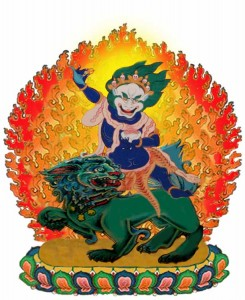
Lion Vajra, an important dharma protector in the Buddha School

True esoteric Buddhism includes all the teachings of the exoteric schools as well as the secret teachings and practices. There are those who claim to be esoteric teachers who can only offer intricate hand movements or mudras, chant mantras, make mandala offerings, or lead the disciple through elaborate visualizations, but who teach or know little of the exoteric sutras. This is not true esoteric Buddhism. Without the foundation in the essential doctrine of the Buddha as found in the Tripitaka, one should not even do the esoteric practices, let alone teach them. That is why the authentic temples which has holly masters teach meditation practices from the Theravadan and Zen or Ch’an Schools, along with certain Pure Land Practices and those of the Hua-yen and Fa-hsiang Schools and others as well as the esoteric methods. Disciples are taught according to their particular karmic affinity with the dharma.

Sometimes these exoteric techniques are taught concurrently with certain esoteric or tantric practices and sometimes they must be mastered prior to introduction to tantra. Not all students are able to receive tantra, which in its highest forms can bring liberation in this lifetime. However, everyone can progress and reach high levels of achievement, according to their efforts and karma. All of the teachings of our temples are to lead beings to liberation from the suffering of the cycle of life and death. That is the only purpose in practicing Buddhism! This is an important point!

Those who learn exoteric Buddhism exclusively are learning only the foundational aspect (some of the theoretical or doctrinal part) of Buddhism. The esoteric vehicle contains the lessor vehicle teachings AND the complete and unsurpassed mahayana teachings of both exoteric and the esoteric Buddhism AND the esoteric practices and rituals.

Tantric initiation is a ceremony within vajrayana Buddhism whereby dharma is transmitted according to tantra by means of a master’s limitless merit and power. During the ceremony, the master visualizes that he or she becomes one with a Buddha or Bodhisattva. During this ceremony the disciple is empowered by the master to carry out specific meditation practices. The student is ritually entered into a mandala of a particular tantric deity by his or her vajra master. He or she is thus empowered to practice the spiritual practices (sadhana) or associated mantras, mudras, and visualization of that deity.

There are three classes of initiation: Outer-tantric initiations, inner-tantric initiations and secret or supreme-tantric initiations (also called “holy” initiations). Each of these three classes is further divided into various dharma methods. During the highest and greatest inner-tantra and secret-tantra initiations there must be supernormal states that are manifested in front of the disciple at the Buddhist altar area (mandala). These miraculous states must be in accordance with the Tibetan tantra laid down by the Buddhas. The disciple is actually turned over to the Buddhas and Bodhisattvas during these initiations. You must remember that unless you personally see the manifestation of supernatural dharma powers, then you have not received an inner-tantric initiation. Most initiations given today are outer-tantra initiations. The supreme or holy initiations are rarely given with very few masters having the ability to perform this type of practice. Vajra masters must undergo certain tests that demonstrate their level of realization to be able to perform this type of ceremony.

Transmission of the greatest dharma requires true nectar during the initiation. For example, the highest dharma within vajrayana Buddhism, the initiation of Ati-yoga, Great Perfection of the Vajra division, requires nectar as an indispensable holy element for cleansing one’s negative karma and is the resource for planting the “Seeds of Vajra.” Other forms of inner trantric initiations can also eliminate karmic obstructions. Disciples can deeply penetrate into the dharma through inner-tantra initiations.

One must have accumulated considerable merit from past practices and good deeds to be able to receive tantra. There are certain preliminary practices that must be performed which can vary depending on the karma of the disciple. There are exceptions possible for 1) those who have completed these steps in a past life; 2) those with exceptional merit due to extraordinary offerings or actions in this life; and 3) through the grace of the guru.

Tantra requires the initiation or empowerment of a qualified teacher or master who provides specialized teachings, rituals, and practices to enable the disciple to root out or eliminate the dark side of his/her psyche and thus become like the Bodhisattvas and Buddhas. Supernormal powers are viewed as the natural outcome of realization and are used by qualified teachers. However, ordinary disciples are not allowed to discuss or display their supernormal powers. Only very highly evolved Bodhisattvas and Buddhas dare to display such powers and then only to help living beings. A person seeking initiation must demonstrate an understanding of emptiness, exhibit high moral conduct, and have developed an altruistic desire to help all beings. Any empowerment will have limited impact without a proper foundation of preliminary practices or Prayogas. It recognizes that supernormal powers cannot be given to one who has not eliminated the negative aspects of the self.

Today as in times past, the highest tantric teachings and practices are only transmitted orally and are held in great secrecy between the teacher and the disciple. Because of the power of these teachings, it is recognized that the student must be thoroughly prepared to receive them. A true master will usually test a disciple for six to twelve years or longer before transmitting the higher teachings.

What is Esoteric Buddhist Practice

Link:https://peacelilysite.com/2023/10/20/what-is-esoteric-buddhist-practice/

#EsotericBuddhistPractice# EsotericBuddhism #EsotericBuddhaDharma

Source: https://xuanfa.net/buddha-dharma/tantra/

Do not lose Your good nature because of the Reactions of the outside world

I saw a story like this on the internet:

A Zen practitioner was meditating by the river when he heard struggling sounds. Upon opening his eyes, he saw a scorpion struggling in the water.

He reached out to lift it up, only to be stung by the scorpion’s raised stinger. He placed the scorpion on the bank and continued meditating.

After a while, he heard struggling sounds again. Opening his eyes, he saw the scorpion had fallen back into the water.

He rescued it again, and of course, was stung once more. He continued meditating.

After a while, he had the same unfortunate encounter.

A nearby fisherman said, “You’re so foolish, don’t you know that scorpions sting people?”

The Zen practitioner replied, “I know, I’ve been stung three times.”

The fisherman asked, “Then why do you still save it?”

The Zen practitioner said, “Stinging is its nature, compassion is mine. My nature will not change because of its nature.”

At that moment, he heard struggling sounds again. Looking down, it was the same scorpion.

He looked at his swollen hand, then at the struggling scorpion in the water, and without hesitation, reached out to it again.

This story beautifully illustrates the Buddhist principle of compassion and loving-kindness towards all living beings, regardless of their actions. It embodies the teachings of the Buddha, who emphasized the importance of cultivating a heart full of compassion.

The practice of compassion is central to the Buddhist path. In Mahayana Buddhism, the Bodhisattva ideal embodies the ultimate expression of compassion. A Bodhisattva is one who, motivated by great compassion, has generated bodhicitta, the spontaneous wish to attain Buddhahood for the benefit of all sentient beings.

Moreover, the story reminds us of the great sacrifices made by Siddhartha Gautama, who later became known as Shakyamuni Buddha. He renounced his life of luxury and privilege to seek the ultimate truth of life and the universe. His journey was fueled by the desire to find a way to liberate all beings from the cycle of birth and death, known as samsara.

However, after two and a half millennia, the profound teachings of Shakyamuni Buddha have been gradually forgotten. To revive and propagate the Dharma once more, the primordial Tathagata Buddha, Dorje Chang Buddha, incarnated as H.H. Dorje Chang Buddha III in our world.

H.H. Dorje Chang Buddha III has not only brought the highest form of Buddha Dharma to this world but also set a remarkable example for all disciples through his boundless compassion and humility.

In the past decade, H.H. Dorje Chang Buddha III has endured significant suffering due to long-term persecution for his religious activities. A member country of Interpol once requested that the organization issue a warrant for his arrest. This request was later voluntarily withdrawn by the member country after several years. Following a thorough investigation, in October of 2008, the 72nd session of the Commission for the Control of Interpol’s Files withdrew the arrest warrant and dismissed the entire case against H.H. Dorje Chang Buddha III. Interpol also issued a document stating unequivocally that the arrest warrant against H.H. Dorje Chang Buddha III has been canceled and all member countries have been informed of the cancellation.

Although H.H. Dorje Chang Buddha III received official notification of the withdrawal of the arrest warrant and the removal of the entire case, he has never publicly displayed such documents to prove his innocence. Despite enduring slander, H.H. Dorje Chang Buddha III chose not to disclose this irrefutable evidence. When the World Peace Prize Awarding Council inquired about this, he responded by explaining that his duty is to bear all of the karmic offenses committed by living beings and to bestow upon them all of the good karma and merit that he has cultivated. He expressed concern that if he were to prove his innocence using those documents, those who slandered him would be perceived as guilty. He questioned, “Who, then, will bear their karmic offenses?”

There have been many instances that highlight his holiness’s profound compassion. For example, some of his disciples once left and defamed him, but he still welcomed them back with open arms and treated them no differently than before.

H.H. Dorje Chang Buddha III often reminds his disciples that he harbors no enemies and that all sentient beings are his dearest relatives. He encourages everyone to reflect on their own actions and to strive to lead a life filled with kindness, patience, and understanding.

His Holiness Dorje Chang Buddha III embodies the essence of selflessness and serves as a moral beacon for all to follow. He has also demonstrated how peace can be achieved through determination, humility, and the perseverance to champion its cause even in the face of adversity.

Do not lose Your good nature because of the Reactions of the outside world

Link: https://peacelilysite.com/2023/10/19/do-not-lose-your-good-nature-because-of-the-reactions-of-the-outside-world/

#DorjeChangBuddhaIII #HHDorjeChangBuddhaIII #BuddhaDharma#Compassion

Enemies and Foes can Stimulate Your Potential and Become Your Benefactors

Shallow men believe in luck. Strong men believe in cause and effect.” -Ralph Waldo Emerson

My grandmother was a woman of few words but very hardworking and resilient. I remember she once told me “Not to be afraid of being taken advantage of because suffering a loss is a blessing. What you are supposed to receive, Heaven will provide.” I didn’t understand my grandmother’s words at first, but as I grew older and gained life experience, I came to understand her wisdom.

I remember just after graduating from college, a TV company asked me to host a special program. The director of the program liked my writing and asked me to be a scriptwriter as well. However, when the program was finished and it was time to get paid, the director not only didn’t give me the scriptwriting fee but also deducted half of my hosting fee. He handed me a receipt and said, “You should be paid for $1600, but I can only give you $800 because the program is over budget.”

At that time, I didn’t say anything, signed it, and thought to myself, “Revenge is a dish best served cold.”

Later, the director asked me to help him a few more times, and I did.

The last time, he didn’t deduct any money and became very polite to me because by then I had been noticed by the news department of the TV station and suddenly became a TV reporter and news anchor.

We later often met at the company, and he always looked a bit embarrassed when he saw me.

I once thought about telling the boss about what he did to me before, but just as my grandma said, would I have what I have today without him? If I hadn’t held my breath at that time, would I have had the opportunity to continue hosting?

The opportunity was given by him; he was my benefactor. He already knew he was wrong, so why should I retaliate?

Later, I went to study in the United States.

One day, a classmate who had already found a job complained to me about his boss “exploiting” him, not only giving him a low salary but also deliberately delaying his green card application.

Photo by August de Richelieu on Pexels.com

At that time, I said to him: Such a bad boss is not worth working for. But you can’t work for free for so long, you have to learn something, then change jobs, so you have to learn secretly.

He listened to my words, and not only worked overtime every day but also stayed behind to memorize the writing of those business documents.

He even took notes on how to repair the copier, standing next to the workers, so that one day when he went out to start his own business, he could save some repair fees.

After half a year, I asked him if he was going to change jobs?

He smiled: No need! My boss now looks at me with new eyes, has been promoted, got a raise, and even asked me why my attitude changed 180 degrees and became so positive?

His dissatisfaction disappeared, he took revenge, but in a different way, and he also reflected on himself, realizing that he was not working hard at the time.

It was about five years ago when I came across an interesting incident.

A friend of mine suddenly took a keen interest in fortune-telling, studying everything from Bazi (Chinese astrology), naming studies, to astrology, all to prove that fortune-telling was a scam.

The reason was that a master had told his fortune, predicting that he would not live past 47. He swore to discredit the master’s reputation. Guess what happened? The more he learned, the more scared he became, because he realized that his own predictions for himself also indicated a short life.

Photo by Mikhail Nilov on Pexels.com

At that point, he changed. He started doing charity work, thinking, “Since I won’t live long, I might as well make the most of the time I have left and do something meaningful.”

He threw himself into it wholeheartedly. Everyone said he had changed, from an anxious and opportunistic petty person to a kind and gentle gentleman.

Unbeknownst to him, he passed 47, then 48, and is now 53, healthy and full of life, healthier than anyone else.

“You can go smash that master’s sign now!” I joked with him one day.

His eyes lit up, and he asked me, “Why?” Then he laughed, “If it wasn’t for his warning, given my previous personality, I would indeed have had a heart attack by the age of 47. He wasn’t wrong!”

My friends, do you like to show off and be ruthless? Are you always harboring grudges? Do you have the resentment of “a gentleman takes revenge; it is never too late”?

Please think about these stories.

You should know that enemies and adversaries can stimulate your potential and become your benefactors.

You should also know that many grudges, grievances, and dissatisfaction actually stem from your own issues.

You should further know that the best revenge in this world is to use that dissatisfaction to propel yourself towards success, and to treat your past enemies with the magnanimity that comes with that success and the success that follows.

Isn’t turning “a cycle of vengeance that never ends” into “a win-win situation where past grievances are forgotten with a smile” the greatest success in life?

Enemies and Foes can Stimulate Your Potential and Become Your Benefactors

Link: https://peacelilysite.com/2023/10/06/enemies-and-foes-can-stimulate-your-potential-and-become-your-benefactors/

Source: FaceBook 臉書 五味人生。回憶裡。尋找