When Anger Wears the Mask of “Protecting the Dharma” — A Reflection on My Practice

After years of practice, we often believe we are walking the right path. We may even feel completely confident in our own “devotion.” Yet sometimes, in a single moment, a line of true Dharma strikes like thunder—and we suddenly realize that all along, we have only been practicing on the surface.

Recently, while listening to Fundamental Dharma Expounded in the East, Volume 8 by Namo Dorje Chang Buddha III, I was deeply shaken. In the teaching, a disciple shared her confusion: she was extremely respectful toward the Buddhas, Bodhisattvas, and her guru, yet her practice did not truly resonate, and she gained no real benefit. In particular, whenever she saw others showing disrespect or even slandering the Buddhas and Bodhisattvas, her heart would fill with anger and aversion.

The Buddha’s teaching was like a clear mirror. It revealed not only her blind spot, but also something hidden deep within my own heart.

The Buddha compassionately taught that when facing the ignorance and slander of others, a practitioner should not give rise to anger, but to compassion.

When we see someone slandering the Buddhas and Bodhisattvas out of ignorance, we should think: “Because of her ignorance, she may fall into suffering. Her pain is also my responsibility.” This willingness to take others’ suffering as one’s own is the heart of a Bodhisattva.

Not only that—we should quietly pray for them, wishing that they awaken as soon as possible. We may even make this vow: “I must attain realization as quickly as I can, so I can help liberate her. Otherwise, how could she endure the suffering of lower realms?”

The Buddha gave the example of King Kali cutting the body. When Śākyamuni Buddha was subjected to extreme physical harm, there was not the slightest hatred in his heart. Instead, he vowed that after attaining Buddhahood, he would be the first to liberate that very person. This state—where there is no separation between self and others—is true great compassion, the genuine expression of the Four Immeasurables.
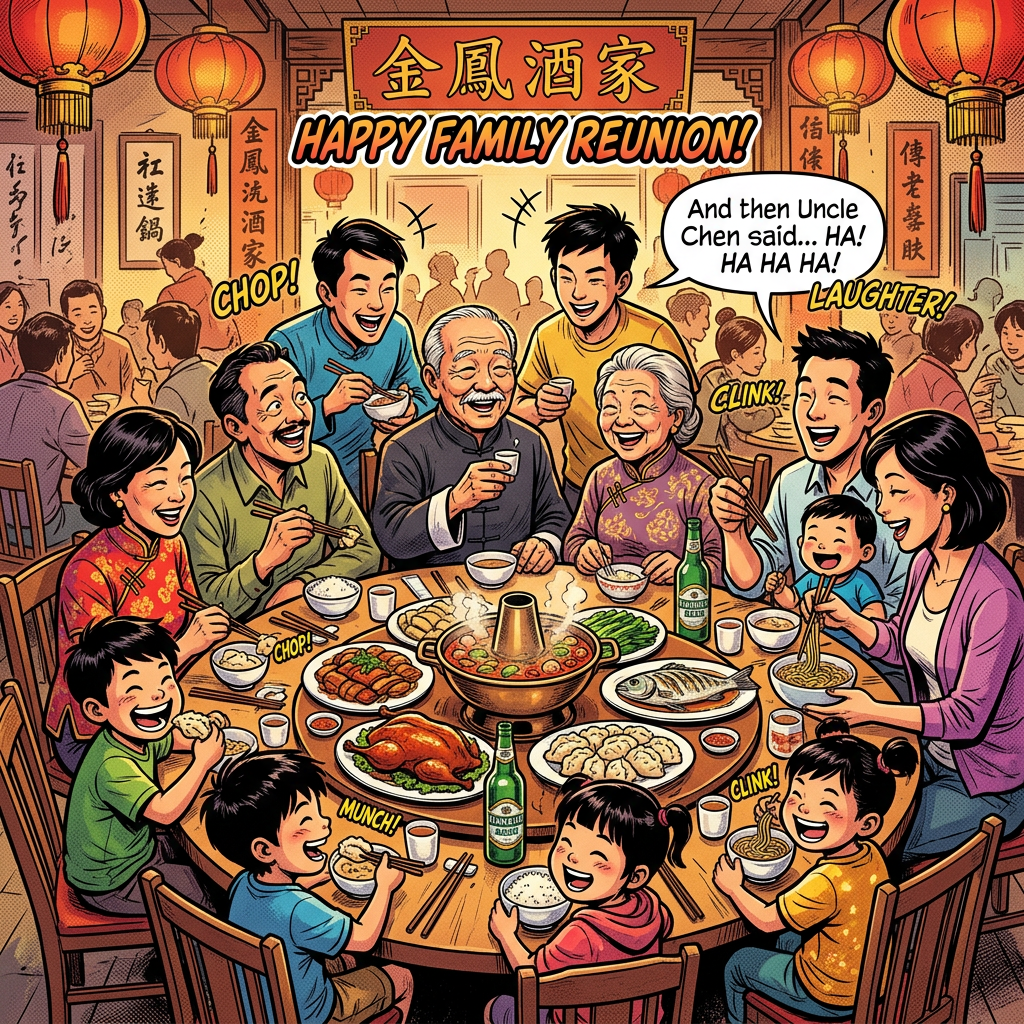
Multi-generational family sharing food and laughter at dinner table

As I listened, I broke into a cold sweat. I was reminded of something that happened in 2025, when I returned to my hometown to visit family.

At a family gathering, my cousin’s husband was filled with anger. He had suffered a stroke and complained that he had never done anything bad in his life, yet had not been protected. My cousin, who has faith in Buddhism—perhaps more from a wish for protection—kept a statue of Guanyin at home. After recovering, he angrily threw the statue onto the ground.

In that moment, a surge of anger rose within me. I felt this was a serious insult to the Buddhas and Bodhisattvas. I argued with him fiercely, my heart filled with resentment. I even thought to myself, “For someone like you, I will never dedicate blessings or prayers again.” After that, I have not contacted with them again.

What is more unsettling is that, at the time, I even felt a subtle sense of righteousness—as if I were “protecting the Dharma,” as if I were standing on principle.

Only after hearing this teaching did I truly see clearly: my anger was not for the sake of the Dharma—it came from my attachment to self.

To “protect the Dharma” without compassion is already to go astray.
The moment I gave rise to anger, refused to communicate, and gave up caring for them, I had already lost the four limitless states of mind. As the Buddha taught, if we turn away from someone, they are more likely to fall. What I thought was “holding my ground” was actually pushing away someone who needed help.

That was merely futile practice.
My mouth recited sutras and mantras, but my heart built a wall of resentment. Outwardly respectful, inwardly hardened—how could such practice bring any true benefit?

Worse still, it was faulty practice.
Facing others with anger creates no merit—it only accumulates karma.

This teaching helped me see the deepest blind spot in my practice.

I came to understand that the essence of practice is not how devout we appear on the outside, but this: when we encounter misunderstanding, slander, or ignorance, what arises in our heart—fire, or light?

Now, I feel both shame and gratitude. Shame for my ignorance and attachment, and deep gratitude for the Buddha’s teaching, which allowed me to turn back in time.

In my heart, I have quietly repented to my cousin’s husband. I have also begun again to pray for them, wishing that they may be free from suffering and awaken soon.

Practice is, in truth, a long process of “tearing down walls”—walls built from self-attachment, prejudice, and emotional reactions.

May we all, guided by the true Dharma, cleanse the dust from our hearts and cultivate a mind that is truly soft and vast—a heart that sees all beings as our own family.


Link:https://peacelilysite.com/2026/04/24/when-anger-wears-the-mask-of-protecting-the-dharma-a-reflection-on-my-practice/

Remembering Our Belonging to the Earth

Dear friends on this beautiful Earth,

I recently came across these words, and they felt less like something to read—and more like something to remember. In a time when the world often feels filled with urgency and uncertainty, this message gently invites us to pause, to listen, and to reconnect with the quiet heartbeat of our Mother Earth… and with one another.

May we breathe a little more deeply, walk a little more gently, and allow love—simple, steady, and sincere—to guide us back to what truly matters.

I hope these words bring you a moment of peace, reflection, and connection, just as they did for me 🌿

Mother Earth’s Humming

By Yuria Celidwen

Now, She still ripples. She still hums, pulses, quivers. She still sighs, murmurs under the Skies.

We pay attention, and all we hear is urgency. Waters whirl, winds rise, fires rage, irate. The challenges are innumerable, but also infinite are the opportunities. Our grief is daunting, but also heartening is our compassion. We course a cosmic webbing holding awe and horror, wonder and doubt, creation and transition . . . us and all others.

This abysmal relentless weaving is love in all its myriad forms.

We listen whole our Mother Earth’s humming, Her calling, Her heartbeat throbbing, and Her ails. We, as made of soil ourselves, are porous. Enacting love flows—throughout— quenching the cracked soils of hopelessness, helplessness, and isolation.

Breathing in, we return, expanding full gratitude.

Breathing out, we connect, unfolding kindness and care.

It is love who guides grief to meaning, anger to action, despair to transformation, fear to safety. Thus, from love, all injuries heal; they repair, restore . . . and bridges open.

Because our beings—whole—open.

Trust becomes.

Relatives, recall those early steps of unknowing and discovering!

Yes.

Those first steps we walk again right here, right now.

Today, we walk our steps attentive and intentional. Our past brings forth sensible alertness now. Tomorrow is right here— made of us—right now.

Yes.

Bring to heart the time we walked barefoot. When our feet caressed the skin of our Lands, concerned little of thorns and pebbles, seeking first to play and connect.

Relatives, evoke the gentle holding of our Mother Earth, Her caring gaze, and Her smiling.

We smile back because we are indeed listening.

Now, we ripple. We hum, pulse, quiver. We sigh, murmur under the Skies.

Earth floating amidst glowing turbulent waves under a vibrant starry sky with aurora and galaxy

Source: https://www.awakin.org/v2/read/view.php?tid=2623

Link:https://peacelilysite.com/2026/04/12/remembering-our-belonging-to-the-earth/

Embracing Life’s Truths: Carl Jung’s Wisdom for Modern Challenges

In a world of endless distractions and relentless challenges, Carl Jung’s reflections on life’s most essential lessons remain profoundly relevant. In his later years, Jung observed that accepting all aspects of life is not just important—it is the cornerstone of a meaningful existence. His insights offer a timeless guide for navigating the complexities of modern society.

Jung poignantly recalled how people often try to escape the realities that life presents, whether in the form of suffering, challenges, or existential questions. This avoidance, he argued, only deepens pain and confusion. By evading suffering and placing blame on external circumstances or personal shortcomings, individuals reject the price of truly living. Such resistance, rather than shielding us from discomfort, births an even greater torment: the isolation and repression of the human spirit.

In today’s fast-paced world, where instant gratification and superficial solutions abound, Jung’s warning is especially pertinent. Modern society often encourages us to numb our struggles—whether through technology, consumerism, or escapism—but this path leads not to fulfillment, but to emptiness.

The Value of Acceptance

Jung’s philosophy centers on the idea that life’s true value lies in accepting one’s destiny, no matter how daunting it may seem. He acknowledged the inevitability of suffering but believed that such pain should stem from our authentic choices and realities, not from a refusal to face life’s responsibilities. Staying true to oneself and living authentically, Jung suggested, is the most profound response to life. As he put it:

“I have always remained true to myself, doing everything I could to the best of my knowledge and ability. As for whether I was right or wrong, I cannot say.”

This philosophy calls on us to embrace the fullness of life, including its struggles, as a path to authenticity and wholeness.

One of Jung’s most profound insights is the intergenerational impact of avoiding one’s destiny. He reflected on the heavy psychological burdens he inherited from his parents, describing them as unfulfilled responsibilities that weighed on his life like a snail’s shell—inescapable and ever-present. Jung warned that when we refuse to confront our challenges, we inadvertently pass these unresolved burdens to the next generation.

In the modern era, this serves as a powerful reminder of the importance of addressing our inner conflicts. By facing our struggles head-on, we not only free ourselves but also spare our children from carrying the weight of our unfinished business.

Jung believed that avoiding life’s essence severs us from our inner selves. While it may seem that evading certain troubles brings temporary relief, such avoidance also cuts us off from the vitality and richness of life itself. Ultimately, the deepest regrets arise not from the joys we never experienced, but from the moments we failed to embrace.

This insight is especially relevant in an age where disconnection has become commonplace. Whether through the overuse of technology or the prioritization of material success over personal growth, many people find themselves estranged from their true selves. Jung’s call to embrace life fully offers a powerful antidote to this modern malaise.

A Path to Wholeness

Jung’s enduring wisdom reminds us that the worth of a human being lies in taking responsibility for their own debts. This is not merely a duty but a journey toward completeness. As he said:

“The worth of a human being lies in taking responsibility for their debts—not just as a duty but as a path to wholeness.”

This profound philosophy encourages us to accept life, embrace our true selves, and confront our challenges with courage and authenticity. In doing so, we reconnect with our inner selves and pave the way for a more meaningful existence.

Jung’s reflections offer a timeless guide for navigating the complexities of modern life. By rejecting avoidance, accepting life’s realities, and living authentically, we can overcome the spiritual isolation that plagues our era. His philosophy is a call to action for anyone seeking to live a life of depth, connection, and purpose.

As we face the uncertainties of today’s world, let us carry forward Jung’s legacy and strive to embrace all aspects of life. In doing so, we honor his profound insights and open the door to a richer, more fulfilling human experience.

Link:https://peacelilysite.com/2025/01/19/embracing-lifes-truths-carl-jungs-wisdom-for-modern-challenges/

A Thanksgiving Reflection: Gratitude towards Our Parents

Embracing Filial Piety in a Modern World

In this season of gratitude, as we gather around tables adorned with festive feasts, it’s an opportune moment to reflect on the essence of filial piety, a cornerstone of Chinese culture. While tradition emphasizes putting parents first, the landscape of communication between generations has evolved, presenting new challenges.

In our pursuit of modernity, we often find a widening gap in understanding between parents and their children. This Thanksgiving, let’s draw inspiration from the timeless wisdom of Socrates, the ancient Greek philosopher.

Once Socrates noticed that Lamprocles was increasingly irritable with Xanthippe, his mother. Recognizing the need for a heart-to-heart conversation, Socrates decided to employ the Socratic method to enhance his son’s relationship with her.

Socrates initiated the dialogue by asking Lamprocles about the meaning of the term “ungrateful.” Lamprocles responded, noting that someone is considered ungrateful if they fail to express gratitude despite being treated well. Establishing this as common ground, Socrates delved deeper, questioning whether ingratitude might be acceptable towards enemies but not friends. Lamprocles rejected this notion, asserting that regardless of friendship or enmity, gratitude should be shown to anyone who has done a favor.

Photo by Berendey_Ivanov / Andrey_Kobysnyn on Pexels.com

Socrates then redirected the conversation toward the unparalleled favor bestowed by parents on their children. Emphasizing the sacrifices parents make, he highlighted the physical and emotional burdens mothers endure, risking their lives during childbirth. Despite this, Lamprocles remained unconvinced, citing his mother’s temper as a significant obstacle.

Socrates posed an intriguing question, asking whether it’s harder to bear with a mother’s ferocity than that of a wild beast. Lamprocles, acknowledging his mother’s intense demeanor, struggled to reconcile her actions with the lack of physical harm. Socrates, steering the conversation, questioned whether Lamprocles had ever been injured by his mother physically, and when the answer was negative, Socrates emphasized the reciprocal nature of their relationship.

The dialogue took an unexpected turn when Socrates compared listening to Xanthippe’s words to actors in tragedies hurling insults at each other. Lamprocles, distinguishing between real intent and theatrical performance, argued that his mother’s words were not mere make-believe. Socrates, unveiling his true intent, reminded Lamprocles that, despite Xanthippe’s anger, it was not devoid of good intentions but rooted in her love for him.

Socrates emphasized Xanthippe’s continuous care for Lamprocles during sickness, her prayers for his well-being, and her genuine desire to help him. He concluded that, ultimately, it is not the sharpness of words but the true underlying intentions that should concern us. Lamprocles, acknowledging his mother’s positive intentions, found solace in understanding that her bluster was akin to the actors’ staged conflicts.

In this heartfelt conversation, Socrates guided his son towards appreciating the true essence of gratitude and the underlying intentions of his mother’s actions. This Thanksgiving, let us draw inspiration from this wisdom, cherishing the imperfect yet unwavering love of our parents.

A Thanksgiving Reflection: Gratitude towards Our Parents

Link:https://peacelilysite.com/2023/11/17/a-thanksgiving-reflection-be-grateful-to-your-parents/

#ThanksgivingReflection #Grateful #Parents #Socrates

Source: https://donaldrobertson.name/2018/03/30/parenting-what-socrates-said/