Confessions of a Rinpoche

Many individuals perceive magical events, such as the Statue of Liberty disappearing or David Copperfield flying through the air, as mysterious. They find Krisha Lawar’s ability to walk through concrete walls equally enigmatic. However, what truly encapsulates magnificence in mystery is Amang Nopu Pamu’s remarkable ability to draw nectar from the realm of the Buddhas into our world. We firmly believe that this transcends the ordinary and qualifies as an accredited mystery.

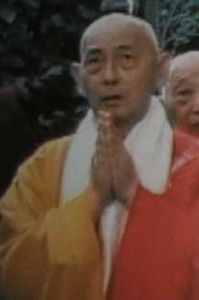
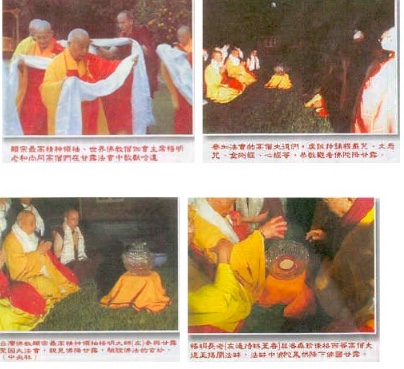
On September 8th, 1997, numerous Rinpohes participated in various segments of a Nectar Sharma Assembly hosted by Amang Nopu Pamu. The following account, penned by Rinpoche Ga Du, provides an authentic narrative of the event.

Nectar Dharma Assembly

Confessions of a Rinpoche

by Ga Du

A FAMOUs RINPOCHE OF THE Nyingma school said the following: “When Dharma King Pamu conducted the Nectar Dharma Assembly, I was in Seattle.
I truly planned to rush over to Washington D.C. to attend, but there were always some doubts in my mind. I was not able to vanquish such doubts. I was not able to rush over to the Dharma Assembly.
“In our minds, Pamu is, of course, a Holy Mother. Her realization is truly foremost. She is pre-eminent among female yidams at the highest level. At the age of eight, she was able to write a penetrating commentary on logical reasoning. No other person in this world has been able to do that. Further-more, she mastered the entire Tripitaka at the age of 20. She also wrote five commentaries, such as The Prajna of Ultimate Reality and Entering the Door of the Dharma, along with other Buddhist books. Throughout the history of Buddhism, it is truly difficult to find such a Holy One. In our hearts, Pamu is truly the most revered one on whom we can rely.
“As a Rinpoche who has reached a rather high state of realization, I do not have any doubt whatsoever about the Buddha Dharma. I practice the Dharma every day and have seen many supernormal states. I transmit the Dharma to others to save them and have many disciples. These are the duties of those of us who are Rinpoches. However, the doubt that I had was as fol-lows: Is there really such a thing as the Buddhas bestowing nectar from the sky? I have seen the magnificent Buddhas during my meditation. However, I have never seen a state where the Buddhas transform themselves and appear in this world, where they appear live in our real world right before us.
“Because of various causes and conditions, I was not able to personally attend the Nectar Dharma Assembly conducted by Pamu. This is something that I regret most of all. It was only after I saw the live videotape of the Buddhas bestowing nectar, along with the photographs, that I realized I was like an immature, ignorant, and pitiful child!

“According to mundane logical thinking, it is impossible for such a mysterious thing to have occurred in this world. However, it truly did occur in this world in front of a number of people! I would like to say that I do not know how to explain this. Ordinary language, high-tech principles, or the most advanced scientific theories cannot explain such a thing. This mysterious thing simply cannot be explained. It is truly wonderful, magnificent, and unbelievable!”
The true feelings expressed by that Rinpoche were also the feelings I had 30 years ago. When I was a boy, I was acknowledged as the reincarnation of a Holy One, as a Rinpoche. Thus, I have always been extremely loyal to the Buddha Dharma, and I respectfully learned the Buddha Dharma. I can be called a devout Buddhist disciple. However, with respect to the Buddhas and Bodhisattvas taking away a piece of paper on the spot!’ or the Buddhas themselves bestowing nectar from clouds in the sky, I always harbored some doubts, which I could not overcome. This is the reason why I never personally encountered, experienced, or saw such things.


Thirty years later, I extricated myself from that diabolical state of doubt when I received the Inner-Tantric Initiation. Because I was able to remove the shackles of doubt, I experienced many wonderful benefits. My supernormal skills and depth of realization increased dramatically. I also believe that my having had the good fortune to participate in the great Buddhas Bestowing Nectar Dharma Assembly conducted by Amang Nopu Pamu, thereby obtaining firsthand experience, was probably due to the fact that I finally overcame those diabolical doubts. It was probably connected with the fact that the Buddhas and Bodhisattvas, seeing in my mind that those doubts were overcome, bestowed upon me this good fortune.


I saw the entire Buddhas Bestowing Nectar Dharma Assembly conducted by Dharma King Pamu and the incomparably wonderful states that appeared on the ground and in the air. I personally saw no fewer than 1,000 Buddhas and Bodhisattvas. I saw the Long Life Buddha bestow nectar. When thinking of how ignorant I was 30 years ago, I feel deeply disgusted with myself and deeply remorseful. When I think about those who are ignorant, pitiful Rinpoches, I think of those practitioners who have not seen true Buddha Dharma states. I believe that not seeing such states is due to their ignorance and foolishness. Maybe even after they see photographs of true nectar, they will still harbor doubts about its genuineness.


In order to prevent other practitioners of Buddhism from taking the tortuous and sinful route that I took, as a Rinpoche with a heart of humility and as one who has been through it before, I must remind and warn those who harbor such doubts that if you continue to give rise to such doubts, you will definitely be guilty of a huge sin!

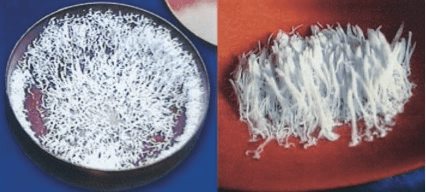
White Bodhi Nectar

You ought to step back and consider the mysteriously natural structure of the nectar. Other than the Buddhas and Bodhisattvas, who could construct such a wonderful and mysterious structure? What skilled craftsman or master artisan in the world could do so? In the entire world, there is no such skilled craftsman or master artisan!


What is even more important is that the Rinpoches and other Buddhist practitioners in attendance all attested to their personal participation in the assembly and what they personally saw. If they spoke falsely, they would naturally descend into the Vajra Hell realm! Is it really possible that these Rinpoches do not know the incomparable suffering of hell? Is it really possible that these Rinpoches and other practitioners of Buddhism are willing to falsely attest and descend into hell? Every sentence that I have written here is from the bottom of my heart.
I would like to earnestly tell all of those ignorant people who still harbor doubts that they must definitely not follow in my ignorant footsteps of 30 years ago!

Confessions of a Rinpoche

Link:https://peacelilysite.com/2024/01/05/confessions-of-a-rinpoche/

#Confessions# Rinpoche #Nectar #BuddhaDharma #Assembly#AmangNopuPamu#Buddhism
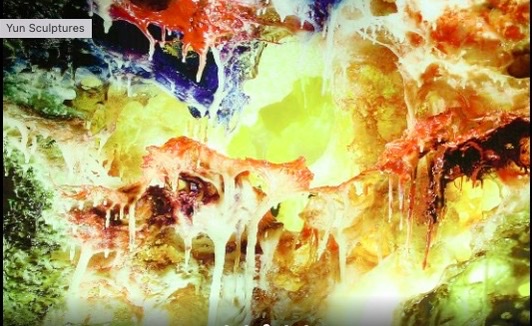

Interview with Elder Monk Yi Zhao After Buddhas Bestowing Nectar Dharma Assembly

The Explanation of the Buddha’s Title – “H.H. Dorje Chang Buddha III

On April 3, 2008, a solemn and dignified first-publishing ceremony of a fact-recording book entitled H.H. Dorje Chang Buddha III, which published jointly by the World Buddhism Publishing LLC and the World Dharma Voice, Inc., was held at the Library of the Congress of the United States. The book was also formally accepted into the collection of the Library of the Congress of the United States. Only since that time, did people in the world know that Master Wan Ko Yee, who had been broadly respected by the great masses and who had also been known as Great Dharma King Yangwo Yeshe Norbu, had been recognized by the world’s leaders, regent dharma kings, and great rinpoches of Buddhism through official documents as the third incarnation of Dorje Chang Buddha, who is the primordial Sambhogakaya Buddha of the universe. The Buddha’s name is H.H. Dorje Chang Buddha III. Since then, people began to address His Holiness the Buddha by “Namo[1] Dorje Chang Buddha III.” This is similar to the situation that Sakyamuni Buddha’s name was Prince Siddhartha Gotama before attaining Buddhahood. However, after Sakyamuni Buddha had attained Buddhahood, His title changed to “Namo Sakyamuni Buddha.” That is why we now address His Holiness the Buddha as “H.H. Dorje Chang Buddha III.” In particular, on December 12, 2012, the Senate Resolution No. 614 of the United States Congress officially used “His Holiness” in the name addressing Dorje Chang Buddha III (That is to say, “H.H. Dorje Chang Buddha III.”) Since then, the title and status of H.H. Dorje Chang Buddha III has been definitive by nature. And, as a matter of fact, “Dorje Chang Buddha III” is a name used legally in governmental and official legislative documents. Therefore, the previously used respected name and titles such as “Wan Ko Yee,” Great Master, and Great Dharma King no longer exist. However, the news below was published before the Buddha’s title of H.H. Dorje Chang Buddha III was publicly announced. At that time, people did not know about the true status of His Holiness the Buddha. Therefore, to respect the true history, we still kept the names used before the title of H.H. Dorje Chang Buddha III was legitimately determined in republishing this news. However, all must clearly know that the only legitimate name of His Holiness the Buddha is H.H. Dorje Chang Buddha III and all other names used before the legitimate determination no longer exist.

Elder Monk Yi Zhao, the rightful heir of the Dharma lineage of Elder Monk Xu Yun, holds the esteemed position of the 44th great master within the Lin Chi sect of Zen Buddhism. Currently, he stands as the highest master in the realm of Zen Buddhism worldwide.

In June 2000, H.H. Dorje Chang Buddha III presided over a Buddhas Bestowing Nectar Dharma Assembly. Following the assembly, an interview with Elder Monk Yi Zhao took place. The following is a transcription derived from the video tape of the Nectar Dharma Assembly.

QUESTION: Could you please briefly describe the wonderful occurrences that took place during the Buddhas Bestowing Nectar Dharma Assembly that you attended? ANSWER: We first saw the Dharma King. We then saw the Dharma King practice the Dharma to raise the consciousness of certain beings to higher realms of existence. We took a look and there were only a few wasps (yellow-jackets). After the Dharma King practiced the Dharma for a period of time, he said that he had already summoned many beings, such as solitary spirits, Kinnaras, etc. in order to raise their consciousness. When we went to take another look, we saw that there were many wasps. I do not know the exact number, but there must have been over ten thousand of them. During another period of time the Dharma King said that the raising of their consciousness is almost complete. Those wasps were specially benefited. Why were there all of those wasps? Certain solitary spirits, certain kinnaras and other beings took on the physical form of wasps, arrived at the scene and received the consciousness raising Dharma. What is receiving the consciousness raising Dharma?

We human beings must eat and drink in order to survive and grow. However, after those solitary spirits received the consciousness raising Dharma, they were able to take birth in a heavenly realm in the Western Paradise or in another buddha realm. We went over and took another look. We noticed that all of the wasps had departed. Why did none of them remain? They received the consciousness raising Dharma and were raised. Therefore, none of them remained, because they were liberated. This is what we first saw at the dharma assembly. The next part of the assembly was the “Buddhas Bestowing Nectar.” There were five or six of us. There were about a dozen monks and nuns. It was not only Chinese people who participated in this part of the assembly. There were even non-Chinese people there! At this time, a bowl was placed about 30 feet away from the Dharma King. What type of bowl was this? It was a crystal bowl. The crystal bowl was placed on the ground. The bowl was in the middle of two opposite lines of people. The bowl was not far from the two lines of people. Everyone sat on the ground and looked at the bowl. This crystal bowl had a lid and was a bit smaller than a washbowl.

There was another bowl that was small. Elder Wu Ming was asked to wash that small bowl with water. After he washed it, he was asked to wipe it dry. He wiped the inside of the bowl so well that not one drop of water remained. This bowl was then placed back inside of the crystal bowl. The Dharma King then told everybody to stare at the bowl. He said that our vision must remain fixed on the bowl. All of us began to stare at the bowl. After awhile, what did the bowl appear to contain? A meteor. Of course, it was not a real meteor. It seemed as if rain had fallen. What exactly was in the bowl? It was white. It descended with flashes of light. It took a while for it to descend. The Dharma King then told us to open the bowl and look inside. The small bowl was inside the crystal bowl, yet flashes of light could be seen within the crystal bowl. This interior bowl slowly became filled. What color was the substance that filled the bowl? It seemed to be white. It was not pure white. It looked like milk, but it was not milk. It was like that of the finest cream. It was a a very savory taste with a bit of sweetness. The Dharma King personally fed it to all of us during the Dharma Assembly. Rays of red light descended. Flashes of red light descended. The strange thing was that each person’s perception of the color of this light was different.

Why? Since each person’s level of cultivation and state of realization are different, there were differences in the supernormal states they perceived. I followed Elder Monk Xu Yun ever since I was young. I also met Master Tai Xu. The two of them practiced different dharma methods and therefore had different states of realization. I have met many practitioners of Buddhism such as those who practice the dharma of the Pure Land School, those who practice Zen meditation, etc. However, I have never seen the supernormal state of nectar descending from the sky. What about this time? This time, I personally saw it. I truly saw it. This is a very rare occurrence. I obtained a certain insight from this experience. Of course, people have different levels of realization. What did the Great Dharma King rely upon in his Tantric visualization? He relied upon our original nature in his visualization. The usefulness arose from the prajna of true emptiness. This even includes nectar bestowed from the sky. The light of the Tathagata descended out of emptiness. This was the wonderful effect of the Dharma King’s application of prajna.

What is Prajna? It is realization that all phenomena are empty. Things arise from true emptiness. Emptiness can bring about wonderful effects. Wonderful effects arise from prajna. All realities thus arise. All phenomena thus arise. Over the past several decades of my life, that was the only time when I actually saw the supernormal state of nectar descending from the sky. I have followed many great elderly monks when they practice the dharma in private. I could not see any effects. However, this time at the Dharma Assembly, I truly saw certain effects. Today I am describing to everybody the facts concerning nectar that descended from the sky. So that everybody will understand, I am not talking about exoteric Buddhism or esoteric Buddhism. I am saying that the wonderful effects of the buddha dharma are beyond logic and reason. If we cultivate ourselves sincerely, we certainly will experience these wonderful effects. Of course, if you meet a good teacher, your cultivation will progress rapidly. If you do not meet up with a good teacher, yet you still diligently cultivate yourself on your own, you will naturally encounter a good teacher in the future. These are my personal insights. Today I have briefly described nectar descending from the sky, which I personally saw. It truly occurred.

QUESTION: With respect to the effects of the nectar on you, after you ate the nectar, was there any great change in your state of realization?

ANSWER: After eating nectar one’s physical strength naturally increases and one’s internal practices are benefited. It helps one’s cultivation, no matter what method of cultivation one practices. Of course, this is something incredible. Whenever a thought arises in my mind, no matter what type of thought it may be, I will introspect upon it. I will immediately become vigilant. I will immediately introspect. If my mind has even just a little greed or anger, I will get rid of it. I feel better physically. Although I am now over 70 years old, my physical condition is not bad. It is a little better than before. I think that each person will experience different effects from having eaten nectar. Why? Each person’s karma is different and each person’s insights into life are different.

For example, fish see the ocean water as something to live in. Human beings view the ocean water as a means of eating, yet celestial beings see this body of water as colored glaze. Each person’s insights are different. Each person will experience different effects from having eaten nectar. Although the effects are different, the nectar will plant a certain seed within the person. Take for example, those who recite Amitabha Buddha’s name. Even though they continually recite Amitabha Buddha’s name, who knows when they will be able to obtain Buddhahood. However, some people recite Amitabha Buddha’s name only a few times or ten times, yet they are able to be reborn in the Western paradise. This is because the underlying karmic conditions of each person are different. Therefore, each person will experience different effects from having eaten nectar. Nevertheless, the nectar will provide each of them with benefits to further their liberation. These are my opinions, understandings, and feelings.

QUESTION: Did the lecture of the Great Dharma King provide you with any insight or great benefit?

ANSWER: What did the Great Dharma King speak about: Emptiness and prajna. Each sentence that he spoke contained prajna wisdom. It was not a general lecture. If it had been, then the words would have been simple. However, all of his words reflected prajna wisdom. That is, all phenomena arise out of emptiness. All of our thoughts of greed, hatred, ignorance, conceit, and doubt arise out of attachment to the concept of self or out of attachment to the concept that the things of the world are real. When these two attachments spur our thoughts, then the various afflictions arise. What type of affliction arises? Pleasure and suffering. From the perspective of our pure, original nature, pleasure and suffering are born of ignorance. Why? To do evil is suffering. One does evil due to the obscuration of ignorance. We can turn this around and speak of pleasure. There is an impure way of doing good. For example, when we do good, we might do so in order to be benefited in a future life. This is an impure way of doing good which leads to more suffering within cyclic existence.

This way of doing good is tainted. Why? When we do a good deed we must not have any attachment in our minds. If we have any attachment in our mind then we will not obtain liberation. Therefore, the Dharma King said that all phenomena are empty. Prajna is the most important thing in the nature of everything. We, if we can understand the Dharma King’s words that all phenomena are empty, then we can simply see the objective truth without giving rise to thoughts of suffering, pleasure, goodness, and evil. Everything arises from the coming together of the four great elements. We should realize prajna through understanding that true emptiness is the true nature of all phenomena. Wonderful effects are produced from true emptiness.

We should understand that all phenomena must go through the process of arising, existing, changing (deteriorating), and passing away. Living beings go through the process of birth, aging, sickness, and death. From where does this process originate? It originates from true emptiness. Using the prajna that has penetrated the empty nature of phenomena we can see the four great elements of earth, water, fire, and wind come together due to the maturing of certain conditions. The four great elements disperse when these conditions end. However, why do we become attached to the worldly phenomenon so as to give rise to all afflictions and all hindrances? We must rely upon the contemplation of prajna to eliminate all ignorance. we must use the flames of wisdom to burn away all negative karma created out of ignorance. every sentence spoken by the Dharma King was permeated with prajna. We will be tremendously benefited from reflecting upon his words. These are my impressions. In the future all one has to do is read just one of the Dharma King’s works and that will be enough. It will be sufficient to only focus on one method. Even if you only assimilate one sentence of the Dharma King’s words, the beneficial effects could last for your entire life or even last for an infinite amount of time in the future.

The original nature of all phenomena is emptiness. Out minds should not dwell on the past, present, or future. Our minds should not dwell on any phenomena or anything that exists in the external world. When we do not dwell on anything, what type of mind do we have? A pure mind. Our various views emanate from our consciousness and form the external environment. These views are based on ignorance. If based upon a pure mind, we are able to contemplate phenomena, yet not become attached to phenomena; abide in emptiness, yet not become attached to emptiness. If we are able to practice the total detachment of the Middle Way, then we can obtain liberation. Each sentence that the Dharma King spoke truly went to the heart of prajna. Each sentence has the potential to break our cycles of birth and death and totally eliminate our ignorance.

Interview with Elder Monk Yi Zhao After Buddhas Bestowing Nectar Dharma Assembly

Link:https://peacelilysite.com/2023/12/29/interview-with-elder-monk-yi-zhao-after-buddhas-bestowing-nectar-dharma-assembly/

#DorjeChangBuddhaIII #HHDorjeChangBuddhaIII#DorjeChangBuddha#HolyFeat #TrueBuddha-Dharma #Nectar #DharmaAssembly #MasterYiZhao #ElderMonkYiZhao

A Holy Feat: H.H. Dorje Chang Buddha III Gave a Proof of True Buddha-Dharma

(Translated from a report in Chinese published in Las Vegas Chinese Newspaper on June 3, 2014)

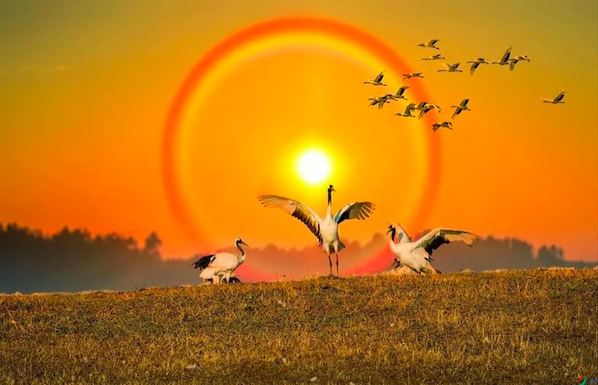
(Reported from Los Angeles) In the spring of 2014, just before the grand opening of the H.H. H.H. Dorje Chang Buddha III Cultural And Art Museum, an extraordinarily sacred event unfolded in the presence of H.H. Dorje Chang Buddha III. During His Holiness’s travels on a tour, a flock of birds appeared within approximately 100 meters of His Holiness the Buddha. In a stunning display of nature’s marvel, the birds gracefully descended onto a water surface, creating a mesmerizing group dance. This ethereal performance was accompanied by the atmospheric phenomenon of a sudden storm.

This extraordinary event took place on May 19, 2014, while H.H. Dorje Chang Buddha III was visiting Mexico in the company of more than 20 individuals. The clock had just passed five in the afternoon. Returning from an excursion to an ancient Maya site near the city of Merida, the Mexican tour guide guided them to the Temozon Resort Hotel, an opulent establishment converted from a manor farm.

Seated at a table near the window inside a coffee shop were H.H. Dorje Chang Buddha III and two distinguished virtuous ones. Through the window, about 100 meters (328 feet) away, lay a rectangular-shaped swimming pool. At this moment, H.H. Dorje Chang Buddha III gathered His entourage and delivered an announcement:

“Throughout this journey, you have witnessed many awe-inspiring scenes. However, today, you are about to witness a breathtaking dance unlike anything you have seen before. Shortly, a multitude of birds will grace this swimming pool to perform a ‘Dragonfly Stepping on Water’ dance. These birds will gracefully descend, shuttle above the water’s surface, tread upon it, and ascend into the sky. This dance is also known as the ‘Spiritual Birds Stepping on Water.’ Moreover, their performance will persist even after the rain commences.”

At that time, people within the entourage all looked outside the window but did not see even one bird. However, since H.H. Dorje Chang Buddha III had called them over and told them that a world-astounding miracle would occur soon, they were confident that it would definitely happen. Still some of them raised a doubt, “Can a bird fly up after touching the water? Wouldn’t it plunge into the water and drown?”

H.H. Dorje Chang Buddha III then asked them, “Do you see birds now?” The disciples replied, “No, there isn’t a bird, not even a bird’s shadow.” H.H. Dorje Chang Buddha III said, “If you suspect that they will not come, or they will plunge into the water and drown, just wait and see what happens. Anyway, I will just tell you this. If there are no birds dancing above the swimming pool, the dharma I expounded would be evil views. If they do show up, that means I am truly Dorje Chang Buddha III, representing all Buddhas in the ten directions and, on the other hand, those dharma kings, rinpoches, venerable ones, and great dharma masters who slandered me are either evil masters or swindlers. The fact will be shown when the birds come. You just wait and see. Moreover, in a sudden moment, celestial deities will cast a heavy rainstorm within one or two seconds, providing an accompanying performance to the dance. However, the birds will not be driven away or stop due to the rain. You will soon see, whether Dorje Chang Buddha III expounded true Buddha-dharma or evil dharma and whether those who engaged in slandering and defamation are demonic persons, evil masters, and swindlers or not.”

Photo by Hakan Tahmaz on Pexels.com

After only one minute or so, many birds did fly to the sky above the swimming pool. There were no birds at any other place. They were circling and flipping very fast above the swimming pool. Some began dashing downward. Shortly afterwards, just as H.H. Dorje Chang Buddha III had predicted a few minutes ago, the birds dived down from the sky and had their feet stepping on the water, and then flew upward back to the sky. The dance repeated this way over and over again.

Then, H.H. Dorje Chang Buddha III said, “It is going rain heavily right away.” Everyone started to count silently, one, two, …… Exactly as told, in less than two seconds, a heavy downpour suddenly started. The bird did not stop or leave, and continued to dance within the rainstorm. Every detail of the prediction made ahead of time by H.H. Dorje Chang Buddha III came true completely, proving that H.H. Dorje Chang Buddha III’s Buddha-dharma is the true dharma and that those who slandered His Holiness the Buddha are all demonic persons, evil masters, and swindlers.

To provide witnesses to this absolutely true holy scene, the disciples who accompanied His Holiness the Buddha on the trip and saw with their own eyes this extremely magnificent holy feat recorded in writing the situation at the time and signed their names. They also took oaths against severe consequences to guarantee what they wrote are ironclad facts. If what they wrote were an untrue fabricated story rather than their own experience, they not only would not become accomplished in this lifetime but also would devolve into the hell of uninterrupted suffering to undergo all kinds of sufferings. On the other hand, if what they stated is true, they will be certain to attain liberation and accomplishment in the current lifetime. They wished that all living beings can learn the true Buddha-dharma from H.H. Dorje Chang Buddha III.

The whole process at that time was recorded by video. This live video recording included many world-astounding scenes one after another that proved His Holiness the Buddha’s realization of enlightenment and will be dedicated as a present to the H.H. Dorje Chang Buddha III Cultural and Art Museum. The video will be shown to the public at the museum’s grand opening ceremony and will be distributed to people of all walks.

The written testimony was signed by thirteen witnesses of the entourage who took oaths against severe consequences, including Xuan Hui, Wenli, Baima Dorje Cuomu, Hengsheng, Long Zhi, Kuan, Jiawei Dianba, Cideji, Cirong Zhuoma, Gesang Quzeng, Renqing Quezan, Dunzhu, and Tongchang. Their testimony stated:

“This event seems to be plain simple. However, after careful thinking, we can realize that:”

  • “First, this place is quite far off. Except the Mexican tour guide, none of us on the tour has been here. Neither did we know the location, the setting, or anything about this place. We did not know this place had birds either.
  • Secondly, when H.H. Dorje Chang Buddha III made the announcement, we all clearly saw that there was not even one bird above the swimming pool and the higher sky above it.
  • Thirdly, birds are of course not human. They have no way to speak to us or communicate with us in other ways. We human are not able to give notice or direction to the birds either to let them tread and dance on the water surface, not to say that they were more than 100 meters (328 feet) away from us.”

“With all these facts, then how was H.H. Dorje Chang Buddha III able to inform all of us two or three minutes ahead of time that many birds would fly to the sky above the swimming pool and state definitively that the birds would perform a world-astounding miraculous dance? What was even more astounding is announcing that celestial deities would produce a heavy downpour within 1-2 seconds and the birds would not be driven away by the rain and would continue to dance. Exactly as forecasted, such a world-astounding scene did take place, proving the truthfulness of the announcement made by His Holiness the Buddha. This is not an issue of prediction. Rather, it represents the ultimate truth and Buddha-dharma that is millions of times more powerful than a prediction!!!! This fact fully proved that the world of Buddhas is completely different from living beings’ world, that the truth of Buddha-dharma that the Buddha expounded to living beings is absolutely true without anything untrue, and that living beings must cultivate in accord with the Buddha’s teaching, in order to become accomplished and truly enter the world of Buddha-dharma. This is because His Holiness the Buddha is the sole highest extremely great holy virtuous one. We simply are unable to know all truths and facts that H.H. Dorje Chang Buddha III is aware of. Therefore, we cultivate in accord with the His Holiness Buddha’s teaching. Only then can we turn the state of an ordinary being into the state of a Buddha and enter the world of Buddhas and Bodhisattvas!”

“You should not believe literally H.H. Dorje Chang Buddha III’s description of this event. His Holiness the Buddha said that He is a humble one, He does not have the ability of telling the birds to present a dance on top of the water or telling celestial deities to rain a heavy downpour as an accompanying performance to the dance, this holy occurrence was a coincidence due to the karmic conditions of all who were present, and He does not have such a power of realization. Rather, you should realize that these statements reflected the supreme virtue of selflessness of a true Buddha. You should think carefully about this situation. Which dharma king, rinpoche, dharma master, or holy one can announce ahead of time when there is no bird seen that many birds will come to perform a dance of treading water? Moreover, within only three minutes, many birds did show up and dance on the water, making many splashes of water.”

“Maybe we can just say that this is not amazing. However, such a statement of announcing the arrival of many birds to perform a dance of treading water cannot be baselessly made by a person with the status of a Buddha when a live video recording was on and there was no bird around. How would the situation end if there weren’t many birds showing up afterwards? Moreover, the announcement said that celestial deities were to pour a heavy rain in two seconds. Two seconds after the sentence ended, a heavy downpour started immediately, manifesting an accompanying performance to the birds’ dance. This is something far more than being amazing. It is truly a holy feat made by His Holiness the Buddha. No other holy one can do so, because he does not have such supreme realization of Buddha-dharma. We know that no eminent monk, dharma king, or rinpoche in history has ever done so. In real life, we do not see any great dharma king, great rinpoche, or great dharma master making such accomplishment either! Looking at the last several thousand years, only H.H. Dorje Chang Buddha III has the true dharma of the Tathagata to manifest such inspiration and virtuous realization. In another instance, H.H. Dorje Chang Buddha III reversed an aged appearance to that of a youth after only a little over ten minutes. Can any great patriarch master, great dharma king, great rinpoche, or great dharma master make an accomplishment that bears a remote resemblance to this?”c

“Now we know that a true Buddha came to our world. Why don’t you seize this opportunity to follow the Buddha to cultivate and learn the dharma to end the cycle of birth and death? Also, it is certain that you will die soon and you will not be able to escape the death!!! That time will soon come, when your breath will stop and you will die. Your soul, which is the spiritual consciousness you have now, will not have anything that you once possessed in the human world. You will be penniless regardless of how much money you once had. At that time, there will be no food, no house, and nothing. While you are at the stage of bardo, you can see your family members but they can’t hear you talking to them. You will only have loneness, extreme suffering, hunger, and fear. There is no hotel on your way to the afterworld. You don’t know where you can stay for the night. This is not to scare you. That day will come very soon! This is an obvious fact. You are certain to experience the loneness, fear, and the coming together of all kinds of sufferings that never end. The only way to avoid this consequence is to learn the true dharma of the Tathagata right now. Only by doing so can you become accomplished and break away from the fear of death. You should look for the Buddha immediately to learn the dharma. There will be no second chance if you waste this lifetime!!! Then only loneness and suffering with no possibility of being rescued are waiting for your soul.”

A Holy Feat: H.H. Dorje Chang Buddha III Gave a Proof of True Buddha-Dharma

Link:https://peacelilysite.com/2023/12/22/a-holy-feat-h-h-dorje-chang-buddha-iii-gave-a-proof-of-true-buddha-dharma/

#DorjeChangBuddhaIII #HHDorjeChangBuddhaIII#DorjeChangBuddha#H.H.DorjeChangBuddhaIIICulturalAndArtMuseum#HolyFeat #TrueBuddha-Dharma

Source: https://xuanfa.net/news/a-holy-feat-h-h-dorje-chang-buddha-iii-gave-a-proof-of-true-buddha-dharma/?hilite=true+story+holy+monk

Embracing the Spirit of Christmas

A Reflection on the 1914 Christmas Truce

In the midst of the First World War, a remarkable event occurred that transcended the boundaries of conflict and highlighted the true essence of Christmas – the Christmas Truce of 1914. As we celebrate this joyous season, it’s essential to reflect on the lessons of compassion, love, and humanity that emerged during that extraordinary moment in history.

“It will be over by Christmas.” This false assurance echoed among the 60 million soldiers sent to the battlefront, exposing the grim reality that war does not adhere to predetermined timelines. The soldiers found themselves entrenched along the Western Front, living in harsh conditions, mere meters away from their adversaries.

Despite the hostility of war, the spirit of Christmas prevailed on that fateful Christmas Eve. German troops, unwrapping gifts from home and lighting lanterns along their trenches, initiated a surprising turn of events. Carol singing broke out, and soon British and French troops joined in, bridging the gap between enemies.

As Christmas morning dawned, a temporary ceasefire was proposed, and soldiers from both sides cautiously ventured into no man’s land. Greetings, well wishes, and even gifts were exchanged. Spontaneous football matches broke out, demonstrating a shared humanity that transcended the barriers of war.

The Truce of 1914 was not an isolated incident; it was a series of truces involving over 100,000 soldiers across the British-held area of the Western Front. The scale of these impromptu ceasefires is a testament to the universal longing for peace, even in the midst of one of the deadliest conflicts in history. Spontaneous football matches broke out, transforming caps and jackets into makeshift goal posts. Corporal John Ferguson vividly described the scene: “What a sight – little groups of Germans and British extending almost the length of our front! Out of the darkness we could hear laughter and see lighted matches, a German lighting a Scotchman’s cigarette and vice versa, exchanging cigarettes and souvenirs.”

Reflecting on the teachings of Jesus, who implored his disciples to love their neighbors, it becomes apparent that the message transcends religious boundaries. In times of war fueled by religious differences, it is crucial to remember that faith should serve as a source of inspiration for compassion, love, and kindness, irrespective of one’s beliefs.

Similarly, the teachings of Shakyamuni Buddha echo through time, emphasizing the compatibility and mutual respect among religions. The contemporary Buddha, H.H. Dorje Chang Buddha III, extends this ethos by acknowledging figures like Jesus Christ as great holy beings. In his Dharma discourses, His Holiness emphasizes the imperative for all Buddhist disciples: “When encountering living beings, regardless of whether they are handicapped, deficient, sick, or healthy, treat them all equally as family members…” His Holiness further calls for global cooperation, transcending religious, cultural, and national boundaries. He underscores the importance of treating each other as dear relatives, emphasizing a collective effort necessary for the peace and auspiciousness of the world.

As we celebrate Christmas today, let us draw inspiration from the Christmas Truce of 1914. In a world where conflicts persist, particularly in places like Gaza, may we strive for peace, understanding, and empathy. Let the spirit of Christmas be a beacon of hope, guiding us towards a future where love triumphs over hatred, and unity prevails over division.

The Christmas Truce of 1914 serves as a timeless reminder that even in the darkest of times, the light of humanity can shine through. As we gather with loved ones during this festive season, may we carry the spirit of Christmas within our hearts and work towards a world where the message of love and peace prevails.

Embracing the Spirit of Christmas: A Reflection on the 1914 Christmas Truce

Link:https://peacelilysite.com/2023/12/20/embracing-the-spirit-of-christmas/

#SpiritofChristmas #Christmas #ChristmasTruce #WorldWarI #Peace#Compassion #Religion #History

Source: https://www.visionofhumanity.org/the-christmas-truce/#:~:text=As%20the%20German%20soldiers%20lit,were%20communicated%20between%20the%20trenches.

Bridging Realms: Dr. Jim B. Tucker Explores Reincarnation

Bridging Realms: Dr. Jim B. Tucker Explores Reincarnation

In the intricate tapestry of human beliefs, the concept of reincarnation has woven itself through the fabric of traditional Asian cultures for centuries. However, this idea finds little resonance in Western cultures and often faces skepticism from the scientific community. Amidst this cultural and scientific dichotomy, a pioneering exploration is unfolding at the prestigious University of Virginia School of Medicine, led by Dr. Jim B. Tucker, a child psychiatrist with a unique perspective on life after death.

Born and raised in the southern United States, Dr. Tucker’s early life was immersed in the traditional beliefs of the American South. As he embarked on his academic journey, obtaining an undergraduate degree in psychology and specializing in child psychiatry, he encountered the notion of reincarnation with a healthy dose of skepticism. The clash between cultural beliefs, scientific inquiry, and personal skepticism set the stage for Dr. Tucker’s intriguing exploration into the mysteries of existence.

The documentary, highlighted on the Discovery Channel, explores the extensive and worldwide research conducted by Dr. Tucker. The film encapsulates the core of his studies, presenting interviews, case studies, and the profound implications of his findings. Through this visual medium, viewers are welcomed to observe the intersection of traditional beliefs, modern skepticism, and scientific exploration—all in the quest to unravel the mysteries of human existence.

Buddhism holds that life undergoes reincarnation through the six realms. After a person dies, if the karmic conditions accumulated in their past life mature, they may be reborn into the heavenly realm as a deity, or into the realm of asuras, or they may be reincarnated in the human realm. If negative karma, such as killing, deception, or greed, comes to fruition, the individual will inevitably fall into the hell realm and suffer, or they may be reborn in the realms of hungry ghosts or animals to endure suffering.

As for which realm one will be reborn into among the six, it depends on the karmic conditions of their virtuous and non-virtuous actions. Why does reincarnation occur? The fundamental reason lies in the attachment of sentient beings. Attachment gives rise to the confusion of karma, and from this confusion arises ignorance. Due to the endless causes and effects generated by ignorance, various positive and negative karmic forces are produced. It is these karmic forces that determine which realm of existence one will be reborn into.

Bridging Realms: Dr. Jim B. Tucker Explores Reincarnation

Link: https://peacelilysite.com/2023/12/08/bridging-realms-dr-jim-b-tucker-explores-reincarnation/

#Buddhism #KarmicCondition #SixRealm#Reincarnation

Remembering Charlie Munger: A Beacon of Wisdom in the Investment World

Charlie Munger, the Philosopher of the Investment World

The investment realm bids farewell to its philosopher, the golden partner of Warren Buffett, Charlie Munger, who passed away on November 28th this year, at the age of 99. Munger’s life was a testament to generosity, kindness, rationality, humility, and a low-key demeanor. Renowned for his honesty, integrity, lack of complaints, and absence of hindsight bias, Munger earned global admiration and respect. His impactful literary work, “Poor Charlie’s Almanack,” reflects his profound humanity.

Among Munger’s profound teachings, five sentences stand out, resonating deeply with individuals and serving as timeless nuggets of wisdom. Deserving Success, Value Investing Strategy, Success and Surroundings, Magic of Compound Interest, Probabilities Over Luck.

“The best way to obtain something is to make oneself deserving of it” reflects classic wisdom upon contemplation. Unlike typical words of wisdom that merely offer principles without practical methods, Munger’s comprehensive approach in “Poor Charlie’s Almanack” reveals a value investing strategy intertwined with life philosophy.

Charlie Munger’s love for books was profound. Often referred to as a “bookshelf with two legs,” Munger’s voracious reading habit extended beyond the realms of finance. He explored diverse genres, not just for knowledge acquisition but to open his mind to different angles and views. His extensive reading shaped him into a profound thinker, and his eclectic taste in literature reflected in his unique perspectives. Munger’s commitment to continuous learning and intellectual curiosity made him an embodiment of wisdom.

Photo by Pixabay on Pexels.com

Munger’s belief in value investments extended beyond finance to personal development. He advocated assessing the value of a business before evaluating its stock, discarding speculative opportunities, and overlooking short-term factors. The enduring factor for a stock’s reliability, according to Munger, is whether it truly deserves its current price. This principle, he argued, holds true for personal growth, embodied in the saying, “The essential reason for a person’s success is that those around him wish for his success.”

Throughout his illustrious investment career, Munger adhered to the traditional values of the American West — diligence, focus, sincerity, thrift, and future investment. These principles earned him the trust of many collaborators. Notably, Munger’s initial million came from a real estate investment while he was still a lawyer. Recognizing the potential for real estate development in a property left by a client’s ancestors, Munger, through the client’s trust, achieved tremendous success.

Munger’s philosophy that making oneself valuable attracts potential collaborators is the most reliable investment method. This philosophy aligns with renowned stock guru Warren Buffett’s simple yet effective secret to wealth: save, invest, continue saving, and continue investing. Munger’s teachings delve into the power of compound interest, demonstrated in a thought experiment within “Poor Charlie’s Almanack.”

The experiment presents two choices — receiving $1000 daily for 30 days or receiving an escalating amount starting with 1 cent, doubling each day for 30 days. The seemingly attractive first choice limits the total to $30,000, while the second, with the magic of compound interest, accumulates to an astonishing $5.37 million. Munger highlights the patience required for compound interest to exhibit its true power, a principle applicable to personal growth.

Economist Xiang Shuai’s intriguing experiment reinforces Munger’s teachings. Progressing a little every day, even by 1%, leads to significant advancement after a year, while regressing daily results in minimal talent advantage. Munger’s emphasis on the importance of daily learning and reading resonates with the ancient wisdom: “Accumulate small steps, and you will cover a thousand miles.” He advocates believing in probability over luck, emphasizing that probability theory aligns closely with the world’s functioning.

Munger’s views on setting goals underscore the importance of realistic expectations and avoiding fanaticism. He advises setting goals slightly beyond one’s capabilities, then striving wholeheartedly to achieve them. The rational and joyful life attitude Munger promotes hinges on believing in the magic of compound interest.

Despite initial misconceptions, “Poor Charlie’s Almanack” is hailed as a seriously underestimated gem, transcending the appearance of a self-help book. Patiently reading through Munger’s insights reveals a figure resembling a traditional Chinese sage, offering universal wisdom for living a fulfilled and prosperous life. His desire for everyone to master universal wisdom echoes in the statement, “I only pass my sword to those who can wield it.” Munger’s legacy serves as a guiding light, illuminating our paths to a brighter and more brilliant existence.

Remembering Charlie Munger: A Beacon of Wisdom in the Investment World

Link: https://peacelilysite.com/2023/12/07/remembering-charlie-munger-a-beacon-of-wisdom-in-the-investment-world/

#CharlieMunger #InvestmentWisdom #LegacyOfLearning #PoorCharlieAlmanack #Wisdom

Experience and Lessons from the Buddha by Zhaxi Zhuoma Rinpoche

I have followed this Buddha – H.H. Dorje Chang Buddha III, before I even knew He was a Buddha, because I wanted to learn the Buddha-dharma of Shakyamuni Buddha; the dharma that can enlighten and enable one to attain liberation from samsara. I am grateful to all the other teachers who helped me on this path, but I have come to know that H.H. Dorje Chang Buddha III is truly a holy being and has the Buddha-dharma that can enable us to become Bodhisattvas and eventually Buddhas. I don’t see that anywhere else, but I do see a lot of erroneous and even evil practices that do not provide the power of the dharma that Shakyamuni Buddha brought to this world. I am alarmed at the secularization of Buddhism that has occurred in the West. It would seem that much of what is presented as Buddhism today is mainly a form of mindfulness that is a method to develop concentration, reduce stress, and achieve serenity. These are all worthy by-products and useful, but fall far short of the wonders and marvelous existence taught by Shakyamuni Buddha. People do not believe in the power of the Buddha-dharma, because they have never experienced or seen it.

 I would like to share two true stories about my wonderful Buddha Master, H.H. Dorje Chang Buddha III:

Some time ago my Buddha Master, asked me to practice the Modesty and Patience Dharma taught by Shakyamuni Buddha. The Buddha Master taught me how to respect persons lower than myself and told me to prostrate to those who were lower than me in their cultivation. To tell you the truth this bothered me. How could I possibly prostrate to them? The Buddha Master told me that in His past lives Shakyamuni Buddha prostrated to everyone. Shakyamuni Buddha practiced in this way to cut off self-attachment and practice forbearance.

One night at Hua Zang Si, a rinpoche attempted the Hidden Mani Stone Selection Dharma. After finding the first stone, he tried for a long time and was never able to locate the second stone  that we had hidden. However, I was able at that time to see them. Because he found one of the mani stones, the temple arranged for me to prostrate to him at the end of the Dharma Assembly. To tell you the truth, my first reaction was resentment—I was almost even angry. Based on my own practice, how could I prostrate to this person who had not been able to successfully complete the test, when I could have easily done so?  When this thought just appeared, I saw my Buddha Master teaching me forbearance again and I was very ashamed. However, several days passed, but I was still bothered by this, so I went to see my Buddha Master and asked: “How can I prostrate to a person who doesn’t have my vajra power in front of so many people?” My Buddha Master asked me, “Did you forget the true story I told you about Shakyamuni Buddha? Putting yourself as low as possible is the true way to true cultivation.” At the same time I saw that my Buddha Master had the best understanding in all of esoteric and exoteric Buddhism and had complete mastery of all five of the vidyas. My Buddha Master is a great Dharma King. At that time His identity as a Buddha had not yet been announced to the public, but we already knew that He was a great Dharma King. How could I not listen to His teachings?

I thought for some time, just which great Bodhisattva is my Buddha Master? Then I had a shocking experience that I have not shared publicly before. I actually saw my Dharma King Master drastically change His appearance in a very short period of time. Even though my Buddha Master had predicted that He would on such and such a day take on the negative karma of others and would not be available to meet the public, I was not prepared for what I saw. He appeared on the predicted day looking very ugly and old—His face was bloodied as if He had just been severely beaten. His eyes were swollen and half closed! There were many people standing around, but they seemed to be accepting of this condition. I had been thinking that,  because of His accomplishments in both exoteric Buddhism and esoteric Buddhism and the Five Vidyas, my Master must be a Buddha, but how could this be true when He looks so old and decrepit? I could barely stand looking at my beloved Dharma King Master when He was like this. Remember, at that time we did not know that our Dharma King Master was a Buddha. In less than an hour, I looked again, and my Buddha Master had changed to a beautiful young man. I was shocked. Oh, my God. How could this be? My Master is a Buddha! What I was thinking is true! He is not just a Bodhisattva, but a Buddha. I looked around, but no one else was shocked or showing any reaction at all to what had just happened. I looked again at my Master and He just smiled. He put His finger to His mouth and quietly said “shhh” and I realized that no one else had seen this transformation, but I knew this fact about the Buddha. 

These photos were true records of the holy miracle Buddha Dharma, they are now displayed at Hua Zang Si, at San Francisco

Another disciple of H.H. Dorje Chang Buddha III, bhiksuni Shi Zheng Hui, has documented a genuine personal account of a sacred transformative experience in the book titled “Revealing The Truth: What Is the Truth about Reversing An Old Age Back to Youth?

Experience and Lessons from the Buddha by Zhaxi Zhuoma Rinpoche

Link:https://peacelilysite.com/2023/12/01/experience-and-lessons-from-the-buddha-by-zhaxi-zhuoma-rinpoche/

#DorjeChangBuddhaIII #HHDorjeChangBuddhaIII#HuaZangSi#HolyManifestation#ReversingAn OldAgeBacktoYouth#RevealingTheTruth#Tripitaka#BuddhaDharma#Zhaxi Zhuoma Rinpoche

Religions should be Tolerant, Compassionate, and Loving

When Shakyamuni Buddha first propagated the true teachings of Buddhism, there were already numerous religions in India and its neighboring countries. Shakyamuni Buddha, with his unparalleled wisdom, tolerance, and compassion, inspired many followers of other religions to convert to Buddhism. Venerable Upali was one such devotee who, deeply moved by the Buddha’s wisdom, became an exemplary disciple of Shakyamuni Buddha.

Upāli, residing in North Magadha, was a wealthy and talented young man and a major supporter of the Jains under the leadership of Mahāvīra. The Jain ascetics lived a very austere life, even going without clothes, a lifestyle admired by many.

In the spring of that year, the Buddha visited Upāli’s mango grove in Nālandā, where he was received by the ascetic Upavāṇa, a faithful follower of Mahāvīra. In the conversation with Upavāṇa, the Buddha learned that Jain followers never mentioned mental defilements, focusing only on actions constituting offenses.

In a dialogue with the Buddha, Upavāṇa revealed that Jain practitioners discussed three types of offenses: bodily, verbal, and mental. When asked which was considered the gravest, Upavāṇa asserted that bodily offenses held the highest severity.

The Buddha countered this view, asserting that, according to the path of awakening, unwholesome thoughts are the most severe since they are more fundamental than actions. This principle, though stated by the Buddha, had to be reiterated thrice before Upavāṇa accepted it.

Following this, Upavāṇa left and conveyed the Buddha’s words to Mahāvīra, who found the Buddha’s perspective erroneous, emphasizing the seriousness of bodily actions.

During this discussion, several disciples, including Upāli, were present. Upāli, having brought a friend from Vājī, expressed his desire to visit the Buddha, intending to challenge the Buddha’s stance.

Although Upavāṇa endorsed Upāli’s initiative, Mahāvīra was hesitant, fearing Upāli might be swayed. Nevertheless, Upāli was determined to meet the Buddha.

Upon meeting the Buddha, Upāli was captivated by his articulate discourse. The Buddha used seven analogies to elucidate why unwholesome thoughts are fundamentally more significant than unwholesome actions.

Aware of the Jains’ strict observance of the non-killing precept, the Buddha asked Upāli if accidentally killing insects constituted an offense. Upāli, echoing Mahāvīra’s teaching, responded that unintentional killing is not an offense.

The Buddha then questioned Upāli’s certainty in the Jain stance. Upāli confidently replied, referring to Mahāvīra’s teachings. The Buddha, smiling, acknowledged that his initial analogy should have sufficed.

Impressed by the Buddha’s wisdom, Upāli expressed his admiration and sought to become a disciple. The Buddha, advising him to contemplate thoroughly, accepted Upāli only after his sincere conviction.

Upon Upāli’s decision to join the Buddha’s order, the Buddha emphasized that while Upāli had shifted allegiance, he should continue supporting the Jains.

As more people in Magadha and Kosala embraced the path of enlightenment, monks visiting Śrāvastī reported this joyful news to the Buddha. In response, the Buddha reminded them that the crucial factor was the diligent practice of the monks, not merely the growth or decline in the number of followers. He encouraged an equanimous outlook towards success and failure, happiness and unhappiness.

The teachings of Shakyamuni Buddha echo through time, emphasizing the compatibility and mutual respect of religions. The contemporary Buddha, H.H.  Dorje Chang Buddha III , extends this ethos by praising figures like Jesus Christ as great holy beings. In Dharma discourses, His Holiness calls for global cooperation, transcending religious, cultural, and national boundaries. He underscores the importance of treating each other as dear relatives, a collective effort necessary for the peace and auspiciousness of the world.

Religions should be Tolerant, Compassionate, and Loving

Link: https://peacelilysite.com/2023/11/24/religions-should-be-tolerant-compassionate-and-loving/

#DorjeChangBuddhaIII #HHDorjeChangBuddhaIII #ShakyamuniBuddha #VenerableUpali

Minimalism: A Meaningful Journey for the Holidays

As the holiday season approaches, it’s an opportune moment for introspection and reevaluation of our lifestyles. In this spirit of reflection, let’s explore the profound wisdom shared by Joshua Fields Millburn and Ryan Nicodemus, renowned as “The Minimalists,” in their transformative book, “Minimalism: Live a Meaningful Life.”

Minimalism, as Millburn and Nicodemus advocate, goes beyond decluttering physical spaces; it’s a philosophy that extends to simplifying every facet of our lives. At its essence, minimalism encourages us to reassess our values and redefine what truly matters.

Live a Simple and Meaningful Life

In their insightful book, Millburn and Nicodemus share a philosophy born from a profound journey of embracing simplicity as a way of life.

Joshua Fields Millburn: His transformative journey began with life-altering events that questioned the true meaning of happiness. Confronting the emptiness material pursuits couldn’t fill, losses, such as the death of his mother and the end of his marriage, compelled Millburn to reassess his priorities, propelling him toward a more intentional existence.

Ryan Nicodemus: Similarly, Nicodemus faced pivotal moments, including a divorce and the death of his mother, prompting deep introspection. Realizing he was living a life dictated by societal expectations, Nicodemus sought a different path aligned with his core values.

These transformative experiences ignited a shared desire in Millburn and Nicodemus to break free from the shackles of consumerism and pursue a simpler, more meaningful life. Their quest for a life rich in experiences, rather than possessions, became the driving force behind the minimalist philosophy they passionately advocate.

Key Insights from Minimalism:

  • Material Possessions Don’t Equal Happiness: Millburn and Nicodemus discovered that the pursuit of material success did not guarantee happiness. True contentment arose from aligning actions with values.
  • Meaningful Connections Matter: Recognizing the importance of fostering deep connections, meaningful relationships became a cornerstone of their minimalist journey.

Having shifted from a life of excess to intentional living, Millburn and Nicodemus inspire individuals worldwide. Through various mediums, they share the liberating potential of living with less and finding more meaning in every aspect of life.

In the book, they offered some Practical Tips for Embracing Minimalism:

  1. Evaluate Your Possessions: Assess belongings and keep only what adds value. Letting go of excess can be liberating.
  2. Mindful Consumption: Consider the necessity and long-term impact of purchases. Opt for quality over quantity.
  3. Prioritize Experiences: Invest in experiences over possessions, as shared moments contribute more to lasting happiness.
  4. Digital Detox: Extend minimalism to the digital realm by decluttering digital spaces. Limit screen time and embrace real-world interactions.
  5. Practice Gratitude: Regularly reflect on gratitude. A grateful mindset enhances contentment and reduces the desire for excess.

As the holiday season unfolds, let’s embody the spirit of minimalism, focusing on what truly matters. Embracing a simpler, intentional life becomes a gift we give ourselves and the planet—a celebration of gratitude and connection.

Minimalism: A Meaningful Journey for the Holidays

Link:https://peacelilysite.com/2023/11/24/minimalism-a-meaningful-journey-for-the-holidays/

#Minimalism #MeaningfulLife #Holidays #Gratitude #MillburnandNicodemus

Embracing the Spirit of Giving: Wisdom from Peace Pilgrim

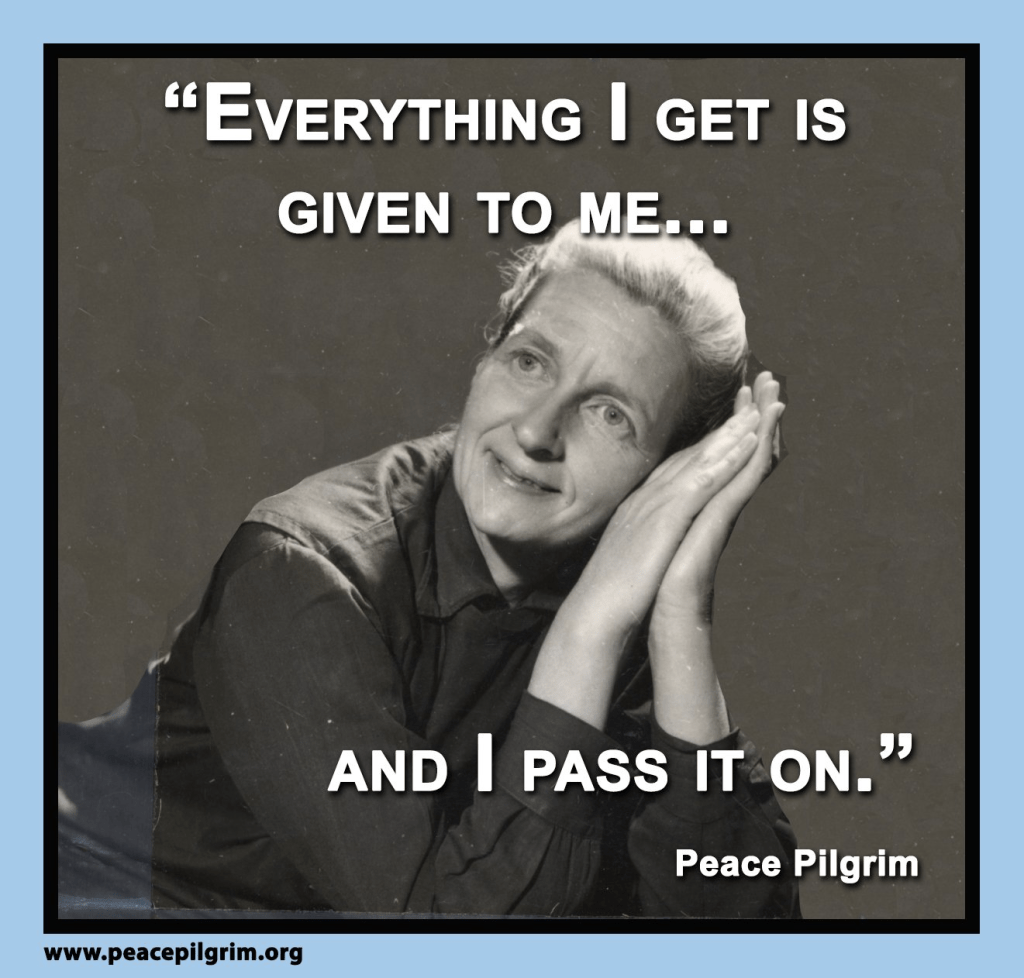
As we enter the holiday season, a time of reflection and celebration, the timeless wisdom of Peace Pilgrim offers profound insights into the true essence of life. “Now there is a living to give instead of to get,” she said, encouraging a shift from acquisition to sharing. Let’s delve into the transformative teachings of Peace Pilgrim, exploring how they can bring peace and fulfillment into our lives.

Peace Pilgrim’s philosophy centers on the joy of giving. Concentrating on the act of giving, she reveals that it becomes a reciprocal source of joy. Health, happiness, and inner peace flow abundantly when one gives selflessly. There’s a profound feeling of endless energy, a connection to the universal source that never seems to deplete.

A key theme in Peace Pilgrim’s teachings is taking control of one’s life. Contrasting the ego, driven by bodily desires and mental demands, with the higher nature governing body, mind, and emotions, she exemplifies the ability to command oneself. Through giving, she demonstrates the power to instruct the body to rest, the mind to focus, and the emotions to find stillness, even in challenging circumstances.

Quoting Thoreau, Peace Pilgrim introduces the concept of dancing to a different drummer—the higher nature instead of the lower. This alternative way of living is marked by aligning oneself with a deeper, more profound purpose. Choosing to follow the rhythm of the higher nature leads to a life driven by compassion, understanding, and a commitment to the well-being of others.

In her journey, Peace Pilgrim made crucial early discoveries. Initially, she found that making money was easy, but the meaninglessness of earning and spending frivolously became apparent. Out of a deep seeking for a meaningful life, she experienced a profound inner shift. Walking through the woods one night, she encountered a psychological hump—a point of no return. With complete willingness and no reservations, she dedicated her life to service.

As we navigate the holiday season, let’s carry the profound wisdom of Peace Pilgrim in our hearts. Embracing the spirit of giving not only enriches the lives of those around us but also brings a sense of fulfillment and purpose. Peace Pilgrim’s inner discovery serves as a poignant reminder that true abundance lies in the joy of giving, connecting us to an endless reservoir of universal energy.

Mildred Norman, later known as Peace Pilgrim, embarked on her peace pilgrimage in 1953, a journey that extended for decades. Her commitment to spreading the message of peace was unparalleled—she walked tirelessly, crisscrossing the United States six times. Remarkably, Peace Pilgrim covered over 25,000 miles during her pilgrimage, a feat she deemed too insignificant to keep precise count.

Her unconventional lifestyle reflected her profound dedication to her mission. Peace Pilgrim adhered to a minimalist philosophy, carrying neither money nor accepting any. She embraced a life of voluntary simplicity, often going without food until it was offered or found in the wild. Accommodations were simple and spontaneous, ranging from bus stations to cornfields when no one extended an invitation.

Peace Pilgrim’s journey became a testament to the transformative power of a singular commitment to a higher purpose. Her life exemplifies the possibility of living with purpose, prioritizing service over material pursuits, and finding fulfillment in the pursuit of peace. As we reflect on her remarkable life, we’re inspired to consider the ways we, too, can contribute to a more compassionate and harmonious world.

Embracing the Spirit of Giving: Wisdom from Peace Pilgrim

Link:https://peacelilysite.com/2023/11/22/embracing-the-spirit-of-giving-wisdom-from-peace-pilgrim/

#PeacePilgrim #Thankgiving #HolidaySeason #Giving #Peace #Love #Compassionate