100. A Mother’s Wise Advice [Non-violence]


100. A Mother’s Wise Advice [Non-violence]

Once upon a time, the son of Brahmadatta was ruling righteously in Benares, in northern India. It came to pass that the King of Kosala made war, killed the King of Benares, and made the queen become his own wife.

Meanwhile, the queen’s son escaped by sneaking away through the sewers. In the countryside he eventually raised a large army and surrounded the city. He sent a message to the king, the murderer of his father and the husband of his mother. He told him to surrender the kingdom or fight a battle.

The prince’s mother, the Queen of Benares, heard of this threat from her son. She was a gentle and kind woman who wanted to prevent violence and suffering and killing. So she sent a message to her son — “There is no need for the risks of battle. It would be wiser to close every entrance to the city. Eventually the lack of food, water and firewood will wear down the citizens. Then they will give the city to you without any fighting.”

The prince decided to follow his mother’s wise advice. His army blockaded the city for seven days and nights. Then the citizens captured their unlawful king, cut off his head, and delivered it to the prince. He entered the city triumphantly and became the new King of Benares.

The moral is: Kind advice is wise advice.

100. A Mother’s Wise Advice [Non-violence]

Link: https://hhdorjechangbuddhaiiiinfo.com/2024/10/22/100-a-mothers-wise-advice-non-violence/

#Buddhisttalesforyoungandold #Buddhiststories #storiesforkids #moralstories #Buddha #Jatakastories #PansiyaPanasJataka
98. A Man Named Wise [Cheating]

Once upon a time, the Enlightenment Being was born in a merchant’s family in Benares, in northern India. He was given the name Wise. When he grew up, he began doing business with a man whose name just happened to be Verywise.

It came to pass that Wise and Verywise took a caravan of 500 bullock carts into the countryside. After selling all their goods they returned to Benares with their handsome profits.

When it came time to split their gains between them, Verywise said, “I should get twice as much profit as you.” “How come?” asked Wise. “Because you are Wise and I am Verywise. It is obvious that Wise should get only half as much as Verywise.”

Then Wise asked, “Didn’t we both invest equal amounts in this caravan trip? Why do you deserve twice as much profit as I?” Verywise replied, “Because of my quality of being Verywise.” In this way their quarrel went on with no end in sight.

Then Verywise thought, “I have a plan to win this argument.” So he went to his father and asked him to hide inside a huge hollow tree. He said, “When my partner and I come by and ask how to share our profits, then you should say, ‘Verywise deserves a double share.”‘

Verywise returned to Wise and said, ‘My friend, neither of us wants this quarrel. Let’s go to the old sacred tree and ask the tree spirit to settle it.”

When they went to the tree Verywise said solemnly, “My lord tree spirit, we have a problem. Kindly solve it for us.” Then his father, hidden inside the hollow tree, disguised his voice and asked, “What is your question?” The man’s cheating son said, “My lord tree spirit, this man is Wise and I am Verywise. We have done business together. Tell us how to share the profits.” Again disguising his voice, his father responded, “Wise deserves a single share and Verywise deserves a double share.”

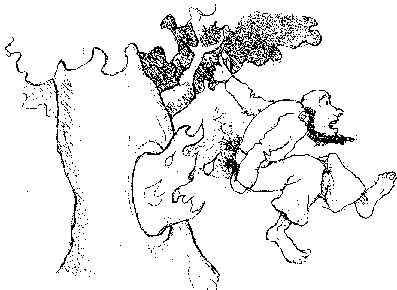
Hearing this solution, Wise decided to find out if it really was a tree spirit speaking from inside the tree. So he threw some hay into it and set it on fire. Immediately Verywise’s father grabbed onto a branch, jumped out of the flames and fell on the ground. He said in his own voice, “Although his name is Verywise, my son is just a clever cheater. I’m lucky that the one named Wise really is so, and I’ve escaped only half toasted!”

Then Wise and Verywise shared their profits equally. Eventually they both died and were reborn as they deserved.

The moral is: A cheater may be clever but not wise.

98. A Man Named Wise [Cheating]

Link: https://hhdorjechangbuddhaiiiinfo.com/2024/10/08/98-a-man-named-wise-cheating/

#Buddhisttalesforyoungandold #Buddhiststories #storiesforkids #moralstories #Buddha #Jatakastories #PansiyaPanasJataka
95. CLEAR-SIGHTED THE GREAT, KING OF THE WORLD [IMPERMANENCE]

95. CLEAR-SIGHTED THE GREAT, KING OF THE WORLD [IMPERMANENCE]

It is said that there are two ways to practice religion. One is to live apart from the ordinary everyday world as a monk, a nun or a holy one. Those who are sincere in this way have as their highest goal the direct experience of complete Truth — full Enlightenment.

The other way to practice religion is within the ordinary world. Those who are sincere in this way have as their highest goal the harmony of an undivided world, living peacefully under a perfectly wholesome ruler — a ‘King of the World’.

Once upon a time the Enlightenment Being was born and given the name ‘Clear-sighted’. As he grew up he developed ten rules of good government: absence of hidden ill will, absence of open hostility, harmlessness, self-control, patience, gentleness, charity, generosity, straightforwardness and goodness.

The people of the world began to notice the wholesomeness and fairness of Clear-sighted, who lived strictly according to these rules. Gradually those in his vicinity volunteered to live under his authority as king, rather than under the dishonest politicians of the time.

As his reputation spread, every king in the world came to Clear-sighted and said, “Come, oh lord, you are welcome, my kingdom is your kingdom, advise me how to rule in your name.”

Then Clear-sighted said, “Do not destroy life. Do not take what is not given. Do not behave wrongly in sexual desires. Do not speak falsely. Do not take alcohol that clouds the mind. My commands to the world are only these five. As long as these five are obeyed, my sixth rule is freedom for all to follow local customs and religions.”

After all the people on earth had come to live under his peaceful rule, he became known as Clear-sighted the Great, King of the World. His royal city, the capital of the whole world, was called Kusavati. It was a beautiful and prosperous city with four magnificent gates — one golden, one silver, one jade and one crystal.

Outside the gates, Kusavati was surrounded by seven rows of palm trees — a row with golden trunks and silver leaves and fruits; a row with silver trunks and golden leaves and fruits; a row with cat’s-eye trunks and crystal leaves and fruits; a row with crystal trunks and cat’s-eye leaves and fruits; a row with agate trunks and coral leaves and fruits; a row with coral trunks and agate leaves and fruits; and finally a row with trunks and leaves and fruits of every kind of jewel found in the world!

When breezes blew through these marvelous palms the sweet sounds of gentle music were heard throughout the city. This music was so enticing and pleasant that some of the citizens were enchanted into stopping their work and dancing for joy!

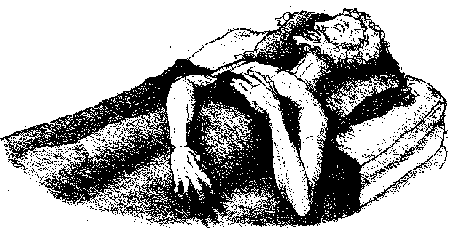
Clear-sighted the Great, King of the World, had a couch encrusted with jewels from the wonderful palms. After a long, righteous and peaceful reign, he lay on the rich couch for the last time. He knew that his end was near.

Of all his 84,000 queens, the one who loved him most was called, ‘Most-pleasant’. Sensing the state of his mind she said, “You rule over all the cities of the world, including this beautiful Kusavati with its four magnificent gates and seven rows of marvelous palms. Think about this and be happy!”

The King of the World said, “No, my dear queen don’t say that. Instead you should advise me to give up attachment to the cities of the world and all they contain.” Surprised she asked, “Why do you say this, my lord?” “Because today I will die,” he said.

Then Queen Most-pleasant started to cry, wiping away the tears as they flowed. And all the other 84,000 queens also broke into tears. And the king’s ministers and his whole court, both men and women, could not keep from weeping and sobbing. All eyes overflowed with tears.

But King Clear-sighted the Great said, “Your tears are useless. Be at peace.” Hearing this the wailing subsided and his subjects became silent. Then he said to Queen Most-pleasant, “Oh my queen, do not cry, do not lament. Anything that comes into being, whether it be a kingdom including the whole world, or just a tiny sesame seed — it cannot last forever. Anyone who comes into being, whether it be the King of the World, or the poorest petty thief — all must decay and die. Whatever is built up, falls apart. Whatever becomes, decays. The only true happiness is in the moment when becoming and decaying are not.”

In this way the Enlightenment Being got them to think about what most people don’t want to think about — that all things come to an end. He advised them to be generous and wholesome. Then the King of the World, like everyone else, died. He was reborn as a god in a heaven world, where in time, like everyone else, he died.

The moral is: “All good things come to an end.”

95. Clear-sighted the Great, King of the World [Impermanence]

Link: https://hhdorjechangbuddhaiiiinfo.com/2024/09/10/95-clear-sighted-the-great-king-of-the-world-impermanence/

#Buddhisttalesforyoungandold #Buddhiststories #storiesforkids #moralstories #Buddha #Jatakastories #PansiyaPanasJataka
89. THE PHONEY HOLY MAN [HYPOCRISY]

89. THE PHONEY HOLY MAN [HYPOCRISY]

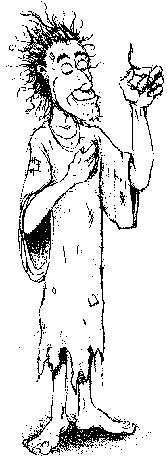
Once upon a time there was a man who looked and acted just like a holy man. He wore nothing but rags, had long matted hair, and relied on a little village to support him. But he was sneaky and tricky. He only pretended to give up attachment to the everyday world. He was a phoney holy man.

A wealthy man living in the village wanted to earn merit by doing good deeds. So he had a simple little temple built in the nearby forest for the holy man to live in. He also fed him the finest foods from his own home.

He thought this holy man with matted hair was sincere and good, one who would not do anything unwholesome. Since he was afraid of bandits, he took his family fortune of 100 gold coins to the little temple. He buried it under the ground and said to the holy man, “Venerable one, please look after this my family fortune.”

The holy man replied, “There’s no need to worry about such things with people like me. We holy ones have given up attachment to the ordinary world. We have no greed or desire to obtain the possessions of others.”

“Very well, venerable one,” said the man. He left thinking himself very wise indeed, to trust such a good holy man.

However, the wicked holy man thought, “Aha! This treasure of 100 gold coins is enough for me to live on for the rest of my life! I will never have to work or beg again!” So a few days later he dug up the gold and secretly buried it near the roadside.

The next day he went to the wealthy villager’s home for lunch as usual. After eating his fill he said, “Most honourable gentleman, I have lived here supported by you for a long time. But holy ones who have given up the world are not supposed to become too attached to one village or supporter. It would make a holy man like me impure! Therefore, kindly permit me to humbly go on my way.”

The man pleaded with him again and again not to go, but it was useless. “Go then, venerable sir,” he agreed at last. He went with him as far as the boundary of the village and left him there.

After going on a short way himself, the phoney holy man thought, “I must make absolutely sure that stupid villager does not suspect me. He trusts me so much that he will believe anything. So I will deceive him with a clever trick!” He stuck a blade of dry grass in his matted hair and went back.

When he saw him returning, the wealthy villager asked, “Venerable one, why have you come back?” He replied, “Dear friend, this blade of grass from the thatched roof of your house has stuck in my hair. It is most unwholesome and impure for a holy one such as myself to ‘take what is not given’.”

The amazed villager said, “Think nothing of it, your reverence. Please put it down and continue on your way. Venerable ones such as you do not even take a blade of grass that belongs to another. How marvellous! How exalted you are, the purest of the holy. How lucky I was to be able to support you!” More trusting than ever, he bowed respectfully and sent him on his way again.

It just so happened that the Enlightenment Being was living the life of a trader at that time. He was in the midst of a trading trip when he stopped overnight at the village. He had overheard the entire conversation between the villager and the ‘purest of the holy’. He thought, “That sounds ridiculous! This man must have stolen something far more valuable than the blade of dry grass he has made such a big show of returning to its rightful owner.”

The trader asked the wealthy villager, “Friend, did you perhaps give anything to this holy looking man for safekeeping?” “Yes friend,” he replied, “I trusted him to guard my family fortune of 100 gold coins.” “I advise you to go see if they are where you left them,” said the trader.

Suddenly worried, he ran to the forest temple, dug up the ground, and found his treasure gone. He ran back to the trader and said, “It has been stolen!” “Friend,” he replied, “No one but that so-called holy man could have taken it. Let’s catch him and get your treasure back.”

They both chased after him as fast as they could. When they caught up with him they made him tell where he had hidden the money. They went to the hiding place by the roadside and dug up the buried treasure.

Looking at the gleaming gold the Bodhisatta said, “You hypocritical holy man. You spoke well those beautiful words, admired by all, that one is not to ‘take what is not given’. You hesitated to leave with even a blade of grass that didn’t belong to you. But it was so easy for you to steal a hundred gold coins!” After ridiculing the way he had acted in this way, he advised him to change his ways for his own good.

The moral is: Be careful of a holy man who puts on a big show.

89. The Phoney Holy Man [Hypocrisy]

Link: https://hhdorjechangbuddhaiiiinfo.com/2024/07/30/89-the-phoney-holy-man-hypocrisy/

#Buddhisttalesforyoungandold #Buddhiststories #storiesforkids #moralstories #Buddha #Jatakastories #PansiyaPanasJataka
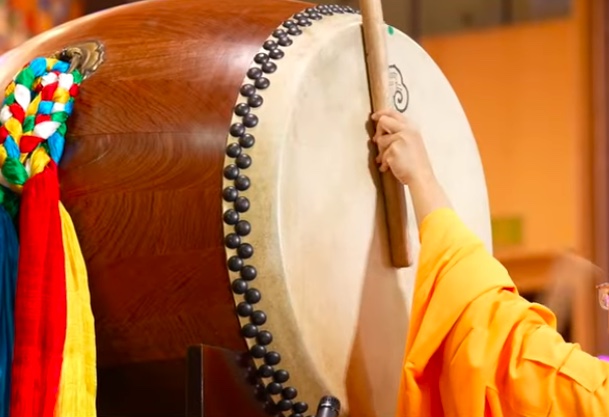
A Great Drum

The Wisdom of Generosity: A Tale of Compassion and Righteousness

Once, the Buddha was residing in the Jetavana Monastery in the kingdom of Śrāvastī, spreading his teachings. At that time, there was a prince of a celestial king named Pilu. One day, he flew down from the heavens to the Jetavana Monastery, prostrated himself at the Buddha’s feet, and, with hands folded in reverence, asked the Buddha: “In this world, people are constantly pursuing clothes, food, treasures, pleasures, official positions, and territories. Are there any treasures that pursue people in return?” The Buddha praised Prince Pilu: “You have asked a good question. Indeed, there are situations where territories, treasures, and pleasures pursue people.”

Prince Pilu asked again, “What does it mean for the causes and conditions that fulfill people’s wishes and bring complete satisfaction to always follow them?”

The Buddha replied, “All actions can be categorized into two types: doing good deeds, which brings blessings, and committing evil deeds, which results in calamities. Whether it is blessings or disasters, they always follow each person like a shadow.”

Prince Pilu said, “This is truly extraordinary! Just as the World-Honored One has taught, in my past life, I was once a king among humans. Because I was aware of the impermanence of life and had no attachment to material things, I wanted to practice generosity widely. One day, during a gathering of my ministers, I announced: ‘I want to make a great drum whose booming sound can spread for a hundred miles. Who can accomplish this task for me?’

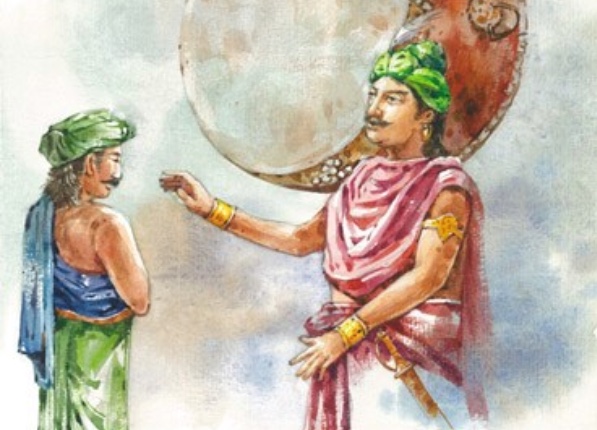
However, the ministers all replied, ‘We are incapable of doing so!’ At that moment, a minister named Kuang Shang, who had always been loyal to the court and compassionate towards the people, stepped forward and said to the king, ‘I can accomplish this task, but it will require some funding.’

The king said, ‘Great! Whatever amount you need is not a problem.’ Thus, the treasury was opened, and a large sum of money was handed over to Kuang Shang.

Kuang Shang transported a carriage full of treasures to the gate of the royal palace and beat the drum to announce, “Today, our benevolent king, with great compassion, is distributing wealth to the world to relieve all those in poverty and distress, as well as to provide for the needs of practitioners. Anyone in need can come to the palace gate to receive these goods.”

The news quickly spread to neighboring countries. The poor, carrying their babies and bringing along the elderly and young, came in droves, filling all the roads leading to the city. People would often look up to the sky and exclaim, “Thank you, benevolent king! We, the poor people, finally have the chance to escape the days of hunger and cold!”

A year later, the king asked Kuang Shang, “Is the great drum completed?” The minister replied, “Your Majesty, it is done.” The king asked again, “Since it is finished, why haven’t I heard the drum sound?” Kuang Shang responded, “Please, Your Majesty, take a trip into the city tomorrow, and you will hear the sound of virtue resonating far and wide.”

The next day, the king’s procession entered the city, discovering it was crowded and bustling. The king exclaimed, “Why are there so many people in the city?” Kuang Shang answered, “Last year, Your Majesty ordered me to create a great drum, hoping its mighty sound would spread for miles, proclaiming Your Majesty’s benevolence. I thought that a drum made of dead wood and cowhide would not adequately convey the king’s virtue. After much deliberation, I decided to use the treasures Your Majesty entrusted to me to provide for the practitioners and relieve the poor and distressed. Since the announcement, people from neighboring countries have come, hoping for Your Majesty’s benevolence, like hungry children yearning for their compassionate mother.”

Upon hearing this, the king asked the nearby citizens, “Where have you come from?” The people respectfully bowed and replied, “We came from a hundred miles away.” Some said, “I came from two hundred miles away.” Others said, “I came from thousands of miles away.” Then, they all declared, “Wise and benevolent king! Your widespread generosity has brought joy to the people of the neighboring countries. Many have even moved their entire families here, seeking to live under your benevolent protection and hoping for a stable life henceforth.”

The king was very pleased and said, “Kuang Shang, you have done an excellent job! Previously, I was attached to fame, hoping that the great drum’s mighty sound would resonate far and wide. Now, I finally understand that the unrest in the country comes from the people’s unease. Just as a sick body needs medicine to be healed, I should provide remedies to address the people’s suffering. You, my minister, understood the hardships of the people and distributed food to help the poor and needy, allowing the people to live in peace and return their loyalty to me.” Thus, the king declared, “From now on, as long as it concerns the people’s needs, take care of it to the best of your ability without needing to consult me!”

After the king’s natural death, he was reborn in heaven as King Miao. After his life in heaven ended, he was reborn as a Cakravartin (Wheel-Turning) King on earth, always accompanied by seven treasures and surrounded by followers who protected him. Now, he has again been reborn in heaven as a prince of the heavenly king. All of this was because he strictly upheld pure precepts and compassionately aided all living beings, earning such blessings. If we follow the Buddha’s teachings and rectify our body, speech, and mind, we can all obtain such magnificent blessings.

The Buddha encouraged Prince Bilu, saying, “A person’s actions are like a shadow following the body, or an echo responding to a sound. For every cause, there is an effect, and retribution is certain!” Prince Bilu, after hearing the Buddha’s teaching, joyfully made obeisance and departed.

A Great Drum

Link:https://peacelilysite.com/2024/05/23/a-great-drum/

Source: https://www.ctworld.org.tw/sutra_stories/story801-1000/story862.htm,


77. THE SIXTEEN DREAMS [CHAPTER 1. PANIC]

77. THE SIXTEEN DREAMS [CHAPTER 1. PANIC]

Once upon a time there was a king called Brahmadatta who was ruling in Benares, in northern India. One night he had sixteen frightening nightmare dreams. He awoke in the morning in a cold sweat, with his heart thumping loudly in his chest. The sixteen dreams had scared him to death. He was sure they meant that something terrible was about to happen. In a panic, he called for his official priests, to ask their advice.

When the priests arrived at the royal bed chamber, they asked the king if he had slept well. He told them that it had been the worst night of his life, that he had been scared to death by sixteen dreams, and that he was desperate to find out their meanings.

At this the priests’ eyes lit up. They asked him, “What were these dreams, your majesty?” King Brahmadatta told them all sixteen dreams. The priests pounded their foreheads and exclaimed, “Oh what horrors! It couldn’t be worse, your majesty. Such dreams as these can mean only one thing — danger!”

The king asked them, ‘What danger, oh priests? You must tell me the meaning at once!” They replied, It is certain, your majesty, these dreams show that one of three disasters will take place — terrible harm to the kingdom, to your life, or to the royal wealth.”

The king had feared as much. He wrung his hands as the sweat kept pouring from his body. He was shaking all over with terror and panic. He asked, “Tell me, oh worthy royal priests, is there any way to avoid this disaster?” “Indeed, it is very dangerous,” they said. “If you do nothing, the end is certain. But we can prevent it. If we couldn’t, then all our training and learning would be useless. Trust us, lord.”

The panic-stricken king cried out, “Just tell me what to do, priests. I’ll do anything! What can you do to save me, my kingdom and my wealth?” “We must offer the greatest animal sacrifice that has ever been seen,” they said. “We must kill, as sacrificial offerings, four of every type of animal that lives!”

Although he was usually a gentle, kind and merciful ruler. King Brahmadatta was so frightened that he couldn’t think straight at all. Paralyzed with fear, he put all his hope and faith in his priests. He gave them permission to prepare the gigantic slaughter.

The priests said, “Have no fear, your majesty, we will take care of everything. We will prevent the coming doom!” They knew they would be paid well to perform the sacrifice. And the meat from the killed animals would be theirs as well. Their secret thoughts were, “This is a great way for us to get piles of money, and the best food and drink too!”

The priests got to work organizing the biggest sacrifice Benares had ever seen. Just outside of town they dug a huge pit. Into it they put the most perfect ones they could find of all the animals — land animals, birds and fish. From each kind they selected four to be killed in the ceremony. It became known as the ‘Four-from-all’ sacrifice.

Meanwhile, the king’s senior teaching priest had a promising young pupil. He was gentle and compassionate, and very well-educated. He wondered about all that was happening. So he asked the teacher priest, “Oh master, you have taught me well the wise teachings of old. Can you show me anywhere it says the killing of one will save the life of another?”

The priest answered, “What kind of question is that? Open your eyes and be realistic, my boy. Don’t you see that this great sacrifice, the Four-from-all, will make us rich? You must be trying to help the king hold onto his riches! “

The idealistic and sincere pupil said, “You have not answered my question, master. If this sacrifice is to be your work, it shall be mine no longer!” With these words he departed and went to the royal pleasure garden to consider what he would do.

It just so happened that the Enlightenment Being had been born into a rich high class family. For many generations the men in that family had been priests, just like the ones who were now preparing the Four-from-all sacrifice. But when the Bodhisatta grew up he abandoned the life of a rich priest. Instead he went to the Himalayas and lived as a humble forest monk. He concentrated his mind in meditation and entered high mental states. He gained the sweetest inner happiness, and even miraculous supernatural powers.

This forest monk loved all the animals. When he heard about what was happening in Benares he was filled with tenderness and compassion. He decided, “I must teach the ignorant people and release them from the chains of superstition. I will go to the city at once!” Then he used his supernatural power to fly through the air to Benares. In an instant he was seated on a rock in the king’s pleasure garden. His gentle nature made him glow like a golden sunrise.

The idealistic young student approached and recognized him as a great holy man. He bowed respectfully and sat on the ground. The forest monk asked him, “Young man, do you have a good and just king reigning here in Benares?”

“Yes”, said the student, “our king is kind and good. But he is being misled by the royal priests. He had sixteen dreams which left him completely panic-stricken. The priests took advantage of this when he told them his dreams. They have convinced him to have a huge sacrifice and kill many animals. Oh holy one, please tell the king the true meanings of his dreams. Free the many helpless beings from fear and death.”

The holy man said, “If he comes and asks me, I will tell him.” “I will bring him, sir,” said the young man. “Kindly wait here a short while until I return.”

The student went to the king and told him there was a marvelous holy man seated on a rock in the royal pleasure garden. He told him he had said he could interpret the king’s dreams. Hearing this, the king went with him to the garden. A crowd followed behind.

77. The sixteen dreams [Chapter 1. Panic]

Link: https://hhdorjechangbuddhaiiiinfo.com/2024/02/27/77-the-sixteen-dreams-chapter-1-panic/

#Buddhisttalesforyoungandold #Buddhiststories #storiesforkids #moralstories #Buddha #Jatakastories #PansiyaPanasJataka