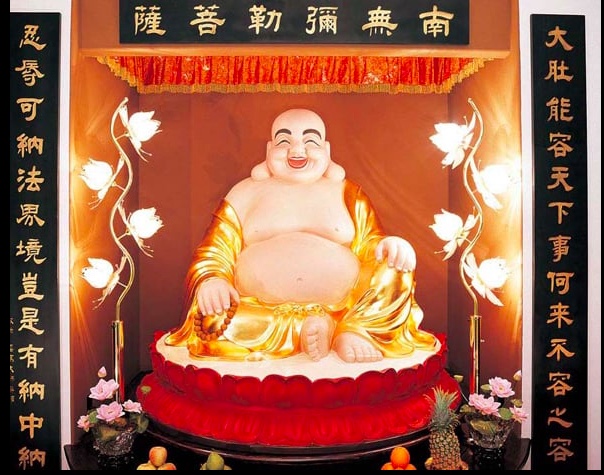
Two Fruits for A Meal

Photo by Susanne Jutzeler, suju-foto on Pexels.com

Two Fruits for A Meal

A young monk asked the master for advice: “What are human desires?” The old monk told the young monk to come back tomorrow, but do not eat or drink until then. When the little monk came back the next day, he was very hungry and thirsty, and felt that he could eat a whole loaf of bread.

The old master monk asked him to go to the orchard to pick some fruits, but asked him to bring them back to the temple to eat.

After a while, the young monk returned to the temple with a basket full of fruits. The old monk told him to eat as much as he could. The young monk felt full after just eating two and could not eat any more.

The master asked him, “What’s the use of these fruits that you brought back after all your hard work, but you didn’t eat them? They’re just useless burdens.”

“Now you may understand, for each of us, what we really need is only two fruits that are enough to satisfy our hunger, and the rest is our desire.”

Photo by Nilina on Pexels.com

Every day we are driven by our own desires to keep running and toiling. We believe that if our desires are satisfied, we will be happy. But that happiness is very short-lived. Think about when you got new beautiful clothes, a pair of fancy shoes, luxury jewelries, or an expensive car — how long does that pleasure last? It may be a year, a month, or just several days, and then we want more to replace these fleeting pleasures. Our desires are endless, they keep on growing until they wrap us completely like a cocoon. Our desires lead us to focus on the various commodities of the outside world, and squeeze out all of our time and energy. Thus, our desires can actually make us feel enslaved and unhappy, and cause suffering.

In Buddhism teachings, the origins of suffering and unhappiness come from craving, desire and attachment. The way to end suffering is letting go of these cravings, and finding your true self. Of course Shakyamuni Buddha had taught many ways in the Buddhist Sutra to reach the eternal happiness and find our true selves. The contemporary Buddha H.H. Dorje Chang Buddha III has expounded many Buddha Dharmas to help us as well, such as What is cultivation? , Learning from Buddha, and several thousand audio-recorded Dharma discourses. By practicing the Buddha Dharma, one can break through the cocoon of life and death, and reach libration.

Hope you can find your own way to be free, happy and healthy.

Two Fruits for A Meal

Link: https://peacelilysite.com/2022/10/02/two-fruits-for-a-meal/

#HHDorjeChangBuddhaIII #DorjeChangBuddhaIII #DorjeChangBuddha #ShakyamuniBuddha #Buddhism#BuddhismTeaching#desire#craving#attchment

37. The Birth of a Banyan Tree [Respect for Elders]

37. The Birth of a Banyan Tree [Respect for Elders]

Buddhist Tales for Young and Old, volume 1, Prince Goodspeaker, Stories 1-50

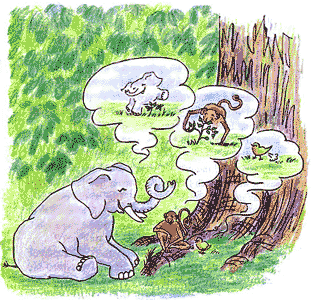
Once upon a time, there was a big banyan tree in the forest beneath the mighty Himalayas. Living near this banyan tree were three very good friends. They were a quail, a monkey and an elephant. Each of them was quite smart.

Occasionally the three friends got into a disagreement. When this happened, they did not consider the opinion of any one of them to be more valuable. No matter how much experience each one had, his opinion was treated the same as the others. So it took them a long time to reach an agreement. Every time this happened, they had to start from the beginning to reach a solution.

After a while they realized that it would save time, and help their friendship, if they could shorten their disagreements. They decided that it would certainly help if they considered the most valuable opinion first. Then, if they could agree on that one, they would not have to waste time, and possibly even become less friendly, by arguing about the other two.

Fortunately, they all thought the most valuable opinion was the one based on the most experience. Therefore, they could live together even more peacefully if they gave higher respect to the oldest among them. Only if his opinion were clearly wrong, would they need to consider others.

Unfortunately, the elephant and the monkey and the quail had no idea which one was the oldest. Since this was a time before old age was respected, they had no reason to remember their birthdays or their ages.

Then one day, while they were relaxing in the shade of the big banyan tree, the quail and the monkey asked the elephant, “As far back as you can remember, what was the size of this banyan tree?”

The elephant replied, “I remember this tree for a very long time. When I was just a little baby, I used to scratch my belly by rubbing it over the tender shoots on top of this banyan tree.”

Then the monkey said, “When I was a curious baby monkey, I used to sit and examine the little seedling banyan tree. Sometimes I used to bend over and nibble its top tender leaves.”

The monkey and the elephant asked the quail, “As far back as you can remember, what was the size of this banyan tree?”

The quail said, “When I was young, I was looking for food in a nearby forest. In that forest, there was a big old banyan tree, which was full of ripe berries. I ate some of those berries, and the next day I was standing right here. This was where I let my droppings fall, and the seeds they contained grew up to be this very tree!”

The monkey and the elephant said, “Aha! Sir quail, you must be the oldest. You deserve our respect and honor. From now on we will pay close attention to your words. Based on your wisdom and experience, advise us when we make mistakes. When there are disagreements, we will give the highest place to your opinion. We ask only that you be honest and just.”

The quail replied, “I thank you for your respect, and I promise to always do my best to deserve it.” It just so happened that this wise little quail was the Bodhisatta the Enlightenment Being.

The moral is: Respect for the wisdom of elders leads to harmony.

Link: https://hhdorjechangbuddhaiiiinfo.com/2022/09/27/the-birth-of-a-banyan-tree-respect-for-elders/

37. The Birth of a Banyan Tree [Respect for Elders]

INTERPRETER’S INTRODUCTION – BUDDHIST TALES FOR YOUNG AND OLD, VOLUME 1, STORIES 1-50

#Buddhisttalesforyoungandold #Buddhiststories #storiesforkids #moralstories #Buddha #Jatakastories #PansiyaPanasJataka

A Story of Transforming Negative Affinity

Photo by Frank Cone on Pexels.com

A Story Transforming Negative Affinity

One day around nightfall, a monk was on his way back to the temple. Suddenly, lightning was striking and it was raining cats and dogs, the rain didn’t seem to be coming to a stop. He thought eagerly,
“What should I do”. Just as he was becoming anxious, a manor was nearby. He ran towards it hoping to be warranted a night’s stay. The manor was enormous, and the servant saw the monk. After asked for the monk’s business there, the servant said, “My master has no affinity with monks. You will need to seek shelter elsewhere.“
The monk replied, “It is raining hard, and there is no other household nearby. If you just provide me a place to stay would be really appreciated.”
“I cannot make the decision, let me go ask for my mater’s permission.” The servant went into the manor, and after he came back, he still refused the monk. The monk asked for the manor’s master’s name after the rejection, and without other options, he hurried back to the temple in the rain.

Three years later, the master of the manor married a concubine, he was very fond of her. One day, the concubine wanted to go to the temple for making offering, the master went with her. In the temple, the master of the manor saw his name written on a plate for meritorious deeds praying. The master was puzzled, and asked a little monk nearby for the reason of the plate.
The little monk replied with a smile, “This is written by the head monk three years ago. There was a night that he hurried back to the temple in heavy rain, and said that there was an almsgiver that he did not build positive affinity with. So the head monk written the plate and chant the prayers for the almsgiver on daily basis to dedicate any merits back to him. Hopefully, their affinity can be transformed to positive. This is as much as I know, the head monk did not provide us with more detail.” When the manor of the master hear what the little monk said, he knew the story and he was regretful. At the end, he became a dedicated almsgiver of the temple.

Photo by Pixabay on Pexels.com

This is a very inspiring story of an old monk, a story to transform “negative affinity”. This mundane world is big yet small, and people often run into each other. A person with great tolerance can understand the fact that “Great kindness and great enmity; others and me are no different.” In addition, the environment and how others treated ourselves should be a catalyst to encourage us. Kindness and enmity are all affinities to help us. On the other hand, those who are shallow and with narrow-minded will hinder themselves from positive affinity, and will aloof themselves from a future with prosperity.
Indeed, to be able to act as the head monk’s heart of embracement might not be easy; however, ” Saints and sages have virtuous actions that we look up to, and have mindsets and actions that are legit and above-board. Though we are not yet at the same extent, but I try to be the same.”


The act of positive thoughts and action can really transform negative affinity. The act of giving is the cause of prosperity, and the action of greed is the cause of poverty. Instead of giving wealth to children, we should leave them with virtue. Have you not noticed? Wealth creates conflict of interest. There are countless incidents where sibling or parents sue each other for money. If our children are well educated and are virtuous, then it is unnecessary to leave them with money.

A Story Transforming Negative Affinity

Link:https://peacelilysite.com/2022/09/14/transforming-negative-affinity/

#BuddhismTeaching#Monk#Buddhism#Affinity#TransformNegativeAffinity#Kindness#GreatEnmity#MoralStorie

THE PRICE MAKER [FOOLISHNESS]


Photo by Diego Caumont on Pexels.com

5. THE PRICE MAKER [FOOLISHNESS]

Buddhist Tales for Young and Old, volume 1, Prince Goodspeaker, Stories 1-50

Long ago and far away, there was a king who ruled in Benares, in northern India. One of his ministers was called the Royal Price Maker, and he was a very honest man. His job was to set a fair price for anything the king wanted to buy or sell.

On some occasions, the king did not like his price making. He did not get as big a profit as he wanted. He did not want to pay so much when he bought, or sell for what he thought was not enough. So he decided to change the price maker.

One day he saw a nice looking young man and he thought, “This fellow will be good for my price making position.” So he dismissed his former honest price maker, and appointed this man to be the new one. The man thought, “I must make the king happy by buying at very low prices and selling at very high prices.” So he made the prices ridiculous, without caring at all what anything was worth. This gained the greedy king a lot of money, and made him very happy. Meanwhile, all the others who dealt with the new price maker, including the king’s other ministers and ordinary people, became very unhappy.

Then one day a horse merchant arrived in Benares with 500 horses to sell. There were stallions, mares and colts. The king invited the merchant to the palace, and called upon his Royal Price Maker to set a price for all 500 horses. Thinking only of pleasing the king, he said, “The entire herd of horses is worth one cup of rice.” So the king ordered that one cup of rice be paid to the horse dealer, and all the horses were taken to the royal stables.

5. The Price Maker [Foolishness]

Of course the merchant was very upset, but he could do nothing at the moment. Later he heard about the former price maker, who had a reputation for being very fair and honest. So he approached him and told him what had happened. He wanted to hear his opinion, in order to get a proper price from the king. The former price maker said, “If you do as I say, the king will be convinced of the true value of the horses. Go back to the price maker and satisfy him with a valuable gift. Ask him to tell the value of one cup of rice, in the presence of the king. If he agrees, come and tell me. I will go with you to the king.”

Following this advice, the merchant went to the price maker and gave him a valuable gift. The gift made him very happy, so that he saw the value of pleasing the horse dealer. Then the merchant said to him, “I was very happy with your previous evaluation. Can you please convince the king of the value of one cup of rice?” The foolish price maker said, ‘Why not? I will explain the worth of one cup of rice, even in the presence of the king.”

So the price maker thought the horse dealer was satisfied with his cup of rice. He arranged for another meeting with the king, as the merchant was departing for his own country. The merchant reported back to the old price maker, and they went together to see the king.

All the king’s ministers and his full court were in the royal meeting hall. The horse merchant said to the king, “My lord, I understand that in this your country, my whole herd of 500 horses is worth one cup of rice. Before I leave for home, I want to know the value of one cup of rice in your country.” The king turned to his loyal price maker and said, “What is the value of one cup of rice?”

The foolish price maker, in order to please the king, had previously priced the herd of horses at one cup of rice. Now, after receiving a bribe from the horse dealer, he wanted to please him too. So he replied to the king, in his most dignified manner, “Your worship, one cup of rice is worth the city of Benares, including even your own harem, as well as all the suburbs of the city. In other words, it is worth the whole kingdom of Benares!”

On hearing this, the royal ministers and wise men in the assembly hall started to roar with laughter, slapping their sides with their hands. When they calmed down a little, they said, “Earlier we heard that the kingdom was priceless. Now we hear that all Benares, with its palaces and mansions, is worth only a cup of rice! The decision of the Royal Price Maker is so strange! Where did your highness find such a man? He is good only for pleasing a king such as you, not for making fair prices for a merchant who sells his horses from country to country.”

Hearing the laughter of his whole court, and the words of his ministers and advisers, the king was ashamed. So he brought back his former price maker to his official position. He agreed to a new fair price for the herd of horses, as set by the honest price maker. Having learned a lesson, the king and his kingdom lived justly and prospered.

The moral is: A fool in high office can bring shame even to a king.

5. The Price Maker [Foolishness]

Link: https://peacelilysite.com/2022/09/10/the-price-maker-foolishness/

INTERPRETER’S INTRODUCTION – BUDDHIST TALES FOR YOUNG AND OLD, VOLUME 1, STORIES 1-50

#Buddhisttalesforyoungandold #Buddhiststories #storiesforkids #moralstories #Buddha #Jatakastories #PansiyaPanasJataka #foolishness #Banares #India

The Quail King and the Hunter [Unity]

The Quail King and the Hunter [Unity]

Buddhist Tales for Young and Old, volume 1, Prince Goodspeaker, Stories 1-50

Once upon a time, there was a Quail King who reigned over a flock of a thousand quails.

There was also a very clever quail hunter. He knew how to make a quail call. Because this sounded just like a real quail crying for help, it never failed to attract other quails. Then the hunter covered them with a net, stuffed them in baskets, and sold them to make a living.

Because he always put the safety of his flock first, Quail King was highly respected by all. While on the lookout for danger, one day he came across the hunter and saw what he did. He thought, “This quail hunter has a good plan for destroying our relatives. I must make a better plan to save us.”

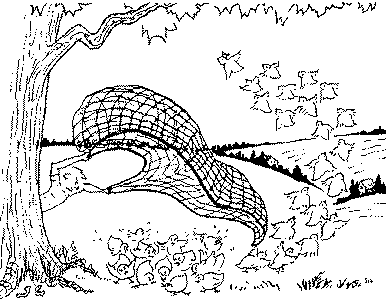
Then he called together his whole nation of a thousand quails. He also invited other quails to attend the meeting. He said, “Greetings to our quail nation and welcome to our visitors. We are faced with great danger. Many of our relatives are being trapped and sold by a clever hunter. Then they are being killed and eaten. I have come up with a plan to save us all. When the hunter covers us with his net, every single one of us must raise his neck at the same time. Then, all together, we should fly away with the net and drop it on a thorn bush. That will keep him busy, and we will be able to escape with our lives.” All agreed to follow this smart strategy.

The next day the hunter lured the quails with his quail call as usual. But when he threw his net over them, they all raised up their necks at once, flew away with the net, and dropped it on a thorn bush. He could catch no quails at all! In addition, it took him the rest of the day to loosen his net from the thorns – so he had no time left to try again!

The same thing happened on the following day. So he spent a second day unhooking his net from sharp thorns. He arrived home only to be greeted by his wife’s sharp tongue! She complained, “You used to bring home quail to eat, and money from selling quails. Now you return empty-handed. What do you do all day? You must have another wife somewhere, who is feasting on quail meat at this very moment!”

The hunter replied, “Don’t think such a thing, my darling. These days the quails have become very unified. They act as one, and raise up their necks and carry my net to a thorn bush. But thanks to you, my one and only wife, I know just what to do! Just as you argue with me, one day they too will argue, as relatives usually do. While they are occupied in conflict and bickering, I will trap them and bring them back to you. Then you will be pleased with me again. Until then, I must be patient.”

The hunter had to put up with his wife’s complaints for several more days. Then one morning after being lured by the quail call, it just so happened that one quail accidentally stepped on the head of another. He immediately got angry and squawked at her. She removed her foot from his head and said, “Please don’t be angry with me. Please excuse my mistake.” But he would not listen. Soon both of them were squawking and squawking, and the conflict got worse and worse!

Hearing this bickering getting louder and louder, Quail King said, “There is no advantage in conflict. Continuing it will lead to danger!” But they just wouldn’t listen.

Then Quail King thought, “I’m afraid this silly conflict will keep them from cooperating to raise the net.” So he commanded that all should escape. His own flock flew away at once.

And it was just in time too! Suddenly the quail hunter threw his net over the remaining quails. The two arguing quails said to each other, “I won’t hold the net for you.” Hearing this, even some of the other quails said, “Why should I hold the net for anyone else?”

So the conflict spread like wildfire. The hunter grabbed all the quails, stuffed them in his baskets, and took them home to his wife. Of course she was overjoyed, and they invited all their friends over for a big quail feast.

The moral is: There is safety in unity, and danger in conflict.

The Quail King and the Hunter [Unity]

Link: https://hhdorjechangbuddhaiiiinfo.com/2022/08/30/the-quail-king-and-the-hunter-unity/

INTERPRETER’S INTRODUCTION – BUDDHIST TALES FOR YOUNG AND OLD, VOLUME 1, STORIES 1-50

#Buddhisttalesforyoungandold #Buddhiststories #storiesforkids #moralstories #Buddha #Jatakastories #PansiyaPanasJataka

32. The Dancing Peacock [Pride and Modesty]

32. The Dancing Peacock [Pride and Modesty]

Once upon a time, a very long time ago, the four-footed animals made the lion their king. There was a gigantic fish that roamed the oceans, and the fish made him their king. The birds were attracted to beauty, so they chose the Golden Swan as their king.

King Golden Swan had a beautiful golden daughter. While she was still young, he granted her one wish. She wished that, when she was old enough, she could pick her own husband.

When his daughter was old enough, King Golden Swan called all the birds living in the vast Himalayan Mountains of central Asia to a gathering. The purpose was to find a worthy husband for his golden daughter. Birds came from far away, even from high Tibet. There were geese, swans, eagles, sparrows, humming birds, cuckoos, owls and many other kinds of birds.

The gathering was held on a high rock slab, in the beautiful green land of Nepal. King Golden Swan told his lovely daughter to select whichever husband she wished.

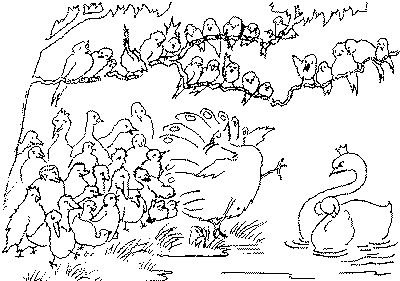
She looked over the many birds. Her eye was attracted by a shining emerald-green long-necked peacock, with gorgeous flowing tail feathers. She told her father, “This bird, the peacock, will be my husband.”

Hearing that he was the lucky one, all the other birds crowded around the peacock to congratulate him. They said, “Even among so many beautiful birds, the golden swan princess has chosen you. We congratulate you on your good fortune.”

The peacock became so puffed up with pride, that he began to show off his colorful feathers in a fantastic strutting dance. He fanned out his spectacular tail feathers and danced in a circle to show off his beautiful tail. Being so conceited, he pointed his head at the sky and forgot all modesty, so that he also, showed his most private parts for all to see!

The other birds, especially the young ones, giggled. But King Golden Swan was not amused. He was embarrassed to see his daughter’s choice behave in this way. He thought, “This peacock has no inner shame to give him proper modesty. Nor does he have the outer fear to prevent indecent behavior. So why should my daughter be shamed by such a mindless mate?”

Standing in the midst of the great assembly of birds, the king said, “Sir peacock, your voice is sweet, your feathers are beautiful, your neck shines like an emerald, and your tail is like a splendid fan. But you have danced here like one who has no proper shame or fear. I will not permit my innocent daughter to marry such an ignorant fool!”

Then King Golden Swan married his golden daughter to a royal nephew. The silly strutting peacock flew away, having lost a beautiful wife.

The moral is: If you let pride go to your head, you’ll wind up acting like a fool.

Link: https://hhdorjechangbuddhaiiiinfo.com/2022/08/23/32-the-dancing-peacock-pride-and-modesty/

INTERPRETER’S INTRODUCTION – BUDDHIST TALES FOR YOUNG AND OLD, VOLUME 1, STORIES 1-50

#Buddhisttalesforyoungandold #Buddhiststories #storiesforkids #moralstories #Buddha #Jatakastories #PansiyaPanasJataka

A True Story: 100,000 Prostrations by a One-Armed Person

A True Story: 100,000 Prostrations by a One-Armed Person who Learns and Practices the True Dharma of the Tathagata from H.H. Dorje Chang Buddha III

I was a factory worker in the past. In 1993, a co-worker had to go home to help plant his family’s wheat crop. His leave request was not approved by the shift leader. So, I went to cover him.

When looking at his work in the past, I thought I should be able to do it. In reality, it was not that simple. I was not skillful in operating the machine. The machine pulled my right hand in. When I dragged the arm out, I had no flesh in my hand and arm, only a long, bare bone left. 

The doctor at the hospital took a look and told me that I must have amputation. The upper arm bone was fractured; however, he could reconnect it back. 

When I slowly woke up from the surgery, I saw that my entire right arm…, my right arm was like, so short , only 5, 6 cm long.

Actually, the doctor had told me very clearly before the surgery that the amputation would only be limited to my hand. This is just not fair at all. I was furious. How could he be a doctor? What medical ethics did he have?

I cried my heart out at that time.  I got very upset. I did not even want to go out of my room. I got a room from the company. I didn’t go out at all and felt that it would be embarrassed to go out and see people. Why do I get such bad luck? 

I was depressed all day long and also could not get along with my wife. I would smash bowls or chopsticks whenever things didn’t go my way. That happened a lot. When I popped open a bottle of white wine, I would have a big, long gulp.  In one morning, I could almost finish a bottle with only a few drops left.  I buried myself in the alcohol at home.  Once I am drunk, I lose my temper. I almost had a mental breakdown and lost confidence in my life. 

It started out from doing a favor, to help out my co-worker. How did it make me to become a handicapped person?  How could such a thing happen to me? Even the hospital mistreated me in that way. The whole society did not treat me fairly. I also didn’t see justice from the Heavenly God…….

One day, my daughter told me: “Father, I will take you to a Buddhist center. Go learn Buddhism. Buddhism will be good for you, and for our family. Chant “Namo H.H. Dorje Chang Buddha III!”

“What did you tell me to chant?” I said, “I have only heard about Amitabha Buddha. Why didn’t I know about H.H.  Dorje Chang Buddha III?”

Starting from that day, I would head to the Buddhist center and then listened to the Dharma discourses every day. I listened to the discourse on the Law of Cause and Effect. I listened to many pre-recorded dharma discourses, such as The Dharma to Cut Off the Twenty Worldly Emotions, etc. I listened to The Dharma to Cut Off the Twenty Worldly Emotionsa few more times. I also listened more times to the discourse on the Law of Cause and Effect. Eventually I understood that everything is a result of the Law of Cause and Effect.

I gradually realized that the loss of my right arm was not without a cause. Whether in my past lifetimes or in this lifetime, I have harmed so many living beings. This bit of suffering is what I deserve. When I took the lives of other living beings in the past, I caused them sufferings.

Through the learning, I slowly understood the truth about the Law of Cause and Effect. The hatred in my mind also gradually vanished.

 I then made a resolve.

100,000 Prostrations by a One-Armed Person who Learns and Practices the True Dharma of the Tathagata from H.H. Dorje Chang Buddha III.

Since I have learned and understood the truth of the Law of Cause and Effect, I will now repent to all the living beings I have killed or harmed. I will repent to them. With the utmost respect, in front of the Buddhas and Bodhisattvas, I will repent with my most pious heart. 

I will do 100,000 prostrations for repentance. In less than four months, I completed 100,000 prostrations. H.H. Dorje Chang Buddha III told us, only cultivation can transform the Law of Cause and Effect. 

The retribution I am receiving right now is caused by what I have done in many lifetimes and eons ago. From now on, I will follow and learn from H.H. Dorje Chang Buddha III and cultivate myself.

As long as I plant good causes. I will definitely get good fruition in the future. I am determined to follow and learn from the Buddha and cultivate myself until I attain accomplishment.

A True Story: 100,000 Prostrations by a One-Armed Person who Learns and Practices the True Dharma of the Tathagata from H.H. Dorje Chang Buddha III

Link: https://peacelilysite.com/2022/08/19/a-true-story-100000-prostrations-by-a-one-armed-person-who-learns-and-practices-the-true-dharma-of-the-tathagata-from-h-h-dorje-chang-buddha-iii/

#HHDorjeChangBuddhaIII #DorjeChangBuddhaIII #DorjeChangBuddha

31.THE HEAVEN OF 33 [CHAPTER 2. COMPASSION]


31.THE HEAVEN OF 33 [CHAPTER 2. COMPASSION]

Buddhist Tales for Young and Old, volume 1, Prince Goodspeaker, Stories 1-50

At that time, so very long ago, there were some unfortunate ugly gods called ‘Asuras’. They had taken to living in the second heaven world.

The one who had been Magha the Good in his previous life, was now Sakka, King of the Heaven of 33. He thought, “Why should we, who are the 33, live in our Heaven of 33 with these unfortunate ugly Asuras? Since this is our world, let us live happily by ourselves.”

So he invited them to a party and got them drunk on very strong liquor. It seems that, in being reborn, King Sakka had forgotten some of his own teachings as Magha the Good. After getting the Asuras drunk, he got them to go to a lower world, just as big as the Heaven of 33.

When they sobered up and realized they had been tricked into going to a lower heaven world, the Asuras became angry. They rose up and made war against King Sakka. Soon they were victorious, and Sakka was forced to run away.

While retreating in his mighty war chariot, he came to the vast forest where the Garudas have their nests. These are gods who, unfortunately, have no super powers. Instead they are forced to get around by flapping huge heavy wings.

When King Sakka’s chariot drove through their forest, it upset their nests and made the baby Garudas fall down. They cried in fear and agony. Hearing this, Sakka asked his charioteer where these sad cries were coming from. He answered, “These are the shrieks of terror coming from the baby Garudas, whose nests and trees are being destroyed by your powerful war chariot.”

Hearing this suffering, King Sakka realized that all lives, including his own, are only temporary. Hearing this suffering, the compassion of the Great Being, which passes from life to life, arose within him and said, “Let the little ones have no more fear. The first training step must not be broken. There can be no exception. I will not destroy even one life for the sake of a heavenly kingdom that must some day end. Instead I will offer my life to the victorious Asuras. Turn back the chariot!”

So the chariot returned in the direction of the Heaven of 33. The Asuras saw King Sakka turn around, and thought he must have reinforcements from other worlds. So they ran, without looking back, down to their lower heaven world.

31.The Heaven of 33 [Chapter 2. Compassion]

Link: https://hhdorjechangbuddhaiiiinfo.com/2022/07/26/the-heaven-of-33-chapter-2-compassion/

INTERPRETER’S INTRODUCTION – BUDDHIST TALES FOR YOUNG AND OLD, VOLUME 1, STORIES 1-50

#Buddhisttalesforyoungandold #Buddhiststories #storiesforkids #moralstories #Buddha #Jatakastories #PansiyaPanasJataka

The Heaven of 33 [Chapter 3. Merit]

The Heaven of 33 [Chapter 3. Merit]

Buddhist Tales for Young and Old, volume 1, Prince Goodspeaker, Stories 1-50

King Sakka returned victoriously to his palace in the Heaven of 33. Next to it stood the mansion of his first wife, the reborn Good-doer. Outside the mansion was the garden of his second wife, the reborn Beauty. And there was the heavenly pond of his third wife, the reborn Happy.

However, Well-born had died and been reborn as a slender crane in the forest. Since he missed her, Sakka found her and brought her up to the Heaven of 33 for a visit. He showed her the mansion and the garden and the pond of his three wives. He told her that, by doing good work, the other three had gained merit. This merit had brought them happiness, both in their previous lives and in their rebirths.

He said. “You, my dear crane, in your previous life as Well-born, did no such good work. So you did not gain either merit or happiness, and were reborn as a forest crane. I advise you to begin on the path of purity by following the Five Training Steps.” After being taught the five steps, the lovely crane decided to follow them. Then she returned to the forest.

Not long afterwards, King Sakka was curious about how the crane was doing. So he took the shape of a fish and lay down in front of her. The crane picked him up by the head. She was just about to swallow the King of the Heaven of 33, when the fish wiggled his tail.

Immediately the crane thought, “This fish must be alive!” Remembering the first training step, she released the living fish back into the stream. Rising from the water, King Sakka returned to his godly form and said, “It is very good, my dear crane, that you are able to follow the Five Training Steps.” Then he returned to the second heaven world.

In the fullness of time, the crane died. Following the Five Training Steps had brought her both merit and a peaceful mind. So she was reborn in the wonderful state of mankind, into a potter’s family in Benares, in northern India.

Again King Sakka was interested in finding out where the one who had been Well-born, and then the crane, was now reborn. He found her in the potter’s family, and wanted to help her in gaining merit and finding happiness.

So he disguised himself as an old man and created a cart full of golden cucumbers. He went into Benares and shouted, “Cucumbers! Cucumbers! I have cucumbers!”

When people came to buy these amazing cucumbers, he said, “These golden cucumbers are not for sale. I will give them away, but only to one who is wholesome, that is, one who follows the Five Training Steps.”

The people said, “We never heard of the Five Training Steps. But we will buy your golden cucumbers. Name your price!” He repeated, “My cucumbers are not for sale. I have brought them to give to any person who practices the Five Training Steps.” The people said, “This man has come here only to play tricks on us.” So they left him alone.

Soon Well-born heard about this unusual man. Even though she had been reborn, she still had the habit of following the Five Training Steps. So she thought, “This man must have come to find me.”

She went to him and asked for the golden cucumbers. He said, “Do you follow the Five Training Steps? Have you given up destroying life, taking what is not given, doing wrong in sexual ways, speaking falsely, and losing your mind from alcohol?” She answered, “Yes sir, I do follow these steps, and I am peaceful and happy.”

Then the old man said, “I brought these cucumbers especially for you, to encourage you to gain more merit and future happiness.” So he left the cart of golden cucumbers with her, and returned to the Heaven of 33.

Throughout the rest of her life, the woman was very generous with all this gold. Spreading her happiness to others, she gained merit. After she died, she was reborn as the daughter of the King of the Asuras. She grew up to be a goddess of great beauty. To the Asuras this seemed like a miracle, since the rest of them were the ugliest of all the gods.

The Asura king was pleased with his daughter’s goodness, as well as her famous beauty. He gathered all the Asuras together and gave her the freedom to choose a husband.

Sakka, King of the Heaven of 33, knew of the latest rebirth of the one who had been his wife Well-born, then a crane, and then a potter’s daughter. So he came down to the lower heaven world and took the shape of an ordinary ugly Asura. He thought, “If Well-born chooses a husband whose inner qualities of wholesomeness are the same as hers, we will be reunited at last!”

Because of her past associations with Magha the Good, reborn as King Sakka, now disguised as an ordinary Asura, the beautiful princess was drawn to him. So she picked him from among all the Asuras.

King Sakka took her to the Heaven of 33, made her his fourth wife, and they lived happily ever after.

The moral is: The Five Training Steps are the beginning of wholesomeness. Wholesomeness is the beginning of peace and happiness.

The Heaven of 33 [Chapter 3. Merit]

Link: https://hhdorjechangbuddhaiiiinfo.com/2022/08/16/the-heaven-of-33-chapter-3-merit/

#Buddhisttalesforyoungandold #Buddhiststories #storiesforkids #moralstories #Buddha #Jatakastories #PansiyaPanasJataka

After Generating Great Compassion in Mind, Master Asanga Was Able to Meet Maitreya Bodhisattva

After Generating Great Compassion in Mind, Master Asanga Was Able to Meet Maitreya Bodhisattva

Maitreya is a transcendent bodhisattva,he will be the next Buddha in the Saha world. Maitreya means “loving kindness.” In Mahayana Buddhism, Maitreya is the embodiment of all-encompassing love. Maitreya, in Buddhist tradition, presently resides in Tushita heaven.

Maitreya Bodhisattva Statue in Hua Zang Si Temple San Francisco

Master Asanga was born with uniquely deep talent and wisdom from his past lifetimes. When studying sutras and commentaries, he was able to understand the meaning with a quick reading. Later, he practiced meditative concentration and became free of desires. He repeatedly thought about the “meaning of emptiness” but was unable to deeply understand and explain it. He was quite unhappy for that. An Arhat named Pindola-Bharadvaja heard about his difficulty and came to him to teach “the Small-Vehicle (Hinayana) School’s view of emptiness.” Then, he practiced contemplation according to the teaching and achieved a deep understanding. However, Master Asanga was still not satisfied after learning the Small-Vehicle School’s view of emptiness because he still did not have perfect answers for many doubts and questions he had.

At that time, the teaching of Mahayana Buddhism (the Large Vehicle) was available from Maitreya Bodhisattva. However, to receive Maitreya Bodhisattva’s teaching in person, one must successfully enter into the state of concentration. Due to his urge to quest for the dharma, Master Asanga longed for the opportunity to meet Maitreya Bodhisattva in person to be taught with the dharma. Therefore, he chose a mountain cave in a sparsely populated area and began practicing cessation and contemplation diligently.

As time was flowing away continuously, six years elapsed. Master Asanga still was unable to see Maitreya Bodhisattva while practicing concentration in the cave. A thought came up in his mind, “If it is impossible to see Maitreya Bodhisattva, I should just give up!” Thus, he decided to take a break from cultivating and practicing in the cave. He put on his regular clothing and walked out of the cave. On his way of coming down from the mountain, he saw a white-haired elder lady, who held an iron stick and was laboriously grinding it on a flab of stone. The scene caught Master Asanga’s attention.

“Elder lady. May I ask what you are doing?” Master Asanga asked.

“Oh, I am grinding this iron stick into a thin needle.”

“You are grinding it into a thin needle?” Master Asanga was very much astonished and also greatly moved. He thought, “This elder lady was willing to grind it day after day with a seemingly silly movement. In contrast, as a cultivator, I could not adhere to practicing true Buddha-dharma to pursue wisdom.” The arising of this extremely precious thought caused Master Asanga to introspect himself and generate humility in mind. Then, he returned to the cave to devote himself into the difficult and hard cultivation and practice once again.

During the next three years, Master Asanga still did not make any achievement. Another thought rose in his mind, “Why should I waste time? It is simply impossible to see Maitreya Bodhisattva!” So he again broke his practice in retreat and went down the mountain. This time, he met a person, who was using a feather to scrub an enormously big rock. Master Asanga asked that person what he was doing. That person said, “This big rock blocks sunlight. I am grinding it to make it smaller, so that sunlight can shine into my room.” Upon hearing that, Asanga was alerted and began to introspect himself, “This person can be so unyielding in doing such a ridiculous thing. Comparing to him, I am so ashamed. I receded from my determination just because of a small setback!” With regret he again returned to his retreat chamber in the mountain.

Photo by Pixabay on Pexels.com

Thus, another three years passed. Master Asanga was still unable to see Maitreya Bodhisattva appearing. At last, he receded from his determination once more. With discouragement, he left the retreat chamber again. On the way of coming down from the mountain, he saw a dying old dog, whose body had already begun to rot. The wounds were totally covered by maggots that were diffusing an awful stench. Compassion rose in Master Asanga toward this dog. He cut off a piece of flesh from his own body to feed the dog and also intended to remove the many maggots from the dog’s wounds. At that time, Master Asanga thought, “These maggots have very tender and fragile bodies. If I use my coarse fingers to move them, they will definitely be harmed.” Therefore, he decided to use his tongue to carefully lick up the maggots to move them to an inhabitable place for them. However, those maggots really looked very terrible. Master Asanga had to kneel on the ground and close his eyes. He then lowered his body to lick the maggots with his tongue.

As he was lowering his body, Master Asanga actually felt that his tongue was touching the ground. He opened his eyes and saw that the dog was no longer there. The solemn and majestic Maitreya Bodhisattva was standing in front of him. After the moment of excitement, Master Asanga asked Maitreya Bodhisattva, “I wholeheartedly prayed and beseeched you, revered Bodhisattva, to manifest before me for the last twelve years. Why didn’t you?”

Maitreya Bodhisattva replied, “Starting from the first day when you entered the retreat and began to pray, I was with you and next to you at every moment. However, due to the obstruction by your karmic forces, you were never able to see me. Through your diligent cultivation and practice during these twelve years, most of the karmic hindrance has been purified. Additionally, you generated great compassion in the occasion that just passed. Now all your karmic hindrance has been removed. That is why you can see me now! If you do not believe what I said, you can carry me on your shoulder and walk around at the market to see if people can see me.”

Thus, Master Asanga carried Maitreya Bodhisattva on his shoulder and walked to the market. While walking, he yelled to people, “What do you see that is on my shoulder?” People all thought that he had mental problems. They laughed and said, “There is nothing!” Only one old lady said that he was carrying a dog with scabies. Thus, Master Asanga was totally convinced and free of any doubt. Uncommon respect and faith rose in him toward Maitreya Bodhisattva.

After meeting Maitreya Bodhisattva, Master Asanga politely sought teaching from the Bodhisattva. Maitreya Bodhisattva asked, “What do you want to learn?” Master Asanga said, “My wish is to propagate the Mahayana Dharma.” Maitreya Bodhisattva was delighted to hear that and brought him to the pure land within the Tusita Heaven. Maitreya Bodhisattva expounded to him the precious views of Mahayana Buddhism and the “Five Shastras (Commentaries) by Maitreya.” The teachings enlightened Master Asanga like pushing away clouds to see the Sun. Many doubts that he had had before were completely removed. Since then, he followed Maitreya Bodhisattva’s teaching to dedicate himself to study “the View of Emptiness of Mahayana Buddhism.” Maitreya Bodhisattva gave him a series of discourses and also explained the essence of the Mahayana sutras to him in detail. Master Asanga was enlightened from listening to the teachings and basically gained the understanding and proficiency in the sutras and shastras of Mahayana Buddhism. Later, Master Asanga also practiced the Dharma of Sunlight Samadhi. Through learning and practicing diligently, he eventually attained holy accomplishment. From then on, he was able to understand what he could not before and could forever remember all Buddhist scriptures he read. Later, he built a big lecture hall and dedicated himself to expound all Mahayana sutras to the great masses.

Master Asanga lived in the world for 150 years and made great contributions to the undertaking of widely propagating the teachings and dharmas of Mahayana Buddhism. He benefited countless living beings.

After Generating Great Compassion in Mind, Master Asanga Was Able to Meet Maitreya Bodhisattva

Link: https://peacelilysite.com/2022/07/08/after-generating-great-compassion-in-mind-master-asanga-was-able-to-meet-maitreya-bodhisattva/

#HHDorjeChangBuddhaIII #DorjeChangBuddhaIII #DorjeChangBuddha#Buddha #Dharma #Sharing #benefit #Buddhism #Koan #Buddhist #temple #dharma#MaitreyaBodhisattva#Compassion