
With a history spanning over 1,300 years, the Dazu Rock Carvings represents the pinnacle of grotto art worldwide from the ninth to the thirteenth century. The exquisite and varied cliff-side sculptures at Dazu caves provide outstanding proof of the harmonious fusion of Buddhism, Taoism, and Confucianism in civil. In 1999, the Dazu Rock Carvings was inscribed on the World Heritage List by UNESCO.
Enjoying a comparable reputation with the top four grottoes in China (Mogao Grottoes, Yungang Grottoes, Longmen Grottoes, and Maijishan Grottoes) and being rated as one of the eight grottoes in the world, the Dazu Rock Carvings (“大足石刻” in Chinese), also known as Dazu Caves or Dazu Grottoes, located 167km from the city center of Chongqing. It is the one and only UNESCO World Cultural Heritage Site in Chongqing municipality. The Dazu Rock Carvings consists of 75 cave temple sites, including more than 50,000 statues, being protected for their historical, artistic, and scientific values at different levels, representing the pinnacle of Chinese cave temple art between the 9th and 13th centuries. Among them, rock carvings of Baodingshan (宝顶山), Beishan (北山), Nanshan (南山), Shimenshan (石门山), and Shizhuanshan (石篆山) are exquisitely sculpted with the most distinctive style.
The Dazu Rock Carvings started in the early Tang Dynasty, went through the late Tang Dynasty and the Five Dynasties, and then experienced its golden time in the Northern and Southern Song Dynasty. At the time when cave art in northern China fell into decay, the Dazu Rock Carvings undoubtedly created another peak in the history of Chinese cave art, extending the history of Chinese cave art for more than 400 years. Since then, there have been no such large-scale rock carving events in China or even in the world. Therefore, the Dazu Rock Carvings are also known as the last monument and swan song in the history of the world’s grotto art.
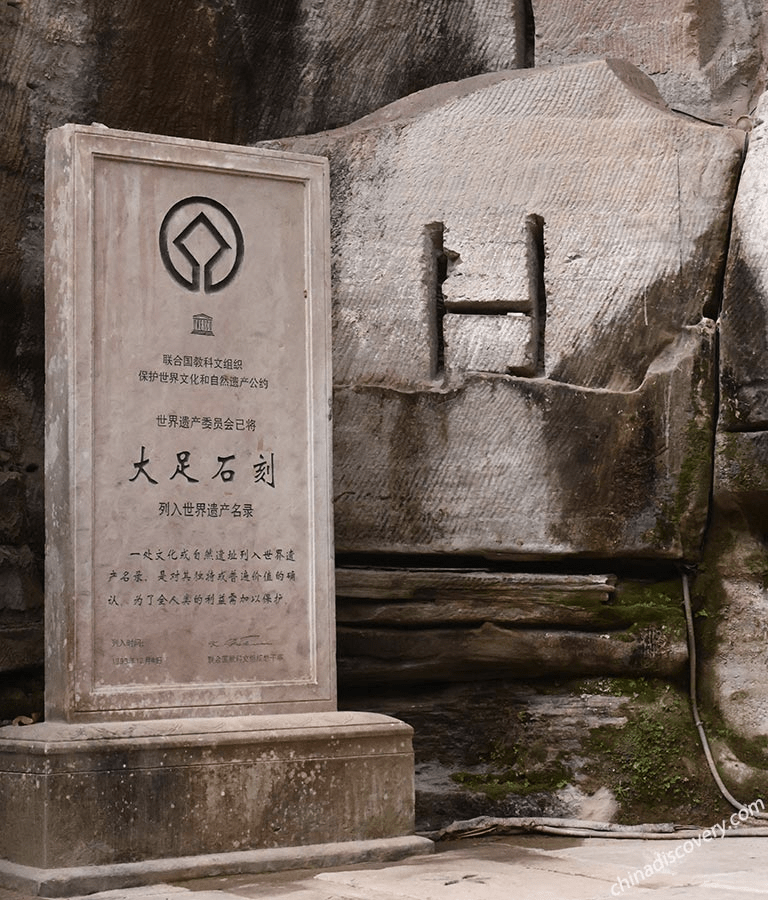
Differing from famous royal grottoes in the north, the religious cliff inscriptions in Dazu show distinctive features of nationalization, secularization, and everyday life, reflecting the remarkable development and changes in folk religious beliefs. Thus, the Dazu caves have the irreplaceable historical, artistic, scientific, and connoisseurship values of grottoes of the previous generations. Another highlight that has to be mentioned is that the statues there provide outstanding evidence of the harmonious synthesis of Tantric Buddhism, Taoism, and Confucianism. Visitors can see separate stone carvings as well as the unity caves reflecting the three religions’ confluence and ruling together. Moreover, thanks to the southern hinterland location of the Dazu Rock Carvings, this cultural heritage stays far away from man-made sabotage, retaining the integrity of the statues, the original characteristics and values of the period when the carvings were created.
Rock carvings in Dazu are mainly located across five mountains, each containing distinct sets of grottoes, among which the cliff-side sculptures on Baodingshan and Beishan are best known and considered to be the model of the late Chinese grottoes statue art. The pictures of the Dazu rock carvings that we commonly find online were mostly taken at the Baodingshan Scenic Area, which is also the must-visit site for a Dazu Rock Carvings tour.
Baodingshan Rock Carvings (Baodingshan Scenic Area)
Fifteen kilometers northeast from Dazu center, Baodingshan Rock Carvings was constructed by the famous monk Zhao Zhifeng in the Song Dynasty for more than 70 years. As one of the most famous Tantric Buddhist shrines in China, there is an old saying that goes like “Go North, climb the Emei Mountain; Go South, reach the Baoding Mountain.” The centerpiece of the Baodingshan rock carvings is the U-shaped Grant Buddha Bay, also known as Dafowan (“大佛湾” in Chinese). Nearly ten thousand statues are carved along the east, north, and south cliffs, which are approximately 500 meters in length and 8-25 meters high. Like a picture scroll with endless photographs, the content of Baodingshan rock carvings is mainly Buddhist scripture stories, each niche related to the other but not identical.
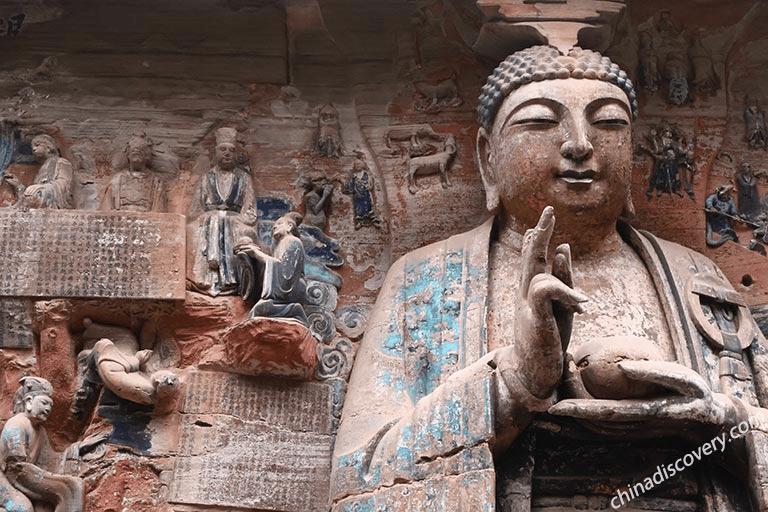
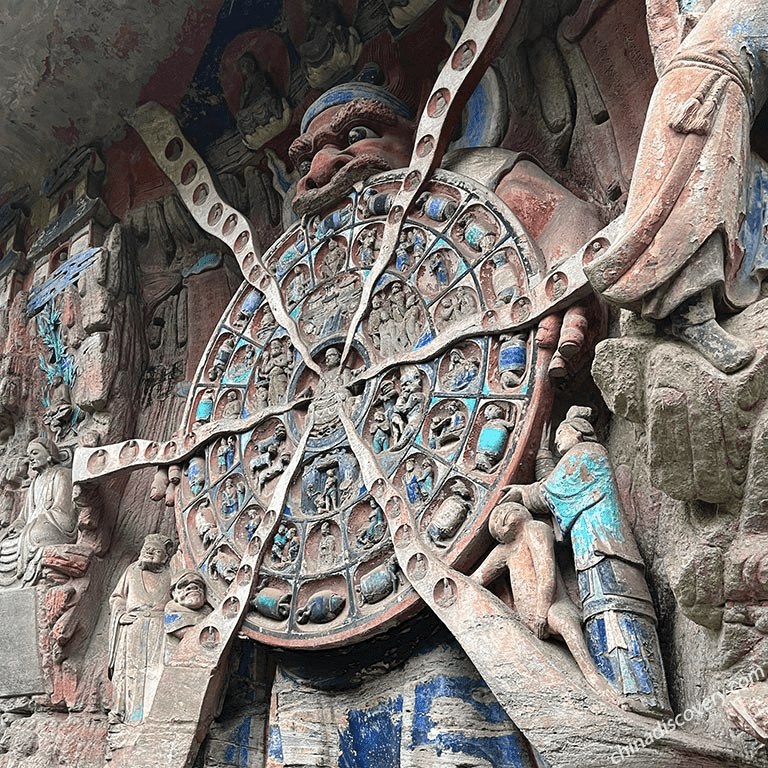

The Buddha statues at Baodingshan are novel in conception, skillful in carving, and rich in secular characters. Religious treasures come one after another, including the representative work – Niche of Sakyamuni Entering Nirvana, one of the wonders of Buddhist art in the world – Avalokitesvara with Thousand Hands, striking image of Buddhist Wheel of Life, scientific designs of Three Saints of Huayan School of Buddhism and Cave of Full Enlightment showed craftsmans’ ingenuity.
In addition, niche content and their expression approach are striving to visualize reality. For instance, Niche of Parental Love Sutra contains ten groups of carvings, including scenes like begging for a son, carrying a child, and going into labor, etc., depicting parental love in bringing up children with plots linking to each other as a picture-book. These carvings are vivid and impressive. They were the outcome after Buddhism had been localized in China.
The ox herding story
Located at the eastern end of the Great Buddha Bend, the ox herding tableau, shows a herdsman taming a disobedient ox—a traditional metaphor for the path to self-enlightenment and a popular theme among Ch’an Buddhist monks and painters in the Song Dynasty. The tableau is made up of eleven vignettes arranged horizontally along a 27-meter cliff wall.

The first three vignettes each depict a lively interaction between a herdsman and an ox in a landscape setting. The herdsman represents the Buddhist practitioner while the ox refers to the practitioner’s potential to become a Buddha. As the ox turns its body away, the stocky herdsman uses force, grass, and a stick to tame the ox. The verses accompanying the scenes further recount these struggles.

In the fourth and fifth vignettes, the ox is finally brought under control. The herdsman, featuring a wide, joyful smile, wraps his arms around his fellow herdsman while holding on to the ox with the rope in his hands.
In addition to the uncanny quality of grottoes’ masterpieces at Grant Buddha Bay (Dafowan), there are also many highlights you can’t miss while visiting Baodingshan Scenic Area:
- Watch a 4K film with English subtitles to learn about the history and development of Dazu rock carvings, and enjoy an 8D view of spectacular grottos at the dome theater
- Take a leisure stroll at Dazu Rock Carvings Museum (大足石刻博物馆) to gain insights into the whole thread of world cave temple art and the basic characteristics of Dazu Rock Carvings
- Visit Shengshou Temple (圣寿寺) to admire the exquisite temple architecture, which was rebuilt at the Ming and Qing Dynasties.

Beishan Rock Carvings
1.5km north to Longgang Town of Dazu, with an altitude of 545.5m, Beishan is also called Longgang Mountain in the past. Beishan Rock Carvings is the initial of Dazu Rock Carvings. They were first created by Wei Junjing, prefect of Changzhou, in 892 A.D. of the late Tang Dynasty. Until 1162 A.D. of the Southern Song Dynasty, the existing scale of Beishan Rock Carvings was formed, and it centered around Fowan. The rock carvings are numbered and divided into two sections: No.1 ~ No.100 are in the south section, while No.101 ~ No. 290 are in the north section. There are over 5,000 statues on a 500m long cliff, with a height of 7 to 10 meters. The grottoes are very dense, just like a hive, and all of them are delicate and carved with high sculpture skills.

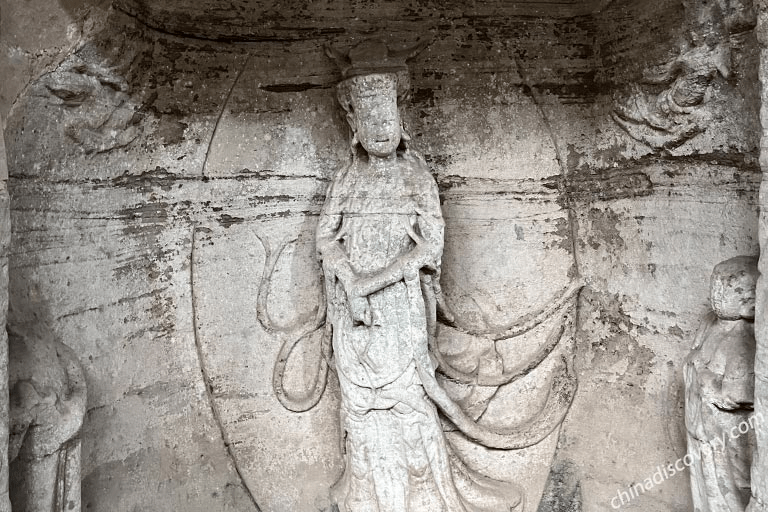
The crowning jewels of Beishan rock carvings are the statues of Avalokitesvara. They are ornamental and artistic, with diverse looks and postures. The most emblematic ones are the Avalokitesvara with a Rosary, Avalokitesvara Watching the Moon Reflection in the Water, and Thousand-armed and Thousand-eyed Avalokitesvara, etc.
Beishan rock carvings can be visited both during the day and at night. An additional visual experience is provided by the scenic spot’s usage of colored light to illuminate the stone statues. Besides, if you have enough time and stamina, don’t forget to follow the downhill trail to visit the Duobao Pagoda (多宝塔) to see the giant cliff statues of Beishan, the Two Buddhas of the North Pagoda.
Dazu Rock Carvings – The Last Monumental Works in the History of World Grotto Art
#AvalokitesvarawithThousandHands #Shakymunibuddha #DazuRockCarvings #History #WorldGrottoArt #Buddhism #BuddhistArt #BuddhaStatue#Cave#TravelChina #ChineseCulture
Source:https://www.chinadiscovery.com/chongqing/dazu-rock-carvings.html, https://smarthistory.org/mt-baoding-dazu-rock-carvings/
 Peace LiLy


