Sometimes beauty finds us when we least expect it—appearing like a sudden blossom of color in an ordinary moment, stopping us in our tracks and opening our hearts to wonder.
I happened to come across two traditional Chinese paintings online, both dominated by bright pink, and was utterly astonished. I couldn’t help but study them carefully. In Chinese painting, it is rare to see large areas of pink used as the main color, since it often risks appearing vulgar. Yet in the works of H.H. Dorje Chang Buddha III, there is not the slightest trace of vulgarity. On the contrary, they radiate grandeur and magnificence, and the artist’s confident mastery of color bursts forth boldly from the canvas.

The above piece in particular was painted with a heart as pure and untainted as that of a child. Within the seemingly naïve brushstrokes lies immense skill and mastery. The style is free and natural, bold and unrestrained yet still gentle. Its simple composition is infused with deep emotion and imagination, brimming with the vitality of childlike wonder that uplifts the viewer’s spirit.
A few pink houses stand in the scene, behind which several pink fruit trees sway delicately. Ink outlines give the houses their structure, while the softly hanging trees add a tender rhythm to the picture. The artist’s unique technique and extraordinary control of color are truly breathtaking. The inscription on the work further enhances its spiritual resonance:
“Brilliant colors, vivid yet dignified; consummate skill that reveals the heart of a child.”
Indeed, this is a rare and outstanding masterpiece of Chinese painting.
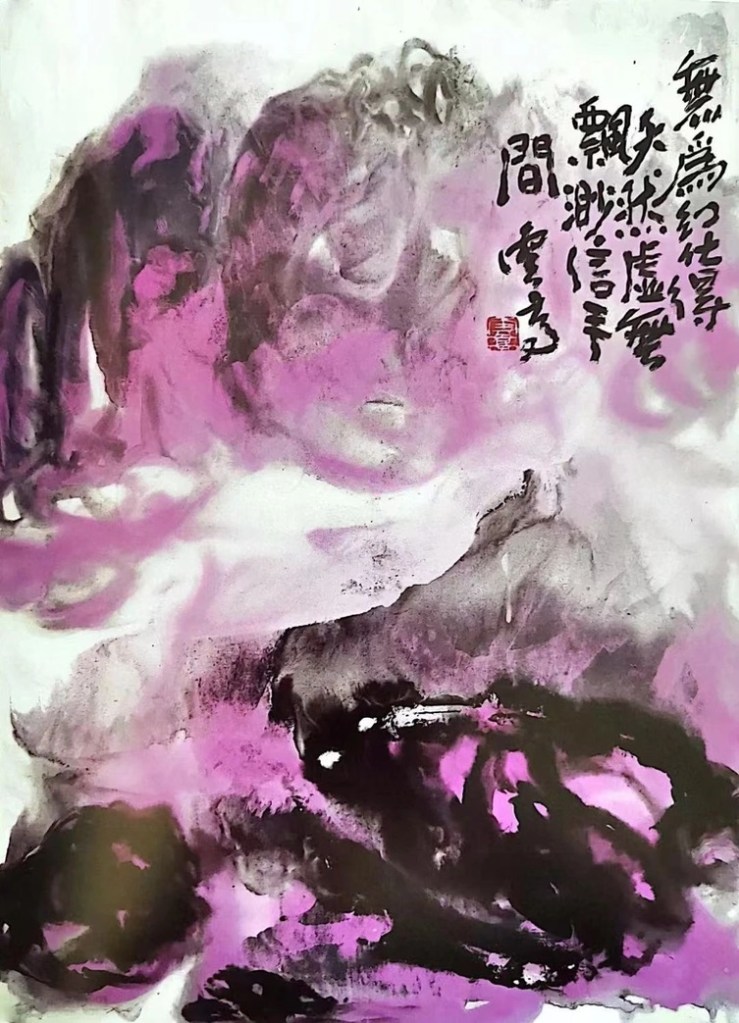
This masterpiece is a freehand splash-ink landscape, where the brush moves with effortless freedom. Layer upon layer of crimson cliffs rise as though born from the artist’s own heart—lines powerful, vigorous, and full of life. Ink strokes carve the very bones of mountains and rocks, each one natural, unrestrained, yet perfectly balanced. Broad washes of pink suffuse the scene, creating an ethereal, dreamlike realm that lingers between presence and absence, as if belonging to an immortal world. To gaze upon this painting is to step into another dimension—where the heart gradually settles into stillness and begins to sense the hidden rhythms of the cosmos.
This painting was not created to showcase skill or to dazzle the eye, but as a natural outpouring of inspiration and emotion. Both ink and color arise directly from the pure stirrings of the artist’s heart.
Here, the true essence of Chinese painting—shen yun (spiritual resonance)—is revealed in its fullest clarity. The inscription makes the artist’s intent unmistakable: “With effortless spontaneity, illusion transforms into nature; in the fleeting and ethereal, the hand finds its way.” The purpose is not simply to depict form, but to open a gateway into a spiritual realm that transcends the material.
Shen yun is at once vivid and elusive—an ineffable charm, a subtle spiritual force that cannot be captured in words. It flows from the painter’s inner cultivation and profound state of mind. When spirit and technique merge seamlessly, the work attains a power far beyond outward appearance.
It is only when the viewer is touched by this shen yun that the formal elements of the painting—the structure of its composition, the interplay of colors, the rhythm of the brush, the unity of poetry and image, the harmony of form and spirit—truly come alive. These elements are essential, of course, but they are not the destination. They are the pathway to something deeper, pointing always toward a higher, transcendent experience.
These two paintings are rare gems of Chinese art, that surprise, inspire, and open a doorway to beauty both profound and pure.
Link:https://peacelilysite.com/2025/08/29/beyond-form-entering-the-dreamlike-realm-of-chinese-painting/

 Peace LiLy