Once upon a time, in a small village nestled amidst rolling hills and verdant fields, lived a humble shoemaker named Michael. Despite his meager existence, Michael was known throughout the village for his kindness and compassion.
One bitterly cold winter’s night, as the village lay shrouded in a thick blanket of snow, a weary traveler knocked on Michael’s door seeking refuge. The traveler, unbeknownst to Michael, was none other than an angel sent to test the hearts of men.
Moved by the traveler’s plight, Michael invited him into his modest home, offering him a warm fire and a hot meal. Oblivious to the angel’s celestial nature, Michael treated him with the utmost care and kindness, tending to his needs as if he were a cherished guest.
As the night wore on, the angel observed Michael’s selfless actions with great interest. He could not help but be touched by the shoemaker’s genuine love and generosity, a love that surpassed the boundaries of wealth and social standing.
Days turned into weeks, and the angel continued to reside with Michael, secretly observing the shoemaker’s interactions with his family, friends, and neighbors. He witnessed how Michael tirelessly toiled to provide for his loved ones, how he shared whatever he had with those less fortunate, and how he spread warmth and kindness wherever he went.
One fateful day, the angel revealed his true identity to Michael. Overwhelmed with awe and wonder, Michael fell to his knees, humbled by the realization that he had unknowingly saved an angel. “Why did you choose me?” Michael asked in astonishment.
The angel smiled warmly and replied, “It was your love, Michael. Your love for your fellow beings and your unwavering kindness touched the depths of my heart. Through your actions, you have shown me what it means to truly live.”
In that moment, Michael understood the profound truth that Tolstoy had sought to convey. Love was the ultimate purpose of life, the force that breathed meaning into our existence. It was love that transcended social barriers, that connected souls, and that had the power to transform the world.
From that day forward, Michael’s love and compassion only grew stronger. He became a guiding light in the village, inspiring others to embrace love and kindness as the guiding principles of their lives.
The echoes of Michael’s love spread throughout the village, reaching the ears of a wealthy man named Simon. Simon, consumed by his own greed and selfishness, felt a profound emptiness within his soul. Touched by the stories of Michael’s love, he yearned to experience that same sense of fulfillment.
With a heavy heart, Simon approached Michael, seeking guidance and redemption. Recognizing the sincerity in Simon’s plea, Michael embraced him with open arms, teaching him the ways of love and compassion. In time, Simon’s heart softened, and he too began to live a life driven by love and selflessness.
Meanwhile, in a neighboring village, a woman named Matryona lived in seclusion, her heart burdened by the loss of her family. But one fateful day, as Matryona journeyed through the forest, she stumbled upon two orphaned girls on the brink of despair. Driven by a surge of love and empathy, Matryona took the girls under her wing, offering them shelter, care, and a mother’s love.
As the seasons passed, the village flourished under the influence of love. Acts of kindness became the norm, and the air was filled with warmth and harmony. The transformative power of love had woven its magic, creating a tapestry of compassion that embraced every soul in the village.
And so, the tale of Michael, Simon, and Matryona became legendary, passed down through generations as a testament to the profound truth that Tolstoy had so eloquently expressed. Love, the essence of life, had indeed triumphed, illuminating the path to a more beautiful and harmonious world.
The Buddha recounted this tale in response to a dispute between two monks, highlighting the destructive nature of harsh words. Gathering a large group in the monastery hall at Jetavana, he addressed them, saying:
“Monks and nuns, even animals suffer unhappiness due to harsh words. Allow me to share with you a story from ancient times, when bitter words caused a farmer to lose his fortune.”
Once, in a bygone era, the Future Buddha manifested as a bull and was gifted to a farmer. Overjoyed, the farmer named the young calf “Great Joy” and treated him like his own child. He provided the bull with the best rice and milk, fostering his growth. Great Joy flourished and became a mighty ox, black as the night sky and as radiant as the stars. Despite his immense strength, he remained gentle and obedient.
After years of tender care, Great Joy felt immense gratitude towards the farmer. He thought to himself, “The farmer has raised me with loving kindness and made great sacrifices for my well-being. He has even gone hungry at times to ensure I am well-fed. I must find a way to repay him for all his kindness!” The next morning, as the farmer brushed the bull, Great Joy spoke to him, saying, “Master, I have devised a plan to repay you for your many years of care.”
Pausing his brushing, the farmer gently placed his hand upon the bull’s large head and replied, “Great Joy, you already plow my fields, turn my well wheel, and carry heavy loads to and from the village. You work tirelessly, and there is no need for you to repay me. Do not trouble yourself with such matters.”
However, Great Joy was determined to execute his plan. “Master, please listen. I have a marvelous idea that will make you instantly wealthy. Journey to the town today and find a merchant who owns a vast herd of oxen. Make a bet with him for a thousand silver pieces, claiming that your bull is the mightiest in all of India. Wager that tomorrow morning, in the village square, your ox will draw a hundred carts overflowing with rocks, stones, and gravel!”
Skeptical, the farmer replied, “My dear friend, how could any ox in the world pull a hundred loaded carts? It has never been done before. The entire town will think I have gone mad.”
Unyielding, Great Joy persisted, “I possess the strength, and I will not let you down.”
“But what if you fail to pull such a heavy load? A thousand silver pieces comprise all I possess! If you lose, I will be left impoverished!”
Remaining steadfast, Great Joy reassured him, “I promise you, I will not let you down. I will not lose the wager, and you shall not lose your money.”
And so, the farmer followed the ox’s suggestion. He ventured to the village and positioned himself in the town square, where business transactions took place. Eventually, a wealthy merchant dressed in fine robes approached him. Seizing the opportunity, the farmer boldly proclaimed, “Did you know, gentlemen, that I am the owner of the strongest ox in the kingdom? I doubt there is a bull in all of India that can rival mine! In fact, my bull may be the largest and mightiest in the entire world!”
The crowd fell silent upon hearing his boast. All eyes turned towards the farmer. Finally, the wealthy merchant broke the silence and retorted, “It is widely known that I, sir, possess an entire herd of the world’s strongest oxen. What makes your single bull so exceptional?”
Realizing he had found the ideal opponent, the farmer promptly replied, “I have a bull capable of effortlessly pulling a hundred fully loaded carts!”
Mockingly, the merchant responded, “And where might this extraordinary bull be found? In the land of fairies and dreams?”
“He resides at my home,” answered the farmer confidently.
“Well, if you hold him in such high regard, let us make it a wager,” challenged the merchant.
“Certainly,” agreed the farmer. “I will bet you a thousand silver pieces that my bull can move one hundred carts fully loaded with rocks, stones, and gravel. Prepare the carts and meet me here in the village square at sunrise tomorrow morning.” With a firm handshake, the deal was sealed, and both parties made their preparations.
The following morning, before daybreak, the farmer fed Great Joy sweet milk and hay, bathed him, and brushed his coat until it shone. Speaking gentle and soothing words, just as he did every day, the farmer adorned the ox’s neck with a garland of flowers.
Great Joy knew the moment had arrived to prove himself.
At dawn, the farmer led Great Joy to the village square. Excited onlookers, including men, women, and children, filled the streets, eager to witness the outcome of this seemingly impossible bet. The farmer was astounded by the sight that greeted him—an unprecedented number of carts, each loaded to the brim with rocks. If any doubts lingered in the farmer’s mind, they were quickly replaced by certainty that he had been foolish to believe a mere animal’s promise.
Nevertheless, Great Joy stood proudly at the head of the line of carts, awaiting his harnessing. Magnificent and towering, his shoulders surpassing any other ox, he captured the awe of the crowd. Two men struggled to secure the heavy yoke upon his broad back, and then they attached the carts in a long chain.
Anxious, the farmer anticipated his impending humiliation before the townsfolk. Clutching the leather goad tightly, he muttered to himself, “I cannot afford to lose this wager. The ox has made a promise, but I am his master. I must ensure that he pulls the carts without fail. Ailee! I have risked my life savings on the word of a mere beast!” With determination, the farmer raised his goad and struck Great Joy forcefully, shouting, “Now, you beast, pull the carts! Pull! Pull, you rascal!”
Great Joy was taken aback by this treatment. He thought, “I am not a rascal! I am not a beast! He has never spoken to me like this before or used a whip on me. I will not move an inch!” Ignoring the lashes of the whip and the harsh words from his friend, Great Joy planted his hooves firmly, like the roots of four Banyan trees, and remained immobile.
Instantly, the crowd erupted in laughter and mockery, witnessing the farmer’s stubborn ox refusing to obey. Once again, the farmer struck Great Joy with the goad and cursed him, but the ox gazed straight ahead, disregarding the goad, the farmer, and the jeering crowd. In no time, the crowd began pelting both the farmer and the ox with mud and dung. Overwhelmed with shame, the farmer hung his head low and reluctantly handed over his entire savings to the merchant.
Jingling the coins in his hands, the merchant chuckled and said, “Whenever you wish to make another wager, seek me out! What ox could possibly pull a hundred loaded carts?” he laughed.
Despondent and penniless, the farmer unharnessed Great Joy from the line of carts and led him back home. The villagers taunted them along the way, hurling insults, rotten fruit, and mud. The farmer tied the ox to a stake and retreated inside his home, overcome with grief. “I am a pauper! It took me twenty years to earn that silver!” he wailed and moaned.
Hearing the farmer’s pained sobs from outside, Great Joy approached the window and inquired what was wrong. “I have lost all my money because of you!” the farmer bitterly exclaimed. “You promised me you wouldn’t let me down!”
Great Joy replied, “Ah, but master, it was you who let me down! Throughout all the time I have lived under your care, have I ever harmed anyone? Have I ever been clumsy or broken a pot? No. I have carried children gently on my back, even allowing the smallest of them to lead me. I have always done exactly as you asked.”
“Yes, I suppose you are right,” sniffed the farmer.
“Well, then, go once more to the town and bet the merchant double the silver. We shall meet him again in the square tomorrow morning at sunrise. But remember, treat me kindly as you always have, and I will treat you as I always have!”
Hurriedly, the farmer returned to town, found the merchant, and presented him with a new offer. Laughing at the prospect of making even more money, the merchant agreed to another wager.
At dawn the next morning, the village square mirrored the scene from the previous day. One hundred carts stood in a long line, each loaded with rocks. Once again, the streets were filled with eager spectators. Great Joy, bathed and brushed with a fresh garland around his neck, walked proudly alongside the farmer to the front of the carts. However, people chatted and joked, not taking the two participants seriously.
The weighty wooden yoke was placed upon Great Joy’s back, and the ropes were securely fastened. The farmer stood beside his ox, gently stroking his powerful shoulders. After a while, he leaned over and spoke softly into the bull’s ear, “Now, my fine fellow, my friend, pull the carts forward!”
Upon hearing these words, Great Joy seemed to grow in size. His muscles tensed, and he leaned against the ropes with all his might, causing them to tighten, cart by cart, until reaching the hundredth. Great Joy strained and pulled, taking one step and then another, each accompanied by a surge of momentum. Step by step, with unwavering determination, Great Joy continued his effort until the final cart stood exactly where the first one had started.
It was a sight to behold! Cheers and applause filled the air as flowers and money rained down upon the bull and the farmer. Great Joy, glistening with sweat, stood nobly and proudly in his place.
The merchant shook his head in disbelief but paid the two thousand silver coins as agreed. Children reached out to stroke the mighty ox, marveling at his remarkable perseverance. There was much celebration. Before the morning came to an end, the farmer and his faithful companion, Great Joy, trotted down the dusty road back home, where they lived happily and prosperously ever after.
Thus, the Buddha finished his lesson with the monks and nuns, sayingagain that harsh words please no one. And he spoke this verse in conclusion:
Speak only kind words: never be unkind.
For he who speaks gently, the ox moves the whole earth,
From Kindness A Treasury of Buddhist wisdom for Children and Parents By Sarah Conover
Long ago, during the time of the Buddha, lived a boy named Chundaka. Chunda-as he was fondly called–was a happy and good youngster, but unable to learn to read or write. In comparison, Chunda’s older brother became quite knowledgeable, with a keen interest in Buddhism. When the older brother decided to lead a monk’s life, Chunda followed along. He sought to live near his brother; but secretly, he also hoped to work alongside the monks and learn about Buddhism.
“Why don’t you ask the Buddha if you can become a monk, too?” his brother encouraged. But Chunda had no confidence. “Brother, how can I?” Chunda sadly replied. “I can’t memorize, and I can’t read or write. I have no knowledge of scriptures, and I won’t be able to learn them. A monk must be able to teach others many things.” But his brother assured him that both riches and knowledge were meaningless to the Buddha.” He values only the compassion we have for one another and the ways to help all creatures suffer less. No one is as gentle and kind as he is. I know he will not disappoint you, Chunda. Go and hear for yourself,” prodded his brother hopefully.
So Chunda mustered all his courage. He bathed and purified himself. When he was certain he was quite ready, he approached the Buddha. The Buddha observed that this humble young man had an earnest and pure heart. He could see that Chunda would try his very best. The Buddha welcomed him as the newest monk in the community. The next morning, Ananda, head of all the monks, gave Chunda a small scripture to memorize, just 6 lines long. It was the first of hundreds that each monk was expected to learn by heart. But a week later, having tried his hardest, poor Chunda could still not recite it from beginning to end. Completely disheartened, he went back to the Buddha and admitted his failure.
But the Buddha was not greatly disappointed; he had total faith in Chunda’s good intentions. The Buddha and Chunda sat thoughtfully together in silence. An idea suddenly occurred to the Buddha. “Chunda, are you a hard worker?” asked the Buddha.”Do you think you can sweep the temple and keep it spotlessly clean?” “Oh yes, Buddha I’m a good worker, and I’m very good at sweeping. I just cannot seem to learn scripture.”
So the Buddha gave Chunda the task of keeping the temple perfectly clean. He was to hold no other job but temple sweeper. The Buddha then requested that Chunda speak two lines while sweeping: remove all dust, remove all dirt. But as soon as poor Chunda attempted his task, the words completely vanished from his mind. Luckily, Ananda overheard the Buddha’s instructions and could help Chunda remember them over and over again.
At last, a month later, Chunda had it learned by heart.”Remove all dust,” the monks heard Chunda whisper with the sweep of the broom. “Remove all dirt, he murmured with the return sweep. Behind Chunda’s back, the other monks snickered at his memory problem. More than a few took some pride in the extent of their learning. Day and night Chunda poured his heart into his work, repeating those six words again and again. Eventually, however, over time every monk couldn’t help but admire Chunda’s perseverance. They had never witnessed such single-minded determination. In time, the few words that the Buddha had given him to memorize became more and more meaningful to Chunda. His chores became a meditation upon the words.
Chunda’s curiosity deepened, and he suspected that the Buddha knew all along that these words were not as simple as they first appeared. “Did my teacher want me to sweep outer dust and dirt or inner dust and dirt?” he wondered. “What is inner dirt? How would one go about cleaning inner dirt?” he asked himself many times. Some months later, Chunda found the answers to these questions himself. While he worked, insight nudged its way into his heart. Once in awhile now, the monks saw Chunda thoughtfully pausing from his endless task, leaning against his broom and looking at the far off horizon. At last a day came when Chunda felt ready to discuss his thoughts with the Buddha. “Venerable sir” said Chundaka enthusiastically, “I think I finally understand the real meaning of the words you gave me.” “Please tell me what you understand,” encouraged the Buddha. “I believe that inner dust and dirt is a grasping, said Chunda. “If we don’t like something in our lives, we grasp for a different situation. But if we really like something that we have, then we also grasp because we don’t want it to change.” Chunda continued, “To look at life clearly, we must always see through this. We must sweep the dust and dirt away and keep our inner temple clean.” The Buddha smiled warmly at Chunda’s thoughtful words.
And so, as the years passed, Chunda swept and meditated and thought deeply. He found he did not have to memorize scriptures as the other monks did, for teachings seemed to arise from within. After a time, he became known as one of the wise and gentle teachers of Buddhism, affectionately called “Chundaka, the Broom Master.” He lived a long and happy life. And for many years people journeyed to the monastery from distant places, not just to hear from the learned monks, but to listen especially to Chundaka, the Broom Master. He was their favorite, loved for his very simple, yet very wise sayings.
Life often presents us with a mix of challenges, ranging from personal struggles to family issues and health problems. It can be overwhelming, especially for a young boy, as he opens up to his Grandma about everything going wrong. However, through a simple baking analogy, Grandma imparts a profound lesson about the nature of adversity and the importance of trust and faith in difficult times.
In the midst of school problems, family issues, and serious health concerns within the family, the little boy finds solace in confiding in his Grandma. He shares his frustrations, expressing how everything seems to be going wrong in his life. Unfazed by the boy’s grievances, Grandma calmly continues her task of baking a cake. Recognizing the boy’s need for a snack, she offers him various individual ingredients used in baking, such as cooking oil, raw eggs, flour, and baking soda. The boy’s disgusted reactions reflect his belief that these items are unpleasant to consume on their own. In response to the boy’s repulsion, Grandma imparts a valuable lesson. She explains that while these ingredients may taste unpleasant individually, when combined in the right amounts and manner, they create a delicious cake. She further extends the analogy to the way God works in our lives.
Grandma draws a parallel between the ingredients in baking and the challenges we face in life. Just as the ingredients, when mixed together, create something wonderful, God works in mysterious ways to bring about goodness from our trials. While we may question why we endure difficult times, Grandma encourages us to trust in God’s divine plan.
Life’s challenges may seem overwhelming and bitter when viewed in isolation. However, Grandma’s wisdom reminds us that even the most difficult circumstances can serve a purpose and lead to positive outcomes. By placing our trust in God’s guidance, we can find meaning, growth, and resilience amidst the adversities we encounter.
The story of the little boy and his Grandma’s cake-baking analogy provides a powerful reminder of the transformative potential hidden within life’s challenges. Like the ingredients in a cake, our trials and tribulations may appear unappealing when viewed individually. However, with faith and trust, we can embrace the belief that God’s hand is at work, orchestrating events in our lives for a greater purpose.
By embracing faith, trust, and resilience, we can find hope, strength, and a renewed sense of purpose, even in the face of adversity.
There was an elementary school teacher who taught in a remote town. One day, he asked the little children in his class, “Do you have anyone you hate?” After thinking it over, some of the little children remained silent while others nodded with great force. The teacher then passed a bag to everyone and said, “Let’s play a game. Now, all of you think about who has offended you and what hateful things have been done to you in the past week. Once you have them in mind, go find a rock by the riverside on your way home after school. “Paste a little paper note, written with the person’s name, on the rock. If his fault was big, then find a bigger rock; if his fault was small, then find a smaller rock. “Every day, place what you have collected in a bag and bring it with you to school and show me!” All the students felt that it was very interesting and new. After school, every one rushed to the riverside to find rocks. Early next morning, all the students brought their bags, filled with pebbles to school, and discussed about it happily. With the passing of one day passed, two days, and three days, some of the students’ bag grew larger and larger. It had become a burden. Finally, someone protested and said, “This is so tiring!” The teacher smiled but did not respond. Immediately, someone picked the conversation and continue to complaint, “Exactly! Carrying all these rocks to school is so tiring!”
At that moment, the teacher spoke up and said, “Now put down these rocks which represent the faults of people who have offended you!” The students were all surprised, so the teacher explained, “Learn to forgive others’ offenses. Do not keep them as treasures in your mind, nor bear them on your shoulders. No one can stand it overtime.” That week, the students of the class learned an extremely precious life lesson. The greater the number and the bigger the rocks held in the bag, the deeper the tired accumulated in the mind, and the heavier the burden. If you have rocks written with others’ names, you should know what to do.
A true story about a female worker who was saved from being locked inside a freezer at work, due to her having a modest and respectful mind. A lady worked for a food processing factory. One day, at the end of her work, she routinely walked into the freezer for a final check. Suddenly, an unfortunate moment happened, the door accidently closed behind her and she got locked inside the freezer. Although she exhaustedly screamed and pounded on the door, no one could hear her crying voice, she was totally out of people’s sight. All the workers were off from factory at this moment and no one could hear what had happened inside. Five hours later, when she was at the brink of death, the security guard of the factory opened that door and miraculously saved her. Afterwards she asked the security guard why he would open the door since that was not his daily job. He explained, “I have been working at this factory for 35 years. Every day there are several hundred workers who enter and walk out: however, you are the only one who greet me with “How are you?” in the morning and say “Goodbye, see you tomorrow.” in the evening. Many people do not see me as if I were transparent. Today, you came to work in the morning as usual and asked me “How are you?”, but at the end of the work day, I did not hear you say to me “Goodbye, see you tomorrow.” As a result, I decided to take a look inside the factory. I anticipated your “Hi” and “Goodbye”, because these words remind me of who I am and make me very happy. Without hearing your word of goodbye, I knew something might have happened. That was the reason why I searched for you in every corner of the factory.”
He who loves others is constantly loved by them; he who respects others is constantly respected by them. Helping others is truly helping ourselves.
Once there was a poor woodcutter who found a wounded dragon snake in the mountains. The woodcutter kindly nursed the dragon snake back to health and later released it into a hole in the mountain. There, a precious ganoderma lucidum grew, which the dragon snake protected day and night.
One day, the emperor fell ill and needed ganoderma lucidum to cure his disease. He offered a heavy reward for anyone who could provide it. The woodcutter remembered the dragon snake and went back to the mountain to find it. The dragon snake, grateful for the woodcutter’s kindness, gave him the ganoderma lucidum. The woodcutter presented it to the emperor, who gave him a lot of gold and silver as a reward.
The woodcutter now lived a life of luxury but was not satisfied. He wanted to become an official and saw an opportunity when the queen lost her sight. The emperor announced that whoever could restore her sight with the eye of a dragon snake would become the prime minister. The woodcutter remembered the dragon snake again and begged for its help. The snake allowed the woodcutter to take one of its eyes with huge pain, which the woodcutter presented to the emperor. The queen’s sight was restored, and the woodcutter was made prime minister.
However, the woodcutter’s greed was insatiable. When the princess fell ill, and the dragon snake’s liver were needed to heal her, the woodcutter asked for the dragon snake once again. The dragon snake, wanting to repay the woodcutter’s kindness, allowed him to cut a small piece of its liver. But the woodcutter, overcome by greed, he went inside dragon snake’s stomach and took a large piece, causing the snake unbearable pain. The snake closed its mouth in agony, and the woodcutter was trapped inside.
This story shows that the woodcutter’s downfall was entirely due to his own actions, driven by his insatiable greed.
Buddhist Tales for Young and Old, volume 1, Prince Goodspeaker, Stories 1-50
Once upon a time, King Brahmadatta was ruling in Benares, in northern India. The Enlightenment Being was born as his son the prince. Being quite intelligent, he completed his entire education by the age of sixteen. So, at this early age, his father made him second in command.
In those days, most people in Benares worshipped gods. They were very superstitious. They thought gods caused things to happen to them, rather than being results of their own actions. So they would pray to these gods and ask special favours. They would ask for a lucky marriage, or the birth of a child or riches or fame.
They would promise the gods that, if their prayers were answered, they would pay them by making offerings to them. In addition to flowers and perfumes, they imagined the gods desired the sacrifice of animals. So, when they thought the gods had helped them, they killed many animals — goats, lambs, chickens, pigs and others.
The prince saw all this and thought, “These helpless animals are also subjects of the king, so I must protect them. The people commit these unwholesome acts due to ignorance and superstition. This cannot be true religion. For true religion offers life as it really is, not killing. True religion offers peace of mind, not cruelty.
“I fear these people believe in their superstitions too strongly to give them up. This is very sad. But perhaps their beliefs can at least be put to good use. Some day I will become king. So I must begin to make a plan to let their superstitions help them. If they must offer sacrifices, let them kill their own greed and hatred, instead of these helpless animals! Then the whole kingdom will benefit.”
So the prince devised a clever long term plan. Every so often, he rode in his grand chariot to a popular banyan tree just outside the city. This was a huge tree, where the people prayed and made offerings to a god they thought lived there. The prince came down from his chariot and made the same offerings as the others — incense, flowers, perfumes and water — but not animal sacrifices.
In this way he made a great show, and the news spread about his offerings. Pretty soon, all the people thought he was a true believer in the great god of the banyan tree.
In due time, King Brahmadatta died and his son became king. He ruled as a righteous king, and the people benefited. So all his subjects came to trust and respect him as a just and honourable king.
Then one day, he decided it was the right time to carry out the rest of his plan. So he called all the leading citizens of Benares to the royal assembly hall. He asked them, “Worthy ministers and loyal subjects, do you know how I was able to make sure that I would become king?” No one could answer.
He said, “Do you remember that I often gave wonderful sweet offerings to the great god of the banyan tree?” “Yes, our lord,” they said.
The king continued, “At each of those times, I made a promise to the powerful god of the tree. I prayed, ‘Oh mighty one, if you make me King of Benares, I will offer a special sacrifice to you, far greater than flowers and perfumes.’
“Since I am now the king, you all can see for yourselves that the god has answered my prayers. So now I must keep my promise and offer the special sacrifice.”
All those in the assembly hall agreed. They said, “We must prepare this sacrifice at once. What animals do you wish to kill?”
The king said, “My dear subjects, I am glad you are so willing to cooperate. I promised the great god of the banyan tree that I would sacrifice anyone who fails to practice the Five Training Steps. That is, anyone who destroys life, takes what is not given, does wrong in sexual ways, speaks falsely, or loses his mind from alcohol. I promised that, if any do these things, I will offer their guts, and their flesh and blood on the great god’s altar!”
Being so superstitious, all those in the hall agreed that this must be done, or the god would surely punish the king and the kingdom.
The king thought, “Ah, such is the power of superstition that these people have lost all common sense! They cannot see that, since the first training step is to give up killing, if I sacrificed one of my subjects, I would be next on the altar! And such is the power of superstition that I could make such a promise, and never have to carry it out!”
So, with full confidence in the power of superstition, the king said to the leading citizens, “Go into all the kingdom and announce the promise I made to the god. Then proclaim that the first one-thousand who break any of the training steps will have the honour of being sacrificed, to keep the king’s promise.”
Lo and behold, the people of Benares became famous for carefully practising the Five Training Steps. And the good king, who knew his subjects so well, sacrificed no one.
The moral is: Sacrifice your own wrong doing, not some helpless animal.
50. The Prince Who Had a Plan [The Power of Superstition]
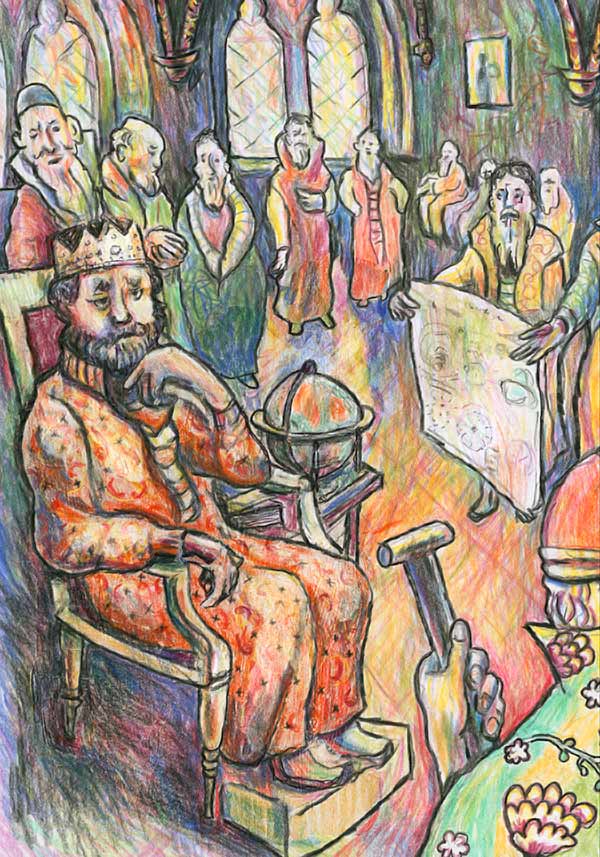
It once occurred to a certain king that if he always knew the right time to begin everything; if he knew who were the right people to listen to, and whom to avoid; and, above all, if he always knew what was the most important thing to do, he would never fail in anything he might undertake.
And this thought having occurred to him, he had it proclaimed throughout his kingdom that he would give a great reward to anyone who would teach him what was the right time for every action, and who were the most necessary people, and how he might know what was the most important thing to do.
And learned men came to the king, but they all answered his questions differently.
In reply to the first question, some said that to know the right time for every action, one must draw up in advance a table of days, months, and years, and must live strictly according to it. Only thus, said they, could everything be done at its proper time. Others declared that it was impossible to decide beforehand the right time for every action, but that, not letting oneself be absorbed in idle pastimes, one should always attend to all that was going on, and then do what was most needful. Others, again, said that however attentive the king might be to what was going on, it was impossible for one man to decide correctly the right time for every action, but that he should have a council of wise men who would help him to fix the proper time for everything.
But then again others said there were some things which could not wait to be laid before a council, but about which one had at once to decide whether to undertake them or not. But in order to decide that, one must know beforehand what was going to happen. It is only magicians who know that; and, therefore, in order to know the right time for every action, one must consult magicians.
Equally various were the answers to the second question. Some said the people the king most needed were his councilors; others, the priests; others, the doctors; while some said the warriors were the most necessary.
To the third question, as to what was the most important occupation, some replied that the most important thing in the world was science. Others said it was skill in warfare; and others, again, that it was religious worship.
All the answers being different, the king agreed with none of them, and gave the reward to none. But still wishing to find the right answers to his questions, he decided to consult a hermit, widely renowned for his wisdom.
The hermit lived in a wood which he never quitted, and he received none but common folk. So the king put on simple clothes and, before reaching the hermit’s cell, dismounted from his horse. Leaving his bodyguard behind, he went on alone.
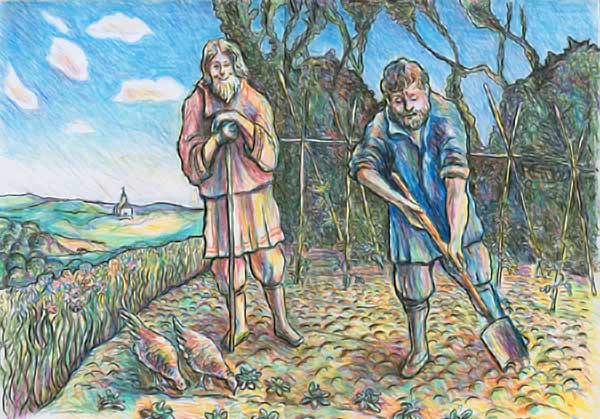
When the king approached, the hermit was digging the ground in front of his hut. Seeing the king, he greeted him and went on digging. The hermit was frail and weak, and each time he stuck his spade into the ground and turned a little earth, he breathed heavily.
The king went up to him and said: “I have come to you, wise hermit, to ask you to answer three questions: How can I learn to do the right thing at the right time? Who are the people I most need, and to whom should I, therefore, pay more attention than to the rest? And, what affairs are the most important and need my first attention?”
The hermit listened to the king, but answered nothing. He just spat on his hand and recommenced digging.
“You are tired,” said the king, “let me take the spade and work awhile for you.”
“Thanks!” said the hermit, and, giving the spade to the king, he sat down on the ground.
When he had dug two beds, the king stopped and repeated his questions. The hermit again gave no answer, but rose, stretched out his hand for the spade, and said:
“Now rest awhile – and let me work a bit.”
But the king did not give him the spade, and continued to dig. One hour passed, and another. The sun began to sink behind the trees, and the king at last stuck the spade into the ground, and said:
“I came to you, wise man, for an answer to my questions. If you can give me none, tell me so, and I will return home.”
“Here comes someone running,” said the hermit. “Let us see who it is.”
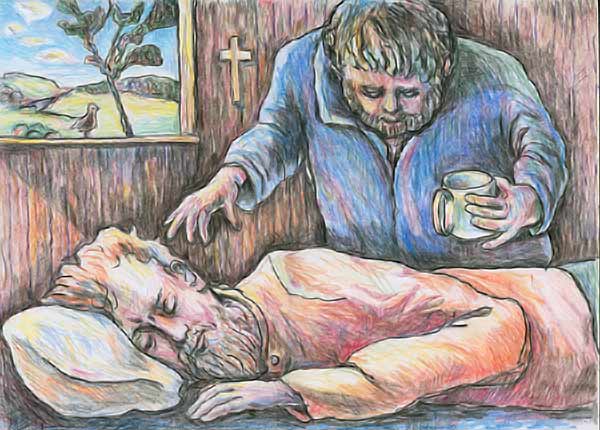
The king turned round and saw a bearded man come running out of the wood. The man held his hands pressed against his stomach, and blood was flowing from under them. When he reached the king, he fell fainting on the ground, moaning feebly. The king and the hermit unfastened the man’s clothing. There was a large wound in his stomach. The king washed it as best he could, and bandaged it with his handkerchief and with a towel the hermit had. But the blood would not stop flowing, and the king again and again removed the bandage soaked with warm blood, and washed and re-bandaged the wound. When at last the blood ceased flowing, the man revived and asked for something to drink. The king brought fresh water and gave it to him. Meanwhile the sun had set, and it had become cool. So the king, with the hermit’s help, carried the wounded man into the hut and laid him on the bed. Lying on the bed, the man closed his eyes and was quiet; but the king was so tired from his walk and from the work he had done that he crouched down on the threshold, and also fell asleep – so soundly that he slept all through the short summer night.
When he awoke in the morning, it was long before he could remember where he was, or who was the strange bearded man lying on the bed and gazing intently at him with shining eyes.
“Forgive me!” said the bearded man in a weak voice, when he saw that the king was awake and was looking at him.
“I do not know you, and have nothing to forgive you for,” said the king.
“You do not know me, but I know you. I am that enemy of yours who swore to revenge himself on you, because you executed his brother and seized his property. I knew you had gone alone to see the hermit, and I resolved to kill you on your way back. But the day passed and you did not return. So I came out from my ambush to find you, and came upon your bodyguard, and they recognized me, and wounded me. I escaped from them, but should have bled to death had you not dressed my wound. I wished to kill you, and you have saved my life. Now, if I live, and if you wish it, I will serve you as your most faithful slave, and will bid my sons do the same. Forgive me!”
The king was very glad to have made peace with his enemy so easily, and to have gained him for a friend, and he not only forgave him, but said he would send his servants and his own physician to attend him, and promised to restore his property.
Having taken leave of the wounded man, the king went out into the porch and looked around for the hermit. Before going away he wished once more to beg an answer to the questions he had put. The hermit was outside, on his knees, sowing seeds in the beds that had been dug the day before.
The king approached him and said, “For the last time, I pray you to answer my questions, wise man.”
“You have already been answered!” said the hermit, still crouching on his thin legs, and looking up at the king, who stood before him.
“How answered? What do you mean?” asked the king.
“Do you not see?” replied the hermit. “If you had not pitied my weakness yesterday, and had not dug these beds for me, but had gone your way, that man would have attacked you, and you would have repented of not having stayed with me. So the most important time was when you were digging the beds; and I was the most important man; and to do me good was your most important business. Afterwards, when that man ran to us, the most important time was when you were attending to him, for if you had not bound up his wounds he would have died without having made peace with you. So he was the most important man, and what you did for him was your most important business. Remember then: there is only one time that is important – now! It is the most important time because it is the only time when we have any power. The most necessary person is the one with whom you are, for no man knows whether he will ever have dealings with anyone else: and the most important affair is to do that person good, because for that purpose alone was man sent into this life.”
This story reminded me of something that Henry Shukman, an English Spiritual Director Emeritus and a Zen Buddhism practitioner, once said: ‘Now… is always and ever the most important thing… there is only one place that fulfillment can happen: here and now.’
Once upon a time, there was a rich family living in Benares, in northern India. They arranged for their son to marry a good and honest girl from a nearby village. Being very pretty as well, they were sure they could not find a better wife for their son.
The groom’s family decided on a date for the wedding. The bride’s family agreed to meet them in the village on the wedding day.
Meanwhile, the rich family also had their own special astrological priest. When he found out they had picked the wedding day, without paying him to consult the stars, he became angry. He decided to get even with them.
When the wedding day arrived, the astrological priest dressed up in his finest robes, and called the family together. He bowed to them all, and then looked at his star charts very seriously. He told them that this star was too close to the horizon, and that planet was in the middle of an unlucky constellation, and the moon was in a very dangerous phase for having a wedding. He told them that, not seeking his advice, they had picked the worst day of the year for a wedding. This could only lead to a terrible marriage.
The frightened family forgot all about the wonderful qualities of the intended bride, and remained home in Benares.
Meanwhile the bride’s family had arranged everything for the village wedding ceremony. When the agreed upon hour arrived, they waited and waited for the future husband and his family. Finally they realized they were not coming. So they thought, “Those city people picked the date and time, and now they didn’t show up. This is insulting! Why should we wait any longer? Let our daughter marry an honourable and hard working village man.” So they quickly arranged a new marriage and celebrated the wedding.
The next day, the astrological priest said that, suddenly, the stars and planets and moon were in perfect positions for a wedding! So the Benares family went to the village and asked for the wedding to take place. But the village people said, “You picked the date and time. Then you disgraced us by not showing up!”
The city people replied, “Our family priest told us that yesterday the stars and planets and moon were in terrible positions. It was a very unlucky day for a wedding. But he has assured us that today is a most lucky day. So please send us the bride at once!”
The village family said, “You have no honour. You have made the choice of the day more important than the choice of the bride. It’s too late now! Our daughter has married another.” Then the two families began to quarrel heatedly.
A wise man happened to come along. Seeing the two families quarrelling he tried to settle the dispute.
The city people told him that they had respected the warnings of their astrological priest. It was because of the unlucky positions of the stars and planets and moon, that they had not come to the wedding.
The wise man said, “The good fortune was in the bride, not in the stars. You fools have followed the stars and lost the bride. Without your foolishness, those far off stars can do nothing!”
The moral is: Luck comes from actions, not from stars.













 Peace LiLy