Maijishan Grottoes – Buddhist Treasure Well-preserved on Maiji Mountain Cliff

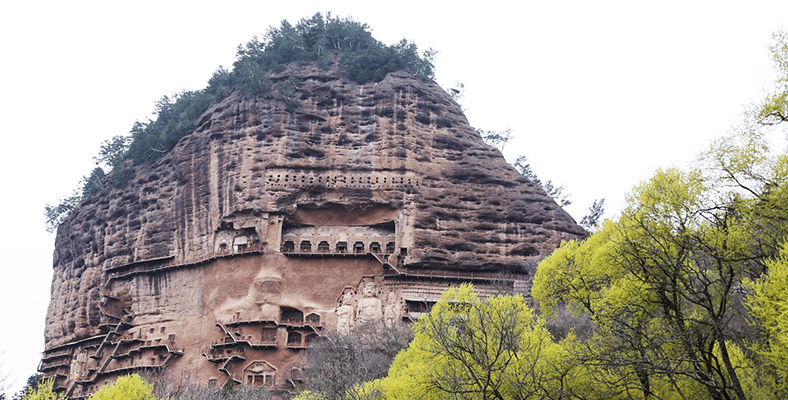
Maijishan Grottoes, also known as Maiji Mountain Grottoes or Maijishan Caves, is situated in Maiji District, Tianshui City, Gansu Province, in northwest China. Alongside the Longmen Grottoes, Yungang Grottoes, and Dunhuang Grottoes, it holds the esteemed title of being one of the “Four Greatest Grottoes in China.”

If the Mogao Caves are likened to a vast mural museum, the Maijishan Caves undoubtedly resemble an expansive sculpture museum. Boasting 10,632 clay sculptures, Maijishan is hailed as “the Oriental Sculpture Art Exhibition Hall.”

Much like the Parthenon temple in ancient Greece, the stone and clay carvings at Maijishan have been remarkably preserved since ancient times, earning it the moniker of “China’s Parthenon Temple.”

In contrast to the exotic sculptures found in the Mogao Caves, the sculptures in Maijishan are characterized by a more secular, human, and distinctly Chinese quality.

Unlike the exotic sculptures in Mogao Caves, the sculptures in Maijishan Caves are more secularized, human, and more Chinese

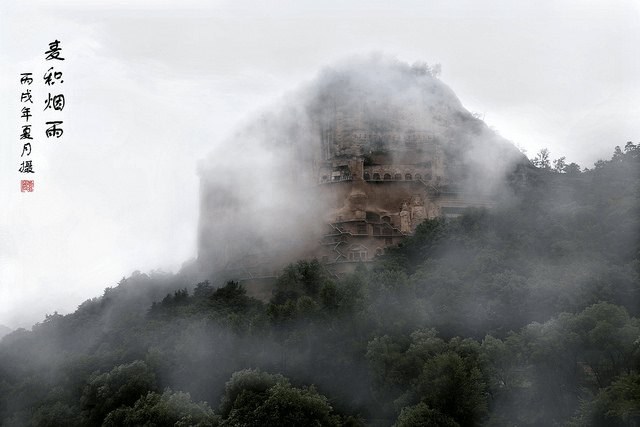
The name Maiji in Chinese translates to “piled sheaves of wheat,” reflecting the mountain’s appearance and the origin of its name. The Maijishan Grottoes were initially constructed in A.D. 384-417 and underwent subsequent expansions in dynasties such as Northern Zhou (A.D. 557-581) and Tang (A.D. 618-907). The site currently comprises 221 caves, 10,632 clay sculptures, and over 1300 square meters of murals, earning global acclaim for its exquisite clay sculpture art and recognition as the “Oriental Sculpture Art Exhibition Hall.”

While Maijishan Grottoes may not be as renowned as the other three great grottoes, it stands out as the best-preserved among them. Carved into the steep cliff of the mountain, the caves were not easily accessible, thus escaping much of the destruction that plagued other sites throughout tumultuous periods in history. Today, visitors can marvel at Buddha sculptures and murals along a narrow path clinging to the cliff’s edge.

Marsman Rom, Wikimediia Commons

Shizao, Wikimedia Commons

Maijishan in a sea of fog. ©Maijishan Grotto Art Institute and Global Heritage Fund

Located just a few miles south of the main road connecting China and Central Asia, Maijishan emerged as a hub of cross-cultural exchange, drawing hundreds of thousands of itinerants and serving as a historical canvas reflecting the art of 12 distinct dynasties. Indians, Mongols, Huns, Sogdians, Tibetans, Chinese, and others traversed its halls, leaving enduring imprints of their cultures in the form of art.

The mountain’s 194 grottoes stand as tangible evidence of this diverse influence, showcasing seven architectural variations, housing over 7,000 statues, and adorned with more than 100 square meters of murals. Everything within reflects a dedication to Buddhism, from depictions of Siddhartha’s birth to bodhisattvas engaged in meditation and scenes of new devotees arriving. While Maijishan’s physical features initially garnered attention, it is the heritage inscribed, painted, and sculpted onto the soft golden stone that solidified its place in the globalized consciousness of Buddhism, akin to Mount Sumeru, the sacred Buddhist mountain often considered the “mythical axis of the universe.”

The history of Maijishan, like the tales along ancient trade routes, commences with a journey. One account tells of the priest Hsüan-kao meditating at Maijishan, later joined by the shaman T’an-Hung. Together, they founded the mountain’s first monastic community, growing to nearly 300 people before their departure, marking a departure filled with religious fervor, and in T’an-Hung’s case, a morbidly poetic self-immolation in Cochin.

This semi-mythical origin, whether entirely factual or not, undeniably solidified Maijishan as a significant religious site for Chinese rulers. In the Fang-yü sheng-lan, a Sung Dynasty-era book, it is noted that Yao Hsing transformed the mountains, carving 1,000 cliffs and 10,000 images, transforming the cliffs into halls. A stele from 1222 attests to the site’s prominence, with 10,000 people praying there, empires granting land for farming, and seven kingdoms continuously contributing to its maintenance. Subsequent imperial decrees bestowed various names, including “Ching-nien ssu,” “Ying-chien kan ssu,” and “Jui-ying ssu,” before settling on the name Maijishan.

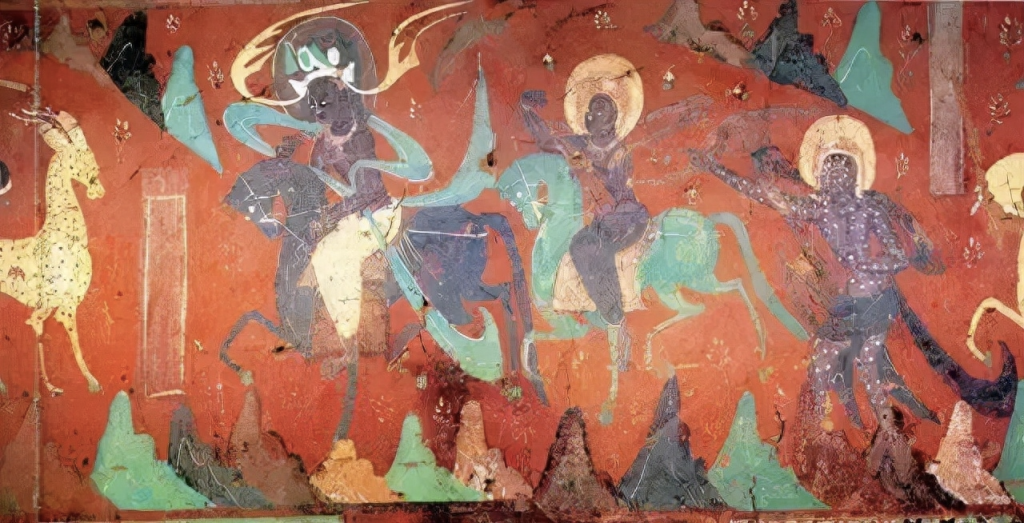
Examples of how brilliantly these works of art were once colored. Shizao, Wikimedia Commons

Differences between Maijishan’s Grottoes and Mogao’s

The Maijishan Grottoes and the Mogao Grottoes, both situated in Gansu Province along the Silk Road, offer distinct experiences, prompting consideration for visitors on a Silk Road journey. Despite being grottoes, they differ significantly, making a visit to both a worthwhile endeavor.

  1. The Maijishan Grottoes are renowned for their clay sculptures, whereas the Mogao Grottoes impress with expansive and beautiful murals. The arid climate in Dunhuang aids mural preservation, while the Maiji Mountain area, with more rainfall and looser mountain rock (clay), is conducive to sculpture carving.
  2. Sculptures in the Maijishan Caves are primarily plain clay pieces, while in the Mogao Caves, they are predominantly painted sculptures integrated with murals. Buddha statues in Maijishan exhibit a more secularized and daily-life-oriented character.
  3. The surrounding natural landscapes vary. Maijishan Caves, located in the Maiji Mountain Reserve area, offer a summer retreat with lush trees and springs, providing opportunities to explore diverse wildlife. In contrast, the Mogao Grottoes are situated in the Gobi Desert, surrounded by wild desert scenery.
  4. The Maiji Grottoes were carved into a steep 100-meter-high cliff face, requiring travelers to ascend the “floating plank road” for a more adventurous experience. In comparison, the Mogao Grottoes were carved into a 30-meter-high sandstone outcrop distributed over four floors.

The breathtaking Maiji Caves, carved into the steep cliffs of Maiji Mountain, stand about 100 meters (330 feet) above the ground, divided into East and West Cliffs. These caves, resembling honeycombs in hives, are interconnected by plank walkways suspended in the air from the cliff face.

Have you ever pondered how this feat was accomplished over a thousand years ago without modern machinery?

Legend has it that the Maijishan Grottoes were excavated at the expense of clearing all the woods near Maiji Mountain. Ancient people built wooden scaffolds from the mountain’s foot to the top, serving as precursors to the later generations’ “plank roads.”

During the Tang Dynasty (618–907), an earthquake divided Maiji Mountain into two cliffs, east and west. Over subsequent dynasties — Song, Yuan, Ming, and Qing — the Maijishan Grottoes underwent development, evolving into the cohesive complex seen today.

The Maijishan Caves stand as a testament to human wisdom and art along the Silk Road, embodying profound respect for Buddhism and an unending yearning for a better life.

Part of the Maiji Mountain Scenic Reserve area (including Xianren (‘Fairy’) Cliff, Shimen, Quxi, and Jieting Hot Spring), the Maijishan Grottoes boast diverse forests and a rich array of plants and animals.

While the Maijishan Grottoes can be visited year-round, the best time to explore the Maiji Mountain Scenic Reserve area is from July to October when the mountain, adorned with dense foliage, provides an ideal summer getaway.

Maijishan Grottoes – Buddhist Treasure Well-preserved on Maiji Mountain Cliff

Link:https://peacelilysite.com/2023/12/15/maijishan-grottoes-buddhist-treasure-well-preserved-on-maiji-mountain-cliff/

#MaijishanGrottoes #BuddhistTreasure #MaijiMountainCliff #Travel #China#Art#TravelChina

Source: https://globalheritagefund.org/2018/02/13/inside-the-lost-grottoes-of-maijishan/, https://www.chinadiscovery.com/gansu/maijishan-grottoes.html, https://www.chinahighlights.com/tianshui/attraction/mount-maiji-grottoes.htm

The Story of the Nine-Colored Deer

The Most Perfect Continuous Mural in the Dunhuang Mogao Caves

“The Story of the Nine-Colored Deer King” is the main theme of the murals in Cave 257 of the Mogao Caves. It unfolds in a long horizontal scroll, narrating many stories from the past life of the founder of Buddhism, Siddhartha Gautama.

Legend has it that long ago, on the banks of the Ganges River in India, there lived a beautiful and kind nine-colored deer king (the previous incarnation of Siddhartha Gautama)…

One day, as the nine-colored deer king was leisurely strolling by the river, he suddenly heard a pitiful cry from the water. Without hesitation, the brave nine-colored deer leaped into the river, risking its own safety, and rescued the drowning person. The saved individual, overwhelmed with gratitude for a second chance at life, repeatedly bowed in thanks to the nine-colored deer.

The nine-colored deer king said, “No need for thanks; just go on your way. My only request is that you do not reveal my whereabouts to anyone.” The drowning person solemnly swore, “Kind benefactor, rest assured. If I ever betray this promise, may my body be covered in sores and my mouth emit a foul odor.” With that, the person departed.

Before long, the queen of that country dreamt of a deer—one with nine colors and silver-like antlers. She told the king about her dream and requested that he order the capture of such a deer. She had a strong desire to use its colorful hide for clothing and its antlers for earrings. Consequently, the king issued a proclamation and offered a substantial reward.

Upon seeing the proclamation, the person who had been saved reported to the king, leading soldiers to the mountain to hunt down the nine-colored deer.

When the nine-colored deer was surrounded by the king’s troops… it spotted the person it had rescued from drowning, tears of sorrow welled up in its eyes…

The nine-colored deer leaped in front of the king and recounted the story of how it had saved the person from drowning and how that person had broken his promise. The king and the soldiers were deeply moved by the deer’s account. The king ordered the soldiers to clear a path, allowing the nine-colored deer to regain its freedom. He also issued a decree: “From now on, people are not allowed to shoot deer.”

As for the person who had broken his promise, in an instant, sores covered his body, and a foul odor emanated from his mouth. From that moment on, he was despised and reviled by the people.

The story of the nine-colored deer is vividly portrayed in Cave 257 of the Dunhuang Grottoes, which is what we now see as “The Story of the Nine-Colored Deer King.” While the mural is not particularly large in size, it holds significant importance in Chinese art history.

This artwork takes the form of a horizontal scroll with the story unfolding from both ends and converging in the middle. It consists of multiple scenes depicting various stages of the story, such as its origin, development, climax, and conclusion, all seamlessly connected to create a cohesive narrative.

“The Story of the Nine-Colored Deer King” is composed of nine panels, illustrating five key plot points: the person drowning, the nine-colored deer rescuing the drowning person, the drowning person expressing gratitude to the deer, the queen’s desire to capture the deer, the informant revealing the deer’s whereabouts to the king, and the confrontation between the king and the deer.

The story progresses from both ends of the mural towards the center, placing the pivotal conversation between the king and the deer in the middle. This unique composition style captures the essence of continuous horizontal scroll art from the Wei and Jin dynasties, showcasing the distinctive historical aesthetics of the era.

In the artwork, the depiction of mountains, rocks, and rivers occupies a significant portion. The rendering of the landscape primarily serves to fill the space and delineate the composition, providing a brief description of the specific environment, thereby enhancing the visual impact of the artwork and its storytelling function.

“The Story of the Nine-Colored Deer King” places the climax of the story—the moment when the nine-colored deer recounts the events—at the center of the composition. At the same time, both nine-colored deer on the left and right sides turn their bodies toward the center, serving as visual guides.

This is precisely the turning point in the storyline of the nine-colored deer, where the drowning person’s affliction receives its retribution. It places the Buddhist concept of rewarding goodness and punishing evil at the visual forefront, narrating the sequence of events step by step to gradually reveal the story’s progression to the viewer.

The entire process is rhythmic, marked by the ebb and flow of the narrative, skillfully aligning the chronological order with the spatial arrangement, showcasing the artist’s unique conceptualization of the composition.

In terms of color usage, “The Story of the Nine-Colored Deer King” appears to be very vibrant, but in reality, it uses a limited color palette, consisting of only six colors. The earthy red color dominates the entire painting, which is a prominent color characteristic of the Wei, Jin, Northern and Southern Dynasties period.

Complementing this are touches of stone blue and stone green, along with the harmonious blending of black, white, and gray. This blending softens the strong contrast between earthy red and stone green and blue, achieving a harmonious contrast of warm and cool tones. At the same time, it also accentuates the brightness of contrasting colors.

The introduction of Buddhism had a significant impact on the development of portraiture in China, introducing a set of strict conventions for Buddhist iconography. During the Northern Wei dynasty, the Dunhuang murals began to emphasize body proportions and adopted more attention to three-dimensionality after incorporating color shading techniques.

In “The Story of the Nine-Colored Deer King,” most of the figures on the canvas have slender bodies, with their clothing belts fluttering in the wind. Their gestures and movements exude a graceful dance-like elegance, evoking the style of figures that “float like wandering dragons and are delicate as startled swans.”

In the murals of the Northern Wei period in Dunhuang, Jataka stories are an important theme. Jataka stories refer to the countless events and experiences in the past lives of Siddhartha Gautama, who would later become the founder of Buddhism. In history, there are numerous Jataka stories related to Siddhartha Gautama.

Within Buddhist art themes, there are many Jataka story paintings, and “The Story of the Nine-Colored Deer King” is just one of them. Story paintings are used to promote the Buddhist concept of karmic retribution and to praise the spirit of self-sacrifice displayed by the Nine-Colored Deer King.

In reality, all Jataka paintings ultimately convey one message: that by performing good deeds, selflessly giving, and enduring hardships, one can achieve positive outcomes, whereas engaging in wrongful actions will lead to self-destruction.

The Story of the Nine-Colored Deer King

Link:https://peacelilysite.com/2023/10/02/the-story-of-the-nine-colored-deer/

#SiddharthaGautama #SakymuniBuddha #JatakaStories #BuddhistStories #MoralStory #Mural #Dunhuang #MogaoCaves #Grottoes #Buddhism #ChineseCulture #Art #karmicRetribution #Paintings

Source: https://www.toutiao.com/article/7025418785972847140/?ug_source=seo_juhe, https://zhuanlan.zhihu.com/p/346828893

A Jataka Tale Depicted by Art

The complete Prince Mahasattva jataka tale mural. Mogao Cave 428. Northern Zhou, 557-581 CE. Dunhuang. Image courtesy of the Dunhuang Academy

Prince Mahasattva

Jataka tales are fascinating narratives that shed light on the past lives of the Buddha. These captivating stories unveil the incarnations preceding Prince Siddhartha Gautama’s birth and illustrate the ways in which he accumulated virtuous karma through selfless acts of sacrifice.

Before his existence as Prince Siddhartha Gautama, the Buddha’s soul had already amassed immense virtue from numerous previous lifetimes, embodying various selfless beings.

One remarkable representation of these Jataka tales can be found in a Dunhuang mural. Located on the eastern wall of Mogao Cave 428, this mural intricately portrays a renowned Jataka tale featuring Prince Mahasattva. The entire narrative is depicted across three registers, capturing the essence of the story within its captivating artwork.

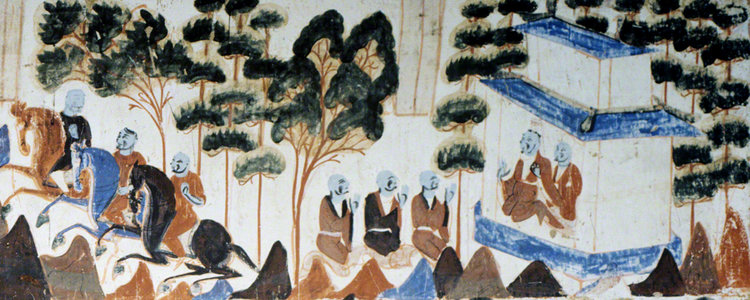
Detail of the three princes paying their respects to the king and queen before they leave for the forest. First register, right section. Mogao Cave 428. Northern Zhou, 557-581 CE. Dunhuang. Image courtesy of the Dunhuang Academy.

The mural commences on the right-hand side of the first register, where a captivating scene unfolds. Three young men, their hands pressed together in a gesture of genuflection, kneel before a majestic blue pagoda. Inside the pagoda, two figures exuding regal aura can be identified as the king and queen, bidding a heartfelt farewell to their sons, the three young men.

As the story progresses, the mural transitions to subsequent scenes, unveiling the brothers’ journey into the forest for a hunting expedition. Within this vibrant forest setting, an array of deer and tigers roam, coexisting with the majestic presence of towering trees and majestic mountain ranges. The undulating mountains, adorned with a multitude of colors, gracefully assume a smaller scale compared to the trees, animals, and human figures, harmoniously framing each scene of the narrative.

Detail of the three princes hunting in the forest. First register, middle section. Mogao Cave 428. Northern Zhou, 557-581 CE. Dunhuang. Image courtesy of the Dunhuang Academy.

The story unfolds on the second register, commencing from the left-hand side. As the three brothers venture deeper into the forest, they eventually dismount from their horses, seeking respite at the foothills of towering mountains.

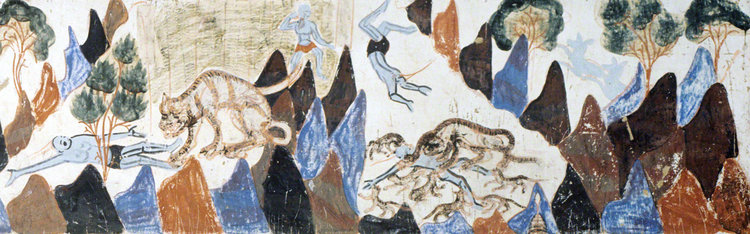
While taking a moment to rest, the brothers catch sight of a tigress accompanied by seven adorable cubs. The tigress is portrayed with her mouth agape, and her painted figure exudes a somber aura with limbs hanging low. Her gaze fixates upon the playful cubs frolicking around her, creating an illusion of impending maternal aggression, as if she were poised to devour her own offspring.

Detail of the starving tigress and her baby cubs. Second register, middle-left section. Mogao Cave 428. Northern Zhou, 557-581 CE. Dunhuang. Image courtesy of the Dunhuang Academy.

The brothers convene to discuss the matter of the tigress. Not wanting to watch a mother devour her own children, the brothers resolve to help her find food. However, there does not appear to be any food nearby.

Prince Mahasattva suddenly comes up with an idea. He keeps it to himself and tells his two brothers to leave the forest to find some food while he stays behind to watch over the tigers.

After his brothers leave, Prince Mahasattva strips off his clothes and lies down in front of the tigress, offering himself to the tigress. He decides to offer himself as food for the tigress so that she wouldn’t have to eat her own children. 

The tigress sniffs at his body but makes no move to harm him even though she is starving.

When we offer help to someone and they are unable to accept what is offered, it’s a chance for us to feel good about having attempted goodness without losing anything. We can think to ourselves, well, we tried to help. In the case of Prince Mahasattva, he understood that good intentions alone would not save a life. It would take determined and complete self-sacrifice to save the tigers.

Realizing that the tigers will not eat him alive, Prince Mahasattva climbs to the edge of a cliff, cuts open his neck and throws himself off the ledge. With his neck bleeding profusely, his body drops in front of the tigress and her cubs. At Prince Mahasattva’s second attempt to offer his body, the tigers devour him as nourishment.

Detail of the Prince Mahasattva’s sacrifices to the tigers. Second register, right section. Mogao Cave 428. Northern Zhou, 557-581 CE. Dunhuang. Image courtesy of the Dunhuang Academy.

Snaking across and down the three registers, the story continues on the third register by beginning on the right-hand side again. Prince Mahasattva’s brothers return and they understand what happened in their absence when they see the bones left behind by the tigress and her cubs.

The brothers’ bodies contort across the scene in shock, anguish, and grief in reaction to the death of their third sibling.

Detail of the grieving brothers and their return to the palace. Third register. Mogao Cave 428. Northern Zhou, 557-581 CE. Dunhuang. Image courtesy of the Dunhuang Academy.

The two brothers practically fly back to the palace on their horses to tell the king about what happened to Prince Mahasattva. 

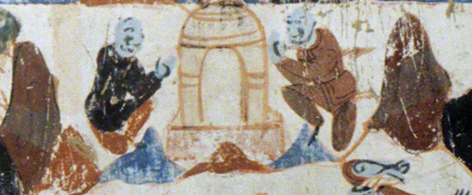
The story actually ends on the topmost right corner of this image, returning to the place where the two princes found their brother’s corpse. After reporting to the king, the family builds a stupa over Prince Mahasattva’s bones and hair to commemorate his selfless actions.

Detail of the brothers building a stupa over Prince Mahasattva’s remains. Third register. Mogao Cave 428. Northern Zhou, 557-581 CE. Dunhuang. Image courtesy of the Dunhuang Academy.

Many of the Mogao caves at Dunhuang have central pillars that take after the stupa form.

Scholars have theorized that worshippers could have circumambulated these central pillars inside the Mogao caves at Dunhuang as one would do around stupas in the open air.

The central pillar in Mogao Cave 428. Northern Zhou dynasty. 557-581 CE. Dunhuang. Image courtesy of the Dunhuang Academy.

Prince Mahasattva

Link:https://peacelilysite.com/2023/06/09/a-jataka-tale-depicted-by-art/

#PrinceMahasattva #Mural #Dunhuang#MogaoCave #BuddhistTeaching #BuddhistSutra #BuddhistTales #moralstories #Buddha #Jatakastories #BuddhistWisdom #BuddhistWisdomforChildrenandParents #Jatakatales

Source: http://dunhuangfoundation.us/blog