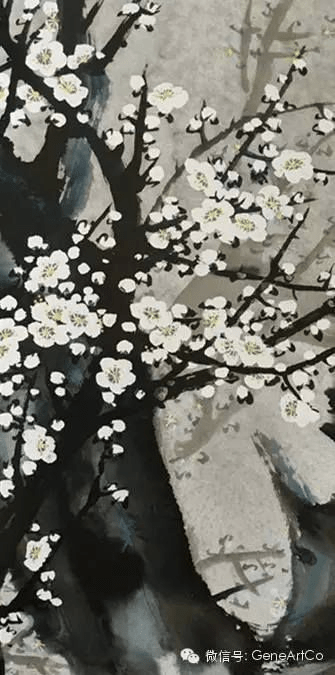
Ode to The Plum Blossom

Ode to The Plum Blossom

Recently, I stumbled upon breathtaking plum blossoms while taking a walk. These delicate flowers evoked feelings of warmth and joy, reminding me of the arrival of spring. In Chinese culture, plum blossoms, beyond just being a physical flower, have become a symbol of perseverance and resilience in the face of harsh winter conditions. This significance was achieved through the extensive descriptions, sublimations, and chanting by literati and scholars over the ages. In ancient China, plum blossoms were considered a lucky symbol and were welcomed as a sign of the arrival of spring during the New Year.

When I was a child, my father taught me to recite the poem “Ode to the Plum Blossom” by Zedong Mao, reminding me to be fearless and strong like the plum blossom that blooms amidst harsh winter conditions. I really like the poem, and can still remember it.

Ode to the Plum Blossom

—to the tune of Bu Suan Zi

By Zedong Mao, December 1961

Wind and rain escorted Spring’s departure, 

Flying snow welcomes Spring’s return. 

On the ice-clad rock rising high and sheer 

A flower blooms sweet and fair. 

Sweet and fair, she craves not Spring for herself alone, 

To be the harbinger of Spring she is content. 

When the mountain flowers are in full bloom 

She will smile mingling in their midst.

But after many years of struggles, I realized that bravery and strength aren’t always enough, especially in managing relationships and family. As a wife and mother, I learned the importance of being magnanimous, compassionate, forbearing, and not rigid. I have since embraced the peaceful and compassionate philosophy of Buddhism.

H.H. Dorje Chang Buddha III, the contemporary Buddha, wrote a poem “Plum Fragrance in the Holy Land.” He broke from traditional poetry styles, instead opting for surreal techniques to directly convey spiritual essence.

To the Tune of “Jiang Jun Song”

Plum Fragrance in the Holy Realm

Reveal her icy bearing and proud bones,

See how plum blossom commands the scene,

The crowd of beauties suddenly lacks color,

Seductive peach has lost its looks.

A few casual strokes,

So many eons of wind and dust.

The smoke and fire of the human world all disappears,

Leaving only a pure fragrance from the paper,

It wafts over me, awakening my mind.

The smile of the enchanted dream still remains,

Buddha Vajradhara has come

Three times to this world.

To this Buddha Land of merciful compassion

That great one has brought purity,

Feelings of the brush,

Traces of the brush,

One smile in the wind and dust,

Now the wind and dust,

So many eons of wind and dust.

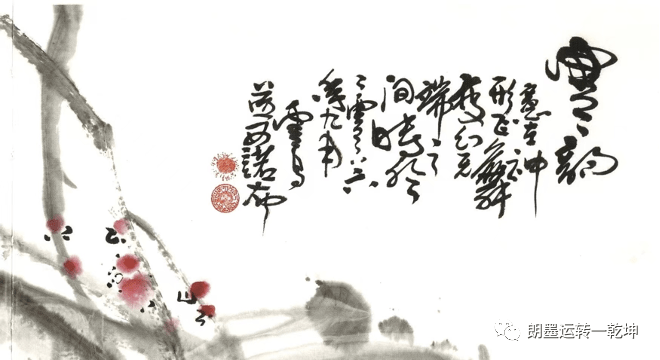
The Buddha also created an ink painting to accompany the poem. The poem delves deeper into the artist’s thoughts, while the painting provides a visual representation.
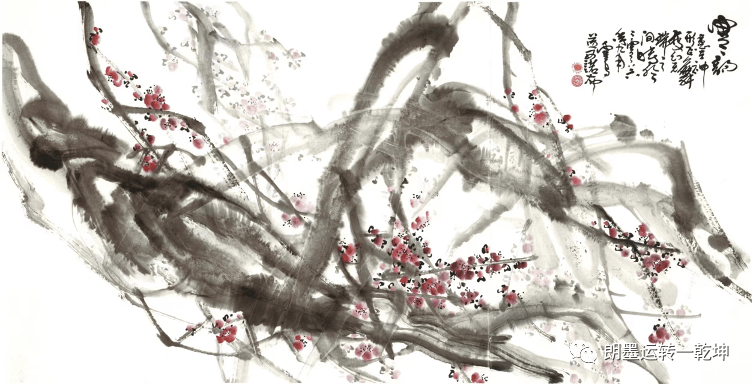
The plum blossoms depicted in the paintings symbolize the artist’s state of mind, embodying inner beauty refined from impurities. The brushwork, casually applied, was accomplished with an unfettered hand and detached mind, free of the slightest artificiality. It is a seemingly ever-changing work. Its charm, tone, transitions, and depictions represent the highest level of Eastern ink-and-wash paintings. A transparent layer of lighter ink on top of darker ink is clearly visible, imbuing the painting with a pure and fragrant air and providing the viewer with a feeling of comfort and ease.

The plum blossoms created by these skilled pens are eternal. While natural blooms may come and go, Buddha’s compassion remains steadfast.

Ode to The Plum Blossom

Link: https://peacelilysite.com/2023/02/02/ode-to-the-plum-blossom/

#DorjeChangBuddhaIII #HHDorjeChangBuddhaIII#DorjeChangBuddha#IAMA#InternationalArtMuseumofAmerica#ChinesePaintings#PlumBlossom#Paintings#

Source: https://www.oktranslation.com/LiteraryTranslation/lt_info32200.html
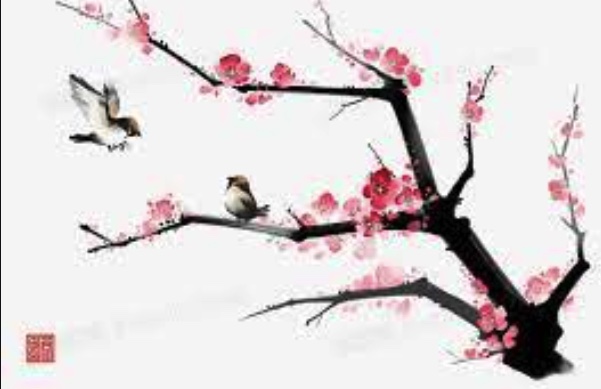
Chinese Plum Blossom Paintings

Chinese Plum Blossom Paintings

One of the most beloved flowers in China, the plum blossoms (méi-huā, 梅花) have been frequently depicted in Chinese painting and poetry for centuries. The Chinese see its blossoms as both a symbol of winter as well as a harbinger of spring. It is precisely for this reason that the blossoms are so beloved, as they bloom most vibrantly amidst the winter snow, after most other plants have shed their leaves, and before other flowers appear. They are seen as an example of resilience and perseverance in the face of adversity. Though neither the plum tree nor its blossoms are very striking, they manage to exude an otherworldly exquisiteness and beautiful elegance. The demeanor and character of the plum tree thereby serves as a metaphor for inner beauty and humble display under adverse conditions. Because they blossom in winter, the plum blossom is a member of the “Three Friends of Winter (歲寒三友)”, along with the pine and the bamboo. The plum blossom is also a member of the “Four Gentlemen (四君子)” in Chinese art (the others being orchid, bamboo, and chrysanthemum), symbolizing nobility. In China, there are over 300 recorded cultivars of mei, which can be broadly divided by color into white, pink, red, purple, and light green types.

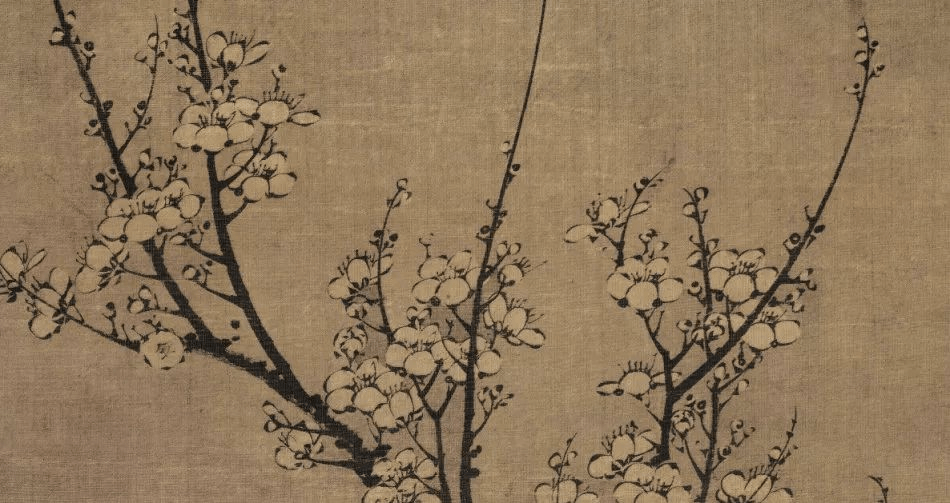
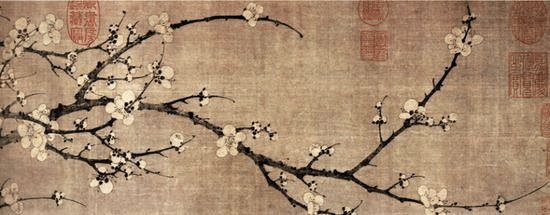
When we look through all of the ancient and modern books on plum blossom paintings, it is not difficult to discover that all of the famous master plum blossom painters had extensive knowledge, deep understanding of ancient and their own contemporary times, and immense talents. No artist in history can be found who lacked virtue and learning and still was capable of painting highly exquisite plum blossom paintings. The plum blossom paintings of ancient artists such as Mian Wang and Dongxin Jin and the modern artist Changshuo Wu are splendid works based upon the profound knowledge and virtue of their creators.

Mian Wang ( 1287-1359 ) : Early Spring at South Corner of Garden
Artist: Dongxin Jin (1687 – 1764)
Artist: Changshuo Wu (1844 – 1927)

As a contemporary artist, the Pop of Buddhist, H.H. Dorje Chang Buddha III has also painted dozens of masterpieces of plum blossom compositions. All in the book entitled Collected Plum Blossom Paintings, Calligraphy, Poems, and Songs. Wielding the brush with great facility, His Holiness creates paintings that are completely devoid of mundane garishness, have the exquisite look of ancient bronze and stone inscriptions, and are imbued with a scholarly air. His Holiness’s painting skills have surpassed the ordinary and reached the consummate mastery of a holy being. Below are several art works from the book. Some of the paintings are in the exhibition of The International Art Museum of America.

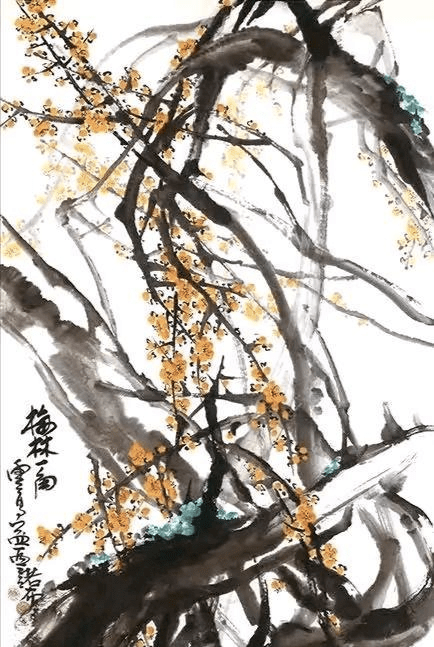
Small Portion of a Plum Grove

Yellow plum blossoms bloom in winter and are generally used during Chinese New Year celebrations as a symbol of great auspiciousness. The painting expresses beauty of a real plum blossom grove.

Drunk in a Green Garden

The turquoise plum blossom is a rare species of plum blossom. These elegant, sublime flowers have a strong resistance to coldness and a scent that is quite fresh and fragrant. This painting has a vigorous and firm style yet maintains great simplicity. The brushwork is bold, vigorous, and completely unconstrained. Large, dancing strokes of a casual hand and free mind bring to form branches and twigs.

Plum Fragrance in the Holy Realm

The brushwork, casually applied, was accomplished with an unfettered hand and detached mind, free of the slightest artificiality. It is a seemingly ever-changing work. Its charm, tone, transitions, and depictions represent the highest level of Eastern ink-and-wash paintings. A transparent layer of lighter ink on top of darker ink is clearly visible, imbuing the painting with a pure and fragrant air and providing the viewer with a feeling of comfort and ease.

Winter Powder

A most elegant and valued plum flower called ‘Dong Fen” (winter powder). It is widely known to be the king of whiter plum blossoms. A strong contrast is presented by the graceful dense ink that was used to paint the tree trunk and the whiting used to form the flowers. The spatial effect of fairness adds to the charm of the picture, showing an awareness of both emptiness and form. A very special aspect of this painting is that the artist did not apply powerful, bold strokes of uneven contour and content. Rather, ink was applied through a gradual moistening process, manifesting the strong talent of the artist.

Chinese Plum Blossom Paintings

Link: https://peacelilysite.com/2022/11/03/chinese-plum-blossom-paintings/

#DorjeChangBuddhaIII #HHDorjeChangBuddhaIII#DorjeChangBuddha#IAMA#InternationalArtMuseumofAmerica#ChinesePaintings#PlumBlossom#Paintings#WangMian#WuChangShuo

Source: https://www.comuseum.com/painting/flower-painting/plum-blossom/