
In the history of painting in China, many renowned artists have used Namo Avalokitesvara Bodhisattva as a subject for their works. These artistic images are beloved by the people because the Bodhisattva is a symbol of compassion. These exalted artistic images subtly influence the inner world of generations, inspiring and shaping the soul of the nation.
The Mogao Caves in Dunhuang are the largest and most well-preserved repository of Buddhist art in China and the world. Among the murals in the Mogao Caves, there are masterpieces of Namo Avalokitesvara Bodhisattva created by painters over the ages, including images of the Water-Moon Guanyin, the White-Robed Guanyin, and the Eleven-Faced Guanyin. It is said that this treasure trove of painting art contains works by masters like Gu Kaizhi and others from various dynasties.
In 1940 Zhang Daqian led a group of artists to the caves of Mogao (莫高) and Yulin (榆林) for the purpose of copying their Buddhist wall paintings. The group completed over 200 paintings, and the experience left Zhang with a repository of religious imagery. He was so captivated by these unparalleled treasures that his original plan to stay for three months extended to two years, during which he dedicated himself to studying and copying the artworks. Today, his paintings of Avalokitesvara Bodhisattva are acclaimed as rare and invaluable masterpieces.

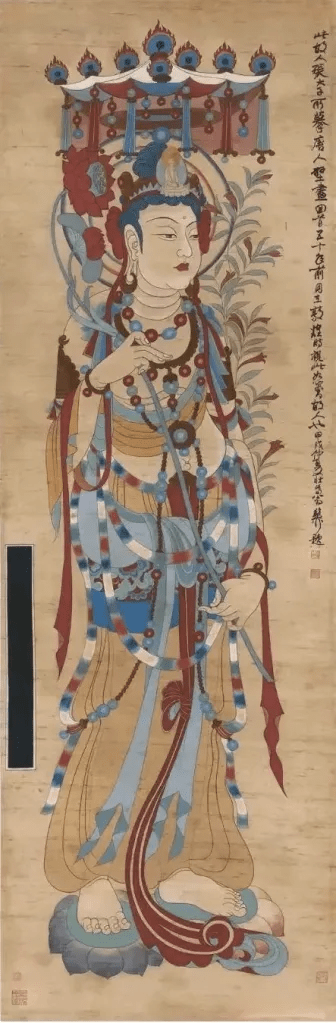
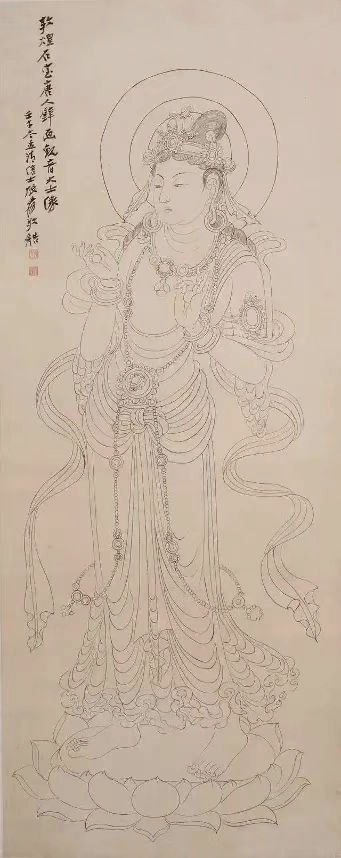
At International Art Museum of America, there is a painting of Namo Guan Shi Yin Bodhisattva by H.H. Dorje Chang Buddha III that left a profound impression on me. The portrait is stunningly beautiful, executed with fine brush strokes characteristic of traditional Chinese painting. The artist used very fine and intricate strokes, rendering every detail vividly and perfectly. I could clearly see the hair, the crown, the intricate jewelry, and even the delicate patterns of the flowing ribbons. These details express the painter’s portrayal of Guan Shi Yin Bodhisattva’s meticulous compassion and love for all living beings. The entire portrait appears lifelike, exuding infinite grace, and showcasing the artist’s extraordinary skill, which is beyond perfection.

In this meticulous painting, Namo Avalokitesvara Bodhisattva is depicted wearing white garments, with a serene and compassionate expression, seemingly walking gracefully accompanied by heavenly music. The Bodhisattva’s face is as delicate as powdered jade, with elegant eyebrows and red lips, and eyes that are reserved yet radiate a light of compassion.
The Bodhisattva’s jewelry, including jade pendants, appears to emit a pleasant chime, and the pink and dark green lotus flowers beneath the feet exude a fragrant aroma. The colorful ribbons on the clothing flutter and dance in the gentle breeze. The entire painting exudes an extraordinary and majestic aura. For hundreds of years, the children of China have dreamed countless times of Namo Avalokitesvara Bodhisattva, as if the Bodhisattva is walking toward us from the vast universe.
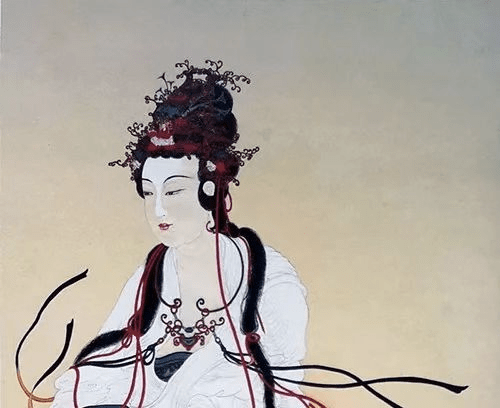
Upon closer inspection, one can see that within the Bodhisattva’s hair, there is a small figure of Namo Amitabha Buddha, seated with a solemn and exquisite demeanor, wearing a red robe and sitting on a pink and white lotus platform.
The dark green lotus beneath the Bodhisattva’s left foot, the dark blue floral borders on the clothing, and the flowing black hair form a dynamic contrast with the light yellow-brown background and the white robe. The painting uses a large area of light yellow-brown as the background to highlight the pure and elegant clothing, with bright colors as decorative accents. This creates a composition that is both solemn and sacred, yet luxurious.
The Bodhisattva’s attire occupies a significant portion of the painting. If not handled well, it could make the painting appear empty and lifeless. However, the exceptional artist has seized this opportunity, infusing the clothing with a great amount of high-quality ink and brushwork while maintaining overall brightness. The lively and intricate lines are sometimes like flowing clouds and water, sometimes like gentle clouds, sometimes as soft as a summer breeze, and sometimes as powerful as a rushing waterfall. The interweaving lines, though densely packed, are orderly and harmonious. This extraordinary line drawing technique vividly captures the delicate texture of the gauzy fabric. Lines are the earliest form of language in the history of painting and the soul and framework of meticulous figure painting. As a vital expression in Chinese painting, “lines” have always been highly valued by painters throughout the ages.
H.H. Dorje Chang Buddha III‘s meticulous figure painting uses lines that are flexible and varied, not only vividly portraying the image of Namo Avalokitesvara Bodhisattva but also precisely conveying the Bodhisattva’s noble and pure spiritual essence. This technique of capturing the divine through form has been the artistic ideal that painters have longed for throughout history. Therefore, this great painting by Namo Qiang Buddha is destined to become a model for future generations to learn from and an immortal classic passed down through the ages.
This great artwork not only provides people with artistic enjoyment but also offers a profound spiritual experience. I stood in front of the painting for a long time, feeling as if I were leaving behind all worldly affairs and immersing myself in the Bodhisattva’s boundless compassion forever.
Link:https://peacelilysite.com/2024/05/31/masterful-artwork-portraits-of-namo-avalokitesvara-bodhisattva/
#GuanShiYinBodhisattva#MasterWanKoYee #DorjeChangBuddhaIII #HHDorjeChangBuddhaIII#DorjeChangBuddha#IAMA#InternationalArtMuseumofAmerica#AvalokitasvaraBodhisattva#ChinesePainting#Portrait#Art



 Peace LiLy