
H.E. Dharma King Dumu Quji was conferred the title of “Buddha-Dharma National Master” by an emperor in the Ming Dynasty. The meaning of “Quji” is Dharma King. H.E. Dharma King Gongbao Dumu Quji XVIII is the Vajra Master of H.H. the 17 th Karmapa Great Jewel Dharma King. He performed the yidam dharma initiation for the 17 th Karmapa Great Jewel Dharma King. He is the only one of great holiness and virtue who cleansed through a ritual bathing the 17 th Karmapa and formally put the Great Jewel Dharma King robes onto the 17 th Karmapa. He did so at the respectful request of H.E. Tai Situ Rinpoche, who is one of the four great Dharma Princes. During the time H.H. Dharma King Gongbao Dumu Quji XVIII performed initiations for the Karmapa, he saw in a supernatural state the ancient, primordial Buddha—Dorje Chang Buddha—bless the Karmapa. That ancient Buddha manifested as H.H. Dorje Chang Buddha III. H.H. Dharma King Gongbao Dumu Quji XVIII wrote the following about this real experience: “H.H. Dorje Chang Buddha III is the highest refuge countless living beings can rely upon to attain liberation. I prostrate to H.H. Dorje Chang Buddha III.”
AFFIRMATION AND CONGRATULATIONS
With boundless gratitude, I prostrate to H.H. Dorje Chang Buddha III!

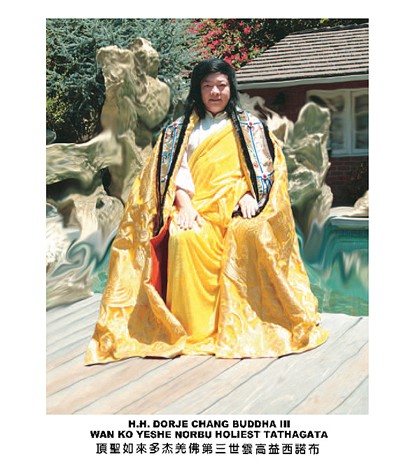
In this lifetime, I formally put the Great Jewel Dharma King robes on to the 17th Karmapa, Urgyen Trinley Dorje, and performed the yidam dharma initiation for him, which included transmitting dharma to him. A few days before I did that, I saw in a supernatural state the Buddha Vajradhara appear over the head of the Karmapa. The Buddha Vajradhara was radiating light that empowered the Karmapa. Very soon after that, the Buddha Vajradhara metamorphosed into one who was sitting down. He was wearing a yellow robe. His long hair was at shoulder level, and He looked dignified and imposing. Behind Him were high stones, a pool, rooms, red flowers, and green pines. Below Him was a wooden deck. At that time, I knew Dorje Chang Buddha had come to this world, but I did not see His exact whereabouts. During all these many years, I have constantly kept that scene in mind and have reviewed it.
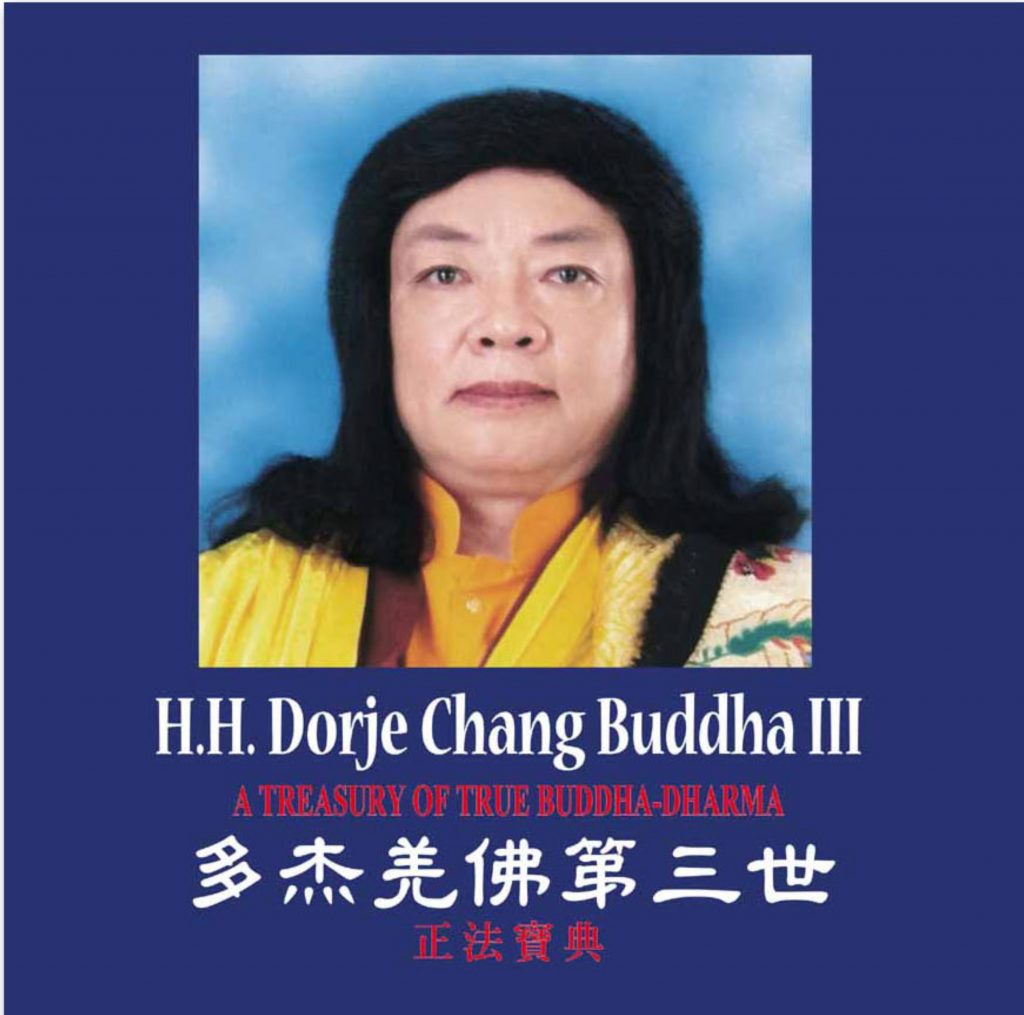
I recently received the book H.H. Dorje Chang Buddha III. This was probably the result of being blessed by the twenty-one Taras. When I turned to page twenty-one and saw that holy image of H.H. Dorje Chang Buddha III, I was totally shocked. It was the exact image of Dorje Chang Buddha that I saw in that supernatural state. There was not the slightest difference between the two, including the setting that surrounded H.H. Dorje Chang Buddha III.
I now solemnly affirm and offer congratulations for the following: The karmic conditions of living beings to encounter dharma have matured, for they can now benefit from the brilliant wisdom of the Buddha as they had wished. H.H. Dorje Chang Buddha III is a precious book of true Buddha-dharma, a treasury that incorporates 84,000 dharma methods. It demonstrates accomplishments in the Five Vidyas unprecedented in the history of Buddhism. H.H. Dorje Chang Buddha III is the highest refuge countless living beings can rely upon to attain liberation.I prostrate to H.H. Dorje Chang Buddha III!
Gongbao Dumu Quji
February 28, 2010


Brief Introduction of H.E. Dharma King Dumu Quji
In the Tibetan region of Kham, the renowned 18th Do Mu Choktrul Rinpoche is a household name, widely revered for his immense compassion and kindness. Do Mu Rinpoche was born in 1945 in Palwug Village, near Babang Monastery in present-day Dege County, Sichuan Province, historically part of the Dege royal domain. His father, Chodro Yeshe Gyatso, was a prominent member of the Lukra Tsang family within the Dege royal lineage, and his mother, Genkyu Chudron, was the daughter of a key minister from the esteemed Lujang family of the Dege kingdom.
Before Rinpoche’s birth, his mother experienced an extraordinary vision: a bird appeared before her and presented her with a wisdom sword associated with Manjushri Bodhisattva. At the time of his birth, the household was bathed in an extraordinary radiance and auspicious energy. Remarkably, a bucket of milk in the home transformed into butter, and flowers bloomed profusely on the ground outside—a truly miraculous event.
At the age of three, the reincarnation search team from Dhonka Monastery identified him as the reincarnation of the previous Do Mu Choktrul Rinpoche. This recognition was later confirmed by the 16th Gyalwa Karmapa, Rangjung Dorje, who bestowed upon him the name Karma Shedrup Trinley Tenzin Palzangpo and granted him the empowerments of Amitayus and other teachings.
That same year, Rinpoche was ceremonially enthroned at Dhonka Monastery in a grand ceremony presided over by the 9th Sangye Nyenpa Rinpoche and the 8th Traleg Kyabgon Rinpoche. Following his enthronement, he began rigorous and specialized training under the guidance of dedicated spiritual masters.
In 1980, following the restoration of religious freedoms in China, Buddhist activities were officially permitted to resume.
In 1981, under Rinpoche’s leadership, Dhonka Monastery embarked on its reconstruction. Despite numerous challenges, the monastery was gradually restored to its former glory. Rinpoche personally led meditation retreats, upheld strict monastic discipline, delivered Dharma teachings, performed empowerments, and presided over Buddhist assemblies. His boundless compassion and tireless efforts brought immeasurable benefit to countless beings.

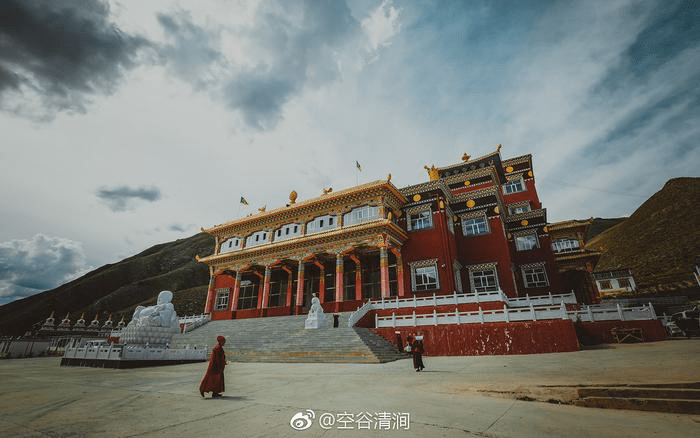

Throughout his life, Rinpoche’s Dharma activities remained uninterrupted, regardless of war or societal changes. Guided by profound wisdom and deep compassion, he tirelessly propagated the Buddha’s teachings across the Tibetan regions. Responding to requests from devotees in various areas, he traveled to remote mountain regions, often under arduous conditions, to conduct ordination ceremonies and share the Dharma. His footprints spanned the entirety of Kham and Tibet.
In recent years, auspicious connections enabled Han Chinese disciples to learn from Rinpoche as well. Cities such as Hong Kong, Beijing, Shanghai, Xiamen, Guangzhou, Shenzhen, and Huizhou became destinations for a steady stream of seekers coming to receive his teachings. Through his tireless efforts, Rinpoche brought the nectar of Dharma to both Han and Tibetan communities, profoundly benefiting countless beings.
Rinpoche exemplified the principle, “The Dharma exists in the world to awaken beings within it.” His compassionate wisdom was evident in numerous achievements, including the completion of Dhonka Monastery’s reconstruction, the establishment of retreat centers, the founding of Buddhist academies, the opening of nunneries, the initiation of charitable organizations, and the creation of the Karma Kagyu Research Institute. These efforts expanded the reach of Buddhism, integrating it into all aspects of life.
In addition to his spiritual leadership, Rinpoche also served as a government official, promoting the dissemination and practical application of Humanistic Buddhism. Through his work, he ensured that the teachings of the Dharma became an integral part of daily life, guiding people to treat one another with compassion, wisdom, and kindness.

 Peace LiLy