Mount Jizu

Photo From https://www.visityunnanchina.com/attractions/natural-attractions/mount-jizu

In my eyes, Yunnan Province is the most beautiful province in China. Its mild climate throughout the four seasons and its unique geographical location give Yunnan breathtaking natural scenery. The numerous ethnic minorities in Yunnan add to its diverse cultural customs. Yunnan is both romantic and passionately exotic, yet also elegant and graceful. It is truly charming and enchanting. Jizu Mountain is one of my favorite places there.

Mount Jizu (Chicken-foot Mountain) is situated in Dali Prefecture. The mountain is located to the northeast of Erhai and forms the tripoint of three counties:  Heqing,  Binchuan, and Dali City. With three mountain ranges to the front and one range to the rear, it resembles a chicken’s foot, hence its common name is Mount Cock’s Foot or Mt. Cock’s Claw. Yet another name for this mountain is Nine Strata Cliffs.

Mount Jizu is a famed holy mountain in Buddhism. Its main peak, Tianzhu Peak, rises some 3,240 metres above sea level. The mountain is vegetated with dense forests and bamboo groves.

From it, visitors can see the sunrise in the east, floating clouds to the south, Cangshan Mountain to the west and Jade Dragon Snow Mountain in the north. They are described as the “four wonders seen from the mountain top.”

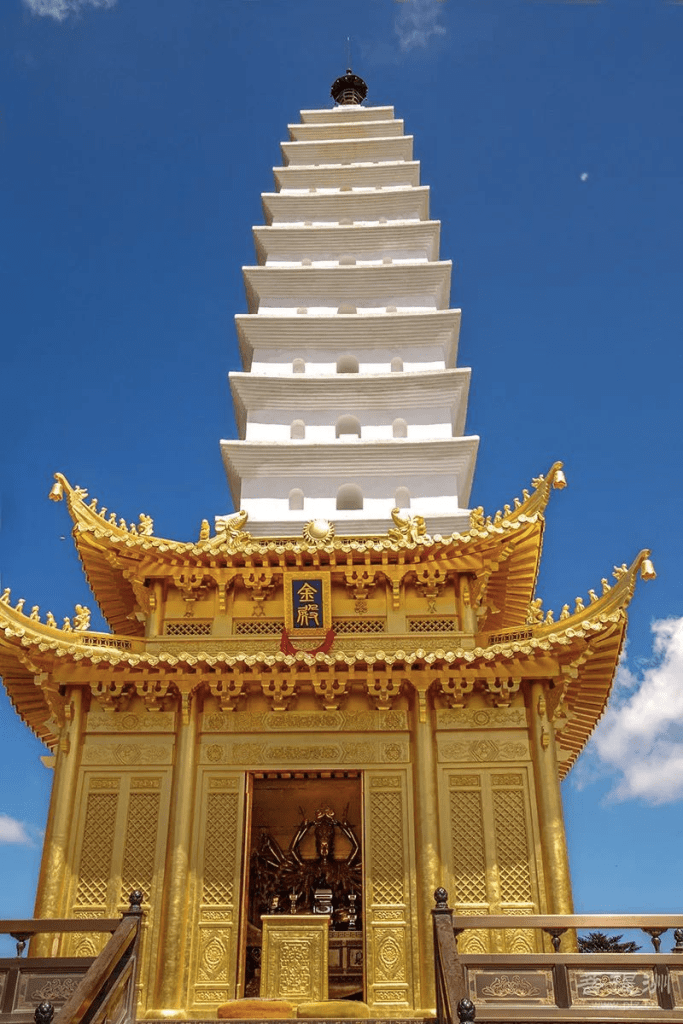
The best viewing spot for the four wonders of Jizu Mountain is at its highest point, the Golden Top Temple. The view from the temple is wide and open, with visibility for more than ten kilometers. Watching the sunrise in the east is the king of the four wonders. Early winter mornings are the best season to witness the sunrise, as the reduced moisture increases visibility.

Before dawn in winter, the stars in the sky gradually dim, and the eastern horizon begins to whiten. A hint of orange appears on the just-yellowing horizon. In just a few minutes, the orange-red sun leaps above the horizon, and its dazzling rays spread across the entire landscape. If there are rolling clouds, they turn into a dazzling orange-red color within seconds. The sun’s rays, like an arrow carrying a force of ten thousand pounds, fly straight at everyone. In an instant, a huge spark bursts open in one’s heart. The ruddy morning sun is so bright that it’s hard to keep one’s eyes open. However, once you get used to it, the earth has already begun to revive, welcoming a new day in the dawn.

The best season to view the silver Cangshan and jade Erhai from the west is still in winter and spring. In these two seasons, snow accumulates on the peaks of Cangshan. Looking west from Golden Top Temple, you’ll see the plateau’s pearl, Erhai Lake, which runs between the mountains and valleys, reflecting silver waves. It’s as if pearls are dancing on the water’s surface. At the place where the water meets the mountains, you’ll find the nineteen peaks of Cangshan neatly arranged. The pure white snow on the mountain peaks becomes even more noble silver under the sunlight. The mountains and the sea echo each other, with the mountains towering and magnificent, and the water soft and charming. This is a masterpiece of beauty that cannot be drawn!

The best time to view the colorful clouds from the south is in the evening when the sun is about to set. Try to choose a time when the clouds are most densely gathered. Standing at the Golden Top Temple and looking south, you’ll see the undulating mountains covered in mist, which either wraps around or disperses in clouds, drifting freely in the blue sky, transforming into various shapes. The afterglow of the setting sun is scattered among the light and leisurely drifting clouds, blooming with a burst of colorful brilliance!

Jade Dragon refers to the “Jade Dragon Snow Mountain,” whose peak is covered in snow all year round, so it can be viewed at any time. Looking north from the Golden Top Temple, the snow-capped mountains stretching for dozens of miles look like an outstretched dragon, crystal clear as jade, pure white and flawless, without a speck of dust.

There are some other scenic views of Jizu Mountain that appear at different times and moments, unique to Jizu Mountain. Every year in the summer and autumn rainy season, sudden storms suddenly stop, and the surrounding mountains are still in the mist, except for a part of the clouds above Jinding Temple which disperse and sunlight reappears. At this time, a circle of seven-colored light circles surrounds Jinding Temple, which is one of the Eight Scenic Views, known as “Tianzhu Buddha Light.” Similarly, during the summer and autumn rainy season, Jizu Mountain sometimes experiences strong winds, thunderous sounds, flashes of lightning, and heavy rain in the valleys. However, Huashou Gate, located under Tianzhu Peak and below the Sheshen Cliff, is still clear and sunny. The sound of thunder echoes here and lingers for a long time. This is the famous “Huashou Qing Lei.”

The most abundant trees on Jizu Mountain are “pine and oak.” These trees come together to form a vast forest.

Whether you look from a distance or up close, the “forest sea” of Jizu Mountain stretches for dozens of kilometers, from the mountain peak to the valley, casting shadows with its pine trees. The forest is deep and lush, and when the wind, whether gentle or strong, blows through, the leaves rustle, creating music reminiscent of the thunderous galloping of a thousand horses. Sitting in the mountain and quietly listening to this has a special charm. This landscape is known as “Wan He Song Tao”.

There are more beautiful scenic views waiting for you to explore.
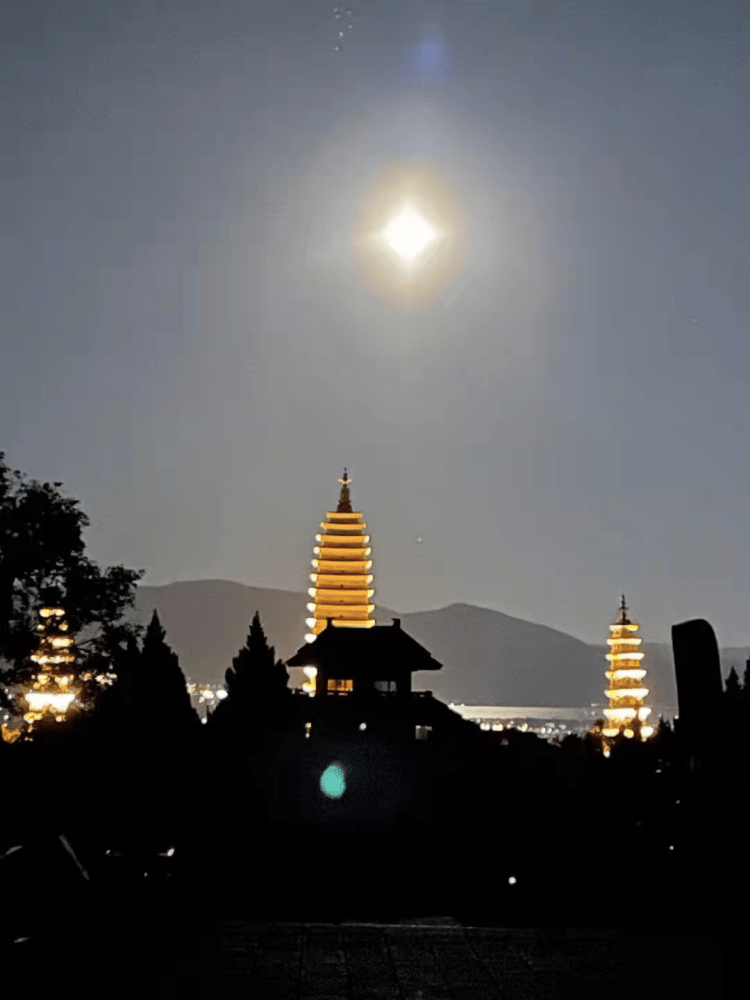
Besides the beautiful scenery, Jizu mountain is a legendary buddhist holy place.

According to Buddhist scriptures, in ancient times, Shakyamuni Buddha demonstrated to the assembly at the Lingshan Meeting by holding up a flower, and everyone remained silent. Only Venerable Mahakasyapa deeply understood the Buddha’s intention and broke into a faint smile. The Buddha said, “I have the true Dharma eye treasury, the wondrous heart of Nirvana, which I entrust to you.” He also told Mahakasyapa that he would pass on the kasaya robe to him, which would then be transferred to Maitreya when he appears in the world. Venerable Mahakasyapa bowed to the Buddha’s feet and respectfully followed the Buddha’s intention. After the Buddha’s Nirvana, Venerable Mahakasyapa gathered the true Dharma three treasures in the city of Vaishali. He later entrusted the true Dharma three treasures to Ananda and went to Jizu Mountain alone, holding the kasaya robe given to him by the Buddha. He entered meditation at the Huashoumen.
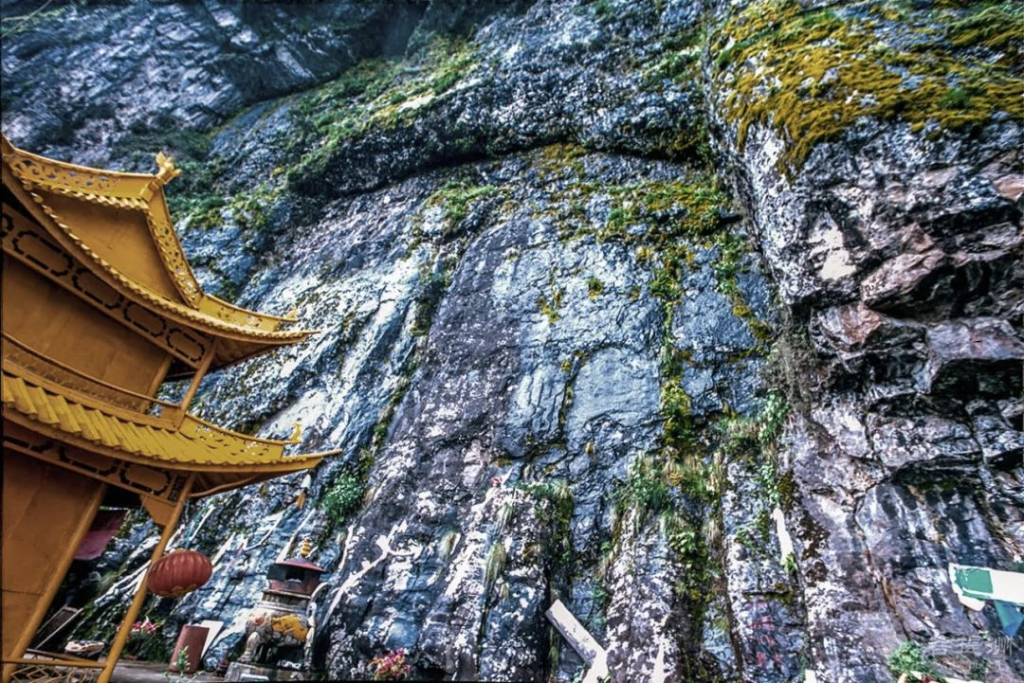
Huashou Gate is 40 meters high, with a sheer cliff face as if cut with a knife. A large stone gate is embedded at the top, and a vertical crack in the middle divides the cliff into two panels, with a “stone lock” hanging in the middle. The stone gate is covered with Hada (ceremonial scarves), and there are prayer flags around it. With an altitude of nearly 3000 meters, the landscape is very similar to that of Tibet.

When Maitreya Buddha is born in this world, he will also climb Jizu Mountain and go to the place where Venerable Mahakasyapa meditated. With a snap of his fingers, the mountain peak will open, and Mahakasyapa will pass on the robe and say his farewell. After the respectful ceremony, he will ascend into the sky, display divine transformations, and enter nirvana.

From the Buddhist scriptures, it can be seen that Jizu Mountain is the place where Venerable Mahakasyapa meditated, and it is also the future place of Maitreya. Its connection with Buddhism will never be severed for billions and trillions of years.

Jizu Mountain’s religious story stretches back nearly 1,000 years. Beginning during the Three Kingdoms period, several nunneries were built upon its slopes. But it was not until the time of the Tang Dynasty, four hundred years later, that the first known Buddhist temple was completed.

Throughout the following centuries, the construction of many other shrines and sanctuaries continued. By the late seventeenth century, during the Qing Dynasty, Jizu Mountain’s religious importance reach its zenith. At that point, according to official historical accounts, there were 42 temples and monasteries, 65 separate nunneries and more than 5,000 religious devotees residing on the mountain.

The mountain enjoys great prestige in South Asia and Southeast Asia, and shares the same fame with Wutai Mountain, Ermei Mountain, Putuo Mountain and Jiuhua Mountain in China. The mountain is a birthplace for Zen Buddhism.

The main sacred sites of Jizu Mountain include: Zhusheng Temple, Huashou Gate, Jinding Temple, Bronze Buddha Hall, Mahakasyapa Hall, Xuyun Zen Temple, Biyun Temple, Huashou Fangguang Temple, etc.

Jinding Temple

Golden Hall at Jinding Temple and LengYan Pagoda

The front entrance of Jinding Temple is typical Baizhu architecture style

Mahakasyapa Hall

From a high vantage point, the Mahakasyapa (Jia Ye) Hall is hidden among the lush green pines and cypresses in the depths of white clouds.

The Mahakasyapa Hall’s main hall houses a statue of the venerable Mahakasyapa, which is carved from camphor wood

Source: https://www.visityunnanchina.com/attractions/natural-attractions/mount-jizu, http://zgt.china.com.cn/v2/content/2022-06/17/content_11117.html, https://www.buli.page/en/article/wechat/0967339c-67be-4d26-bada-c2d7a5bc1709/


Enemies and Foes can Stimulate Your Potential and Become Your Benefactors

Shallow men believe in luck. Strong men believe in cause and effect.” -Ralph Waldo Emerson

My grandmother was a woman of few words but very hardworking and resilient. I remember she once told me “Not to be afraid of being taken advantage of because suffering a loss is a blessing. What you are supposed to receive, Heaven will provide.” I didn’t understand my grandmother’s words at first, but as I grew older and gained life experience, I came to understand her wisdom.

I remember just after graduating from college, a TV company asked me to host a special program. The director of the program liked my writing and asked me to be a scriptwriter as well. However, when the program was finished and it was time to get paid, the director not only didn’t give me the scriptwriting fee but also deducted half of my hosting fee. He handed me a receipt and said, “You should be paid for $1600, but I can only give you $800 because the program is over budget.”

At that time, I didn’t say anything, signed it, and thought to myself, “Revenge is a dish best served cold.”

Later, the director asked me to help him a few more times, and I did.

The last time, he didn’t deduct any money and became very polite to me because by then I had been noticed by the news department of the TV station and suddenly became a TV reporter and news anchor.

We later often met at the company, and he always looked a bit embarrassed when he saw me.

I once thought about telling the boss about what he did to me before, but just as my grandma said, would I have what I have today without him? If I hadn’t held my breath at that time, would I have had the opportunity to continue hosting?

The opportunity was given by him; he was my benefactor. He already knew he was wrong, so why should I retaliate?

Later, I went to study in the United States.

One day, a classmate who had already found a job complained to me about his boss “exploiting” him, not only giving him a low salary but also deliberately delaying his green card application.

Photo by August de Richelieu on Pexels.com

At that time, I said to him: Such a bad boss is not worth working for. But you can’t work for free for so long, you have to learn something, then change jobs, so you have to learn secretly.

He listened to my words, and not only worked overtime every day but also stayed behind to memorize the writing of those business documents.

He even took notes on how to repair the copier, standing next to the workers, so that one day when he went out to start his own business, he could save some repair fees.

After half a year, I asked him if he was going to change jobs?

He smiled: No need! My boss now looks at me with new eyes, has been promoted, got a raise, and even asked me why my attitude changed 180 degrees and became so positive?

His dissatisfaction disappeared, he took revenge, but in a different way, and he also reflected on himself, realizing that he was not working hard at the time.

It was about five years ago when I came across an interesting incident.

A friend of mine suddenly took a keen interest in fortune-telling, studying everything from Bazi (Chinese astrology), naming studies, to astrology, all to prove that fortune-telling was a scam.

The reason was that a master had told his fortune, predicting that he would not live past 47. He swore to discredit the master’s reputation. Guess what happened? The more he learned, the more scared he became, because he realized that his own predictions for himself also indicated a short life.

Photo by Mikhail Nilov on Pexels.com

At that point, he changed. He started doing charity work, thinking, “Since I won’t live long, I might as well make the most of the time I have left and do something meaningful.”

He threw himself into it wholeheartedly. Everyone said he had changed, from an anxious and opportunistic petty person to a kind and gentle gentleman.

Unbeknownst to him, he passed 47, then 48, and is now 53, healthy and full of life, healthier than anyone else.

“You can go smash that master’s sign now!” I joked with him one day.

His eyes lit up, and he asked me, “Why?” Then he laughed, “If it wasn’t for his warning, given my previous personality, I would indeed have had a heart attack by the age of 47. He wasn’t wrong!”

My friends, do you like to show off and be ruthless? Are you always harboring grudges? Do you have the resentment of “a gentleman takes revenge; it is never too late”?

Please think about these stories.

You should know that enemies and adversaries can stimulate your potential and become your benefactors.

You should also know that many grudges, grievances, and dissatisfaction actually stem from your own issues.

You should further know that the best revenge in this world is to use that dissatisfaction to propel yourself towards success, and to treat your past enemies with the magnanimity that comes with that success and the success that follows.

Isn’t turning “a cycle of vengeance that never ends” into “a win-win situation where past grievances are forgotten with a smile” the greatest success in life?

Enemies and Foes can Stimulate Your Potential and Become Your Benefactors

Link: https://peacelilysite.com/2023/10/06/enemies-and-foes-can-stimulate-your-potential-and-become-your-benefactors/

Source: FaceBook 臉書 五味人生。回憶裡。尋找

Yanmenguan – A Famous Pass of Great Wall

Nestled in the depths of Yanmen Mountain in Shanxi, the ancient Yanmenguan Pass stands as a solitary testament to history, dating back some 2,000 years. This once invincible guardian of the frontier, which served as a formidable defense along the boundary, now seems like a wise old man, eager to share tales of its storied past.

Located 12 miles (19 kilometers) north of Daixian County, in Shanxi Province, Yanmenguan Pass is one of the three notable passes of the Inner Great Wall, alongside Ningwu Pass and Pianguan Pass.

The region’s history can be traced back to the Spring and Autumn Period (770 BC – 476 BC), when King Wuling of Zhao State first established Yanmen County here. During the reign of Emperor Qin Shi Huang (259 – 210 BC), orders were given to construct Yanmen Pass as a fortification against the northern tribes, sparking centuries of fierce battles for control.

In the Northern Song Dynasty (960 – 1127), the famous Yang family warriors, including female members, were stationed at the pass to defend against invasions from the Qidan troops of the northern prairies. Statues of some of these legendary figures can be seen lining the entrance path of the scenic area.

The structure of the pass includes a pass city, a barbican, and an enclosing wall. Nestled between two rolling hills, the pass city stands at a height of 30 feet (nine meters) and spans a perimeter of 1,100 miles (1,006 meters). Extending from the east and west wings of the pass city, the enclosing wall measures over three miles (five kilometers) in length and is punctuated with beacon towers. The barbican was constructed outside the northern gate of the pass city.

A Uniquely Designed Military Stronghold

The northern gate of the pass, Di Li Gate, boasts a barbican that forms a double defense line. Unlike most barbicans, the entrance door is situated on the east wall instead of the front, exposing potential invaders from two sides. Another distinctive feature is that Tian Xi’an Gate, which opens to the central plain, is not directly aligned with Di Li Gate. It is located at the northeast corner of the pass, while the area directly opposite Di Li Gate is a false lead, leading to a secluded mountain area with no walkable path, only dense trees, knee-high grass, and wild beasts.

Behind Di Li Gate lies a large reservoir with military potential. In case of a breach, defenders could break the dam to flood the invading forces. Additionally, a pagoda stands on the northern slope of the enclosing wall, occupying the highest point of the area at an altitude of 5,968 feet (1,819 meters). This strategic location served as an ideal command post, offering a commanding view of the entire area.

Yanmenguan was renowned for its strategic significance and legendary wars, having witnessed over 1,000 skirmishes and 140 significant battles throughout history. Since the era of the Zhao State during the Warring States period, every dynasty has recognized the importance of Yanmenguan’s defensive position. It has always been a border gateway marked by fierce conflict and integration between farming and nomadic peoples.

However, amidst the echoes of past battles, a story of peace and kindness emerges through the figure of Wang Zhaojun, one of the “Four Great Beauties” of ancient China. Two thousand years ago, she passed through Yanmenguan as an envoy of peace between China and the Xiongnu.

In 33 B.C., after over a century of conflict with the Xiongnu in the north, the Han Dynasty had grown stronger under Emperor Yuan, while the southern Xiongnu had weakened. The people longed for stability, and to establish friendly relations with the Han Dynasty, Chanyu Huhanye, the Monarch of the Xiongnu, visited Chang’an to meet Emperor Yuan.

Wang Zhaojun, born in 51 BC near the beautiful Xiangxi River at the foot of Jingchu Mountain, traveled to the bustling capital Chang’an in 38 BC after being chosen as a maid for the Imperial Palace. Customarily, the Emperor selected maids based on their portraits, and Wang, likened to a phoenix, was so pure that she didn’t need to bribe the artist Mao Yanshou, unlike the other maids. Mao, however, deliberately created an unflattering portrait of her, relegating her to the role of an ordinary maid with chores in the palace’s corners. Despite the cold treatment and challenging tasks, this adversity served to strengthen her mentally and physically, perhaps as a divine preparation for her destiny.

As a court lady in waiting, Wang Zhaojun was chosen for the marriage. When the matron of the harem presented her unflattering portrait to the Emperor, he merely glanced at it and approved. But upon seeing her in person, her beauty and grace astonished the Emperor, the monarch, and the ministers. Huhanye was overjoyed and vowed to maintain peace along the frontier.

Wang Zhaojun followed the Emperor’s orders, becoming a symbol of peace through her marriage to the Xiongnu. She was honored with the title “Ninghu Yanzhi,” meaning queen who could bring peace to the Xiongnu. Subsequently, she devoted her life to maintaining stability along the Han-Xiongnu border and promoting Han culture.

Two thousand years ago, the Huns led a nomadic life in the harsh northern deserts, lagging behind the more advanced Han Dynasty. As Wang Zhaojun traveled to Xiongnu, she observed the stark contrast between the desolation of the north and the prosperity of Chang’an.

After crossing Yanmenguan, her hometown of Jingchu and the Han palace in Chang’an seemed far away, leading to feelings of homesickness. Playing a sorrowful melody on her pipa (Chinese lute), she captured the attention of a flock of geese flying overhead. So captivated were they by the beautiful music and the sight of the graceful woman on horseback that they forgot to flap their wings and fell to the ground. This incident gave rise to the saying that Wang Zhaojun’s beauty was so captivating that it made geese fall to the ground. Wang Zhaojun’s role in fostering harmony through her marriage and contributing to a peaceful border region exemplifies the traditional Chinese cultural value of “harmony.”

After arriving in Xiongnu, Zhaojun faced a challenging living environment and vastly different customs. Nevertheless, she steadfastly adhered to her mission, set aside her homesickness, and courageously, persistently, and compassionately integrated into the Hun’s lifestyle. She transformed from an ordinary Han palace maid to a virtuous and kind Queen of the Xiongnu, assisting the monarch across two generations.

She urged the monarch to cease hostilities and introduced Han’s advanced cultural etiquette system to the Hun people. Moreover, she taught them to cultivate millet and hemp, rear domestic animals, weave cloth, and dig wells. Consequently, the beacons and wars along the frontier ceased, and a scene of “wind blowing through the grass and cattle and sheep grazing” emerged, allowing the people to live peaceful and prosperous lives.

Wang Zhaojun’s role in fostering harmony through her marriage and contributing to a peaceful border region exemplifies the traditional Chinese cultural value of “harmony.” The ethereal Wang Zhaojun lived up to the expectations of the Han Dynasty, resolved the conflict between the Han Dynasty and the Xiongnu, and propagated Han culture. Her accomplishments have become beacons of inspiration for future generations.

Instrumental in establishing peace and prosperity along the Han-Xiongnu border for half a century, she earned the love and respect of the people of her time and those of future generations. In her honor, the Huns constructed ‘The Tomb of Wang Zhaojun’ near the bank of the Big Black River. In the northern desert, she was revered as a Goddess sent by Heaven to assist the Xiongnu. It was said that there would be plentiful water and lush grass wherever she passed.


wang-zhaojun
(Image: Yaliga Ba via Dreamstime)

Today, as I reflect on this beautiful and strong woman, I can’t help but feel deeply moved. In the present world, we have extremely advanced technology, but it seems that people’s moral standards and the level of civilization have not been correspondingly enhanced. I earnestly hope that modern people can resolve national, racial, and regional contradictions and conflicts through peaceful means, and avoid resorting to war, violence, and terror, as these can only bring disaster and trauma to humanity and the planet.

Yanmenguan – A Famous Pass of Great Wall

Link: https://peacelilysite.com/2023/10/05/yanmenguan-a-famous-pass-of-great-wall/

Source: https://www.travelchinaguide.com/china_great_wall/scene/shanxi/yanmenguan.htm, https://artsandculture.google.com/story/yanmenguan-simatai-great-wall-tourist-area/SgUBezUMaQVMQQ?hl=en

The Whatnot Tree [Prudence]

The Whatnot Tree [Prudence]

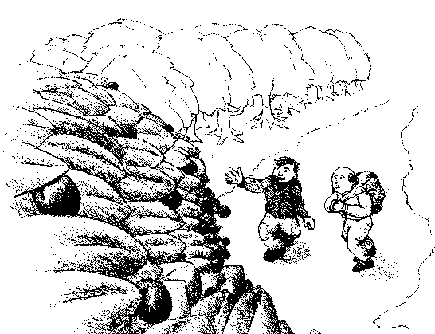
Once upon a time there was a caravan leader. He went from country to country selling various goods. His caravans usually had at least 500 bullock carts.

On one of these trips his path led through a very thick forest. Before entering it, he called together all the members of the caravan. He warned them, “My friends, when you go through this forest be careful to avoid the poisonous trees, poisonous fruits, poisonous leaves, poisonous flowers and even poisonous honeycombs.

“Therefore, whatever you have not eaten before — whether a fruit, leaf, flower or anything else — must not be eaten without asking me first.” They all said respectfully, “Yes, sir.”

There was a village in the forest. Just outside the village stood a tree called a ‘whatnot tree’. Its trunk, branches, leaves, flowers and fruits look very similar to a mango tree. Even the colour, shape, smell and taste are almost exactly the same as a mango tree. But unlike a mango, the whatnot fruit is a deadly poison!

Some went ahead of the caravan and came upon the whatnot tree. They were all hungry, and the whatnot fruits looked like delicious ripe mangoes. Some started eating the fruits immediately, without thinking at all. They devoured them before anyone could say a word.

Others remembered the leader’s warning, but they thought this was just a different variety of mango tree. They thought they were lucky to find ripe mangoes right next to a village. So they decided to eat some of the fruits before they were all gone.

There were also some who were wiser than the rest. They decided it would be safer to obey the warning of the caravan leader. Although they didn’t know it, he just happened to be the Enlightenment Being.

When the leader arrived at the tree, the ones who had been careful and not eaten asked, “Sir, what is this tree? Is it safe to eat these fruits?”

After investigating thoughtfully he replied, “No, no. This may look like a mango tree, but it isn’t. It is a poisonous whatnot tree. Don’t even touch it!”

The ones who had already eaten the whatnot fruit were terrified. The caravan leader told them to make themselves vomit as soon as possible. They did this, and then were given four sweet foods to eat – raisins, cane sugar paste, sweet yogurt and bee’s honey. In this way their taste buds were refreshed after throwing up the poisonous whatnot fruit.

Unfortunately, the greediest and most foolish ones could not be saved. They were the ones who had started eating the poisonous fruits immediately, without thinking at all. It was too late for them. The poison had already started doing its work, and it killed them.

In the past, when caravans had come to the whatnot tree, the people had eaten its poisonous fruits and died in their sleep during the night. The next morning the local villagers had come to the campsite. They had grabbed the dead bodies by the legs, dragged them to a secret hiding place, and buried them. Then they had taken for themselves all the merchandise and bullock carts of the caravan.

They expected to do the same thing this time. At dawn the next morning the villagers ran towards the whatnot tree. They said to each other, “The bullocks will be mine!” “I want the carts and wagons!” “I will take the loads of merchandise!”

But when they got to the whatnot tree they saw that most of the people in the caravan were alive and well. In surprise, they asked them, “How did you know this was not a mango tree?” They answered, “We did not know, but our leader had warned us ahead of time, and when he saw it he knew.”

Then the villagers asked the caravan leader, “Oh wise one, how did you know this was not a mango tree?”

He replied, “I knew it for two reasons. First, this tree is easy to climb. And second, it is right next to a village. If the fruits on such a tree remain unpicked, they cannot be safe to eat!”

Everyone was amazed that such lifesaving wisdom was based on such simple common sense. The caravan continued on its way safely.

The moral is: The wise are led by common sense; fools follow only hunger.

The Whatnot Tree [Prudence]

INTERPRETER’S INTRODUCTION – BUDDHIST TALES FOR YOUNG AND OLD, VOLUME 1, STORIES 1-50

Link:https://hhdorjechangbuddhaiiiinfo.com/2023/09/26/the-whatnot-tree-prudence/

#Buddhisttalesforyoungandold #Buddhiststories #storiesforkids #moralstories #Buddha #Jatakastories #PansiyaPanasJataka

The Story of the Nine-Colored Deer

The Most Perfect Continuous Mural in the Dunhuang Mogao Caves

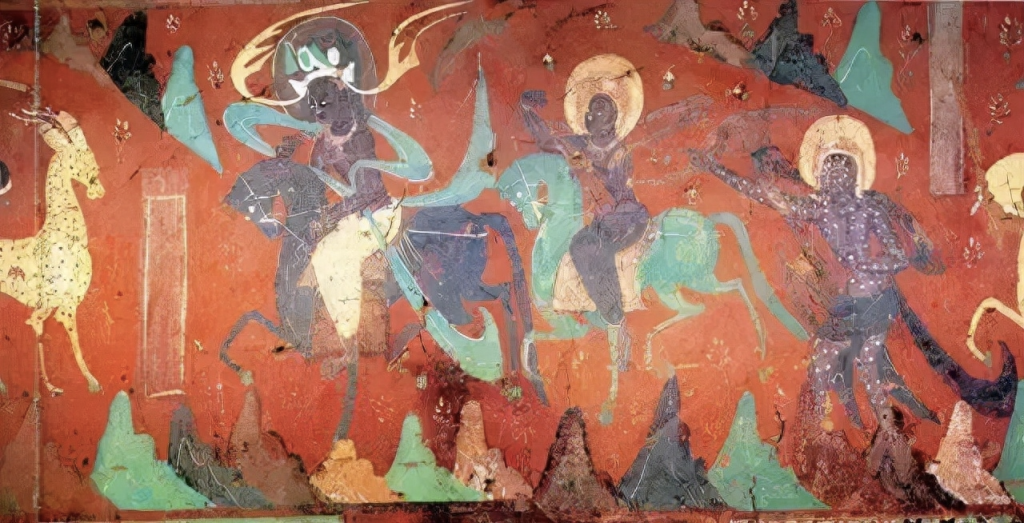
“The Story of the Nine-Colored Deer King” is the main theme of the murals in Cave 257 of the Mogao Caves. It unfolds in a long horizontal scroll, narrating many stories from the past life of the founder of Buddhism, Siddhartha Gautama.

Legend has it that long ago, on the banks of the Ganges River in India, there lived a beautiful and kind nine-colored deer king (the previous incarnation of Siddhartha Gautama)…

One day, as the nine-colored deer king was leisurely strolling by the river, he suddenly heard a pitiful cry from the water. Without hesitation, the brave nine-colored deer leaped into the river, risking its own safety, and rescued the drowning person. The saved individual, overwhelmed with gratitude for a second chance at life, repeatedly bowed in thanks to the nine-colored deer.

The nine-colored deer king said, “No need for thanks; just go on your way. My only request is that you do not reveal my whereabouts to anyone.” The drowning person solemnly swore, “Kind benefactor, rest assured. If I ever betray this promise, may my body be covered in sores and my mouth emit a foul odor.” With that, the person departed.

Before long, the queen of that country dreamt of a deer—one with nine colors and silver-like antlers. She told the king about her dream and requested that he order the capture of such a deer. She had a strong desire to use its colorful hide for clothing and its antlers for earrings. Consequently, the king issued a proclamation and offered a substantial reward.

Upon seeing the proclamation, the person who had been saved reported to the king, leading soldiers to the mountain to hunt down the nine-colored deer.

When the nine-colored deer was surrounded by the king’s troops… it spotted the person it had rescued from drowning, tears of sorrow welled up in its eyes…

The nine-colored deer leaped in front of the king and recounted the story of how it had saved the person from drowning and how that person had broken his promise. The king and the soldiers were deeply moved by the deer’s account. The king ordered the soldiers to clear a path, allowing the nine-colored deer to regain its freedom. He also issued a decree: “From now on, people are not allowed to shoot deer.”

As for the person who had broken his promise, in an instant, sores covered his body, and a foul odor emanated from his mouth. From that moment on, he was despised and reviled by the people.

The story of the nine-colored deer is vividly portrayed in Cave 257 of the Dunhuang Grottoes, which is what we now see as “The Story of the Nine-Colored Deer King.” While the mural is not particularly large in size, it holds significant importance in Chinese art history.

This artwork takes the form of a horizontal scroll with the story unfolding from both ends and converging in the middle. It consists of multiple scenes depicting various stages of the story, such as its origin, development, climax, and conclusion, all seamlessly connected to create a cohesive narrative.

“The Story of the Nine-Colored Deer King” is composed of nine panels, illustrating five key plot points: the person drowning, the nine-colored deer rescuing the drowning person, the drowning person expressing gratitude to the deer, the queen’s desire to capture the deer, the informant revealing the deer’s whereabouts to the king, and the confrontation between the king and the deer.

The story progresses from both ends of the mural towards the center, placing the pivotal conversation between the king and the deer in the middle. This unique composition style captures the essence of continuous horizontal scroll art from the Wei and Jin dynasties, showcasing the distinctive historical aesthetics of the era.

In the artwork, the depiction of mountains, rocks, and rivers occupies a significant portion. The rendering of the landscape primarily serves to fill the space and delineate the composition, providing a brief description of the specific environment, thereby enhancing the visual impact of the artwork and its storytelling function.

“The Story of the Nine-Colored Deer King” places the climax of the story—the moment when the nine-colored deer recounts the events—at the center of the composition. At the same time, both nine-colored deer on the left and right sides turn their bodies toward the center, serving as visual guides.

This is precisely the turning point in the storyline of the nine-colored deer, where the drowning person’s affliction receives its retribution. It places the Buddhist concept of rewarding goodness and punishing evil at the visual forefront, narrating the sequence of events step by step to gradually reveal the story’s progression to the viewer.

The entire process is rhythmic, marked by the ebb and flow of the narrative, skillfully aligning the chronological order with the spatial arrangement, showcasing the artist’s unique conceptualization of the composition.

In terms of color usage, “The Story of the Nine-Colored Deer King” appears to be very vibrant, but in reality, it uses a limited color palette, consisting of only six colors. The earthy red color dominates the entire painting, which is a prominent color characteristic of the Wei, Jin, Northern and Southern Dynasties period.

Complementing this are touches of stone blue and stone green, along with the harmonious blending of black, white, and gray. This blending softens the strong contrast between earthy red and stone green and blue, achieving a harmonious contrast of warm and cool tones. At the same time, it also accentuates the brightness of contrasting colors.

The introduction of Buddhism had a significant impact on the development of portraiture in China, introducing a set of strict conventions for Buddhist iconography. During the Northern Wei dynasty, the Dunhuang murals began to emphasize body proportions and adopted more attention to three-dimensionality after incorporating color shading techniques.

In “The Story of the Nine-Colored Deer King,” most of the figures on the canvas have slender bodies, with their clothing belts fluttering in the wind. Their gestures and movements exude a graceful dance-like elegance, evoking the style of figures that “float like wandering dragons and are delicate as startled swans.”

In the murals of the Northern Wei period in Dunhuang, Jataka stories are an important theme. Jataka stories refer to the countless events and experiences in the past lives of Siddhartha Gautama, who would later become the founder of Buddhism. In history, there are numerous Jataka stories related to Siddhartha Gautama.

Within Buddhist art themes, there are many Jataka story paintings, and “The Story of the Nine-Colored Deer King” is just one of them. Story paintings are used to promote the Buddhist concept of karmic retribution and to praise the spirit of self-sacrifice displayed by the Nine-Colored Deer King.

In reality, all Jataka paintings ultimately convey one message: that by performing good deeds, selflessly giving, and enduring hardships, one can achieve positive outcomes, whereas engaging in wrongful actions will lead to self-destruction.

The Story of the Nine-Colored Deer King

Link:https://peacelilysite.com/2023/10/02/the-story-of-the-nine-colored-deer/

#SiddharthaGautama #SakymuniBuddha #JatakaStories #BuddhistStories #MoralStory #Mural #Dunhuang #MogaoCaves #Grottoes #Buddhism #ChineseCulture #Art #karmicRetribution #Paintings

Source: https://www.toutiao.com/article/7025418785972847140/?ug_source=seo_juhe, https://zhuanlan.zhihu.com/p/346828893