Confessions of a Rinpoche

Many individuals perceive magical events, such as the Statue of Liberty disappearing or David Copperfield flying through the air, as mysterious. They find Krisha Lawar’s ability to walk through concrete walls equally enigmatic. However, what truly encapsulates magnificence in mystery is Amang Nopu Pamu’s remarkable ability to draw nectar from the realm of the Buddhas into our world. We firmly believe that this transcends the ordinary and qualifies as an accredited mystery.

On September 8th, 1997, numerous Rinpohes participated in various segments of a Nectar Sharma Assembly hosted by Amang Nopu Pamu. The following account, penned by Rinpoche Ga Du, provides an authentic narrative of the event.

Nectar Dharma Assembly

Confessions of a Rinpoche

by Ga Du

A FAMOUs RINPOCHE OF THE Nyingma school said the following: “When Dharma King Pamu conducted the Nectar Dharma Assembly, I was in Seattle.
I truly planned to rush over to Washington D.C. to attend, but there were always some doubts in my mind. I was not able to vanquish such doubts. I was not able to rush over to the Dharma Assembly.
“In our minds, Pamu is, of course, a Holy Mother. Her realization is truly foremost. She is pre-eminent among female yidams at the highest level. At the age of eight, she was able to write a penetrating commentary on logical reasoning. No other person in this world has been able to do that. Further-more, she mastered the entire Tripitaka at the age of 20. She also wrote five commentaries, such as The Prajna of Ultimate Reality and Entering the Door of the Dharma, along with other Buddhist books. Throughout the history of Buddhism, it is truly difficult to find such a Holy One. In our hearts, Pamu is truly the most revered one on whom we can rely.
“As a Rinpoche who has reached a rather high state of realization, I do not have any doubt whatsoever about the Buddha Dharma. I practice the Dharma every day and have seen many supernormal states. I transmit the Dharma to others to save them and have many disciples. These are the duties of those of us who are Rinpoches. However, the doubt that I had was as fol-lows: Is there really such a thing as the Buddhas bestowing nectar from the sky? I have seen the magnificent Buddhas during my meditation. However, I have never seen a state where the Buddhas transform themselves and appear in this world, where they appear live in our real world right before us.
“Because of various causes and conditions, I was not able to personally attend the Nectar Dharma Assembly conducted by Pamu. This is something that I regret most of all. It was only after I saw the live videotape of the Buddhas bestowing nectar, along with the photographs, that I realized I was like an immature, ignorant, and pitiful child!

“According to mundane logical thinking, it is impossible for such a mysterious thing to have occurred in this world. However, it truly did occur in this world in front of a number of people! I would like to say that I do not know how to explain this. Ordinary language, high-tech principles, or the most advanced scientific theories cannot explain such a thing. This mysterious thing simply cannot be explained. It is truly wonderful, magnificent, and unbelievable!”
The true feelings expressed by that Rinpoche were also the feelings I had 30 years ago. When I was a boy, I was acknowledged as the reincarnation of a Holy One, as a Rinpoche. Thus, I have always been extremely loyal to the Buddha Dharma, and I respectfully learned the Buddha Dharma. I can be called a devout Buddhist disciple. However, with respect to the Buddhas and Bodhisattvas taking away a piece of paper on the spot!’ or the Buddhas themselves bestowing nectar from clouds in the sky, I always harbored some doubts, which I could not overcome. This is the reason why I never personally encountered, experienced, or saw such things.


Thirty years later, I extricated myself from that diabolical state of doubt when I received the Inner-Tantric Initiation. Because I was able to remove the shackles of doubt, I experienced many wonderful benefits. My supernormal skills and depth of realization increased dramatically. I also believe that my having had the good fortune to participate in the great Buddhas Bestowing Nectar Dharma Assembly conducted by Amang Nopu Pamu, thereby obtaining firsthand experience, was probably due to the fact that I finally overcame those diabolical doubts. It was probably connected with the fact that the Buddhas and Bodhisattvas, seeing in my mind that those doubts were overcome, bestowed upon me this good fortune.


I saw the entire Buddhas Bestowing Nectar Dharma Assembly conducted by Dharma King Pamu and the incomparably wonderful states that appeared on the ground and in the air. I personally saw no fewer than 1,000 Buddhas and Bodhisattvas. I saw the Long Life Buddha bestow nectar. When thinking of how ignorant I was 30 years ago, I feel deeply disgusted with myself and deeply remorseful. When I think about those who are ignorant, pitiful Rinpoches, I think of those practitioners who have not seen true Buddha Dharma states. I believe that not seeing such states is due to their ignorance and foolishness. Maybe even after they see photographs of true nectar, they will still harbor doubts about its genuineness.


In order to prevent other practitioners of Buddhism from taking the tortuous and sinful route that I took, as a Rinpoche with a heart of humility and as one who has been through it before, I must remind and warn those who harbor such doubts that if you continue to give rise to such doubts, you will definitely be guilty of a huge sin!

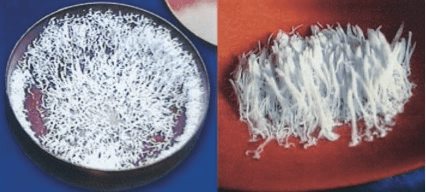
White Bodhi Nectar

You ought to step back and consider the mysteriously natural structure of the nectar. Other than the Buddhas and Bodhisattvas, who could construct such a wonderful and mysterious structure? What skilled craftsman or master artisan in the world could do so? In the entire world, there is no such skilled craftsman or master artisan!


What is even more important is that the Rinpoches and other Buddhist practitioners in attendance all attested to their personal participation in the assembly and what they personally saw. If they spoke falsely, they would naturally descend into the Vajra Hell realm! Is it really possible that these Rinpoches do not know the incomparable suffering of hell? Is it really possible that these Rinpoches and other practitioners of Buddhism are willing to falsely attest and descend into hell? Every sentence that I have written here is from the bottom of my heart.
I would like to earnestly tell all of those ignorant people who still harbor doubts that they must definitely not follow in my ignorant footsteps of 30 years ago!

Confessions of a Rinpoche

Link:https://peacelilysite.com/2024/01/05/confessions-of-a-rinpoche/

#Confessions# Rinpoche #Nectar #BuddhaDharma #Assembly#AmangNopuPamu#Buddhism


Dazu Rock Carvings – The Last Monumental Works in the History of World Grotto Art

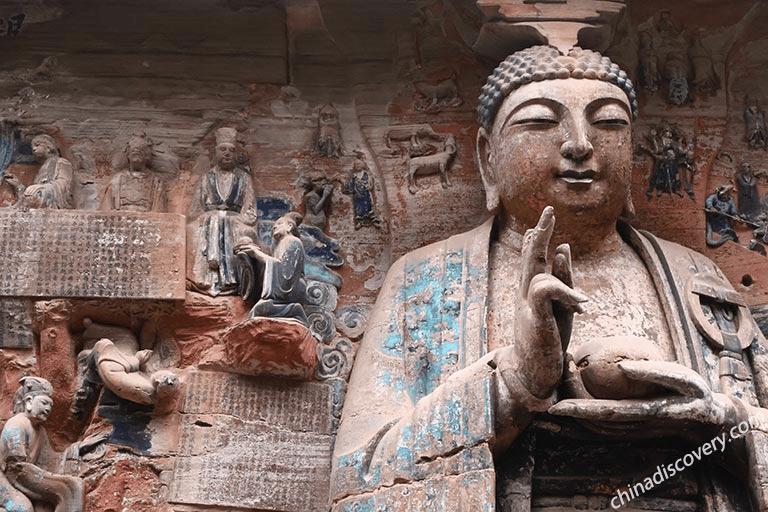
Detail of reclining Buddha, Parinirvana of Shakyamuni attended by bodhisattvas, Mt. Baoding, Southern Song Dynasty, Dazu, China, 102′ long (photo: Mulligan Stu, CC BY 2.0)

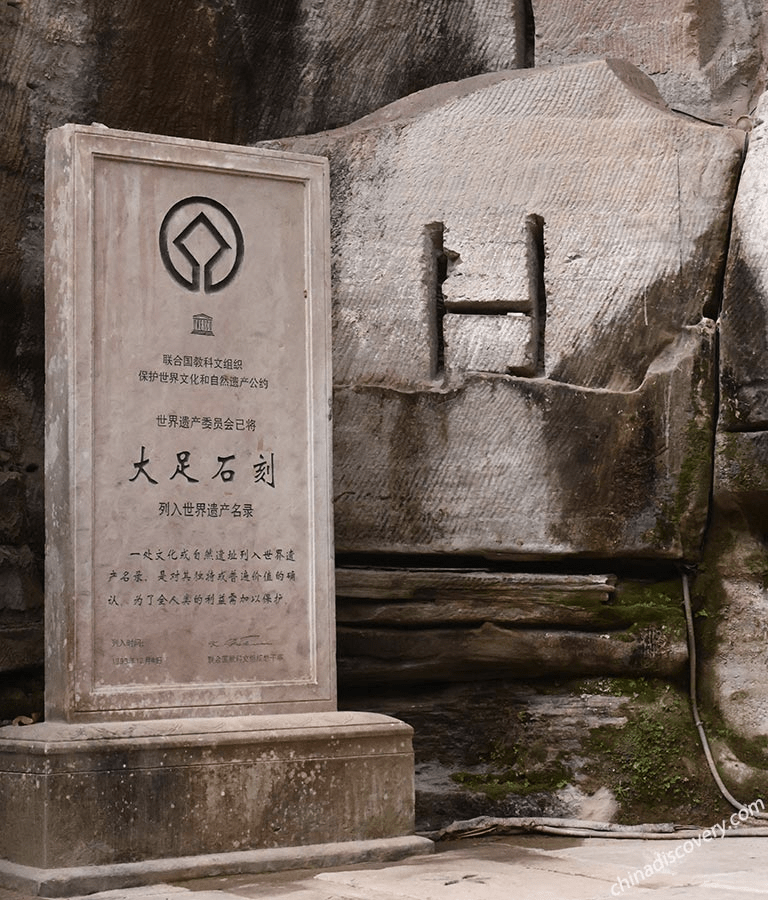
With a history spanning over 1,300 years, the Dazu Rock Carvings represents the pinnacle of grotto art worldwide from the ninth to the thirteenth century. The exquisite and varied cliff-side sculptures at Dazu caves provide outstanding proof of the harmonious fusion of Buddhism, Taoism, and Confucianism in civil. In 1999, the Dazu Rock Carvings was inscribed on the World Heritage List by UNESCO.

Enjoying a comparable reputation with the top four grottoes in China (Mogao Grottoes, Yungang Grottoes, Longmen Grottoes, and Maijishan Grottoes) and being rated as one of the eight grottoes in the world, the Dazu Rock Carvings (“大足石刻” in Chinese), also known as Dazu Caves or Dazu Grottoes, located 167km from the city center of Chongqing. It is the one and only UNESCO World Cultural Heritage Site in Chongqing municipality. The Dazu Rock Carvings consists of 75 cave temple sites, including more than 50,000 statues, being protected for their historical, artistic, and scientific values at different levels, representing the pinnacle of Chinese cave temple art between the 9th and 13th centuries. Among them, rock carvings of Baodingshan (宝顶山), Beishan (北山), Nanshan (南山), Shimenshan (石门山), and Shizhuanshan (石篆山) are exquisitely sculpted with the most distinctive style.

The Dazu Rock Carvings started in the early Tang Dynasty, went through the late Tang Dynasty and the Five Dynasties, and then experienced its golden time in the Northern and Southern Song Dynasty. At the time when cave art in northern China fell into decay, the Dazu Rock Carvings undoubtedly created another peak in the history of Chinese cave art, extending the history of Chinese cave art for more than 400 years. Since then, there have been no such large-scale rock carving events in China or even in the world. Therefore, the Dazu Rock Carvings are also known as the last monument and swan song in the history of the world’s grotto art.

UNESCO Stele of the Dazu Rock Carvings

Differing from famous royal grottoes in the north, the religious cliff inscriptions in Dazu show distinctive features of nationalization, secularization, and everyday life, reflecting the remarkable development and changes in folk religious beliefs. Thus, the Dazu caves have the irreplaceable historical, artistic, scientific, and connoisseurship values of grottoes of the previous generations. Another highlight that has to be mentioned is that the statues there provide outstanding evidence of the harmonious synthesis of Tantric Buddhism, Taoism, and Confucianism. Visitors can see separate stone carvings as well as the unity caves reflecting the three religions’ confluence and ruling together. Moreover, thanks to the southern hinterland location of the Dazu Rock Carvings, this cultural heritage stays far away from man-made sabotage, retaining the integrity of the statues, the original characteristics and values of the period when the carvings were created.

Rock carvings in Dazu are mainly located across five mountains, each containing distinct sets of grottoes, among which the cliff-side sculptures on Baodingshan and Beishan are best known and considered to be the model of the late Chinese grottoes statue art. The pictures of the Dazu rock carvings that we commonly find online were mostly taken at the Baodingshan Scenic Area, which is also the must-visit site for a Dazu Rock Carvings tour.

Baodingshan Rock Carvings (Baodingshan Scenic Area)

Fifteen kilometers northeast from Dazu center, Baodingshan Rock Carvings was constructed by the famous monk Zhao Zhifeng in the Song Dynasty for more than 70 years. As one of the most famous Tantric Buddhist shrines in China, there is an old saying that goes like “Go North, climb the Emei Mountain; Go South, reach the Baoding Mountain.” The centerpiece of the Baodingshan rock carvings is the U-shaped Grant Buddha Bay, also known as Dafowan (“大佛湾” in Chinese). Nearly ten thousand statues are carved along the east, north, and south cliffs, which are approximately 500 meters in length and 8-25 meters high. Like a picture scroll with endless photographs, the content of Baodingshan rock carvings is mainly Buddhist scripture stories, each niche related to the other but not identical.

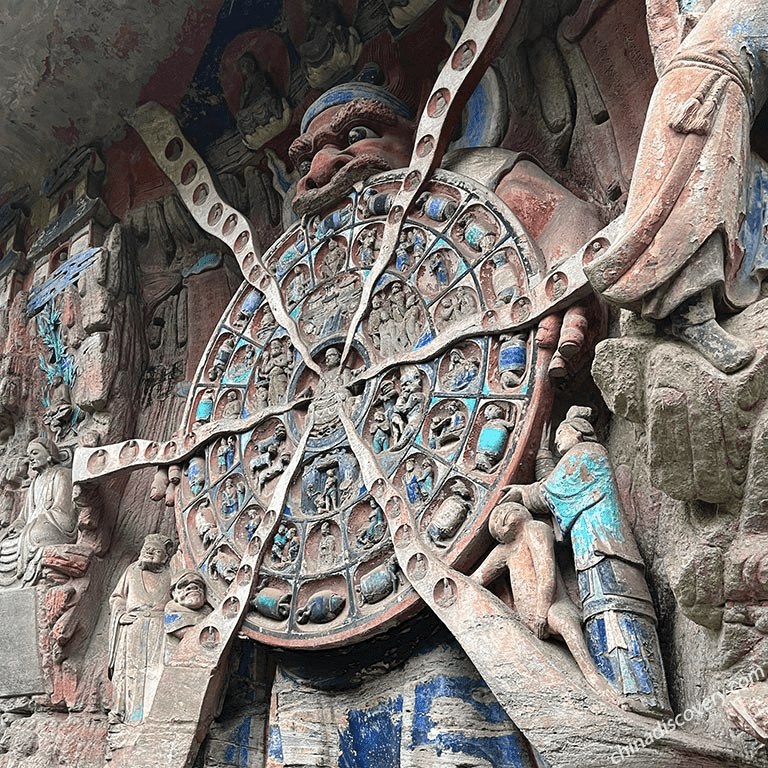
Dazu Rock Carvings – Buddhist Wheel of Life

Avalokitesvara with Thousand Hands

The Buddha statues at Baodingshan are novel in conception, skillful in carving, and rich in secular characters. Religious treasures come one after another, including the representative work – Niche of Sakyamuni Entering Nirvana, one of the wonders of Buddhist art in the world – Avalokitesvara with Thousand Hands, striking image of Buddhist Wheel of Life, scientific designs of Three Saints of Huayan School of Buddhism and Cave of Full Enlightment showed craftsmans’ ingenuity.

In addition, niche content and their expression approach are striving to visualize reality. For instance, Niche of Parental Love Sutra contains ten groups of carvings, including scenes like begging for a son, carrying a child, and going into labor, etc., depicting parental love in bringing up children with plots linking to each other as a picture-book. These carvings are vivid and impressive. They were the outcome after Buddhism had been localized in China.

The ox herding story

Located at the eastern end of the Great Buddha Bend, the ox herding tableau, shows a herdsman taming a disobedient ox—a traditional metaphor for the path to self-enlightenment and a popular theme among Ch’an Buddhist monks and painters in the Song Dynasty. The tableau is made up of eleven vignettes arranged horizontally along a 27-meter cliff wall.

Ox herding story (scene 1–2), Niche 30, Dafowan, Mt. Baoding, Dazu. Southern Song Dynasty (photos: G41rn8, CC BY-SA 4.0)

The first three vignettes each depict a lively interaction between a herdsman and an ox in a landscape setting. The herdsman represents the Buddhist practitioner while the ox refers to the practitioner’s potential to become a Buddha. As the ox turns its body away, the stocky herdsman uses force, grass, and a stick to tame the ox. The verses accompanying the scenes further recount these struggles. 

Herdsmen embracing in the ox herding story (scene 5), Niche 30, Dafowan, Mt. Baoding, Dazu. Southern Song Dynasty (photos: G41rn8, CC BY-SA 4.0)

In the fourth and fifth vignettes, the ox is finally brought under control. The herdsman, featuring a wide, joyful smile, wraps his arms around his fellow herdsman while holding on to the ox with the rope in his hands.

In addition to the uncanny quality of grottoes’ masterpieces at Grant Buddha Bay (Dafowan), there are also many highlights you can’t miss while visiting Baodingshan Scenic Area:

  • Watch a 4K film with English subtitles to learn about the history and development of Dazu rock carvings, and enjoy an 8D view of spectacular grottos at the dome theater
  • Take a leisure stroll at Dazu Rock Carvings Museum (大足石刻博物馆) to gain insights into the whole thread of world cave temple art and the basic characteristics of Dazu Rock Carvings
  • Visit Shengshou Temple (圣寿寺) to admire the exquisite temple architecture, which was rebuilt at the Ming and Qing Dynasties.
Shengshou Temple & Dazu Rock Carvings Museum

Beishan Rock Carvings

1.5km north to Longgang Town of Dazu, with an altitude of 545.5m, Beishan is also called Longgang Mountain in the past. Beishan Rock Carvings is the initial of Dazu Rock Carvings. They were first created by Wei Junjing, prefect of Changzhou, in 892 A.D. of the late Tang Dynasty. Until 1162 A.D. of the Southern Song Dynasty, the existing scale of Beishan Rock Carvings was formed, and it centered around Fowan. The rock carvings are numbered and divided into two sections: No.1 ~ No.100 are in the south section, while No.101 ~ No. 290 are in the north section. There are over 5,000 statues on a 500m long cliff, with a height of 7 to 10 meters. The grottoes are very dense, just like a hive, and all of them are delicate and carved with high sculpture skills.

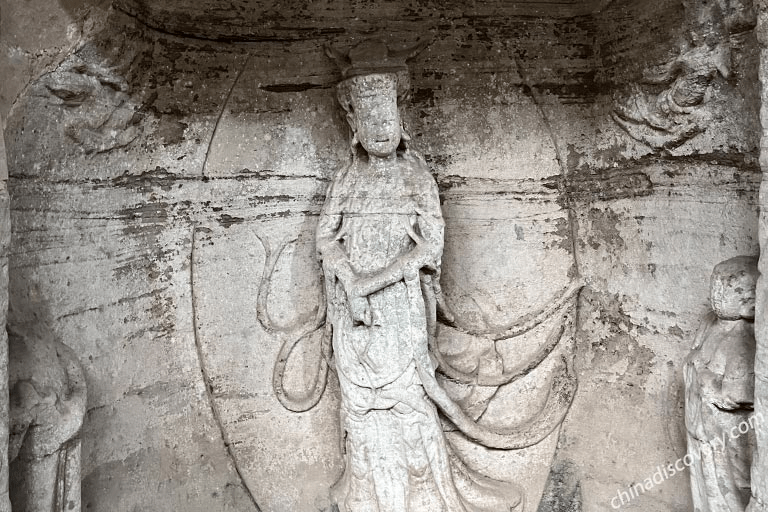
Avalokitesvara with a Rosary

The crowning jewels of Beishan rock carvings are the statues of Avalokitesvara. They are ornamental and artistic, with diverse looks and postures. The most emblematic ones are the Avalokitesvara with a RosaryAvalokitesvara Watching the Moon Reflection in the Water, and Thousand-armed and Thousand-eyed Avalokitesvara, etc.

Beishan rock carvings can be visited both during the day and at night. An additional visual experience is provided by the scenic spot’s usage of colored light to illuminate the stone statues. Besides, if you have enough time and stamina, don’t forget to follow the downhill trail to visit the Duobao Pagoda (多宝塔) to see the giant cliff statues of Beishan, the Two Buddhas of the North Pagoda.

Dazu Rock Carvings – The Last Monumental Works in the History of World Grotto Art

Link:https://peacelilysite.com/2024/01/04/dazu-rock-carvings-the-last-monumental-works-in-the-history-of-world-grotto-art/

#AvalokitesvarawithThousandHands #Shakymunibuddha #DazuRockCarvings #History #WorldGrottoArt #Buddhism #BuddhistArt #BuddhaStatue#Cave#TravelChina #ChineseCulture

Source:https://www.chinadiscovery.com/chongqing/dazu-rock-carvings.html, https://smarthistory.org/mt-baoding-dazu-rock-carvings/