I have not lived for nothing as of yet I believe. At the age of ninety-five, I do not anticipate having too many more years to look forward to, but still at this point in time I believe I cannot answer the question as to what I have lived for as I am still living. Because if there is anything that I have learned it’s that I cannot see what is further ahead of me than the span of my arms. As a rider is to be approaching a cave, from a distance he may be deceived — especially in the night — and it may be the case that the cave is truly a rounded bridge of sorts. I do not pretend to know what is to come next so rather than explaining what I have lived for, I would much rather give you the words that would explain why I am still among the living.
I am still among the living for precisely this purpose: the joy it gives me to write — to explicate the answers to the questions of my heart — is greater than any worldly pleasure I have ever known of. The truth remains that I would like to have written more in the years that I have lived, but I am keen to continue as the tide never stops its charge despite how often it breaks at the shore.
Truthfully, I am alive for the people that this world has housed as their temporary abode. The men, the women, but most of all the children that I have had the truest honor of coming to understand as my companions — as friends — with whom I have created many meaningful memories and a body of magnificent works are my most profound reason for existence. The loving people I have encountered are to know that I am still alive for them; if it’s something that they forget in the course of our frightened retreats in our fleeting livelihoods then I pray that I remind them of this fact every day that I am blessed with living.
Finally, I live to meditate on the ecstasies of the universe — both of nothing and of everything. Neither is greater than the other, but as I have learned in my time here, they are nearly one and the same. The truth of the essence within me is the only part of me that I don’t regret keeping. Even at this age I have yet to let go to the extent that I know I must. Maybe it isn’t too long that I drift into oblivion.
But if that’s what must happen then I am glad to have been able to share these thoughts with you.
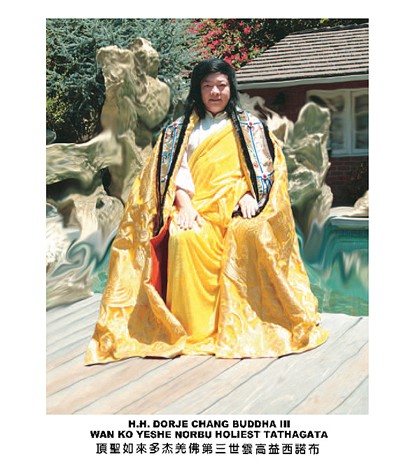
In the course of benefiting sentient beings in this world, H.H. Dorje Chang Buddha III Wan Ko Yeshe Norbu Holiest Tathagata has inadvertently revealed His state of virtue and realization. This has profoundly enriched our understanding of the realization, boundless compassion, enlightenment, and sublime conduct of a Buddha. Sacred phenomena manifest wherever H.H. Dorje Chang Buddha III goes. These phenomena occur during His Holiness’s initiation ceremonies for esteemed monastics, rinpoches, dharma kings, and even renowned Bodhisattvas. They also arise when His Holiness delivers discourses on the dharma to His disciples or when He bestows blessings upon sentient beings to enhance their fortune and wisdom.
In this post, I would like to share some examples.
Dragon-Fish Stand Straight Up on the Surface of the Water and Pay Respect to H.H. Dorje Chang Buddha III by Bowing to His Holiness
On November 6th, 1999, at Puttamonton, Thailand, a group of around thirty people accompanied H.H. Dorje Chang Buddha III. After prostrating before the holy image of Sakyamuni Buddha, they gathered under a bodhi tree beside a serene lake, where H.H. Dorje Chang Buddha III sat. One of the Rinpoches respectfully beseeched H.H. Dorje Chang Buddha III to give a discourse on how an Arhat can realize the state of a Bodhisattva, how a Bodhisattva can attain the supreme and complete enlightenment of a Buddha, and why a Buddha must rely on saving sentient beings to attain Buddhahood.
At that moment, various birds flew over from all directions and perched themselves on the tree, while different types of wild fish in the lake swam over to them. Two wild dogs even approached and joined the group in front of H.H. Dorje Chang Buddha III’s seat, creating an extraordinary scene.
As H.H. Dorje Chang Buddha III began expounding the highest wondrous dharma, waves suddenly surged from the calm waters of the lake, accompanied by a loud sound. A black dragon transformed into a large black and gold fish, emerging vertically from the water’s surface and bowing its head toward H.H. Dorje Chang Buddha III after each movement.
This remarkable display lasted about twenty seconds, with other fish, both white and black, also emerging to pay their respects to H.H. Dorje Chang Buddha III.
Witnessing this unprecedented spectacle, the disciples were filled with wonder, understanding that these fish were dragon-spirits transformed to receive the dharma and pay homage. H.H. Dorje Chang Buddha III, however, remained humble, stating, “This is a response evoked by the Buddha-dharma. One should practice the Buddha-dharma with a heart of humility. Amazing feats are like dreams and illusions, like clouds and smoke that pass in an instant. One must not be attached to them. They are not worth mentioning.”
Indeed, when great saints expound the wondrous dharma, both humans and non-humans pay their respects, a testament to the merit and realization of a Buddha.
A Wild Squirrel Offered Avocadoes to H.H. Dorje Chang Buddha III
In the afternoon of April 24th, 2000, disciples Long Zhi and Juehai walked along the swimming pool in the outer area of the mandala with H.H. Dorje Chang Buddha III Wan Ko Yeshe Norbu Holiest Tathagata. H.H. Dorje Chang Buddha III pointed to an avocado tree and said, “I want everyone to try the fruits.” So H.H. Dorje Chang Buddha III instructed Long Zhi to get a fruit catcher. Long Zhi searched but couldn’t find one. H.H. Dorje Chang Buddha III then said, “We have to pick some avocados.”
Moments later, a brown squirrel descended from an old pine tree. H.H. Dorje Chang Buddha III instructed everyone, “Don’t chase the squirrel away. It came to help.” The squirrel skillfully climbed the avocado tree, searching for ripe fruit. Jumping from branch to branch and sometimes hanging upside down, it located the avocados hidden amidst the dense foliage. Within minutes, the squirrel retrieved six avocados. H.H. Dorje Chang Buddha III deemed it sufficient.
Addressing the squirrel, Long Zhi said, “Hey, squirrel, you have worked diligently. Your offering has accumulated ample merit. It is enough.” The squirrel paused on a branch, holding its paws together, acknowledging H.H. Dorje Chang Buddha III. These six avocados were offerings to H.H. Dorje Chang Buddha III from the squirrel.
As H.H. Dorje Chang Buddha III prepared to leave, the squirrel performed one prostration before the Buddha Master and then departed slowly. Since then, the nuns residing at the holy mandala have observed squirrels climbing the avocado tree but no longer witness avocados being offered as offerings.
The Buddhas Praise H.H. Dorje Chang Buddha III’s Discourse; Buddha Light Blessing Illuminates the Lecture Hall
In April 2006, the Buddha Master was in the lecture hall delivering a discourse on “What Is Cultivation” in response to a question from Zhaxi Zhuoma Rinpoche. As the Buddha Master began, a beam of sparkling iridescent light suddenly appeared, circling the indoor lecture hall with the force of lightning. The sight was dazzling and auspicious! Throughout the discourse, this radiant Buddha light appeared and illuminated the hall as many as five times.
Approximately twenty Rinpoches and masters were present, witnessing the phenomenon. However, not all disciples perceived the same colors and number of Buddha lights due to their varying levels of cultivation and karmic conditions. Some witnessed Buddha lights appearing six times, while others saw them twice. The colors varied as well, with some seeing red, others white, and still others witnessing iridescent Buddha lights sparkling in the hall. The Buddha Master’s discourse on the Buddha-dharma, along with the praise and blessings of the Buddhas and Bodhisattvas, filled all present with joy.
These Buddha lights were special manifestations with underlying causes. They appeared when the Buddha Master discussed the karmic conditions behind the publication of the book “A Treasury of True Buddha-Dharma.” Dazzling Buddha lights flashed in the mandala, as the Buddhas and Bodhisattvas used them to celebrate the birth of this book, which would provide countless beings in the earthly realm with a path to practice the true dharma. As proclaimed by many great dharma kings and rinpoches, the karmic conditions for beings to experience good fortune have matured!
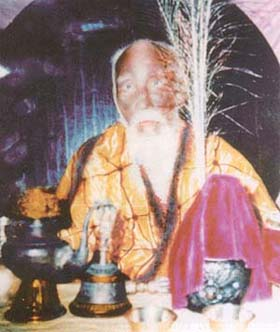
H.E. Queji Jiangyang Qingzhen was a disciple of H.H. Dorje Chang Buddha III who truly manifested realization. This Sakya rinpoche of great holiness had white hair and a youthful complexion. His silver beard extended below his belly, and a heavenly eye opened between his eyebrows. Through his practice he attained the state in which his whole body was semi transparent. Thus, his three channels and five chakras could be vaguely seen. He realized a state of true longevity equal to that of heaven. The rinpoche was able to fly through the air, coming and going anywhere with total ease and control.
When he received from H.H. Dorje Chang Buddha III an inner-tantric initiation in the holy form called Drawing Lots From a Golden Vase, the lot landed upon the Xian Liang Great Perfection mandala. The Buddha Master transmitted to him the Lion Vajra Dharma and the highest great dharma called the Xian Liang Great Perfection Dharma. Right then and there H.E. Queji Jiangyang Qingzhen realized the rainbow-body perfection state.
Witnessing the Manifestation of Supernormal Power by H.E. Queji Jiangyang Qingzhen
One day, a gathering of highly virtuous laypersons and esteemed Rinpoches convened at the Pici Vajra Castle. Their purpose was to welcome the imminent arrival of H.E. Queji Jiangyang Qingzhen, a revered Dharma King and rinpoche of the Sayka sect, who, at more than one hundred years old, commanded great respect. In anticipation of his arrival, meticulous preparations had been made, including the arrangement of white silk hadas and offerings to honor him.
Shortly after midnight, at around 12:30, a wondrous phenomenon unfolded. A vibrant rainbow light appeared, encircling the sky, accompanied by celestial music. Gradually, the luminous rainbow expanded in size, descending gracefully until it settled atop the seven-story building housing our Buddhist altar. As the spectacle unfolded, a figure descended from above.
It was none other than H.E. Great Dharma King Jiangyang Qingzhen, gracing us with his presence.
We paid our respects and presented offerings to him with profound admiration, expressing our deepest reverence through our actions. While tales of centenarians ascending into the skies are often recounted in Tibetan scriptures, never before had we been blessed with the opportunity to witness such an extraordinary event firsthand. It was truly a manifestation of the boundless fortune we have accrued through countless lifetimes. How could one not be moved to tears by such a profound occurrence?
Truly, we stood assembled in the concrete courtyard below, with an uninterrupted view of the elder Dharma King’s descent from the sky to the rooftop. Although our sight was briefly obscured by the building’s roof, within moments, we beheld the elder Dharma King’s graceful descent from the top of the seven-story building to the ground below. His descent, with arms outstretched and legs slightly bent, resembled the elegant flight of an eagle—a spectacle beyond the capabilities of an ordinary person.
The following day, the Dharma King of the Sayka sect bestowed teachings upon us and initiated us, imbuing us with profound compassion. During the initiation ceremony, as we held a one-foot-long vajra in our hands, we experienced its boundless and awe-inspiring power, unable to control its movements. The ensuing mandala states were marvelously magnificent.
As the initiation ceremony drew to a close, the sound of ringing bells suddenly filled the air, and an attendant announced the arrival of ‘His Holiness the Great Master.’ In response, H.E. Dharma King Jiangyang Qingzhen promptly descended from his dharma seat and prostrated himself on the ground. Although we were initially uncertain about the significance of this auspicious moment, we followed suit, believing it might herald the arrival of Guru Padmasambhava. However, upon raising our heads, we beheld not Guru Padmasambhava but H.H. Master Wan Ko Yee (H.H. Dorje Chang Buddha III). Sensing our confusion, H.E. Dharma King Jiangyang Qingzhen reassured us, declaring, “Do not harbor doubts. H.H. Master Yee is the illustrious Buddha Vajradhara Great Dharma King—His Holiness Wan Ko Yeshe Norbu Holiest Tathagata (H.H. Dorje Chang Buddha III).”
One time, Shakyamuni Buddha and King Prasenajit engaged in a profound and comprehensive discussion about love and compassion.
“Master Gautama,” King Prasenajit began, “some people say you taught them not to love. They argue that the more you advocate for love, the more pain and sorrow there is. Though I can discern a grain of truth in this, I’ve always harbored a bit of unease about that perspective. Life without love feels devoid of meaning. Please enlighten me on this matter.”
The Buddha regarded the King with kindness and responded, “Your Majesty, that’s an insightful question, one from which many can benefit. Love, indeed, manifests in various forms, each requiring careful examination. While love is indispensable in life, it must not be rooted in lust, obsession, or prejudice. There is another form of love urgently needed in life. This entails love and compassion, or great kindness and great compassion. What people commonly perceive as love is often confined to mutual affection among family members and citizens. However, such love, tethered to notions of ‘me’ and ‘mine,’ fosters attachment and separation.”
“People primarily yearn to love those within their immediate circle—parents, spouses, children, grandchildren, relatives, and fellow citizens,” he elaborated. “However, love imbued with partiality breeds bias, leading to indifference or discrimination toward those outside one’s circle. Attachment and separation, therefore, perpetuate suffering for oneself and others.”
“The love that humanity truly craves is one rooted in love and compassion,” the Buddha emphasized. “Great kindness and compassion extend universally to all beings, transcending distinctions of ‘mine’ and ‘not mine.’ Devoid of attachment, they bring about happiness and alleviate suffering.”
“In great kindness and compassion, there lies no trace of differentiation,” he concluded. “They serve as the path to liberation from distress.”
The King bowed his head in thought. “I have a family and a country to take care of,” he said. “If I don’t love my family and my country, how can I take care of them? Please clarify this for me.”
The Buddha reassured him, saying, “Of course, you should love your family and your people, but your love can extend beyond them. Your present limited love can be transformed into an all-embracing love, and the young people of this country will become your sons and daughters. This is the true meaning of compassion.”
The King asked again, “This is something that can actually be done, especially where you live. It’s much easier. What about young people in other countries?”
The Buddha replied, “Though they are not in your country, that doesn’t stop you from thinking about the youth of other countries, just as you treat your own children. You love your people; that’s no reason why you can’t love other people.”
The King said, “But when they’re not under my jurisdiction, how can I show my love for them?”
The Buddha looked at the King and spoke, “The prosperity and security of a nation should not be gained at the expense of the weakness and turmoil of other countries. Your Majesty, lasting peace relies on the cooperation of all nations moving towards the common good. Kaushambi Salo will remain safe if you strive for it. You do not wish for your young men to perish on the battlefield; therefore, you must aid in stabilizing other nations. For genuine peace, foreign and economic policies must be guided by compassion. While you prioritize the well-being of your own people, you must also extend love and care to neighboring kingdoms such as Magadha, Gashi, Vitiha, Shakya, and Khalil.”
The King exclaimed with enthusiasm, “Wonderful! This is profound! Your words deeply resonate with me. Surely, you possess true enlightenment! I promise to ponder your teachings diligently and understand their wisdom thoroughly. However, I have a simple question for you. General love, as you mentioned, often involves separation, desire, and attachment, leading to sorrow and misery. But how can one love without desire or attachment? How can I, for example, love my children without succumbing to worry and pain?”
“In the path of enlightenment, love cannot exist without understanding,” the Buddha continued. “Love is born out of understanding. You cannot truly love someone unless you know them. Couples who are unfamiliar with each other will struggle to foster love. Similarly, parents and children who lack understanding of each other will find it challenging to cultivate love. If you desire the happiness of the one you love, you must make an effort to comprehend their concerns and aspirations. True love stems from this understanding. Conversely, if you merely seek to impose your own desires onto them, disregarding their needs, it is not genuine love but rather a desire for control and self-gratification. When everyone experiences peace, happiness, and joy, you will also come to understand these states. This is the essence of love on the path of awareness.”
The King, profoundly touched, conveyed his gratitude, stating, “I am truly grateful for the profound wisdom you have shared with me. However, I still find myself grappling with a lingering question. You assert that love rooted in attachment leads to pain and turmoil, while compassionate love brings peace and happiness. Although I perceive compassionate love as altruistic and selfless, I still harbor concerns that it may entail suffering.”
“Compassion is indeed the fruit of understanding,” the Buddha replied. “To tread the path of awareness is to bear witness to the reality of life—a reality characterized by impermanence. In everything, there exists no eternal or individual self. One day, all of this will be behind us.”
“When one comprehends the impermanence of existence, their perspective becomes tranquil and harmonious,” he continued. “The presence of impermanence does not disturb their mind and body; hence, the poignant feeling induced by compassion is unparalleled in its bitterness. Yet, the anguish of compassion serves to fortify one’s resolve.”
Moved deeply by the teachings, the King of Persia realized that no spiritual teacher or Brahmin priest had ever succeeded in opening his heart to such profound understanding. He considered the presence of the Buddha as a divine blessing bestowed upon the country. Filled with reverence, he expressed his wish to become a disciple of the Buddha.









 Peace LiLy