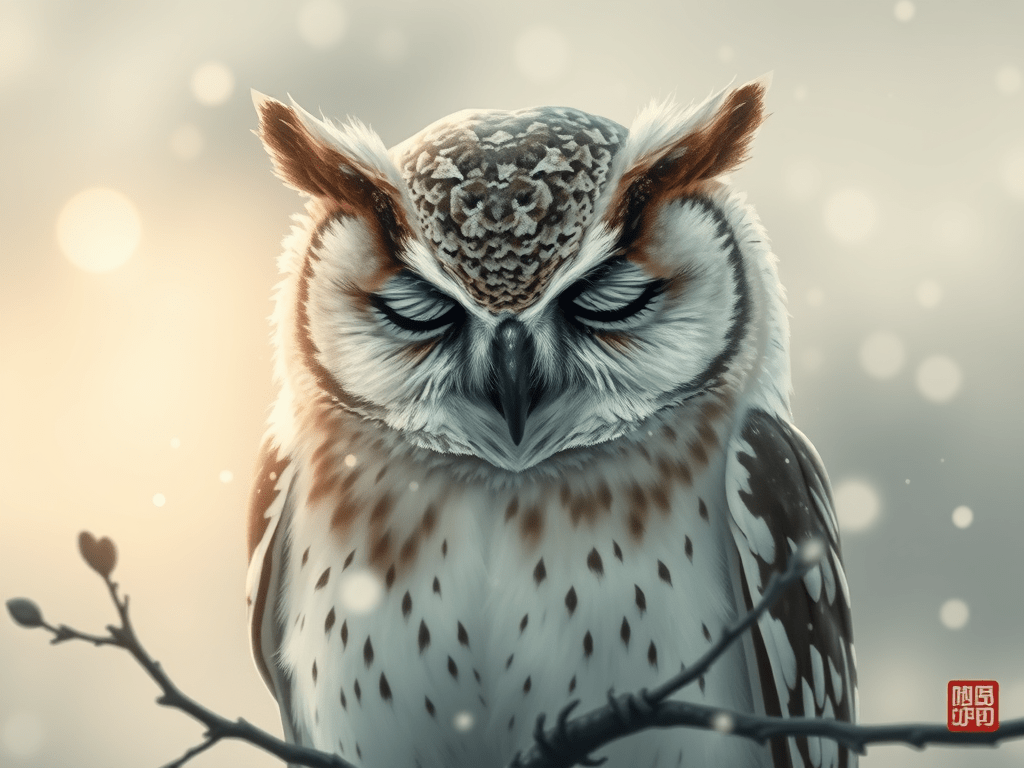
Owls have always fascinated me with their air of enigma. Creatures of the night, they rest in the shadows by day and emerge only after dusk, rarely granting humans more than a fleeting glimpse. Across cultures, they have inspired legends both wondrous and foreboding. In ancient Greece, the wise and fearless goddess Athena chose the owl as her emblem, making it an enduring symbol of wisdom. So revered was this bird that Greek coins bore Athena’s face on one side and the owl on the other. Yet, in other parts of the world, the owl has been shrouded in darker associations, seen as a harbinger of misfortune or an omen of ill will.
In Chinese culture, the owl’s symbolism is particularly layered—holding both shadows and light. In ancient times, owls were often viewed as inauspicious creatures, linked to misfortune, death, and the old saying, “When the night owl enters a home, it never comes without cause.” And yet, in certain cultural contexts, they also stand for wisdom, keen insight, and even mysterious, almost magical power.

When most people picture an owl, they think of its round, unblinking eyes and penetrating gaze—features that can feel cold, even intimidating. But my perception shifted entirely when I encountered the Chinese ink painting Childlike Delight by H.H. Dorje Chang Buddha III.
This is no ordinary artwork. With the freehand grace of traditional Chinese brushwork infused with a touch of dreamlike realism, it bridges the poetic subtlety of Eastern art and the fresh, luminous clarity of Western modernism.
With just a few effortless strokes, the artist creates a whimsical, pure, and gently humorous world—a dreamscape that seems to invite the viewer into the peaceful slumber of childhood. The small owl, covered with delicate ink spots of varying sizes and shades, appears almost as if glimpsed through a soft morning mist. Look closely, and you might see the tender image of a sleepy child, finger to lips, caught in that sweet moment before surrendering to dreams.
This is not a literal portrayal of nature, but rather nature reflected through the artist’s own heart—capturing not merely the physical form of a creature, but its spirit, vitality, and essence.
Here, the owl is reborn—not as the ominous figure of superstition, but as a symbol of innocence, purity, and quiet wisdom. The artist’s compassionate and unblemished inner world radiates through the painting, gently cleansing the heart of the viewer until it feels as fresh and clear as morning dew.
Childlike Delight reminds us that we can close the sharp, competitive eyes of rivalry and open instead the eyes of kindness, innocence, and warmth—gifts that have the power to heal, to inspire, and to light the world.
Link:https://peacelilysite.com/2025/08/15/childlike-delight-a-new-vision-of-the-owl/


 Peace LiLy