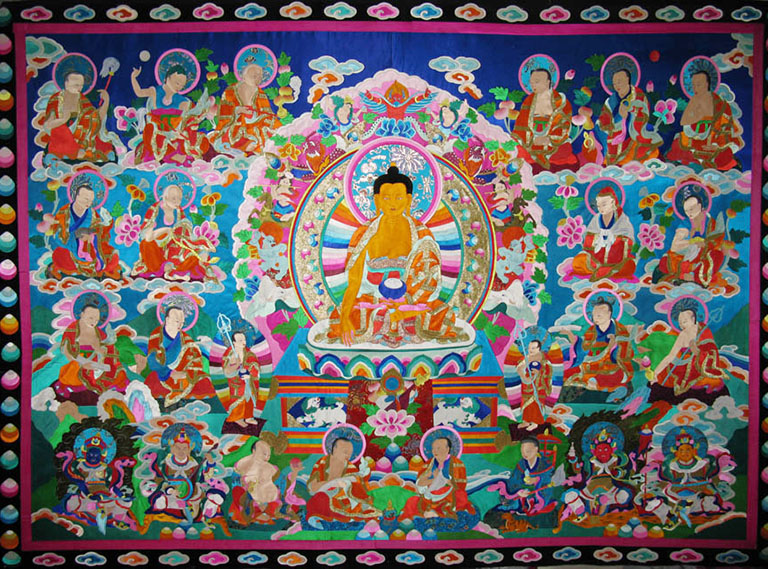
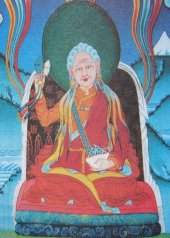
In the rich tapestry of Tibetan Buddhism, there are extraordinary practitioners whose lives themselves become teachings. Among them, Ayu Khandro (阿玉康卓) — also known by her Dharma name Dorje Peldron — stands as one of the most inspiring yoginis of the Nyingma tradition. Her life is not merely a story; it is a living example of devotion, perseverance, and profound realization.
Born in 1839 in the remote region of Kham, eastern Tibet, Ayu Khandro began her spiritual journey at a young age. She received teachings from many of the greatest masters of her time, including Jamyang Khyentse Wangpo, Jamgon Kongtrul, Chokgyur Lingpa, Nyala Pema Dundul, Adzom Drukpa, and Togden Rangrig — figures who were central to the non-sectarian Rimé movement in Tibetan Buddhism.
Unlike many who seek comfort or recognition, Ayu Khandro chose a life of renunciation and yogic discipline. She wandered widely across Tibet, lived in caves and hermitages, and devoted herself to decades of intense meditation. She spent more than fifty years in retreat, including prolonged periods of dark retreat, known in Tibetan as Yangti Nagpo — an advanced Dzogchen practice where the meditator withdraws from external light to focus inwardly on the nature of mind.
Dzogchen — The Great Perfection
Ayu Khandro’s life was profoundly rooted in Dzogchen (Great Perfection) — a teaching that points directly to the intrinsic, luminous nature of consciousness. Rather than seeking external accomplishments, she focused entirely on direct inner realization.
She was recognized as a terton — a revealer of hidden teachings — and was particularly known for transmitting sacred practices and giving initiations to practitioners, including the renowned master Chogyal Namkhai Norbu Rinpoche, who later wrote her biography based on her own oral account.
Ayu Khandro lived to the remarkable age of 115. In 1953, near the end of her life, she received visitors, gave away her precious possessions, and continued to teach and encourage those around her. After she passed away, it is reported in Tibetan Buddhist biography that her body remained in meditation posture for about two weeks before any signs of physical change occurred. By the end of this period, her body had shrunk to a fraction of its original size — an occurrence some traditions associate with deep spiritual attainment in Dzogchen practice, where the physical elements dissolve into subtler states.
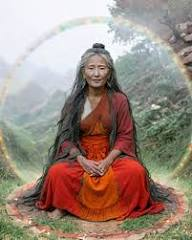
This remarkable account, while extraordinary, is part of how her life has been transmitted in spiritual biographies — not as a spectacle, but as a sign of the depth and authenticity of her practice.
What makes Ayu Khandro’s life especially compelling is not just her longevity or her meditative achievements, but her steadfast devotion to the Dharma. She never sought fame or comfort. Instead, she walked the rugged paths of realization, teaching through action rather than words, presence rather than proclamation. Her retreats, pilgrimages, and meditation practices were not about escape, but about coming fully home to the true nature of mind.
Although few of us will ever undertake decades of meditation in darkness or faraway hermitages, Ayu Khandro’s life still speaks directly to modern seekers. In an era filled with distraction and ambition, her example invites us to ask:
- What is true commitment?
- How deeply can we trust the path we walk?
- Can we place inner understanding above outer achievement?
Her life encourages us to remember that spiritual depth is not measured by loud accomplishments, but by quiet fidelity to practice.
Ayu Khandro remains a powerful reminder that liberation is not found on the surface of life, but in its quiet depths. Her unwavering dedication, her silent courage, and her embrace of the path offer inspiration — not as myth, but as a living reminder of what is humanly possible when devotion meets discipline.
Sources:
Allione, Tsultrim. 1984. “A-yu Khadro”, in Women of Wisdom. London: Penguin Group, pp.233-264.
Namkhai Norbu. 1986. The Crystal and the Way of Light: Sutra, Tantra and Dzogchen. New York; Routledge and Kegan Paul, pp.113-114.
Namkhai Norbu and Michael Katz. 2002. Dream Yoga and the Practice of Natural Light. New York: Snow Lion Publications, pp.130-131.


 Peace LiLy