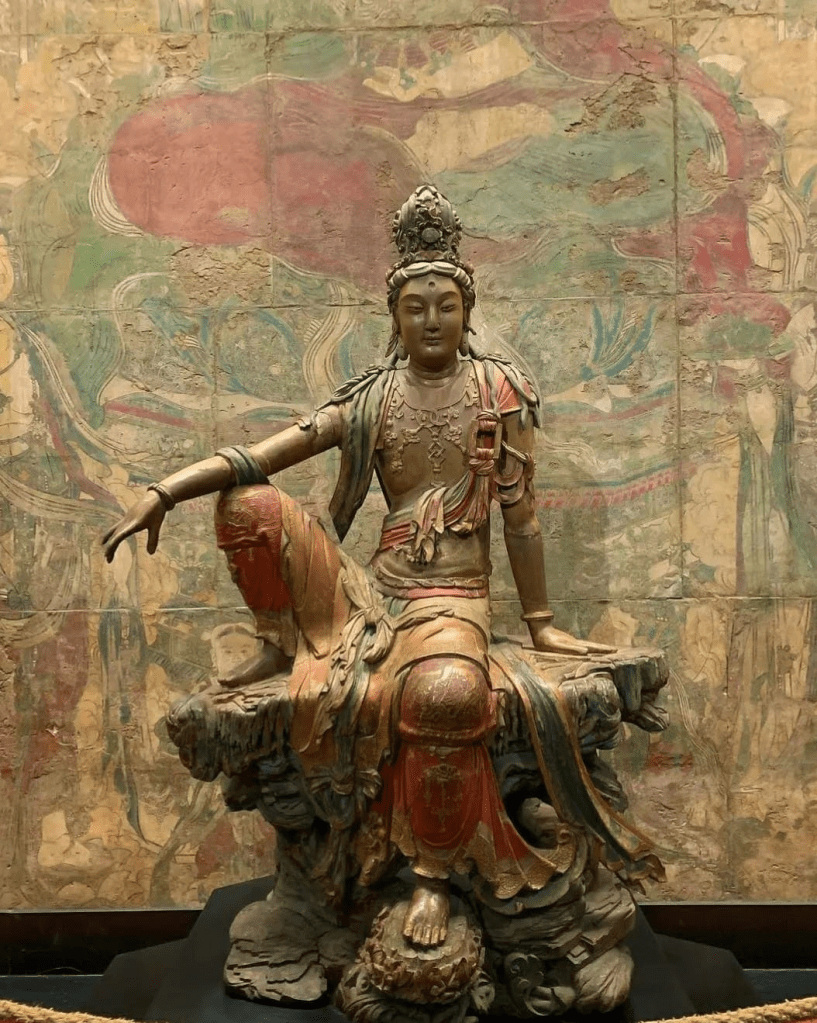
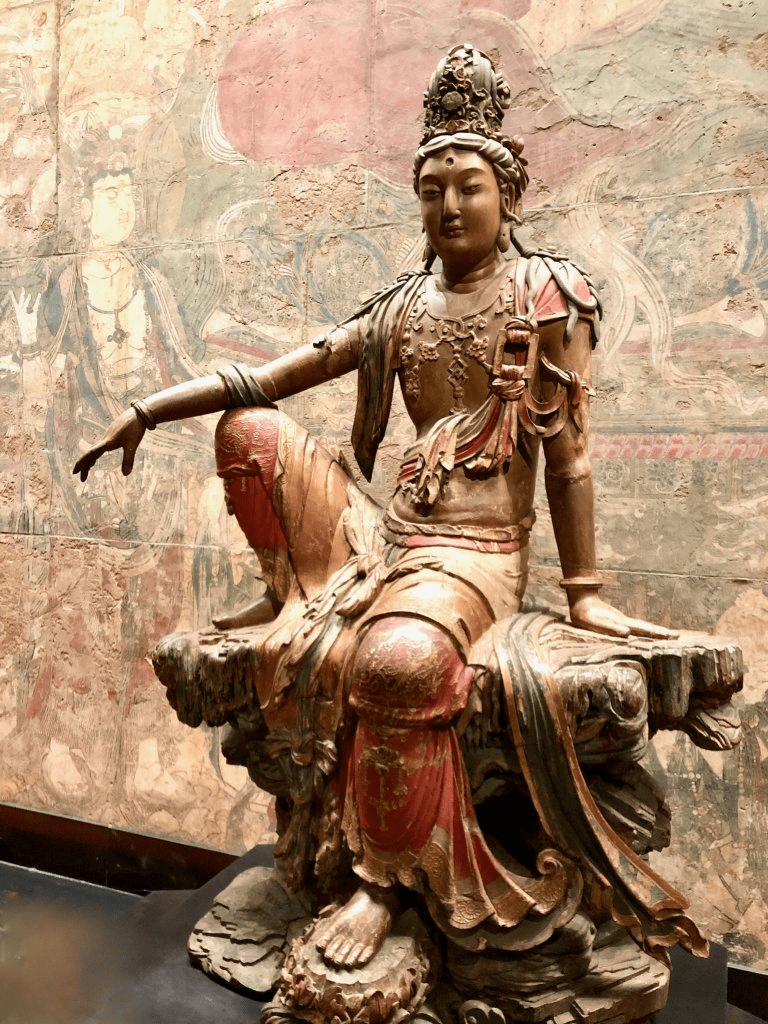
Tucked within the tranquil halls of the Nelson-Atkins Museum of Art stands a breathtaking wooden sculpture of Water-Moon Guanyin from the Liao Dynasty—a work hailed as “the most magnificent surviving sculpture in China” and “a triumph of religion and aesthetics.” It has also been honored by the media as “one of the thirty finest works held in American public institutions.”
Officially labeled by the museum as “Guanyin of the Southern Sea,” this statue rises to an impressive height of 2.4 meters. Aside from the right forearm, the entire figure—including its base—was masterfully carved from a single block of wood. Dating back to the 11th or 12th century (Liao or Jin Dynasty), the sculpture has been remarkably well-preserved over the centuries.
This Guanyin is an extraordinary example of religious artistry. Her face is gently sculpted with refined features—serene, graceful, and quietly majestic. Adorned with a jeweled crown, her eyes are softly closed, gazing downward in meditation and compassion. The statue’s pose reflects the elegance and wisdom traditionally associated with the feminine form, especially in the flowing hand gestures—while still retaining some subtle masculine traits in the upper body, a nod to Guanyin’s transcendent nature.
In classic iconography, Water-Moon Guanyin is often portrayed seated on a rock or lotus throne, gazing compassionately at the world. In this sculpture, she sits with one leg bent and the other gracefully draped downward. Her right arm rests lightly on her knee, fingers gently curved, as she gazes diagonally downward with a calm smile—evoking the image of the moon reflected in water. This visual metaphor powerfully symbolizes a core Buddhist teaching: the illusion of form and the essence of emptiness.
Every aspect of the statue—the proportions, the flowing posture, the tranquil expression—conveys a sense of effortless grace, inner freedom, and compassionate presence. It is a piece that invites quiet reflection, stirring something deep within the soul of the viewer.
The Legend Behind the Water-Moon Guanyin
The form of Water-Moon Guanyin, also known as “Auspicious Water Guanyin” or “Auspicious Water Bodhisattva,” is one of the most beloved among the thirty-three manifestations of Guanyin in Chinese Buddhist tradition. Interestingly, the name “Water-Moon” does not come from early Buddhist scriptures, but rather from Chinese folklore—born of the fusion between Buddhism and indigenous Chinese culture.
According to legend, Guanyin once appeared in Suzhou during a time of war, where she witnessed the brutal slaughter of civilians by the Jin army. Out of great compassion, she transformed into a beautiful woman, built a ritual platform, and began chanting sutras to deliver the souls of the dead. When her recitation was complete, someone among the crowd recognized her divine aura and asked to see her true form.
The Bodhisattva pointed to the riverbank. There, reflected in the still waters, was the image of a radiant full moon, within which her sacred figure appeared—graceful and ethereal. Among the witnesses was a talented artist named Qiu Zijing, who quickly sketched the vision. As his painting circulated, this image came to be known and venerated as the Water-Moon Guanyin.
A Space Worthy of the Divine
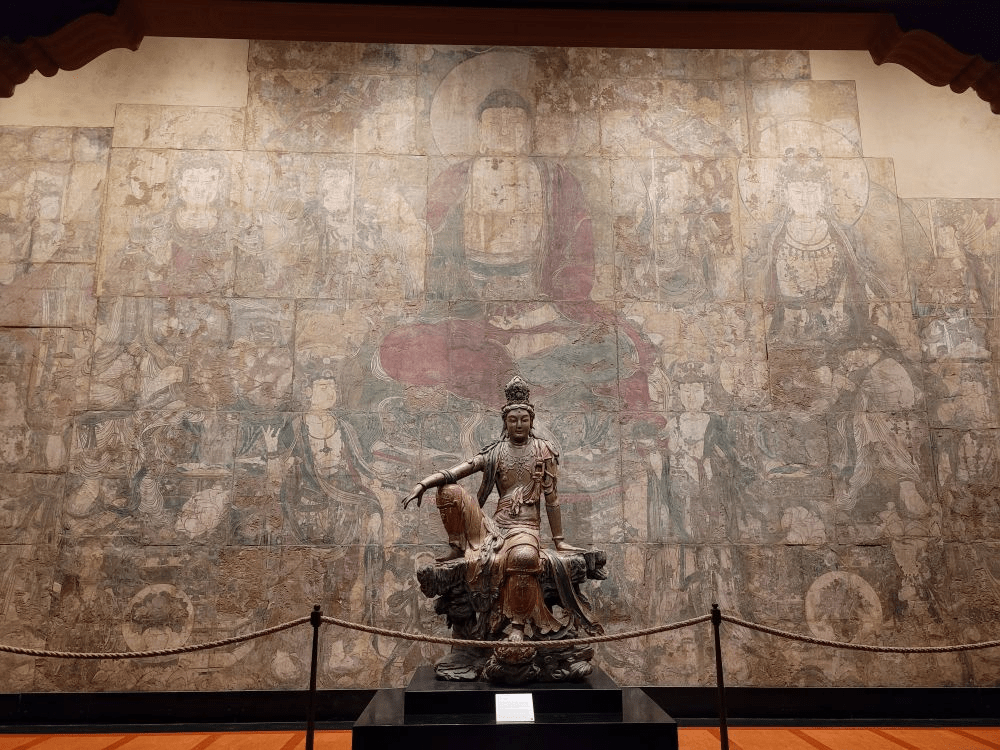
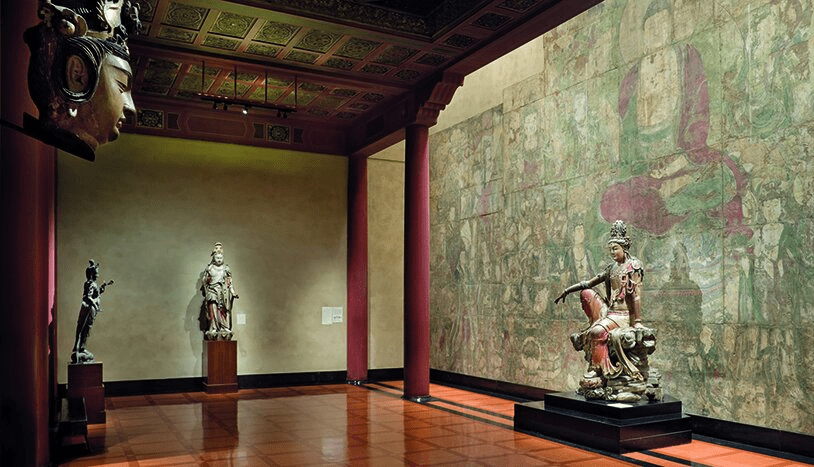
To properly honor this extraordinary statue, the Nelson-Atkins Museum created an expansive Chinese Temple Gallery. Behind Guanyin stands a Yuan Dynasty mural titled “Assembly of the Radiant Buddha,” originally from Guangsheng Temple in Shanxi Province. Above hangs a carved Ming Dynasty coffered ceiling adorned with dragons, while in front, finely carved lattice doors from a Qing Dynasty official’s residence in Beijing complete the immersive setting.
This harmonious environment allows visitors to experience the sculpture not just as a museum piece, but as a living expression of faith, beauty, and timeless spiritual insight.
The Water-Moon Guanyin at the Nelson-Atkins Museum is more than an ancient sculpture—it is a sacred embodiment of compassion, artistry, and transcultural storytelling. Whether viewed through the lens of religion, history, or aesthetics, it stands as a serene reminder of the enduring power of beauty to transcend time and touch the human spirit.
In the Guanyin Spiritual Inspiration Records, there is a story about karmic retribution.
During the Qing Dynasty, a merchant from Anhui named Cheng Bolin was a devout believer in Guanyin Bodhisattva. He had settled with his family in Yangzhou, Jiangsu. At that time, war and conflict were common. When Cheng Bolin heard that marauding soldiers were approaching Yangzhou, he prayed earnestly to Guanyin Bodhisattva for protection.
Guanyin appeared to him in a dream and said, “There are seventeen people in your household. Sixteen will be spared from harm, but you have a fixed karma that cannot be avoided, and you will not escape this disaster.” When Cheng awoke, he was very anxious. He prayed again, asking, “Oh, I cannot avoid this fate. Bodhisattva, is there any way out?”
Out of great compassion, Guanyin once again appeared in his dream and told him, “Among the approaching soldiers, there is a man named Wang Mazi. In your past life, you struck him twenty-six times and caused his death. In this life, he has come to take his revenge. Have your family take shelter in the eastern wing, while you wait in the main room. Do not involve them.”
Although Guanyin did not offer a direct means of escape, the dream subtly revealed the karmic connection from Cheng’s past life, and Cheng believed it wholeheartedly.
Five days later, the soldiers arrived and began pounding on the door of Cheng’s house. Calmly sitting in the main hall, Cheng spoke, “Stop knocking. Who among you is Wang Mazi? Let him come forward.” Wang Mazi, fierce and angry, approached. As they met, they both felt a deep hatred flare up. Wang Mazi was astonished and asked, “How do you know my name?” Cheng replied, “I am a devotee of Guanyin Bodhisattva. She came to me in a dream and told me that in my previous life, I struck you twenty-six times and took your life. Now I have no regrets. You may strike me twenty-six times in return.”
Suddenly, Wang Mazi’s conscience awakened, and he sighed, “In our past lives, you struck me twenty-six times, which led me to come seek revenge in this life. But if I now strike you twenty-six times, then in the next life, you will come back and strike me again. When will this cycle ever end?”
Wang Mazi then said, “Since Guanyin Bodhisattva told you that you owe me twenty-six strikes, turn around!”
He picked up his knife, but instead of using the blade, he struck Cheng Bolin twenty-six times with the back of the knife and said, “Since you struck me twenty-six times in the past, now I have struck you twenty-six times. With this, our karma is settled!”
There is a saying that encourages people to strive for self-improvement: “You reap what you sow.” Everything has a cause. The law of cause and effect is all-encompassing and ever-present, even in our thoughts and intentions. For instance, when we see someone doing a good deed and feel joy in our hearts, seeing the good deed is the cause, and feeling joy is the effect. That joyful feeling then becomes a new cause, and by planting this seed of good karma through positive thoughts, we will eventually reap good results.
Similarly, when others treat us poorly, it may be because we owed them something from a previous encounter. If we can endure this mistreatment with patience, without resentment or blame, and even forgive the other person, it is possible to resolve and dissolve the karmic debt. Otherwise, the cycle of revenge and retribution will continue endlessly.
It was late January, just a few weeks before Chinese New Year, when we headed to Zhoushan in Zhejiang Province. It was bitterly cold and traveling to Mount Putuo (普陀) for a two-day visit was not good timing. COVID-19 was—and still is—running rampant around the world. Any kind of travel required constant and painstaking vigilance, including full compliance with stringent prevention measures in China. Nevertheless, our destination looked as beautiful as ever, a glimmering island in the great ocean, celebrated as the “Buddha-land in the sea.” (Haitian fogou 海天佛國)
Mount Putuo is very environmentally friendly. Except for public buses, no vehicles are allowed, so we had to leave our car at the wharf. Most residents simply cycle around for their daily errands, and even said bicycles are under a quota control. For visitors to move about, you can take a bus, cycle, or simply walk. Roads and pathways are well maintained, and there is a long road that connects all the temples on the island, big or small, affording a pleasant journey at one’s own pace.
It was warm and sunny with a gentle breeze by the time we reached the island in the early afternoon. As there were very few visitors, we could stroll around at our leisure, enjoying the sunlight’s embrace. “You are so lucky,” commented our trip’s docent. “It was so windy in the morning that the ferry service was about to be suspended. In a week, the entire mountain might be closed to prevent the chance of further infections, no matter how sporadic.” We were blessed with the good fortune of a joyful excursion.
Mount Putuo is classified by the Chinese government as an “AAAAA Grade Scenic Resort and Historic Site,” attracting about 10 million visitors each year under normal circumstances. Visitation, though down 40 per cent during the pandemic in 2020, has rebounded sharply; as of April, 2.8 million people had visited Mount Putuo, a fivefold increase. The effort to attract visitors is ongoing: the Putuo Mountain College of the Buddhist Academy of China was recently completed, and Guanyin Dharma Park opened last November.
Putuo is a Chinese transliteration of the Sanskrit Potalaka, which is mentioned in several Buddhist scriptures, including the Gandavyuha Sutra (added as the final sutra in the Avatamsaka Sutra). Potalaka is described as the holy residence of Avalokiteshvara, the bodhisattva of compassion. According to Guang Xing, Mount Putuo was identified as the mythical Potalaka mountain by Buddhist monks and Chinese literati (Guang 2011: 1-22). It has been the pilgrimage site of Avalokiteshvara for about a millennium, honored as one of the four sacred Buddhist mountains in Chinese Buddhism. We speak here of Guanyin, the feminine form of Avalokiteshvara popularized in Chinese Buddhism. We will return to Guanyin below. For now, we simply need to know that Mount Putuo’s status matches that of Mount Wutai (五台) for Manjushri, Mount Jiuhua (九華) for Kshitigarbha, and Mount Emei (峨眉) for Samantabhadra.
There seem to be three main demographics for visitors to Mount Putuo: sightseers, pilgrims, and students of Buddhism. The majority of sightseers are visitors who do not have much knowledge of Buddhism, nor much interest in its history, sutras, or temples. Nevertheless, everyone, regardless of background, recognizes this place as one expecting reverence and respect for the buddhas and bodhisattvas. When we worship and make our wishes before the famous 33-meter statue of Nanhai Guanyin, we are also introspecting, contemplating, and reflecting on the vicissitudes and travails of our lives.
The town nearby is neat and chic, full of activity and interesting souvenirs for tourists to commemorate their visit. Even in the winter, Mount Putuo is generously covered with greenery and vegetation, with a multitude of species including ancient camphor trees and the rare wild plants of Carpinus putoensis (普陀鵝耳櫟). They are one of the major treasures on Mount Putuo and monoecious. There are red and yellow variations coexisting, but they do not mature at the same time, so the pollination rate is extremely low. When the Sun is shining, the leaves of many trees turn golden in the backdrop of the Prussian blue sky, surrounded by the various temples. It is truly a picturesque sight.
Carpinus Putoensis Cheng. From baidu
The beautiful scenery, unique to Mount Putuo, is reminiscent of places I have visited in Japan. The connection between Mount Putuo and Japan can be traced back to the Tang dynasty (618–907), when a Japanese Zen and Tendai monk-pilgrim named Egaku (Chinese: 慧鍔; Hui’E) wanted to bring a statue of Guanyin from Mount Wutai to Japan. However, his voyage back via Mount Putuo was hampered by storms and waves despite several attempts. One day, Egaku had a dream in which he realized that the statue of Guanyin did not want to leave. He decided to enshrine it and built a simple hut near the Tidal Sound Cave. Immediately, his ship sailed through and he was able to return to Japan. This is the story of Guanyin “bu ken qu” or “unwilling to go,” and is the source of many folktales surrounding the establishment of temples and monasteries on Mount Putuo. Exchanges between Mount Putuo and Japan continued over many centuries.
Guanyin is the real protagonist linking Japan and China, with Guanyin known as Kannon or Kanzeon in Japan. Belief in this personification of compassion and benevolence has a long history in China. First introduced from India in the Western Han dynasty (202 BCE–9 CE), Avalokiteshvara was adapted and amalgamated into Chinese culture, most famously through the female figuration and her unique 32 transformations (Guang 2011: 1-22). Beginning in the Song dynasty (960–1279), the Chinese transformed the bodhisattva into the Goddess of Mercy, depicted in the feminine. (Minneapolis Institute of Art)
Belief in Guanyin has flourished in China ever since, going beyond even religious boundaries in everyday life (Guang 2011: 1-22). She is not confined to monastic life, as it is said in the Universal Gate chapter of the Lotus Sutra that any worldly being in danger will be delivered instantly on calling her name. Therefore, Guanyin has been worshipped and revered by all classes of people. As she is a compassionate divinity with countless virtues and merits, she is endowed with transcendental power. She excels in skilful means, allowing her to appear in whatever form needed by sentient beings. And that, in my opinion, is probably the reason behind the 32 forms in the Chinese tradition, including Guanyin Yangzhi (楊枝), or Willow Branch Guanyin. The Guanyin Yangzhi is only one example among many of her history-rich gender transitions.
Willow Branch Guanyin. From online source
We were able to visit a 2.5-meter-high, 2.2-meter-wide monument of Guanyin Yangzhi at a nunnery of the same name. The nunnery, situated at the foot of Putuo’s Western Xiangwang Peak, was built in 1608. The artistic style was pioneered by Yan Liben (閻立本), a famous figure painter in the Tang dynasty, while the stele’s engravings appeared during the Ming dynasty (1368–1644). Holding a tender willow branch in her right hand and a clear water vase in the left, Guanyin is luxuriously crowned with pearls and precious stones, dressed in sumptuously embroidered garments, and adorned with agate, amber, and pearls. She spreads dewdrops to all the world’s quarters to dispel suffering and pain.
Guanyin is replete with the marks of beauty, dignity, and calm. Except for her face, there are not many traditionally female features shown. Indeed, she appears tall and somehow mighty and masculine, standing on her bare feet. Her belly bulges out slightly, and she has large hands and feet. While beholding her, I could not help but think of the mural of Padmapani, another manifestation of Avalokiteshvara, at Ajanta Cave No.1, in India. Painted during the sixth century BCE, the bearer of the blue lotus is a male figure with a slender body. Both forms of Avalokiteshvara are crowned and bejewelled, have physically beautiful features, and appear composed and graceful.
Padmapani, Ajanta Cave 1. From alamy.com
There are many temples on Mount Putuo, but the two most well known are Puji Temple (普濟寺) or the “front temple” (又稱前寺), and Huiji Temple (慧濟寺) on the peak of the mountain. They receive the most pilgrims, but Fayu Temple (法雨寺) is my personal favorite; when there is no pedestrian crowding, it has a gentle and soothing atmosphere. It is surrounded by towering ancient trees, suspending the visitor in time between past and present. From a distance, one can see that the gate to the monastery is unique, unlike those of other temples on Mount Putuo, which are painted in yellow ochre. Here it is light red in color: a soft, ambient hue that emphasizes an atmosphere of paradisical peace and bliss.
Upon entering and reaching the main hall of Nine Dragons, where a statue of Guanyin is enshrined, one feels a strong sense of sublime and resplendent majesty. Yuantong Hall of the Fayu Temple is renowned for its resplendent appearance and ingenious interior structure, with a large ball hanging from the ceiling of its dome surrounded by nine vertical rafters. Each rafter is carved with a dragon that rears its head in a scramble for the ball. This intricate layout is called the Bracket with Nine Coiling Dragons and is ascribed to Emperor Kangxi (康熙) (1654–1722), who used the materials of the former palace of the Ming dynasty in Nanjing to reconstruct an earlier monastery, Zhenhai Monastery, on Mount Putuo.
Fayu Temple. From the author
What strikes me most, however, is not Fayu Temple’s imperial heritage, but rather two great minds that made their mark here. Venerable Yinguang (印光) (1861–1940) was the 13th patriarch of the Pure Land tradition and the abbot of Fayu Temple for decades. Meanwhile, Ven. Hongyi (弘一) (1880–1942) wrote in traditional calligraphy Fayu Temple’s nameplate of “heavenly flowers and Dharma rain”—first devised by Emperor Kangxi. Li Shu Tong (李叔同) was Hongyi’s secular name. A wealthy and rakish young man, he was also an eclectic and learned scholar of high culture. He relinquished what he possessed and committed to living a monastic life. Fully devoted to promulgating Buddhism, he rose to become an eminent monk.
At some point, the two monastics met each other. It is said that Master Hongyi admired Master Yinguang and asked him to be his teacher. Humble and modest, Master Yinguang refused, but invited him to stay as long as he wanted. The two spent seven days together, studying, practicing, and meditating without a single word exchanged. They simply were, as minds think alike, without verbal obstructions, thoughts traveling and flowing effortlessly. How wonderful it is to exist together beyond words. But in the era of the Internet, we are bombarded with so many words and so much information that we lose our sense of their meaning, let alone their authenticity.
If we wish to be heard, we need to be sincere, candid, and heartfelt. “Guanyin” in Chinese means the Perceiver of Sounds, or “Guanshiyin,” the Perceiver of World’s Sounds. As chanted in the Universal Gate chapter of the Lotus Sutra: “Perceiver of the World’s Sounds, heavenly voice, the voice of the sea’s tide—magnificent, rich and harmonious surpassing all worldly sounds.” If we keep Guanyin in our hearts and call on her sincerely, she will always respond.
One of the deities most frequently seen on altars in China’s temples is Quan Yin (also spelled Kwan Yin, Kuanyin; in pinyin, Guanyin). In Sanskrit, her name is Padma-pâni, or “Born of the Lotus.” Quan Yin, alone among Buddhist gods, is loved rather than feared and is the model of Chinese beauty. Regarded by the Chinese as the goddess of mercy, she was originally male until the early part of the 12th century and has evolved since that time from her prototype, Avalokiteshvara, “the merciful lord of utter enlightment,” an Indian bodhisattva who chose to remain on earth to bring relief to the suffering rather than enjoy for himself the ecstasies of Nirvana. One of the several stories surrounding Quan Yin is that she was a Buddhist who through great love and sacrifice during life, had earned the right to enter Nirvana after death. However, like Avlokiteshvara, while standing before the gates of Paradise she heard a cry of anguish from the earth below. Turning back to earth, she renounced her reward of bliss eternal but in its place found immortality in the hearts of the suffering. In China she has many names and is also known as “great mercy, great pity; salvation from misery, salvation from woe; self-existent; thousand arms and thousand eyes,” etc. In addition she is often referred to as the Goddess of the Southern Sea — or Indian Archipelago — and has been compared to the Virgin Mary. She is one of the San Ta Shih, or the Three Great Beings, renowned for their power over the animal kingdom or the forces of nature. These three Bodhisattvas or P’u Sa as they are know in China, are namely Manjusri (Skt.) or Wên Shu, Samantabhadra or P’u Hsien, and Avalokitesvara or Quan Yin.
Quan Yin is a shortened form of a name that means One Who Sees and Hears the Cry from the Human World. Her Chinese title signifies, “She who always observes or pays attention to sounds,” i.e., she who hears prayers. Sometimes possessing eleven heads, she is surnamed Sung-Tzu-Niang-Niang, “lady who brings children.” She is goddess of fecundity as well as of mercy. Worshiped especially by women, this goddess comforts the troubled, the sick, the lost, the senile and the unfortunate. Her popularity has grown such through the centuries that she is now also regarded as the protector of seafarers, farmers and travelers. She cares for souls in the underworld, and is invoked during post-burial rituals to free the soul of the deceased from the torments of purgatory. There are temples all over China dedicated to this goddess, and she is worshiped by women in South China more than in the North, on the 19th day of the 2nd, 6th and 9th moons. (For example, it is a prevalent birth custom in Foochow that when a family has a daughter married since the 15th day of the previous year, who has not yet given birth to a male infant, a present of several articles is sent to her by her relatives on a lucky day between the 5th and 14th of the first month. The articles sent are as follows: a paper lantern bearing a picture of the Goddess of Mercy, Quan Yin, with a child in her arms, and the inscription, “May Quan Yin present you with a son”; oysters in an earthenware vessel; rice-cakes; oranges; and garlic.) Worshipers ask for sons, wealth, and protection.
She can bring children (generally sons, but if the mother asks for a daughter she will be beautiful), protect in sorrow, guide seamen and fishermen (thus we see her “crossing the waves” in many poses), and render harmless the spears of an enemy in battle. Her principal temple on the island of Putuoshan, in the Chusan Archipelago off the Zhejiang coast near Ningbo, is a major pilgrimage site sacred to the Buddhists, the worship of Quan Yin being its most prominent feature on account of the fact that the Goddess is said to have resided there for nine years, reigning as the Queen of the Southern Seas. The full name of the island is P’u t’o lo ka, from Mount Pataloka, whence the Goddess, in her transformation as Avalokiteshvara, looks down upon mankind. Miao Feng Shan (Mount of the Wondrous Peak) attracts large numbers of pilgrims, who use rattles and fireworks to emphasize their prayers and attract her attention. In 847, the first temple of Quan Yin was built on this island. By 1702, P’u Tuo had four hundred temples and three thousand monks, and was the destination of countless pilgrims. (By 1949, however, P’u Tuo was home to only 140 monasteries and temples.)
No other figure in the Chinese pantheon appears in a greater variety of images, of which there are said to be thousands of different incarnations or manifestations. Quan Yin is usually depicted as a barefoot, gracious woman dressed in beautiful, white flowing robes, with a white hood gracefully draped over the top of the head and carrying a small upturned vase of holy dew. (However, in the Lamaistic form, common in bronze from eighteenth-century China and Tibet, she is often entirely naked.) She stands tall and slender, a figure of infinite grace, her gently composed features conveying the sublime selflessness and compassion that have made her the favorite of all deities. She may be seated on an elephant, standing on a fish, nursing a baby, holding a basket, having six arms or a thousand, and one head or eight, one atop the next, and four, eighteen, or forty hands, which which she strives to alleviate the sufferings of the unhappy. She is frequently depicted as riding a mythological animal known as the Hou, which somewhat resembles a Buddhist lion, and symbolizes the divine supremacy exercised by Quan Yin over the forces of nature. Her bare feet are the consistent quality. On public altars, Quan Yin is frequently flanked by two acolytes, to her right a barefoot, shirtless youth with his hands clasped in prayer known as Shan-ts’ai (Golden Youth), and on her left a maid demurely holding her hands together inside her sleeves known as Lung-nü (Jade Maiden). Her principal feast occurs yearly on the nineteenth day of the second lunar month. However, she is fortunate in having three birthdays, the nineteenth of the second, sixth and ninth months. There are many metamorphoses of this goddess. She is the model of Chinese beauty, and to say a lady or a little girl is a Kwan Yin is the highest compliment that can be paid to grace and loveliness.
According to one ancient legend her name was Miao Shan, and she was the daughter of an Indian Prince. Youthful and serene, she chose to follow a path of self-sacrifice and virtue, and became a pious follower of Buddha, herself attaining the right to buddhahood but remaining on earth to help mankind. In order to convert her blind father, she visited him transfigured as a stranger, and informed him that were he to swallow an eyeball of one of his children, his sight would be restored. His children would not consent to the necessary sacrifice, whereupon the future goddess created an eye which her parent swallowed and he regained his sight. She then persuaded her father to join the Buddhist priesthood by pointing out the folly and vanity of a world in which children would not even sacrifice an eye for the sake of a parent.
Another Miao Shan legend was that the son of the dragon king had taken the form of a carp and was caught by a fisherman and displayed for sale in the market place. Miao Shan sent her servant to buy the fish and released it.
As related in yet another legend Quan Yin was said to be the daughter of a sovereign of the Chou dynasty, who strenuously opposed her wish to be a nun, and was so irritated by her refusal to marry that he put her to humiliating tasks in the convent. This means of coercion failed, and her father then ordered her to be executed for disobedience to his wishes. But the executioner, a man of tender heart and some forethought, brought it about that the sword which was to descend upon her should break into a thousand pieces. Her father thereupon ordered her to be stifled. As the story goes, she forthwith went to Hell, but on her arrival the flames were quenched and flowers burst into bloom. Yama, the presiding officer, looked on in dismay at what seemed to be the summary abolition of his post, and in order to keep his position he sent her back to life again. Carried in the fragrant heart of a lotus flower she went to the island of Putuo, near Ningbo. One day her father fell ill and according to a Chinese custom, she cut the flesh from her arms that it might be made into medicine. A cure was effected, and in his gratitude her father ordered her statue to be made “with completely-formed arms and eyes.” Owing to a misunderstanding of the orders the sculptor carved the statue with many heads and many arms, and so it remains to this day.
The image of this divinity is generally placed on a special altar at the back of the great Shakyamuni Buddha behind a screen, and facing the north door, in the second half of the Buddhist monastery. Quan Yin is also worshiped by the Taoists, and they imitate the Buddhists in their descriptions of this deity, speaking in the same manner of her various metamorphoses, her disposition to save the lost, her purity, wisdom, and marvel-working power.
From early Ch’ing times to the present, many thousands of statues of Quan Yin have been carved in jade. The Maternal Goddess, the Protectress of Children, the Observer of All Sounds, Quan Yin is a favorite figure in domestic shrines. As well, her image is carved on small jades which Chinese women offer faithfully at the temples dedicated to her. She also is the single most important figure crafted in blanc de Chine ware, with approximately nine out of every ten figures from Dehua representing that divinity in one or other of her manifestations. (The Quan Yins often were described to European purchasers as “white Santa Marias,” so as to make them more desirable to a Christian market.)





 Peace LiLy