Bi Shang Zhi Gong – Skillful Brushwork

After learning about Eastern painting, American painter Graves said: “I realized that art and nature are landscapes of the soul, from which we can perceive the essence of human existence.” When you are fortunate enough to encounter these masterpieces, you will gain insight into the essence of Eastern art.

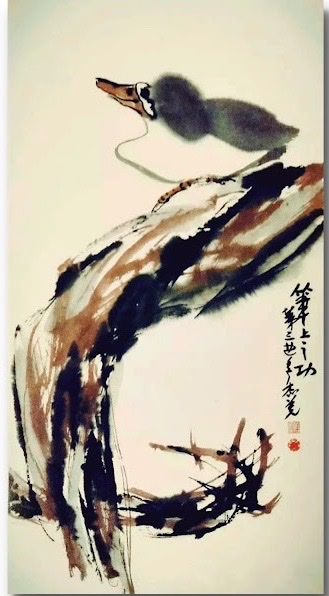
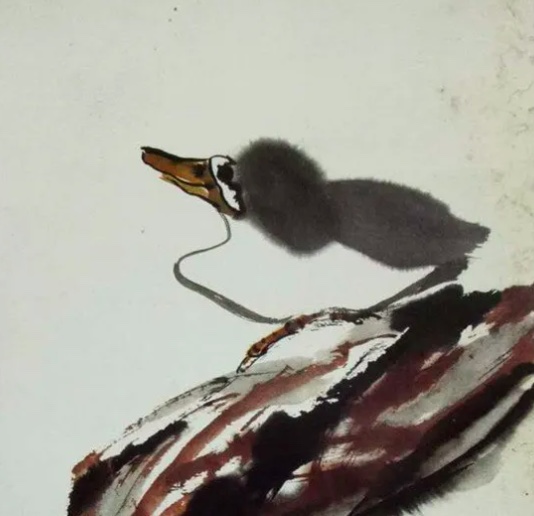
“Bi Shang Zhi Gong (Skillful Brushwork)” is a masterpiece of Chinese flower and bird painting that appears fresh and clear at first glance, profound in meaning after viewing, and unforgettable after further contemplation. The composition is extremely simple: in the center of the painting is a uniquely shaped bird with a flat, long beak and a spotlessly white belly. It sits comfortably and alone on the curved, thick trunk. Its eyes are ethereal and deep, as if completely focused; its posture demonstrates that wherever it is, is the focal point.

Upon careful observation, you will find that everything in the painting is in a state of colorful transformation. The bird’s head and back are painted with two blocks of ink that are close in shade, creating a melting effect, with the ink color seemingly still wet and spreading around.

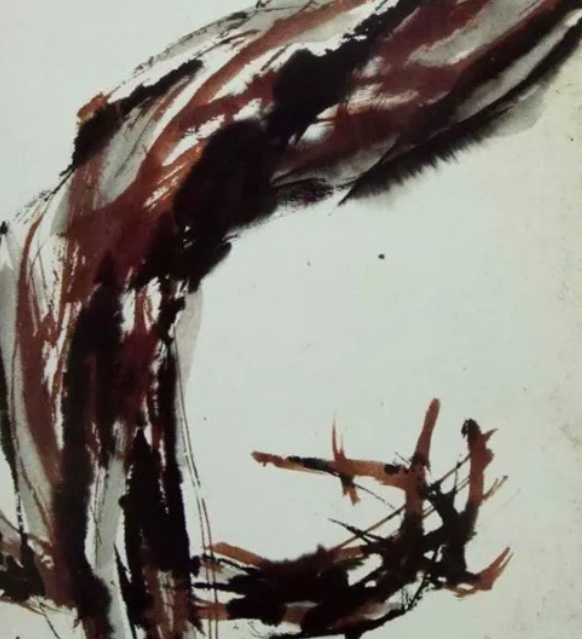
The trunk’s ink lines are clear and distinct, resembling a tree yet not quite a tree, as if constantly changing in the impermanence. At the bottom left of the tree, a branch twists and turns out, creating an S-shaped composition in the painting that is still in motion. The painting also uses color sparingly, with only a warm and friendly purple-brown color applied to the bird’s beak and the trunk.

This painting has a fascinating story behind it. It was created in 1982 during the filming of a movie in Sanhe, Sichuan. The painting captures an on-the-spot portrayal of a real-life scene. The artist used ink sparingly, treating it as if it were as precious as gold, while still showcasing his exceptional skills. At the time, the News Film Studio of China was producing a documentary exclusively about the artist, Master Yi Yungao (H.H. Dorje Chang Buddha III).

The cameramen and other observers witnessed a wild duck landing on a withered tree trunk. Master Yi Yungao quickly picked up his brush and swiftly completed the entire painting. By the time the wild duck took flight again, the painting had already been finished. Furthermore, the artistic mastery embodied in this artwork is extraordinary. It not only preserves the elegance, purity, and high-quality of traditional paintings but also introduces a new style—expressing the artistic conception of returning to original purity and simplicity. The artist, with an unfettered hand and mind, applies his most mature skills without the slightest attachment and with minimal, natural brushstrokes.

This masterpiece Chinese painting by H.H. Dorje Chang Buddha III is rich in literary atmosphere and varied in layers. It does not merely depict the external world, but rather it serves as a true manifestation of the inner spirit, transcending the natural material form to open up the world through the illumination of life’s spiritual light, reflecting the spiritual world. Appreciating the painting can reveal the pure world behind it, where everything, including the self, is forgotten, remaining untainted.

This painting is part of the permanent exhibition at The International Art Museum of America, located in the heart of San Francisco.

Bi Shang Zhi Gong – Skillful Brushwork

Link:https://peacelilysite.com/2023/10/26/bi-shang-zhi-gong-skillful-brushwork/

#DorjeChangBuddhaIII #HHDorjeChangBuddhaIII#DorjeChangBuddha#IAMA#InternationalArtMuseumofAmerica #ChinesePainting #MasterYiYunGao

Ms. Han Suyin held the Young painter in the Highest Esteem, and His Artworks Reached Record-breaking Prices at Auctions

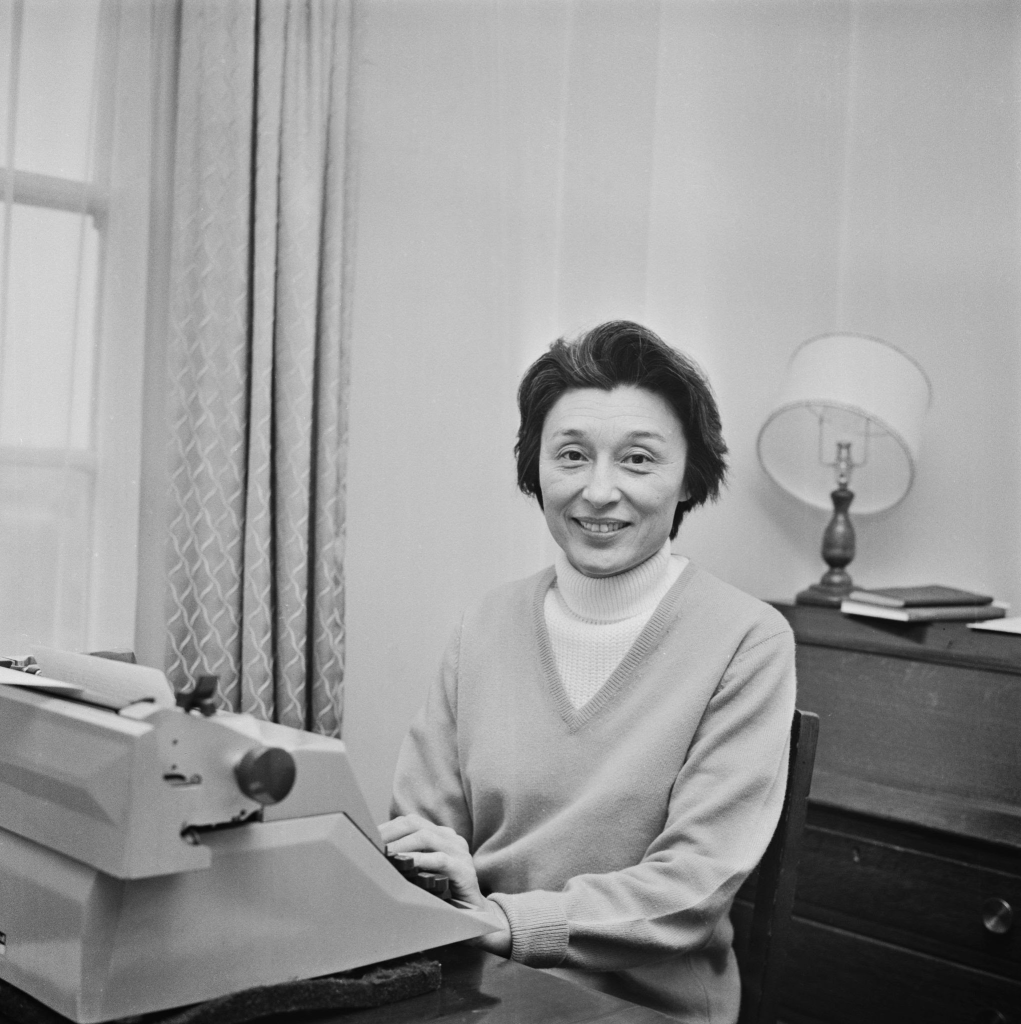
Han Suyin was born in Xinyang, Henan Province, China, on September 12, 1916, to a Chinese father and a Belgian mother. She was raised in a multicultural and multilingual environment, which greatly influenced her future writings and perspectives.

Ms. Han Suyin gained international recognition as a prolific writer, primarily known for her semi-autobiographical novels. Her most famous work, “A Many-Splendored Thing,” published in 1952, became a bestseller and was adapted into a successful Hollywood film titled “Love Is a Many-Splendored Thing” in 1955. She authored numerous novels, essays, and articles that delved into themes of love, cultural identity, and East-West relations.

Ms. Han Suyin, an extraordinary figure in her own right, shared a remarkable connection with world leaders and spiritual luminaries from across the globe. Her life was intertwined with a little-known story of profound affinity with a great sage.

In February 1982, Ms. Han Suyin and her husband, Mr. Lu Wenxing, made a long-awaited journey to Sichuan, their ancestral homeland, to celebrate the Chinese New Year with their family. This marked her first return to Sichuan for the New Year since the establishment of the People’s Republic of China. As a professional writer, she was an unwavering observer of the human and cultural aspects of her homeland. She once articulated, “My life will forever traverse two opposing directions, leaving love to embrace love; leaving China to return to China.” This succinctly summarized her life’s journey. Her deep love for this ancient land fueled an unceasing quest for individuals with profound philosophical ideals, firmly convinced that within the mystical realm of China’s ancient civilization, cultural giants awaited discovery to awe the Western world.

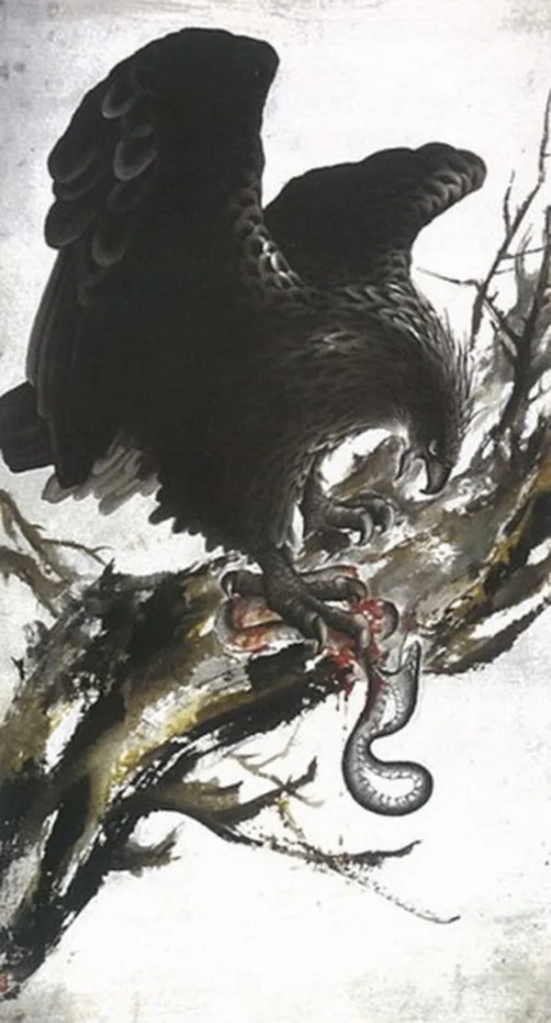
Fate and reason have their own ways. Soon, Ms. Han Suyin discerned her calling with remarkable acumen. While visiting an exhibition of Chinese paintings at Sichuan’s Wenshu Monastery, she was captivated by a yet-to-be-displayed masterpiece of a soaring eagle. The painting exuded vastness, antiquity, ethereality, and enduring profundity. Having toured renowned art museums worldwide and seen countless world-famous paintings, she found herself profoundly moved by this artwork, eagerly wishing to acquire it as a lifelong treasure. Regrettably, the exhibition had not yet officially opened, dashing her immediate hopes.

With the assistance of the local cultural department, Ms. Han Suyin eventually tracked down the artist behind the masterpiece. To her astonishment, the creator was an elegant young man, and an instant kinship developed between Ms. Han and this young prodigy. Their conversations touched upon a spectrum of subjects, from various styles within the Chinese art scene to global artistic movements and the evolution of humanistic ideals.

Upon parting ways, Ms. Han Suyin not only acquired the eagle painting for her collection but also handpicked two additional Chinese paintings, intending them as cherished gifts for her close friends. Thus, an international writer and an ancient sage forged a profound and enduring connection.

In 1993, eleven years later, Ms. Han Suyin reflected on this treasured memory, describing it as follows: “…I was the first fortunate individual to witness His artwork and immediately recognize His talent. His painting technique, marked by ever-shifting nuances and a compelling balance of strength and delicacy in each brushstroke, left an indelible impression on me. His vast knowledge and wide-ranging interests extended beyond art into the realm of traditional Chinese herbal medicine. His passion for medicine stemmed from his father’s status as a renowned traditional Chinese medicine practitioner. Moreover, he ventured into enhancing a particular palace-grade tea and brought it to market. In recent years, he has dedicated himself to creating a significant work, striving to establish a new life philosophy rooted in the authentic principles of Buddhism and the universe. Consequently, he produced internationally acclaimed paintings. His series of paintings featuring Buddhist monks garnered high praise in Japan and Singapore. His achievements were also acknowledged in North America, where he assumed a professorship at the Sino-American Cultural and Arts Research Institute and served as the president of the Chinese Painting Research Association at the Chinese Social Welfare and Education Center in Beijing. I genuinely believe he is an exceptional artist, and I am firmly convinced that his unwavering pursuit of knowledge will lead to even greater accomplishments…”

So, who is this extraordinary sage whom Ms. Han Suyin esteemed, and whom the world came to admire? None other than H.H.  Dorje Chang Buddha III.

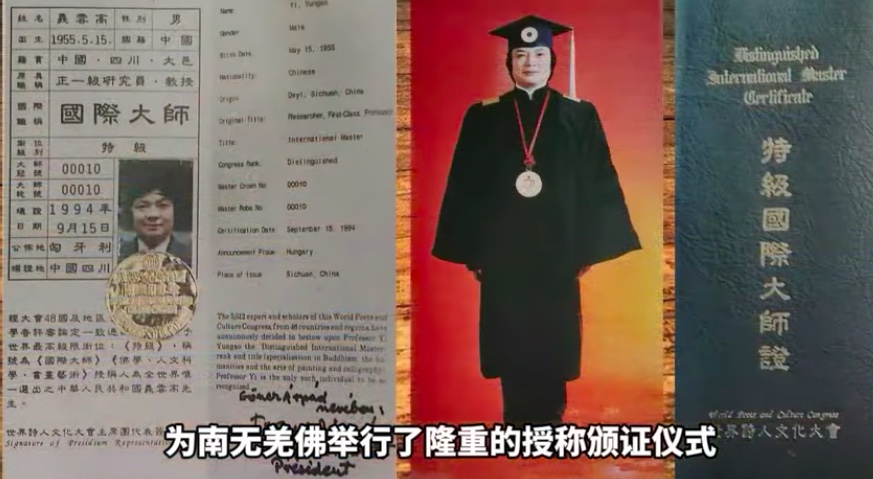
It must be acknowledged that Ms. Han Suyin’s discerning judgment was remarkably precise, as she firmly believed. H.H.  Dorje Chang Buddha III‘s achievements were indeed unparalleled. In 1994, at the World Poets Conference, 5,612 experts and scholars from 48 countries and regions acclaimed Mr. Yi Yungao (H.H.  Dorje Chang Buddha III ) as the world’s sole supreme international master, acknowledging his extraordinary contributions in Buddhism, the humanities, medicine, painting, and his lofty moral character. On September 28 of the same year, special envoys from the conference traveled to Sichuan to present him with the certificate of supreme international master, bearing the signature of the President of the International Olympic Committee, Samaranch.

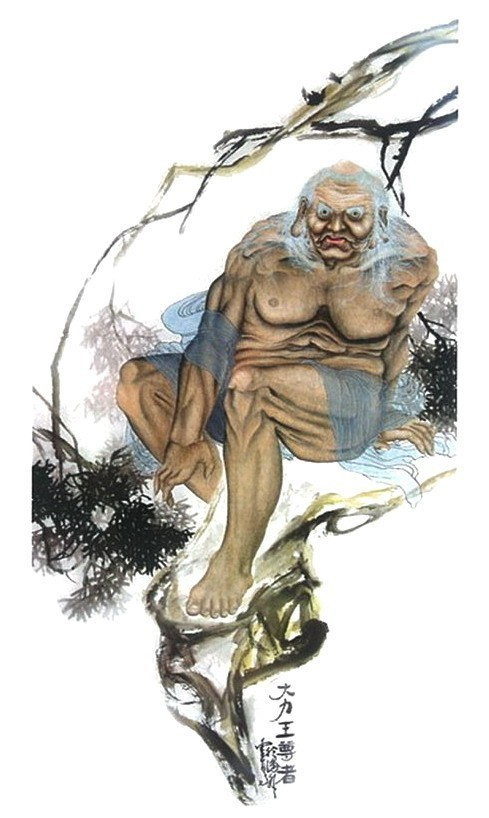
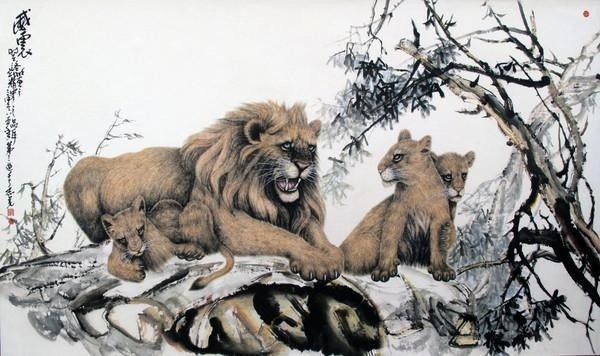
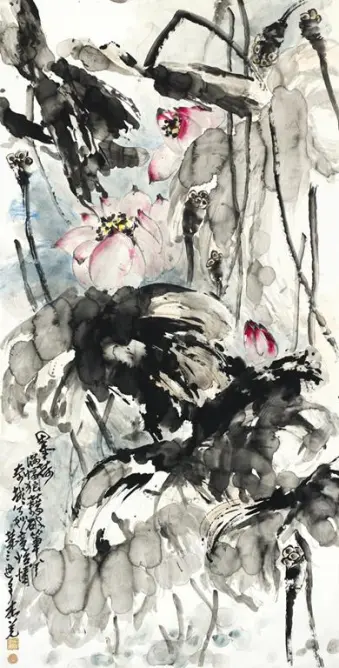
In the year 2000, H.H.  Dorje Chang Buddha III‘s artworks “Thunderous” and “Great Strength Vajra” achieved prices exceeding 2.12 million dollars and 2.2 million dollars, respectively, in the international market. Then, in March 2015, his artwork “Ink Lotus” set a record price at the New York Spring Auction, reaching an astonishing 1.65 million dollars per square foot.

Vulnerable Dali Wang
威震 WeiZheng (Thunderous)

Ink Lotus

You can appreciate all these three masterpieces at The International Art Museum of America (IAMA).

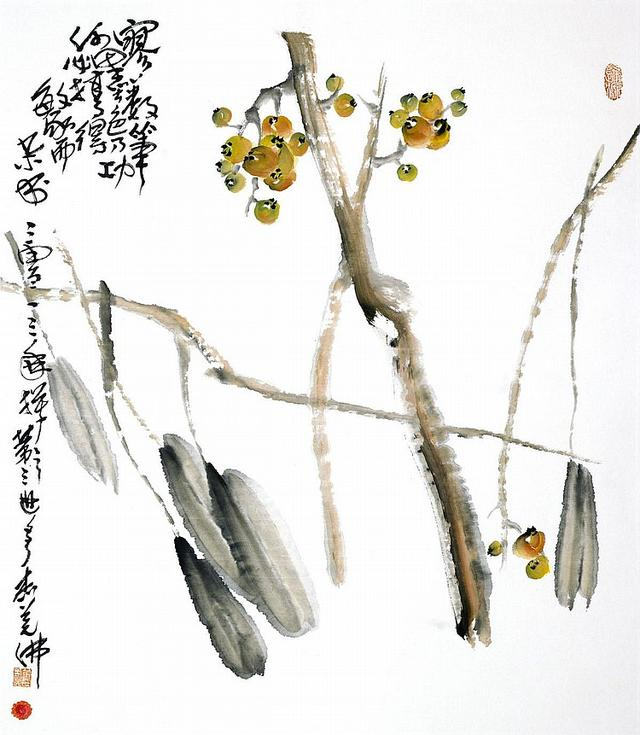
Another piece, “Loquat,” measuring six square feet, was successfully auctioned at an astounding price of 10.2 million dollars at the New York Zhenguan International Auction Company’s autumn auction, establishing an unprecedented record for Chinese paintings in the auction market. When calculated on a per square foot basis, it reached an astonishing 1.7 million dollars per square foot. The painting, “Loquat,” drew praise from experts at the auction company during the autumn preview, exceeding the criteria of a “masterpiece” set by ancient Chinese art critics. They described it as follows: “In the style of H.H.  Dorje Chang Buddha III , this painting exhibits an ever-changing technique, with strength and depth in every brushstroke, and an endless charm.”

World news media reports have hailed H.H.  Dorje Chang Buddha III as an “unprecedented master in the history of Chinese painting” and as the “pioneer who propelled Chinese painting art onto the global stage.” At this juncture, we, the younger generation, express our deep admiration and respect for Ms. Han Suyin’s extraordinary discernment.

Ms. Han Suyin held the Young painter in the Highest Esteem, and His Artworks Reached Record-breaking Prices at Auctions

Link: https://peacelilysite.com/2023/09/22/ms-han-suyin-held-the-young-painter-in-the-highest-esteem-and-his-artworks-reached-record-breaking-prices-at-auctions/

#MasterYiyungao #InternationalMaster #ChinesePaintings #MsHanSuyin #DorjeChangBuddhaIII  #HHDorjeChangBuddhaIII #DorjeChangBuddha#IAMA#InternationalArtMuseumofAmerica

Source: https://www.tpcdct.org/article/4869

The Three Perfections: Image, Poem, and Calligraphy in Chinese Painting

In traditional China, painting was revered as “silent poetry,” while poetry was seen as “painting with sound.” Both art forms found expression through the medium of calligraphy, which was considered the “art of handwriting.” Scholars and artist-scholars incorporated calligraphic brushstrokes into their paintings, viewing their artworks as vehicles for self-expression. Consequently, painting was not only regarded as an art form of equal purity and lyricism to poetry and contemplative thought but also as a means to evoke sensory experiences, emotions, and a holistic engagement with the world.

For Western observers, it may be intriguing why Chinese artists incorporate writing in their paintings and what significance the characters hold. By examining some of H.H. Dorje Chang Buddha III’s paintings, we can gain insight into these questions and witness the embodiment of the concept known as the “Three Perfections.” This concept represents the harmonious fusion of fine painting, poetry, and calligraphy within a single artwork.

Song of the Waves in the Three Gorges by H.H. Dorje Chang Buddha III

This painting, titled “Song of the Waves in the Three Gorges,” beautifully captures the grandeur of splash-ink technique alongside the charm of water and ink colors. Its overall tone carries a weighty presence. The brushwork employed in this artwork evokes a powerful sense of momentum, lively charm, and a vividness akin to the scene of a long, flowing river just passing by. The inclusion of a few small sailboats adds elegance to the water scene as they gracefully navigate through it. The combination of the mighty river and awe-inspiring mountains, enveloped in mist and holding sacred spaces, has a purifying effect on one’s emotions. This painting possesses a quality that is reminiscent of both poetry and calligraphy.

Notably, H.H. Dorje Chang Buddha III has inscribed an elegant Chinese poem onto this painting, which can be translated as follows: “The song of waves echoes in the gorge. Hanging colors of rocky cliffs burst with charm. A few cloudy, misty mountains reveal shades of blue. The vast water’s melody sets the sails in motion.” This poem aptly captures the beautiful and misty landscape of the Three Gorges, where the water and sky harmoniously blend, and human emotions become intertwined with the scenery. This painting serves as an artistic paragon, showcasing the mastery of poetic, calligraphic, and painting skills.

Yi Shan Shui Yun Liang Qing Nong ( One Landscape Charm Presents Two Strong Emotions) By H.H. Dorje Chang Buddha III

This remarkable painting showcases a rare combination of splash-ink and splash-color techniques, displaying the artist’s bold and skillful brushwork. The resulting natural effect achieved through these techniques is truly indescribable. Within the bold and dynamic brushstrokes, one can discern countless intricate details and traces of charm emerging from the flowing watery ink.

The painting depicts a scene of mountains and water during the approaching dusk, conveying a profound message. The poem imparts the wisdom that we should strive to engage in virtuous deeds rather than harmful actions, treating all living beings with kindness and respect. By embodying such a way of life, one can transcend to another realm and grasp the truth of existence beyond the concepts of birth and death. This painting offers a profound contemplation on the purpose and significance of human existence.

The calligraphy in the two art works are executed in a cursive style, known for its swift and dynamic strokes. Cursive writing is often characterized by its rapidity and vitality, effectively conveying the artist’s profound emotions.

These paintings are in the permanent exhibition at The International Art Museum of America  in downtown San Francisco. Admission of the museum is free.

The Three Perfections: Image, Poem, and Calligraphy in Chinese Painting

Link:https://peacelilysite.com/2023/06/02/the-three-perfections-image-poem-and-calligraphy-in-chinese-painting/

#DorjeChangBuddhaIII #HHDorjeChangBuddhaIII  #MasterWanKoYee #Buddha#IAMA#InternationalArtMuseumofAmerica #ChineseCulture #ChinesePainting#ChineseCalligraphy #SplashInk #WaterColor

A Chinese Painting Conveys Profound and Enchanting Meaning

A Lotus Pond Has Carp by H.H. Dorje Chang Buddha III

The Title “A Lotus Pond Has Carp” suggests profound Philosophical implications that transcend everyday life. In addition to its masterful artistry, the painting contains subtle messages of the Dao and its fruits. The lyrics on the left and right sides of this work correspond perfectly with the image of the fish, forming a whole that awakens and enlightens, richly rewarding its viewers.

Why is this painting so artistically enchanting that it stirs the hearts of those who see it? One reason is that the fish are depicted with uncanny realism. The swimming carp are infused with vitality. The painting’s details clearly reveal the damage done to the carp’s skin, accumulated over a lifetime in the water, through lines that fade in and out. Appearing as delicate as a fine gauze, the translucent fins, for example, possess a natural realism. Texture and spirit are captured with utter precision, providing the viewer with stirring aesthetic pleasure. The surface and bottom of the pond are depicted with a wonderfully hazy charm, while the lotus flowers, leaves, and pods are portrayed in bold freehand brushwork with distinct and unusual brushstrokes rapidly applied.

The painting is mainly composed of back ink and rich colors. Only a few brushstrokes were used to create each vibrantly red flower, which seem to emit a pure fragrance. The hanging lotus pods embellish the painting, conveying an elegant contrast of hues and instilling a sense of vitality. As the fish swim about, free of any inhibition, the sunlight faintly reflecting off the water ripples provides the illusion of movement that occurs in the natural world.

When examined more closely, the painting has an intricate style to ascertain, for it seems to transcend realistic fine brushwork and convey the feeling of freehand brushwork. It is not in the style of conventional paintings. Instead, freehand brushwork was applied to produce the effect of fine brushwork with close attention to detail.

Fine brushwork was applied that transcends realism. The real and the surreal blend, resulting in a work that excels the beauty of a natural lotus pond. It represents a combination of techniques from the “Menglong” style of painting and bold, large-scale freehand brushwork.

For the painting, H.H. Dorje Chang Buddha III composed these lyrics of a Dao song: “No Dao exists on the high mountain, yet hearts yearn to go there. A lotus pond has carp; men have inquired about them. Which path leads to the truth is worth pondering. It would be better to look tranquil to our original nature, like a lotus flower sitting over its leaves in tranquility.” These lyrics speak of mysteries unknown to the ordinary person – seeing fish, not as fish; seeing water, not as water; no Dao exists on the high mountain, so no value exists in searching for it; and the fish have neither life nor death.

To understand the origin of the painting, we must ask: where did the fish come from? What state of realization was relied upon and gave birth to this exquisite painting? What form of realization manifested this mysterious, hazy, and illusory painting? The magical illusion of the fish and water is nothing more than a superficial image. Spirit is within; A life force underlies spirit. Spirit is empty or nothingness. The original essence of all things is neither empty nor substantive. Everything illusory and impermanent quickly changes in time and space, but their original nature remains constant. Thus, the lyrics of the Dao song continue: “To find our original nature, do not seek the source, as the source is our original nature, tranquil and unmoving, like a lotus flower sitting over its leaves in tranquility. There is no such thing as arising, passing away, and change. From this surpassing wisdom, usages that arise from Buddha-nature will naturally manifest. These usages include calligraphy and painting. Only in such a way is a consummate work created.” Thus, one should understand the tremendous meaning of this song of Dao written in this painting. Profound mysteries are deeply hidden within it.

In case the viewer remains oblivious to right stanza, on the left side of the painting, the second stanza of the song continues with: “The carp rely on the Dao, and the Dao awakens the fish.” The Dao refers to the state of holy ones, a realm that transcends the realm of ordinary people. It does not refer to regular abilities. The artist created this carp painting based on such a holy state. “The Dao awakens the fish” means that this painting of carp in a lotus pond was accomplished based on the wisdom of the transcendent Dao. Only with such wisdom could this lifelike, graceful scene of carp swimming in water be painted, a setting that combines the real and the surreal, emptiness and substance in such a wondrously appealing way. This scene of carp complimented by the boldly and powerfully depicted lotus leaves results from the artist’s awakening to the holy Dao.

This painting of carp, then, is merely an expression of one who has attained the Dao and reached enlightenment. Thus, this work is not just an ordinary combination of brush strokes, color, ink, and water. Instead, it results from techniques derived from the beautiful application of holy wisdom. The profound mysteries contained in “A Lotus Pond Has Carp” cannot possibly be conveyed by the superficial meaning of the words in its title! Actually, this explanation is entirely unnecessary. All those with discerning eyes will understand once they see the lyrics of the Dao song and the calligraphic skills with which they were written on the painting.

A Chinese Painting Conveys Profound and Enchanting Meaning

Link:https://peacelilysite.com/2023/05/25/a-chinese-painting-conveys-profound-and-enchanting-meaning/

#DorjeChangBuddhaIII #HHDorjeChangBuddhaIII#DorjeChangBuddha#IAMA#InternationalArtMuseumofAmerica#ChinesePaintings#Carp #LotusPond #Painting #Lotus

Source: https://new.artsmia.org/exhibition/the-three-perfections-image-poem-and-calligraphy-in-chinese-painting, iamasf.org

Discovering a Hidden Gem in IAMA Gift Shop

A Majestic Wood Carving Depicting Spiritual Growth and Achievements in Buddhism

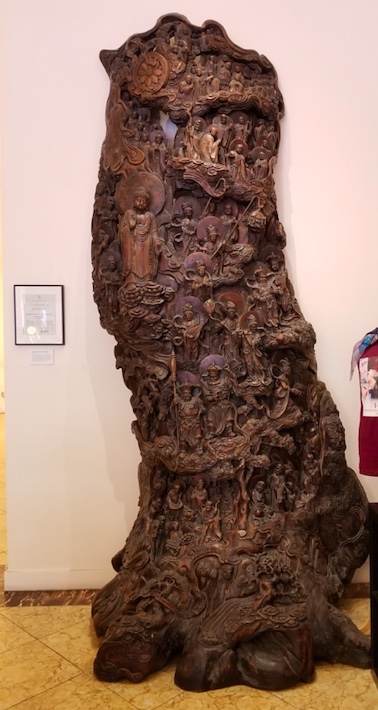
In a world where art manifests itself in countless forms, there are rare instances when we stumble upon something truly extraordinary—a concealed treasure that enthralls our senses and moves us on a deep level. Such a remarkable encounter occurred one fateful day as I explored the gift shop at The International Art Museum of America (IAMA), nestled in the heart of downtown San Francisco. Amidst the vast array of artistic wonders, my gaze became fixated on an exquisitely crafted wood carving—a masterpiece that exuded an ethereal essence of spirituality and profound significance.

This awe-inspiring sculpture, meticulously chiseled from a single tree, originated from China and was skillfully brought to life by gifted folk artists. It portrayed an enchanting realm of spiritual growth and profound accomplishments in Buddhism. Towering at an impressive height of approximately three and a half meters and spanning one meter in width, this artwork was a testament to the dedication and artistry of its creators. Every intricate detail, meticulously carved figures, and delicate embellishments, painted a vivid tableau illustrating the virtues of compassion, enlightenment, and the transformative journey towards Nirvana.

The intricately carved sculpture was a masterpiece that depicted the journey of practitioners from being ordinary to mastering the higher levels of Buddhahood. The figures in the relief were so vividly carved that it was easy to see their progression towards enlightenment and Nirvana. Every detail, from the facial expressions to the flowing cloth, the delicate flowers, and the instruments, was so meticulously presented that it was impossible not to be impressed.

The beauty of this piece lay not just in its stunning visual presentation but also in the message it conveyed. It illustrated the importance of practicing compassion in thoughts, words, and deeds to achieve spiritual growth. It reminded us that every act of kindness, every gesture of love, and every moment of selflessness is a step towards enlightenment and Nirvana.

The sculpture had a calming effect on me. It was a tangible reminder of the power of art to transcend language, culture, and time. It spoke to me in a language that was universal, one that transcended borders and connected people across the world.

As an art lover, I have seen many beautiful pieces over the years, but this wood carving sculpture stood out as a true masterpiece. It was a testament to the skill and craftsmanship of the folk artists who created it, and it served as a reminder of the timeless beauty of art.

Discovering a Hidden Gem in IAMA Gift Shop

Link:https://peacelilysite.com/2023/05/18/discovering-a-hidden-gem-in-iama-gift-shop/

#Buddhism #IAMA#InternationalArtMuseumofAmerica #Art #Artist#ChineseCulture#Sculpture #WoodCarving #Buddhahood #Enlightenment #Nirvana

Gao Zu Bao MaXi (High-Leg Treasure Horses)

Gao Zu Bao MaXi (High-Leg Treasure Horses)
Artist: H.H. Dorje Chang Buddha III 

The High-Leg Treasure Horse is a thoroughbred horse with great stamina. When this treasure horse perspires, it appears to be bleeding due to the color of its perspiration. According to ancient legend, it is the most precious among all species of horses. It has the reputation of being able to travel over three hundred miles a day. Long mane hairs and a mighty, strong-willed, handsome appearance are its prominent characteristics.
The High-Leg Treasure Horses in this painting have longer legs than horses commonly seen in paintings. The hairs of their manes are also long and strong. An extremely rare brushwork technique that combines haziness with clarity was applied to paint the hairs of the horses. The gossamer-thin hairs are strong but pliable. One can clearly see the natural effect of sunlight on the horses’ manes. Moreover, contrasting variations of dark and light are seen in every hair. The hairs of the horses are depicted with a realistic effect that nonetheless transcend their natural look.


An artistic technique was used to thoroughly capture on paper the charm and atmosphere of the grassland, lake, sky, and land. The “haziness technique” was applied to express a state of realization in which there is no distinction between emptiness and form.
The ancient cypress tree was drawn in one shade of green without the need to add decorative touches in several different shades of green. Both the spirit and form of the tree were captured through the artist’s brush. In addition, elegant charm is revealed by a small number dots of red leaves in the background that compliment the scene. The most difficult part of this work of art was painting the roots, trunk, and leaves in a spontaneous, casual manner using the center brush-up technique yet maintaining a scholarly tone. Such mastery of painting cannot be easily attained and requires solid skills in calligraphy, literature, and painting as well as a noble moral character.
From the brushwork style and details of this painting, we can sense the profound inner-cultivation of a renowned scholar. The abilities of a literary giant with abundant talent are visible everywhere. The scholarly tone and brushwork style are skinful and vigorous, totally free of any trace of the mundane, and reflect the highest level of painting and calligraphy.
Anyone who lifts a brush in an attempt to paint such painting will appreciate the fact that this scholarly style cannot be accomplished by anyone other than a literary giant who is a great master of art.
This painting coherently unites realism and small-scale freehand brushwork as well as the use of haze and clarity.

This painting is in the permanent exhibition of The International Art Museum of America. H.H. Dore Chang Buddha III, an artist of great talent, has created sixteen distinctive painting styles. The composition we are discussing here belongs to the “Menglong” style. This style combines realism and non-realism to capture the essence of the portrayed subject, resulting in a seemingly realistic but actually non-representational depiction. The brush strokes and color application in these paintings create a whimsical and dreamlike appearance, where the real and surreal merge into a lovely and hazy composition.

Gao Zu Bao MaXi (High-Leg Treasure Horses)

Link:https://peacelilysite.com/2023/04/25/gao-zu-bao-maxi-high-leg-treasure-horses/

#MasterWanKoYee #DorjeChangBuddhaIII #HHDorjeChangBuddhaIII#DorjeChangBuddha#IAMA#InternationalArtMuseumofAmerica

Art Works by Professor Yuhua Shouzhi Wang and Her Great Wisdom and Compassion

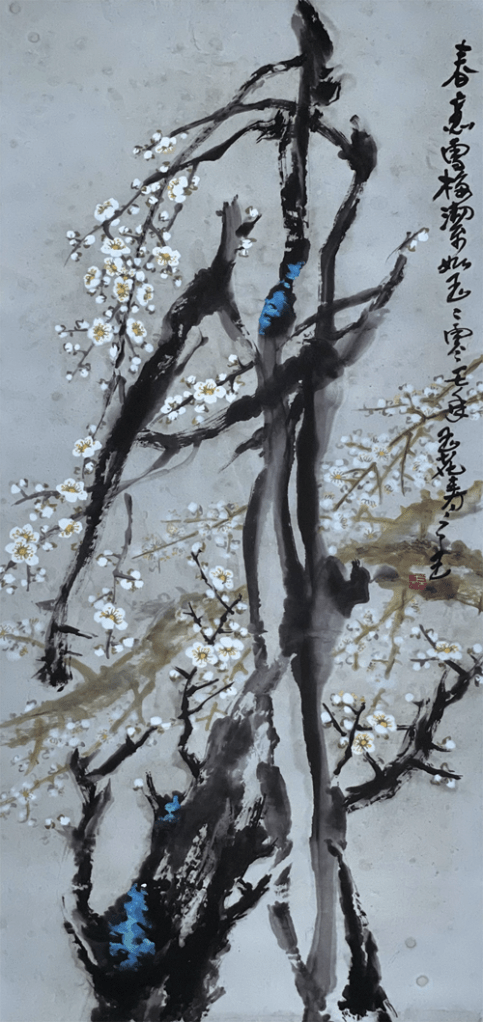
Springtime Snow-White Plum Blossoms as Pure as Jade

At the International Art Museum of America in downtown San Francisco, there is a special exhibition room, dedicated to Professor Yuhua Shouzhi Wang. This installation was established in 2018, containing a variety of water and ink paintings as wells as sketches. Professor Wang’s acclaimed works have been displayed all over the world, including an exhibition at Congress in 2008, where they called her work a ‘treasure of the world’. In 2019, Professor Wang’s art was exhibited at Shanghai Exhibition Center in China and the Louvre Museum in Paris. An art critic Aude de Kerros praised this event in Paris, saying ‘I have curated and critiqued so many art exhibitions, yet I have never seen an exhibition like this where all the guests are so touched and amazed by the art.’ Following the Paris exhibition, Professor Peter Drake, the Provost of the New York Academy of Art, presented a certificate to Professor Wang, recognizing her extraordinary contributions to representational and abstract art. In December 2020, the Chairman of Centre for Peace in United Nations Educational, Scientific and Cultural Organization (UNESCO), Guy Djoken awarded an “International First-Class Artist” title to Professor Wang for her accomplishment. Professor Wang is the only Asian artist who has ever received such a title. On December 29th 2020, Chairman Guy Djoken came to the museum to personally present the title certificate to Professor Wang.

Hand crafted cobblestone
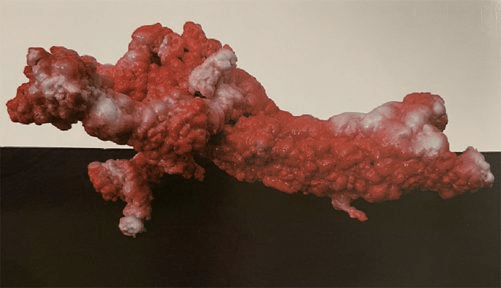
Hand Crafted Coral Sea Palace Monarch

Many people are aware that Professor Yuhua Shouzhi Wang is a world-renowned artist. However, the true identity of Professor Yuhua Shouzhi Wang is revealed as Fomu, Holy Mother the Great Mahasattva. She embodies great wisdom and compassion, noble morality, kindness, altruism, and selflessness in a perfect manner. She always considers other people’s well-being and is humble and very approachable. The compassion and kindness of Fomu, Holy Mother the Great Mahasattva, are pure and flawless. For example, in 2015, someone sneaked into the International Art Museum of America in San Francisco and tried to steal an artwork that had been acclaimed by the World Federation of UNESCO (WFUCA). This person was arrested by the police on site and subsequently detained. Since the artwork that he tried to steal was one of Fomu’s masterpieces, the court repeatedly requested Fomu to provide a valuation of the artwork, so that they could use her valuation to determinethe term for sentencing. When Fomu, Holy Mother the Great Mahasattva, knew about this person’s distress, She provided a statement saying that the artwork was rather ordinary and had no value. The court had no way of sentencing the person to any term and had to release him.

Another time, Fomu, Holy Mother the Great Mahasattva, saved a butterfly that had fallen into the water. Worried about the butterfly’s safety, Fomu brought it home and kept it for a few days to make sure the butterfly is well-recovered before letting it fly away. Fomu relentlessly led disciples to conduct life-releases. She went every week to woodlands to feed ducks and birds and never missed a week. She paid for it with Her own money and never accepted offerings from Buddhist disciples. Fomu, Holy Mother the Great Mahasattva, is well known for Her diligence and thriftiness. For many decades, the noble Fomu, Holy Mother the Great Mahasattva, always cooked Her own meals and washed Her own clothes. She never entrusted others to do Her chores. She would save the food that She could not finish eating and finish it the next day or two. She was never wasteful. Usually, Fomu, Holy Mother the Great Mahasattva, would even save the water that She did not finish drinking, the water used for washing vegetables or hands, or wastewater from the filter and use it for irrigating flowers or flushing toilet. Through Her deeds, the Great Fomu, Holy Mother the Great Mahasattva, was teaching us how to start with the small things, cherish our good fortune, and actualize our cultivation practices.It is impossible to recount all the numerous exemplary deeds of Fomu.

Photo from internet weixin.com

Wherever Fomu, Holy Mother the Great Mahasattva, went, dragon Dharma protectors were present, and holy miracles manifested. When Fomu performed initiation and transmitted Dharma, holy states were manifested. For example, at the Antelope Valley, Fomu’s hat turned into a black garuda. In New Jersey, the hair of Fomu, Holy Mother the Great Mahasattva, suddenly went up and wrapped around a tall building in Manhattan on the opposite shore. In San Francisco, a twin Buddha light suddenly appeared, centered around where Fomu stood. All cultivators are touched by the compassion and morality of Fomu, Holy Mother the Great Mahasattva.

Art Works by Professor YuHua Shouzhi Wang and Her Great Wisdom and Compassion

Link:https://peacelilysite.com/2023/04/14/art-works-by-professor-yuhua-shouzhi-wang/

#ProfessorYuHuaShouZhiWang#Art#Artist#ClassofEase#InternationalArtMuseumofAmerica#TenUltimateArtistries#ArtistofFirstclassstanding #Inkpaintings #LotusPainters #HolyMother #Fomu #GreatMahasattva

Hand Crafted Corals By Dr. Yuhua Shouzhi Wang

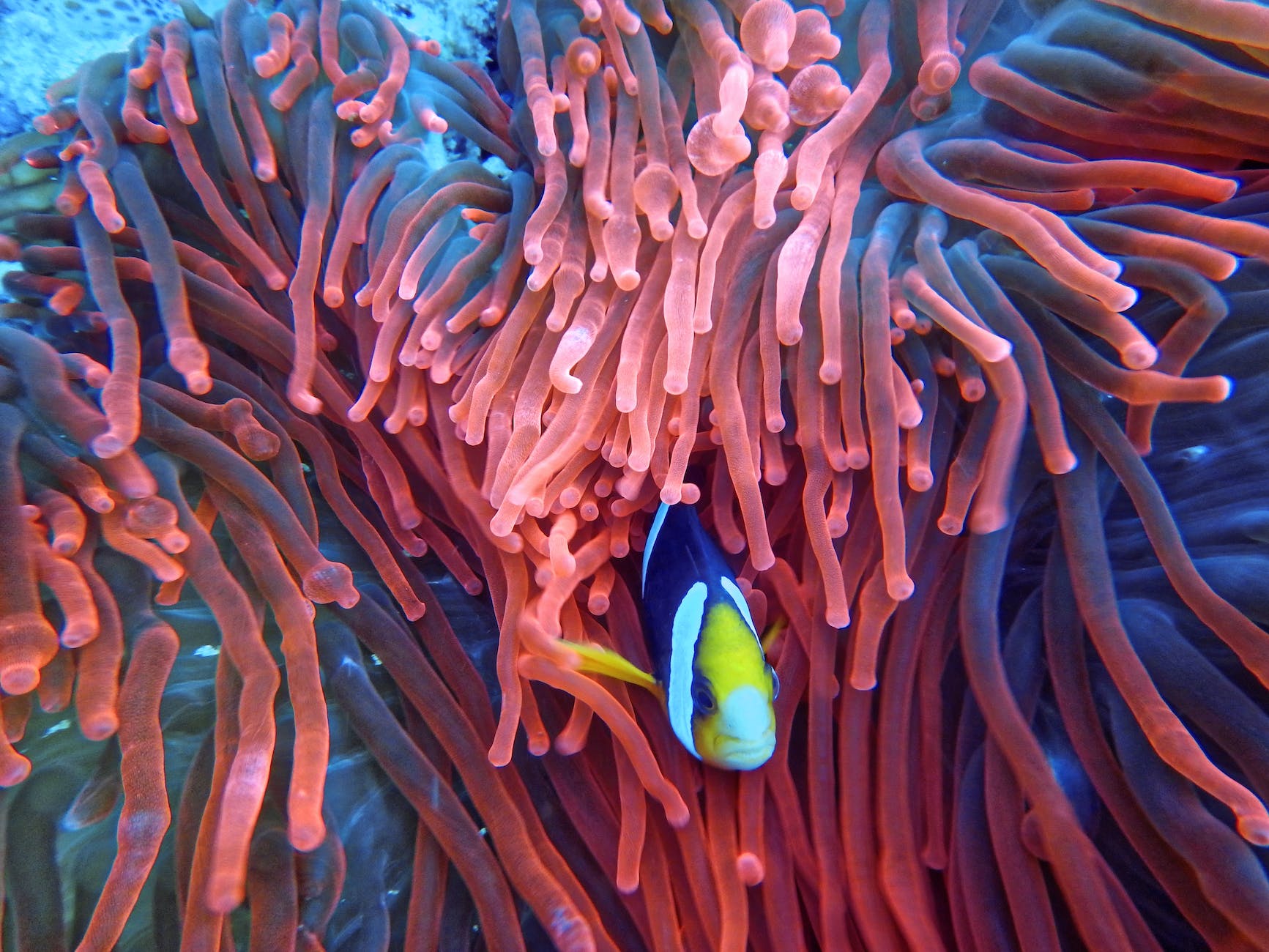
Photo by Tom Fisk on Pexels.com

Hand Crafted Corals By Dr. Yuhua Shouzhi Wang

Dr. Yuhua Shouzhi Wang is a highly skilled and talented artist who has created a unique form of art using hand-sculpted wood and oil paints. Her faux coral sculptures are so realistic that they are often mistaken for real coral. The texture, watery tone, colors, and charm of her sculptures are breathtaking and truly unique.

In 2008, Dr. Wang’s artworks were exhibited in the Gold Room at the United States Capitol, where her talents were recognized by the United States Congress. She was officially recognized as “a great artist and sculptor” for her outstanding accomplishments and contributions to cultural exchange between the East and the West.

Coral reefs are one of nature’s most impressive creations, often referred to as the “rainforests of the sea.” They are massive structures made of limestone deposited by coral polyps. Dr. Wang’s sculptures not only capture the beauty of coral reefs but also showcase her own artistic talents. Her work truly is a testament to the power of human creativity and imagination.

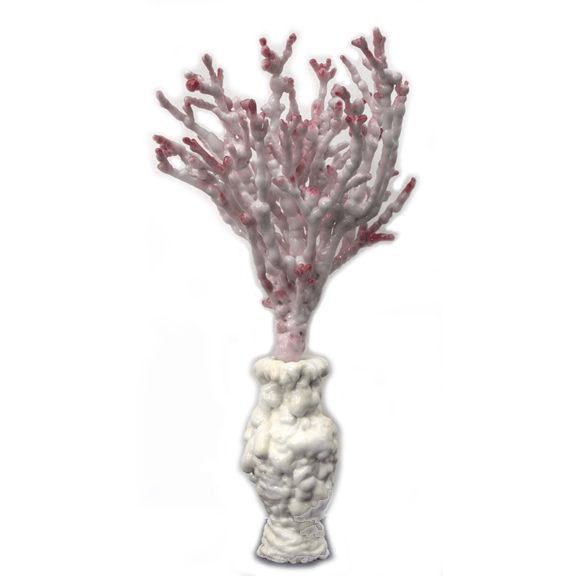
Parched Ancient Coral

This piece was hand-sculpted and painted in oil colors by Professor Yuhua Shouzhi Wang. Its shape and colors are even more genuine-looking and beautiful than those of real coral from the bottom of the sea or parched islands. When touching this sculpture, it tangibly feels like coral that has been eroded through immersion in water for millions of years. One cannot help but marvel at how such coral texture is created by Prof. Wang. Corals of such kind are difficult to find. Its appeal is further enhanced by the matching hand-sculpted vase called Emerald Green Fine Jade. The set has an air of elegance and refinement, surpassing the beauty of natural coral.

Sheep Tallow Dew

Pink, moist-looking, and with an understated luster, this faux coral seems as sleek as sheep tallow jade. It conveys a sense of morning dew that is deeply moving. Its wonder, colors, lustrous beauty, overall quality, and artistic flair unite to form a precious sculpture captivating in both spirit and appearance. Combined with a hand-sculpted, delightful, elegant matching vase of milky white faux jade, it becomes a doubly charming masterpiece. When a special exhibition of the art of Yuhua Shouzhi Wang was held at the United States Capitol, it was stated in the Congressional Record that her wood-based faux coral and cobblestones that she hand-sculpted and painted with oil colors “have become treasures of the world.”

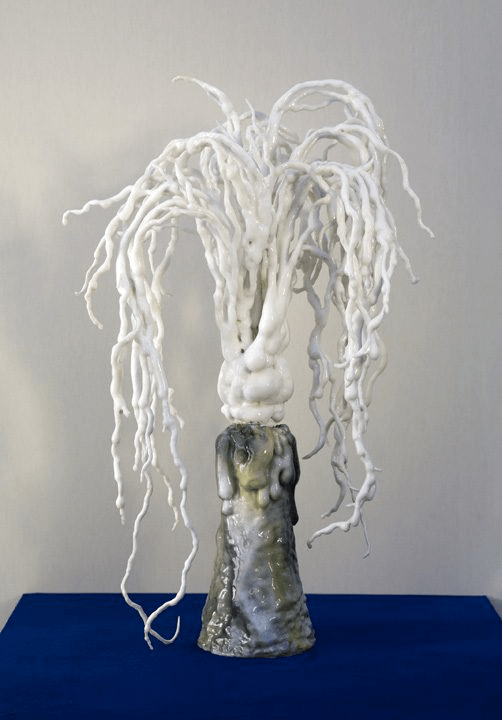
Hanging Coral

This attractively hanging coral is as clean as white jade. After it was sculpted from wood material, it was painted with oil colors and glazed. It conveys a sense of moistness and distinctive texture stemming from its natural-looking shape, hues, and luster. It is sleek yet true to life as if it were real coral. All who view it will enjoy its purity, elegance, and comforting air. Combined with the matching vase called “Cai Yi Tao,” this faux coral appears even more beautiful, attractive, and elegant than real ones in nature. This piece was on view in a dedicated exhibition of Dr. Yuhua Shouzhi Wang at the United States Capitol in 2008.

Sea Palace Monarch

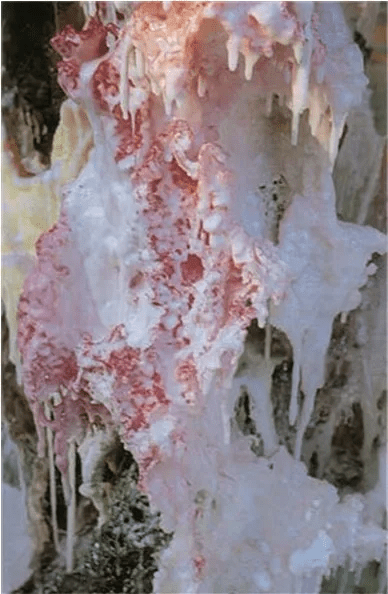
This gigantic coral you now see has been named “Sea Palace Monarch.” Presumably, your first feeling was that of surprise. Is it a genuine coral? Does such large coral exist in the world? If it is not a genuine coral, then why do its luster, texture, and appearance look so real and natural? From the bottom of your heart, you would happily accept it as genuine coral because it is truly so beautiful, so aesthetically pleasing. How beautiful your living room would be if it contained this sculpture! Nonetheless, reason and knowledge tell you that this world could not possibly have genuine coral so huge and so gorgeous. Indeed, even if you searched every corner of every coral reef in the oceans of the earth, you would still not find coral of such beauty and size. Its name, “Sea Palace Monarch,” means that it is the sovereign of the seas since it is the largest treasure in all the oceans. However, such colossal and splendid coral cannot be found in real oceans because it simply does not exist in this world.

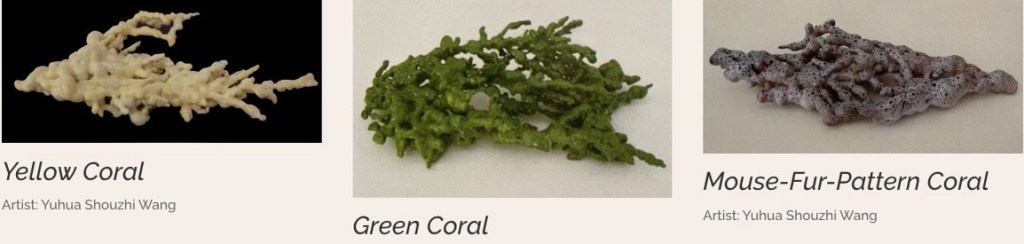
Each of these three faux coral sculptures has its own distinct allure and shades of color. The aged appearance of the mouse-fur-pattern faux coral gives it the particularly strong charm of an ancient fossil from the deep sea. However, the green faux coral, which seems permeable to light, looks as if it was taken from the waters near Malaysia and Indonesia. It was painted in vivid watercolors and conveys sublime elegance. Its delightful spring green expresses purity and freshness. The yellow faux coral resembling fine jade reveals an inner warmth that would certainly be enjoyable to the touch. Each of these three works is an embodiment of talent in sculpting and painting.

With unparalleled works of art such as this, it is no wonder the artistic accomplishments of Yuhua Shouzhi Wang were recognized as “treasures of the world.” Those amazing beautiful treasures are in the permanent exhibition at The International Art Museum of America  in downtown San Francisco. Admission of the museum is free.

Hand Crafted Corals By Dr. Yuhua Shouzhi Wang

Link: https://peacelilysite.com/2023/01/18/hand-crafted-corals-by-dr-yuhua-shouzhi-wang/

#ProfessorYuhuaShoushiWang#Art#Artist#Coral#Treasureoftheworld#craftsmanship#TheInternational Art MuseumofAmerica #Internationalfirst-classArtist

Hand Painted Cobblestones

Hand Painted Cobblestones

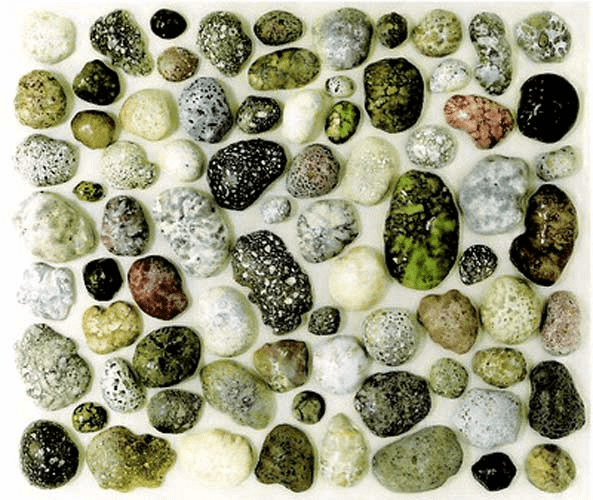
If you’re a fan of cobblestone streets and the charming, rustic aesthetic they bring to a neighborhood, you’ll love these hand painted cobblestones created by Professor Yuhua Shouzhi Wang. These cobblestones were painstakingly hand-sculpted from a light-weight material and then completed with fine, dedicated brushwork by the artist.

Although they may look like real cobblestones at first glance, these pieces are actually more beautiful than the real thing. They are precious works of art, not actual cobblestones. Upon closer examination, it is clear that the texture and color tones of these faux cobblestones are just as realistic as the real ones.

Professor Wang has spent many years sculpting these cobblestones from a light-weight material, and has then meticulously completed them with her fine brushwork. The result is a set of cobblestones that are not only beautiful, but also have the same texture and color tones as real ones. It’s hard to believe that these cobblestones are not the real thing when you look at them.

In The International Art Museum of America  permanent exhibition, has a set of seventy seven these cobblestones in total. These cobblestones are more than just a pretty facade. They are truly works of art, and a testament to the dedication and talent of Professor Wang. Every pebble she creates is unique, with its own shape, texture, color, and degree of weathering and aging. And with each pebble being an independent fine brushwork painting, it’s clear to see the level of detail and craftsmanship that goes into each one.

In year 2019, New York Academy of Art has certified that Dr. Yuhua Shouzhi Wang is the international first-class artist in the world, who is ranked at the same level as Cezanne, Gaugain, Monet, and Van Gogh.

If you have the opportunity to see Professor Wang’s hand painted cobblestones in person, I highly recommend it. They are a sight to behold and a true work of art. You’ll be amazed at the level of detail and craftsmanship that has gone into creating these precious pieces. So don’t miss the chance to see these hand painted cobblestones at The International Art Museum of America  in downtown San Francisco. Admission of the museum is free.

Hand Painted Cobblestones

Link:https://peacelilysite.com/2023/01/11/hand-painted-cobblestones/

#ProfessorYuhuaShoushiWang#Art#Artist#Cobblestones#craftsmanship#TheInternational Art MuseumofAmerica #Internationalfirst-classArtist

Dr. Yuhua Shouzhi Wang Art Sold at Top Price in Spring Auction at Gianguan Auctions in New York
Dr. Yuhua Shouzhi Wang Art Sold at Top Price in Spring Auction at Gianguan Auctions in New York

On March 18, 2019, the painting “Pomegranates in a Bamboo Basket” by Dr. Yuhua Shouzhi Wang was sold at the exceptional price of US$1.27 million during the spring auction at Gianguan Auctions in New York. Dr. Wang has been recognized by the New York Academy of Art as an international first-class artist. The auction price of this small painting, which is only twenty-seven by eighteen inches, astounded the art market!

The paintings of Dr. Yuhua Shouzhi Wang are characterized by divine, out of this world artistic conception. Her paintings carry the likeness of both the form and the spirit, and are created with profound skills. They also carry a strong sense of scholarly essence. There rarely is anyone in this world who can be of comparison. Her artistic skill is solid and formidable. Following the tradition of Chinese ink paintings as her foundation, Dr. Wang also incorporates the super-realistic skills and transcends her works to become that of distinguished style and purity. Her paintings transcend the mundane to attain the class of ease which is the highest of the four classes of artistic mastery.

Dr. Yuhua Shouzhi Wang was recognized and chronicled in the United States Congressional Record as “a great artist and sculptor,” and “treasure of the world.” In 2013, President George Christophides of the World Federation of UNESCO Clubs, Centers, and Associations (WFUCA) conferred the title “2013WFUCA” to one of her artworks.

In 2019, a solo exhibition of Dr. Yuhua Shouzhi Wang, that was held by the Department of Culture of Thailand, astounded Thailand. The Thai Department of Culture issued official notice to all schools and universities informing them to visit the exhibition and learn from the art of Dr. Yuhua Shouzhi Wang. The Department of Culture also thanked Dr. Wang for bringing her art of distinguished quality to Thailand.

International Art Museum of America

The unique artworks of Dr. Yuhua Shouzhi Wang are hard to come by. There are a small number of editions in the market. For many years, the unique artworks are collected by admirers and are rarely available in the market. During the recent Gianguan spring auction, a small painting was sold at the shocking price of US$1.27 million, making the top lot of the auction.

What is even more exceptional is that Dr. Yuhua Shouzhi Wang is the only Asian international first-class artist in the world who is ranked at the same level as Cezanne, Gaugain, Monet, and Van Gogh.

There is a dedicated gallery hall for Dr. Wang’s artworks in The International Art Museum of America, located at downtown San Francisco.

Dr. Yuhua Shouzhi Wang Art Sold at Top Price in Spring Auction at Gianguan Auctions in New York

Link: https://peacelilysite.com/2022/12/28/dr-yuhua-shouzhi-wang-art-sold-at-top-price-in-spring-auction-at-gianguan-auctions-in-new-york/

#Art#Artist#ArtAuctions#ChineseInkPaintings#Dr.YuhuaShouzhiWang#FirstClassArtist