

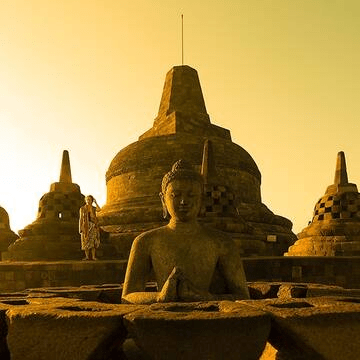
In the heart of Central Java’s fertile Kedu Valley, embraced by volcanic peaks and emerald landscapes, rises a monument unlike any other—Borobudur, the world’s largest Buddhist temple and a UNESCO World Heritage Site. Built more than 1,200 years ago, this colossal stone mountain is not just an architectural wonder, but a spiritual journey carved in stone.
A Monument Born of Devotion
Borobudur was constructed in the 8th and 9th centuries under the Sailendra Dynasty. Without a drop of mortar, two million volcanic stone blocks were precisely interlocked like a massive puzzle, forming a structure that has endured centuries of nature’s tests. From above, its shape is breathtaking—a giant mandala, the sacred geometric symbol of the Buddhist cosmos.
The temple rises in three tiers, each representing one of the realms of Buddhist cosmology:
- Kamadhatu – The Realm of Desire: The base, adorned with reliefs that portray the karmic law and the cycle of birth and death.
- Rupadhatu – The Realm of Form: Five square terraces lined with intricate reliefs and 504 serene Buddha statues.
- Arupadhatu – The Realm of Formlessness: Three circular platforms crowned with 72 bell-shaped stupas, each sheltering a meditating Buddha. At the summit stands the great central stupa, symbolizing ultimate enlightenment.
A Living Story in Stone
Walking through Borobudur is like entering a vast storybook. The temple’s bas-reliefs, stretching across 2,500 square meters, are the most complete ensemble of Buddhist reliefs in the world. They illustrate tales from the life of Shakyamuni Buddha, Jataka stories, and profound teachings, guiding pilgrims step by step upward—from worldly desires to spiritual liberation.
Buried, Forgotten, and Found Again
Despite its grandeur, Borobudur fell silent between the 10th and 14th centuries, likely due to political shifts and the spread of Islam in Java. Nature reclaimed it—volcanic ash and thick jungle hid the monument from the world’s eyes. For centuries, it slumbered, until 1814, when Sir Thomas Stamford Raffles, the British governor of Java, was informed of a “buried hill.” Excavations revealed not a hill, but a hidden treasure of human devotion.
From Restoration to Reverence
In the 20th century, Borobudur was painstakingly restored with UNESCO’s support, safeguarding its stones against further decay. In 1991, it was declared a World Heritage Site, recognized as both a cultural and spiritual masterpiece.
Today, Borobudur is not just a monument of the past—it is alive with faith. Each year, thousands of Buddhists from across Indonesia and beyond gather here for Vesak Day, celebrating the birth, enlightenment, and passing of the Buddha under the full moon. Lanterns rise into the night sky, echoing the timeless aspiration for wisdom and compassion.
Borobudur is more than stone, stupas, and statues. It is a meditation frozen in time, a pilgrimage for both the feet and the heart. For travelers, standing atop Borobudur at sunrise—watching the mist lift from the valley as the first rays of light kiss the central stupa—is an experience beyond words.
This temple is not just Indonesia’s pride; it is humanity’s shared treasure, reminding us of the enduring power of faith, art, and the human spirit.
Travel Guide: Planning Your Visit
If Borobudur is on your travel list, here are some helpful tips:
📍 Location
- Situated in Magelang, Central Java, about 25 miles (40 km) northwest of Yogyakarta.
- Easily accessible by car, bus, or organized tour from Yogyakarta (1–1.5 hours).
🕰 Best Time to Visit
- Sunrise tours are especially popular. Watching the first light illuminate the misty valley and stupas is unforgettable.
- The dry season (April–October) offers clearer skies and comfortable weather.
🎟 Tickets
- General admission is separate for local and international visitors.
- Sunrise access often requires booking through official operators.
- Combination tickets are available if you also wish to visit Prambanan Temple, another UNESCO site nearby.
👟 What to Bring
- Comfortable walking shoes (you’ll be climbing many steps).
- A hat, sunscreen, and water—the tropical sun can be intense.
- A respectful outfit: shoulders and knees covered, as Borobudur is a sacred site.
🛕 Nearby Attractions
- Prambanan Temple – A magnificent Hindu temple complex about an hour away.
- Mendut Temple – A smaller Buddhist temple with a giant Buddha statue, often part of the Vesak procession.
- Yogyakarta City – Known for its royal palace, batik art, and vibrant street food scene.
Link: https://peacelilysite.com/2025/09/12/the-worlds-largest-buddhist-temple-borobudur-indonesia/
 Peace LiLy