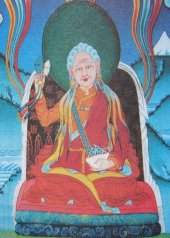
Ayu Khandro (阿玉康卓): A Life of Fearless Practice and Silent Realization

Courtesy of Merigar, Italy.

In the rich tapestry of Tibetan Buddhism, there are extraordinary practitioners whose lives themselves become teachings. Among them, Ayu Khandro (阿玉康卓) — also known by her Dharma name Dorje Peldron — stands as one of the most inspiring yoginis of the Nyingma tradition. Her life is not merely a story; it is a living example of devotion, perseverance, and profound realization.

Born in 1839 in the remote region of Kham, eastern Tibet, Ayu Khandro began her spiritual journey at a young age. She received teachings from many of the greatest masters of her time, including Jamyang Khyentse Wangpo, Jamgon Kongtrul, Chokgyur Lingpa, Nyala Pema Dundul, Adzom Drukpa, and Togden Rangrig — figures who were central to the non-sectarian Rimé movement in Tibetan Buddhism.

Unlike many who seek comfort or recognition, Ayu Khandro chose a life of renunciation and yogic discipline. She wandered widely across Tibet, lived in caves and hermitages, and devoted herself to decades of intense meditation. She spent more than fifty years in retreat, including prolonged periods of dark retreat, known in Tibetan as Yangti Nagpo — an advanced Dzogchen practice where the meditator withdraws from external light to focus inwardly on the nature of mind.

Dzogchen — The Great Perfection

Ayu Khandro’s life was profoundly rooted in Dzogchen (Great Perfection) — a teaching that points directly to the intrinsic, luminous nature of consciousness. Rather than seeking external accomplishments, she focused entirely on direct inner realization.

She was recognized as a terton — a revealer of hidden teachings — and was particularly known for transmitting sacred practices and giving initiations to practitioners, including the renowned master Chogyal Namkhai Norbu Rinpoche, who later wrote her biography based on her own oral account.

Ayu Khandro lived to the remarkable age of 115. In 1953, near the end of her life, she received visitors, gave away her precious possessions, and continued to teach and encourage those around her. After she passed away, it is reported in Tibetan Buddhist biography that her body remained in meditation posture for about two weeks before any signs of physical change occurred. By the end of this period, her body had shrunk to a fraction of its original size — an occurrence some traditions associate with deep spiritual attainment in Dzogchen practice, where the physical elements dissolve into subtler states.
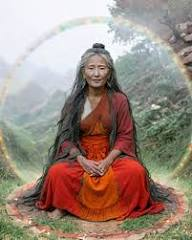
This remarkable account, while extraordinary, is part of how her life has been transmitted in spiritual biographies — not as a spectacle, but as a sign of the depth and authenticity of her practice.

What makes Ayu Khandro’s life especially compelling is not just her longevity or her meditative achievements, but her steadfast devotion to the Dharma. She never sought fame or comfort. Instead, she walked the rugged paths of realization, teaching through action rather than words, presence rather than proclamation. Her retreats, pilgrimages, and meditation practices were not about escape, but about coming fully home to the true nature of mind.

Although few of us will ever undertake decades of meditation in darkness or faraway hermitages, Ayu Khandro’s life still speaks directly to modern seekers. In an era filled with distraction and ambition, her example invites us to ask:

  • What is true commitment?
  • How deeply can we trust the path we walk?
  • Can we place inner understanding above outer achievement?

Her life encourages us to remember that spiritual depth is not measured by loud accomplishments, but by quiet fidelity to practice.

Ayu Khandro remains a powerful reminder that liberation is not found on the surface of life, but in its quiet depths. Her unwavering dedication, her silent courage, and her embrace of the path offer inspiration — not as myth, but as a living reminder of what is humanly possible when devotion meets discipline.

Link:https://peacelilysite.com/2026/02/10/ayu-khandro-%e9%98%bf%e7%8e%89%e5%ba%b7%e5%8d%93-a-life-of-fearless-practice-and-silent-realization/

Sources:

Allione, Tsultrim. 1984. “A-yu Khadro”, in Women of Wisdom. London: Penguin Group, pp.233-264.

Namkhai Norbu. 1986. The Crystal and the Way of Light: Sutra, Tantra and Dzogchen. New York; Routledge and Kegan Paul, pp.113-114.

Namkhai Norbu and Michael Katz. 2002. Dream Yoga and the Practice of Natural Light. New York: Snow Lion Publications, pp.130-131.
NINETY-EIGHT POUND STALACTITE STONE WENT THROUGH A HUMAN BODY; FOUR-HUNDRED-THIRTY POUND GIGANTIC MANI STONE DUO QIE XU FLIES INTO THE AIR

Unveiling the mystical realization state of esoteric Buddha-dharma—a true account of a grand assembly of esoteric Buddha-dharma

People think of Tibetan Buddhism in general as a far-away culture full of mystery. Especially when patriarchs from various sects manifested mystical phenomena and supernatural powers, people become curious about esoteric Buddha dharma.

Based on the descriptions of some lamas, there are various examinations for Buddhist practitioners in Tibet. One’s proficiency of Buddhism is examined by means of different scales of dialectical debates. The one who passes thousands of debates and is in first place is called Lharampa geshe. The ones in second place and third place are called geshes. Only after completion of tens of thousands of dialectical debates can geshes enter schools of Esoteric Buddhism to learn esoteric dharma.

These lamas said that esoteric dharma emphasizes states of realization. In Esoteric Buddhism schools, mani stones are usually used to evaluate practitioners’ levels of realization. There are two types of mani stones.

The first type is stones that are inscribed with mantras by ordinary people and placed in mani stone mounds. This type of mani stone does not contain dharma power.

The second type is stones that are inscribed by great patriarchs from lineages of Tibetan Buddhism after practicing dharma. These stones are inscribed with images of Buddhas or seed syllables of mantras. They are placed in mani stone mounds to be used as empowerment to eliminate disasters and obstacles. The most important function of this type of mani stone with power is to test and measure levels of self-cultivation.

According to some accounts, only practitioners who have attained states of realization through self-cultivation are able to practice dharma that causes mani stones to move at a distance. Mani stones move in different ways: some move slowly, while others walk or fly. Ordinary people cannot make them move at all, no matter how much force they use or how many people recite mantras at the same time. These stories have added an element of mystery and significance to Tibetan esoteric dharma.

Recently, the reporter had the honor of attending a grand assembly in the United States where various states of realization were revealed. Attendees included great lamas and ordinary lamas from Tibet, as well as great dharma masters and ordinary dharma masters of Exoteric Buddhism.

The mantras recited included the Great Compassion Mantra, the Green Tara Heart Mantra, and the mantra of Vajrakila (Dorje Phurba). Some dharma masters were unable to cause the mani stone to move even after a prolonged period of practicing dharma. Several Exoteric Buddhist dharma masters recited mantras in unison and, across space, caused a 150-gram mani stone on a glass table to move. A great dharma master and a female lama were able to make a mani stone at a distance move as soon as they chanted mantras combined with mudras.

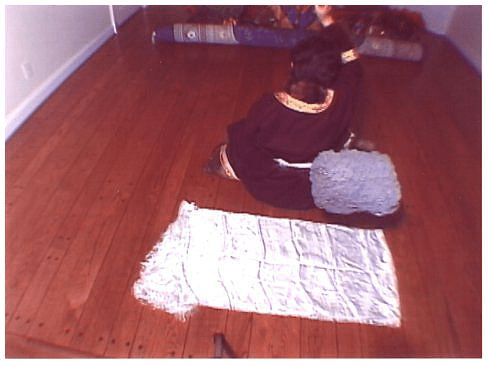
While the attendees marveled at these sights, a great female lama from Tibet arrived. Before the testing, she requested that the person videotaping not capture her face. She said that she was a self-cultivator who wished to attain liberation and realization, and that she did not intend to manifest Buddha-dharma to show off her powers. Soon after, something stunning happened.

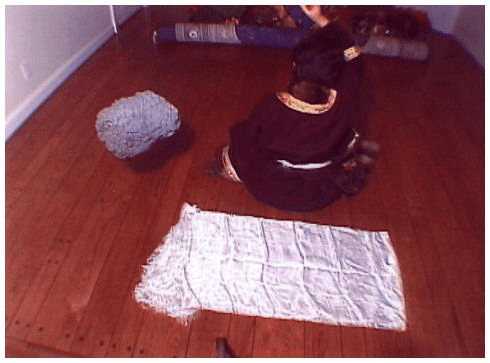
As soon as she recited mantras, a ninety-eight-pound stalactite stone surprisingly rose from the ground and circulated in the air following her hand gestures. This mani stone with supernatural powers stopped and trembled after rising into the air.

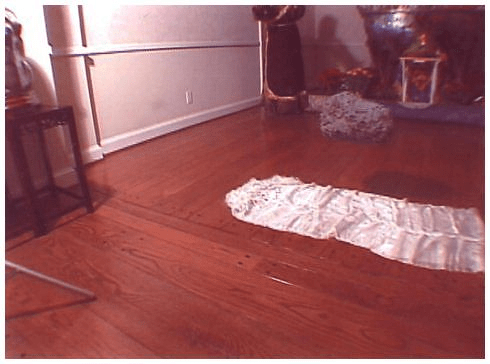
What was even more astonishing was that when the female lama sat on the wooden floor, the mani stone moved from behind her to the front in a split second. Witnesses felt that the ninety-eight-pound mani stone had moved in the blink of an eye, at such speed that it seemed to pass through her body.

Then the mani stone circled the great female lama twice, following her finger gestures. It moved up and down while trembling as it circled. When the mani stone moved to her back the second time, her index finger—forming a mudra above her head—pointed downward, and the stone immediately descended. Following the direction of her fingers, it paused briefly and then dropped onto the wooden floor with a heavy thump. The weight of the stone was evident, and it would be difficult to imagine such a scene without witnessing it firsthand.

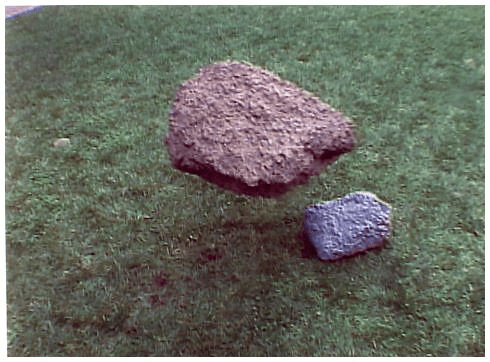
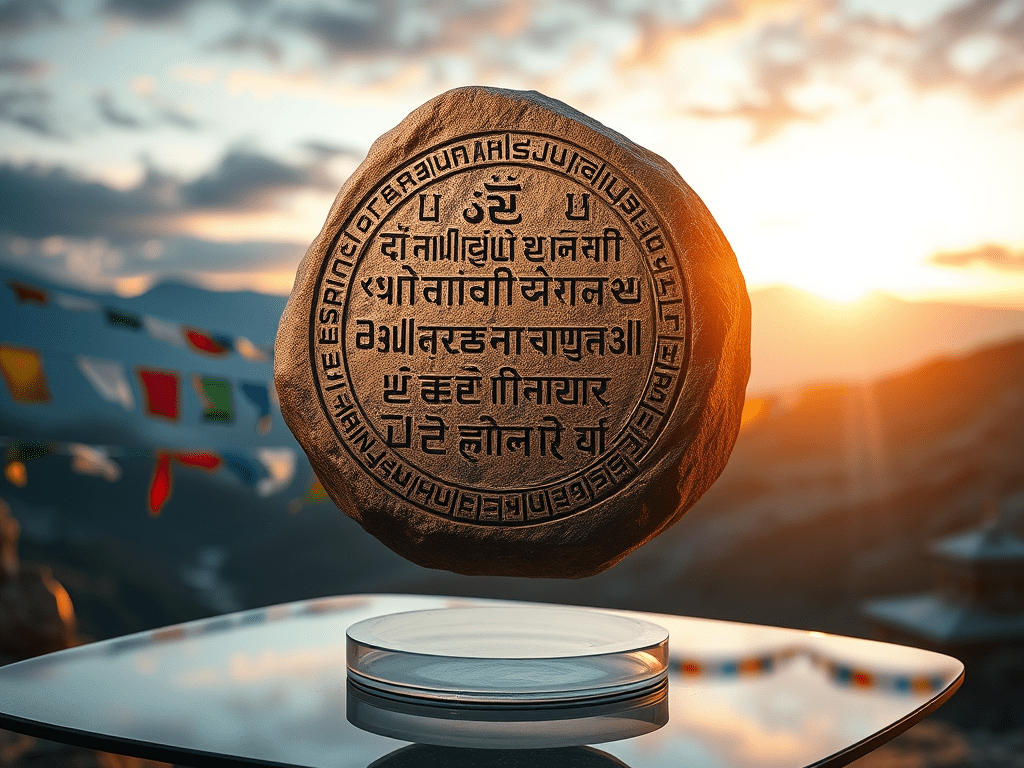
The most famous gigantic stalactite mani stone, Duo Qie Xu from Tibet, was also included in the assembly. It weighs approximately 430 pounds, equivalent to about 200 kilograms, and was shipped from Tibet to the United States. It revealed great supernatural powers during the assembly.

The gigantic mani stone Duo Qie Xu is not an ordinary stone. It is a mani stone with a distinct identity, similar to the famous Cuiyu Cabbage (a renowned jade carving from the Qing Dynasty displayed at the National Palace Museum in Taipei). Most Tibetan Buddhist practitioners are familiar with Duo Qie Xu. During the testing involving Duo Qie Xu, even more incredible phenomena occurred.

When the great Tibetan female lama was about to test her powers on Duo Qie Xu, she again requested that her face not be captured on camera, for the same reasons as before. The video recordings were intended solely as keepsakes for those present and were not to be used for any form of promotion. Her strict adherence to the precepts deeply moved those in attendance.

Then something extraordinary happened. The 430-pound Duo Qie Xu followed the hand gestures of the great Tibetan female lama, trembling as it rose from the lawn and flew into the air. The crowd was awestruck and suddenly felt the lawn move like ocean waves. Rooftops and trees also appeared to move simultaneously.

The mani stone flying in the air then returned and suddenly fell from a height of three feet above the ground, making a large dent in the lawn. Such an occurrence—normally found only in fiction—unfolded in real life. The lamas and dharma masters present stated that this holy feat demonstrated the magnificence and authenticity of Buddha-dharma, through which all things can be accomplished, including the transformation of mountains and oceans.

At the Exposing Buddha Statues to the Sun Dharma Assembly held at Chiang Kai-shek Memorial Hall in Taipei on January 13, 2002, there was a mound of stones inscribed with mantras from Lapuleng Temple in Gansu. It was a Mani Stone Mound consisting of mani stones.

This article is from “H.H. Dorje Chang Buddha III (A TREASURY OF TRUE BUDDHA-DHARMA)” P485.

Link:https://peacelilysite.com/2026/01/21/ninety-eight-pound-stalactite-stone-went-through-a-human-body-four-hundred-thirty-pound-gigantic-mani-stone-duo-qie-xu-flies-into-the-air/